
Chapter 20 Section 1 The Nature of Waves
- Slides: 10
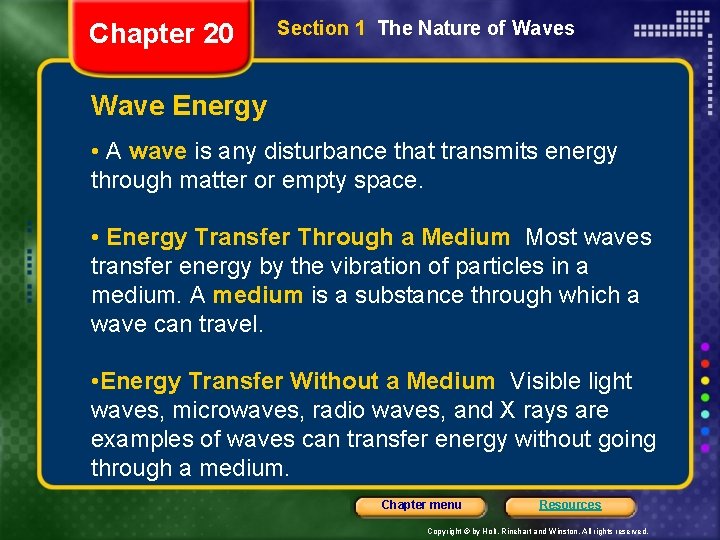
Chapter 20 Section 1 The Nature of Waves Wave Energy • A wave is any disturbance that transmits energy through matter or empty space. • Energy Transfer Through a Medium Most waves transfer energy by the vibration of particles in a medium. A medium is a substance through which a wave can travel. • Energy Transfer Without a Medium Visible light waves, microwaves, radio waves, and X rays are examples of waves can transfer energy without going through a medium. Chapter menu Resources Copyright © by Holt, Rinehart and Winston. All rights reserved.
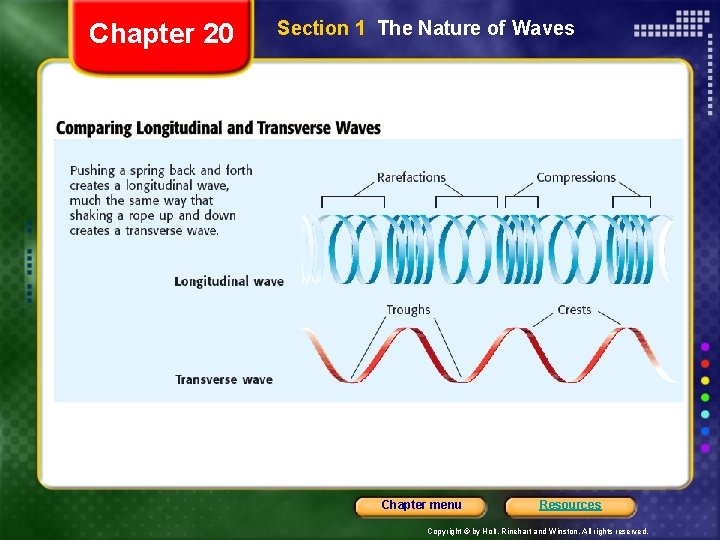
Chapter 20 Section 1 The Nature of Waves Chapter menu Resources Copyright © by Holt, Rinehart and Winston. All rights reserved.
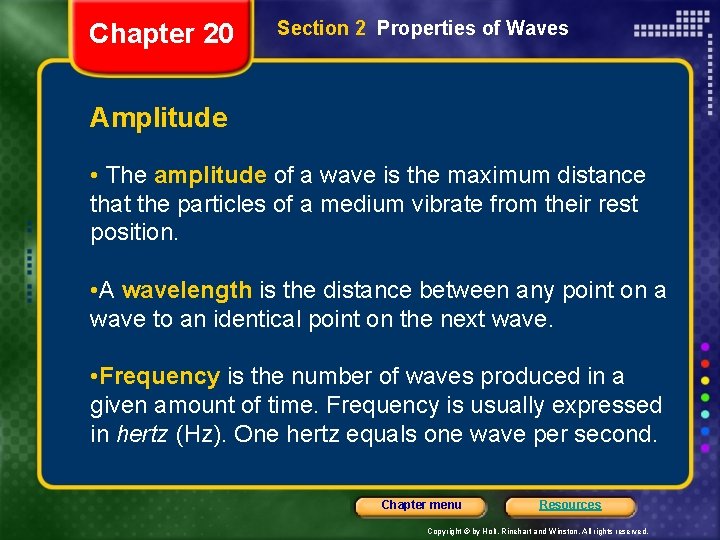
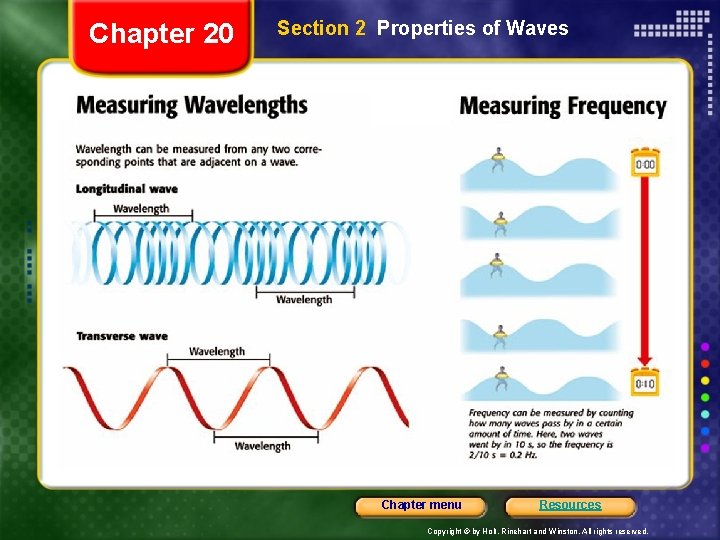
Chapter 20 Section 2 Properties of Waves Amplitude • The amplitude of a wave is the maximum distance that the particles of a medium vibrate from their rest position. • A wavelength is the distance between any point on a wave to an identical point on the next wave. • Frequency is the number of waves produced in a given amount of time. Frequency is usually expressed in hertz (Hz). One hertz equals one wave per second. Chapter menu Resources Copyright © by Holt, Rinehart and Winston. All rights reserved.
Chapter 20 Section 2 Properties of Waves Chapter menu Resources Copyright © by Holt, Rinehart and Winston. All rights reserved.
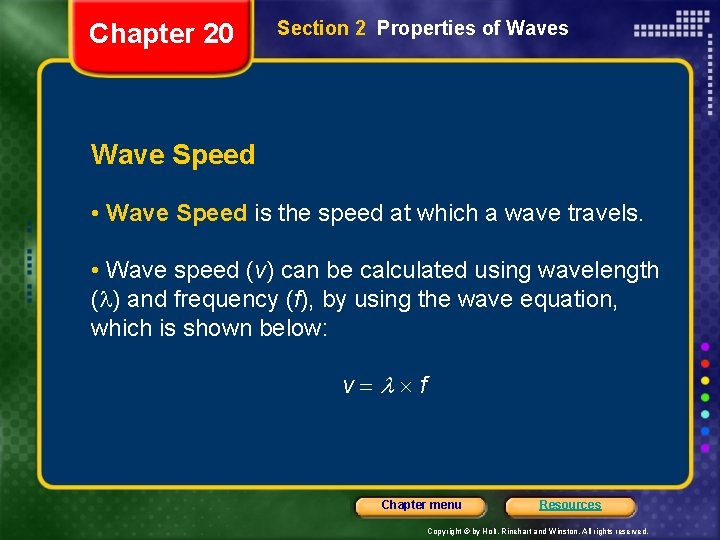
Chapter 20 Section 2 Properties of Waves Wave Speed • Wave Speed is the speed at which a wave travels. • Wave speed (v) can be calculated using wavelength ( ) and frequency (f), by using the wave equation, which is shown below: v f Chapter menu Resources Copyright © by Holt, Rinehart and Winston. All rights reserved.
Chapter 20 Section 3 Wave Interactions Reflection • Reflection happens when a wave bounces back after hitting a barrier. • Waves are not always reflected when they hit a barrier. A wave is transmitted through a substance when it passes through the substance. Chapter menu Resources Copyright © by Holt, Rinehart and Winston. All rights reserved.
Chapter 20 Section 3 Wave Interactions Refraction • Refraction is the bending of a wave as the wave pass from one medium to another at an angle. • When light waves from the sun pass through a water droplet or a prism, the light is refracted. • But the different colors in sunlight are refracted by different amounts, so the light is spread out into its separate colors. Chapter menu Resources Copyright © by Holt, Rinehart and Winston. All rights reserved.
Chapter 20 Section 3 Wave Interactions Diffraction • Diffraction is the bending of waves around a barrier or through an opening. • The amount of diffraction of a wave depends on its wavelength and the size of the barrier or opening the wave encounters. Chapter menu Resources Copyright © by Holt, Rinehart and Winston. All rights reserved.
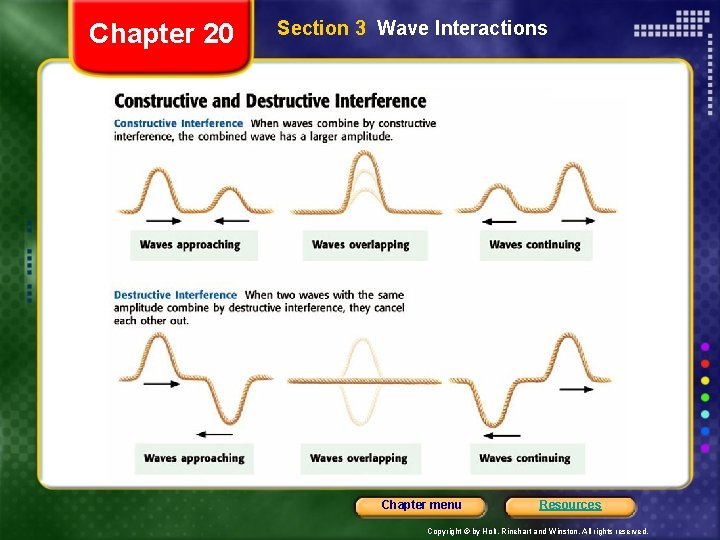
Chapter 20 Section 3 Wave Interactions Chapter menu Resources Copyright © by Holt, Rinehart and Winston. All rights reserved.
Chapter 20 Section 3 Wave Interactions Interference, continued • Standing Waves are waves that appear to be standing still. A standing wave only looks as if it is standing still. Waves are actually going in both directions. • Resonance happens when an object vibrating at or near the resonant frequency of a second object causes the second object to vibrate. Chapter menu Resources Copyright © by Holt, Rinehart and Winston. All rights reserved.