
Chapter 20 Section 1 Introduction to Electrochemistry Because
Chapter 20 Section 1 Introduction to Electrochemistry • Because oxidation-reduction reactions involve electron transfer, the net release or net absorption of energy can occur in the form of electrical energy rather than as heat. • The branch of chemistry that deals with electricityrelated applications of oxidation-reduction reactions is called electrochemistry. Chapter menu Resources Copyright © by Holt, Rinehart and Winston. All rights reserved.
Chapter 20 Section 1 Introduction to Electrochemistry Electrochemical Cells • Oxidation-reduction reactions involve a transfer of electrons. • If the two substances are in contact with one another, a transfer of energy as heat accompanies the electron transfer. • If the substance that is oxidized is separated from the substance that is reduced, the electron transfer is accompanied by a transfer of electrical energy instead of energy as heat. Chapter menu Resources Copyright © by Holt, Rinehart and Winston. All rights reserved.
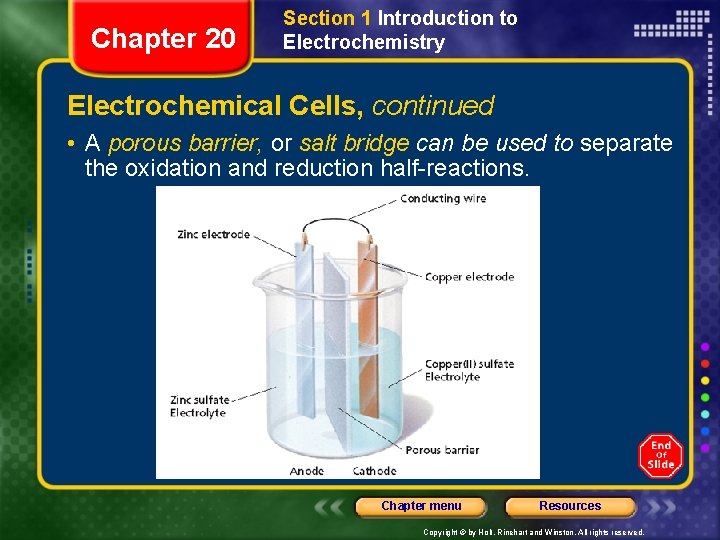
Chapter 20 Section 1 Introduction to Electrochemistry Electrochemical Cells, continued • A porous barrier, or salt bridge can be used to separate the oxidation and reduction half-reactions. Chapter menu Resources Copyright © by Holt, Rinehart and Winston. All rights reserved.
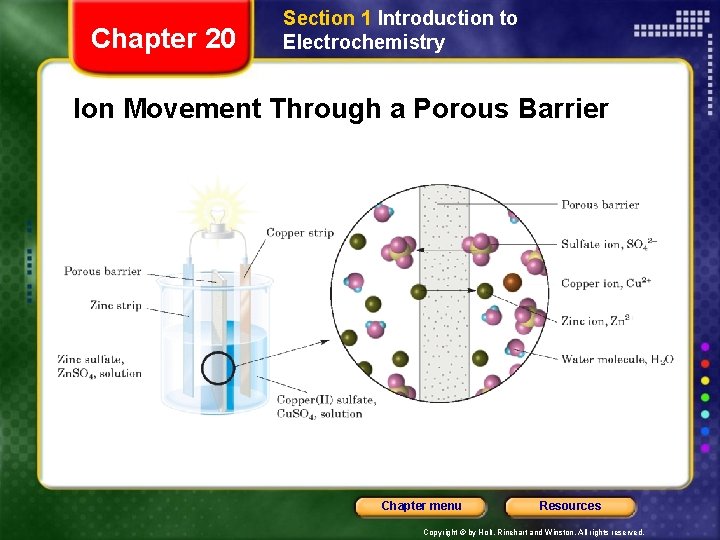
Chapter 20 Section 1 Introduction to Electrochemistry Ion Movement Through a Porous Barrier Chapter menu Resources Copyright © by Holt, Rinehart and Winston. All rights reserved.
Chapter 20 Section 1 Introduction to Electrochemistry Electrochemical Cells, continued • Electrons can be transferred from one side to the other through an external connecting wire. • Electric current moves in a closed loop path, or circuit, so this movement of electrons through the wire is balanced by the movement of ions in solution. • An electrode is a conductor used to establish electrical contact with a nonmetallic part of a circuit, such as an electrolyte. Chapter menu Resources Copyright © by Holt, Rinehart and Winston. All rights reserved.
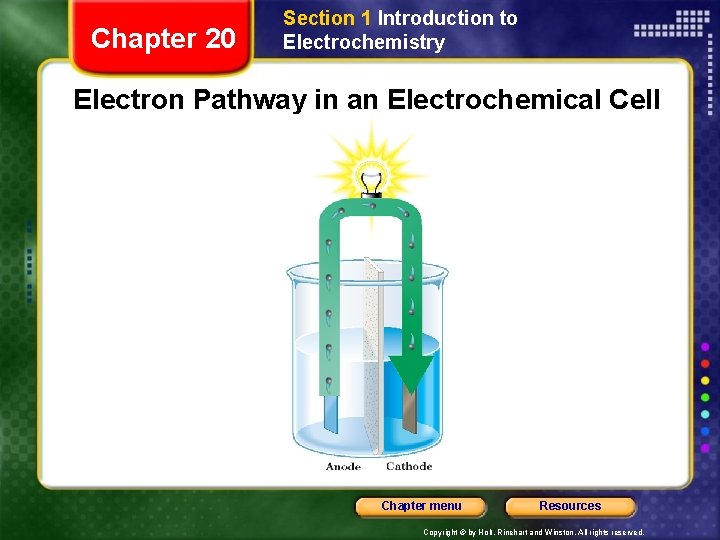
Chapter 20 Section 1 Introduction to Electrochemistry Electron Pathway in an Electrochemical Cell Chapter menu Resources Copyright © by Holt, Rinehart and Winston. All rights reserved.
Chapter 20 Section 1 Introduction to Electrochemistry Electrochemical Cells, continued Half-Cell • A single electrode immersed in a solution of its ions is a half-cell. • The electrode where oxidation occurs is called the anode. • example: Zn(s) Zn 2+(aq) + 2 e • The electrode where reduction occurs is called the cathode. • example: Cu 2+(aq) + 2 e Cu(s) Chapter menu Resources Copyright © by Holt, Rinehart and Winston. All rights reserved.
Chapter 20 Section 1 Introduction to Electrochemistry Electrochemical Cells, continued Half-Cell, continued • Both oxidation and reduction must occur in an electrochemical reaction. • The two half-cells taken together make an electrochemical cell. The Complete Cell • An electrochemical cell may be represented by the following notation: anode electrode|anode solution||cathode solution|cathode electrode • The double line represents the salt bridge, or the porous barrier. Chapter menu Resources Copyright © by Holt, Rinehart and Winston. All rights reserved.
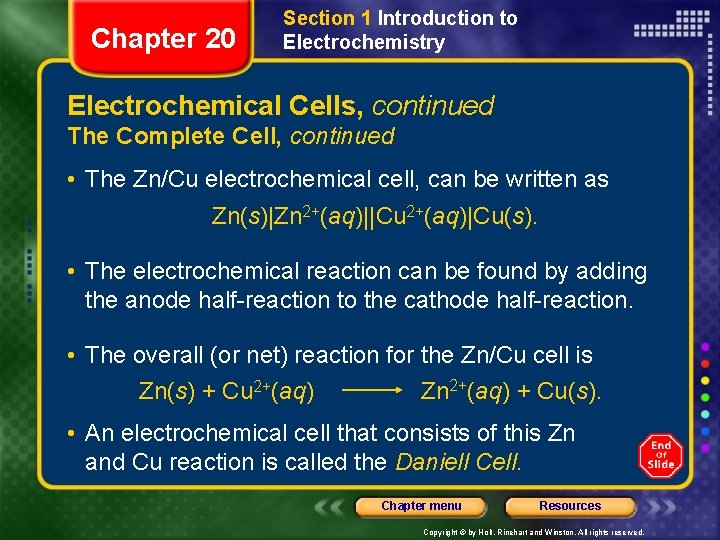
Chapter 20 Section 1 Introduction to Electrochemistry Electrochemical Cells, continued The Complete Cell, continued • The Zn/Cu electrochemical cell, can be written as Zn(s)|Zn 2+(aq)||Cu 2+(aq)|Cu(s). • The electrochemical reaction can be found by adding the anode half-reaction to the cathode half-reaction. • The overall (or net) reaction for the Zn/Cu cell is Zn 2+(aq) + Cu(s). Zn(s) + Cu 2+(aq) • An electrochemical cell that consists of this Zn and Cu reaction is called the Daniell Cell. Chapter menu Resources Copyright © by Holt, Rinehart and Winston. All rights reserved.
Chapter 20 Section 2 Voltaic Cells • Voltaic cells use spontaneous oxidation-reduction reactions to convert chemical energy into electrical energy. • Voltaic cells are also called galvanic cells. • The most common application of voltaic cells is in batteries. Chapter menu Resources Copyright © by Holt, Rinehart and Winston. All rights reserved.
Chapter 20 Section 2 Voltaic Cells How Voltaic Cells Work • Electrons given up at the anode pass along the external connecting wire to the cathode. • The movement of electrons through the wire must be balanced by the movement of ions in the solution. • Dry cells are voltaic cells. • The three most common types of dry cells are the zinc-carbon battery, the alkaline battery, and the mercury battery Chapter menu Resources Copyright © by Holt, Rinehart and Winston. All rights reserved.
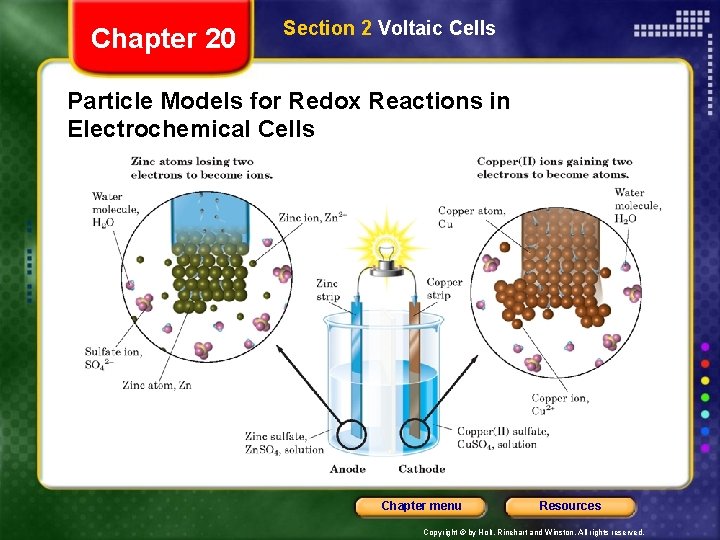
Chapter 20 Section 2 Voltaic Cells Particle Models for Redox Reactions in Electrochemical Cells Chapter menu Resources Copyright © by Holt, Rinehart and Winston. All rights reserved.
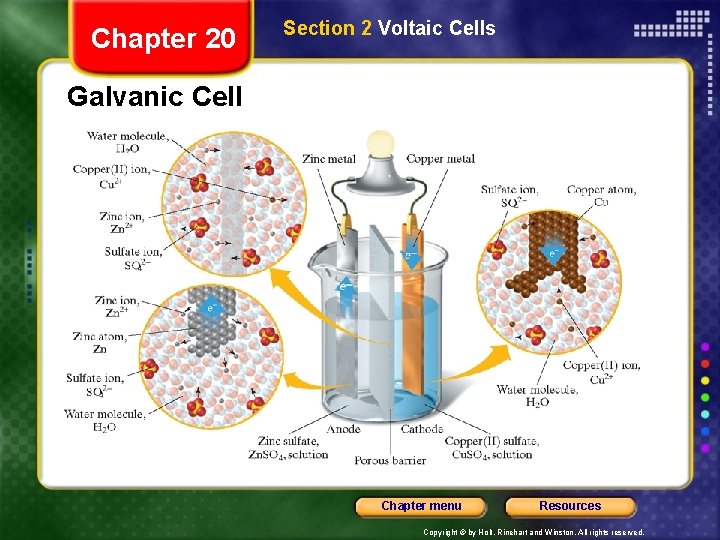
Chapter 20 Section 2 Voltaic Cells Galvanic Cell Chapter menu Resources Copyright © by Holt, Rinehart and Winston. All rights reserved.

Chapter 20 Visual Concepts Battery Chapter menu Resources Copyright © by Holt, Rinehart and Winston. All rights reserved.
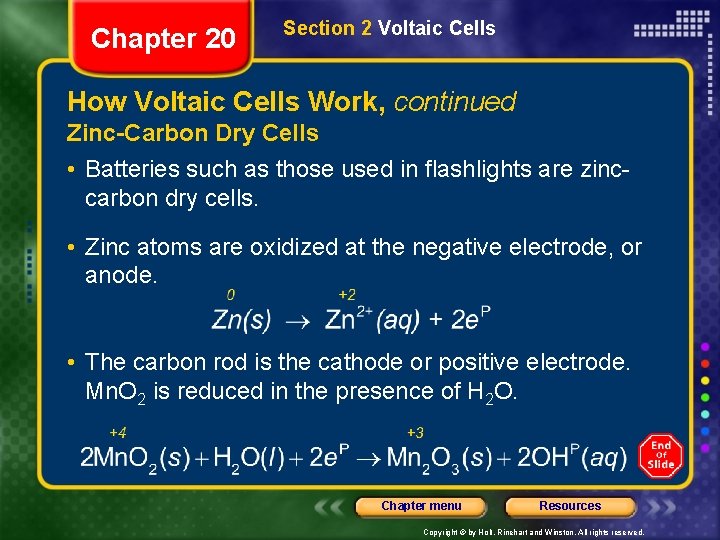
Chapter 20 Section 2 Voltaic Cells How Voltaic Cells Work, continued Zinc-Carbon Dry Cells • Batteries such as those used in flashlights are zinccarbon dry cells. • Zinc atoms are oxidized at the negative electrode, or anode. • The carbon rod is the cathode or positive electrode. Mn. O 2 is reduced in the presence of H 2 O. Chapter menu Resources Copyright © by Holt, Rinehart and Winston. All rights reserved.
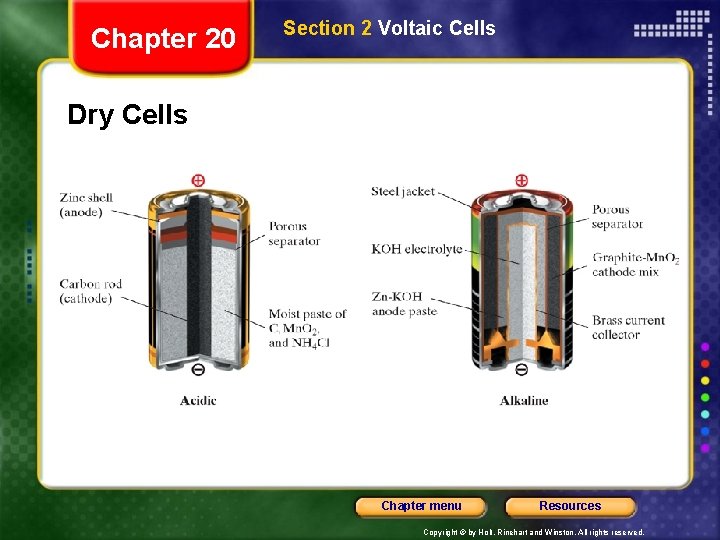
Chapter 20 Section 2 Voltaic Cells Dry Cells Chapter menu Resources Copyright © by Holt, Rinehart and Winston. All rights reserved.
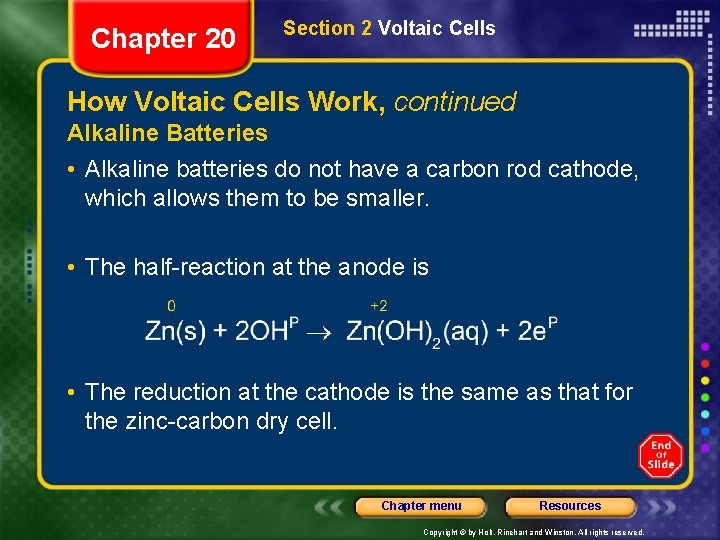
Chapter 20 Section 2 Voltaic Cells How Voltaic Cells Work, continued Alkaline Batteries • Alkaline batteries do not have a carbon rod cathode, which allows them to be smaller. • The half-reaction at the anode is • The reduction at the cathode is the same as that for the zinc-carbon dry cell. Chapter menu Resources Copyright © by Holt, Rinehart and Winston. All rights reserved.
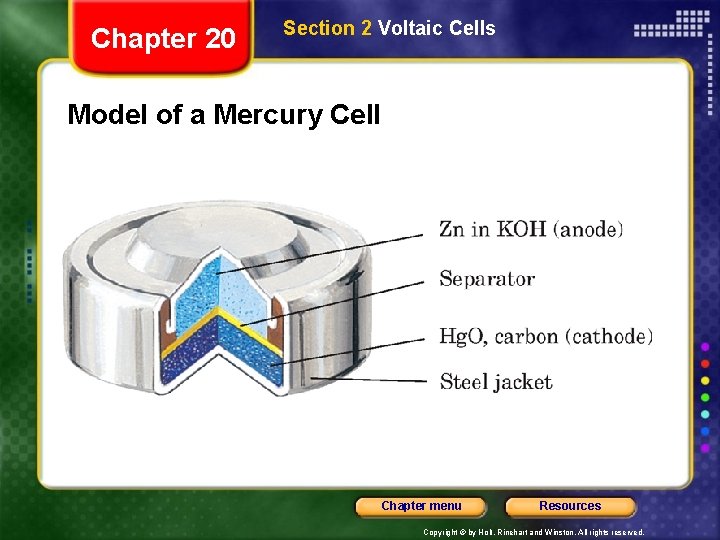
Chapter 20 Section 2 Voltaic Cells Model of a Mercury Cell Chapter menu Resources Copyright © by Holt, Rinehart and Winston. All rights reserved.
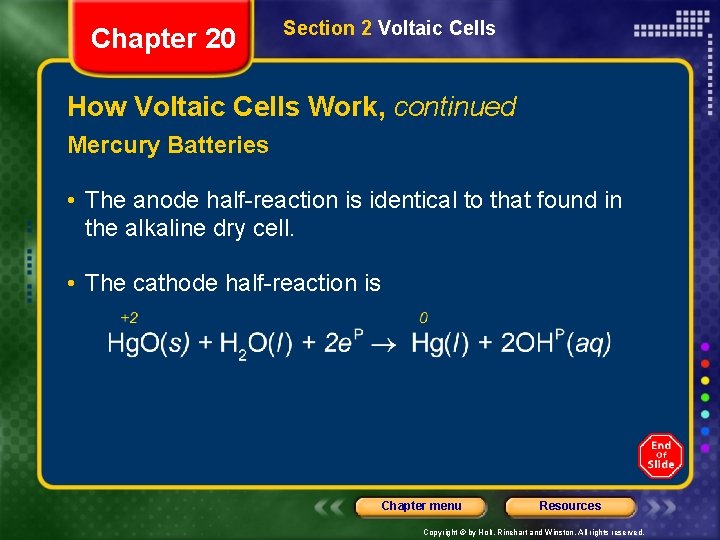
Chapter 20 Section 2 Voltaic Cells How Voltaic Cells Work, continued Mercury Batteries • The anode half-reaction is identical to that found in the alkaline dry cell. • The cathode half-reaction is Chapter menu Resources Copyright © by Holt, Rinehart and Winston. All rights reserved.
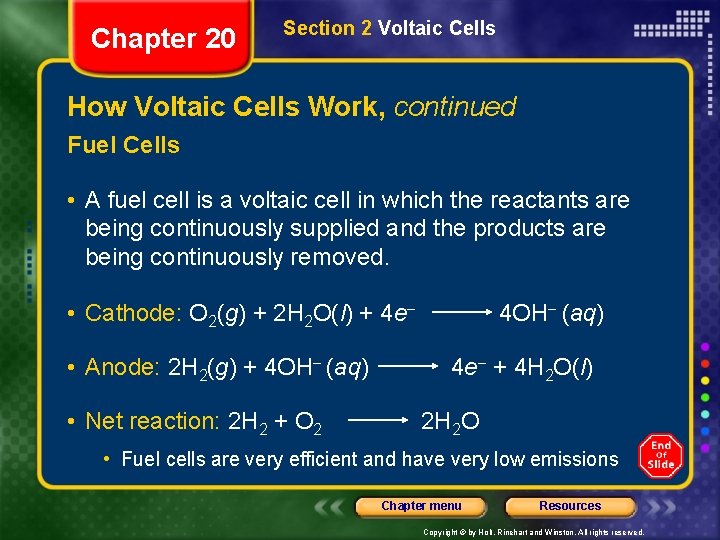
Chapter 20 Section 2 Voltaic Cells How Voltaic Cells Work, continued Fuel Cells • A fuel cell is a voltaic cell in which the reactants are being continuously supplied and the products are being continuously removed. • Cathode: O 2(g) + 2 H 2 O(l) + 4 e • Anode: 2 H 2(g) + 4 OH (aq) • Net reaction: 2 H 2 + O 2 4 OH (aq) 4 e + 4 H 2 O(l) 2 H 2 O • Fuel cells are very efficient and have very low emissions Chapter menu Resources Copyright © by Holt, Rinehart and Winston. All rights reserved.
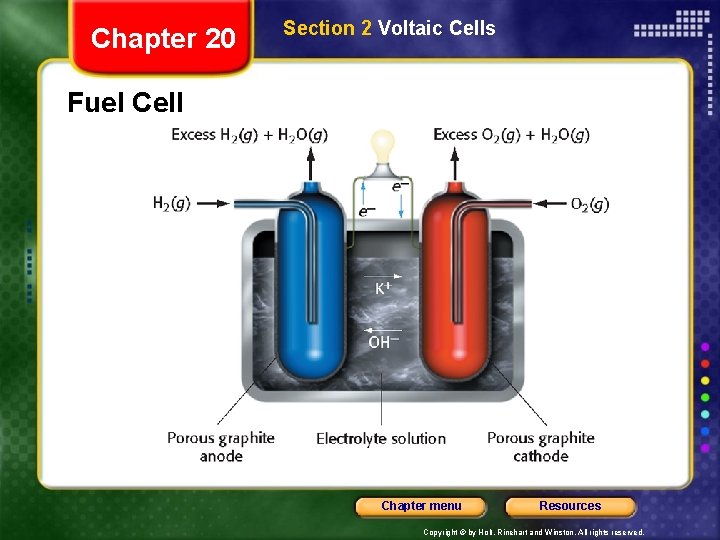
Chapter 20 Section 2 Voltaic Cells Fuel Cell Chapter menu Resources Copyright © by Holt, Rinehart and Winston. All rights reserved.
Chapter 20 Section 2 Voltaic Cells Corrosion and Its Prevention • One of the metals most commonly affected by corrosion is iron. • Rust is hydrated iron(III) oxide. 4 Fe(s) + 3 O 2(g) + x. H 2 O(l) 2 Fe 2 O 3 • x. H 2 O(s) • The anode and cathode reactions occur at different regions of the metal surface. • Anode: Fe(s) Fe 2+(aq) + 2 e • Cathode: O 2(g) + 2 H 2 O(l) + 4 e Chapter menu 4 OH (aq) Resources Copyright © by Holt, Rinehart and Winston. All rights reserved.
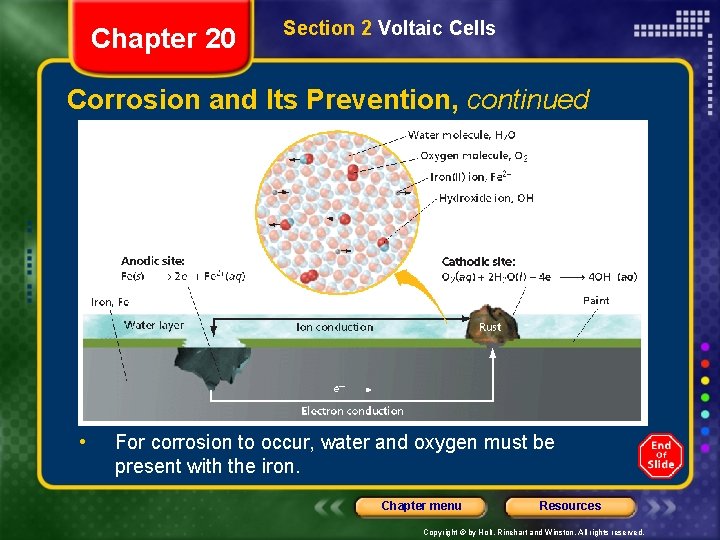
Chapter 20 Section 2 Voltaic Cells Corrosion and Its Prevention, continued • For corrosion to occur, water and oxygen must be present with the iron. Chapter menu Resources Copyright © by Holt, Rinehart and Winston. All rights reserved.
Chapter 20 Section 2 Voltaic Cells Corrosion and Its Prevention, continued • Coating steel with zinc in a process called galvanizing can prevent corrosion. • Zinc is more easily oxidized than iron • Zinc will react before the iron is oxidized. • This is called cathodic protection. • The more easily oxidized metal used is called a sacrificial anode. Chapter menu Resources Copyright © by Holt, Rinehart and Winston. All rights reserved.
Chapter 20 Section 2 Voltaic Cells Electrical Potential • In a voltaic cell, the oxidizing agent at the cathode pulls the electrons through the wire away from the reducing agent at the anode. • The “pull, ” or driving force on the electrons, is called the electric potential. • Electric potential, or voltage, is expressed in units of volts (V), which is the potential energy per unit charge. • Current is the movement of the electrons and is expressed in units of amperes, or amps (A). Chapter menu Resources Copyright © by Holt, Rinehart and Winston. All rights reserved.
Chapter 20 Section 2 Voltaic Cells Electrical Potential, continued Electrode Potentials • The tendency for the half-reaction of either copper or zinc to occur as a reduction half-reaction in an electrochemical cell can be quantified as a reduction potential. • The difference in potential between an electrode and its solution is known as electrode potential. • This potential difference, or voltage, is proportional to the energy required to move a certain electric charge between the electrodes. Chapter menu Resources Copyright © by Holt, Rinehart and Winston. All rights reserved.
Chapter 20 Section 2 Voltaic Cells Electrical Potential, continued Electrode Potentials, continued • The potential difference measured across the complete voltaic cell is easily measured. • It equals the sum of the electrode potentials for the two half-reactions. • An individual electrode potential cannot be measured directly. • A relative value for the potential of a half-reaction can be determined by connecting it to a standard half-cell as a reference. Chapter menu Resources Copyright © by Holt, Rinehart and Winston. All rights reserved.
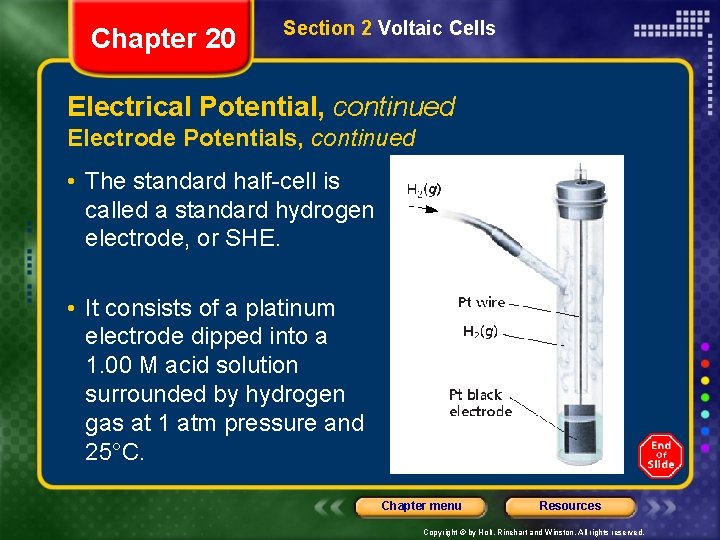
Chapter 20 Section 2 Voltaic Cells Electrical Potential, continued Electrode Potentials, continued • The standard half-cell is called a standard hydrogen electrode, or SHE. • It consists of a platinum electrode dipped into a 1. 00 M acid solution surrounded by hydrogen gas at 1 atm pressure and 25°C. Chapter menu Resources Copyright © by Holt, Rinehart and Winston. All rights reserved.
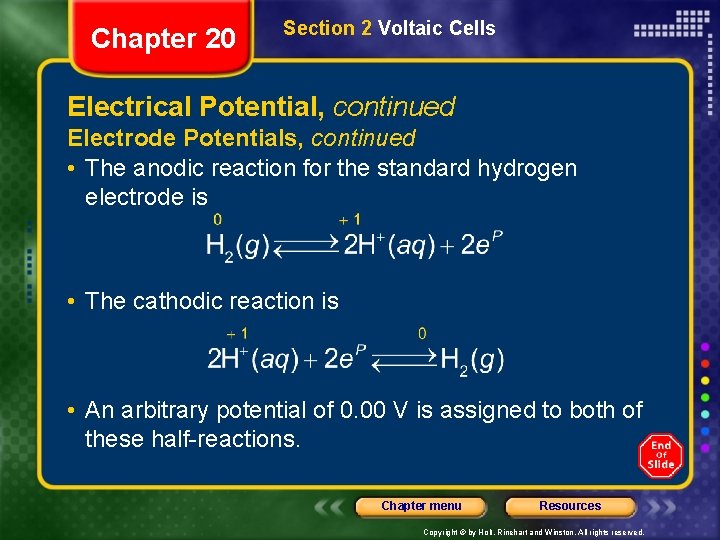
Chapter 20 Section 2 Voltaic Cells Electrical Potential, continued Electrode Potentials, continued • The anodic reaction for the standard hydrogen electrode is • The cathodic reaction is • An arbitrary potential of 0. 00 V is assigned to both of these half-reactions. Chapter menu Resources Copyright © by Holt, Rinehart and Winston. All rights reserved.
Chapter 20 Section 2 Voltaic Cells Electrical Potential, continued Electrode Potentials, continued • The potential of a half-cell under standard conditions measured relative to the standard hydrogen electrode is a standard electrode potential, E 0. • Electrode potentials are expressed as potentials for reduction. • Effective oxidizing agents have positive E 0 values. • example: Cu 2+ and F 2 • Effective reducing agents have negative E 0 values. • example: Li and Zn Chapter menu Resources Copyright © by Holt, Rinehart and Winston. All rights reserved.
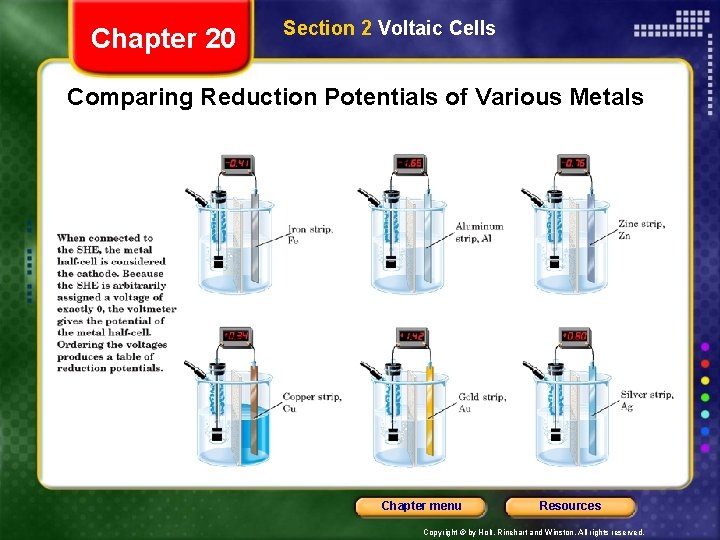
Chapter 20 Section 2 Voltaic Cells Comparing Reduction Potentials of Various Metals Chapter menu Resources Copyright © by Holt, Rinehart and Winston. All rights reserved.
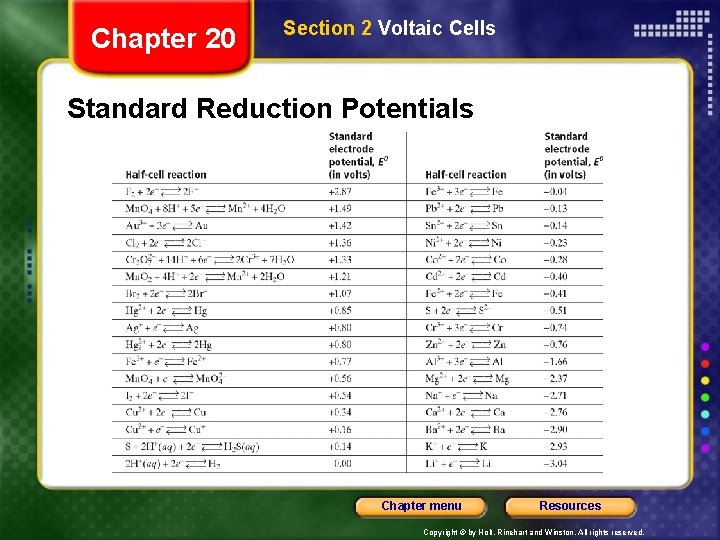
Chapter 20 Section 2 Voltaic Cells Standard Reduction Potentials Chapter menu Resources Copyright © by Holt, Rinehart and Winston. All rights reserved.
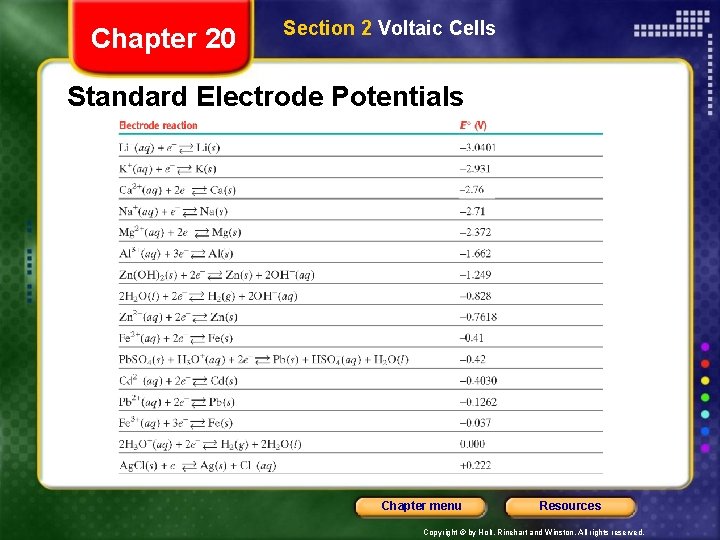
Chapter 20 Section 2 Voltaic Cells Standard Electrode Potentials Chapter menu Resources Copyright © by Holt, Rinehart and Winston. All rights reserved.
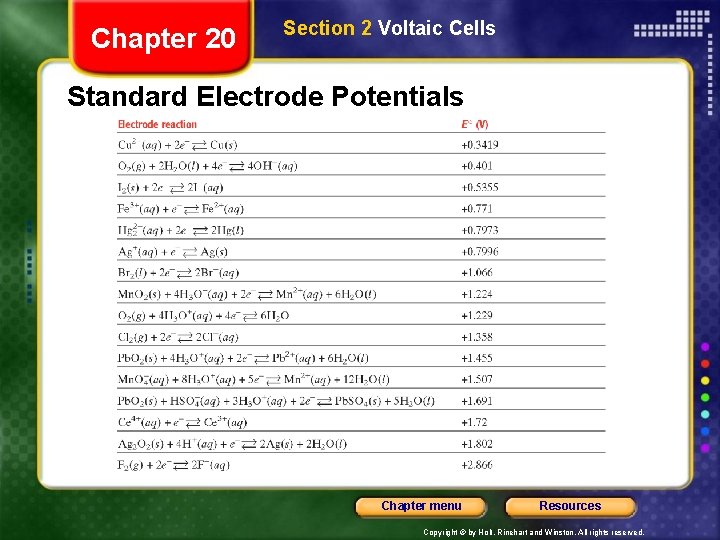
Chapter 20 Section 2 Voltaic Cells Standard Electrode Potentials Chapter menu Resources Copyright © by Holt, Rinehart and Winston. All rights reserved.
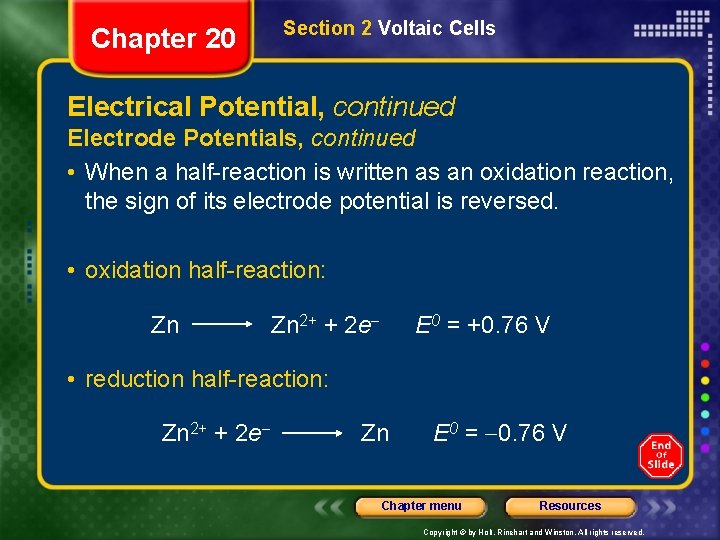
Chapter 20 Section 2 Voltaic Cells Electrical Potential, continued Electrode Potentials, continued • When a half-reaction is written as an oxidation reaction, the sign of its electrode potential is reversed. • oxidation half-reaction: Zn Zn 2+ + 2 e E 0 = +0. 76 V • reduction half-reaction: Zn 2+ + 2 e Zn E 0 = 0. 76 V Chapter menu Resources Copyright © by Holt, Rinehart and Winston. All rights reserved.
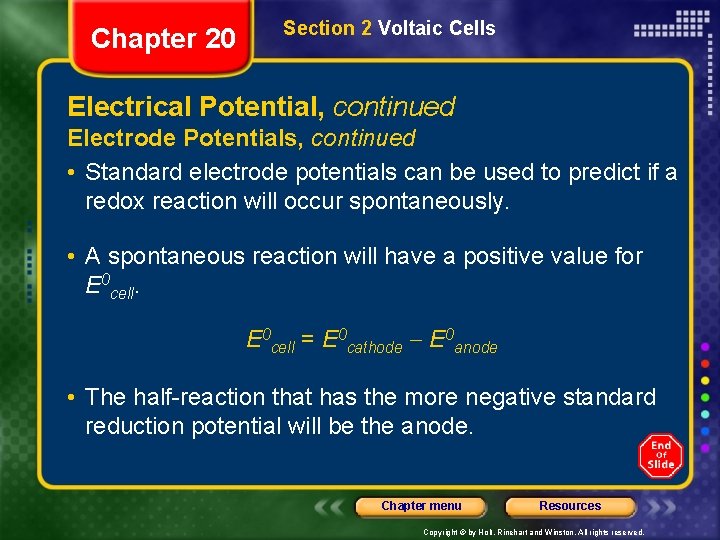
Chapter 20 Section 2 Voltaic Cells Electrical Potential, continued Electrode Potentials, continued • Standard electrode potentials can be used to predict if a redox reaction will occur spontaneously. • A spontaneous reaction will have a positive value for E 0 cell = E 0 cathode E 0 anode • The half-reaction that has the more negative standard reduction potential will be the anode. Chapter menu Resources Copyright © by Holt, Rinehart and Winston. All rights reserved.
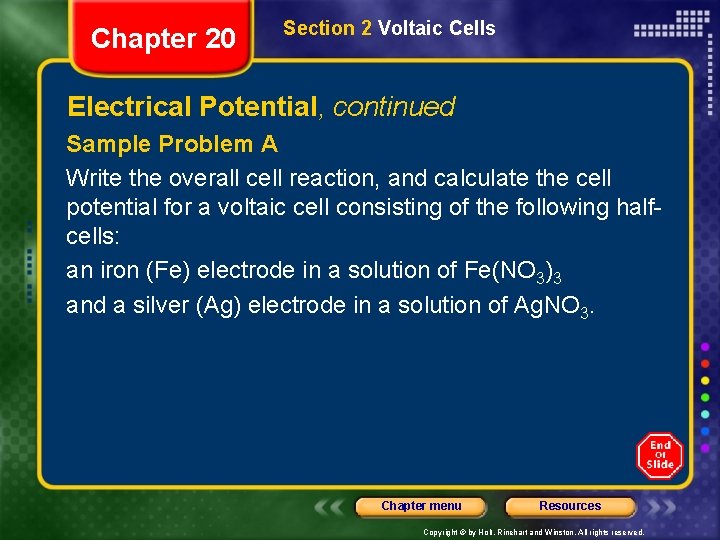
Chapter 20 Section 2 Voltaic Cells Electrical Potential, continued Sample Problem A Write the overall cell reaction, and calculate the cell potential for a voltaic cell consisting of the following halfcells: an iron (Fe) electrode in a solution of Fe(NO 3)3 and a silver (Ag) electrode in a solution of Ag. NO 3. Chapter menu Resources Copyright © by Holt, Rinehart and Winston. All rights reserved.
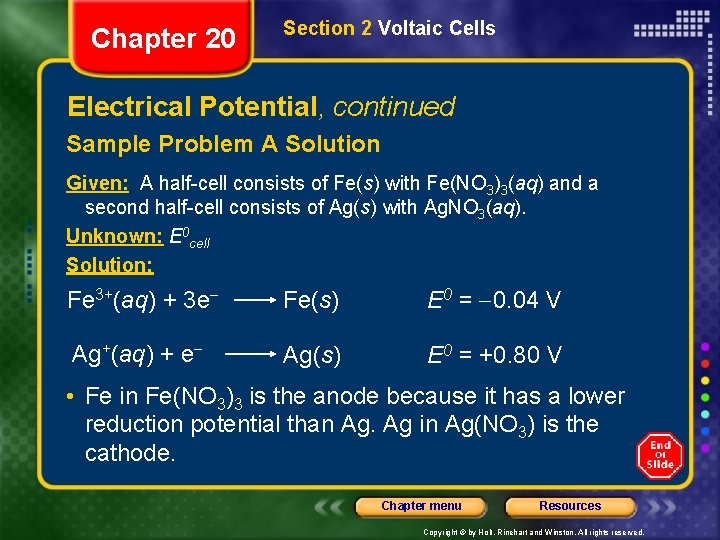
Chapter 20 Section 2 Voltaic Cells Electrical Potential, continued Sample Problem A Solution Given: A half-cell consists of Fe(s) with Fe(NO 3)3(aq) and a second half-cell consists of Ag(s) with Ag. NO 3(aq). Unknown: E 0 cell Solution: Fe 3+(aq) + 3 e Fe(s) E 0 = 0. 04 V Ag+(aq) + e Ag(s) E 0 = +0. 80 V • Fe in Fe(NO 3)3 is the anode because it has a lower reduction potential than Ag. Ag in Ag(NO 3) is the cathode. Chapter menu Resources Copyright © by Holt, Rinehart and Winston. All rights reserved.
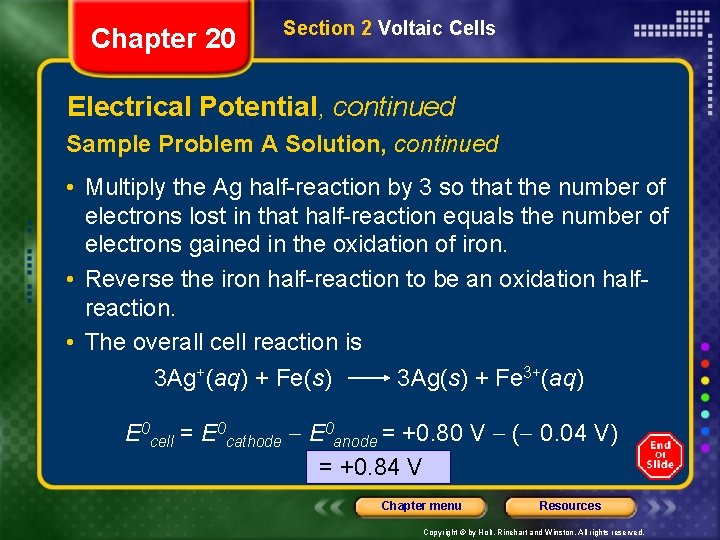
Chapter 20 Section 2 Voltaic Cells Electrical Potential, continued Sample Problem A Solution, continued • Multiply the Ag half-reaction by 3 so that the number of electrons lost in that half-reaction equals the number of electrons gained in the oxidation of iron. • Reverse the iron half-reaction to be an oxidation halfreaction. • The overall cell reaction is 3 Ag+(aq) + Fe(s) 3 Ag(s) + Fe 3+(aq) E 0 cell = E 0 cathode E 0 anode = +0. 80 V ( 0. 04 V) = +0. 84 V Chapter menu Resources Copyright © by Holt, Rinehart and Winston. All rights reserved.
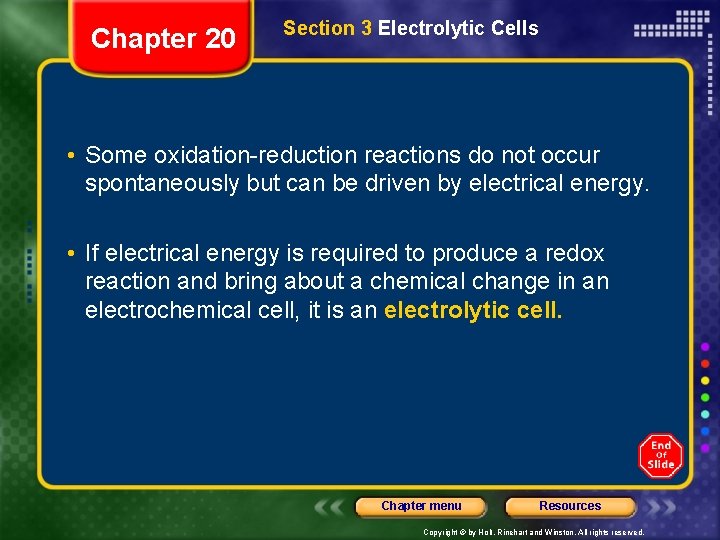
Chapter 20 Section 3 Electrolytic Cells • Some oxidation-reduction reactions do not occur spontaneously but can be driven by electrical energy. • If electrical energy is required to produce a redox reaction and bring about a chemical change in an electrochemical cell, it is an electrolytic cell. Chapter menu Resources Copyright © by Holt, Rinehart and Winston. All rights reserved.
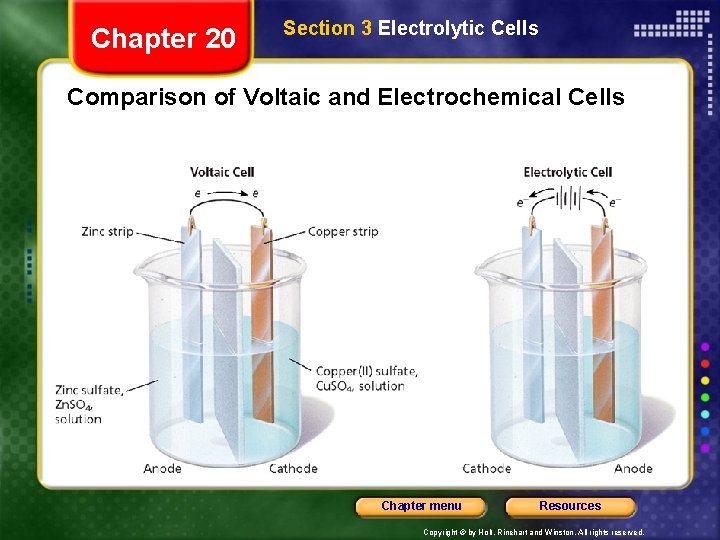
Chapter 20 Section 3 Electrolytic Cells Comparison of Voltaic and Electrochemical Cells Chapter menu Resources Copyright © by Holt, Rinehart and Winston. All rights reserved.
Chapter 20 Section 3 Electrolytic Cells How Electrolytic Cells Work • There are two important differences between the voltaic cell and the electrolytic cell. 1. The anode and cathode of an electrolytic cell are connected to a battery or other direct-current source, whereas a voltaic cell serves as a source of electrical energy. Chapter menu Resources Copyright © by Holt, Rinehart and Winston. All rights reserved.
Chapter 20 Section 3 Electrolytic Cells How Electrolytic Cells Work, continued 2. Electrolytic cells are those in which electrical energy from an external source causes nonspontaneous redox reactions to occur. Voltaic cells are those in which spontaneous redox reactions produce electricity. • In an electrolytic cell, electrical energy is converted to chemical energy. • In a voltaic cell, chemical energy is converted to electrical energy. Chapter menu Resources Copyright © by Holt, Rinehart and Winston. All rights reserved.
Chapter 20 Section 3 Electrolytic Cells How Electrolytic Cells Work, continued Electroplating • An electrolytic process in which a metal ion is reduced and a solid metal is deposited on a surface is called electroplating. • An electroplating cell contains • a solution of a salt of the plating metal • an object to be plated (the cathode) • a piece of the plating metal (the anode) Chapter menu Resources Copyright © by Holt, Rinehart and Winston. All rights reserved.
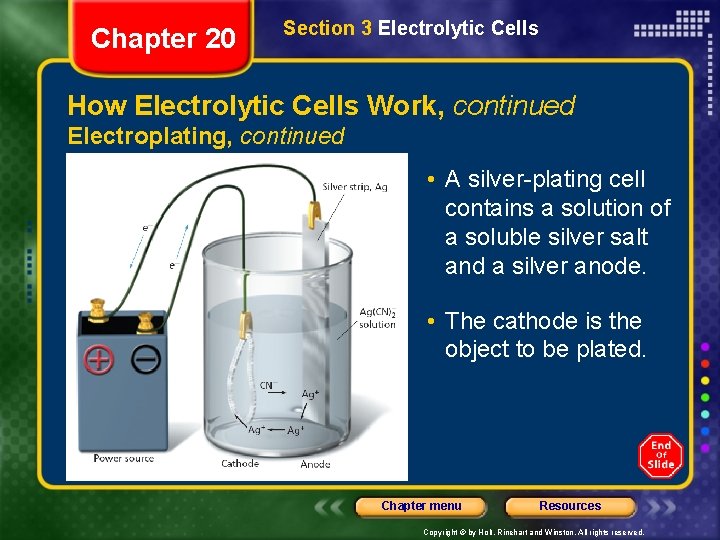
Chapter 20 Section 3 Electrolytic Cells How Electrolytic Cells Work, continued Electroplating, continued • A silver-plating cell contains a solution of a soluble silver salt and a silver anode. • The cathode is the object to be plated. Chapter menu Resources Copyright © by Holt, Rinehart and Winston. All rights reserved.
Chapter 20 Section 3 Electrolytic Cells How Electrolytic Cells Work, continued Rechargeable Cells • A rechargeable cell combines the oxidation-reduction chemistry of both voltaic cells and electrolytic cells. • When a rechargeable cell converts chemical energy to electrical energy, it operates as a voltaic cell. • But when the cell is recharged, it operates as an electrolytic cell, converting electrical energy to chemical energy. Chapter menu Resources Copyright © by Holt, Rinehart and Winston. All rights reserved.
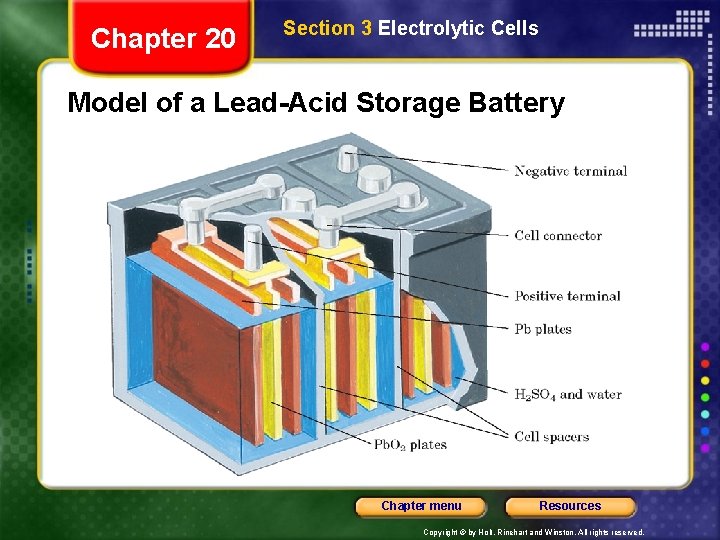
Chapter 20 Section 3 Electrolytic Cells Model of a Lead-Acid Storage Battery Chapter menu Resources Copyright © by Holt, Rinehart and Winston. All rights reserved.
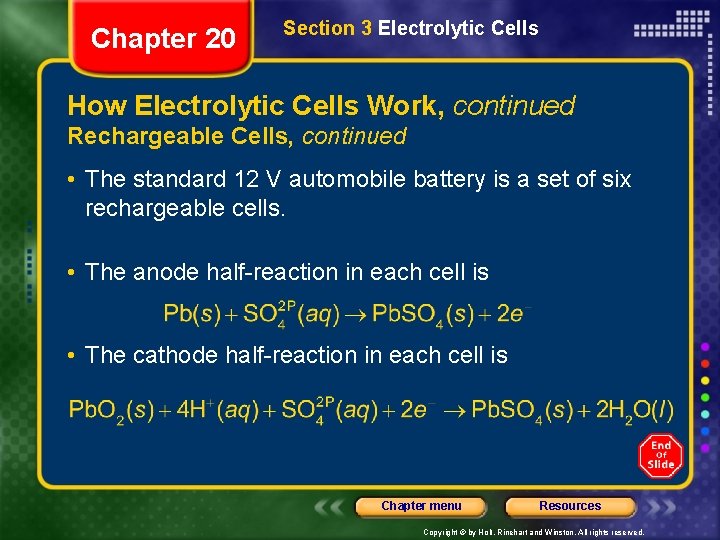
Chapter 20 Section 3 Electrolytic Cells How Electrolytic Cells Work, continued Rechargeable Cells, continued • The standard 12 V automobile battery is a set of six rechargeable cells. • The anode half-reaction in each cell is • The cathode half-reaction in each cell is Chapter menu Resources Copyright © by Holt, Rinehart and Winston. All rights reserved.
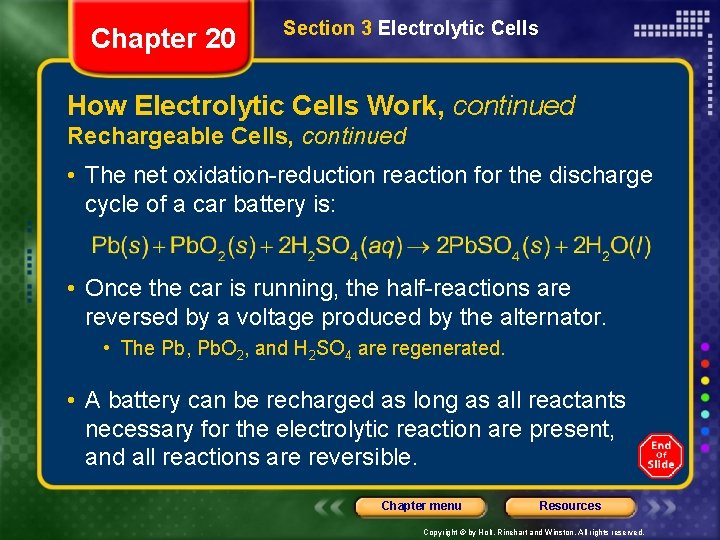
Chapter 20 Section 3 Electrolytic Cells How Electrolytic Cells Work, continued Rechargeable Cells, continued • The net oxidation-reduction reaction for the discharge cycle of a car battery is: • Once the car is running, the half-reactions are reversed by a voltage produced by the alternator. • The Pb, Pb. O 2, and H 2 SO 4 are regenerated. • A battery can be recharged as long as all reactants necessary for the electrolytic reaction are present, and all reactions are reversible. Chapter menu Resources Copyright © by Holt, Rinehart and Winston. All rights reserved.
Chapter 20 Section 3 Electrolytic Cells Electrolysis • Electrolysis is the process of passing a current through a cell for which the cell potential is negative and causing an oxidation-reduction reaction to occur. • examples: Electroplating and recharging a battery • Electrical energy is used to force a nonspontaneous chemical reaction to occur. • For the cell reaction to occur, the external voltage must be greater than the potential that would be produced by the spontaneous reverse cell reaction. Chapter menu Resources Copyright © by Holt, Rinehart and Winston. All rights reserved.
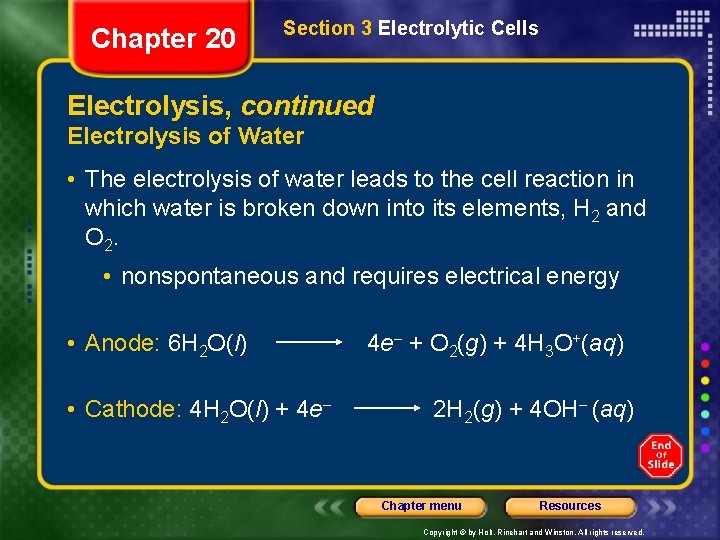
Chapter 20 Section 3 Electrolytic Cells Electrolysis, continued Electrolysis of Water • The electrolysis of water leads to the cell reaction in which water is broken down into its elements, H 2 and O 2. • nonspontaneous and requires electrical energy • Anode: 6 H 2 O(l) • Cathode: 4 H 2 O(l) + 4 e + O 2(g) + 4 H 3 O+(aq) 2 H 2(g) + 4 OH (aq) Chapter menu Resources Copyright © by Holt, Rinehart and Winston. All rights reserved.
Chapter 20 Section 3 Electrolytic Cells Electrolysis, continued Aluminum Production by Electrolysis • Pure aluminum is obtained by from an electrolytic process called the Hall-Héroult process. • Bauxite ore contains not only aluminum oxide (Al 2 O 3), but oxides of iron, silicon, and titanium. • Aluminum oxide (called alumina) must be separated from the other compounds in the ore. • Sodium hydroxide is used to dissolve the alumina. Chapter menu Resources Copyright © by Holt, Rinehart and Winston. All rights reserved.
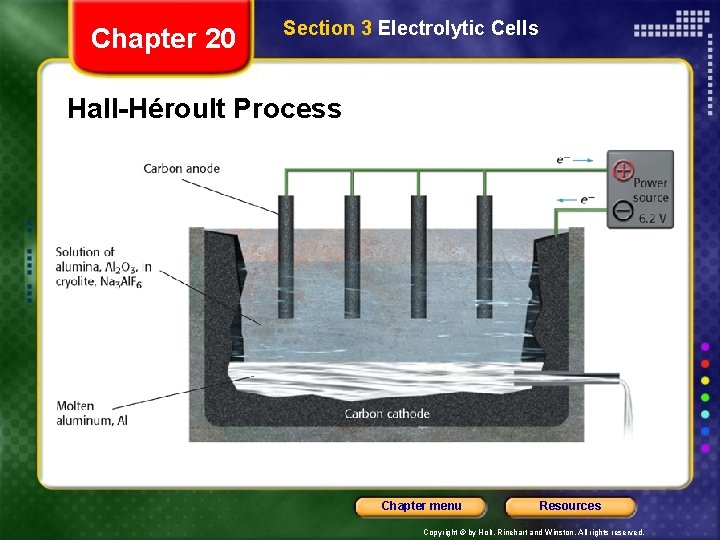
Chapter 20 Section 3 Electrolytic Cells Hall-Héroult Process Chapter menu Resources Copyright © by Holt, Rinehart and Winston. All rights reserved.
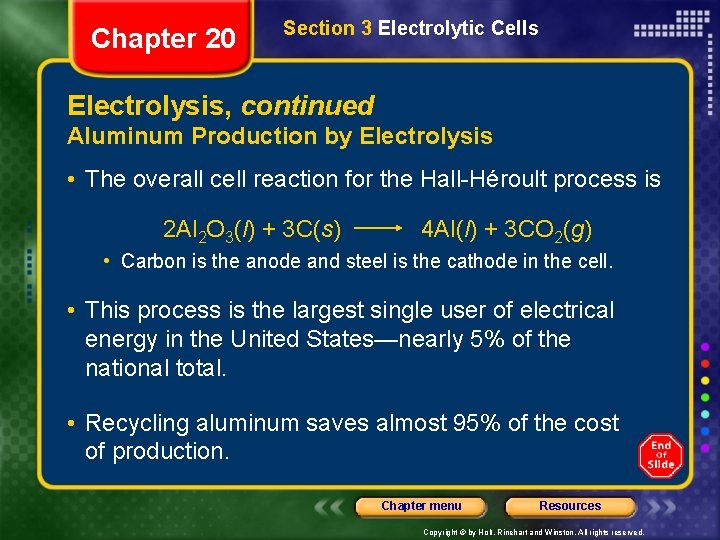
Chapter 20 Section 3 Electrolytic Cells Electrolysis, continued Aluminum Production by Electrolysis • The overall cell reaction for the Hall-Héroult process is 2 Al 2 O 3(l) + 3 C(s) 4 Al(l) + 3 CO 2(g) • Carbon is the anode and steel is the cathode in the cell. • This process is the largest single user of electrical energy in the United States—nearly 5% of the national total. • Recycling aluminum saves almost 95% of the cost of production. Chapter menu Resources Copyright © by Holt, Rinehart and Winston. All rights reserved.
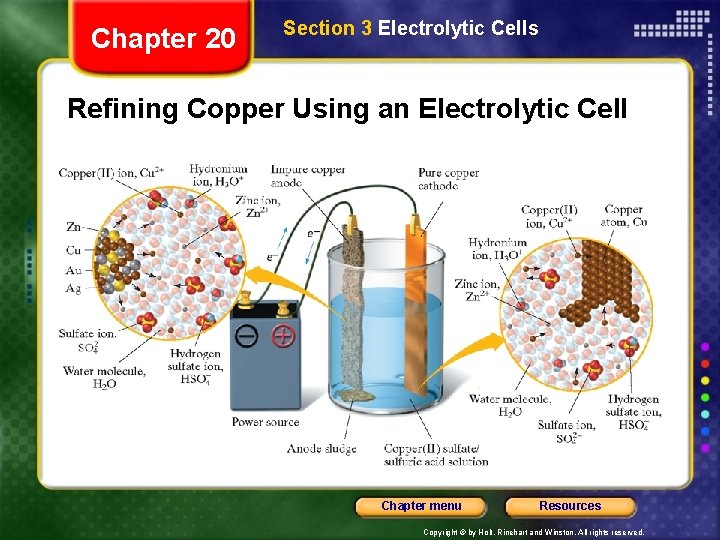
Chapter 20 Section 3 Electrolytic Cells Refining Copper Using an Electrolytic Cell Chapter menu Resources Copyright © by Holt, Rinehart and Winston. All rights reserved.
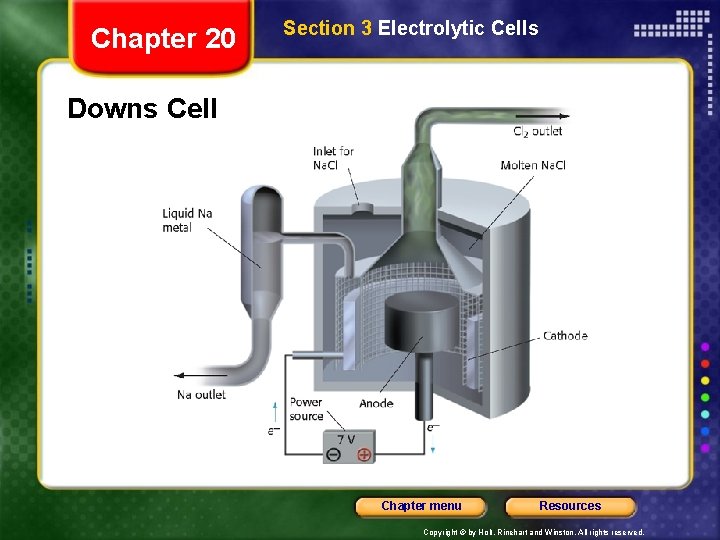
Chapter 20 Section 3 Electrolytic Cells Downs Cell Chapter menu Resources Copyright © by Holt, Rinehart and Winston. All rights reserved.

End of Chapter 20 Show Chapter menu Resources Copyright © by Holt, Rinehart and Winston. All rights reserved.
- Slides: 57