
Chapter 20 OxidationReduction Reactions Redox Reactions 1 The

- Slides: 42
Chapter 20 Oxidation-Reduction Reactions (Redox Reactions) 1
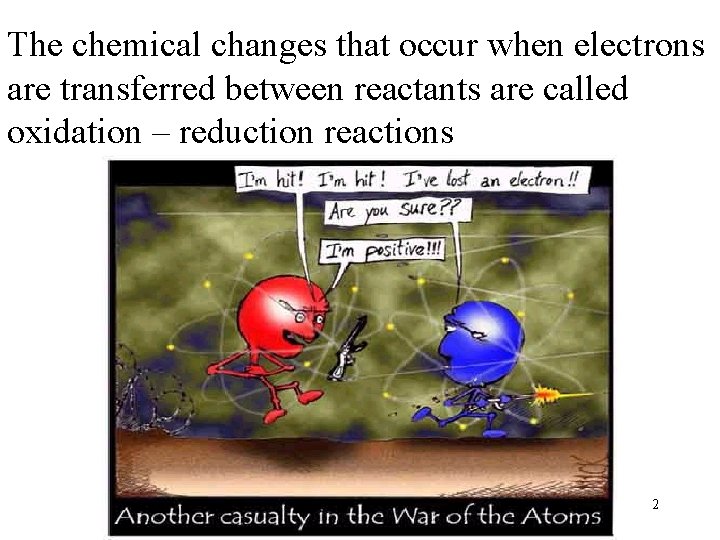
The chemical changes that occur when electrons are transferred between reactants are called oxidation – reduction reactions 2
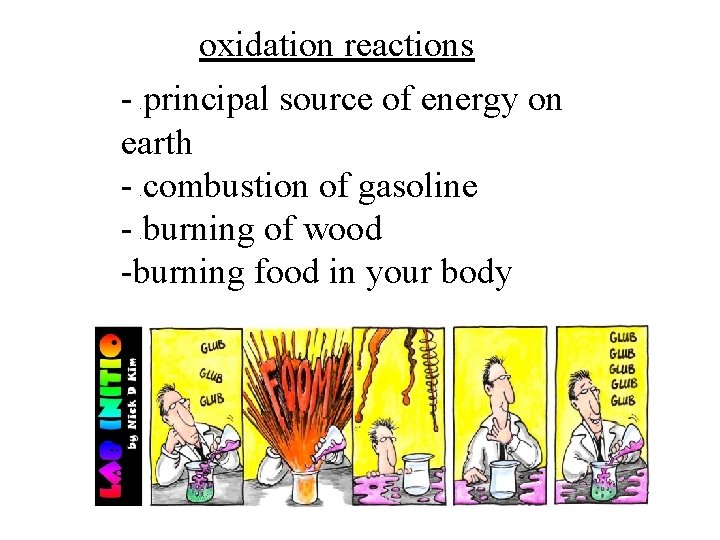
oxidation reactions - principal source of energy on earth - combustion of gasoline - burning of wood -burning food in your body - - - 3
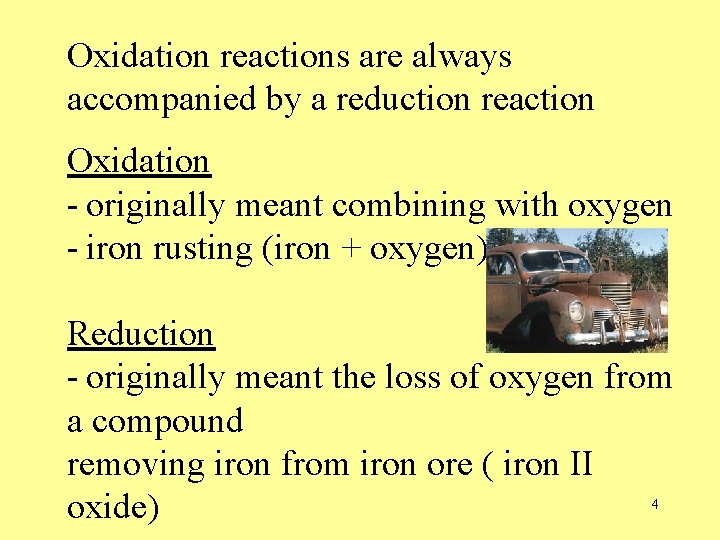
Oxidation reactions are always accompanied by a reduction reaction Oxidation - originally meant combining with oxygen - iron rusting (iron + oxygen) Reduction - originally meant the loss of oxygen from a compound removing iron from iron ore ( iron II oxide) 4
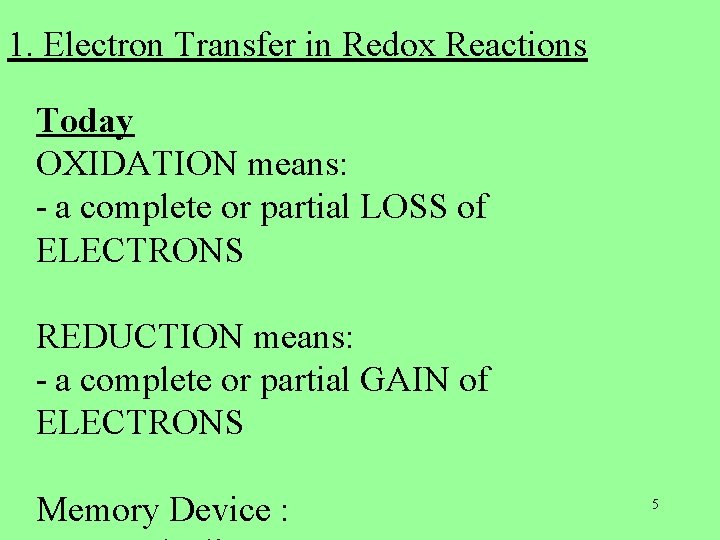
1. Electron Transfer in Redox Reactions Today OXIDATION means: - a complete or partial LOSS of ELECTRONS REDUCTION means: - a complete or partial GAIN of ELECTRONS Memory Device : 5
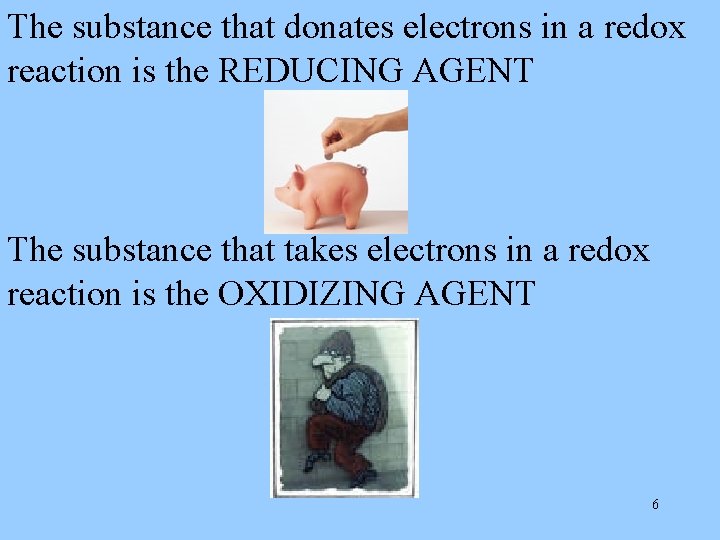
The substance that donates electrons in a redox reaction is the REDUCING AGENT The substance that takes electrons in a redox reaction is the OXIDIZING AGENT 6
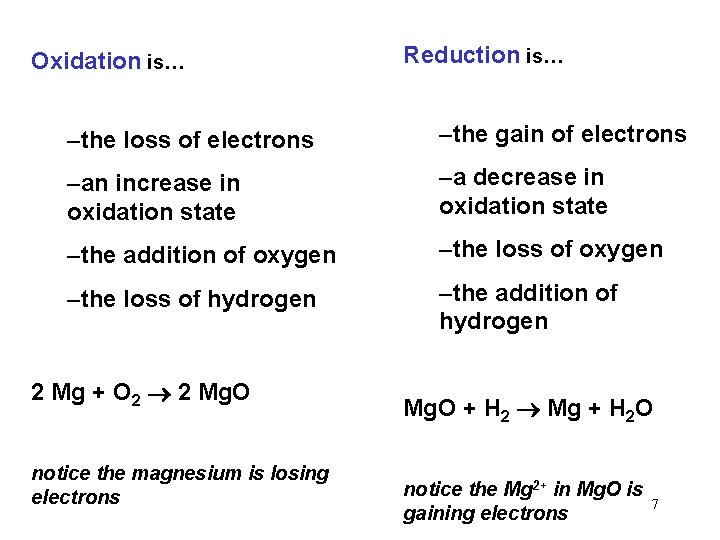
Oxidation is… Reduction is… –the loss of electrons –the gain of electrons –an increase in oxidation state –a decrease in oxidation state –the addition of oxygen –the loss of hydrogen –the addition of hydrogen 2 Mg + O 2 ® 2 Mg. O notice the magnesium is losing electrons Mg. O + H 2 ® Mg + H 2 O notice the Mg 2+ in Mg. O is gaining electrons 7
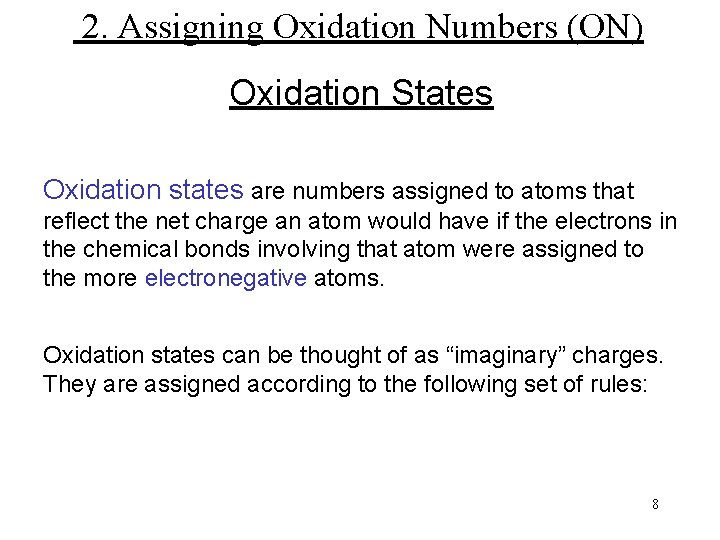
2. Assigning Oxidation Numbers (ON) Oxidation States Oxidation states are numbers assigned to atoms that reflect the net charge an atom would have if the electrons in the chemical bonds involving that atom were assigned to the more electronegative atoms. Oxidation states can be thought of as “imaginary” charges. They are assigned according to the following set of rules: 8
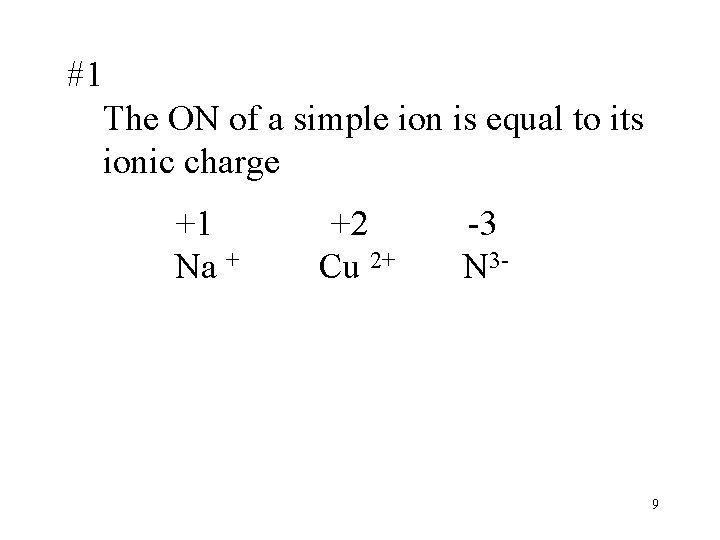
#1 The ON of a simple ion is equal to its ionic charge +1 +2 -3 Na + Cu 2+ N 3 - 9
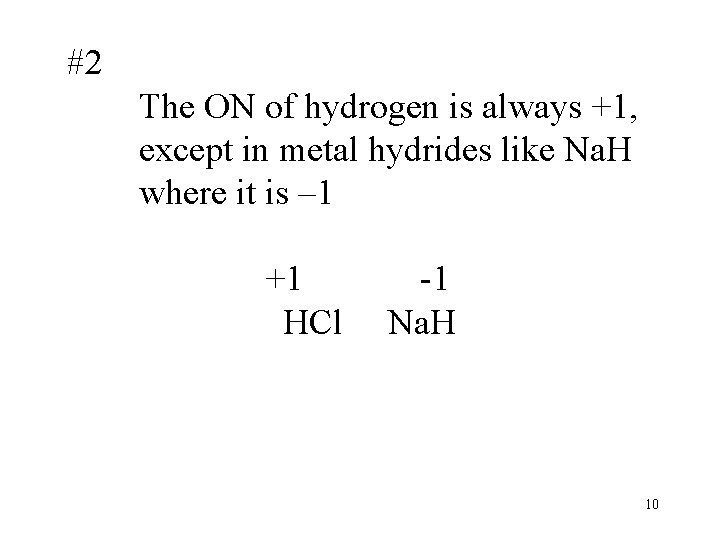
#2 The ON of hydrogen is always +1, except in metal hydrides like Na. H where it is – 1 +1 -1 HCl Na. H 10
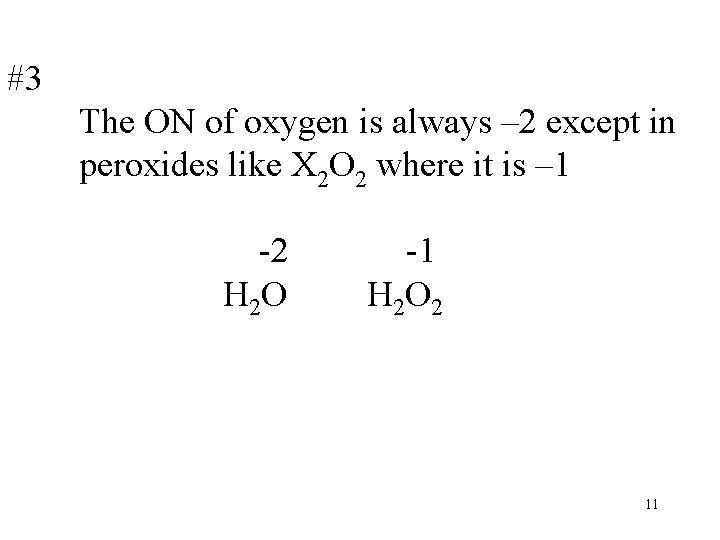
#3 The ON of oxygen is always – 2 except in peroxides like X 2 O 2 where it is – 1 -2 -1 H 2 O 2 11
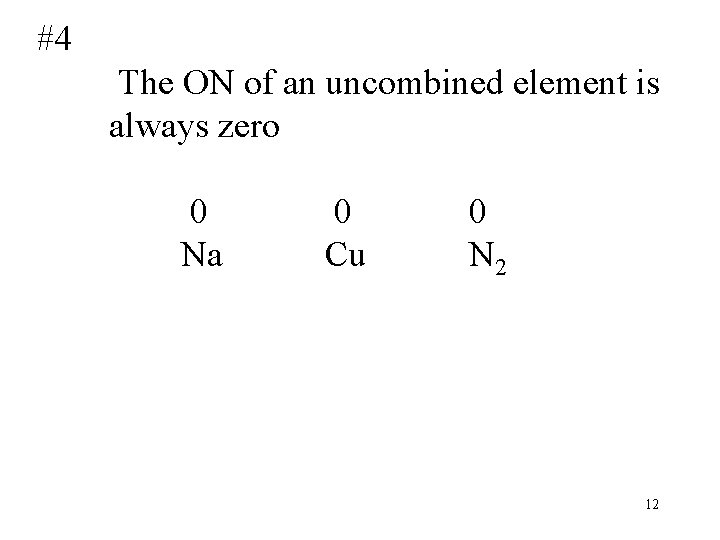
#4 The ON of an uncombined element is always zero 0 0 Na Cu N 2 12
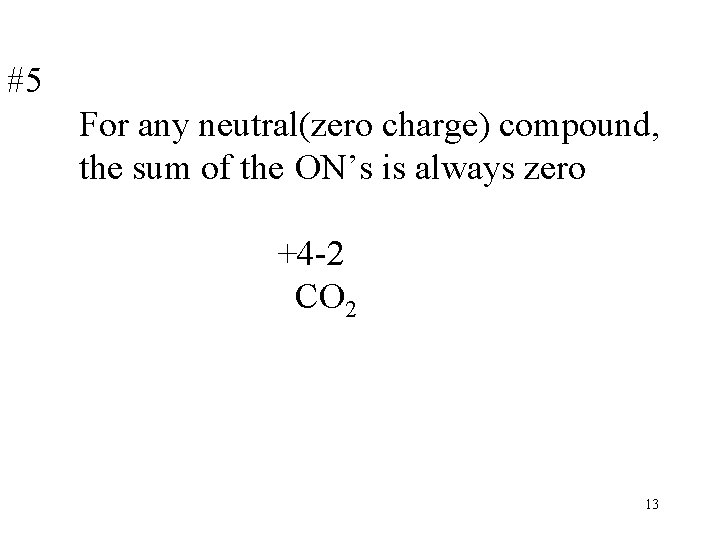
#5 For any neutral(zero charge) compound, the sum of the ON’s is always zero +4 -2 CO 2 13
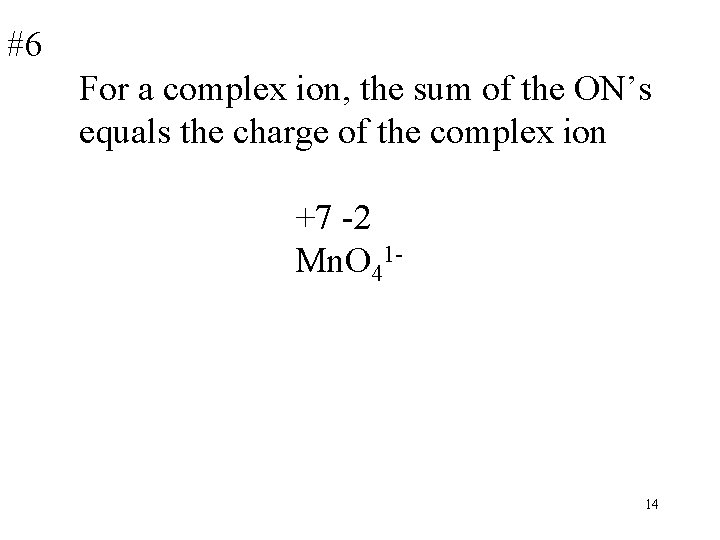
#6 For a complex ion, the sum of the ON’s equals the charge of the complex ion +7 -2 Mn. O 41 - 14
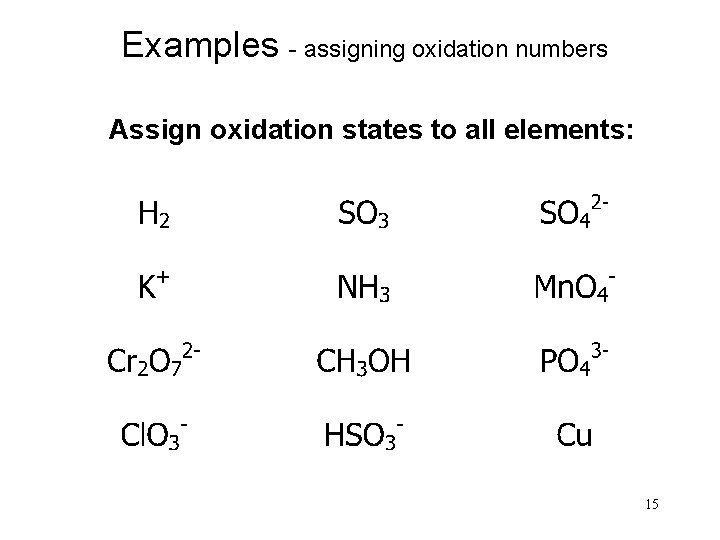
Examples - assigning oxidation numbers Assign oxidation states to all elements: 15
Assignment Read pages 158 -160 in workbook Answer numbers 1 -10 16
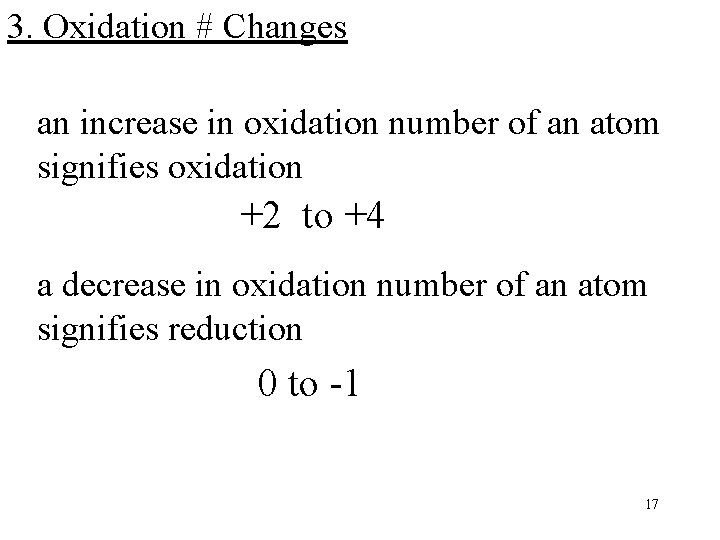
3. Oxidation # Changes an increase in oxidation number of an atom signifies oxidation +2 to +4 a decrease in oxidation number of an atom signifies reduction 0 to -1 17
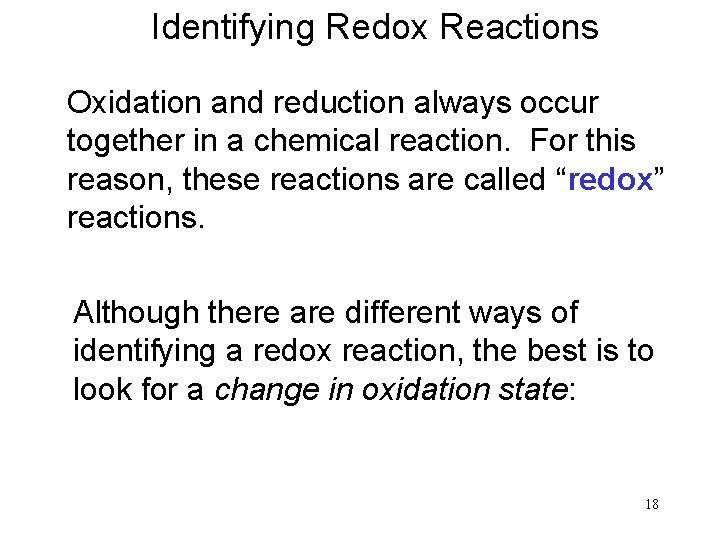
Identifying Redox Reactions Oxidation and reduction always occur together in a chemical reaction. For this reason, these reactions are called “redox” reactions. Although there are different ways of identifying a redox reaction, the best is to look for a change in oxidation state: 18
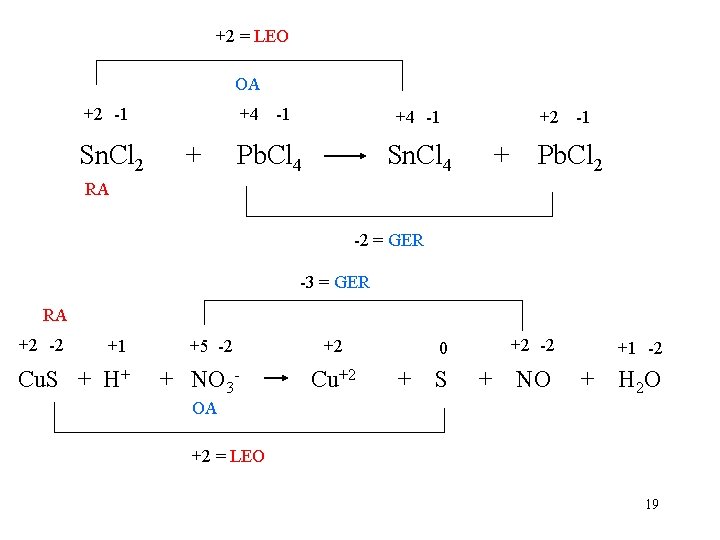
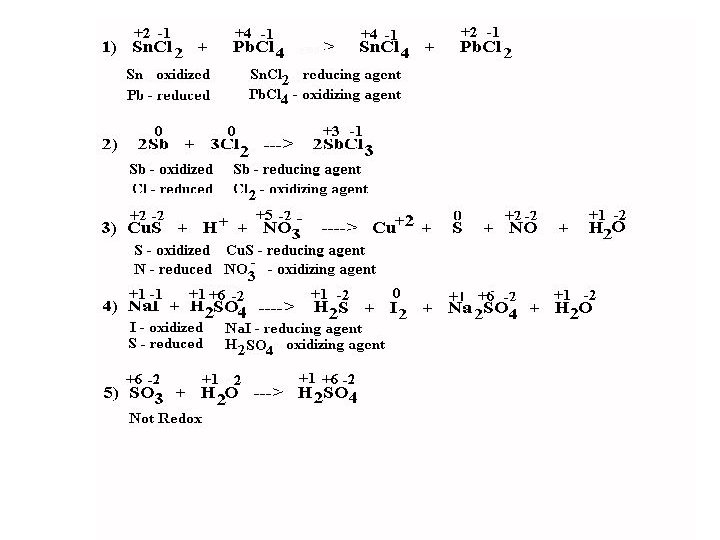
+2 = LEO OA +2 -1 +4 -1 +2 -1 Sn. Cl 2 + Pb. Cl 4 Sn. Cl 4 + Pb. Cl 2 RA -2 = GER -3 = GER RA +2 -2 +1 +5 -2 +2 0 +2 -2 +1 -2 Cu. S + H+ + NO 3 - Cu+2 + S + NO + H 2 O OA +2 = LEO 19
20
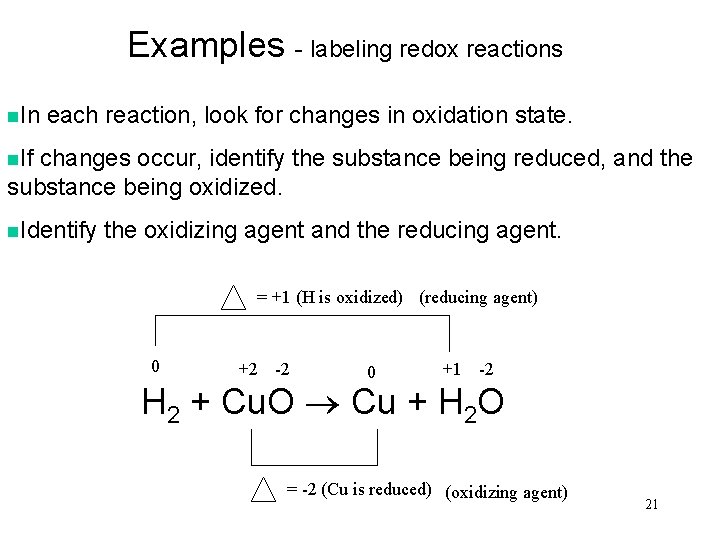
Examples - labeling redox reactions n. In each reaction, look for changes in oxidation state. n. If changes occur, identify the substance being reduced, and the substance being oxidized. n. Identify the oxidizing agent and the reducing agent. = +1 (H is oxidized) (reducing agent) 0 +2 -2 0 +1 -2 H 2 + Cu. O ® Cu + H 2 O = -2 (Cu is reduced) (oxidizing agent) 21
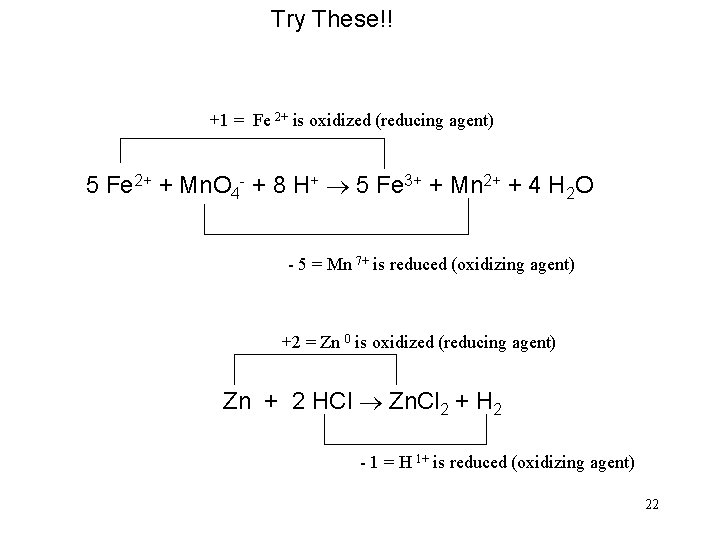
Try These!! +1 = Fe 2+ is oxidized (reducing agent) 5 Fe 2+ + Mn. O 4 - + 8 H+ ® 5 Fe 3+ + Mn 2+ + 4 H 2 O - 5 = Mn 7+ is reduced (oxidizing agent) +2 = Zn 0 is oxidized (reducing agent) Zn + 2 HCl ® Zn. Cl 2 + H 2 - 1 = H 1+ is reduced (oxidizing agent) 22
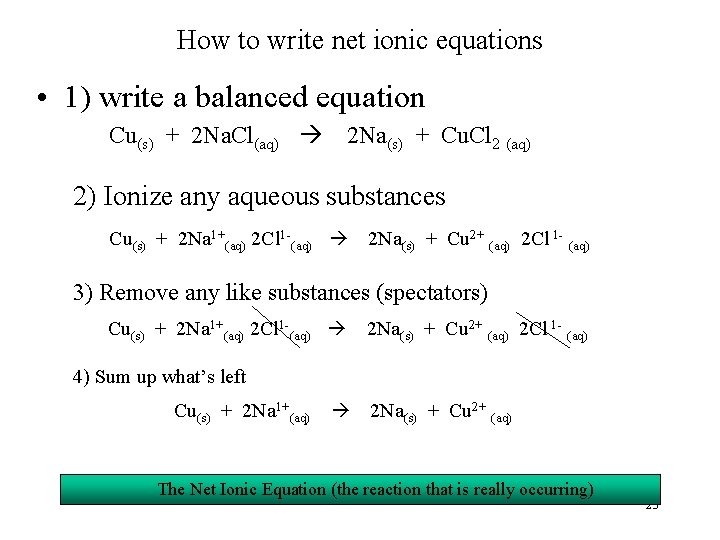
How to write net ionic equations • 1) write a balanced equation Cu(s) + 2 Na. Cl(aq) 2 Na(s) + Cu. Cl 2 (aq) 2) Ionize any aqueous substances Cu(s) + 2 Na 1+(aq) 2 Cl 1 -(aq) 2 Na(s) + Cu 2+ (aq) 2 Cl 1 - (aq) 3) Remove any like substances (spectators) Cu(s) + 2 Na 1+(aq) 2 Cl 1 -(aq) 2 Na(s) + Cu 2+ (aq) 2 Cl 1 - (aq) 4) Sum up what’s left Cu(s) + 2 Na 1+(aq) 2 Na(s) + Cu 2+ (aq) The Net Ionic Equation (the reaction that is really occurring) 23
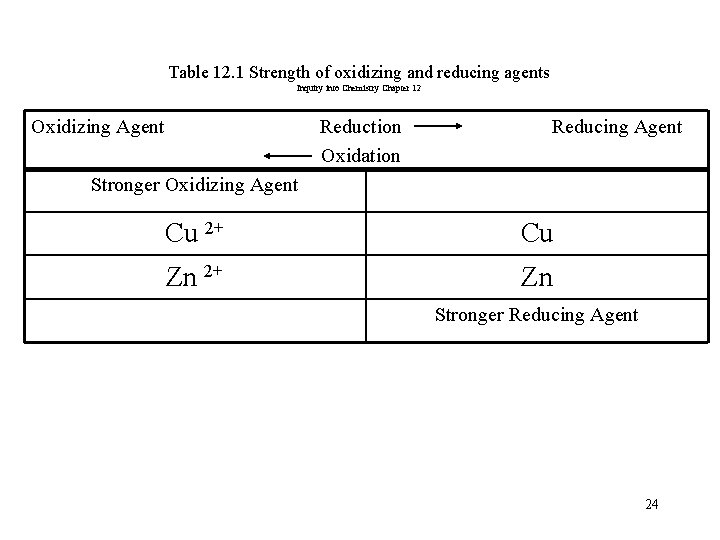
Table 12. 1 Strength of oxidizing and reducing agents Inquiry into Chemistry Chapter 12 Oxidizing Agent Reduction Reducing Agent Oxidation Stronger Oxidizing Agent Cu 2+ Cu Zn 2+ Zn Stronger Reducing Agent 24
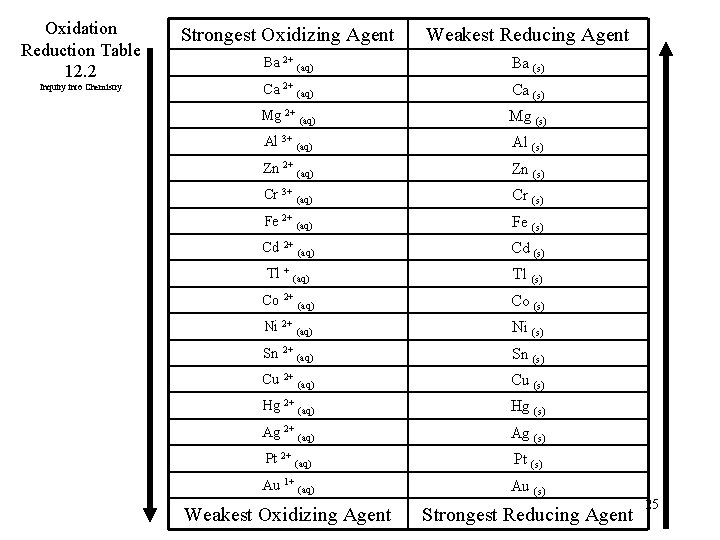
Oxidation Reduction Table 12. 2 Inquiry into Chemistry Strongest Oxidizing Agent Weakest Reducing Agent Ba 2+ (aq) Ba (s) Ca 2+ (aq) Ca (s) Mg 2+ (aq) Mg (s) Al 3+ (aq) Al (s) Zn 2+ (aq) Zn (s) Cr 3+ (aq) Cr (s) Fe 2+ (aq) Fe (s) Cd 2+ (aq) Cd (s) Tl + (aq) Tl (s) Co 2+ (aq) Co (s) Ni 2+ (aq) Ni (s) Sn 2+ (aq) Sn (s) Cu 2+ (aq) Cu (s) Hg 2+ (aq) Hg (s) Ag 2+ (aq) Ag (s) Pt 2+ (aq) Pt (s) Au 1+ (aq) Au (s) Weakest Oxidizing Agent Strongest Reducing Agent 25
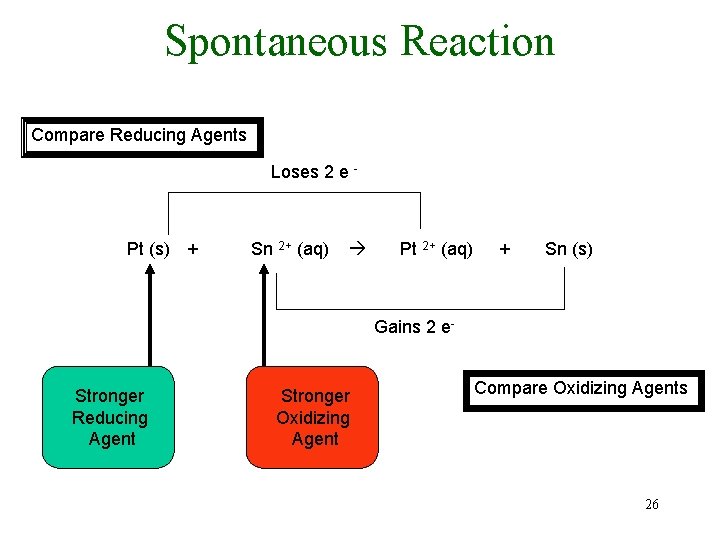
Spontaneous Reaction Compare Reducing Agents Loses 2 e - Pt (s) + Sn 2+ (aq) Pt 2+ (aq) + Sn (s) Gains 2 e- Stronger Reducing Agent Stronger Oxidizing Agent Compare Oxidizing Agents 26
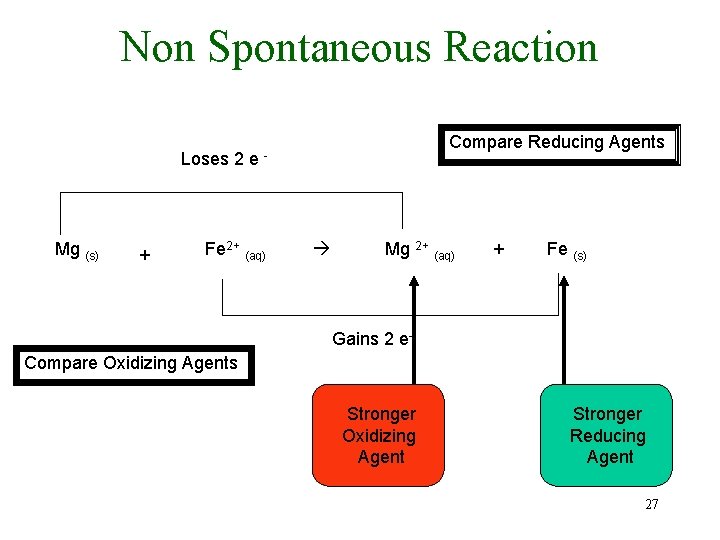
Non Spontaneous Reaction Loses 2 e Mg (s) + Compare Reducing Agents - Fe 2+ (aq) Mg 2+ (aq) + Fe (s) Gains 2 e. Compare Oxidizing Agents Stronger Oxidizing Agent Stronger Reducing Agent 27
Assignment Read page 61 Answer questions 11 -31 28
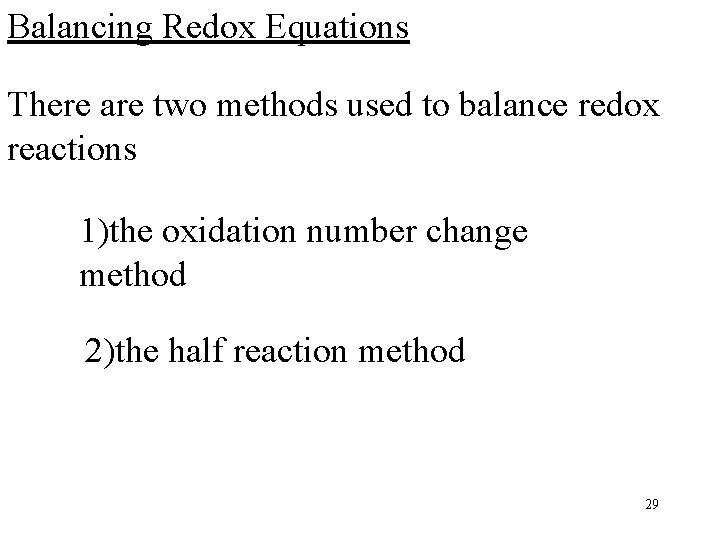
Balancing Redox Equations There are two methods used to balance redox reactions 1)the oxidation number change method 2)the half reaction method 29
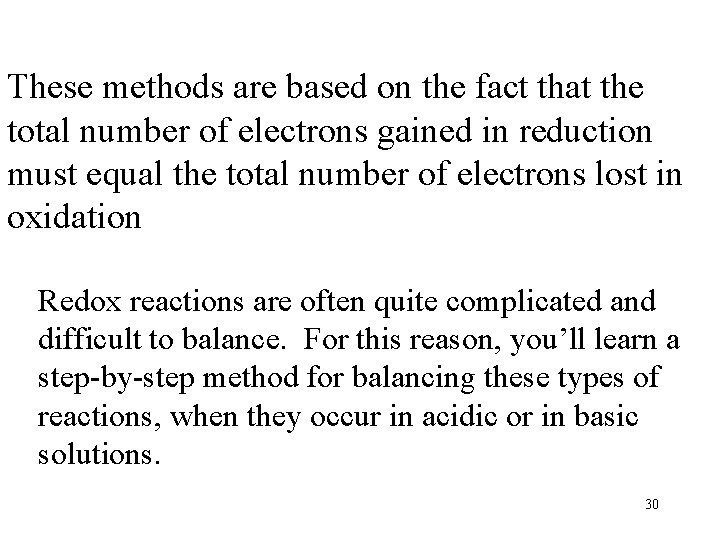
These methods are based on the fact that the total number of electrons gained in reduction must equal the total number of electrons lost in oxidation Redox reactions are often quite complicated and difficult to balance. For this reason, you’ll learn a step-by-step method for balancing these types of reactions, when they occur in acidic or in basic solutions. 30
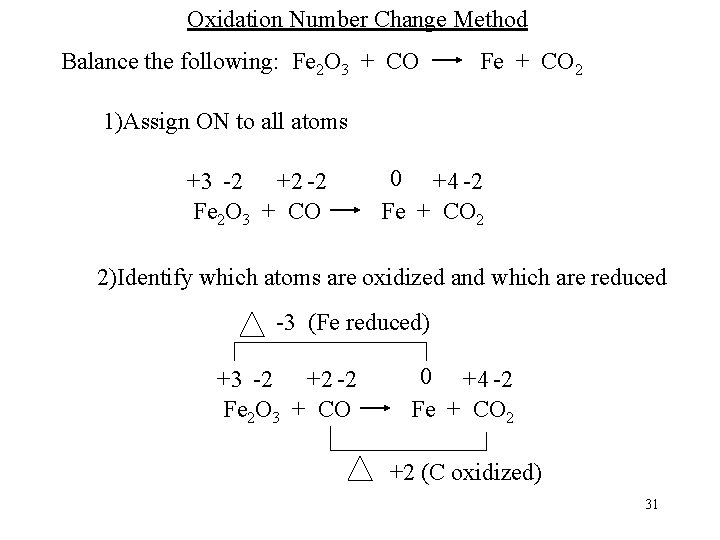
Oxidation Number Change Method Balance the following: Fe 2 O 3 + CO Fe + CO 2 1)Assign ON to all atoms 0 +4 -2 +3 -2 +2 -2 Fe 2 O 3 + CO Fe + CO 2 2)Identify which atoms are oxidized and which are reduced -3 (Fe reduced) 0 +4 -2 +3 -2 +2 -2 Fe 2 O 3 + CO Fe + CO 2 +2 (C oxidized) 31
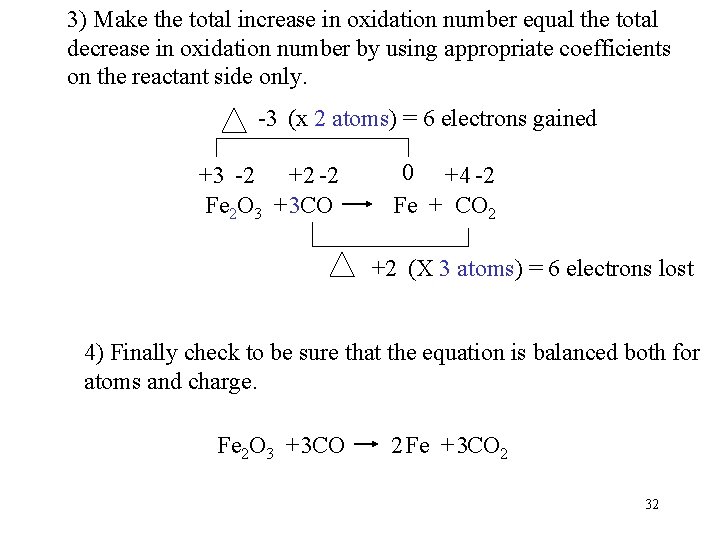
3) Make the total increase in oxidation number equal the total decrease in oxidation number by using appropriate coefficients on the reactant side only. -3 (x 2 atoms) = 6 electrons gained 0 +4 -2 +3 -2 +2 -2 Fe 2 O 3 + CO Fe + CO 3 2 +2 (X 3 atoms) = 6 electrons lost 4) Finally check to be sure that the equation is balanced both for atoms and charge. Fe 2 O 3 + CO Fe + CO 3 2 32
Assignment Read pages 163 -164 Answer questions 32 -36 33
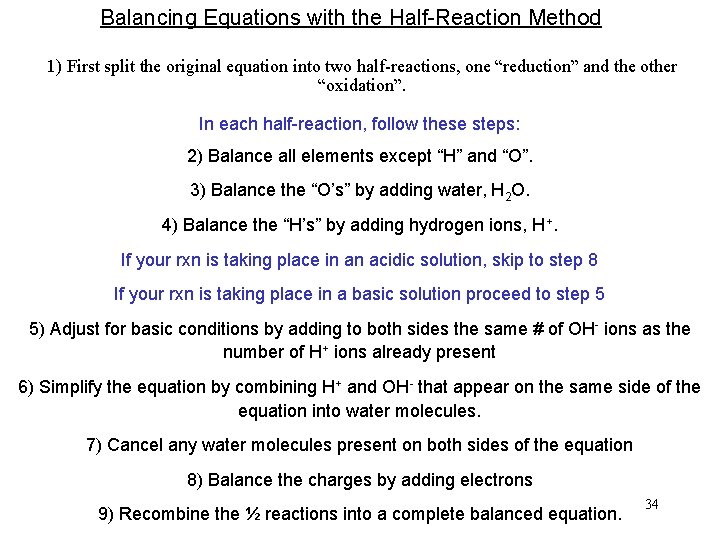
Balancing Equations with the Half-Reaction Method 1) First split the original equation into two half-reactions, one “reduction” and the other “oxidation”. In each half-reaction, follow these steps: 2) Balance all elements except “H” and “O”. 3) Balance the “O’s” by adding water, H 2 O. 4) Balance the “H’s” by adding hydrogen ions, H+. If your rxn is taking place in an acidic solution, skip to step 8 If your rxn is taking place in a basic solution proceed to step 5 5) Adjust for basic conditions by adding to both sides the same # of OH- ions as the number of H+ ions already present 6) Simplify the equation by combining H+ and OH- that appear on the same side of the equation into water molecules. 7) Cancel any water molecules present on both sides of the equation 8) Balance the charges by adding electrons 9) Recombine the ½ reactions into a complete balanced equation. 34
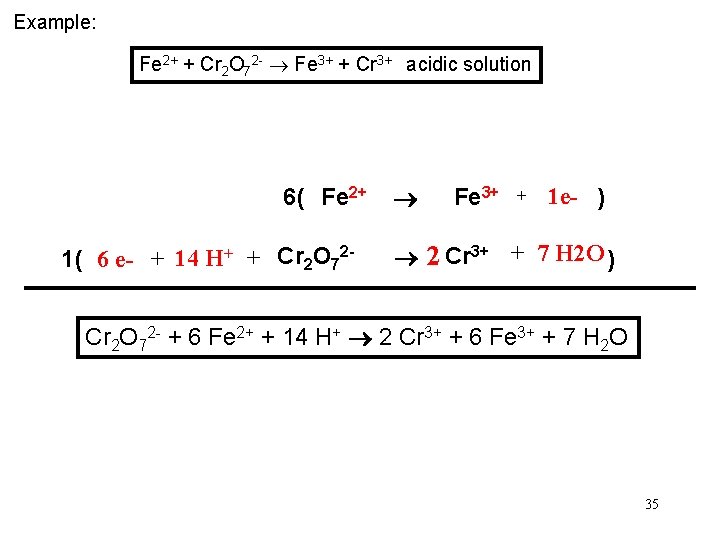
Example: Fe 2+ + Cr 2 O 72 - ® Fe 3+ + Cr 3+ acidic solution 6( Fe 2+ 1( 6 e- + 14 H+ + Cr 2 O 72 - ® Fe 3+ + 1 e- ) ® 2 Cr 3+ + 7 H 2 O ) Cr 2 O 72 - + 6 Fe 2+ + 14 H+ ® 2 Cr 3+ + 6 Fe 3+ + 7 H 2 O 35
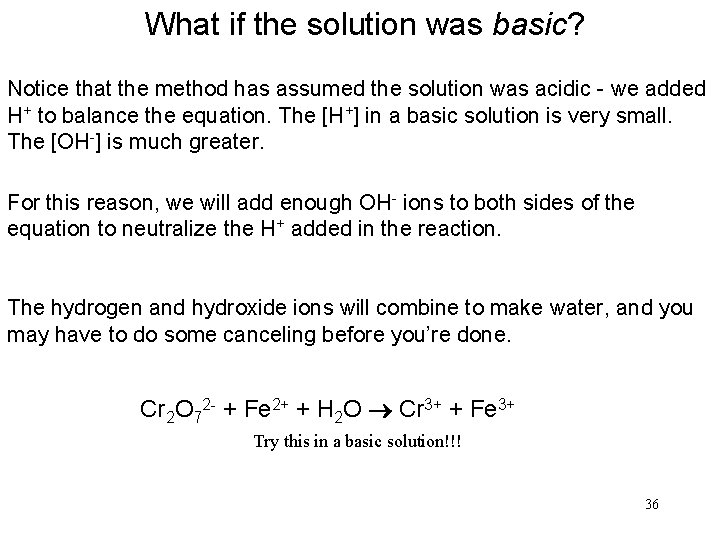
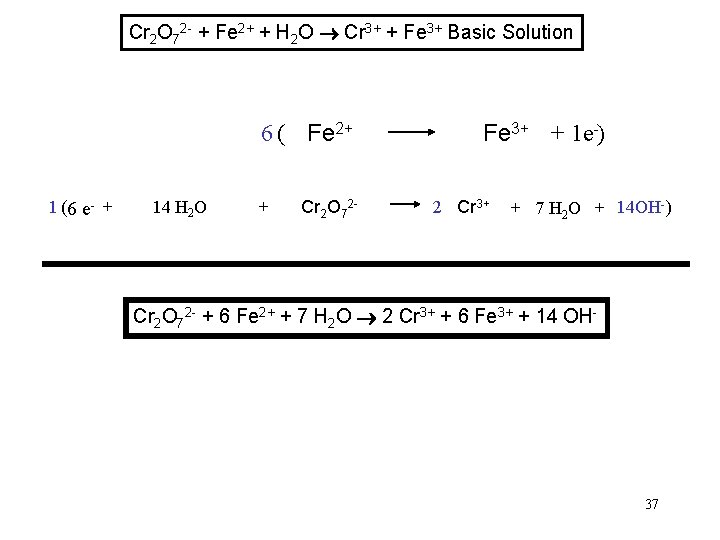
What if the solution was basic? Notice that the method has assumed the solution was acidic - we added H+ to balance the equation. The [H+] in a basic solution is very small. The [OH-] is much greater. For this reason, we will add enough OH- ions to both sides of the equation to neutralize the H+ added in the reaction. The hydrogen and hydroxide ions will combine to make water, and you may have to do some canceling before you’re done. Cr 2 O 72 - + Fe 2+ + H 2 O ® Cr 3+ + Fe 3+ Try this in a basic solution!!! 36
Cr 2 O 72 - + Fe 2+ + H 2 O ® Cr 3+ + Fe 3+ Basic Solution 6 ( ) Fe 2+ Fe 3+ + 1 e- + O + 1 ( ) 14 H + 2 Cr 3+ + 7 H 2 O + 14 OHCr 2 O 726 e- + 14 OH 2 14 H Cr 2 O 72 - + 6 Fe 2+ + 7 H 2 O ® 2 Cr 3+ + 6 Fe 3+ + 14 OH- 37
Balancing Redox Equations Practice n. Balance in acidic solution: H 2 C 2 O 4 + Mn. O 4 - ® Mn 2+ + CO 2 5 H 2 C 2 O 4 + 2 Mn. O 4 - + 6 H+ ® 2 Mn 2+ + 10 CO 2 + 8 H 2 O n. Balance in basic solution: CN- + Mn. O 4 - ® CNO- + Mn. O 2 3 CN- + 2 Mn. O 4 - + H 2 O ® 3 CNO- + 2 Mn. O 2 + 2 OH- 38
Assignment Worksheet: Half Reactions 39
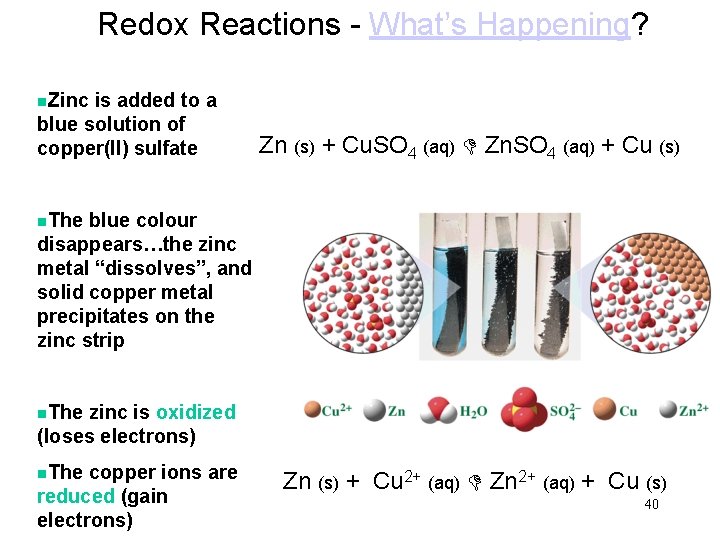
Redox Reactions - What’s Happening? n. Zinc is added to a blue solution of copper(II) sulfate Zn (s) + Cu. SO 4 (aq) Zn. SO 4 (aq) + Cu (s) n. The blue colour disappears…the zinc metal “dissolves”, and solid copper metal precipitates on the zinc strip n. The zinc is oxidized (loses electrons) n. The copper ions are reduced (gain electrons) Zn (s) + Cu 2+ (aq) Zn 2+ (aq) + Cu (s) 40
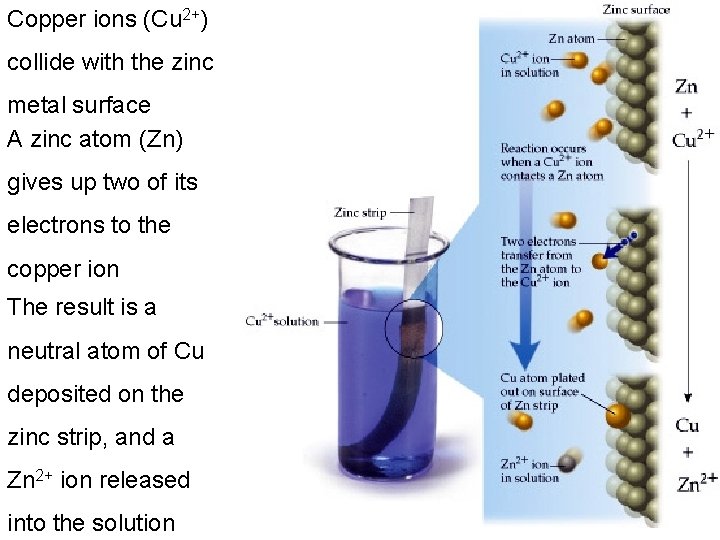
Copper ions (Cu 2+) collide with the zinc metal surface A zinc atom (Zn) gives up two of its electrons to the copper ion The result is a neutral atom of Cu deposited on the zinc strip, and a Zn 2+ ion released into the solution 41
SIMULATIONS Voltaic Cell Electrolysis Redox Titration 42