
Chapter 20 Eye Injuries Chapter 20 Eye Injuries
- Slides: 15
Chapter 20 Eye Injuries
Chapter 20: Eye Injuries Objectives (1 of 3) • List the main anatomic features of the eye. • Describe the signs and symptoms of eye injuries. • List the steps necessary to assess eye injuries. • Describe the steps for managing foreign objects in the eye. 2
Chapter 20: Eye Injuries Objectives (2 of 3) • Describe the steps for managing puncture wounds to the eye. • Describe how to manage burns to the eye. • Describe how to remove contact lenses from the eye. • Demonstrate the use of irrigation to flush out foreign bodies lying on the surface of the eye. 3
Chapter 20: Eye Injuries Objectives (3 of 3) • Demonstrate the steps in the emergency care of the patient with lacerations of the eyelids, ruptured globe, and impaled foreign body. • Demonstrate the stabilization of a foreign object impaled in the eye. 4
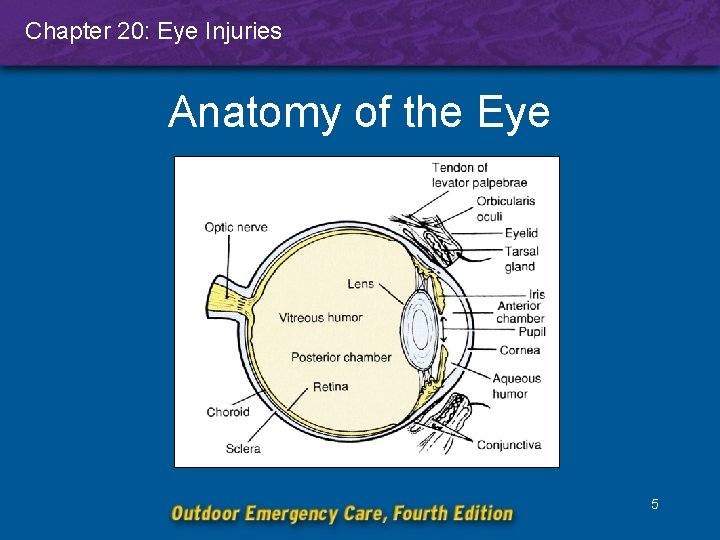
Chapter 20: Eye Injuries Anatomy of the Eye 5
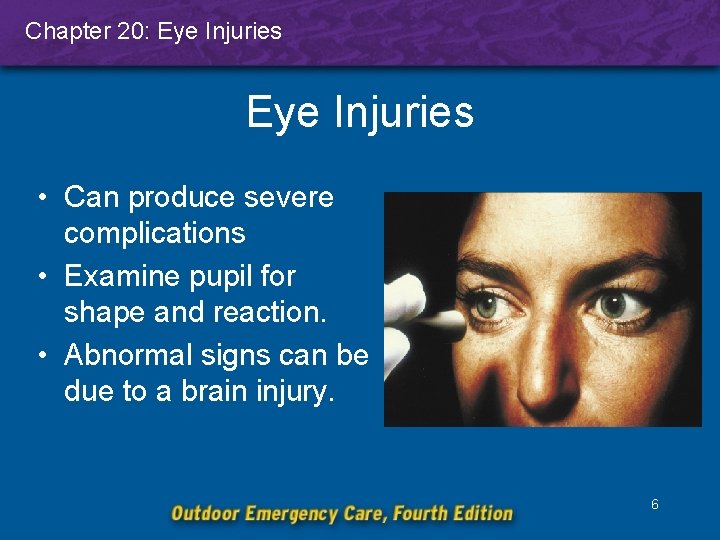
Chapter 20: Eye Injuries • Can produce severe complications • Examine pupil for shape and reaction. • Abnormal signs can be due to a brain injury. 6
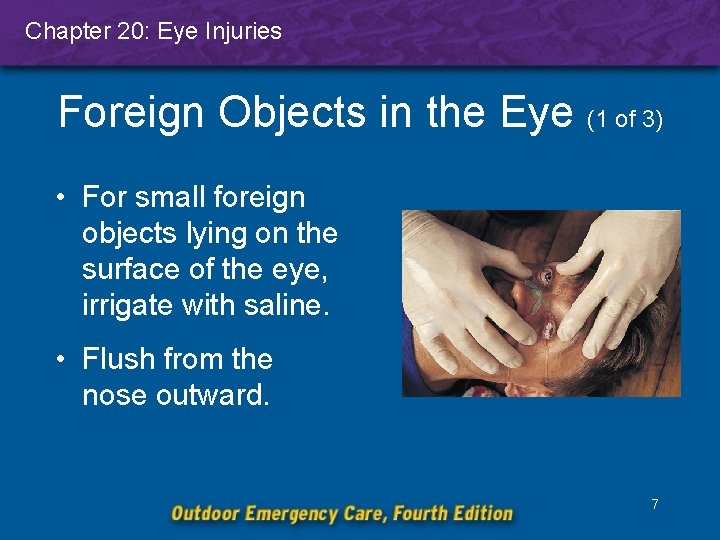
Chapter 20: Eye Injuries Foreign Objects in the Eye (1 of 3) • For small foreign objects lying on the surface of the eye, irrigate with saline. • Flush from the nose outward. 7
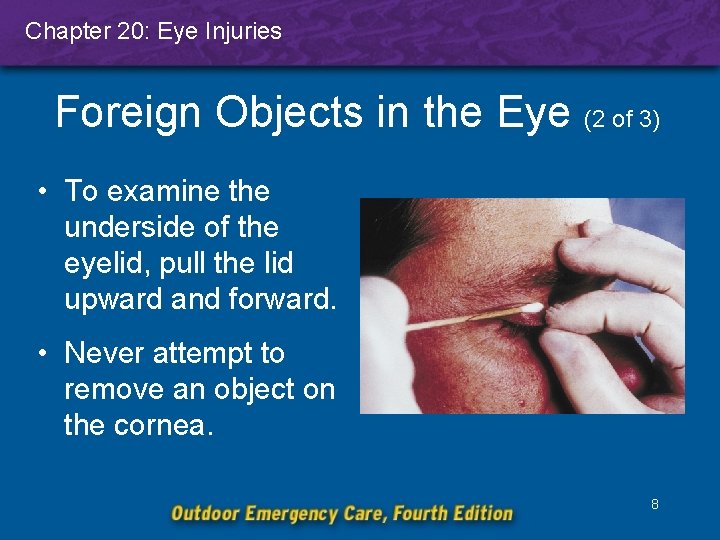
Chapter 20: Eye Injuries Foreign Objects in the Eye (2 of 3) • To examine the underside of the eyelid, pull the lid upward and forward. • Never attempt to remove an object on the cornea. 8
Chapter 20: Eye Injuries Foreign Objects in the Eye (3 of 3) • If there is an object impaled in the eye, do not remove it. • Immobilize the object in place. • Place a moist, sterile dressing over the injured eye. • Cover the injured and uninjured eye. 9
Chapter 20: Eye Injuries Chemical Burns • Chemicals, heat, and light rays can burn the eye. • For chemicals, flush the eye with saline solution or clean water. • You may have to force the eye open to get enough irrigation to the eye. • With an alkali or strong acid burn, irrigate the eye for 20 minutes. • Bandage the eye with dry dressing. 10
Chapter 20: Eye Injuries Thermal and Light Burns • For thermal burns, cover both eyes with a moist, sterile dressing. • Arrange for transport to a burn center. • Infrared rays, eclipse light, direct sunlight, and laser burns can damage the eye. • Cover each eye with a sterile pad and eye shield. Evacuate patient in supine position. 11
Chapter 20: Eye Injuries Lacerations • Lacerations to the eyelids require very careful repair. • Never exert pressure on or manipulate the eye. • If part of the eyeball is exposed, apply a moist, sterile dressing. • Cover the injured eye with a protective eye shield. 12
Chapter 20: Eye Injuries Blunt Trauma • Blunt trauma can cause a number of serious injuries. – “Black eye” – Hyphema – A fracture of the orbit (blowout fracture) – Retinal detachment 13
Chapter 20: Eye Injuries Following a Head Injury • One pupil larger than the other • Eyes not moving together, or pointing in different directions • Failure of the eyes to follow equally – Bleeding under the conjunctiva – Protrusion or bulging of one eye 14
Chapter 20: Eye Injuries Contact Lenses and Artificial Eyes • Contact lenses should be kept in the eye unless there is a chemical burn. • Do not attempt to remove a lens from an injured eye. • Advise EMS if the patient has contact lenses. • If there is no function in an eye, ask if the patient has an artificial eye. 15