
Chapter 20 Enzymes and Vitamins 20 2 Enzyme
- Slides: 14
Chapter 20 Enzymes and Vitamins 20. 2 Enzyme Action General, Organic, and Biological Chemistry Copyright © 2010 Pearson Education, Inc. 1
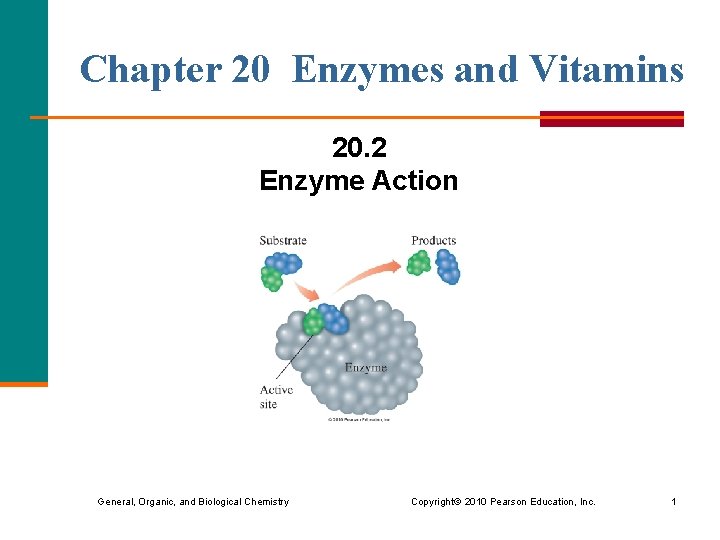
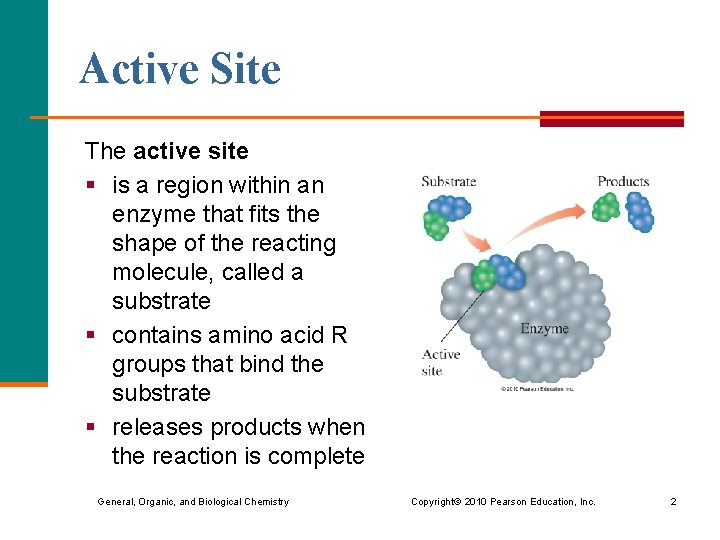
Active Site The active site § is a region within an enzyme that fits the shape of the reacting molecule, called a substrate § contains amino acid R groups that bind the substrate § releases products when the reaction is complete General, Organic, and Biological Chemistry Copyright © 2010 Pearson Education, Inc. 2
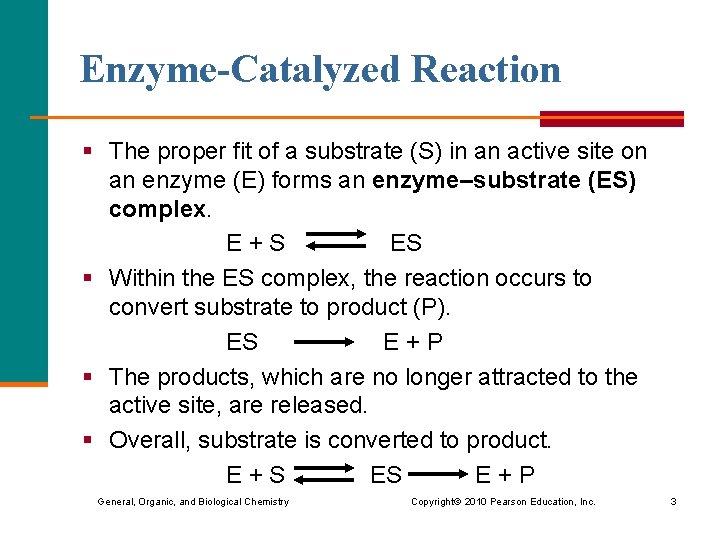
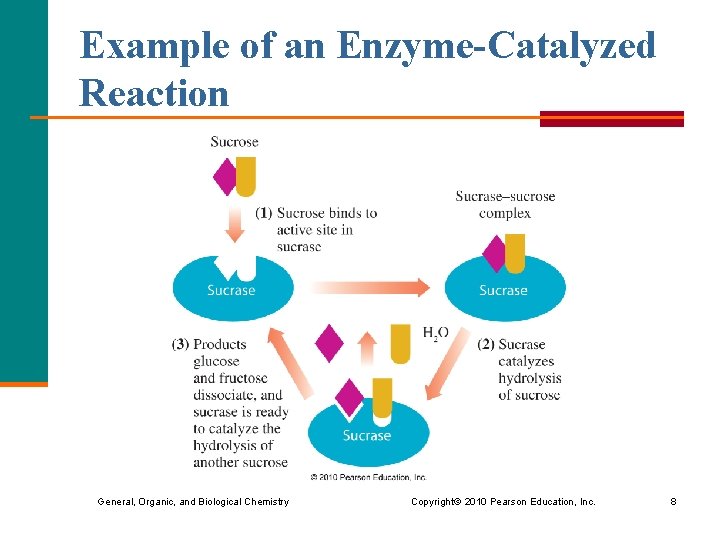
Enzyme-Catalyzed Reaction § The proper fit of a substrate (S) in an active site on an enzyme (E) forms an enzyme–substrate (ES) complex. E + S ES § Within the ES complex, the reaction occurs to convert substrate to product (P). ES E + P § The products, which are no longer attracted to the active site, are released. § Overall, substrate is converted to product. E + S ES E + P General, Organic, and Biological Chemistry Copyright © 2010 Pearson Education, Inc. 3
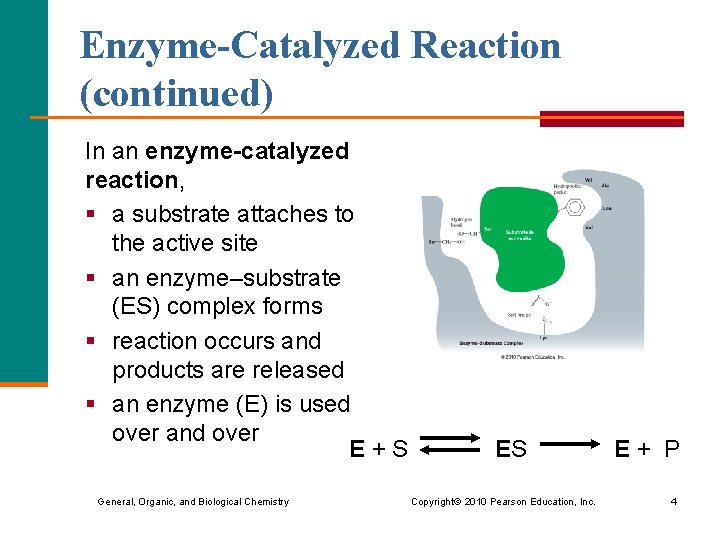
Enzyme-Catalyzed Reaction (continued) In an enzyme-catalyzed reaction, § a substrate attaches to the active site § an enzyme–substrate (ES) complex forms § reaction occurs and products are released § an enzyme (E) is used over and over E + S E + P General, Organic, and Biological Chemistry Copyright © 2010 Pearson Education, Inc. 4
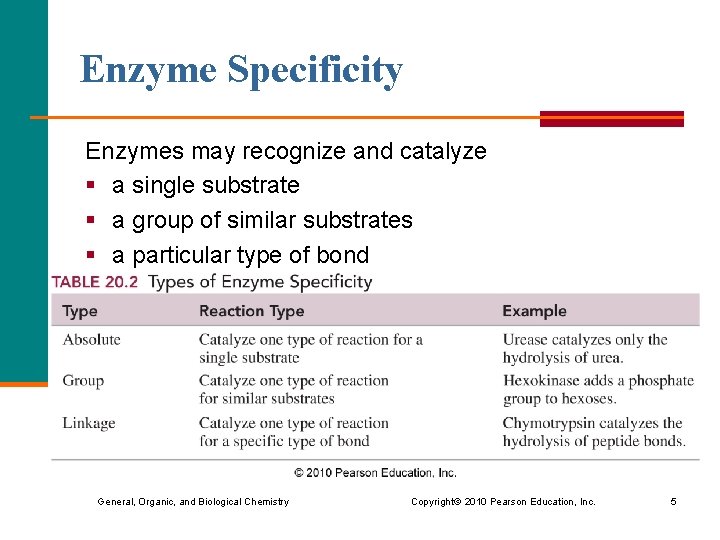
Enzyme Specificity Enzymes may recognize and catalyze § a single substrate § a group of similar substrates § a particular type of bond General, Organic, and Biological Chemistry Copyright © 2010 Pearson Education, Inc. 5
Lock-and-Key Model In the lock-and-key model of enzyme action, § the active site has a rigid shape § only substrates with the matching shape can fit § the substrate is the key that fits that lock General, Organic, and Biological Chemistry Copyright © 2010 Pearson Education, Inc. 6
Induced-Fit Model In the induced-fit model of enzyme action, § enzyme structure is flexible, not rigid § shapes of enzyme and substrate adjust for best fit at the active site to improve catalysis of reaction § substrate specificity increases General, Organic, and Biological Chemistry Copyright © 2010 Pearson Education, Inc. 7
Example of an Enzyme-Catalyzed Reaction General, Organic, and Biological Chemistry Copyright © 2010 Pearson Education, Inc. 8
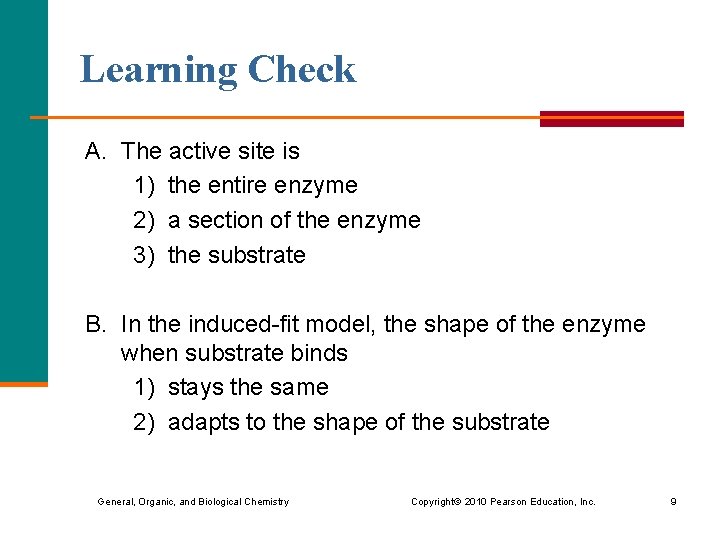
Learning Check A. The active site is 1) the entire enzyme 2) a section of the enzyme 3) the substrate B. In the induced-fit model, the shape of the enzyme when substrate binds 1) stays the same 2) adapts to the shape of the substrate General, Organic, and Biological Chemistry Copyright © 2010 Pearson Education, Inc. 9
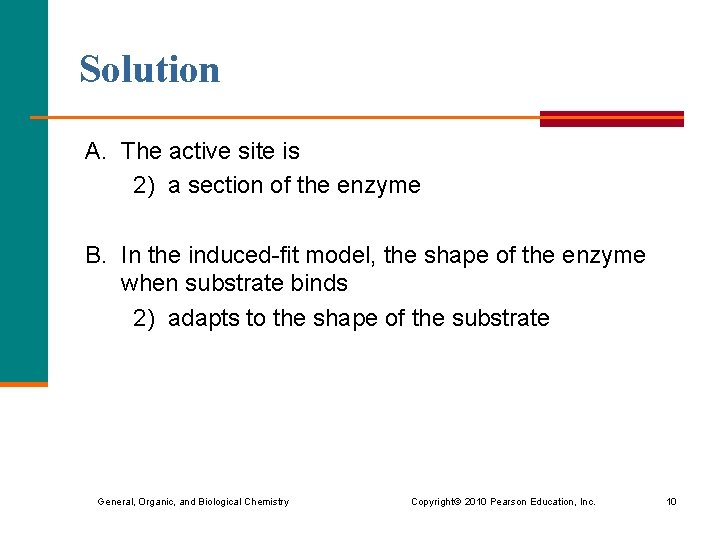
Solution A. The active site is 2) a section of the enzyme B. In the induced-fit model, the shape of the enzyme when substrate binds 2) adapts to the shape of the substrate General, Organic, and Biological Chemistry Copyright © 2010 Pearson Education, Inc. 10
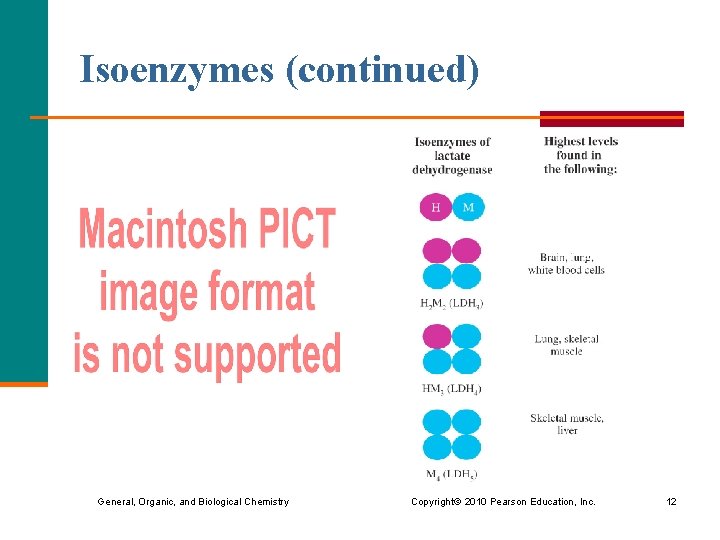
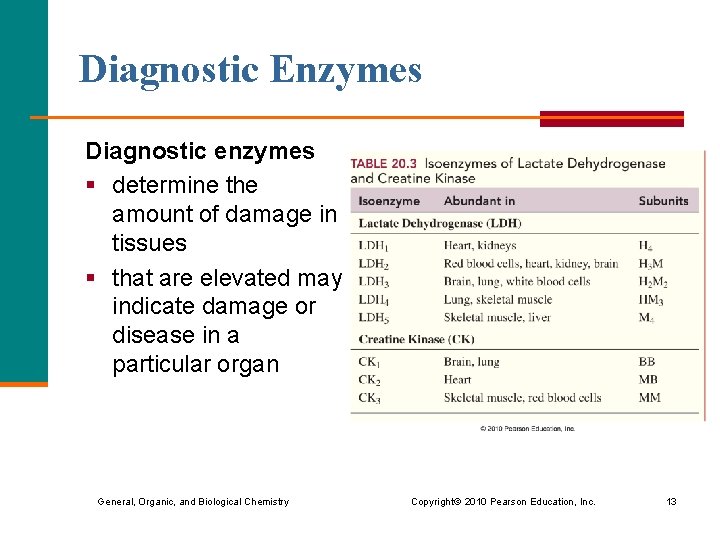
Isoenzymes § catalyze the same reaction in different tissues in the body § such as lactate dehydrogenase (LDH), which converts lactate to pyruvate, consist of five isoenzymes § can be used to identify the organ or tissue involved in damage or disease § such as LDH have one form more prevalent in heart muscle and another form in skeletal muscle and liver tissue General, Organic, and Biological Chemistry Copyright © 2010 Pearson Education, Inc. 11
Isoenzymes (continued) General, Organic, and Biological Chemistry Copyright © 2010 Pearson Education, Inc. 12
Diagnostic Enzymes Diagnostic enzymes § determine the amount of damage in tissues § that are elevated may indicate damage or disease in a particular organ General, Organic, and Biological Chemistry Copyright © 2010 Pearson Education, Inc. 13
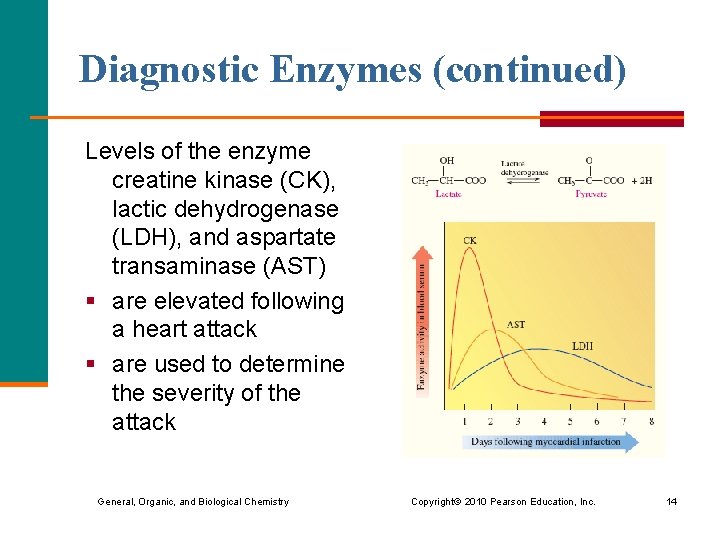
Diagnostic Enzymes (continued) Levels of the enzyme creatine kinase (CK), lactic dehydrogenase (LDH), and aspartate transaminase (AST) § are elevated following a heart attack § are used to determine the severity of the attack General, Organic, and Biological Chemistry Copyright © 2010 Pearson Education, Inc. 14