
Chapter 20 Enols and Enolates 20 1 Aldehyde


- Slides: 38
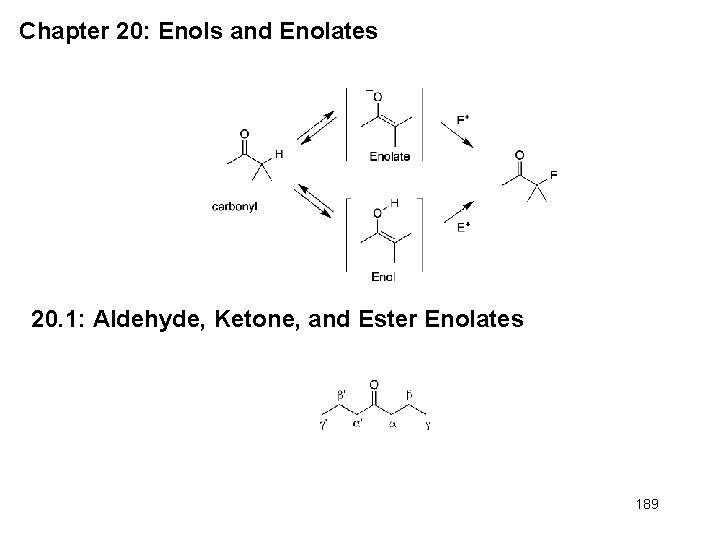
Chapter 20: Enols and Enolates 20. 1: Aldehyde, Ketone, and Ester Enolates 189
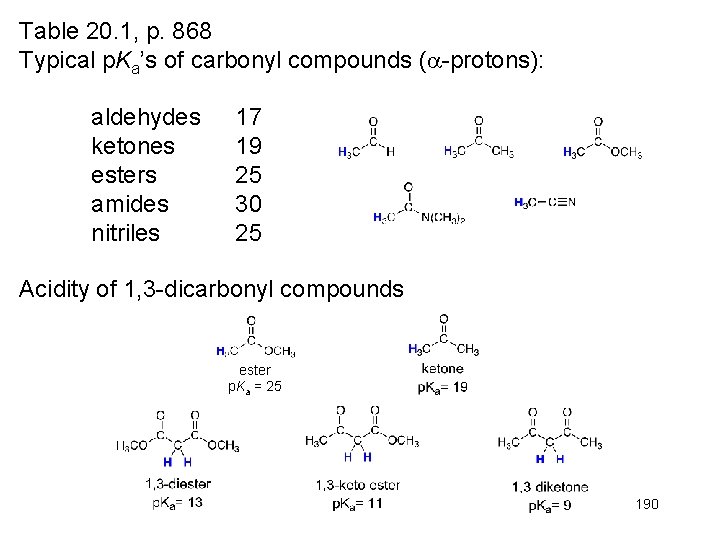
Table 20. 1, p. 868 Typical p. Ka’s of carbonyl compounds ( -protons): aldehydes ketones esters amides nitriles 17 19 25 30 25 Acidity of 1, 3 -dicarbonyl compounds ester p. Kaa== 24 25 190
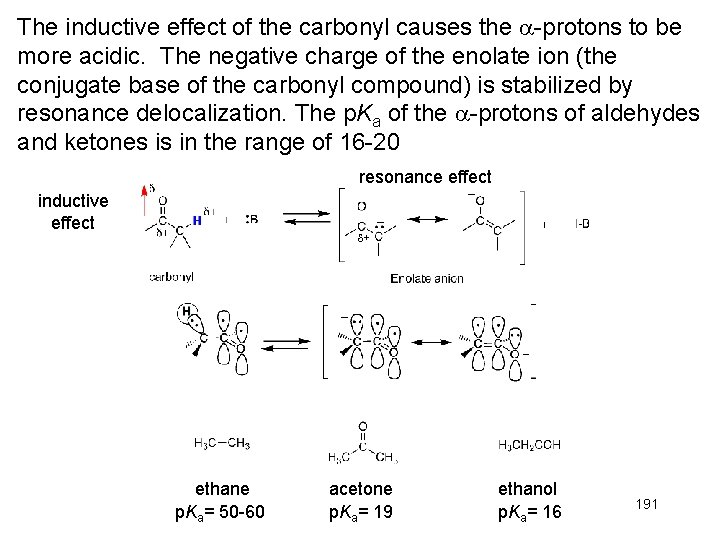
The inductive effect of the carbonyl causes the -protons to be more acidic. The negative charge of the enolate ion (the conjugate base of the carbonyl compound) is stabilized by resonance delocalization. The p. Ka of the -protons of aldehydes and ketones is in the range of 16 -20 resonance effect inductive effect d+ ethane p. Ka= 50 -60 acetone p. Ka= 19 ethanol p. Ka= 16 191
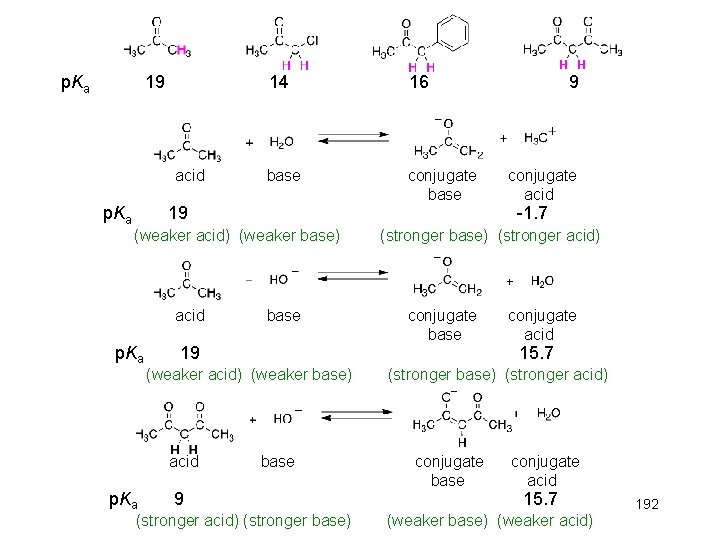
p. Ka 19 acid p. Ka 14 16 base conjugate base 19 (weaker acid) (weaker base) acid p. Ka base 9 (stronger acid) (stronger base) 9 conjugate acid -1. 7 (stronger base) (stronger acid) conjugate base conjugate acid 15. 7 (stronger base) (stronger acid) _ conjugate base conjugate acid 15. 7 (weaker base) (weaker acid) 192
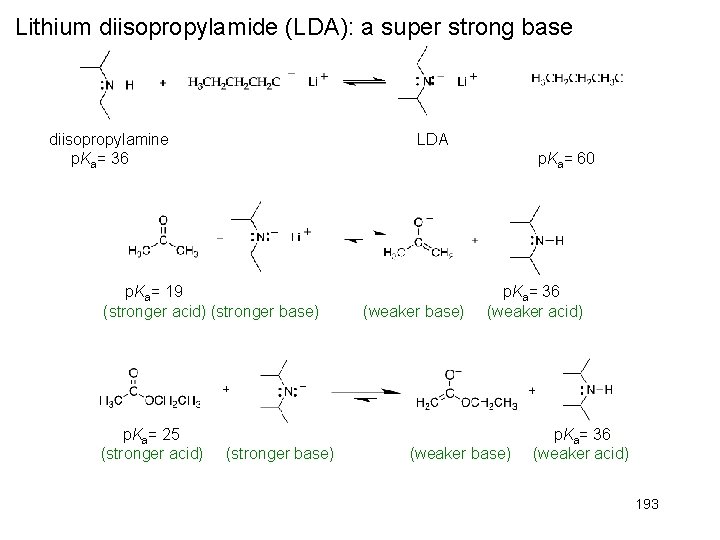
Lithium diisopropylamide (LDA): a super strong base diisopropylamine p. Ka= 36 LDA p. Ka= 60 p. Ka= 19 (stronger acid) (stronger base) p. Ka= 25 (stronger acid) (stronger base) (weaker base) p. Ka= 36 (weaker acid) 193
20. 2: Enolate Regiochemistry – deprotonation of unsymmetrical ketones. More substituted enolate: thermodynamically more stable Less substituted enolate: less hindered, formed faster kinetically The more substituted (thermodynamic) enolate is formed under reversible conditions (t. Bu. O- K+, t. Bu. OH). The less substituted (kinetic) enolate is formed under irreversible conditions (LDA, THF, -78°C). 194
20. 3: The Aldol Condensation- An enolate of one carbonyl (nucleophile) reacts with the carbonyl carbon (electrophile) of a second carbonyl compound resulting in the formation of a new C-C bond. Mechanism of the base-catalyzed aldol reaction (p. 874): The position of the equilibrium for the aldol reaction is highly dependent on the reaction conditions, substrates, and steric considerations of the aldol product. Low temperature tends 195 to favor the aldol product.
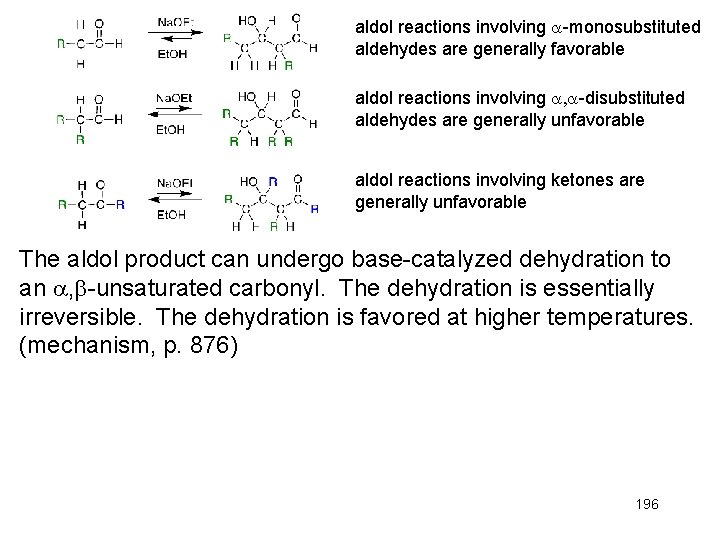
aldol reactions involving -monosubstituted aldehydes are generally favorable aldol reactions involving -disubstituted aldehydes are generally unfavorable aldol reactions involving ketones are generally unfavorable The aldol product can undergo base-catalyzed dehydration to an , -unsaturated carbonyl. The dehydration is essentially irreversible. The dehydration is favored at higher temperatures. (mechanism, p. 876) 196
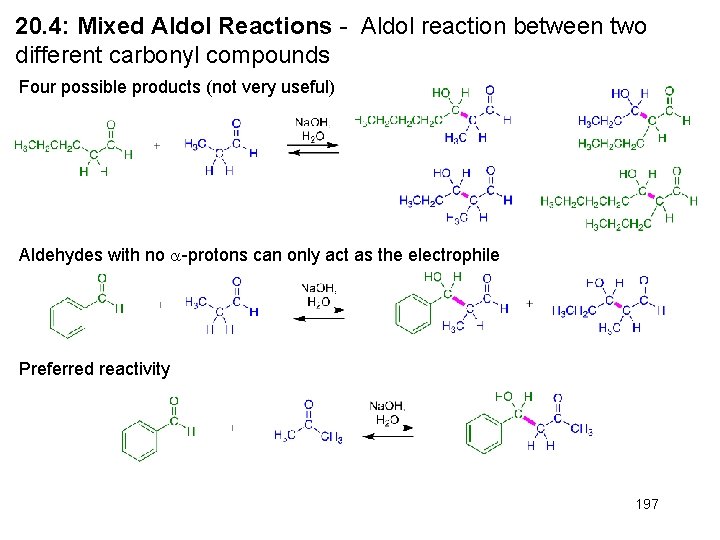
20. 4: Mixed Aldol Reactions - Aldol reaction between two different carbonyl compounds Four possible products (not very useful) Aldehydes with no -protons can only act as the electrophile Preferred reactivity 197
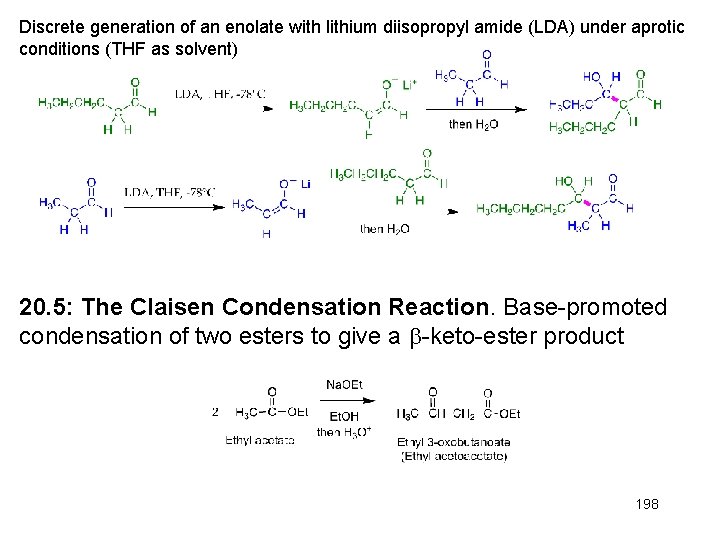
Discrete generation of an enolate with lithium diisopropyl amide (LDA) under aprotic conditions (THF as solvent) 20. 5: The Claisen Condensation Reaction. Base-promoted condensation of two esters to give a -keto-ester product 198
The mechanism of the Claisen condensation (p. 883) is a base promoted nucleophilic acyl substitution of an ester by an ester enolate and is related to the mechanism of the aldol reaction. 199
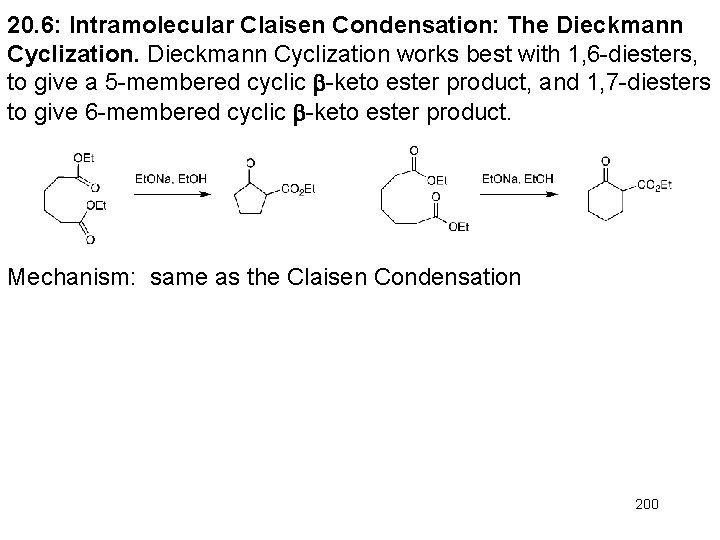
20. 6: Intramolecular Claisen Condensation: The Dieckmann Cyclization works best with 1, 6 -diesters, to give a 5 -membered cyclic -keto ester product, and 1, 7 -diesters to give 6 -membered cyclic -keto ester product. Mechanism: same as the Claisen Condensation 200
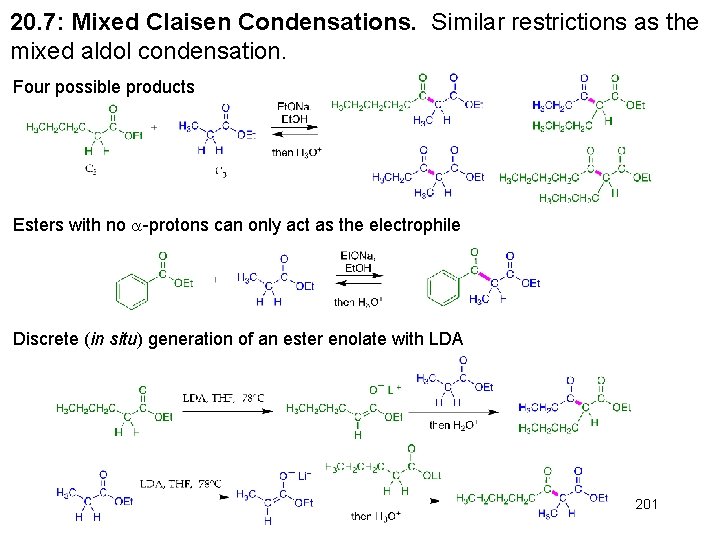
20. 7: Mixed Claisen Condensations. Similar restrictions as the mixed aldol condensation. Four possible products Esters with no -protons can only act as the electrophile Discrete (in situ) generation of an ester enolate with LDA 201
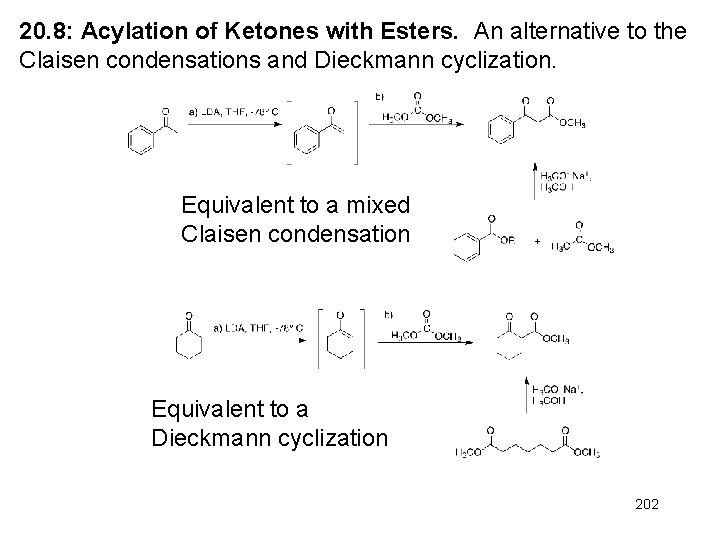
20. 8: Acylation of Ketones with Esters. An alternative to the Claisen condensations and Dieckmann cyclization. Equivalent to a mixed Claisen condensation Equivalent to a Dieckmann cyclization 202
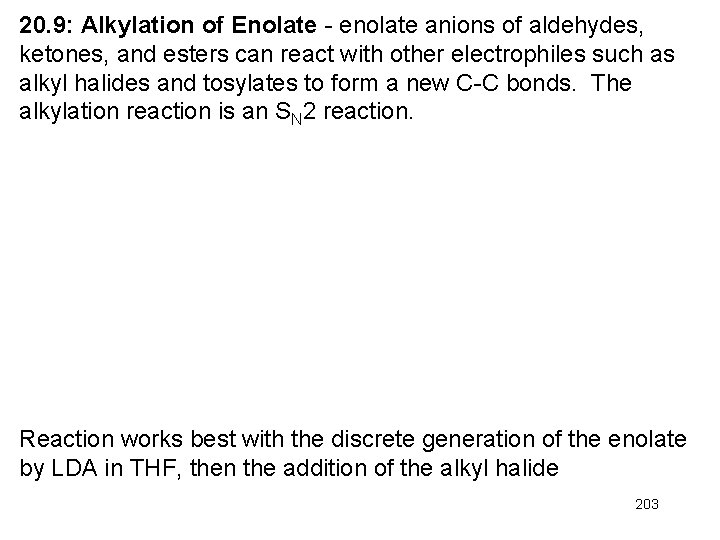
20. 9: Alkylation of Enolate - enolate anions of aldehydes, ketones, and esters can react with other electrophiles such as alkyl halides and tosylates to form a new C-C bonds. The alkylation reaction is an SN 2 reaction. Reaction works best with the discrete generation of the enolate by LDA in THF, then the addition of the alkyl halide 203
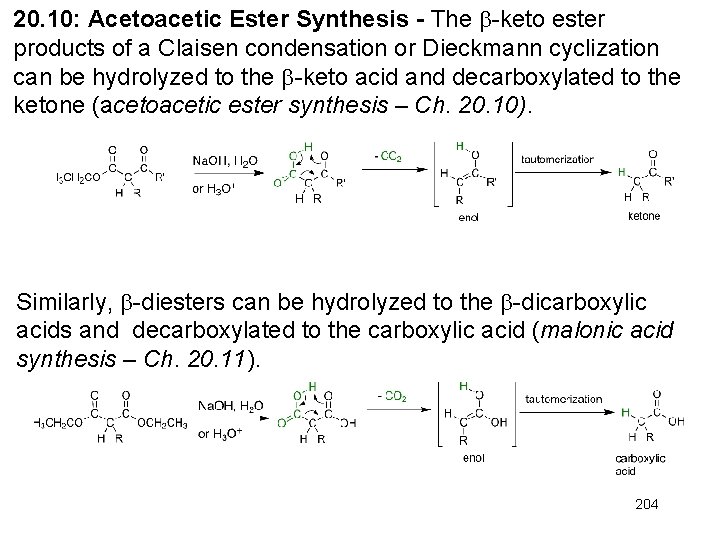
20. 10: Acetoacetic Ester Synthesis - The -keto ester products of a Claisen condensation or Dieckmann cyclization can be hydrolyzed to the -keto acid and decarboxylated to the ketone (acetoacetic ester synthesis – Ch. 20. 10). Similarly, -diesters can be hydrolyzed to the -dicarboxylic acids and decarboxylated to the carboxylic acid (malonic acid synthesis – Ch. 20. 11). 204
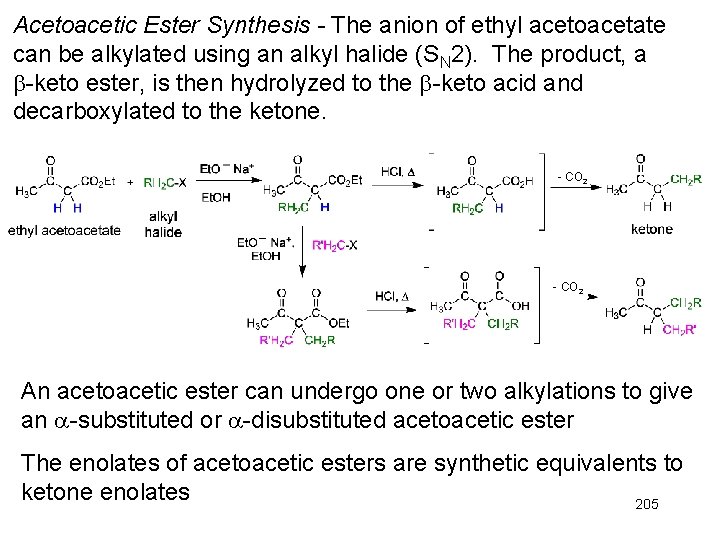
Acetoacetic Ester Synthesis - The anion of ethyl acetoacetate can be alkylated using an alkyl halide (SN 2). The product, a -keto ester, is then hydrolyzed to the -keto acid and decarboxylated to the ketone. - CO 2 _ - CO 2 An acetoacetic ester can undergo one or two alkylations to give an -substituted or -disubstituted acetoacetic ester The enolates of acetoacetic esters are synthetic equivalents to ketone enolates 205
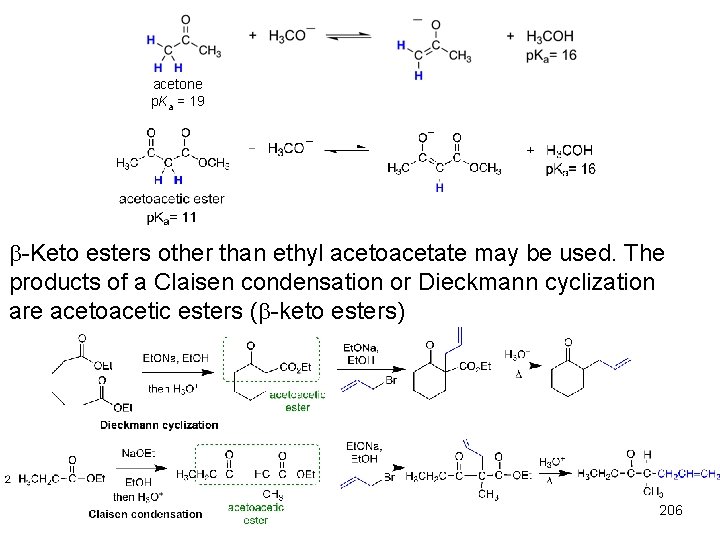
acetone p. Ka = 19 -Keto esters other than ethyl acetoacetate may be used. The products of a Claisen condensation or Dieckmann cyclization are acetoacetic esters ( -keto esters) 206
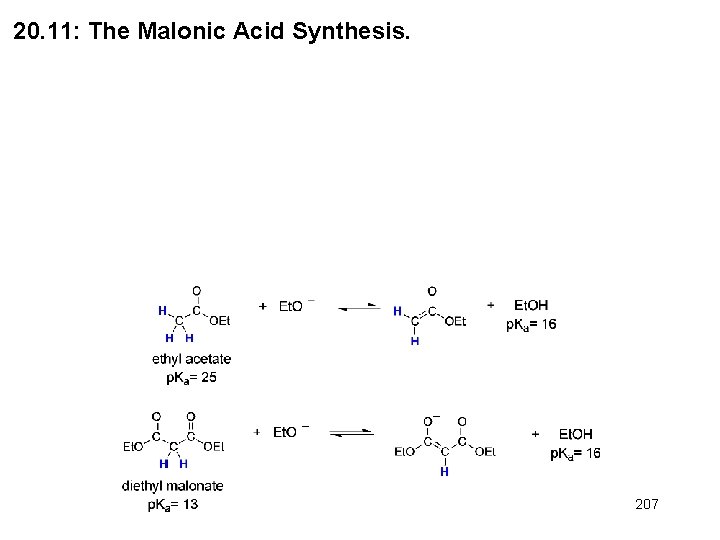
20. 11: The Malonic Acid Synthesis. 207
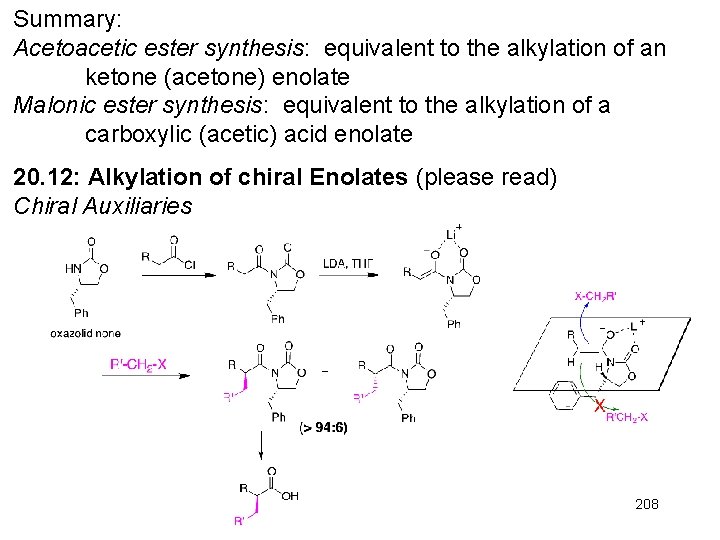
Summary: Acetoacetic ester synthesis: equivalent to the alkylation of an ketone (acetone) enolate Malonic ester synthesis: equivalent to the alkylation of a carboxylic (acetic) acid enolate 20. 12: Alkylation of chiral Enolates (please read) Chiral Auxiliaries 208
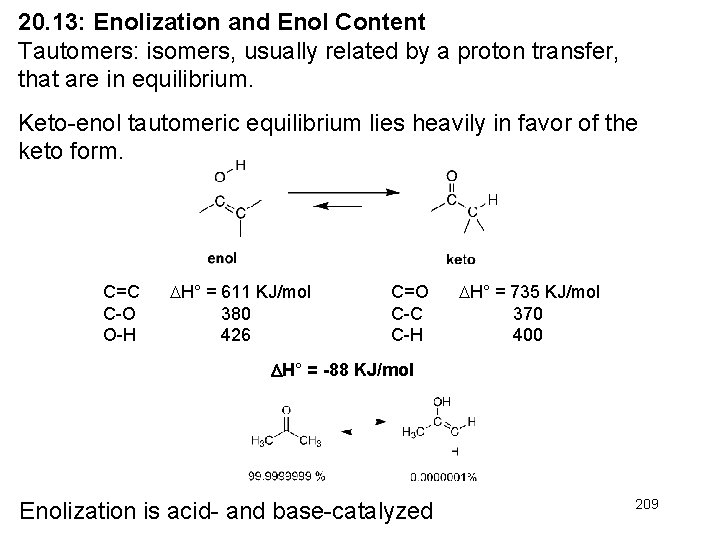
20. 13: Enolization and Enol Content Tautomers: isomers, usually related by a proton transfer, that are in equilibrium. Keto-enol tautomeric equilibrium lies heavily in favor of the keto form. C=C C-O O-H DH° = 611 KJ/mol 380 426 C=O C-C C-H DH° = 735 KJ/mol 370 400 DH° = -88 KJ/mol Enolization is acid- and base-catalyzed 209
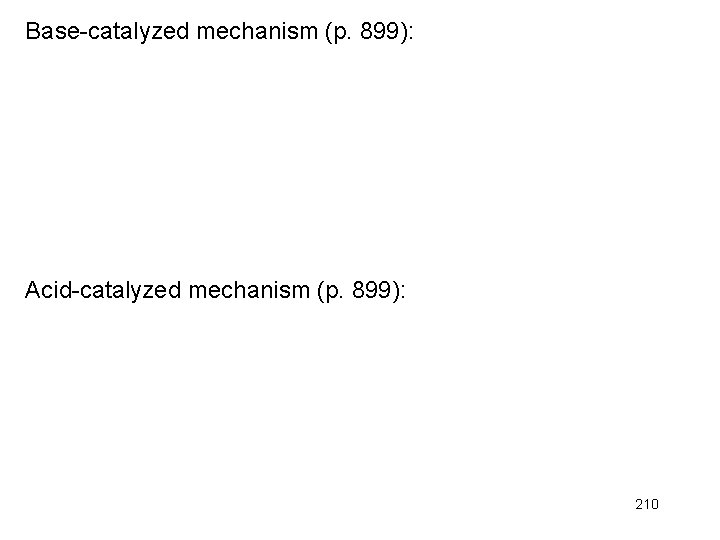
Base-catalyzed mechanism (p. 899): Acid-catalyzed mechanism (p. 899): 210
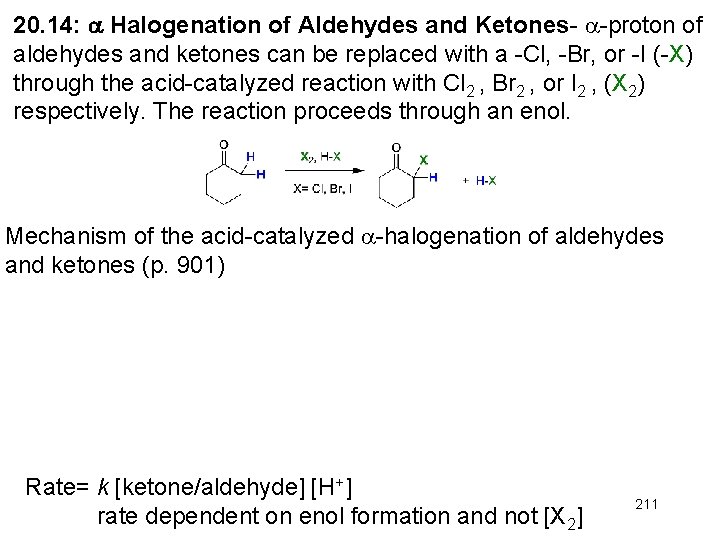
20. 14: Halogenation of Aldehydes and Ketones- -proton of aldehydes and ketones can be replaced with a -Cl, -Br, or -I (-X) through the acid-catalyzed reaction with Cl 2 , Br 2 , or I 2 , (X 2) respectively. The reaction proceeds through an enol. Mechanism of the acid-catalyzed -halogenation of aldehydes and ketones (p. 901) Rate= k [ketone/aldehyde] [H+] rate dependent on enol formation and not [X 2] 211
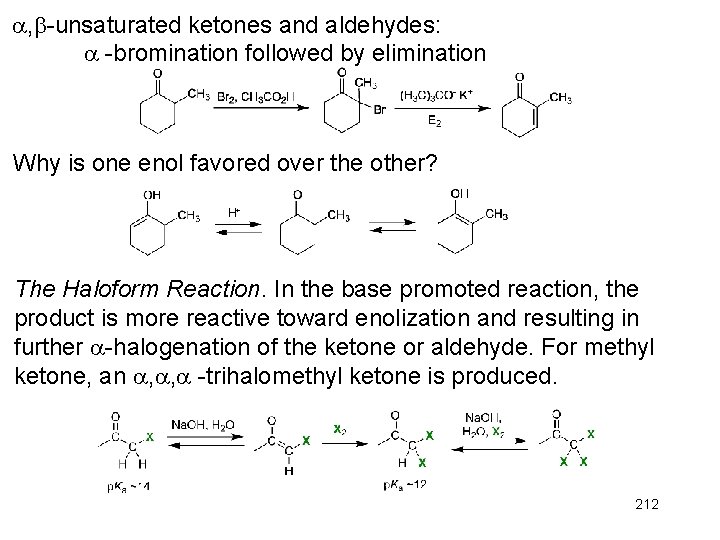
, -unsaturated ketones and aldehydes: -bromination followed by elimination Why is one enol favored over the other? H+ The Haloform Reaction. In the base promoted reaction, the product is more reactive toward enolization and resulting in further -halogenation of the ketone or aldehyde. For methyl ketone, an , , -trihalomethyl ketone is produced. 212
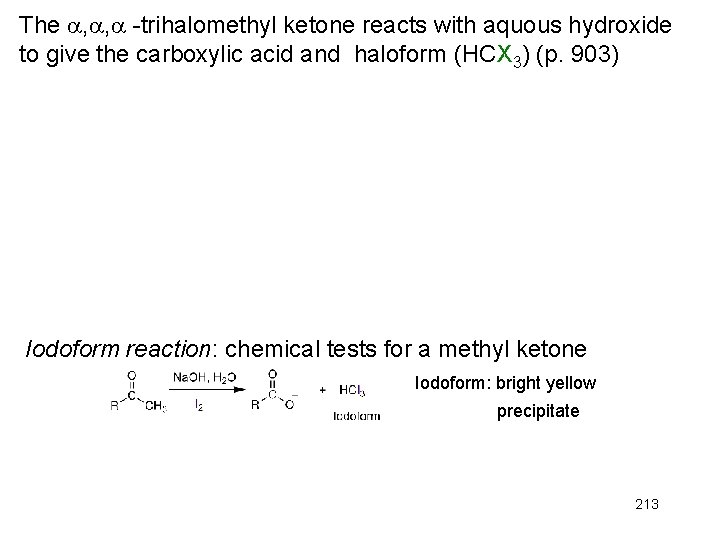
The , , -trihalomethyl ketone reacts with aquous hydroxide to give the carboxylic acid and haloform (HCX 3) (p. 903) Iodoform reaction: chemical tests for a methyl ketone Iodoform: bright yellow precipitate 213
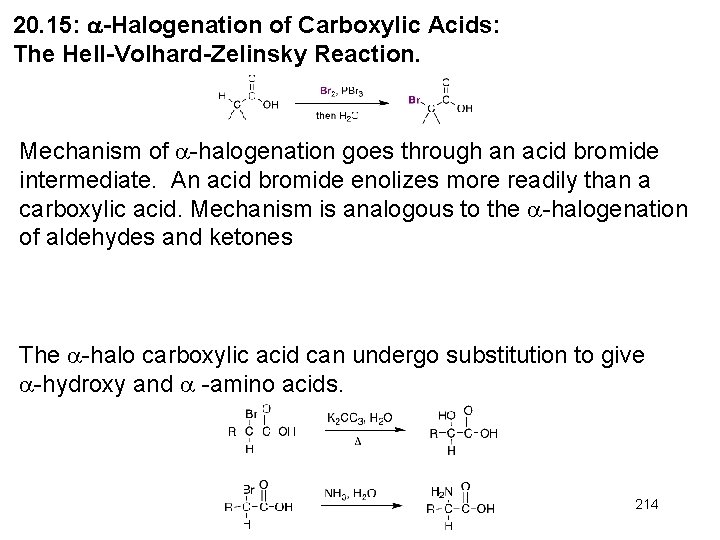
20. 15: -Halogenation of Carboxylic Acids: The Hell-Volhard-Zelinsky Reaction. Mechanism of -halogenation goes through an acid bromide intermediate. An acid bromide enolizes more readily than a carboxylic acid. Mechanism is analogous to the -halogenation of aldehydes and ketones The -halo carboxylic acid can undergo substitution to give -hydroxy and -amino acids. 214
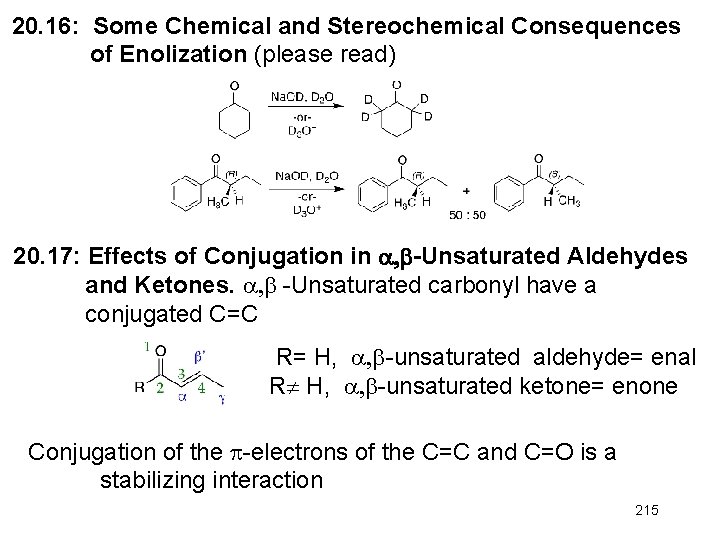
20. 16: Some Chemical and Stereochemical Consequences of Enolization (please read) 20. 17: Effects of Conjugation in -Unsaturated Aldehydes and Ketones. -Unsaturated carbonyl have a conjugated C=C R= H, -unsaturated aldehyde= enal R H, -unsaturated ketone= enone Conjugation of the -electrons of the C=C and C=O is a stabilizing interaction 215
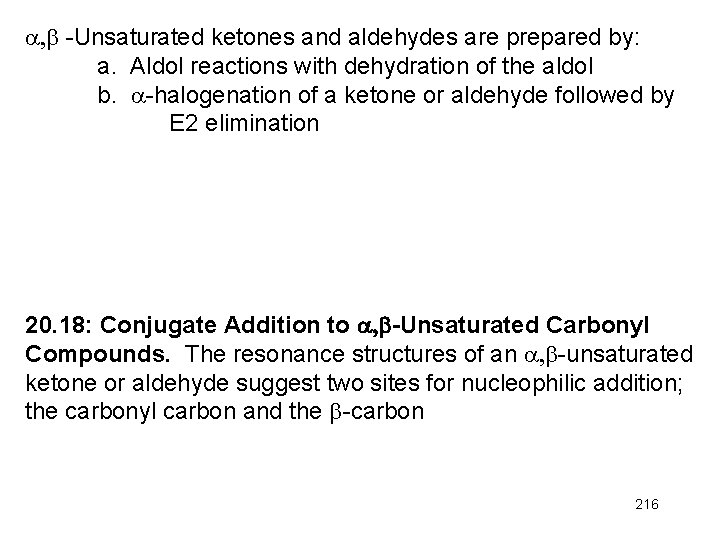
-Unsaturated ketones and aldehydes are prepared by: a. Aldol reactions with dehydration of the aldol b. -halogenation of a ketone or aldehyde followed by E 2 elimination 20. 18: Conjugate Addition to -Unsaturated Carbonyl Compounds. The resonance structures of an -unsaturated ketone or aldehyde suggest two sites for nucleophilic addition; the carbonyl carbon and the -carbon 216
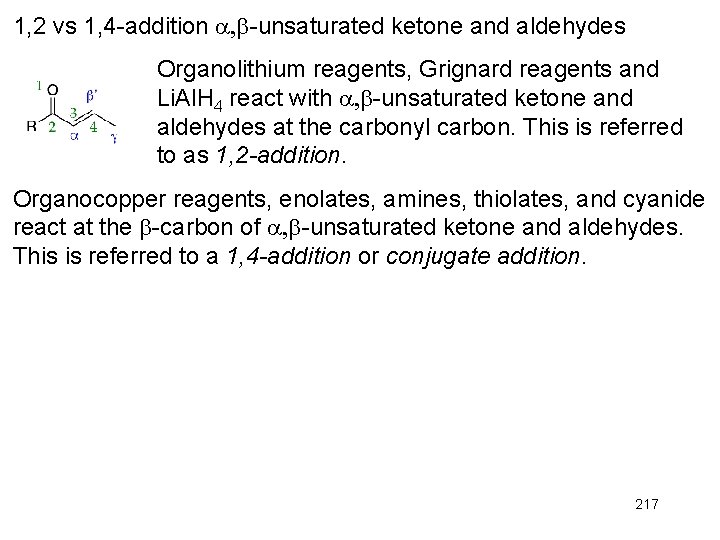
1, 2 vs 1, 4 -addition -unsaturated ketone and aldehydes Organolithium reagents, Grignard reagents and Li. Al. H 4 react with -unsaturated ketone and aldehydes at the carbonyl carbon. This is referred to as 1, 2 -addition. Organocopper reagents, enolates, amines, thiolates, and cyanide react at the -carbon of -unsaturated ketone and aldehydes. This is referred to a 1, 4 -addition or conjugate addition. 217
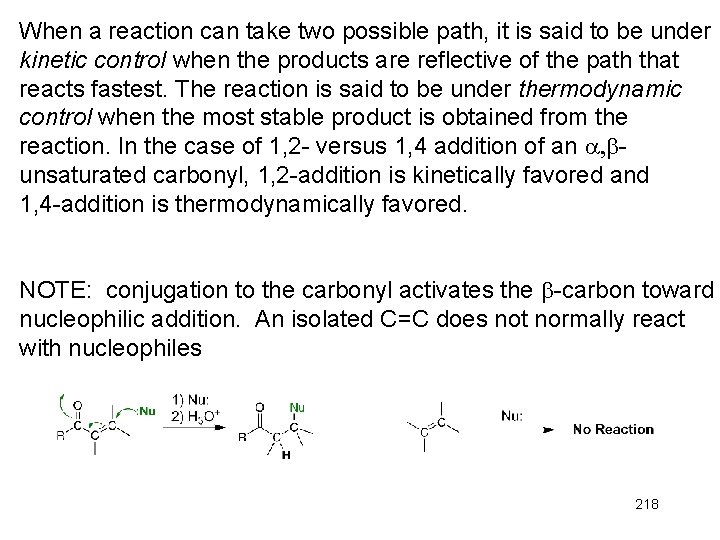
When a reaction can take two possible path, it is said to be under kinetic control when the products are reflective of the path that reacts fastest. The reaction is said to be under thermodynamic control when the most stable product is obtained from the reaction. In the case of 1, 2 - versus 1, 4 addition of an unsaturated carbonyl, 1, 2 -addition is kinetically favored and 1, 4 -addition is thermodynamically favored. NOTE: conjugation to the carbonyl activates the -carbon toward nucleophilic addition. An isolated C=C does not normally react with nucleophiles 218
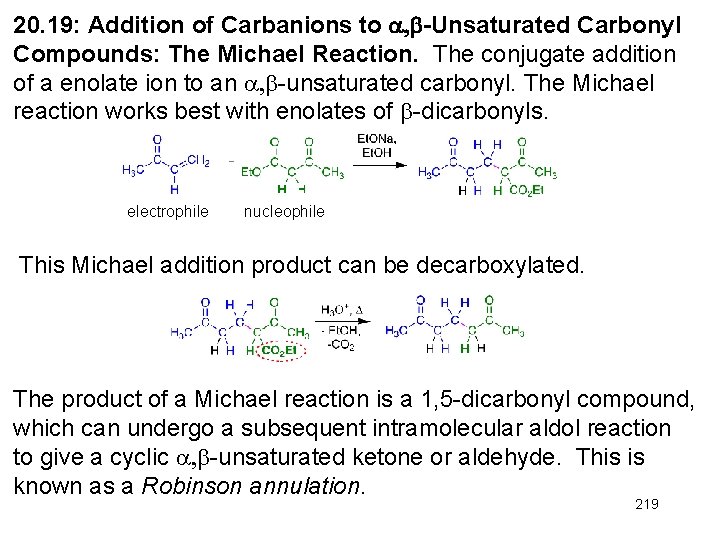
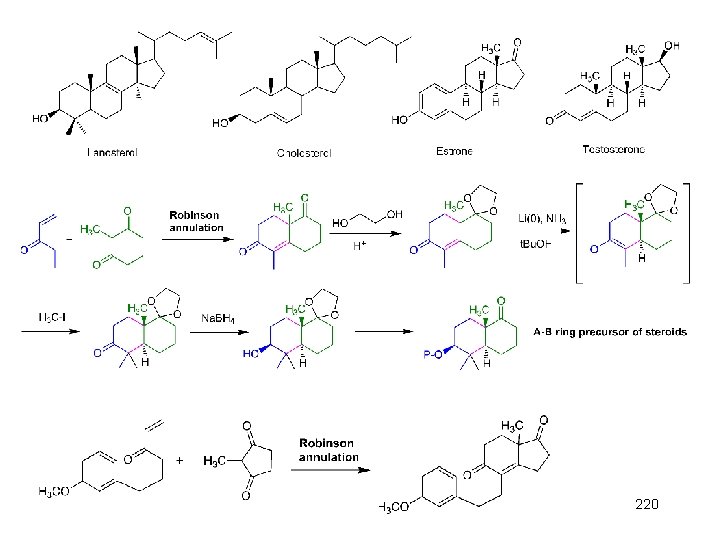
20. 19: Addition of Carbanions to -Unsaturated Carbonyl Compounds: The Michael Reaction. The conjugate addition of a enolate ion to an -unsaturated carbonyl. The Michael reaction works best with enolates of -dicarbonyls. electrophile nucleophile This Michael addition product can be decarboxylated. The product of a Michael reaction is a 1, 5 -dicarbonyl compound, which can undergo a subsequent intramolecular aldol reaction to give a cyclic -unsaturated ketone or aldehyde. This is known as a Robinson annulation. 219
220
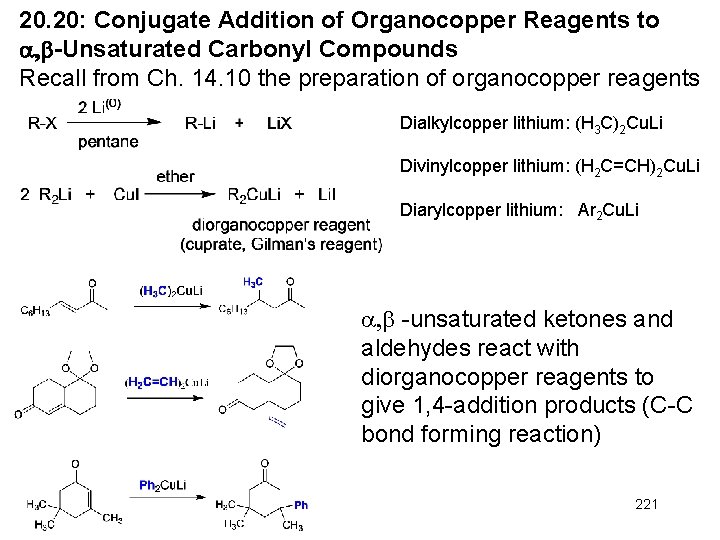
20. 20: Conjugate Addition of Organocopper Reagents to -Unsaturated Carbonyl Compounds Recall from Ch. 14. 10 the preparation of organocopper reagents Dialkylcopper lithium: (H 3 C)2 Cu. Li Divinylcopper lithium: (H 2 C=CH)2 Cu. Li Diarylcopper lithium: Ar 2 Cu. Li -unsaturated ketones and aldehydes react with diorganocopper reagents to give 1, 4 -addition products (C-C bond forming reaction) 221
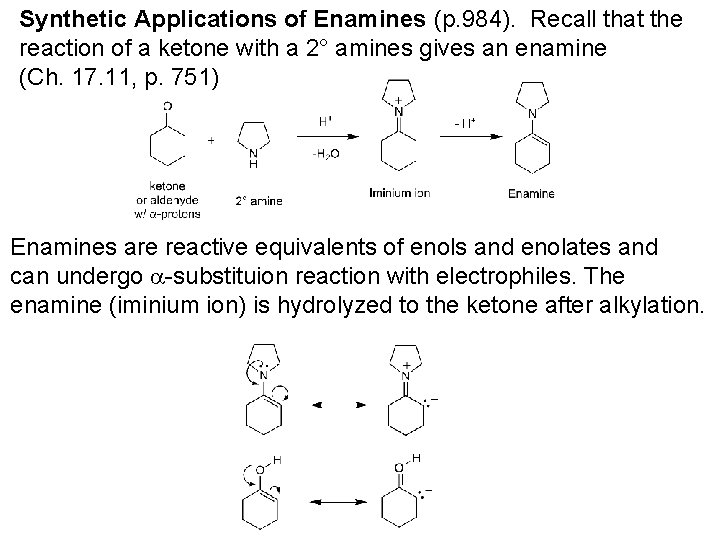
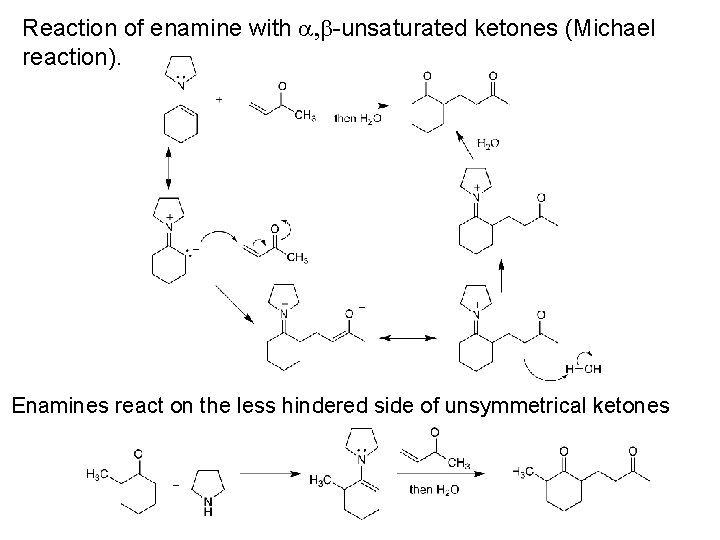
Synthetic Applications of Enamines (p. 984). Recall that the reaction of a ketone with a 2° amines gives an enamine (Ch. 17. 11, p. 751) Enamines are reactive equivalents of enols and enolates and can undergo -substituion reaction with electrophiles. The enamine (iminium ion) is hydrolyzed to the ketone after alkylation.
Reaction of enamine with -unsaturated ketones (Michael reaction). Enamines react on the less hindered side of unsymmetrical ketones
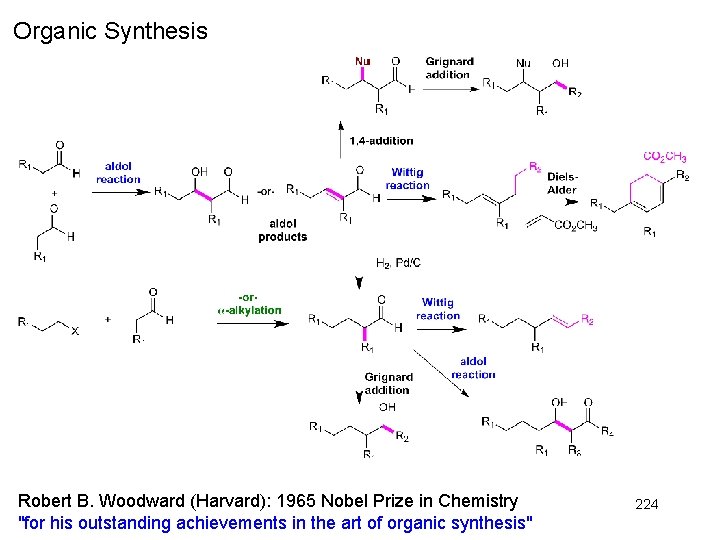
Organic Synthesis Robert B. Woodward (Harvard): 1965 Nobel Prize in Chemistry "for his outstanding achievements in the art of organic synthesis" 224
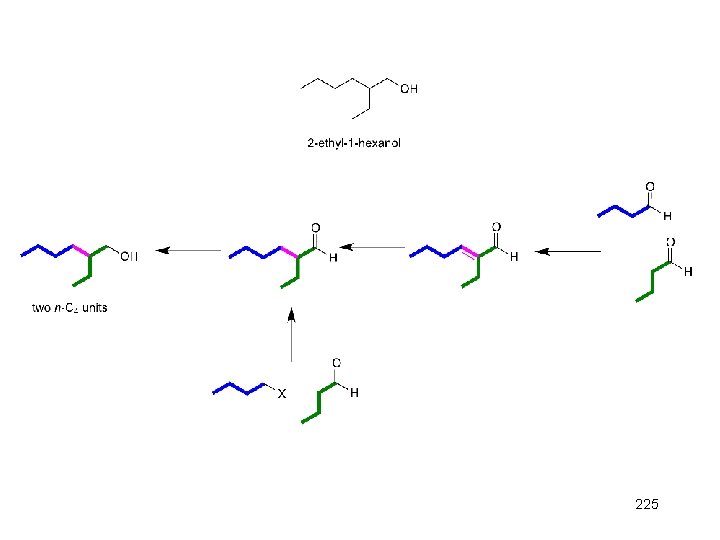
225
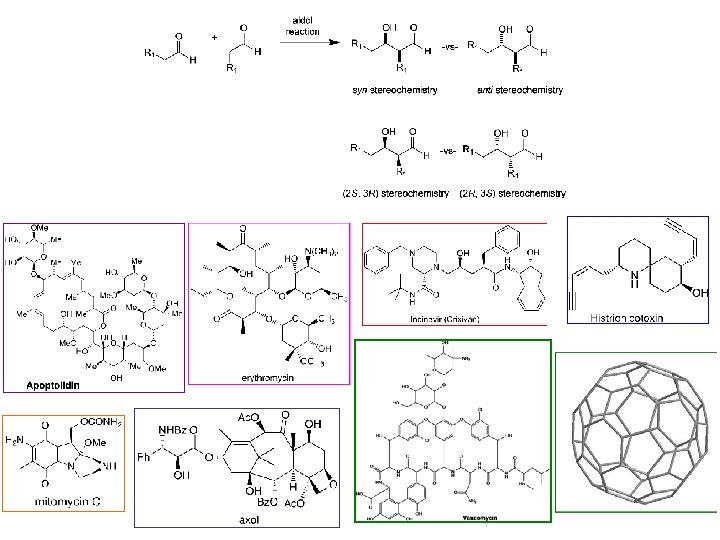
226