
Chapter 20 DNA Technology and Genomics DNA as

- Slides: 23
Chapter 20 DNA Technology and Genomics
DNA as Hereditary Material l So how do we know that DNA is the hereditary material? l From the standpoint of the nature of science, the answer to this question is quite interesting. 2
Determining the Chemical Composition of DNA After Morgan determined that genes were on chromosomes, scientists began wondering what they were made of. • Early on, scientists thought they were made of proteins because they were large and structurally sound. • Nucleic acids were deemed too simple to carry out the complex tasks chromosomes required. •
Determining the Chemical Composition of DNA As scientists continued their experiments with viruses and bacteria, many results were observed that gave support to the notion that DNA was the hereditary material. • A classic experiment demonstrated the genetic role of DNA. •
Frederick Griffith Studied the bacterium that caused pneumonia--S. pneumonia. • Worked with two strains: pathogenic and non-pathogenic. •
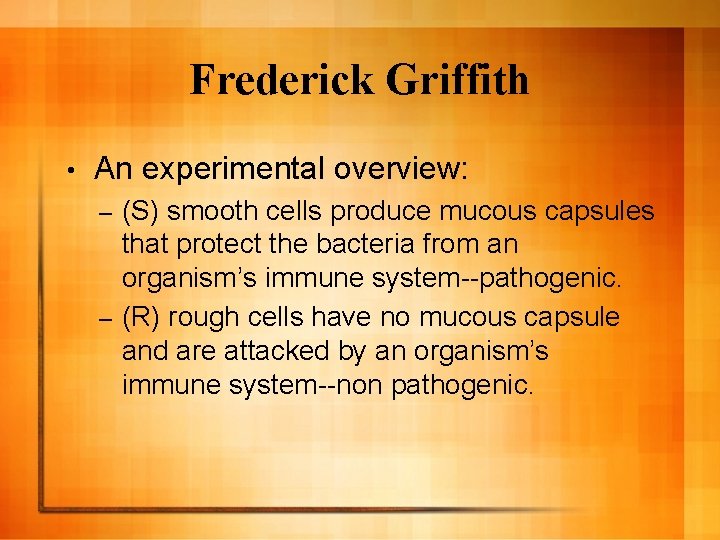
Frederick Griffith • An experimental overview: (S) smooth cells produce mucous capsules that protect the bacteria from an organism’s immune system--pathogenic. – (R) rough cells have no mucous capsule and are attacked by an organism’s immune system--non pathogenic. –
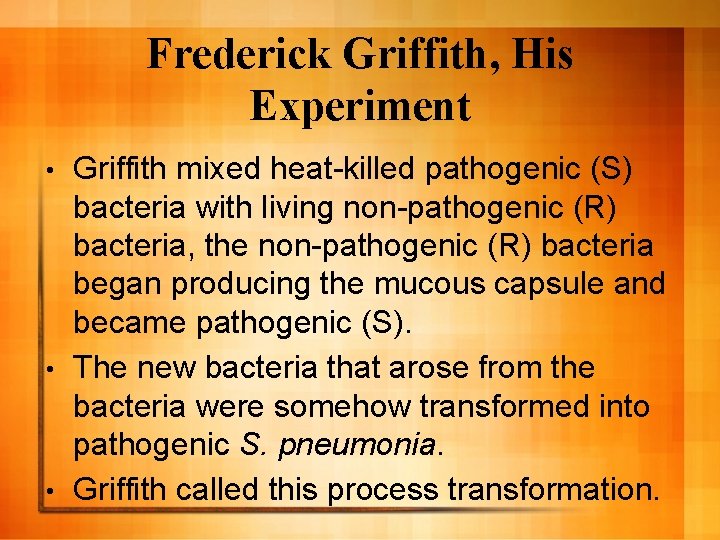
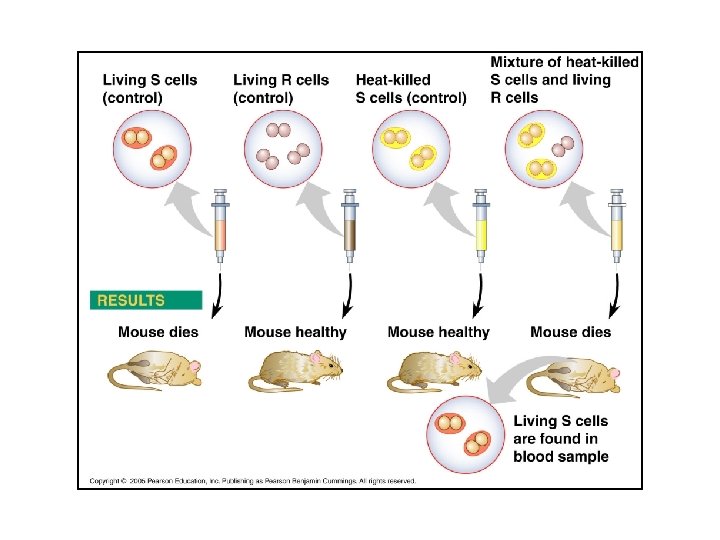
Frederick Griffith, His Experiment Griffith mixed heat-killed pathogenic (S) bacteria with living non-pathogenic (R) bacteria, the non-pathogenic (R) bacteria began producing the mucous capsule and became pathogenic (S). • The new bacteria that arose from the bacteria were somehow transformed into pathogenic S. pneumonia. • Griffith called this process transformation. •
Griffith’s Transformation Experiment • This experiment did not identify DNA as the transforming factor, but it set the stage for other experiments.
Oswaldt Avery worked for about 10 years trying to identify the transforming factor. • After isolating and purifying numerous macromolecules from the heat killed pathogenic bacteria he and his colleagues could only get DNA to work. • The prevailing beliefs about proteins vs. DNA continued to generate skepticism. •
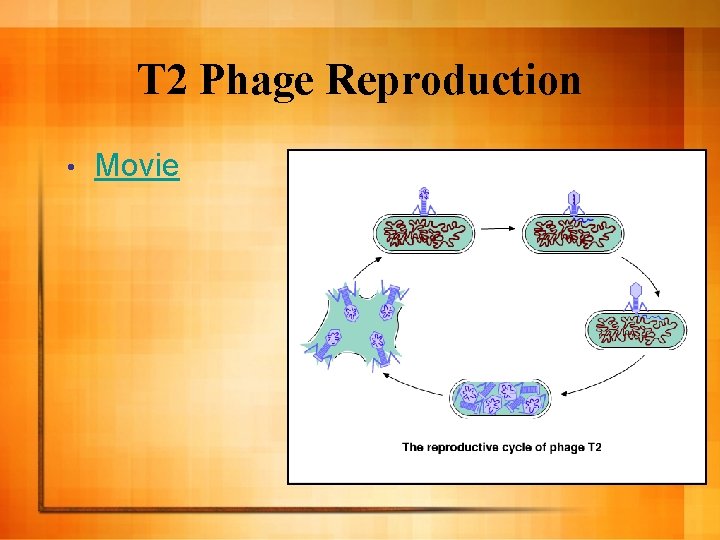
T 2 Phage Reproduction • Movie
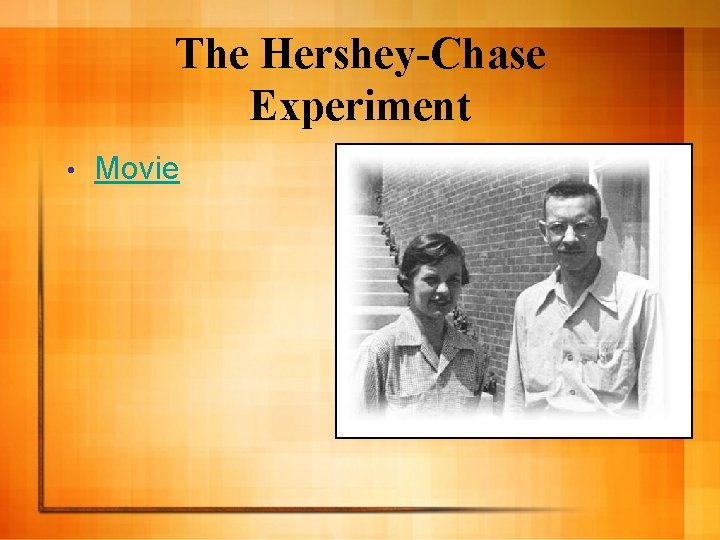
The Hershey-Chase Experiment In 1952, Alfred Hershey and Martha Chase performed experiments with viruses showing that DNA is genetic material. • Viruses (aka phages) are DNA or RNA wrapped in a protein. • E. coli is a bacteria that is often used in experiments. •
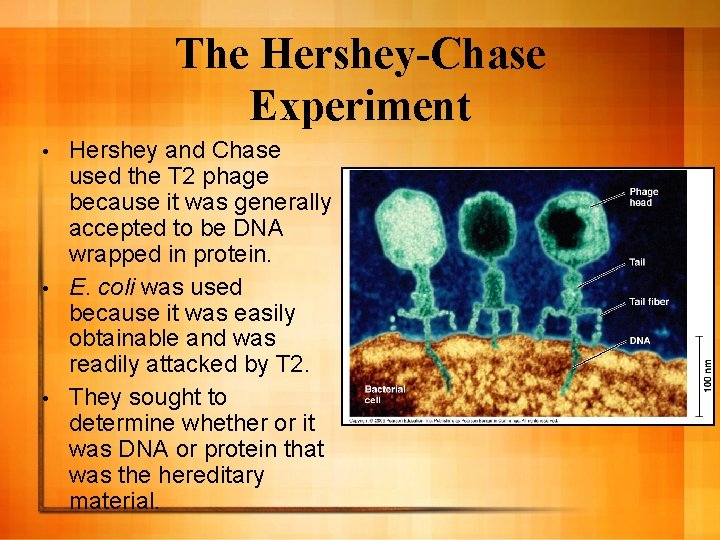
The Hershey-Chase Experiment Hershey and Chase used the T 2 phage because it was generally accepted to be DNA wrapped in protein. • E. coli was used because it was easily obtainable and was readily attacked by T 2. • They sought to determine whether or it was DNA or protein that was the hereditary material. •
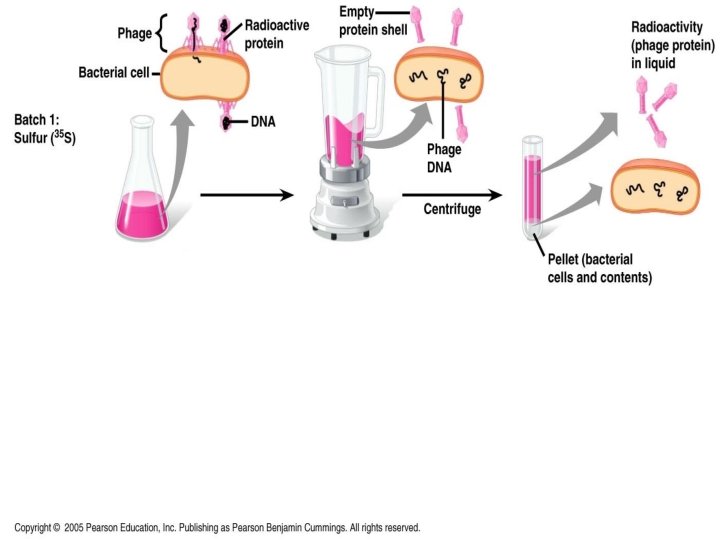
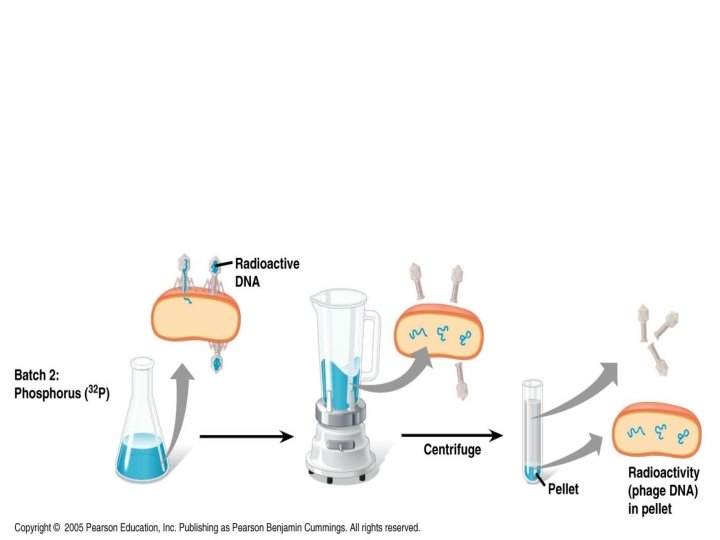
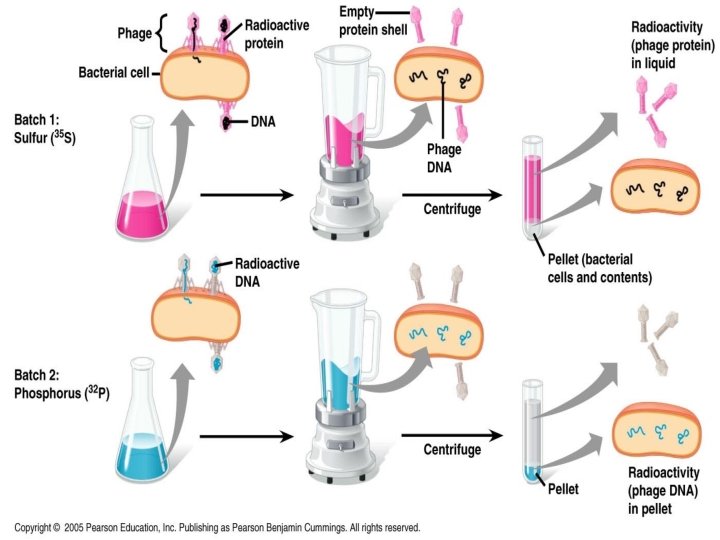
The Hershey-Chase Experiment Their experiment demonstrated which part of the T 2 entered the E. coli. • They grew T 2 in the presence of radioactive sulfur--proteins contain sulfur, DNA does not. • Next, they grew the T 2 in a separate batch of radioactive phosphorous. The DNA of T 2 contains phosphorous--the proteins do not. •
The Hershey-Chase Experiment The scientists now had 2 batches of T 2, one labeled with radioactive sulfur and one labeled with radioactive phosphorous. • These 2 batches were separately incubated with non-radioactive samples of E. coli and analyzed shortly after infection. •
The Hershey-Chase Experiment Shortly after infection, the E. coli samples were spun in a blender to knock off loose parts of T 2. • The mixtures were then spun in high speed centrifuges for a long time to separate out various parts of the mixture. • At the bottom of the tube was a pellet of E. coli. •
The Hershey-Chase Experiment The pellet was examined for radioactivity and radioactive phosphorous was found. • The supernatant was analyzed and a lot of radioactive sulfur was found, but no radioactive phosphorous. • This indicates that the DNA got into the E. coli and was in the pellet • The protein did not get into the bacteria and was left in the supernatant. •
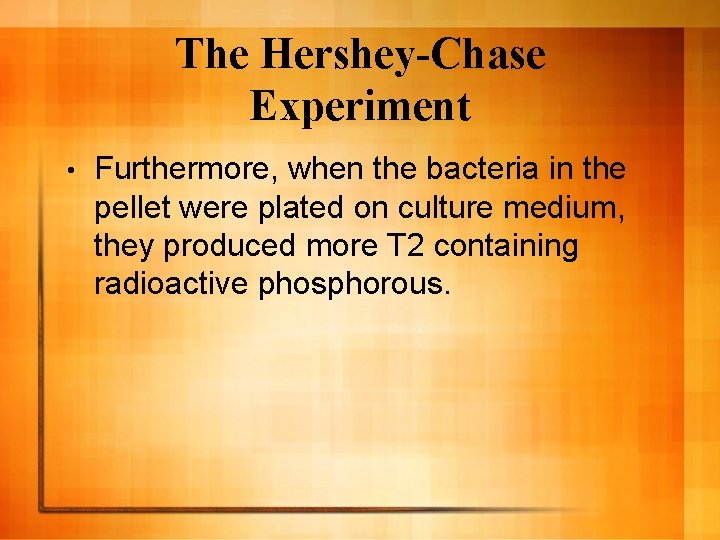
The Hershey-Chase Experiment • Furthermore, when the bacteria in the pellet were plated on culture medium, they produced more T 2 containing radioactive phosphorous.
The Hershey-Chase Experiment • They concluded: That the virus injects DNA into the E. coli and it is the genetic material that programs the cells to produce new T 2 phages. • The protein stays outside. • • This experiment provided firm evidence that DNA was the hereditary material and not protein.
The Hershey-Chase Experiment • Movie