
Chapter 20 Conjugated Systems 20 1 Conjugated Dienes
- Slides: 32
Chapter 20 Conjugated Systems 20 -1
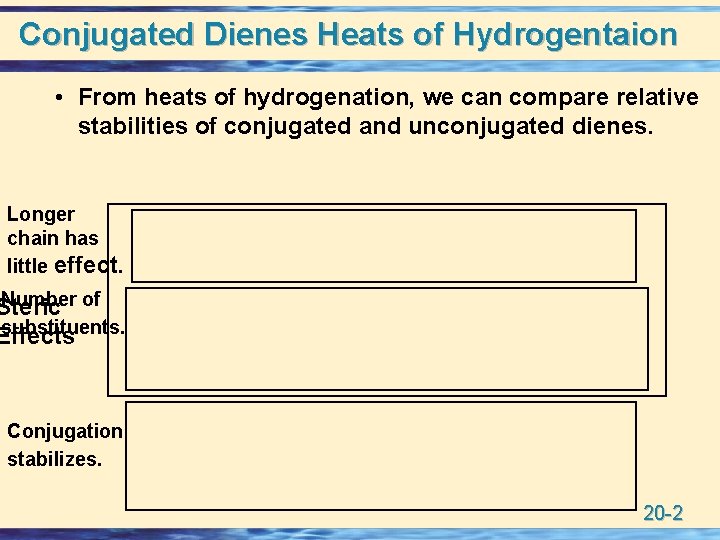
Conjugated Dienes Heats of Hydrogentaion • From heats of hydrogenation, we can compare relative stabilities of conjugated and unconjugated dienes. Longer chain has little effect. Number of Steric substituents. Effects Conjugation stabilizes. 20 -2
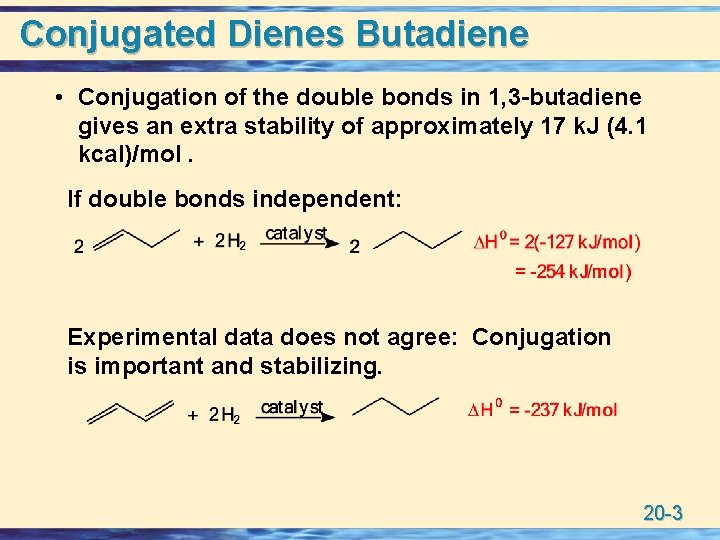
Conjugated Dienes Butadiene • Conjugation of the double bonds in 1, 3 -butadiene gives an extra stability of approximately 17 k. J (4. 1 kcal)/mol. If double bonds independent: Experimental data does not agree: Conjugation is important and stabilizing. 20 -3
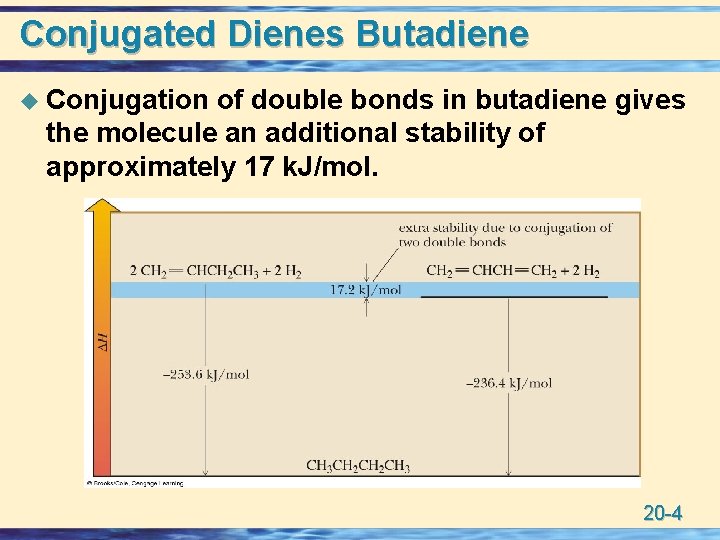
Conjugated Dienes Butadiene u Conjugation of double bonds in butadiene gives the molecule an additional stability of approximately 17 k. J/mol. 20 -4
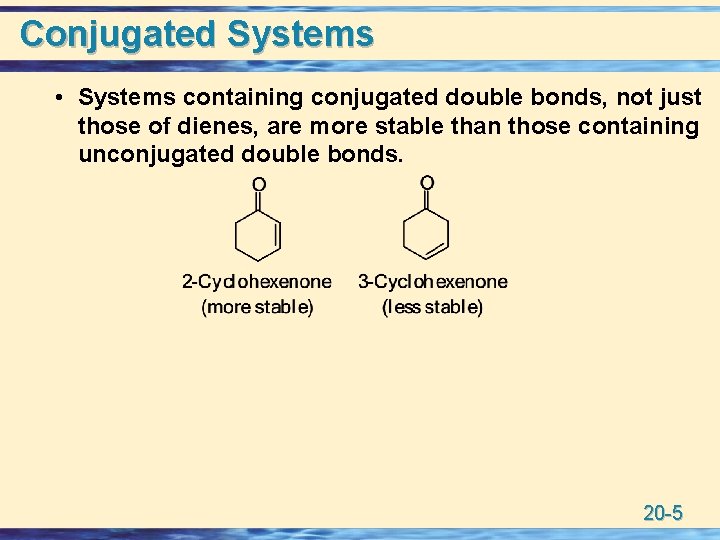
Conjugated Systems • Systems containing conjugated double bonds, not just those of dienes, are more stable than those containing unconjugated double bonds. 20 -5
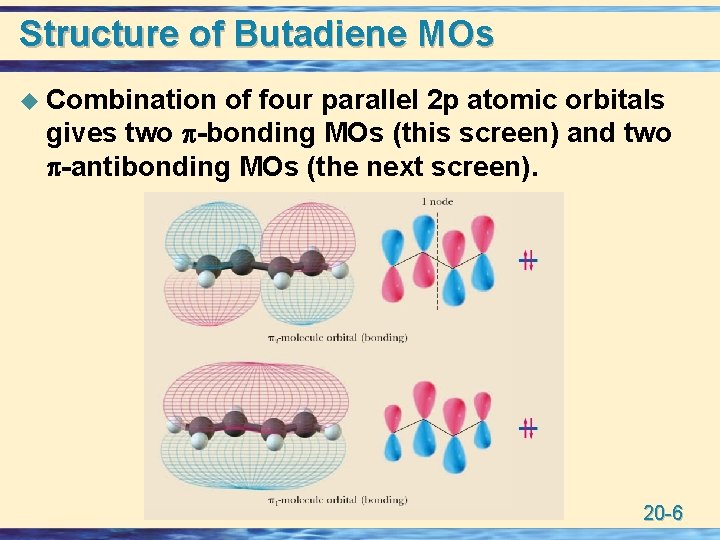
Structure of Butadiene MOs u Combination of four parallel 2 p atomic orbitals gives two p-bonding MOs (this screen) and two p-antibonding MOs (the next screen). 20 -6
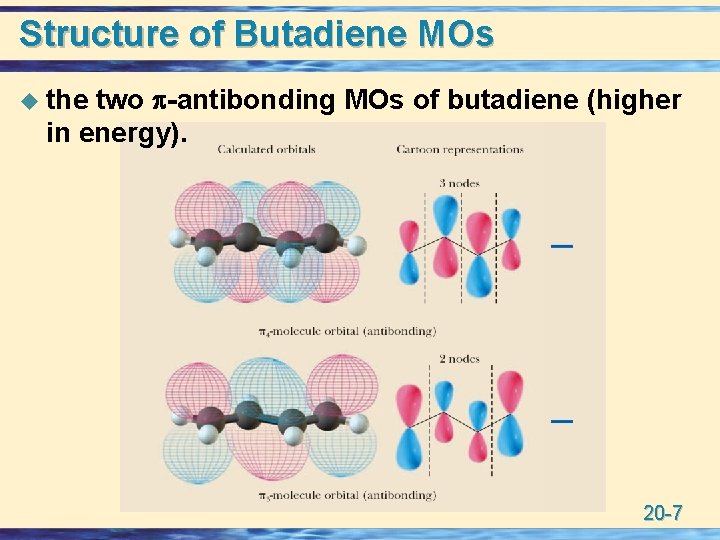
Structure of Butadiene MOs two p-antibonding MOs of butadiene (higher in energy). u the 20 -7
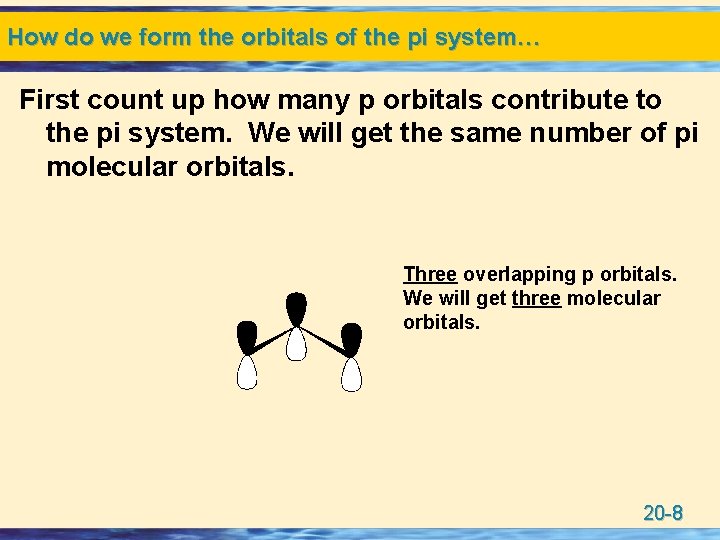
How do we form the orbitals of the pi system… First count up how many p orbitals contribute to the pi system. We will get the same number of pi molecular orbitals. Three overlapping p orbitals. We will get three molecular orbitals. 20 -8
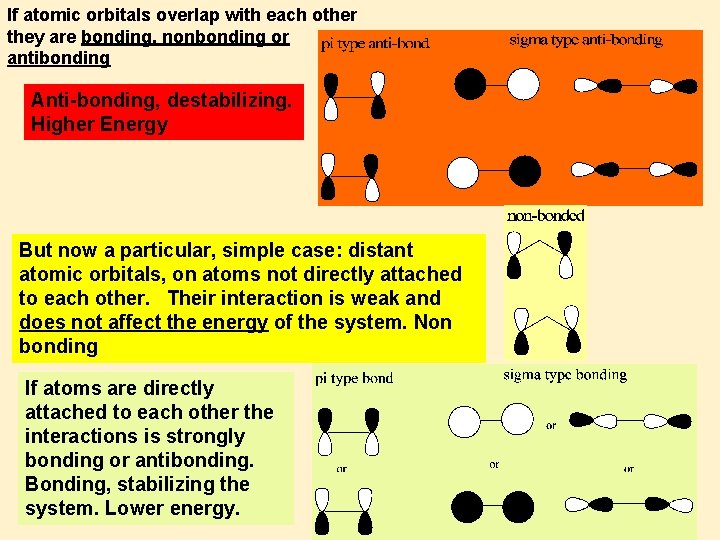
If atomic orbitals overlap with each other they are bonding, nonbonding or antibonding Anti-bonding, destabilizing. Higher Energy But now a particular, simple case: distant atomic orbitals, on atoms not directly attached to each other. Their interaction is weak and does not affect the energy of the system. Non bonding If atoms are directly attached to each other the interactions is strongly bonding or antibonding. Bonding, stabilizing the system. Lower energy.
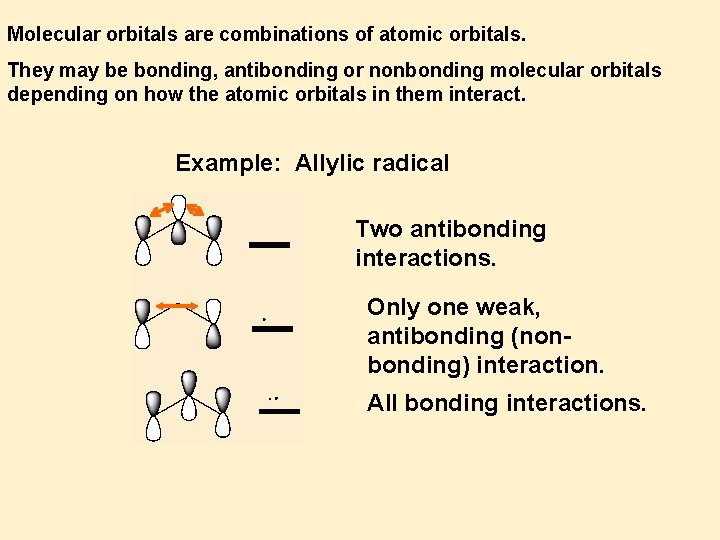
Molecular orbitals are combinations of atomic orbitals. They may be bonding, antibonding or nonbonding molecular orbitals depending on how the atomic orbitals in them interact. Example: Allylic radical Two antibonding interactions. Only one weak, antibonding (nonbonding) interaction. All bonding interactions.
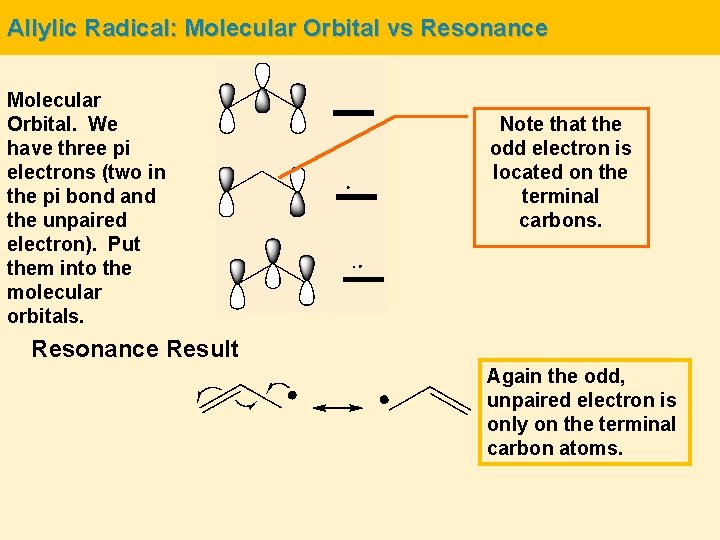
Allylic Radical: Molecular Orbital vs Resonance Molecular Orbital. We have three pi electrons (two in the pi bond and the unpaired electron). Put them into the molecular orbitals. Note that the odd electron is located on the terminal carbons. Resonance Result Again the odd, unpaired electron is only on the terminal carbon atoms.
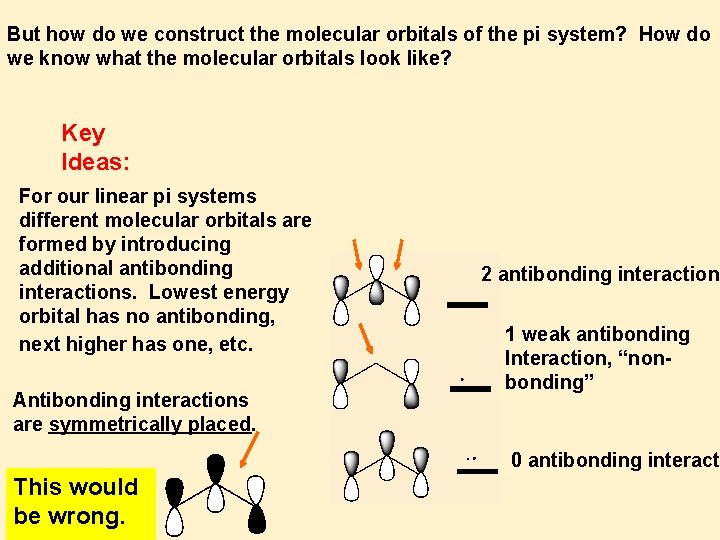
But how do we construct the molecular orbitals of the pi system? How do we know what the molecular orbitals look like? Key Ideas: For our linear pi systems different molecular orbitals are formed by introducing additional antibonding interactions. Lowest energy orbital has no antibonding, next higher has one, etc. Antibonding interactions are symmetrically placed. 2 antibonding interactions 1 weak antibonding Interaction, “nonbonding” 0 antibonding interacti This would be wrong.
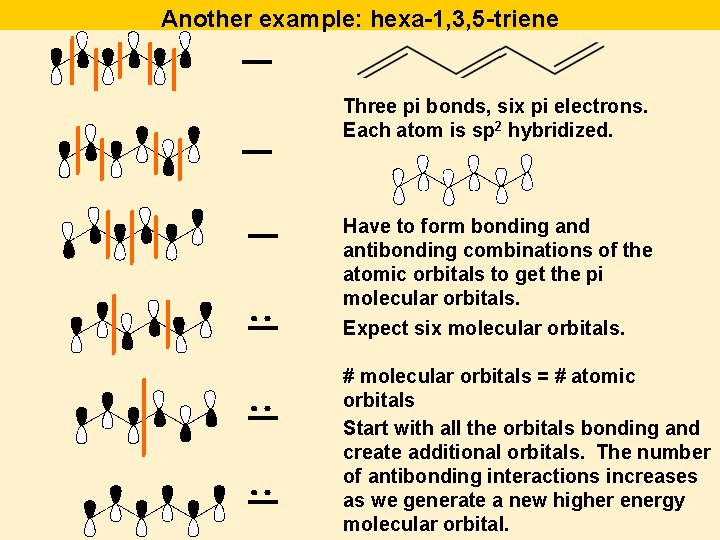
Another example: hexa-1, 3, 5 -triene Three pi bonds, six pi electrons. Each atom is sp 2 hybridized. Have to form bonding and antibonding combinations of the atomic orbitals to get the pi molecular orbitals. Expect six molecular orbitals. # molecular orbitals = # atomic orbitals Start with all the orbitals bonding and create additional orbitals. The number of antibonding interactions increases as we generate a new higher energy molecular orbital.
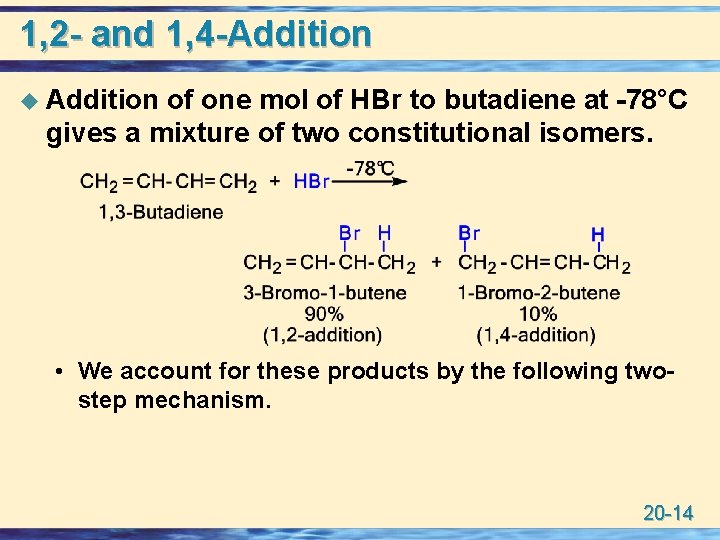
1, 2 - and 1, 4 -Addition u Addition of one mol of HBr to butadiene at -78°C gives a mixture of two constitutional isomers. • We account for these products by the following twostep mechanism. 20 -14
1, 2 - and 1, 4 -Addition • The key intermediate is a resonance-stabilized allylic carbocation. 20 -15
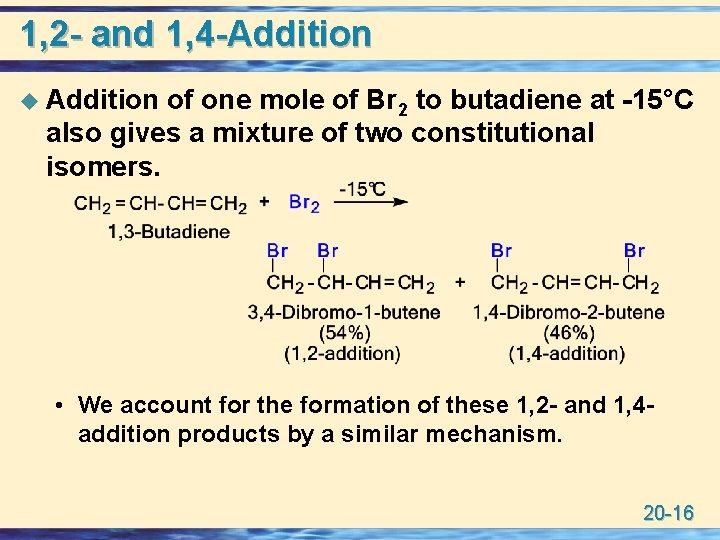
1, 2 - and 1, 4 -Addition u Addition of one mole of Br 2 to butadiene at -15°C also gives a mixture of two constitutional isomers. • We account for the formation of these 1, 2 - and 1, 4 addition products by a similar mechanism. 20 -16
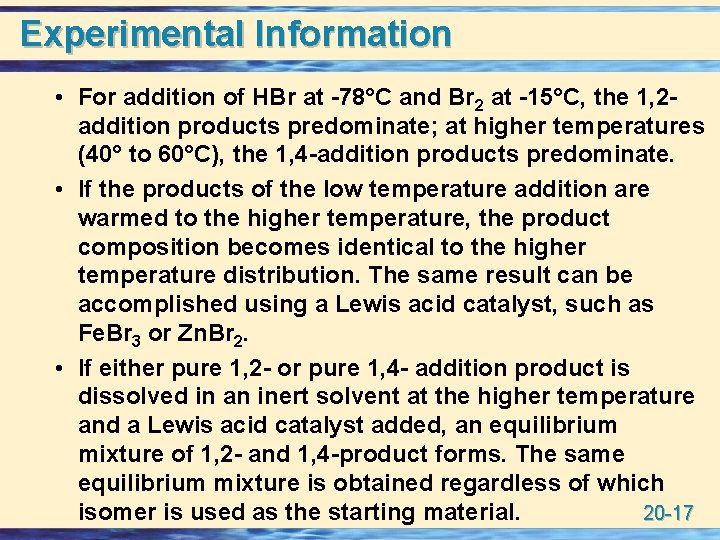
Experimental Information • For addition of HBr at -78°C and Br 2 at -15°C, the 1, 2 addition products predominate; at higher temperatures (40° to 60°C), the 1, 4 -addition products predominate. • If the products of the low temperature addition are warmed to the higher temperature, the product composition becomes identical to the higher temperature distribution. The same result can be accomplished using a Lewis acid catalyst, such as Fe. Br 3 or Zn. Br 2. • If either pure 1, 2 - or pure 1, 4 - addition product is dissolved in an inert solvent at the higher temperature and a Lewis acid catalyst added, an equilibrium mixture of 1, 2 - and 1, 4 -product forms. The same equilibrium mixture is obtained regardless of which isomer is used as the starting material. 20 -17
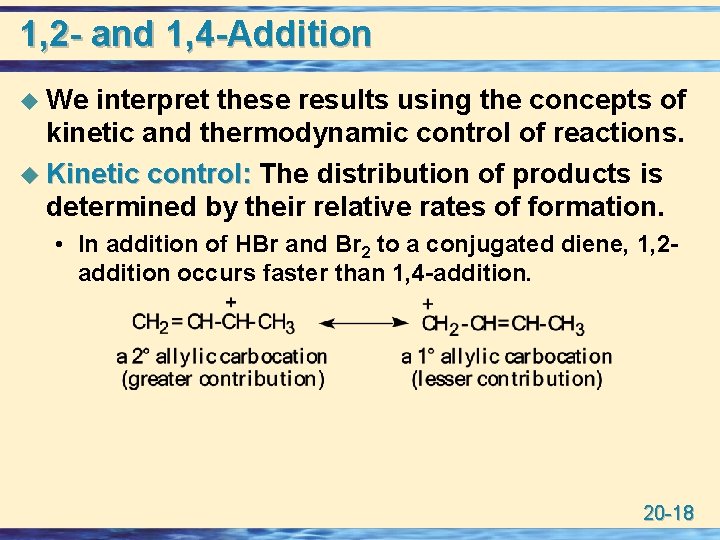
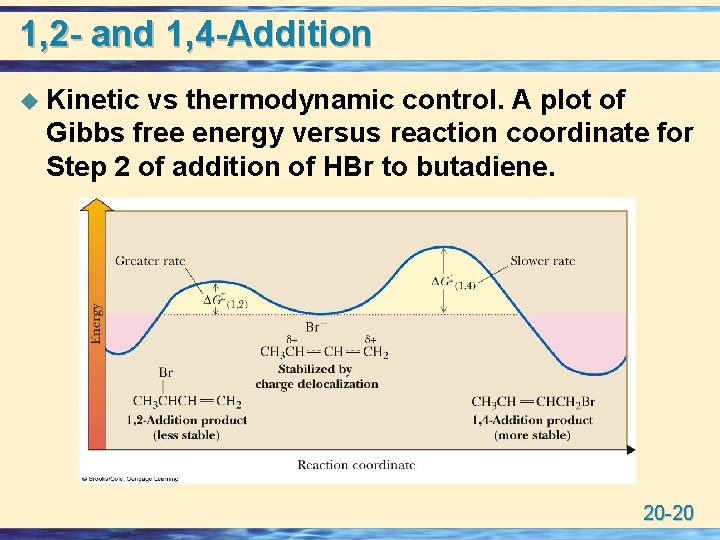
1, 2 - and 1, 4 -Addition u We interpret these results using the concepts of kinetic and thermodynamic control of reactions. u Kinetic control: The distribution of products is determined by their relative rates of formation. • In addition of HBr and Br 2 to a conjugated diene, 1, 2 addition occurs faster than 1, 4 -addition. 20 -18
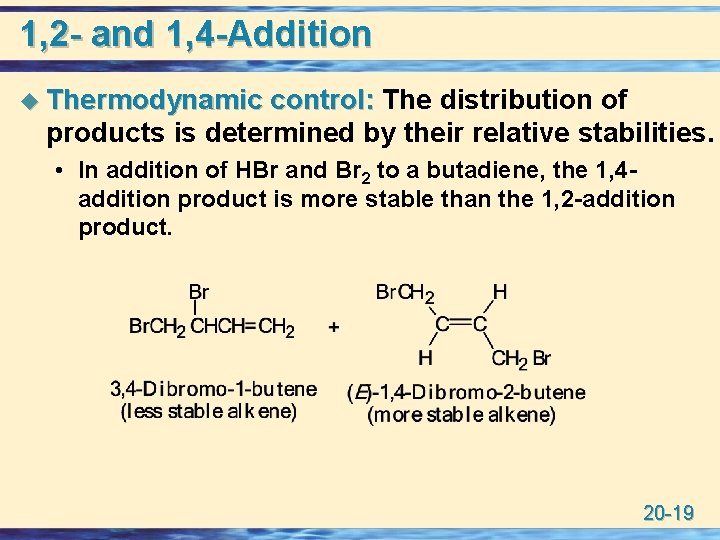
1, 2 - and 1, 4 -Addition u Thermodynamic control: The distribution of products is determined by their relative stabilities. • In addition of HBr and Br 2 to a butadiene, the 1, 4 addition product is more stable than the 1, 2 -addition product. 20 -19
1, 2 - and 1, 4 -Addition u Kinetic vs thermodynamic control. A plot of Gibbs free energy versus reaction coordinate for Step 2 of addition of HBr to butadiene. 20 -20
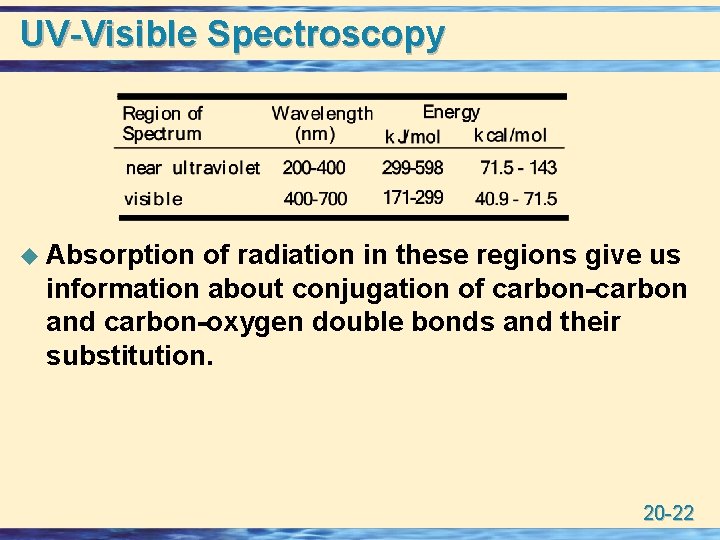
UV-Visible Spectroscopy u Absorption of radiation in these regions give us information about conjugation of carbon-carbon and carbon-oxygen double bonds and their substitution. 20 -22
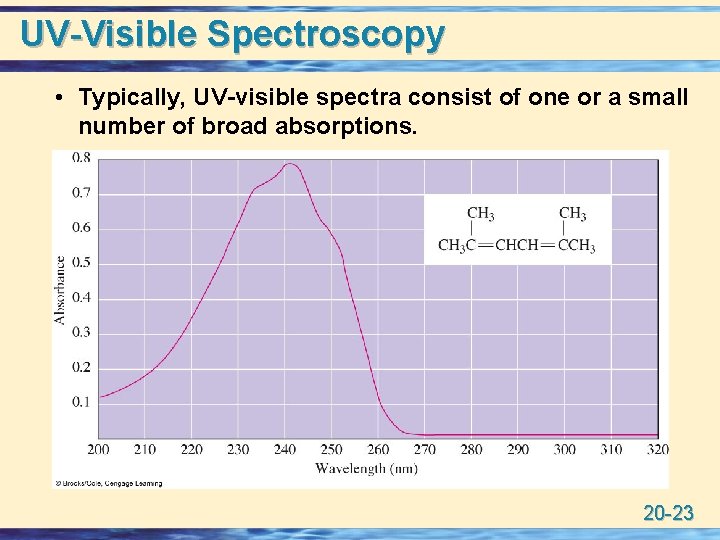
UV-Visible Spectroscopy • Typically, UV-visible spectra consist of one or a small number of broad absorptions. 20 -23
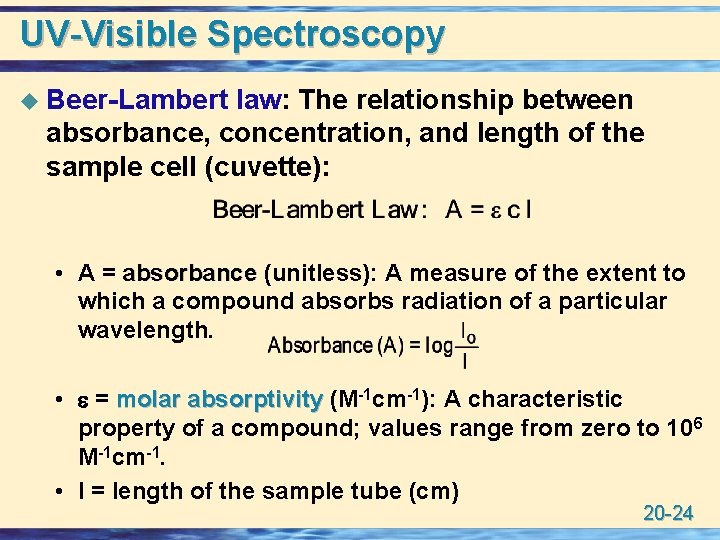
UV-Visible Spectroscopy u Beer-Lambert law: The relationship between absorbance, concentration, and length of the sample cell (cuvette): • A = absorbance (unitless): A measure of the extent to which a compound absorbs radiation of a particular wavelength. • e = molar absorptivity (M-1 cm-1): A characteristic property of a compound; values range from zero to 106 M-1 cm-1. • I = length of the sample tube (cm) 20 -24
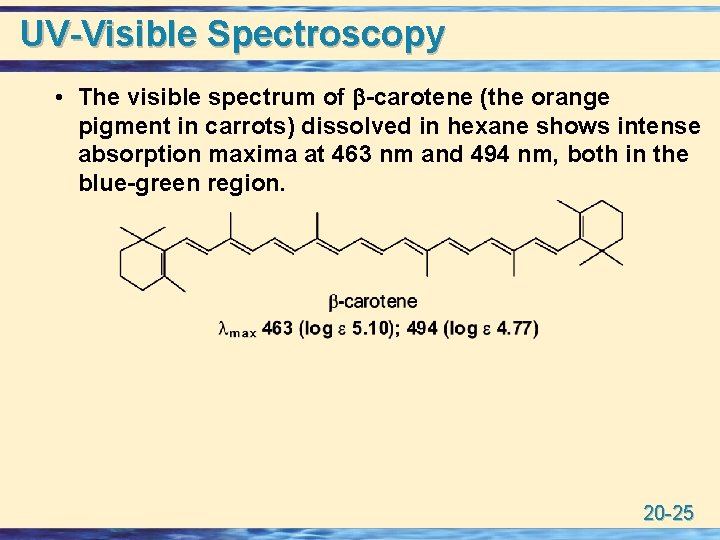
UV-Visible Spectroscopy • The visible spectrum of b-carotene (the orange pigment in carrots) dissolved in hexane shows intense absorption maxima at 463 nm and 494 nm, both in the blue-green region. 20 -25
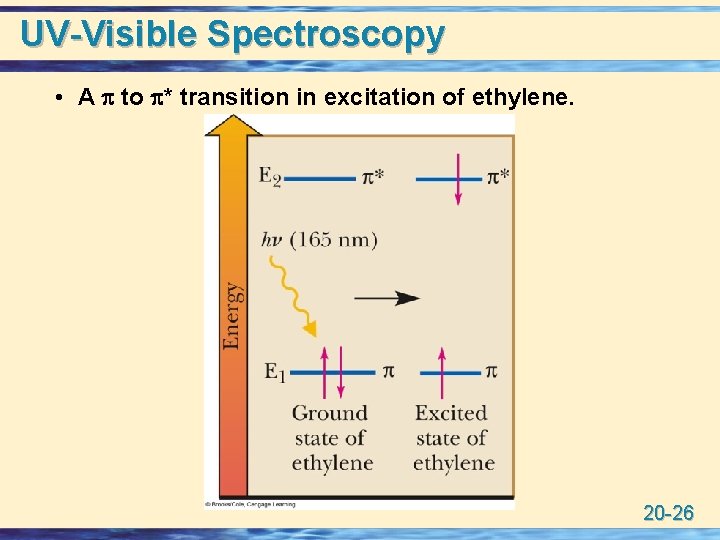
UV-Visible Spectroscopy • A p to p* transition in excitation of ethylene. 20 -26
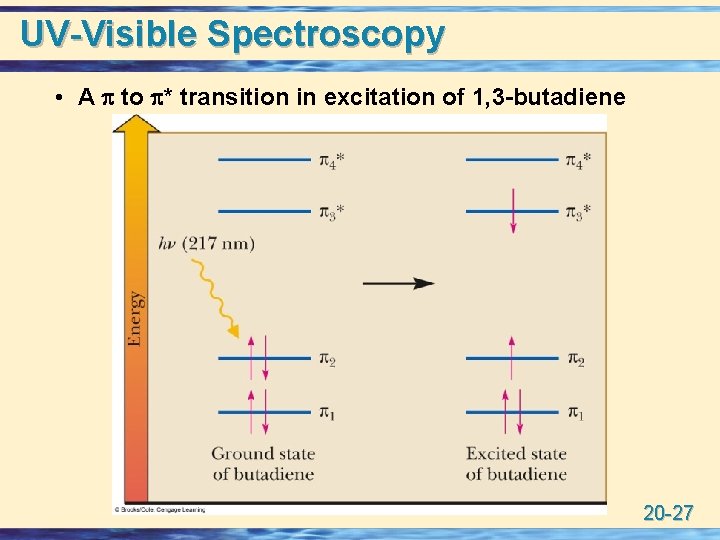
UV-Visible Spectroscopy • A p to p* transition in excitation of 1, 3 -butadiene 20 -27
UV-Visible Spectroscopy • Wavelengths and energies required for p to p* transitions of ethylene and three conjugated polyenes 20 -28
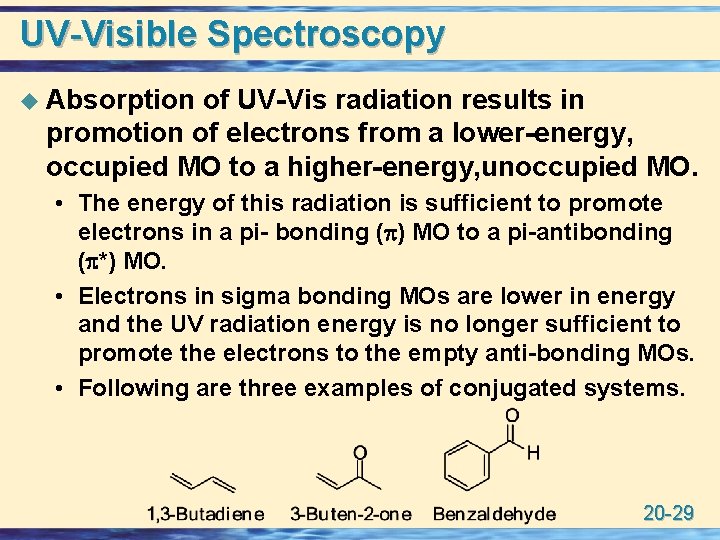
UV-Visible Spectroscopy u Absorption of UV-Vis radiation results in promotion of electrons from a lower-energy, occupied MO to a higher-energy, unoccupied MO. • The energy of this radiation is sufficient to promote electrons in a pi- bonding (p) MO to a pi-antibonding (p*) MO. • Electrons in sigma bonding MOs are lower in energy and the UV radiation energy is no longer sufficient to promote the electrons to the empty anti-bonding MOs. • Following are three examples of conjugated systems. 20 -29
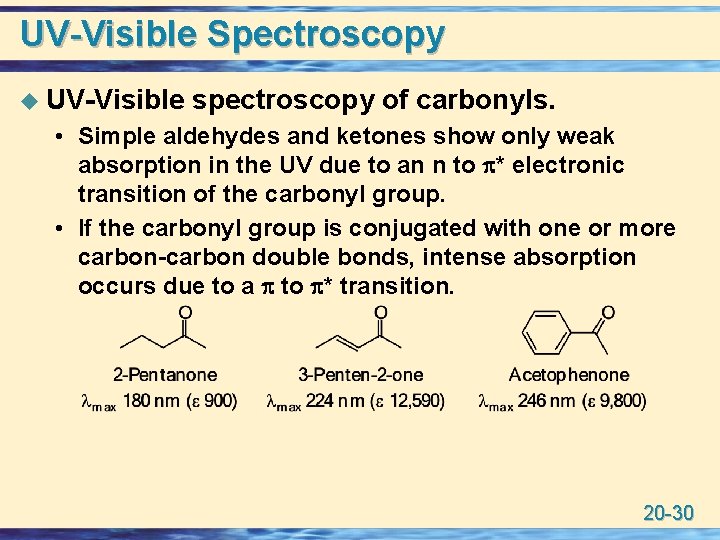
UV-Visible Spectroscopy u UV-Visible spectroscopy of carbonyls. • Simple aldehydes and ketones show only weak absorption in the UV due to an n to p* electronic transition of the carbonyl group. • If the carbonyl group is conjugated with one or more carbon-carbon double bonds, intense absorption occurs due to a p to p* transition. 20 -30
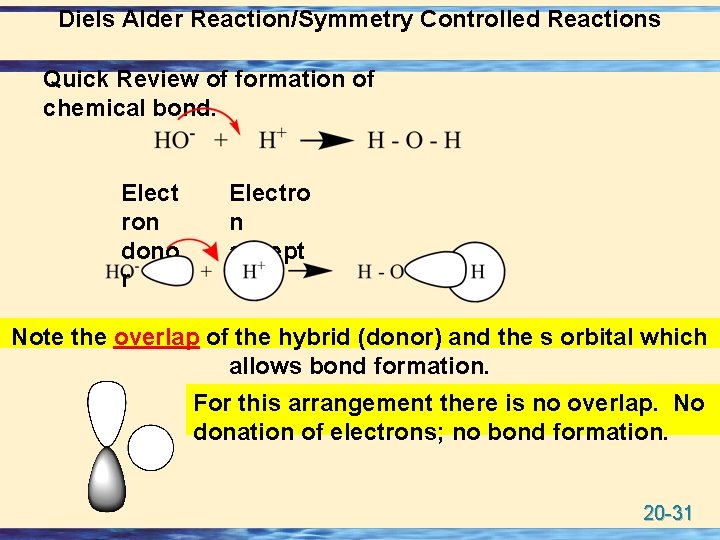
Diels Alder Reaction/Symmetry Controlled Reactions Quick Review of formation of chemical bond. Elect ron dono r Electro n accept or Note the overlap of the hybrid (donor) and the s orbital which allows bond formation. For this arrangement there is no overlap. No donation of electrons; no bond formation. 20 -31
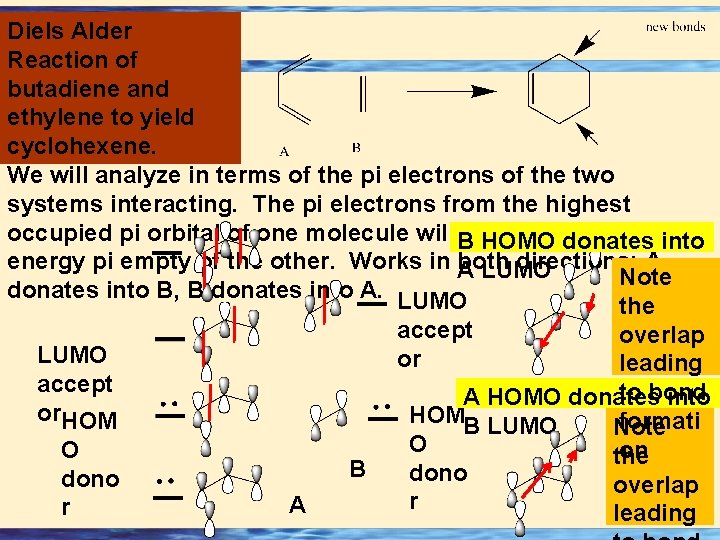
Diels Alder Reaction of butadiene and ethylene to yield cyclohexene. We will analyze in terms of the pi electrons of the two systems interacting. The pi electrons from the highest occupied pi orbital of one molecule will B donate an lowest HOMOinto donates into energy pi empty of the other. Works in A both directions: A LUMO Note donates into B, B donates into A. LUMO the accept overlap LUMO or leading accept to bond A HOMO donates into or. HOMB LUMO formati Note O O on the B dono overlap r A r 20 -32 leading
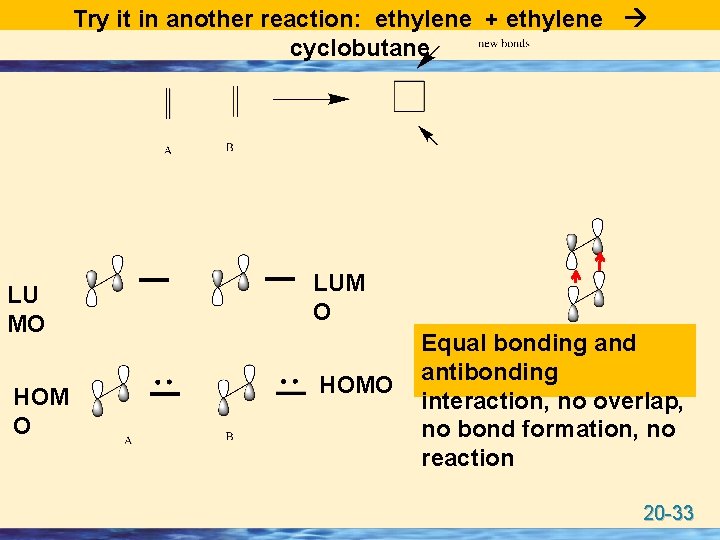
Try it in another reaction: ethylene + ethylene cyclobutane LU MO LUM O HOMO Equal bonding and antibonding interaction, no overlap, no bond formation, no reaction 20 -33