
Chapter 20 AVL Trees 1 Objectives F To

Chapter 20 AVL Trees 1
Objectives F To know what an AVL tree is (§ 20. 1). F To understand how to rebalance a tree using the LL rotation, LR rotation, RR rotation, and RL rotation (§ 20. 2). F To know how to design the AVLTree class (§ 20. 3). F To insert elements into an AVL tree (§ 20. 4). F To implement node rebalancing (§ 20. 5). F To delete elements from an AVL tree (§ 20. 6). F To implement the AVLTree class (§ 20. 7). F To test the AVLTree class (§ 20. 8). F To analyze the complexity of search, insert, and delete operations in AVL trees (§ 20. 9). 2
Why AVL Tree? The search, insertion, and deletion time for a binary tree is dependent on the height of the tree. In the worst case, the height is O(n). If a tree is perfectly balanced, i. e. , a complete binary tree, its height is. Can we maintain a perfectly balanced tree? Yes. But it will be costly to do so. The compromise is to maintain a well-balanced tree, i. e. , the heights of two subtrees for every node are about the same. 3
What is an AVL Tree? AVL trees are well-balanced. AVL trees were invented by two Russian computer scientists G. M. Adelson-Velsky and E. M. Landis in 1962. In an AVL tree, the difference between the heights of two subtrees for every node is 0 or 1. It can be shown that the maximum height of an AVL tree is O(logn). 4
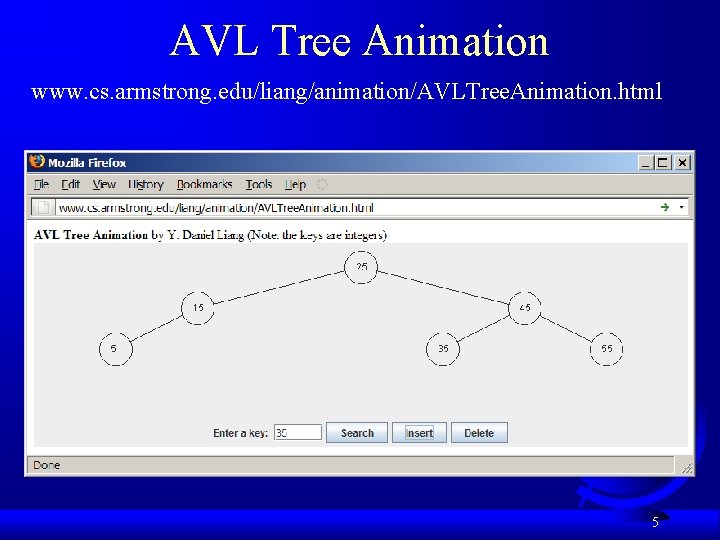
AVL Tree Animation www. cs. armstrong. edu/liang/animation/AVLTree. Animation. html 5
Balance Factor/Left-Heavy/Right-Heavy The process for inserting or deleting an element in an AVL tree is the same as in a regular binary search tree. The difference is that you may have to rebalance the tree after an insertion or deletion operation. The balance factor of a node is the height of its right subtree minus the height of its left subtree. A node is said to be balanced if its balance factor is -1, 0, or 1. A node is said to be left -heavy if its balance factor is -1. A node is said to be right-heavy if its balance factor is +1. 6
Balancing Trees If a node is not balanced after an insertion or deletion operation, you need to rebalance it. The process of rebalancing a node is called a rotation. There are four possible rotations. 7
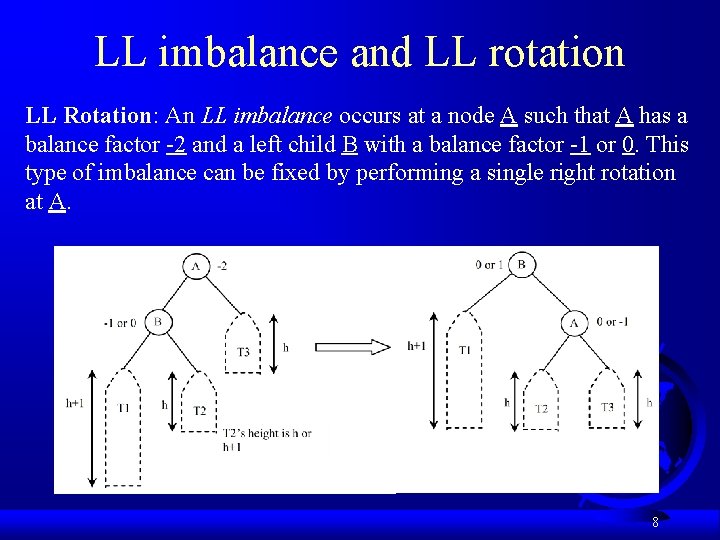
LL imbalance and LL rotation LL Rotation: An LL imbalance occurs at a node A such that A has a balance factor -2 and a left child B with a balance factor -1 or 0. This type of imbalance can be fixed by performing a single right rotation at A. 8
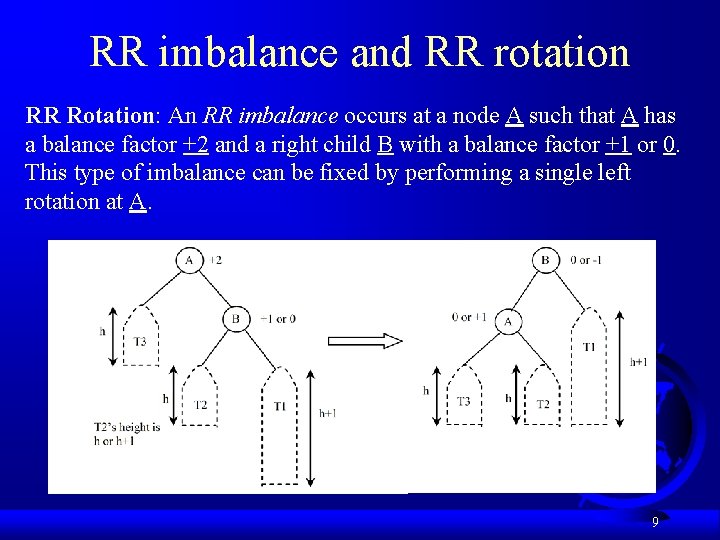
RR imbalance and RR rotation RR Rotation: An RR imbalance occurs at a node A such that A has a balance factor +2 and a right child B with a balance factor +1 or 0. This type of imbalance can be fixed by performing a single left rotation at A. 9
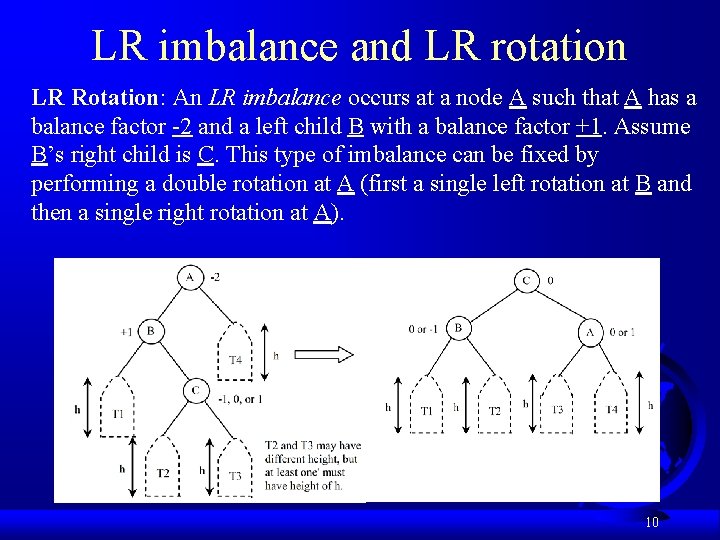
LR imbalance and LR rotation LR Rotation: An LR imbalance occurs at a node A such that A has a balance factor -2 and a left child B with a balance factor +1. Assume B’s right child is C. This type of imbalance can be fixed by performing a double rotation at A (first a single left rotation at B and then a single right rotation at A). 10
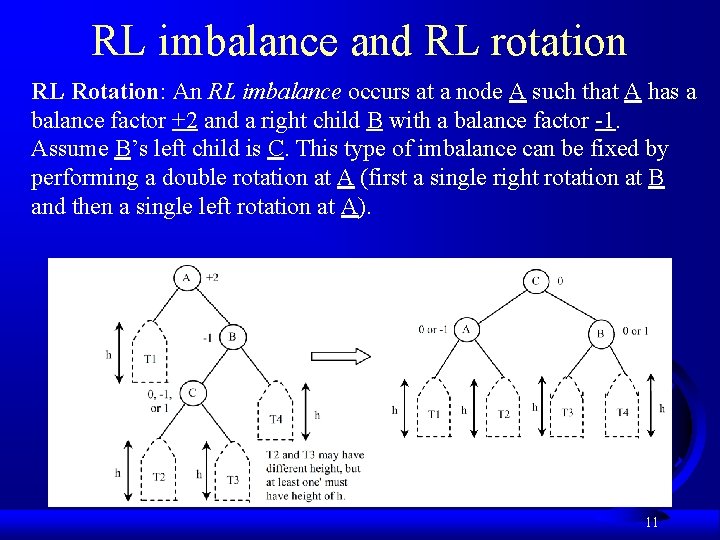
RL imbalance and RL rotation RL Rotation: An RL imbalance occurs at a node A such that A has a balance factor +2 and a right child B with a balance factor -1. Assume B’s left child is C. This type of imbalance can be fixed by performing a double rotation at A (first a single right rotation at B and then a single left rotation at A). 11
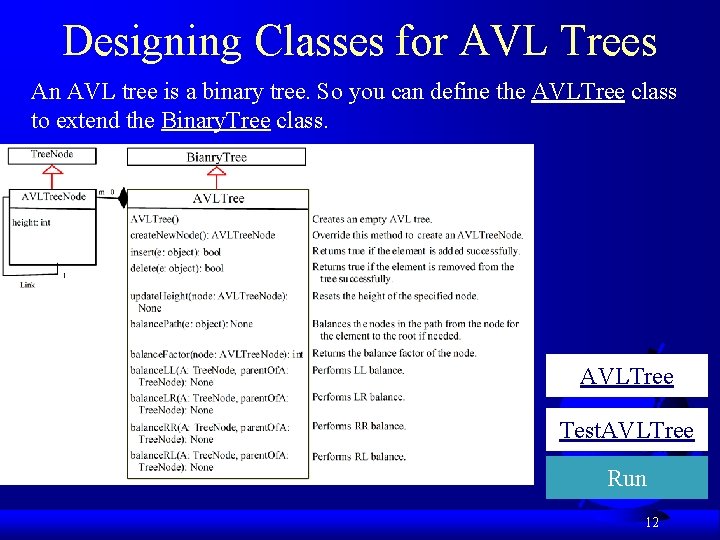
Designing Classes for AVL Trees An AVL tree is a binary tree. So you can define the AVLTree class to extend the Binary. Tree class. AVLTree Test. AVLTree Run 12
- Slides: 12