
Chapter 20 An Envelope of Gas Earths Atmosphere
- Slides: 90
Chapter 20 An Envelope of Gas: Earth’s Atmosphere and Climate LECTURE OUTLINE earth Portrait of a Planet Third Edition © 2008 W. W. Norton & Company, Inc. Earth: Portrait of a Planet, 3 rd edition, by Stephen Marshak Chapter 20: An Envelope of Gas: Earth's Atmosphere and Climate
An Envelope of Gas: Earth’s Atmosphere and Climate Prepared by Ronald Parker Earlham College Department of Geosciences Richmond, Indiana
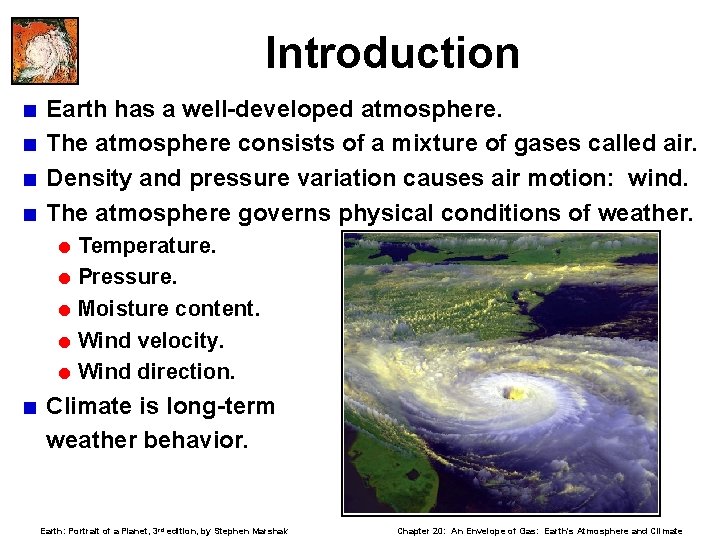
Introduction < Earth has a well-developed atmosphere. < The atmosphere consists of a mixture of gases called air. < Density and pressure variation causes air motion: wind. < The atmosphere governs physical conditions of weather. = Temperature. = Pressure. = Moisture content. = Wind velocity. = Wind direction. < Climate is long-term weather behavior. Earth: Portrait of a Planet, 3 rd edition, by Stephen Marshak Chapter 20: An Envelope of Gas: Earth's Atmosphere and Climate
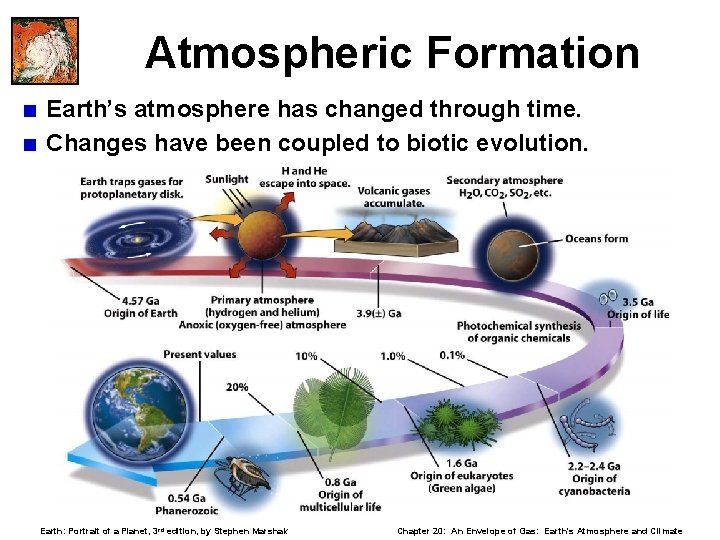
Atmospheric Formation < Earth’s atmosphere has changed through time. < Changes have been coupled to biotic evolution. Earth: Portrait of a Planet, 3 rd edition, by Stephen Marshak Chapter 20: An Envelope of Gas: Earth's Atmosphere and Climate
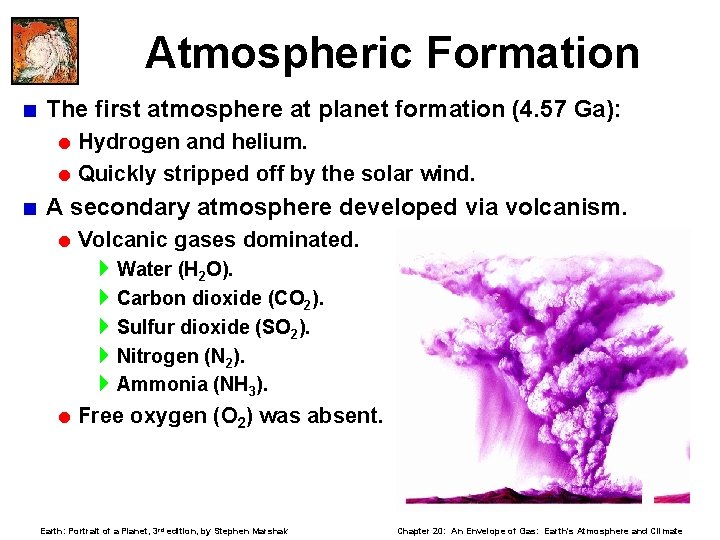
Atmospheric Formation < The first atmosphere at planet formation (4. 57 Ga): = Hydrogen and helium. = Quickly stripped off by the solar wind. < A secondary atmosphere developed via volcanism. = Volcanic gases dominated. 4 Water (H 2 O). 4 Carbon dioxide (CO 2). 4 Sulfur dioxide (SO 2). 4 Nitrogen (N 2). 4 Ammonia (NH 3). = Free oxygen (O 2) was absent. Earth: Portrait of a Planet, 3 rd edition, by Stephen Marshak Chapter 20: An Envelope of Gas: Earth's Atmosphere and Climate
Atmospheric Formation < The secondary atmosphere evolved as the planet cooled. = Condensed water fell as rain to form the oceans. = Atmospheric CO 2 decreased by dissolving in ocean water. 4 CO 2 is a powerful heat-trapping (greenhouse) gas. 4 CO 2 removal permitted atmospheric cooling. = The relative abundance of stable N 2 increased. Earth: Portrait of a Planet, 3 rd edition, by Stephen Marshak Chapter 20: An Envelope of Gas: Earth's Atmosphere and Climate
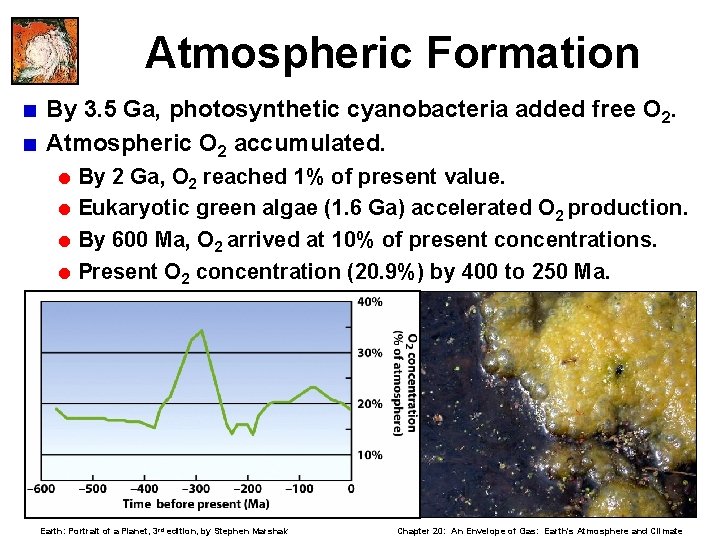
Atmospheric Formation < By 3. 5 Ga, photosynthetic cyanobacteria added free O 2. < Atmospheric O 2 accumulated. = By 2 Ga, O 2 reached 1% of present value. = Eukaryotic green algae (1. 6 Ga) accelerated O 2 production. = By 600 Ma, O 2 arrived at 10% of present concentrations. = Present O 2 concentration (20. 9%) by 400 to 250 Ma. Earth: Portrait of a Planet, 3 rd edition, by Stephen Marshak Chapter 20: An Envelope of Gas: Earth's Atmosphere and Climate
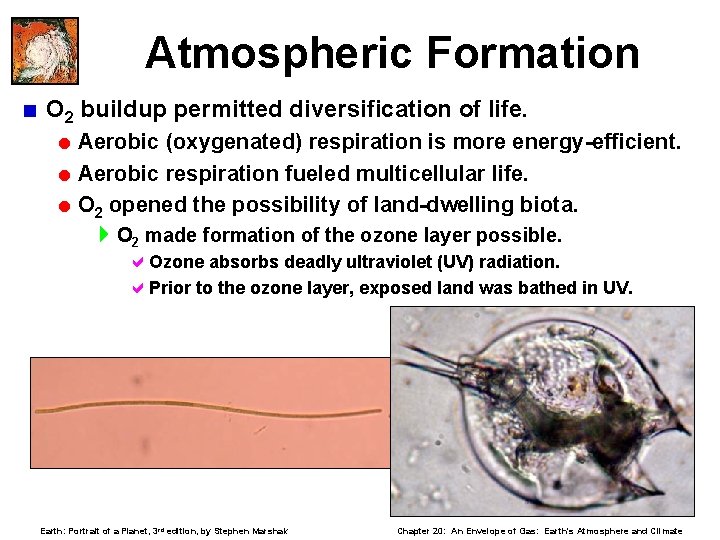
Atmospheric Formation < O 2 buildup permitted diversification of life. = Aerobic (oxygenated) respiration is more energy-efficient. = Aerobic respiration fueled multicellular life. = O 2 opened the possibility of land-dwelling biota. 4 O 2 made formation of the ozone layer possible. a. Ozone absorbs deadly ultraviolet (UV) radiation. a. Prior to the ozone layer, exposed land was bathed in UV. Earth: Portrait of a Planet, 3 rd edition, by Stephen Marshak Chapter 20: An Envelope of Gas: Earth's Atmosphere and Climate
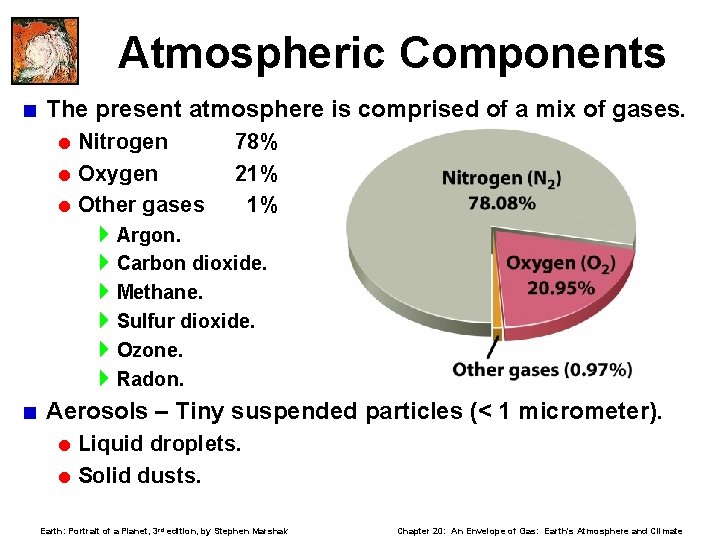
Atmospheric Components < The present atmosphere is comprised of a mix of gases. = Nitrogen 78% = Oxygen 21% = Other gases 1% 4 Argon. 4 Carbon dioxide. 4 Methane. 4 Sulfur dioxide. 4 Ozone. 4 Radon. < Aerosols – Tiny suspended particles (< 1 micrometer). = Liquid droplets. = Solid dusts. Earth: Portrait of a Planet, 3 rd edition, by Stephen Marshak Chapter 20: An Envelope of Gas: Earth's Atmosphere and Climate
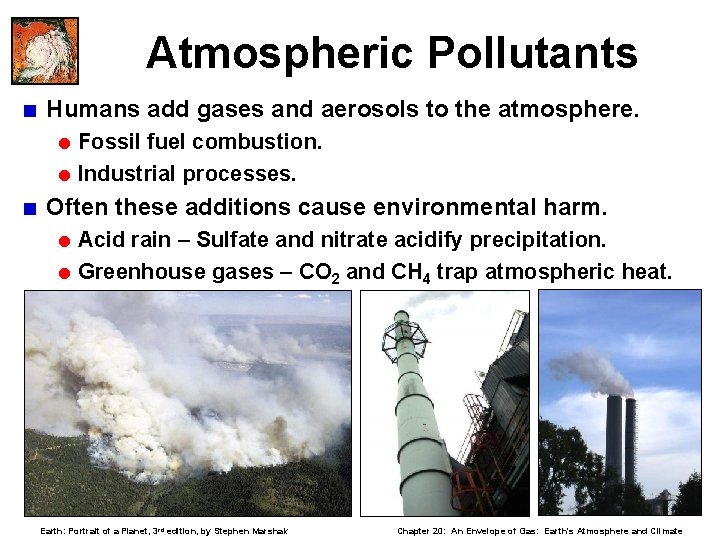
Atmospheric Pollutants < Humans add gases and aerosols to the atmosphere. = Fossil fuel combustion. = Industrial processes. < Often these additions cause environmental harm. = Acid rain – Sulfate and nitrate acidify precipitation. = Greenhouse gases – CO 2 and CH 4 trap atmospheric heat. Earth: Portrait of a Planet, 3 rd edition, by Stephen Marshak Chapter 20: An Envelope of Gas: Earth's Atmosphere and Climate
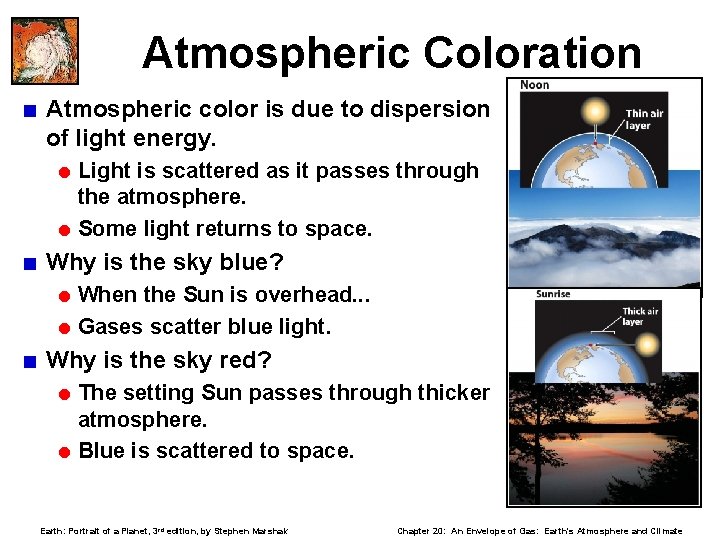
Atmospheric Coloration < Atmospheric color is due to dispersion of light energy. = Light is scattered as it passes through the atmosphere. = Some light returns to space. < Why is the sky blue? = When the Sun is overhead. . . = Gases scatter blue light. < Why is the sky red? = The setting Sun passes through thicker atmosphere. = Blue is scattered to space. Earth: Portrait of a Planet, 3 rd edition, by Stephen Marshak Chapter 20: An Envelope of Gas: Earth's Atmosphere and Climate
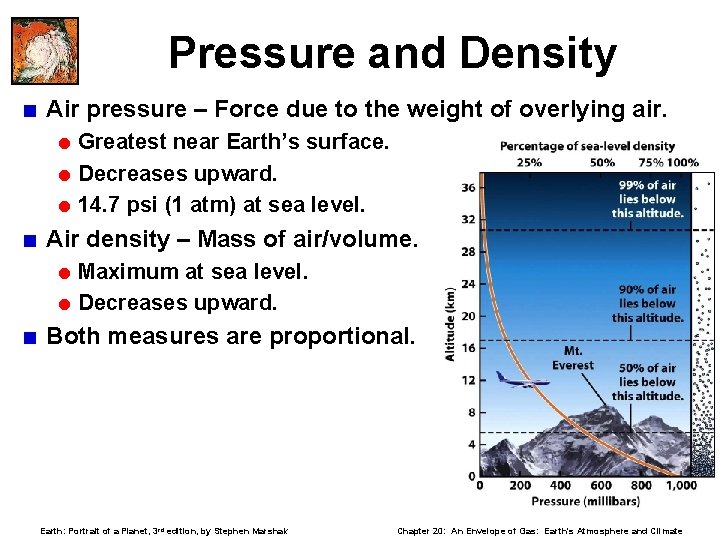
Pressure and Density < Air pressure – Force due to the weight of overlying air. = Greatest near Earth’s surface. = Decreases upward. = 14. 7 psi (1 atm) at sea level. < Air density – Mass of air/volume. = Maximum at sea level. = Decreases upward. < Both measures are proportional. Earth: Portrait of a Planet, 3 rd edition, by Stephen Marshak Chapter 20: An Envelope of Gas: Earth's Atmosphere and Climate
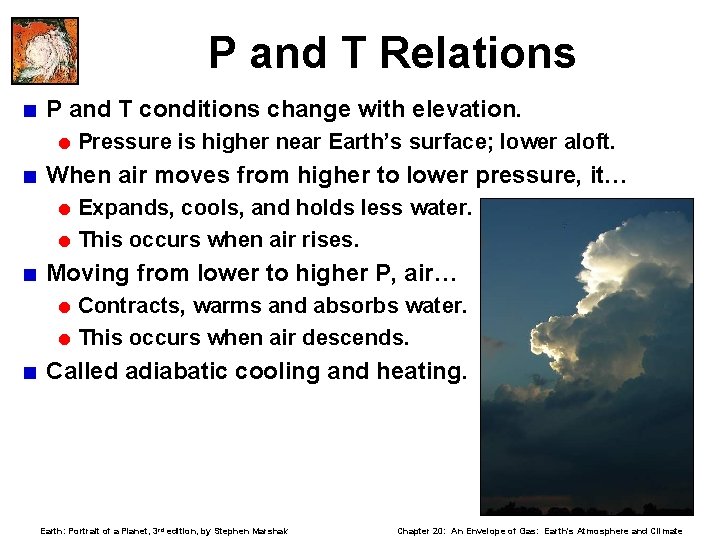
P and T Relations < P and T conditions change with elevation. = Pressure is higher near Earth’s surface; lower aloft. < When air moves from higher to lower pressure, it… = Expands, cools, and holds less water. = This occurs when air rises. < Moving from lower to higher P, air… = Contracts, warms and absorbs water. = This occurs when air descends. < Called adiabatic cooling and heating. Earth: Portrait of a Planet, 3 rd edition, by Stephen Marshak Chapter 20: An Envelope of Gas: Earth's Atmosphere and Climate
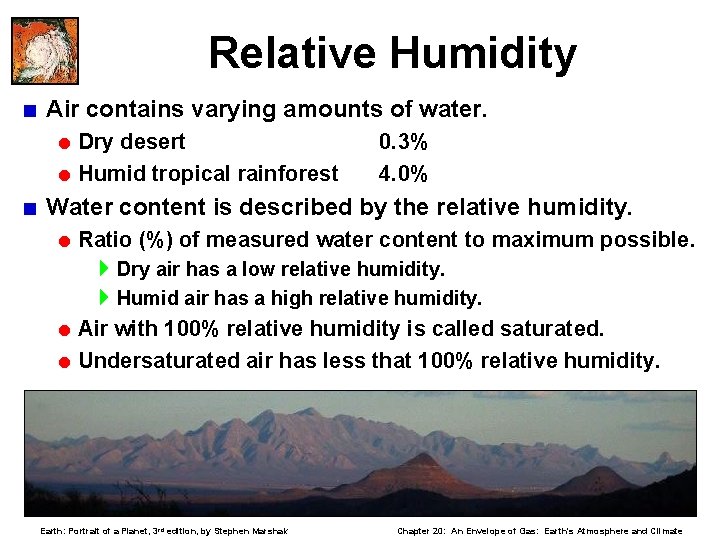
Relative Humidity < Air contains varying amounts of water. = Dry desert 0. 3% = Humid tropical rainforest 4. 0% < Water content is described by the relative humidity. = Ratio (%) of measured water content to maximum possible. 4 Dry air has a low relative humidity. 4 Humid air has a high relative humidity. = Air with 100% relative humidity is called saturated. = Undersaturated air has less that 100% relative humidity. Earth: Portrait of a Planet, 3 rd edition, by Stephen Marshak Chapter 20: An Envelope of Gas: Earth's Atmosphere and Climate
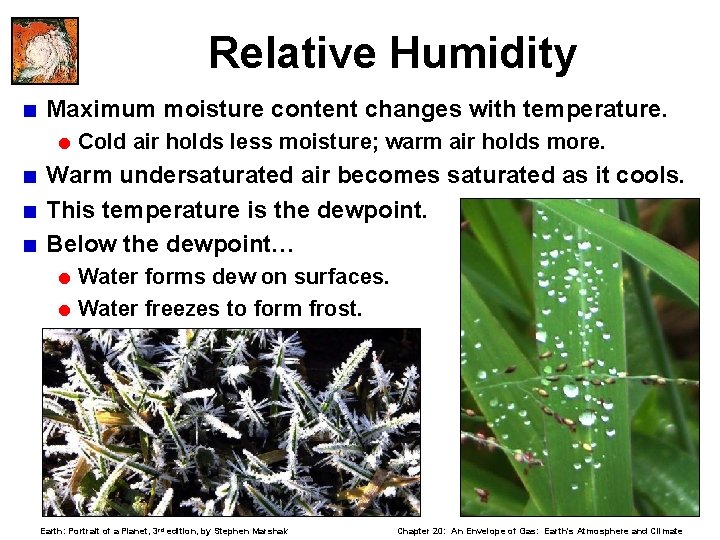
Relative Humidity < Maximum moisture content changes with temperature. = Cold air holds less moisture; warm air holds more. < Warm undersaturated air becomes saturated as it cools. < This temperature is the dewpoint. < Below the dewpoint… = Water forms dew on surfaces. = Water freezes to form frost. Earth: Portrait of a Planet, 3 rd edition, by Stephen Marshak Chapter 20: An Envelope of Gas: Earth's Atmosphere and Climate
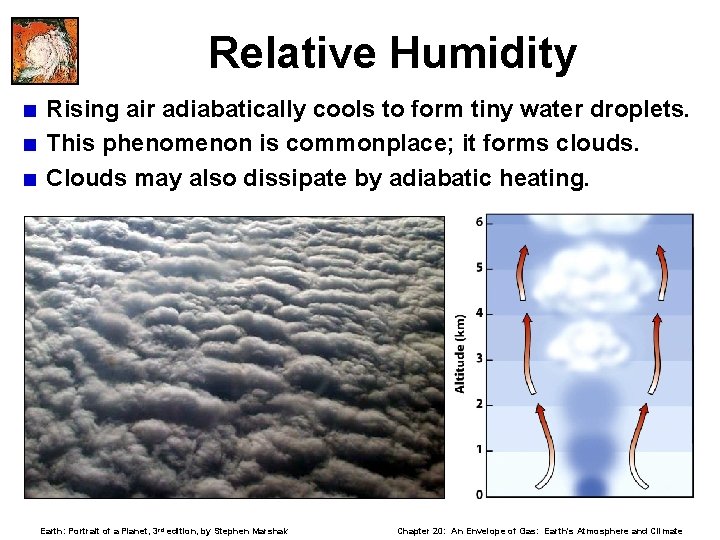
Relative Humidity < Rising air adiabatically cools to form tiny water droplets. < This phenomenon is commonplace; it forms clouds. < Clouds may also dissipate by adiabatic heating. Earth: Portrait of a Planet, 3 rd edition, by Stephen Marshak Chapter 20: An Envelope of Gas: Earth's Atmosphere and Climate
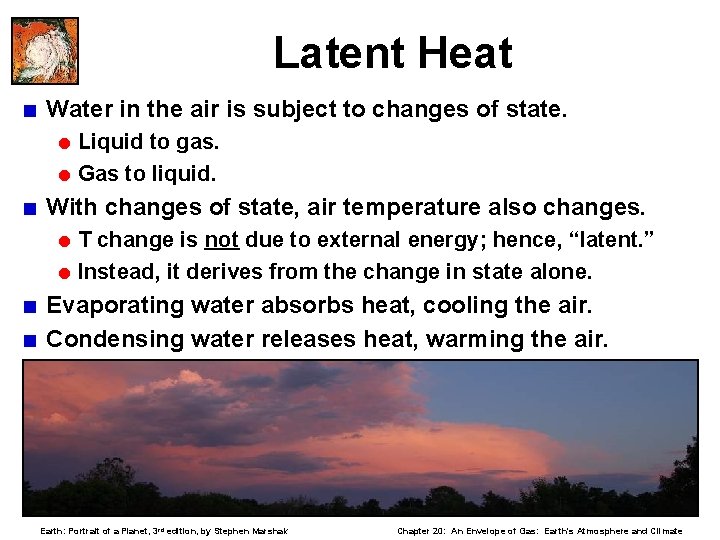
Latent Heat < Water in the air is subject to changes of state. = Liquid to gas. = Gas to liquid. < With changes of state, air temperature also changes. = T change is not due to external energy; hence, “latent. ” = Instead, it derives from the change in state alone. < Evaporating water absorbs heat, cooling the air. < Condensing water releases heat, warming the air. Earth: Portrait of a Planet, 3 rd edition, by Stephen Marshak Chapter 20: An Envelope of Gas: Earth's Atmosphere and Climate
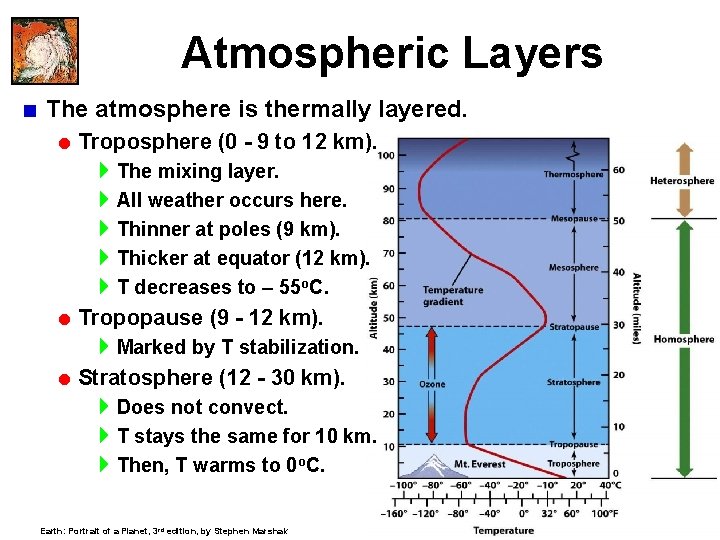
Atmospheric Layers < The atmosphere is thermally layered. = Troposphere (0 - 9 to 12 km). 4 The mixing layer. 4 All weather occurs here. 4 Thinner at poles (9 km). 4 Thicker at equator (12 km). 4 T decreases to – 55 o. C. = Tropopause (9 - 12 km). 4 Marked by T stabilization. = Stratosphere (12 - 30 km). 4 Does not convect. 4 T stays the same for 10 km. 4 Then, T warms to 0 o. C. Earth: Portrait of a Planet, 3 rd edition, by Stephen Marshak Chapter 20: An Envelope of Gas: Earth's Atmosphere and Climate
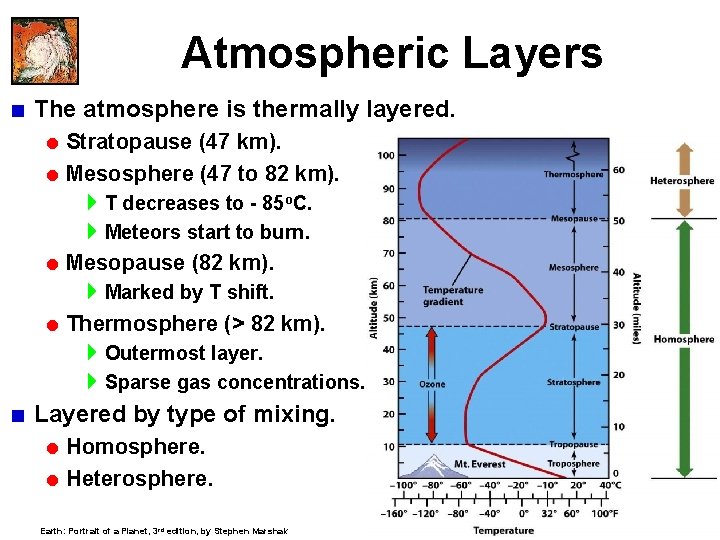
Atmospheric Layers < The atmosphere is thermally layered. = Stratopause (47 km). = Mesosphere (47 to 82 km). 4 T decreases to - 85 o. C. 4 Meteors start to burn. = Mesopause (82 km). 4 Marked by T shift. = Thermosphere (> 82 km). 4 Outermost layer. 4 Sparse gas concentrations. < Layered by type of mixing. = Homosphere. = Heterosphere. Earth: Portrait of a Planet, 3 rd edition, by Stephen Marshak Chapter 20: An Envelope of Gas: Earth's Atmosphere and Climate
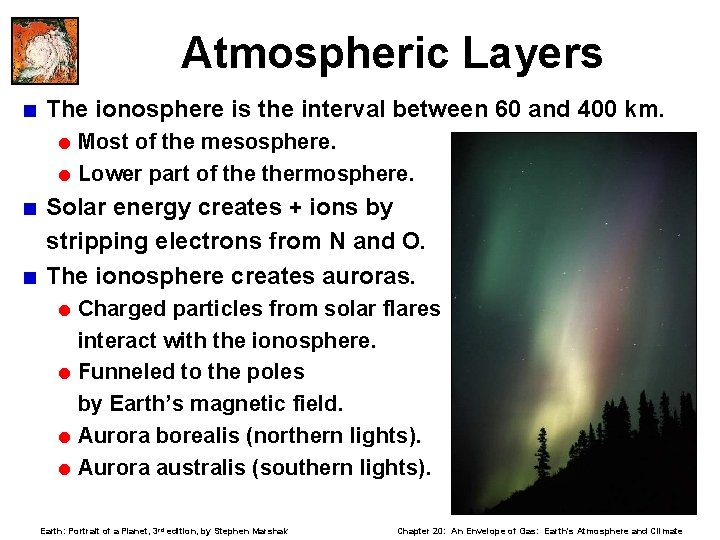
Atmospheric Layers < The ionosphere is the interval between 60 and 400 km. = Most of the mesosphere. = Lower part of thermosphere. < Solar energy creates + ions by stripping electrons from N and O. < The ionosphere creates auroras. = Charged particles from solar flares interact with the ionosphere. = Funneled to the poles by Earth’s magnetic field. = Aurora borealis (northern lights). = Aurora australis (southern lights). Earth: Portrait of a Planet, 3 rd edition, by Stephen Marshak Chapter 20: An Envelope of Gas: Earth's Atmosphere and Climate
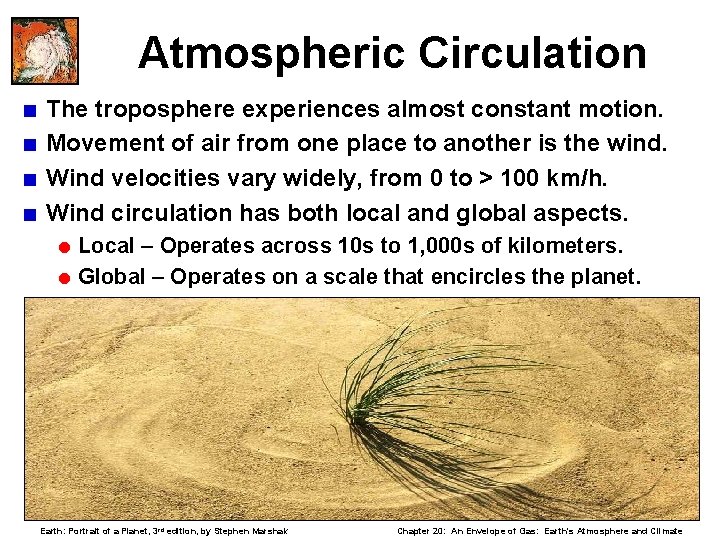
Atmospheric Circulation < The troposphere experiences almost constant motion. < Movement of air from one place to another is the wind. < Wind velocities vary widely, from 0 to > 100 km/h. < Wind circulation has both local and global aspects. = Local – Operates across 10 s to 1, 000 s of kilometers. = Global – Operates on a scale that encircles the planet. Earth: Portrait of a Planet, 3 rd edition, by Stephen Marshak Chapter 20: An Envelope of Gas: Earth's Atmosphere and Climate
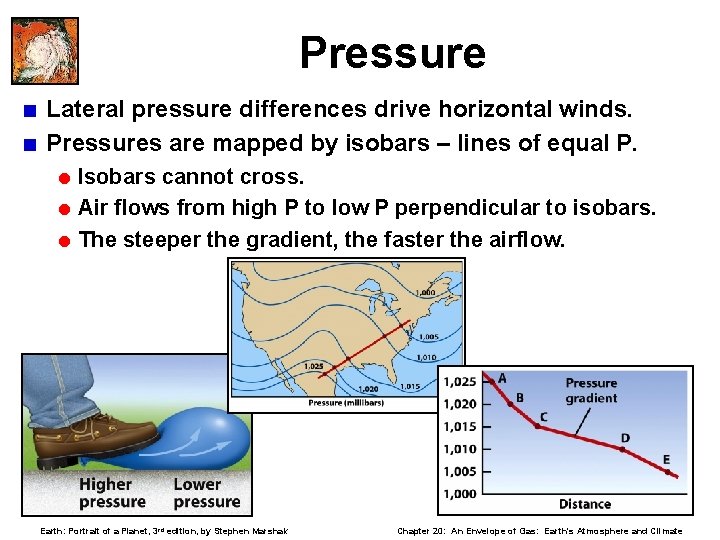
Pressure < Lateral pressure differences drive horizontal winds. < Pressures are mapped by isobars – lines of equal P. = Isobars cannot cross. = Air flows from high P to low P perpendicular to isobars. = The steeper the gradient, the faster the airflow. Earth: Portrait of a Planet, 3 rd edition, by Stephen Marshak Chapter 20: An Envelope of Gas: Earth's Atmosphere and Climate
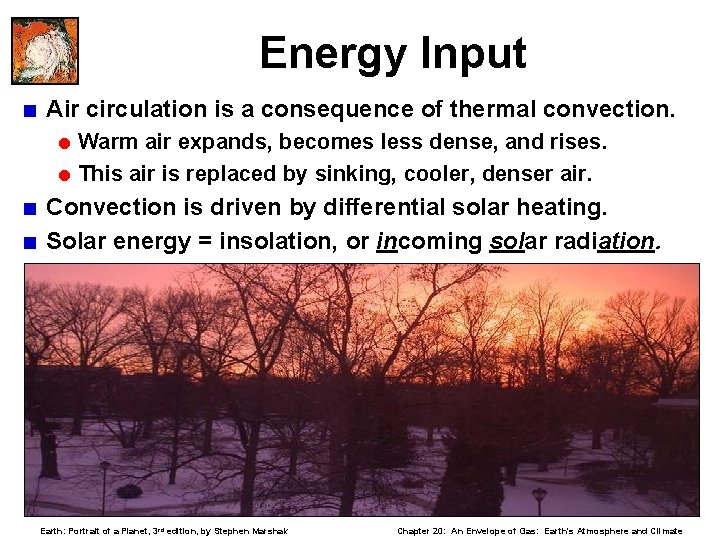
Energy Input < Air circulation is a consequence of thermal convection. = Warm air expands, becomes less dense, and rises. = This air is replaced by sinking, cooler, denser air. < Convection is driven by differential solar heating. < Solar energy = insolation, or incoming solar radiation. Earth: Portrait of a Planet, 3 rd edition, by Stephen Marshak Chapter 20: An Envelope of Gas: Earth's Atmosphere and Climate
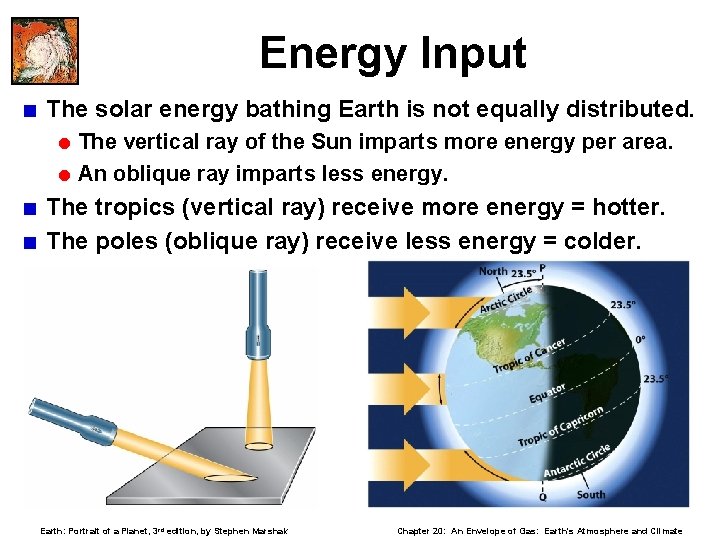
Energy Input < The solar energy bathing Earth is not equally distributed. = The vertical ray of the Sun imparts more energy per area. = An oblique ray imparts less energy. < The tropics (vertical ray) receive more energy = hotter. < The poles (oblique ray) receive less energy = colder. Earth: Portrait of a Planet, 3 rd edition, by Stephen Marshak Chapter 20: An Envelope of Gas: Earth's Atmosphere and Climate
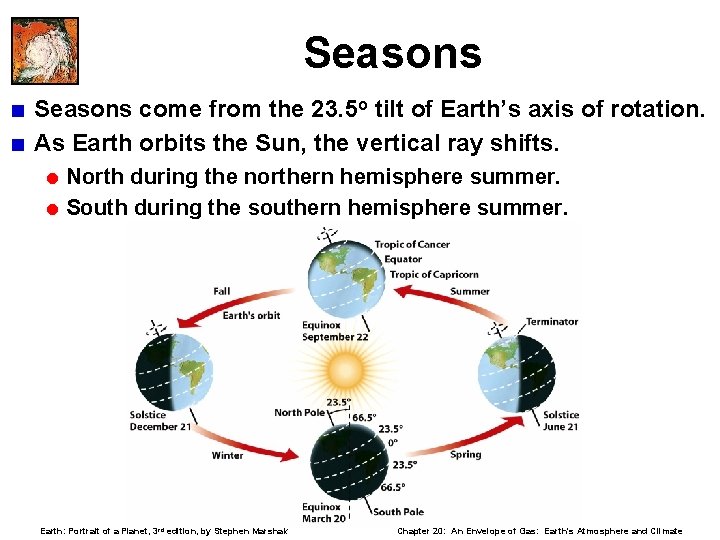
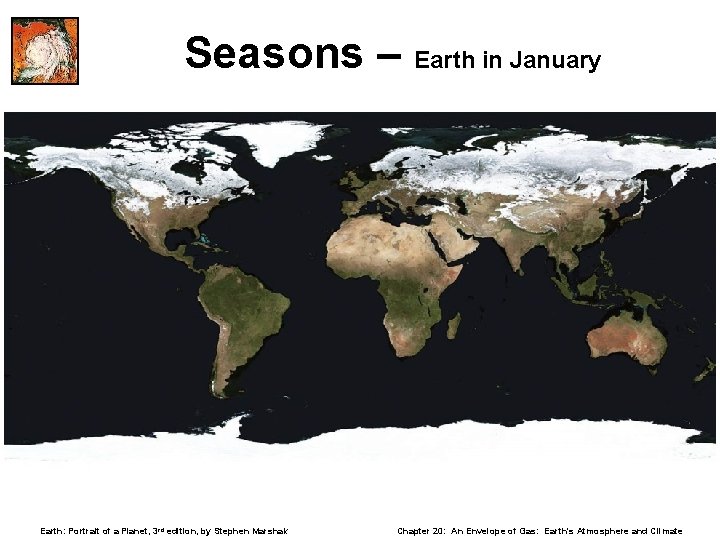
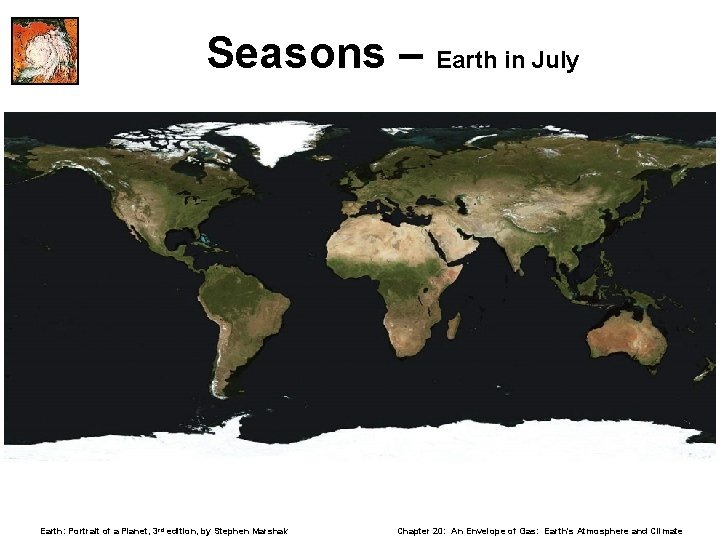
Seasons < Seasons come from the 23. 5 o tilt of Earth’s axis of rotation. < As Earth orbits the Sun, the vertical ray shifts. = North during the northern hemisphere summer. = South during the southern hemisphere summer. Earth: Portrait of a Planet, 3 rd edition, by Stephen Marshak Chapter 20: An Envelope of Gas: Earth's Atmosphere and Climate
Seasons – Earth in January Earth: Portrait of a Planet, 3 rd edition, by Stephen Marshak Chapter 20: An Envelope of Gas: Earth's Atmosphere and Climate
Seasons – Earth in July Earth: Portrait of a Planet, 3 rd edition, by Stephen Marshak Chapter 20: An Envelope of Gas: Earth's Atmosphere and Climate
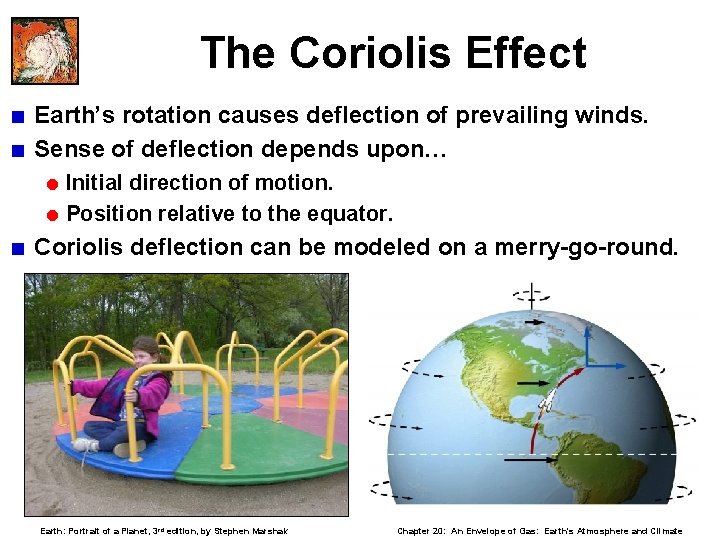
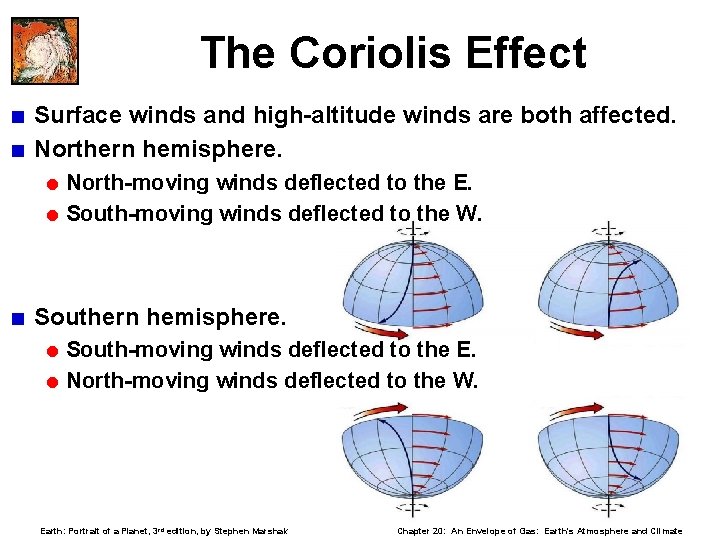
The Coriolis Effect < Earth’s rotation causes deflection of prevailing winds. < Sense of deflection depends upon… = Initial direction of motion. = Position relative to the equator. < Coriolis deflection can be modeled on a merry-go-round. Earth: Portrait of a Planet, 3 rd edition, by Stephen Marshak Chapter 20: An Envelope of Gas: Earth's Atmosphere and Climate
The Coriolis Effect < Surface winds and high-altitude winds are both affected. < Northern hemisphere. = North-moving winds deflected to the E. = South-moving winds deflected to the W. < Southern hemisphere. = South-moving winds deflected to the E. = North-moving winds deflected to the W. Earth: Portrait of a Planet, 3 rd edition, by Stephen Marshak Chapter 20: An Envelope of Gas: Earth's Atmosphere and Climate
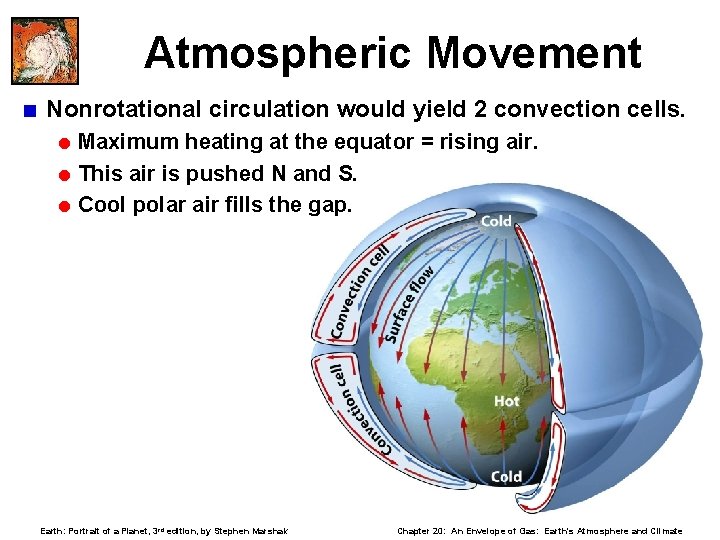
Atmospheric Movement < Nonrotational circulation would yield 2 convection cells. = Maximum heating at the equator = rising air. = This air is pushed N and S. = Cool polar air fills the gap. Earth: Portrait of a Planet, 3 rd edition, by Stephen Marshak Chapter 20: An Envelope of Gas: Earth's Atmosphere and Climate
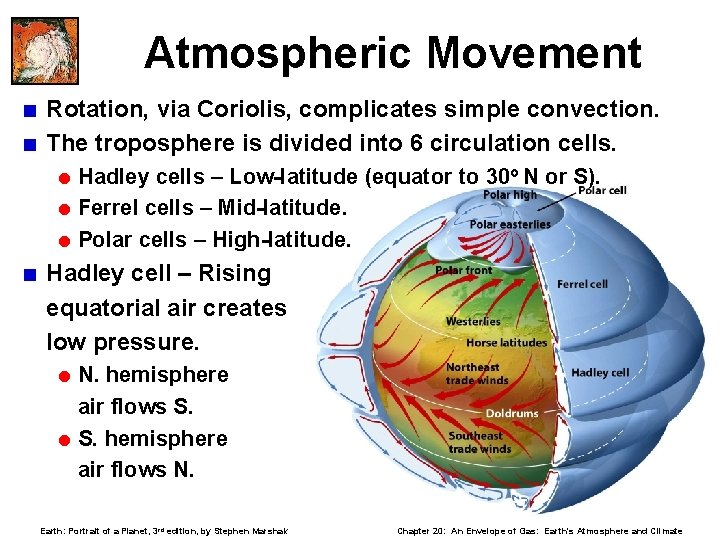
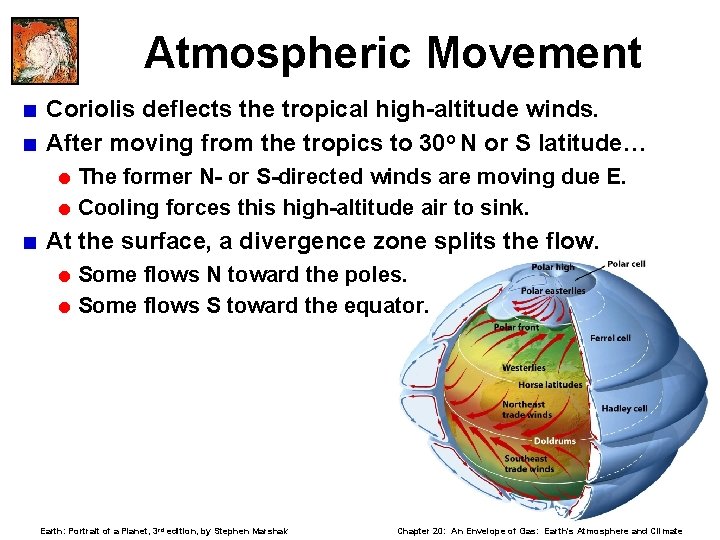
Atmospheric Movement < Rotation, via Coriolis, complicates simple convection. < The troposphere is divided into 6 circulation cells. = Hadley cells – Low-latitude (equator to 30 o N or S). = Ferrel cells – Mid-latitude. = Polar cells – High-latitude. < Hadley cell – Rising equatorial air creates low pressure. = N. hemisphere air flows S. = S. hemisphere air flows N. Earth: Portrait of a Planet, 3 rd edition, by Stephen Marshak Chapter 20: An Envelope of Gas: Earth's Atmosphere and Climate
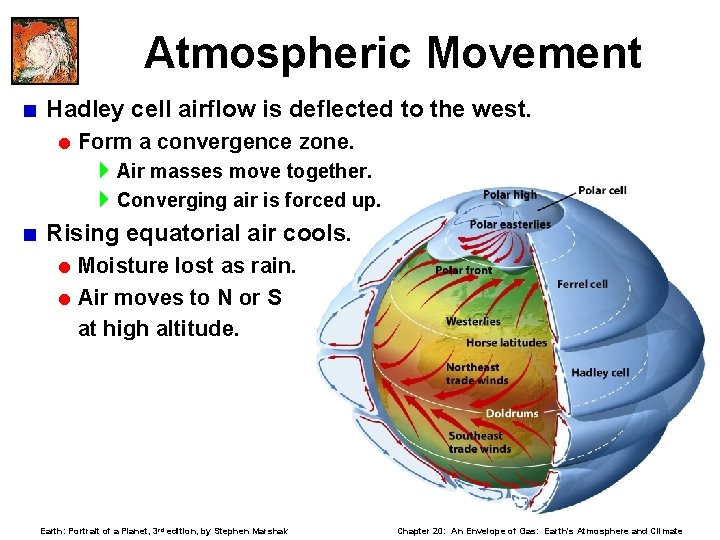
Atmospheric Movement < Hadley cell airflow is deflected to the west. = Form a convergence zone. 4 Air masses move together. 4 Converging air is forced up. < Rising equatorial air cools. = Moisture lost as rain. = Air moves to N or S at high altitude. Earth: Portrait of a Planet, 3 rd edition, by Stephen Marshak Chapter 20: An Envelope of Gas: Earth's Atmosphere and Climate
Atmospheric Movement < Coriolis deflects the tropical high-altitude winds. < After moving from the tropics to 30 o N or S latitude… = The former N- or S-directed winds are moving due E. = Cooling forces this high-altitude air to sink. < At the surface, a divergence zone splits the flow. = Some flows N toward the poles. = Some flows S toward the equator. Earth: Portrait of a Planet, 3 rd edition, by Stephen Marshak Chapter 20: An Envelope of Gas: Earth's Atmosphere and Climate
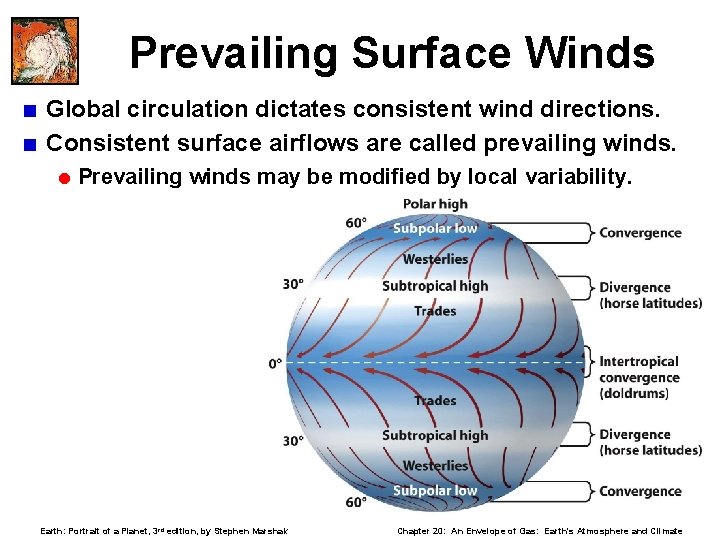
Prevailing Surface Winds < Global circulation dictates consistent wind directions. < Consistent surface airflows are called prevailing winds. = Prevailing winds may be modified by local variability. Earth: Portrait of a Planet, 3 rd edition, by Stephen Marshak Chapter 20: An Envelope of Gas: Earth's Atmosphere and Climate
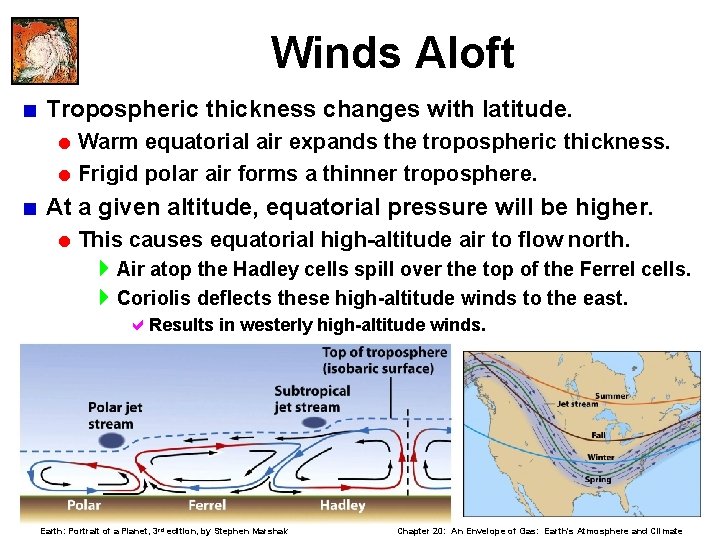
Winds Aloft < Tropospheric thickness changes with latitude. = Warm equatorial air expands the tropospheric thickness. = Frigid polar air forms a thinner troposphere. < At a given altitude, equatorial pressure will be higher. = This causes equatorial high-altitude air to flow north. 4 Air atop the Hadley cells spill over the top of the Ferrel cells. 4 Coriolis deflects these high-altitude winds to the east. a. Results in westerly high-altitude winds. Earth: Portrait of a Planet, 3 rd edition, by Stephen Marshak Chapter 20: An Envelope of Gas: Earth's Atmosphere and Climate
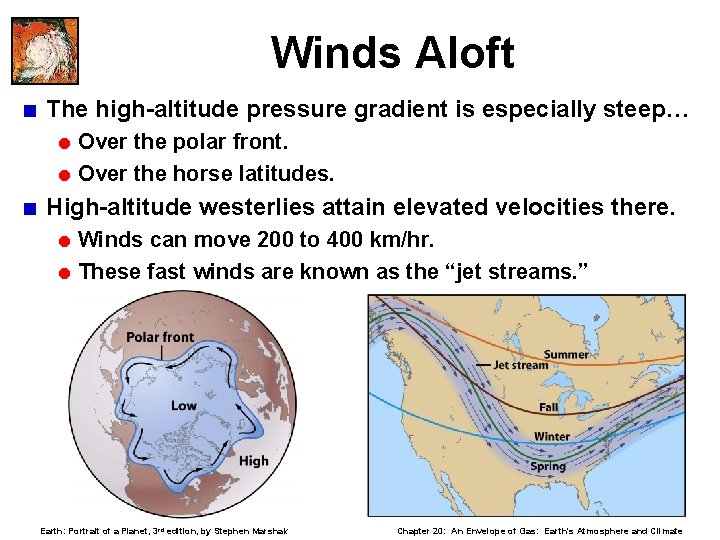
Winds Aloft < The high-altitude pressure gradient is especially steep… = Over the polar front. = Over the horse latitudes. < High-altitude westerlies attain elevated velocities there. = Winds can move 200 to 400 km/hr. = These fast winds are known as the “jet streams. ” Earth: Portrait of a Planet, 3 rd edition, by Stephen Marshak Chapter 20: An Envelope of Gas: Earth's Atmosphere and Climate
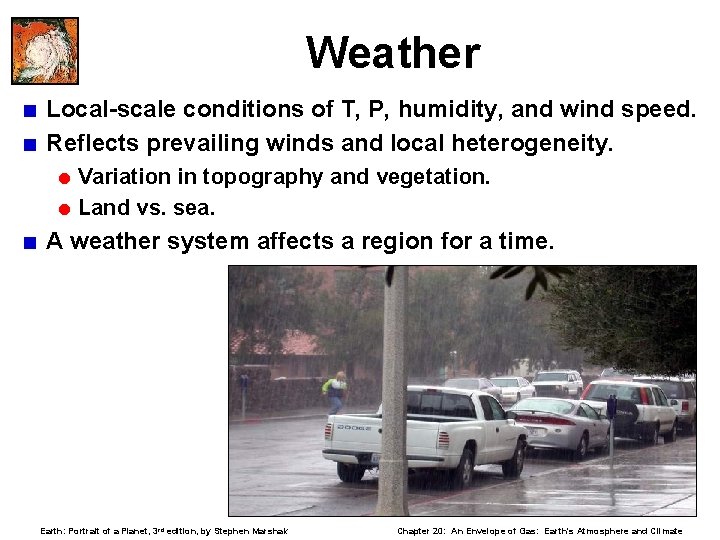
Weather < Local-scale conditions of T, P, humidity, and wind speed. < Reflects prevailing winds and local heterogeneity. = Variation in topography and vegetation. = Land vs. sea. < A weather system affects a region for a time. Earth: Portrait of a Planet, 3 rd edition, by Stephen Marshak Chapter 20: An Envelope of Gas: Earth's Atmosphere and Climate
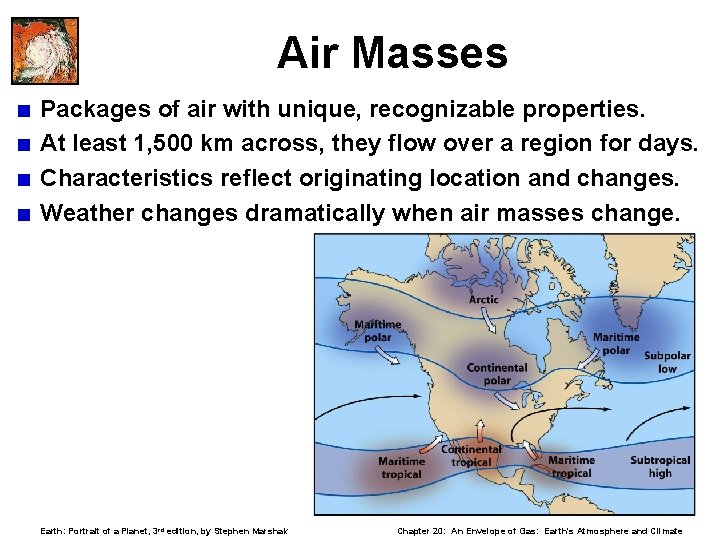
Air Masses < Packages of air with unique, recognizable properties. < At least 1, 500 km across, they flow over a region for days. < Characteristics reflect originating location and changes. < Weather changes dramatically when air masses change. Earth: Portrait of a Planet, 3 rd edition, by Stephen Marshak Chapter 20: An Envelope of Gas: Earth's Atmosphere and Climate
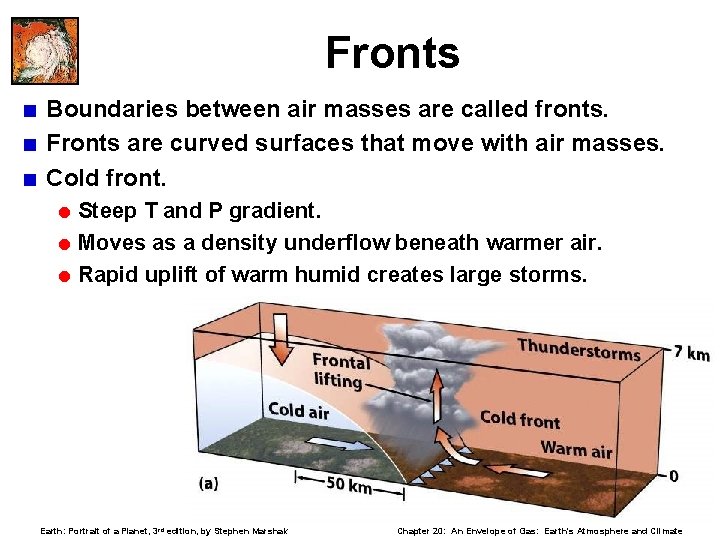
Fronts < Boundaries between air masses are called fronts. < Fronts are curved surfaces that move with air masses. < Cold front. = Steep T and P gradient. = Moves as a density underflow beneath warmer air. = Rapid uplift of warm humid creates large storms. Earth: Portrait of a Planet, 3 rd edition, by Stephen Marshak Chapter 20: An Envelope of Gas: Earth's Atmosphere and Climate
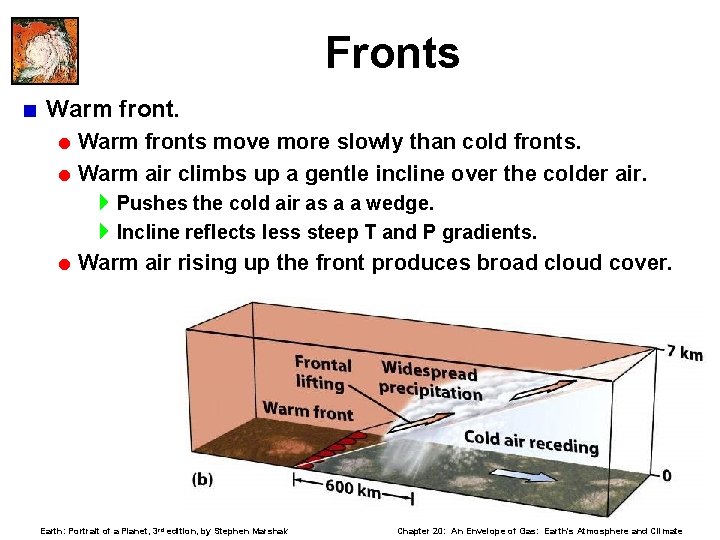
Fronts < Warm front. = Warm fronts move more slowly than cold fronts. = Warm air climbs up a gentle incline over the colder air. 4 Pushes the cold air as a a wedge. 4 Incline reflects less steep T and P gradients. = Warm air rising up the front produces broad cloud cover. Earth: Portrait of a Planet, 3 rd edition, by Stephen Marshak Chapter 20: An Envelope of Gas: Earth's Atmosphere and Climate
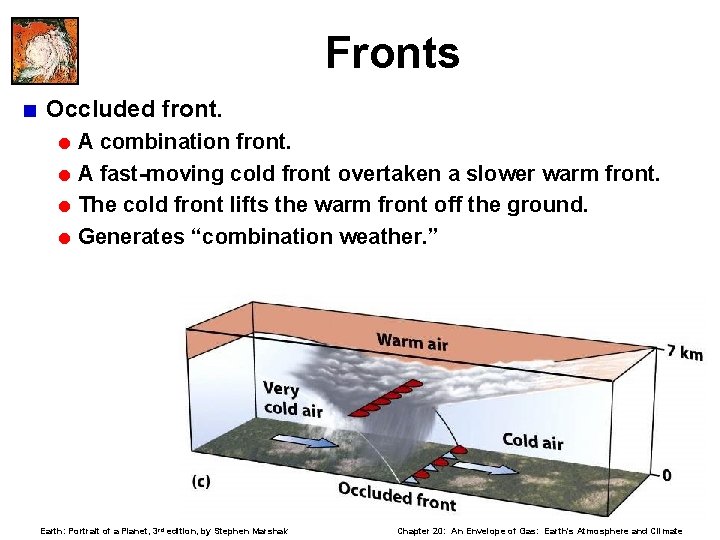
Fronts < Occluded front. = A combination front. = A fast-moving cold front overtaken a slower warm front. = The cold front lifts the warm front off the ground. = Generates “combination weather. ” Earth: Portrait of a Planet, 3 rd edition, by Stephen Marshak Chapter 20: An Envelope of Gas: Earth's Atmosphere and Climate
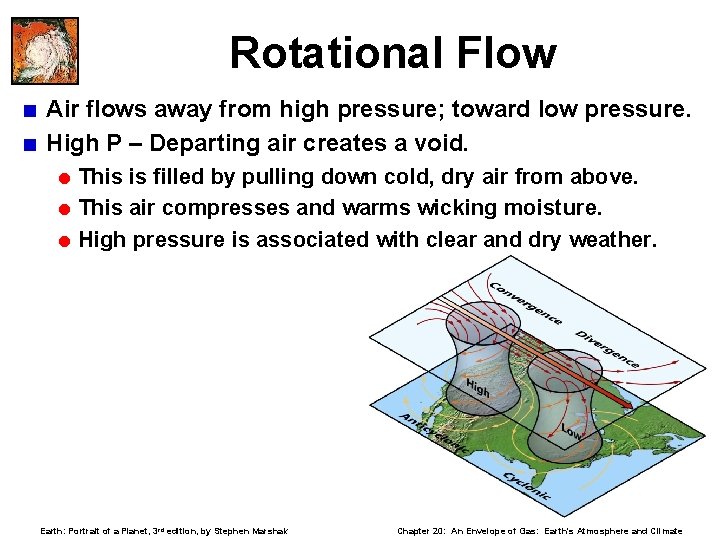
Rotational Flow < Air flows away from high pressure; toward low pressure. < High P – Departing air creates a void. = This is filled by pulling down cold, dry air from above. = This air compresses and warms wicking moisture. = High pressure is associated with clear and dry weather. Earth: Portrait of a Planet, 3 rd edition, by Stephen Marshak Chapter 20: An Envelope of Gas: Earth's Atmosphere and Climate
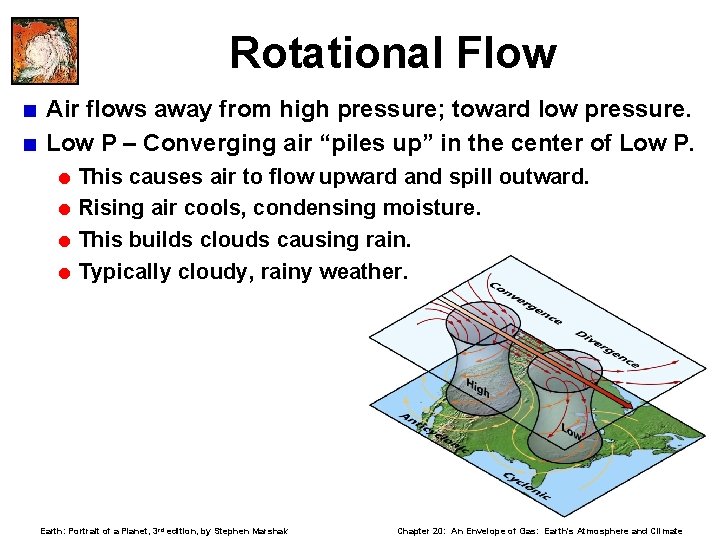
Rotational Flow < Air flows away from high pressure; toward low pressure. < Low P – Converging air “piles up” in the center of Low P. = This causes air to flow upward and spill outward. = Rising air cools, condensing moisture. = This builds clouds causing rain. = Typically cloudy, rainy weather. Earth: Portrait of a Planet, 3 rd edition, by Stephen Marshak Chapter 20: An Envelope of Gas: Earth's Atmosphere and Climate
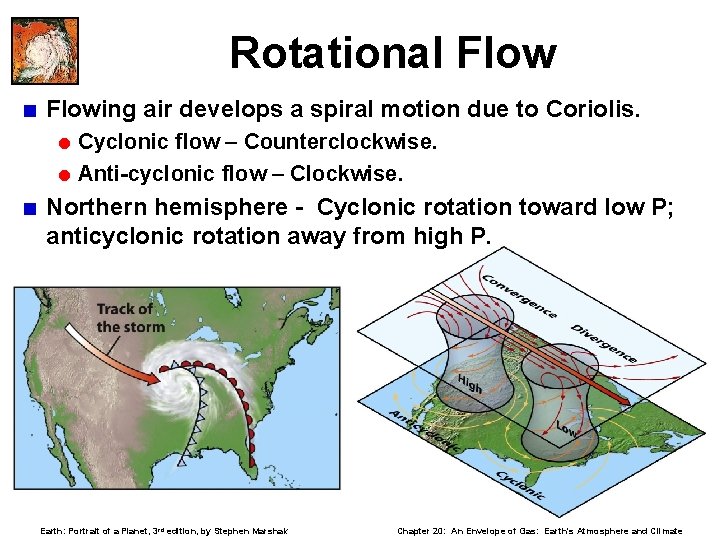
Rotational Flow < Flowing air develops a spiral motion due to Coriolis. = Cyclonic flow – Counterclockwise. = Anti-cyclonic flow – Clockwise. < Northern hemisphere - Cyclonic rotation toward low P; anticyclonic rotation away from high P. Earth: Portrait of a Planet, 3 rd edition, by Stephen Marshak Chapter 20: An Envelope of Gas: Earth's Atmosphere and Climate
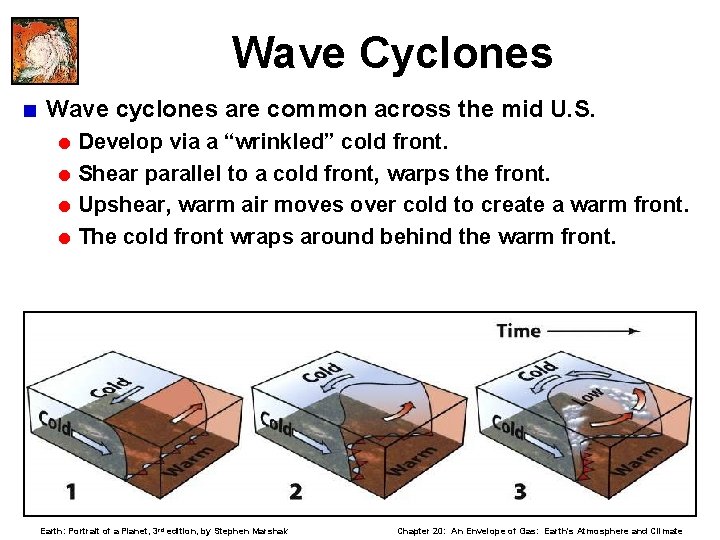
Wave Cyclones < Wave cyclones are common across the mid U. S. = Develop via a “wrinkled” cold front. = Shear parallel to a cold front, warps the front. = Upshear, warm air moves over cold to create a warm front. = The cold front wraps around behind the warm front. Earth: Portrait of a Planet, 3 rd edition, by Stephen Marshak Chapter 20: An Envelope of Gas: Earth's Atmosphere and Climate
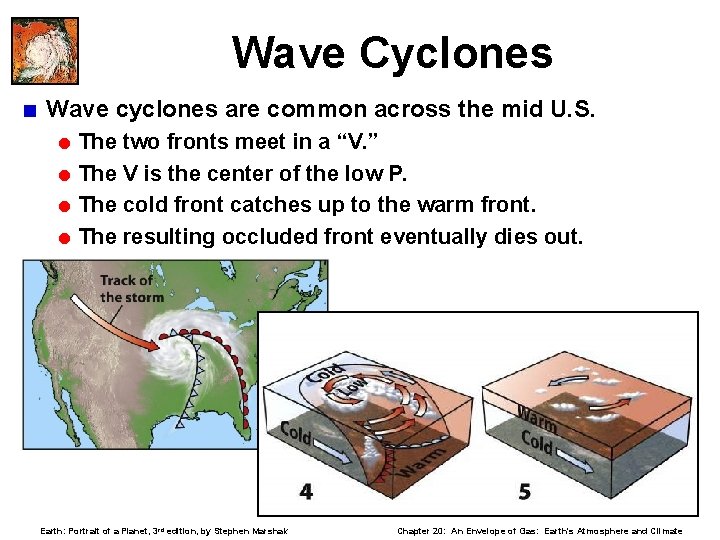
Wave Cyclones < Wave cyclones are common across the mid U. S. = The two fronts meet in a “V. ” = The V is the center of the low P. = The cold front catches up to the warm front. = The resulting occluded front eventually dies out. Earth: Portrait of a Planet, 3 rd edition, by Stephen Marshak Chapter 20: An Envelope of Gas: Earth's Atmosphere and Climate
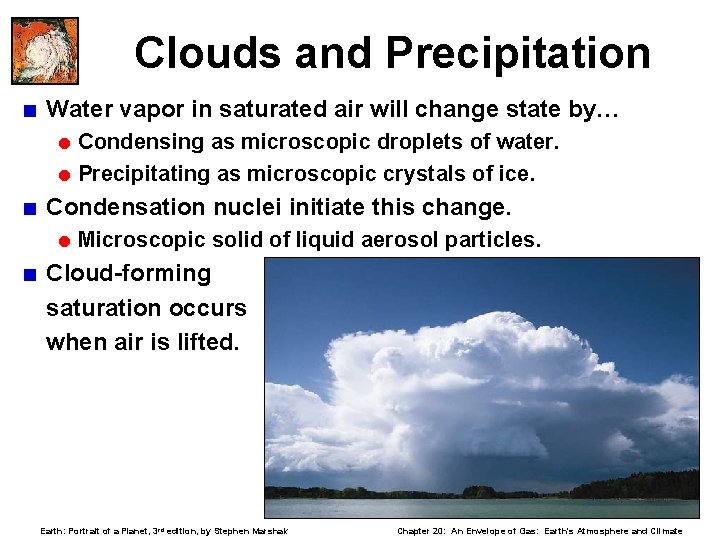
Clouds and Precipitation < Water vapor in saturated air will change state by… = Condensing as microscopic droplets of water. = Precipitating as microscopic crystals of ice. < Condensation nuclei initiate this change. = Microscopic solid of liquid aerosol particles. < Cloud-forming saturation occurs when air is lifted. Earth: Portrait of a Planet, 3 rd edition, by Stephen Marshak Chapter 20: An Envelope of Gas: Earth's Atmosphere and Climate
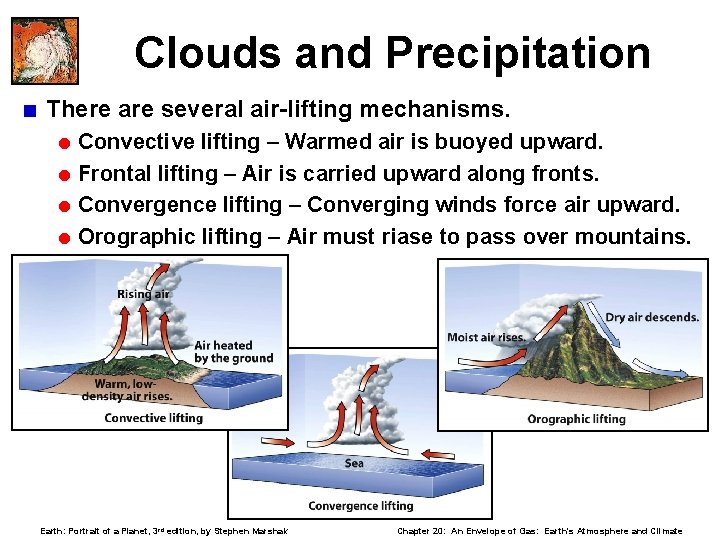
Clouds and Precipitation < There are several air-lifting mechanisms. = Convective lifting – Warmed air is buoyed upward. = Frontal lifting – Air is carried upward along fronts. = Convergence lifting – Converging winds force air upward. = Orographic lifting – Air must riase to pass over mountains. Earth: Portrait of a Planet, 3 rd edition, by Stephen Marshak Chapter 20: An Envelope of Gas: Earth's Atmosphere and Climate
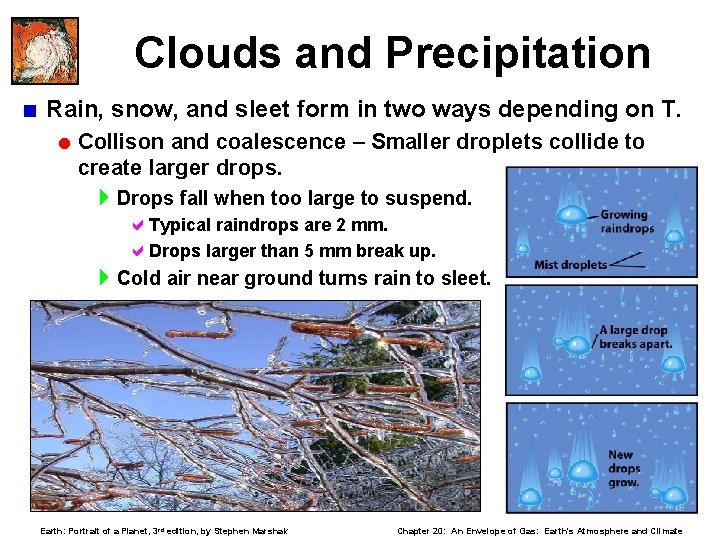
Clouds and Precipitation < Rain, snow, and sleet form in two ways depending on T. = Collison and coalescence – Smaller droplets collide to create larger drops. 4 Drops fall when too large to suspend. a. Typical raindrops are 2 mm. a. Drops larger than 5 mm break up. 4 Cold air near ground turns rain to sleet. Earth: Portrait of a Planet, 3 rd edition, by Stephen Marshak Chapter 20: An Envelope of Gas: Earth's Atmosphere and Climate
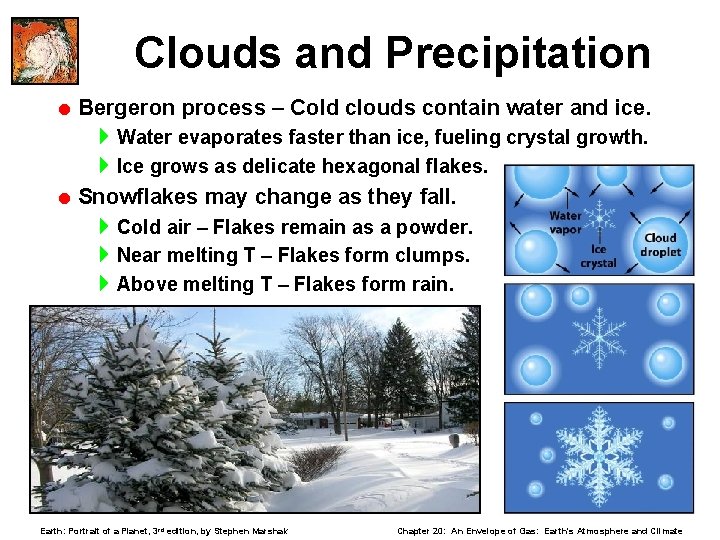
Clouds and Precipitation = Bergeron process – Cold clouds contain water and ice. 4 Water evaporates faster than ice, fueling crystal growth. 4 Ice grows as delicate hexagonal flakes. = Snowflakes may change as they fall. 4 Cold air – Flakes remain as a powder. 4 Near melting T – Flakes form clumps. 4 Above melting T – Flakes form rain. Earth: Portrait of a Planet, 3 rd edition, by Stephen Marshak Chapter 20: An Envelope of Gas: Earth's Atmosphere and Climate
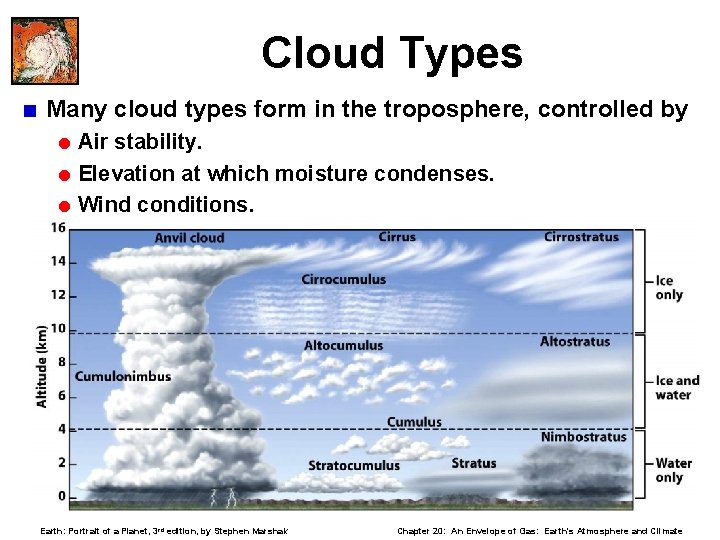
Cloud Types < Many cloud types form in the troposphere, controlled by = Air stability. = Elevation at which moisture condenses. = Wind conditions. Earth: Portrait of a Planet, 3 rd edition, by Stephen Marshak Chapter 20: An Envelope of Gas: Earth's Atmosphere and Climate
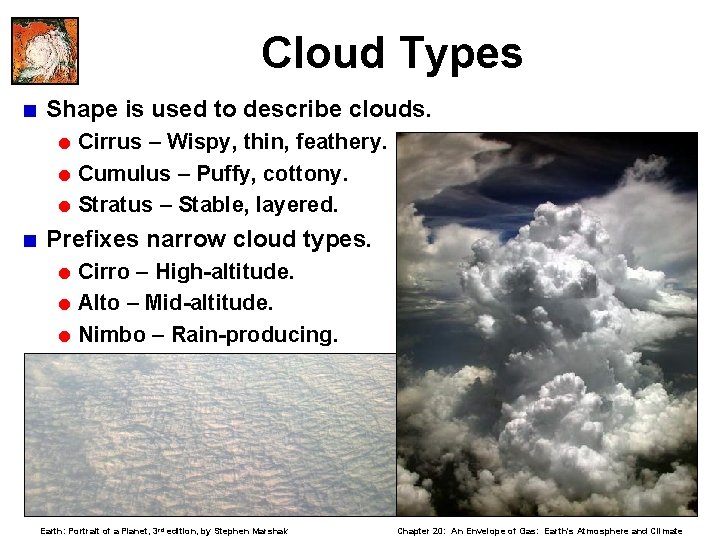
Cloud Types < Shape is used to describe clouds. = Cirrus – Wispy, thin, feathery. = Cumulus – Puffy, cottony. = Stratus – Stable, layered. < Prefixes narrow cloud types. = Cirro – High-altitude. = Alto – Mid-altitude. = Nimbo – Rain-producing. Earth: Portrait of a Planet, 3 rd edition, by Stephen Marshak Chapter 20: An Envelope of Gas: Earth's Atmosphere and Climate
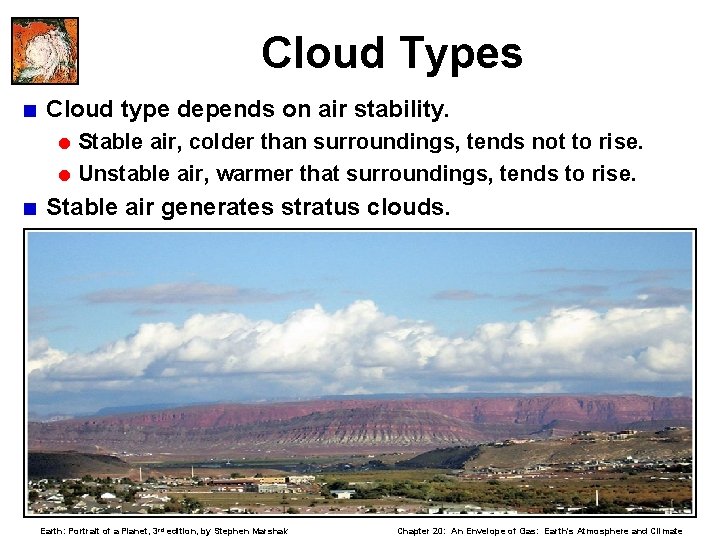
Cloud Types < Cloud type depends on air stability. = Stable air, colder than surroundings, tends not to rise. = Unstable air, warmer that surroundings, tends to rise. < Stable air generates stratus clouds. Earth: Portrait of a Planet, 3 rd edition, by Stephen Marshak Chapter 20: An Envelope of Gas: Earth's Atmosphere and Climate
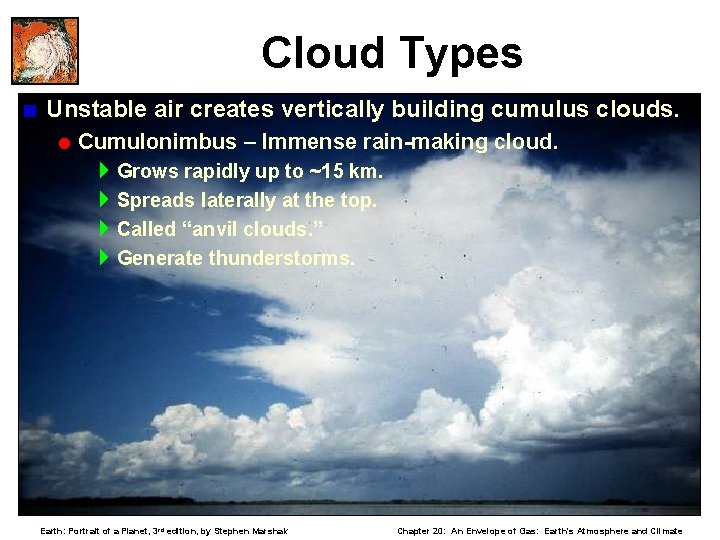
Cloud Types < Unstable air creates vertically building cumulus clouds. = Cumulonimbus – Immense rain-making cloud. 4 Grows rapidly up to ~15 km. 4 Spreads laterally at the top. 4 Called “anvil clouds. ” 4 Generate thunderstorms. Earth: Portrait of a Planet, 3 rd edition, by Stephen Marshak Chapter 20: An Envelope of Gas: Earth's Atmosphere and Climate
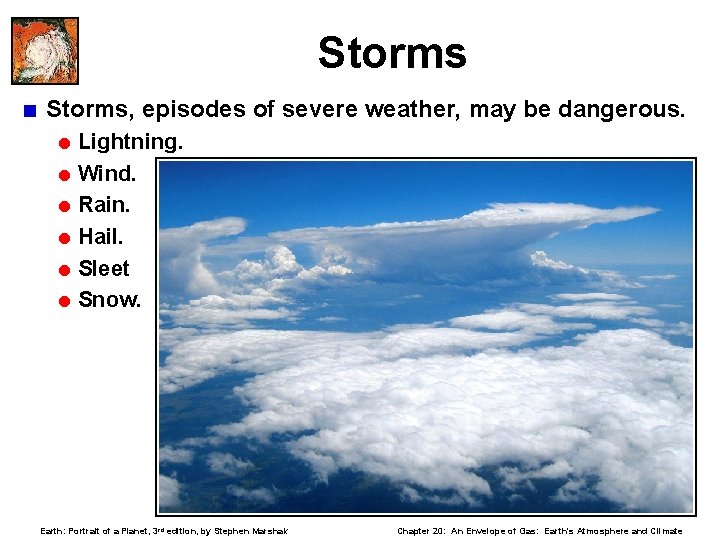
Storms < Storms, episodes of severe weather, may be dangerous. = Lightning. = Wind. = Rain. = Hail. = Sleet = Snow. Earth: Portrait of a Planet, 3 rd edition, by Stephen Marshak Chapter 20: An Envelope of Gas: Earth's Atmosphere and Climate
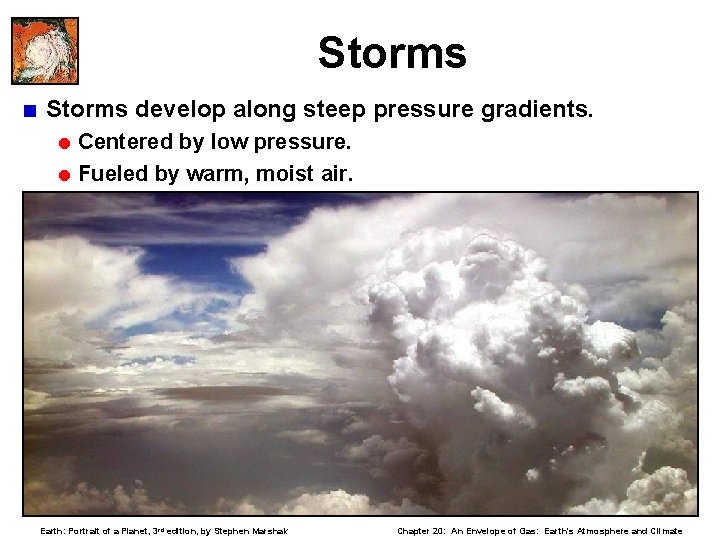
Storms < Storms develop along steep pressure gradients. = Centered by low pressure. = Fueled by warm, moist air. Earth: Portrait of a Planet, 3 rd edition, by Stephen Marshak Chapter 20: An Envelope of Gas: Earth's Atmosphere and Climate
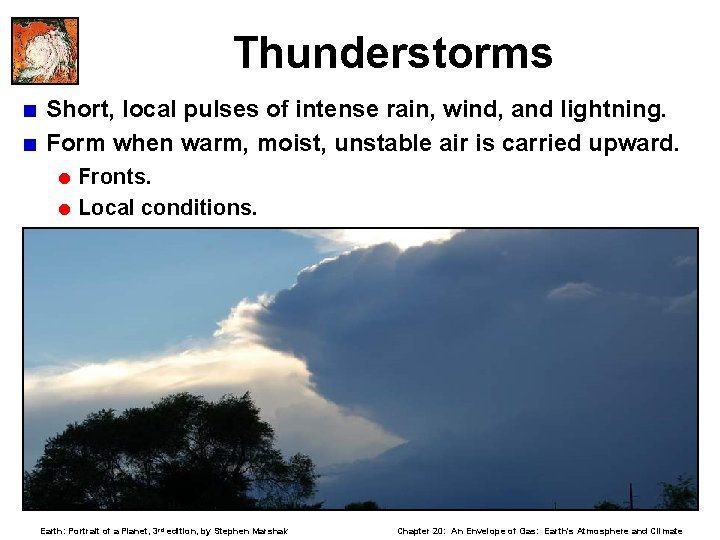
Thunderstorms < Short, local pulses of intense rain, wind, and lightning. < Form when warm, moist, unstable air is carried upward. = Fronts. = Local conditions. Earth: Portrait of a Planet, 3 rd edition, by Stephen Marshak Chapter 20: An Envelope of Gas: Earth's Atmosphere and Climate
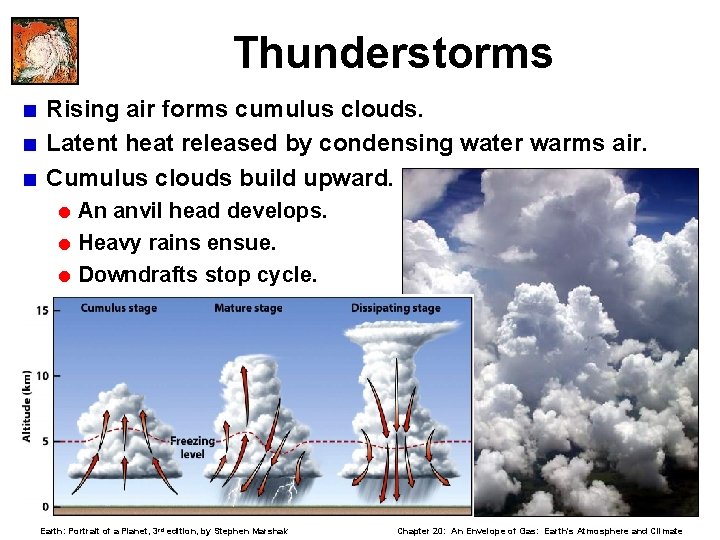
Thunderstorms < Rising air forms cumulus clouds. < Latent heat released by condensing water warms air. < Cumulus clouds build upward. = An anvil head develops. = Heavy rains ensue. = Downdrafts stop cycle. Earth: Portrait of a Planet, 3 rd edition, by Stephen Marshak Chapter 20: An Envelope of Gas: Earth's Atmosphere and Climate
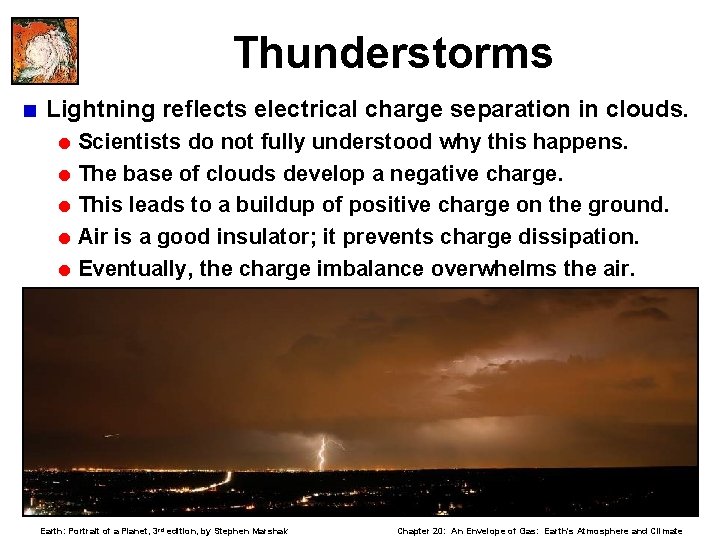
Thunderstorms < Lightning reflects electrical charge separation in clouds. = Scientists do not fully understood why this happens. = The base of clouds develop a negative charge. = This leads to a buildup of positive charge on the ground. = Air is a good insulator; it prevents charge dissipation. = Eventually, the charge imbalance overwhelms the air. Earth: Portrait of a Planet, 3 rd edition, by Stephen Marshak Chapter 20: An Envelope of Gas: Earth's Atmosphere and Climate
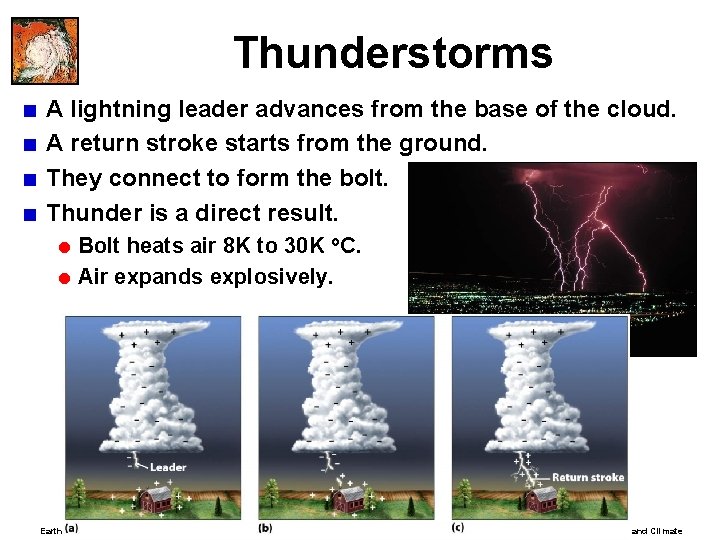
Thunderstorms < A lightning leader advances from the base of the cloud. < A return stroke starts from the ground. < They connect to form the bolt. < Thunder is a direct result. = Bolt heats air 8 K to 30 K o. C. = Air expands explosively. Earth: Portrait of a Planet, 3 rd edition, by Stephen Marshak Chapter 20: An Envelope of Gas: Earth's Atmosphere and Climate
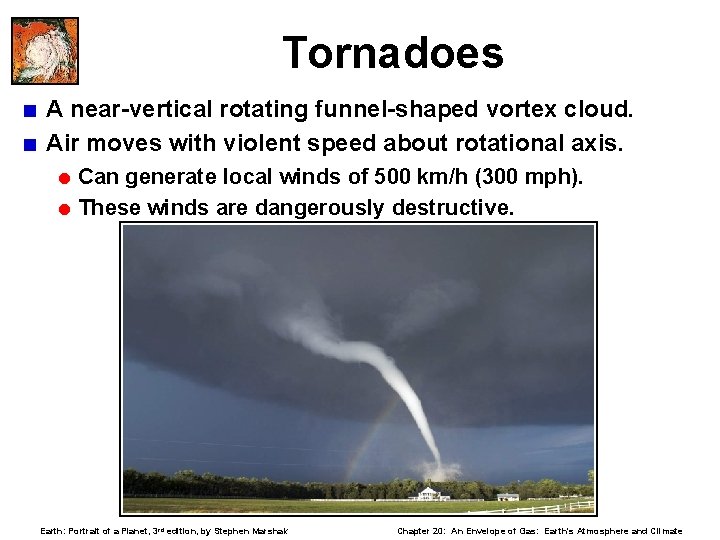
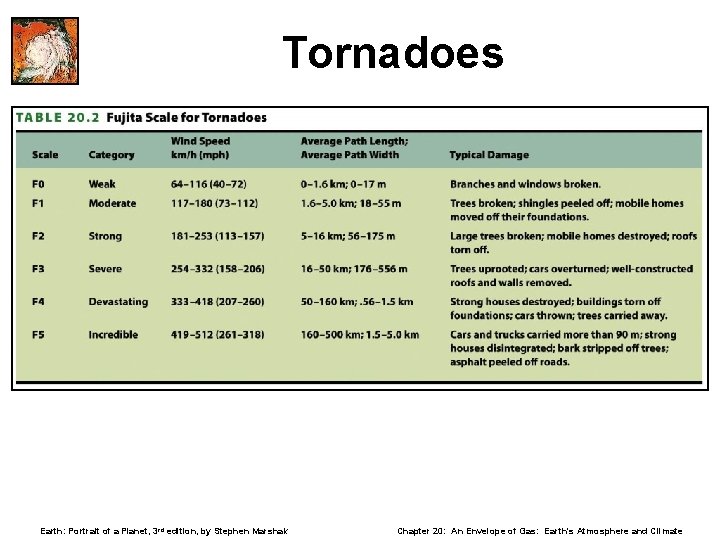
Tornadoes < A near-vertical rotating funnel-shaped vortex cloud. < Air moves with violent speed about rotational axis. = Can generate local winds of 500 km/h (300 mph). = These winds are dangerously destructive. Earth: Portrait of a Planet, 3 rd edition, by Stephen Marshak Chapter 20: An Envelope of Gas: Earth's Atmosphere and Climate
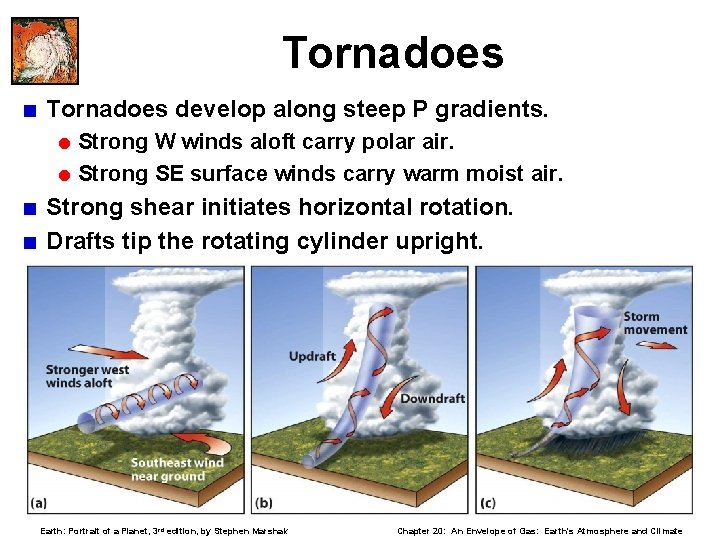
Tornadoes < Tornadoes develop along steep P gradients. = Strong W winds aloft carry polar air. = Strong SE surface winds carry warm moist air. < Strong shear initiates horizontal rotation. < Drafts tip the rotating cylinder upright. Earth: Portrait of a Planet, 3 rd edition, by Stephen Marshak Chapter 20: An Envelope of Gas: Earth's Atmosphere and Climate
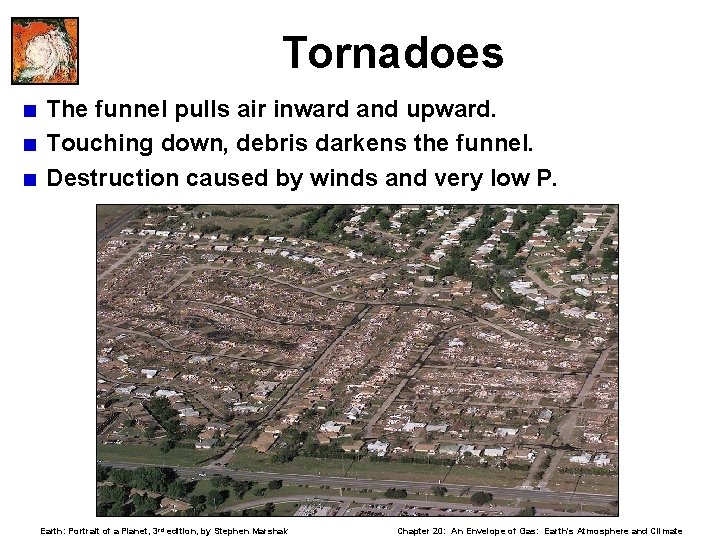
Tornadoes < The funnel pulls air inward and upward. < Touching down, debris darkens the funnel. < Destruction caused by winds and very low P. Earth: Portrait of a Planet, 3 rd edition, by Stephen Marshak Chapter 20: An Envelope of Gas: Earth's Atmosphere and Climate
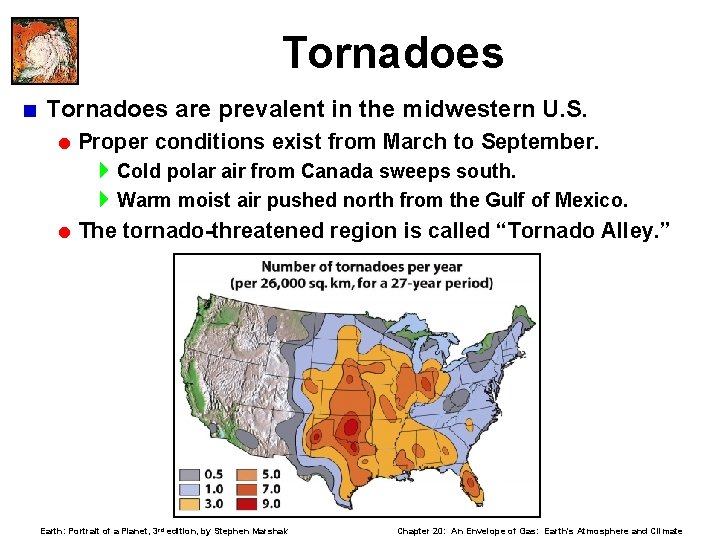
Tornadoes < Tornadoes are prevalent in the midwestern U. S. = Proper conditions exist from March to September. 4 Cold polar air from Canada sweeps south. 4 Warm moist air pushed north from the Gulf of Mexico. = The tornado-threatened region is called “Tornado Alley. ” Earth: Portrait of a Planet, 3 rd edition, by Stephen Marshak Chapter 20: An Envelope of Gas: Earth's Atmosphere and Climate
Tornadoes Earth: Portrait of a Planet, 3 rd edition, by Stephen Marshak Chapter 20: An Envelope of Gas: Earth's Atmosphere and Climate
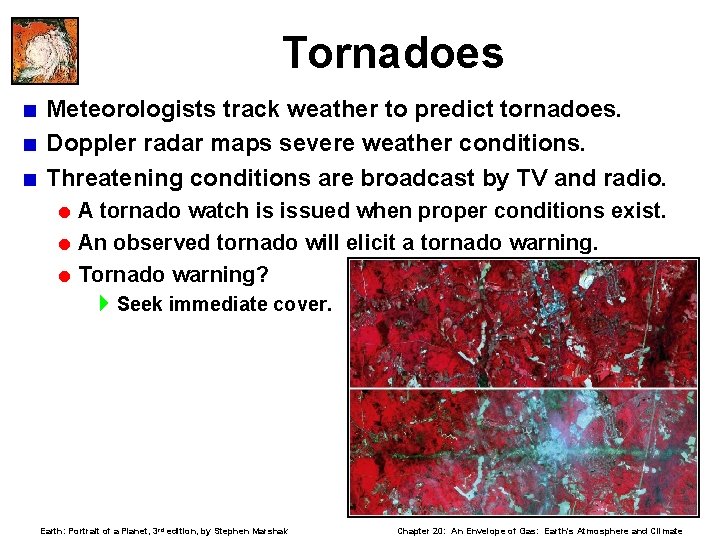
Tornadoes < Meteorologists track weather to predict tornadoes. < Doppler radar maps severe weather conditions. < Threatening conditions are broadcast by TV and radio. = A tornado watch is issued when proper conditions exist. = An observed tornado will elicit a tornado warning. = Tornado warning? 4 Seek immediate cover. Earth: Portrait of a Planet, 3 rd edition, by Stephen Marshak Chapter 20: An Envelope of Gas: Earth's Atmosphere and Climate
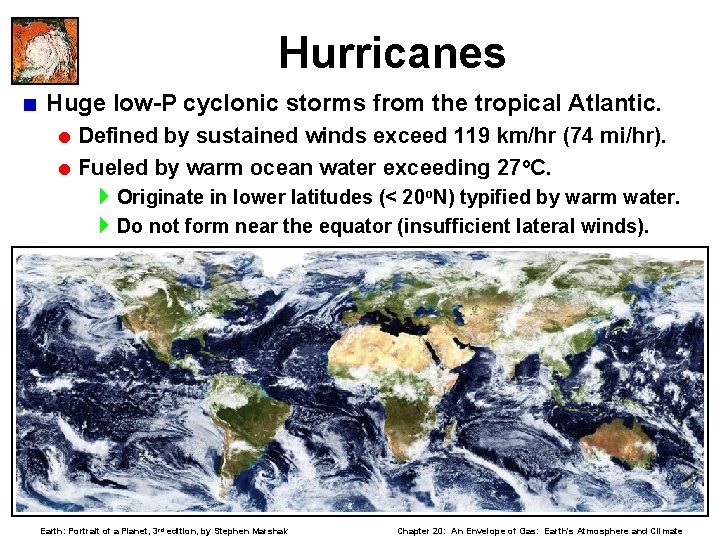
Hurricanes < Huge low-P cyclonic storms from the tropical Atlantic. = Defined by sustained winds exceed 119 km/hr (74 mi/hr). = Fueled by warm ocean water exceeding 27 o. C. 4 Originate in lower latitudes (< 20 o. N) typified by warm water. 4 Do not form near the equator (insufficient lateral winds). Earth: Portrait of a Planet, 3 rd edition, by Stephen Marshak Chapter 20: An Envelope of Gas: Earth's Atmosphere and Climate
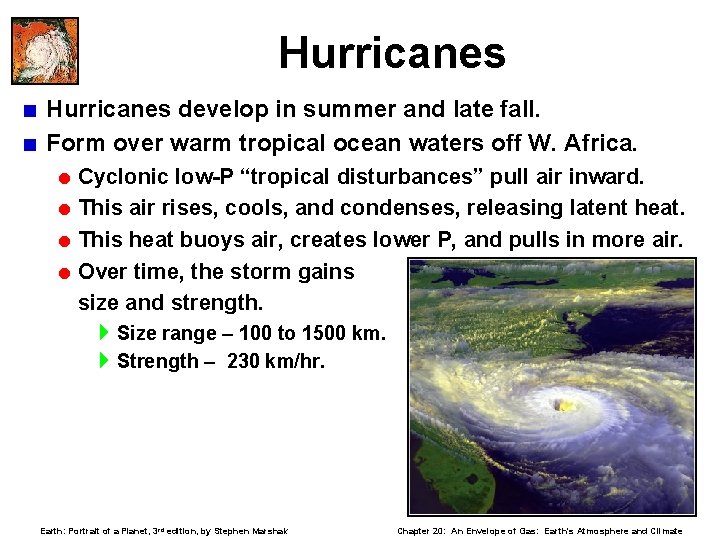
Hurricanes < Hurricanes develop in summer and late fall. < Form over warm tropical ocean waters off W. Africa. = Cyclonic low-P “tropical disturbances” pull air inward. = This air rises, cools, and condenses, releasing latent heat. = This heat buoys air, creates lower P, and pulls in more air. = Over time, the storm gains size and strength. 4 Size range – 100 to 1500 km. 4 Strength – 230 km/hr. Earth: Portrait of a Planet, 3 rd edition, by Stephen Marshak Chapter 20: An Envelope of Gas: Earth's Atmosphere and Climate
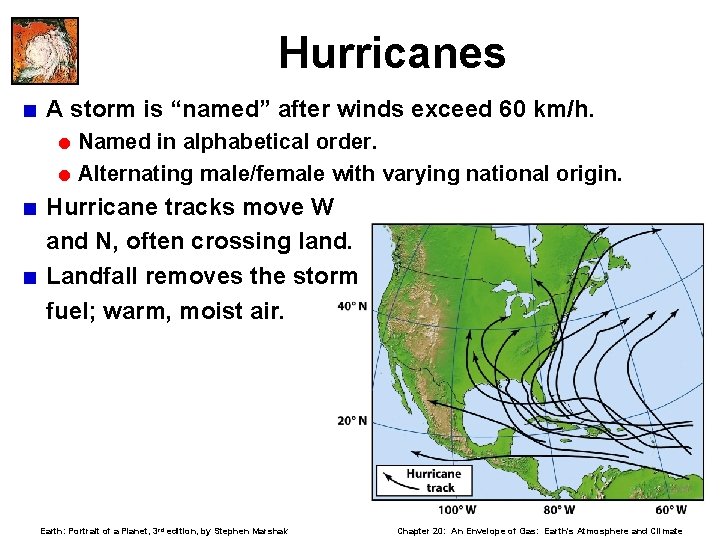
Hurricanes < A storm is “named” after winds exceed 60 km/h. = Named in alphabetical order. = Alternating male/female with varying national origin. < Hurricane tracks move W and N, often crossing land. < Landfall removes the storm fuel; warm, moist air. Earth: Portrait of a Planet, 3 rd edition, by Stephen Marshak Chapter 20: An Envelope of Gas: Earth's Atmosphere and Climate
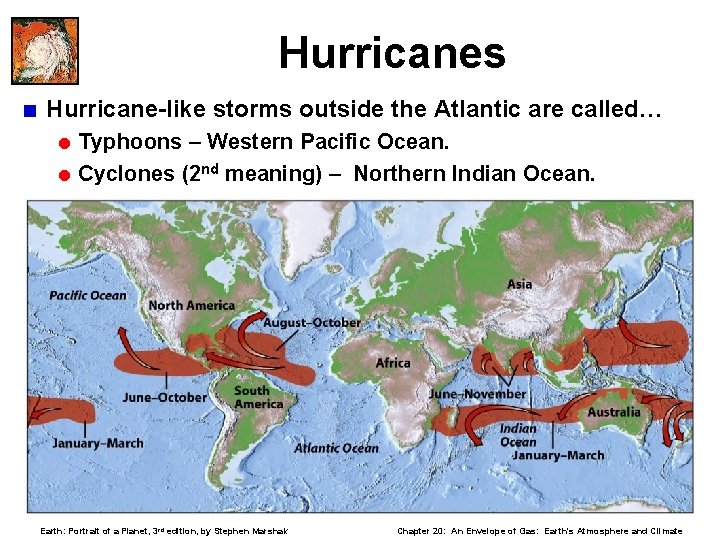
Hurricanes < Hurricane-like storms outside the Atlantic are called… = Typhoons – Western Pacific Ocean. = Cyclones (2 nd meaning) – Northern Indian Ocean. Earth: Portrait of a Planet, 3 rd edition, by Stephen Marshak Chapter 20: An Envelope of Gas: Earth's Atmosphere and Climate
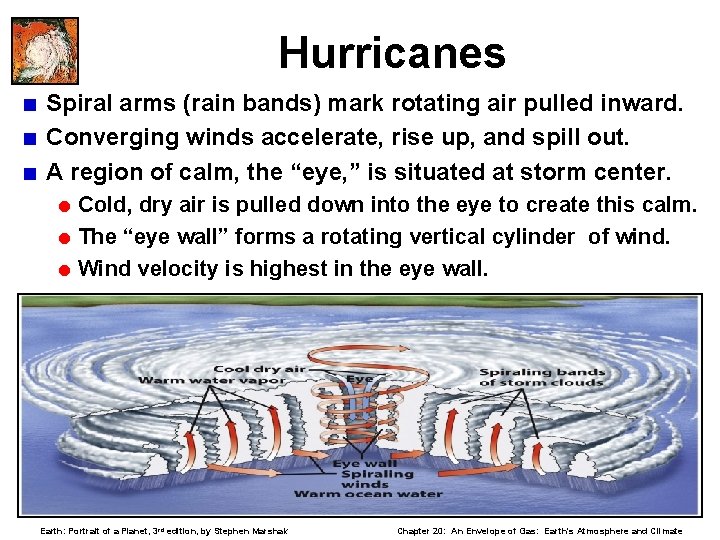
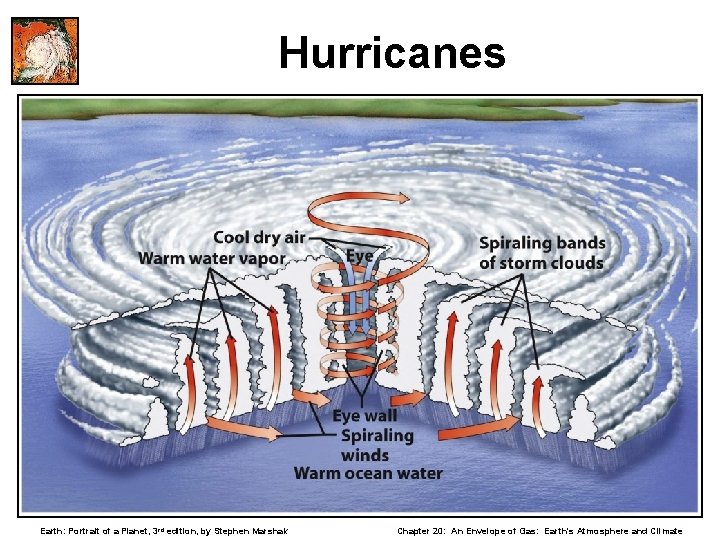
Hurricanes < Spiral arms (rain bands) mark rotating air pulled inward. < Converging winds accelerate, rise up, and spill out. < A region of calm, the “eye, ” is situated at storm center. = Cold, dry air is pulled down into the eye to create this calm. = The “eye wall” forms a rotating vertical cylinder of wind. = Wind velocity is highest in the eye wall. Earth: Portrait of a Planet, 3 rd edition, by Stephen Marshak Chapter 20: An Envelope of Gas: Earth's Atmosphere and Climate
Hurricanes Earth: Portrait of a Planet, 3 rd edition, by Stephen Marshak Chapter 20: An Envelope of Gas: Earth's Atmosphere and Climate
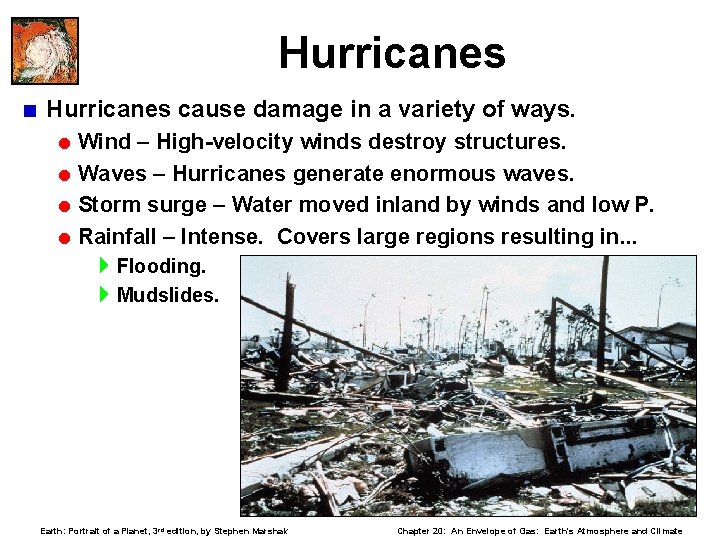
Hurricanes < Hurricanes cause damage in a variety of ways. = Wind – High-velocity winds destroy structures. = Waves – Hurricanes generate enormous waves. = Storm surge – Water moved inland by winds and low P. = Rainfall – Intense. Covers large regions resulting in. . . 4 Flooding. 4 Mudslides. Earth: Portrait of a Planet, 3 rd edition, by Stephen Marshak Chapter 20: An Envelope of Gas: Earth's Atmosphere and Climate
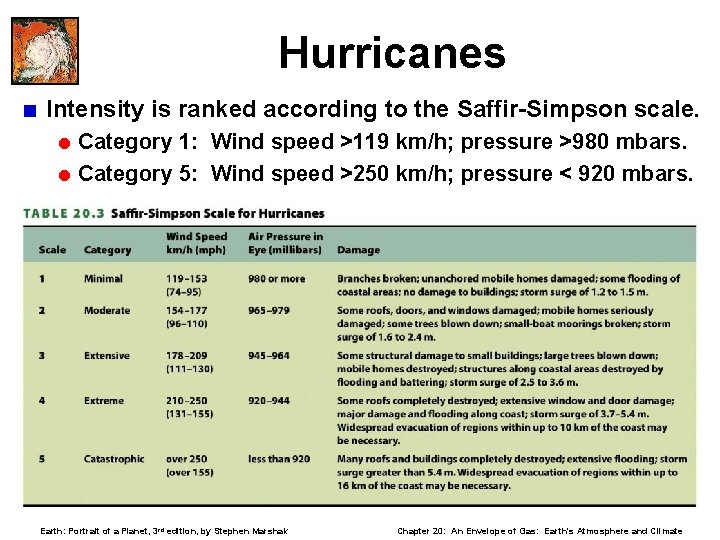
Hurricanes < Intensity is ranked according to the Saffir-Simpson scale. = Category 1: Wind speed >119 km/h; pressure >980 mbars. = Category 5: Wind speed >250 km/h; pressure < 920 mbars. Earth: Portrait of a Planet, 3 rd edition, by Stephen Marshak Chapter 20: An Envelope of Gas: Earth's Atmosphere and Climate
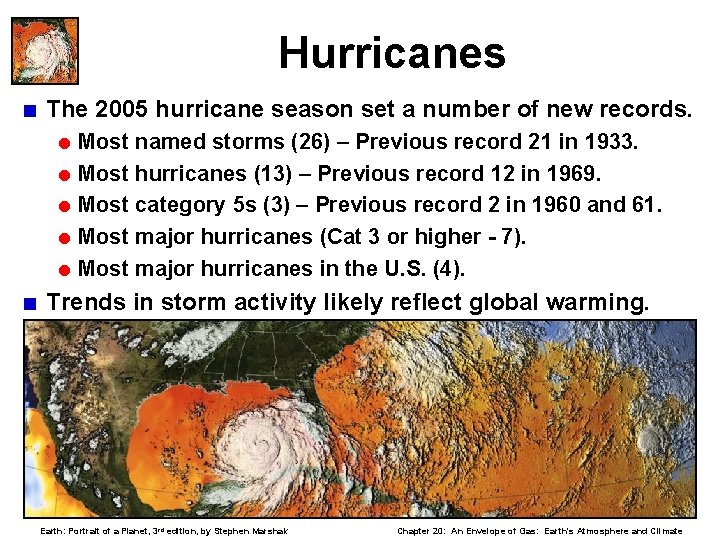
Hurricanes < The 2005 hurricane season set a number of new records. = Most named storms (26) – Previous record 21 in 1933. = Most hurricanes (13) – Previous record 12 in 1969. = Most category 5 s (3) – Previous record 2 in 1960 and 61. = Most major hurricanes (Cat 3 or higher - 7). = Most major hurricanes in the U. S. (4). < Trends in storm activity likely reflect global warming. Earth: Portrait of a Planet, 3 rd edition, by Stephen Marshak Chapter 20: An Envelope of Gas: Earth's Atmosphere and Climate
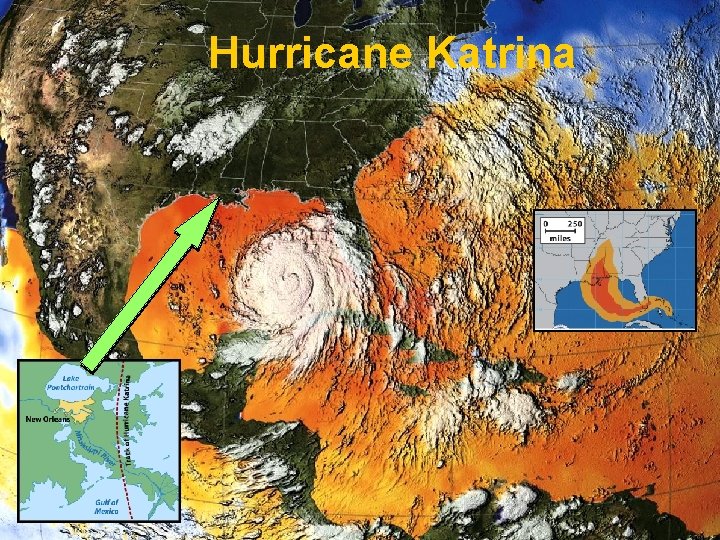
Hurricane Katrina
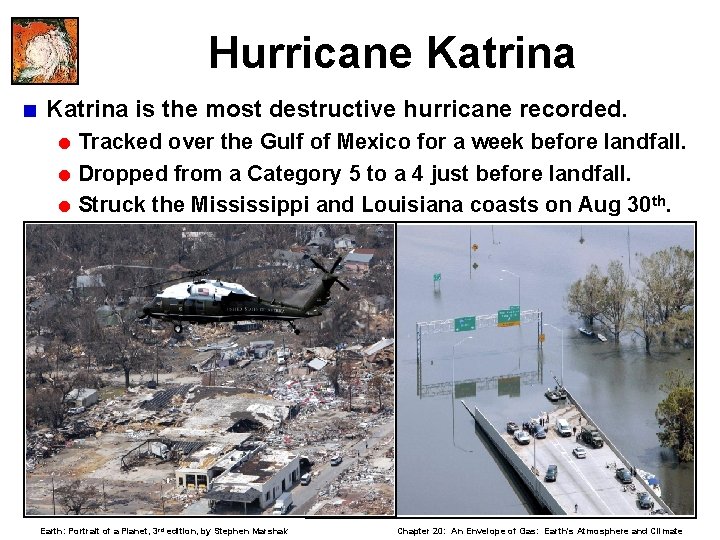
Hurricane Katrina < Katrina is the most destructive hurricane recorded. = Tracked over the Gulf of Mexico for a week before landfall. = Dropped from a Category 5 to a 4 just before landfall. = Struck the Mississippi and Louisiana coasts on Aug 30 th. Earth: Portrait of a Planet, 3 rd edition, by Stephen Marshak Chapter 20: An Envelope of Gas: Earth's Atmosphere and Climate
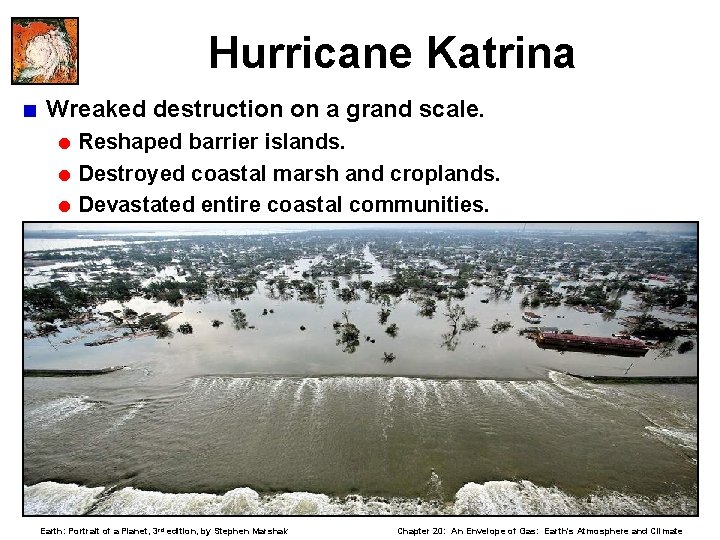
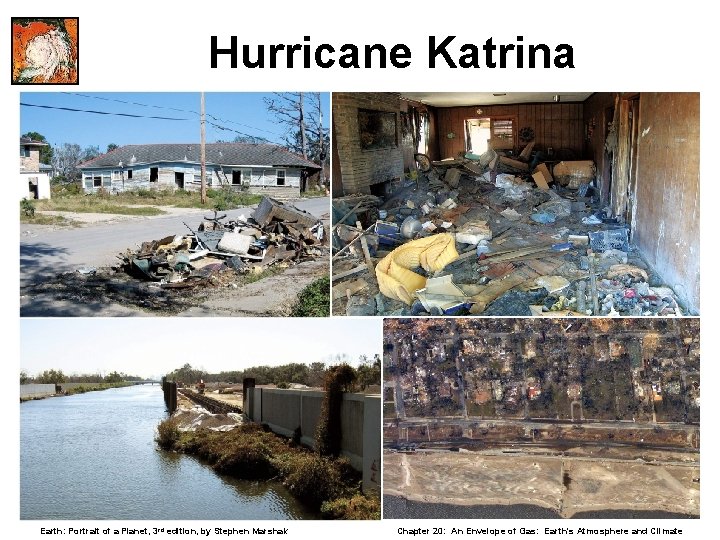
Hurricane Katrina < Wreaked destruction on a grand scale. = Reshaped barrier islands. = Destroyed coastal marsh and croplands. = Devastated entire coastal communities. Earth: Portrait of a Planet, 3 rd edition, by Stephen Marshak Chapter 20: An Envelope of Gas: Earth's Atmosphere and Climate
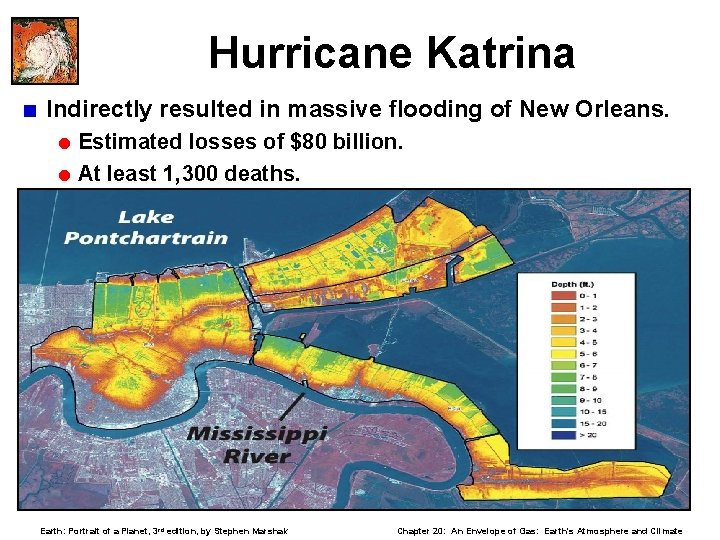
Hurricane Katrina < Indirectly resulted in massive flooding of New Orleans. = Estimated losses of $80 billion. = At least 1, 300 deaths. Earth: Portrait of a Planet, 3 rd edition, by Stephen Marshak Chapter 20: An Envelope of Gas: Earth's Atmosphere and Climate
Hurricane Katrina Earth: Portrait of a Planet, 3 rd edition, by Stephen Marshak Chapter 20: An Envelope of Gas: Earth's Atmosphere and Climate
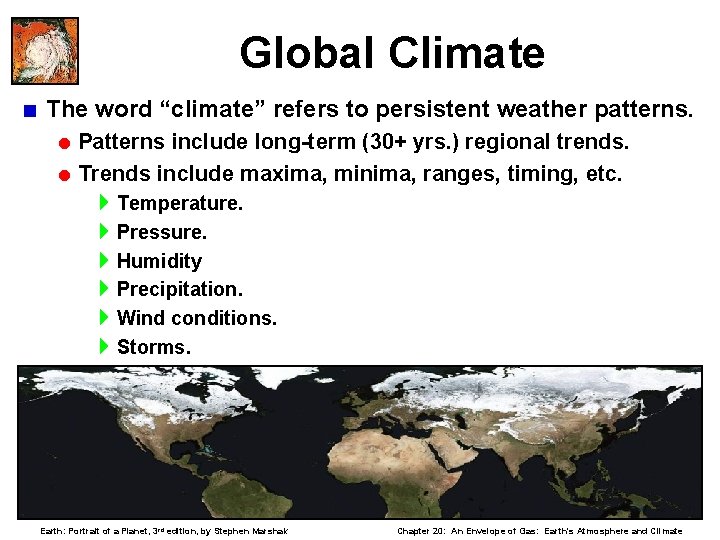
Global Climate < The word “climate” refers to persistent weather patterns. = Patterns include long-term (30+ yrs. ) regional trends. = Trends include maxima, minima, ranges, timing, etc. 4 Temperature. 4 Pressure. 4 Humidity 4 Precipitation. 4 Wind conditions. 4 Storms. Earth: Portrait of a Planet, 3 rd edition, by Stephen Marshak Chapter 20: An Envelope of Gas: Earth's Atmosphere and Climate
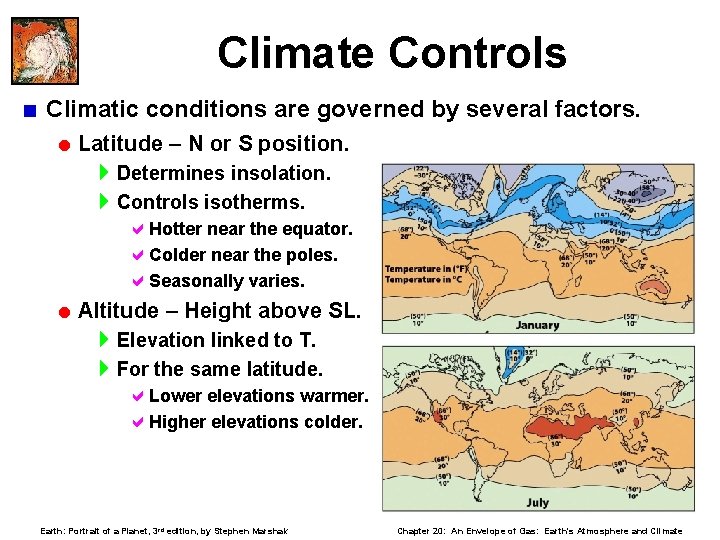
Climate Controls < Climatic conditions are governed by several factors. = Latitude – N or S position. 4 Determines insolation. 4 Controls isotherms. a. Hotter near the equator. a. Colder near the poles. a. Seasonally varies. = Altitude – Height above SL. 4 Elevation linked to T. 4 For the same latitude. a. Lower elevations warmer. a. Higher elevations colder. Earth: Portrait of a Planet, 3 rd edition, by Stephen Marshak Chapter 20: An Envelope of Gas: Earth's Atmosphere and Climate
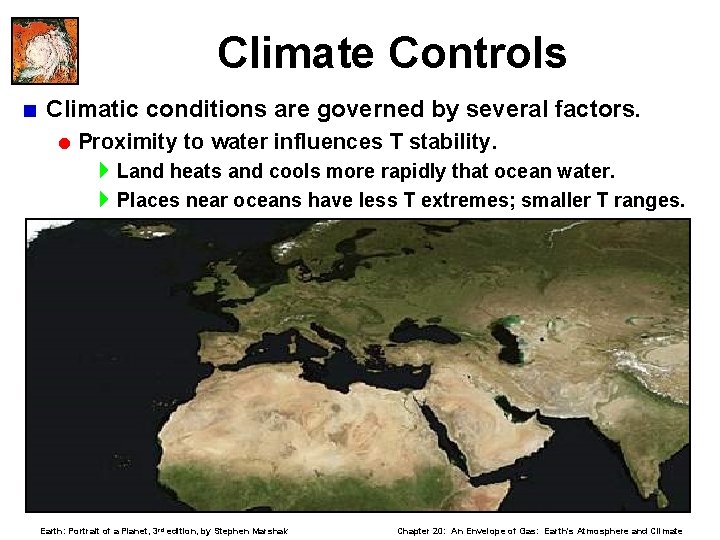
Climate Controls < Climatic conditions are governed by several factors. = Proximity to water influences T stability. 4 Land heats and cools more rapidly that ocean water. 4 Places near oceans have less T extremes; smaller T ranges. Earth: Portrait of a Planet, 3 rd edition, by Stephen Marshak Chapter 20: An Envelope of Gas: Earth's Atmosphere and Climate
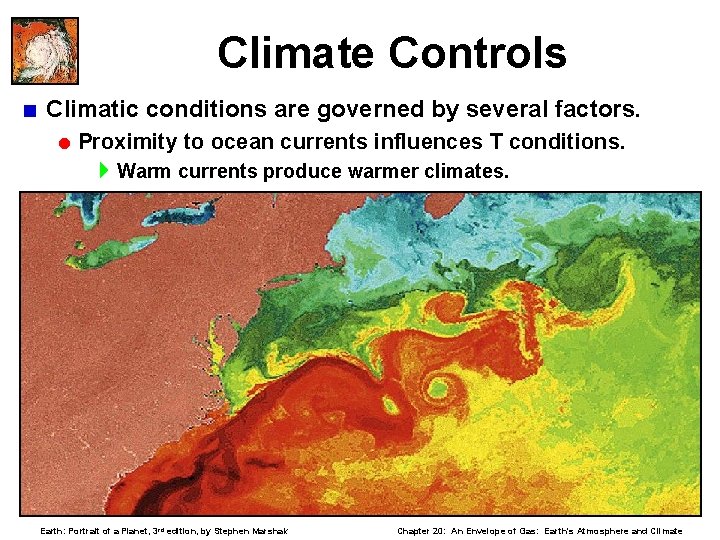
Climate Controls < Climatic conditions are governed by several factors. = Proximity to ocean currents influences T conditions. 4 Warm currents produce warmer climates. Earth: Portrait of a Planet, 3 rd edition, by Stephen Marshak Chapter 20: An Envelope of Gas: Earth's Atmosphere and Climate
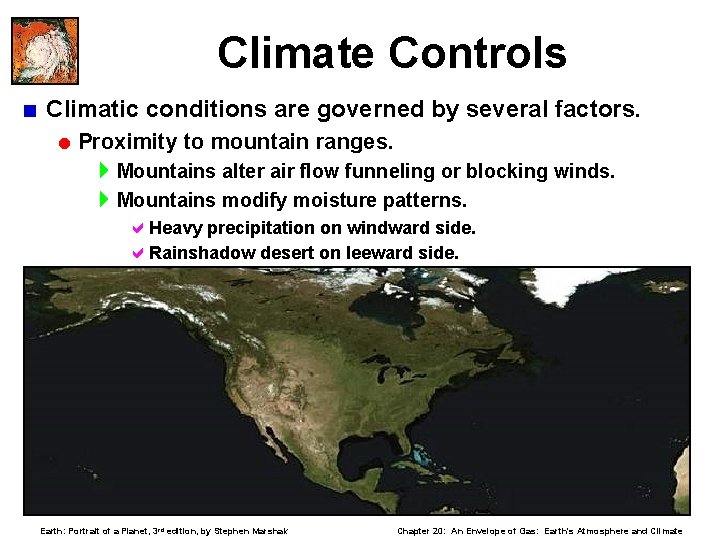
Climate Controls < Climatic conditions are governed by several factors. = Proximity to mountain ranges. 4 Mountains alter air flow funneling or blocking winds. 4 Mountains modify moisture patterns. a. Heavy precipitation on windward side. a. Rainshadow desert on leeward side. Earth: Portrait of a Planet, 3 rd edition, by Stephen Marshak Chapter 20: An Envelope of Gas: Earth's Atmosphere and Climate
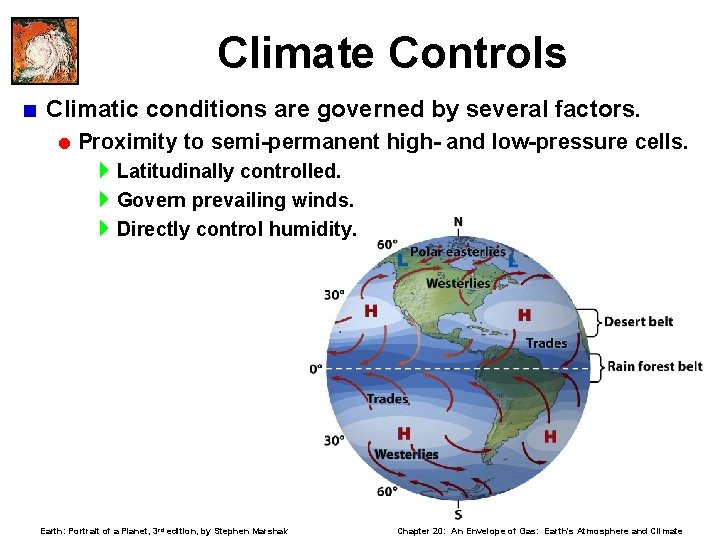
Climate Controls < Climatic conditions are governed by several factors. = Proximity to semi-permanent high- and low-pressure cells. 4 Latitudinally controlled. 4 Govern prevailing winds. 4 Directly control humidity. Earth: Portrait of a Planet, 3 rd edition, by Stephen Marshak Chapter 20: An Envelope of Gas: Earth's Atmosphere and Climate
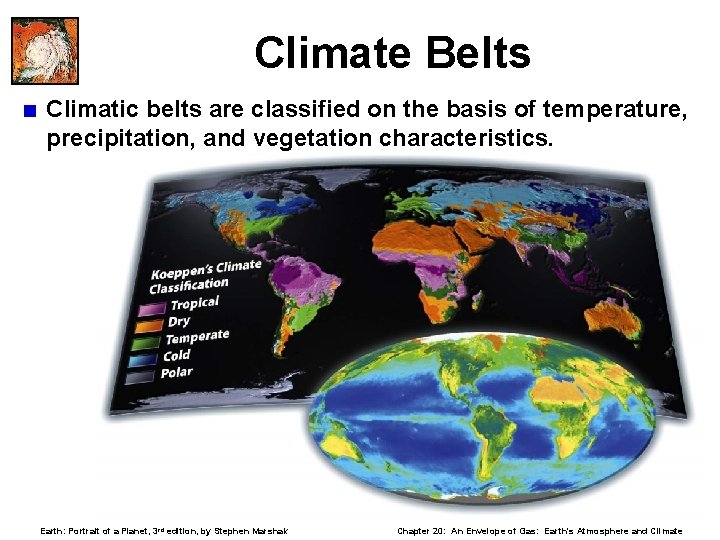
Climate Belts < Climatic belts are classified on the basis of temperature, precipitation, and vegetation characteristics. Earth: Portrait of a Planet, 3 rd edition, by Stephen Marshak Chapter 20: An Envelope of Gas: Earth's Atmosphere and Climate
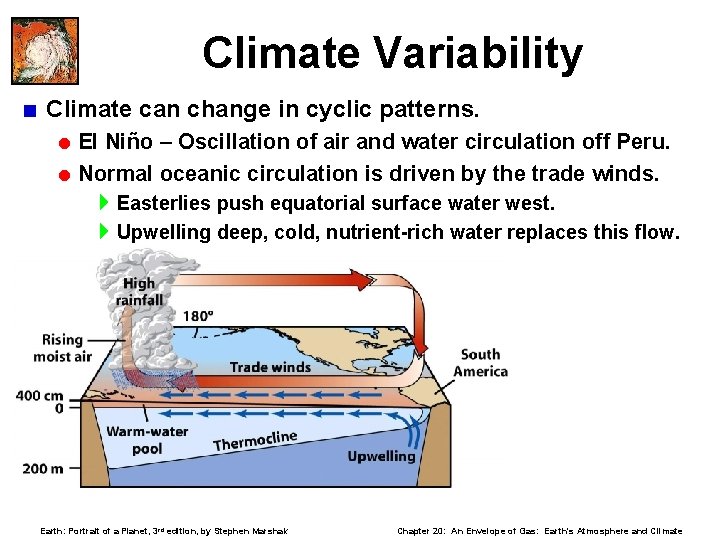
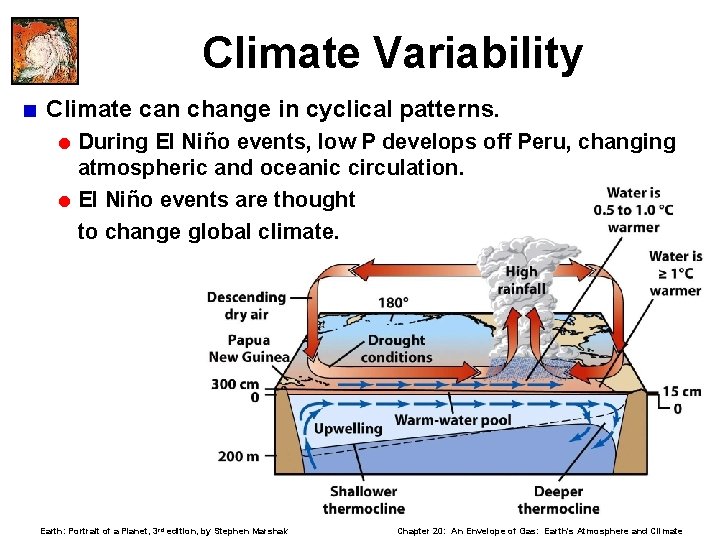
Climate Variability < Climate can change in cyclic patterns. = El Niño – Oscillation of air and water circulation off Peru. = Normal oceanic circulation is driven by the trade winds. 4 Easterlies push equatorial surface water west. 4 Upwelling deep, cold, nutrient-rich water replaces this flow. Earth: Portrait of a Planet, 3 rd edition, by Stephen Marshak Chapter 20: An Envelope of Gas: Earth's Atmosphere and Climate
Climate Variability < Climate can change in cyclical patterns. = During El Niño events, low P develops off Peru, changing atmospheric and oceanic circulation. = El Niño events are thought to change global climate. Earth: Portrait of a Planet, 3 rd edition, by Stephen Marshak Chapter 20: An Envelope of Gas: Earth's Atmosphere and Climate
This concludes the Chapter 20 An Envelope of Gas: Earth’s Atmosphere and Climate LECTURE OUTLINE earth Portrait of a Planet Third Edition © 2008 W. W. Norton & Company, Inc. Earth: Portrait of a Planet, 3 rd edition, by Stephen Marshak Chapter 20: An Envelope of Gas: Earth's Atmosphere and Climate