
Chapter 2 Values and Ethics This chapter will
- Slides: 23
Chapter 2: Values and Ethics This chapter will cover • Value assumptions • Conflicts between value assumptions • Value priorities • Ideal values versus real values • Ethics in argumentation • Ethical decision making Copyright © 2012 Pearson Education, Inc. All rights reserved.
Values and Ethics Assumptions • Unstated (and often unconscious) beliefs Copyright © 2012 Pearson Education, Inc. All rights reserved.
Value Assumptions and Conflicts Values • Beliefs, ideals, or principles that are considered worthy and held in high regard. • Truth • Loyalty • Freedom Copyright © 2012 Pearson Education, Inc. All rights reserved.
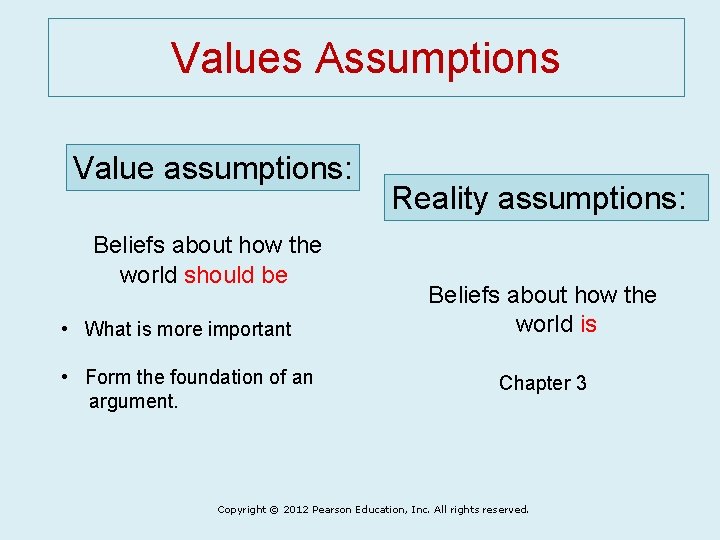
Values Assumptions Value assumptions: Beliefs about how the world should be • What is more important • Form the foundation of an argument. Reality assumptions: Beliefs about how the world is Chapter 3 Copyright © 2012 Pearson Education, Inc. All rights reserved.
Value Assumptions and Conflicts Value Conflict • When two competing values cannot be held to the same degree in a given argument or situation: Copyright © 2012 Pearson Education, Inc. All rights reserved.
Skill Understand that different values form the basis of many arguments and that conflicts are often based on differing value priorities. Copyright © 2012 Pearson Education, Inc. All rights reserved.
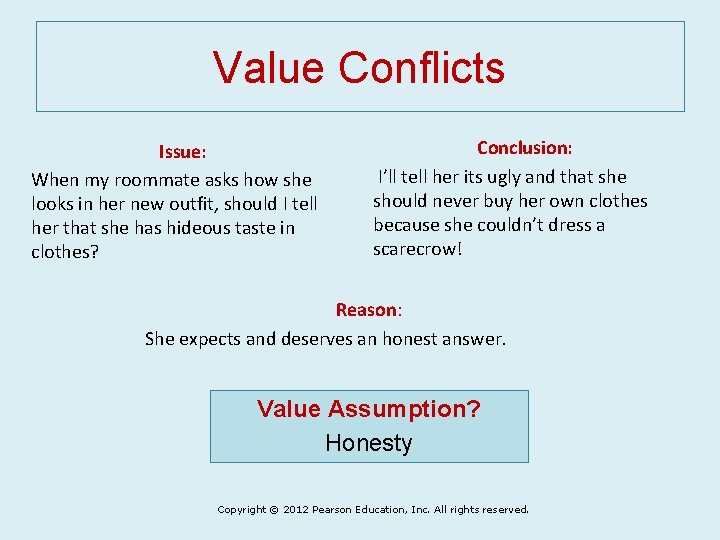
Value Conflicts Issue: When my roommate asks how she looks in her new outfit, should I tell her that she has hideous taste in clothes? Conclusion: I’ll tell her its ugly and that she should never buy her own clothes because she couldn’t dress a scarecrow! Reason: She expects and deserves an honest answer. Value Assumption? Honesty Copyright © 2012 Pearson Education, Inc. All rights reserved.
Ethics- A Dimension of Values Ethics • Standards of conduct that reflecting what we consider to be right or wrong Copyright © 2012 Pearson Education, Inc. All rights reserved.
Ethics- A Dimension of Values Morals • Principles that distinguish right from wrong behavior Copyright © 2012 Pearson Education, Inc. All rights reserved.
Ethics Why we have disagreements • We hold many values in common, but to different degrees… Copyright © 2012 Pearson Education, Inc. All rights reserved.
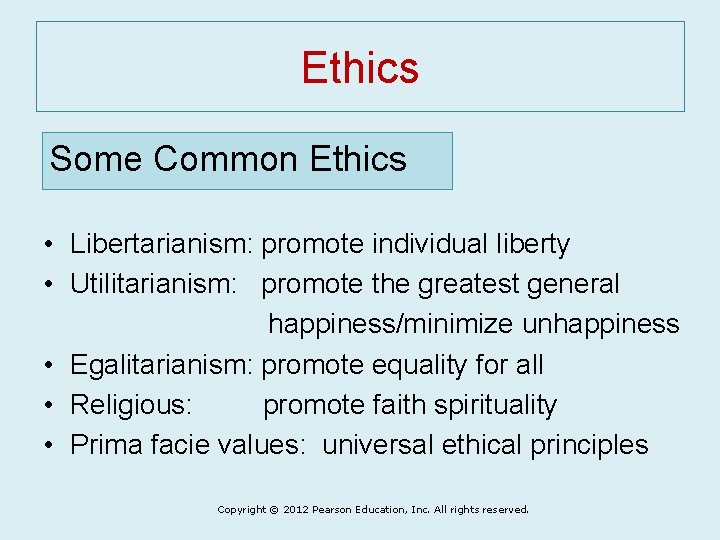
Ethics Some Common Ethics • Libertarianism: promote individual liberty • Utilitarianism: promote the greatest general happiness/minimize unhappiness • Egalitarianism: promote equality for all • Religious: promote faith spirituality • Prima facie values: universal ethical principles Copyright © 2012 Pearson Education, Inc. All rights reserved.
Ideal Values and Real Values Ideal Values • Held by an individual in a theoretical sense Copyright © 2012 Pearson Education, Inc. All rights reserved.
Ideal Values and Real Values • Theoretical and practiced Copyright © 2012 Pearson Education, Inc. All rights reserved.
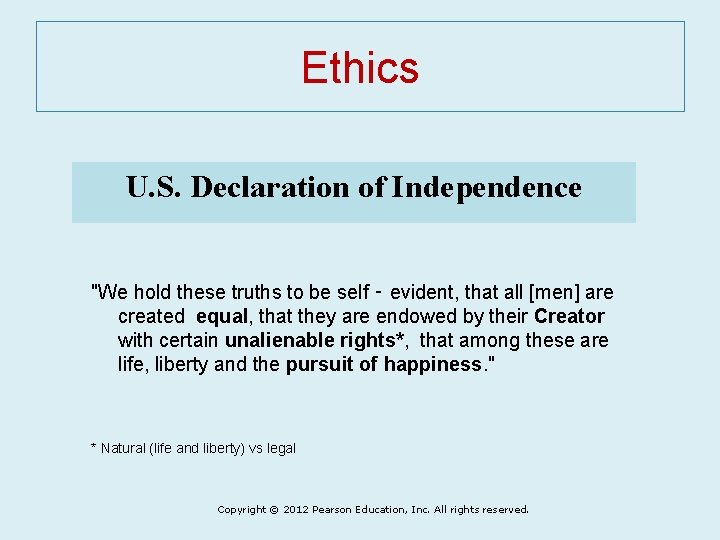
Ethics U. S. Declaration of Independence "We hold these truths to be self ‑ evident, that all [men] are created equal, that they are endowed by their Creator with certain unalienable rights*, that among these are life, liberty and the pursuit of happiness. " * Natural (life and liberty) vs legal Copyright © 2012 Pearson Education, Inc. All rights reserved.
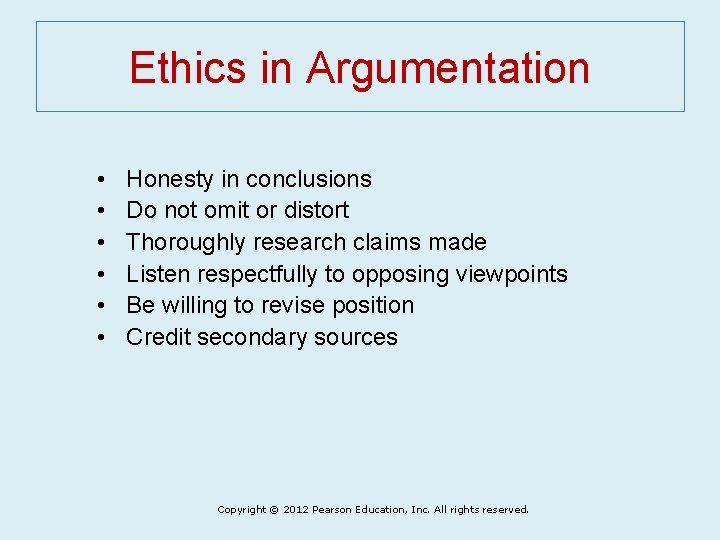
Ethics in Argumentation • • • Honesty in conclusions Do not omit or distort Thoroughly research claims made Listen respectfully to opposing viewpoints Be willing to revise position Credit secondary sources Copyright © 2012 Pearson Education, Inc. All rights reserved.
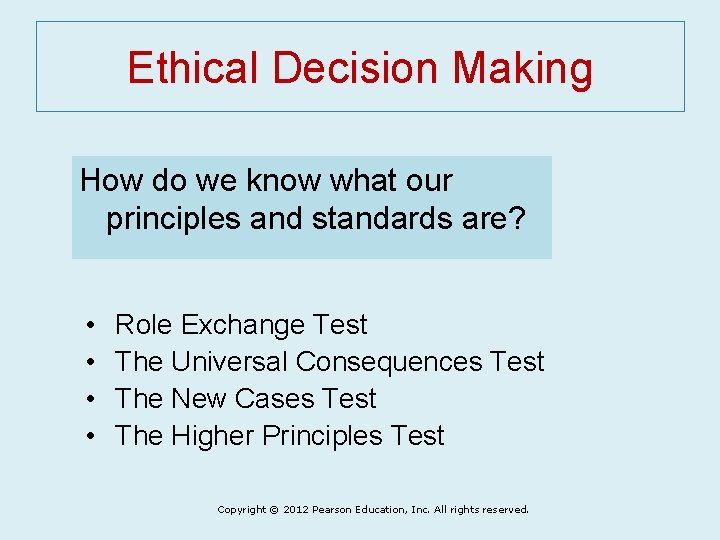
Ethical Decision Making How do we know what our principles and standards are? • • Role Exchange Test The Universal Consequences Test The New Cases Test The Higher Principles Test Copyright © 2012 Pearson Education, Inc. All rights reserved.
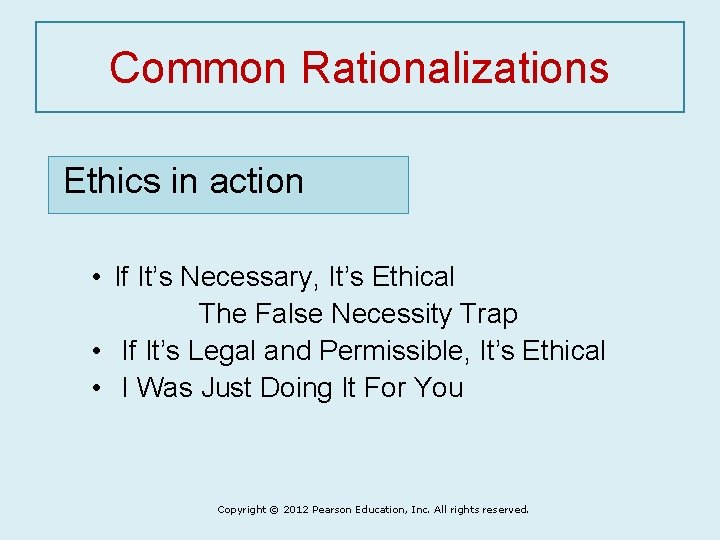
Common Rationalizations Ethics in action • If It’s Necessary, It’s Ethical The False Necessity Trap • If It’s Legal and Permissible, It’s Ethical • I Was Just Doing It For You Copyright © 2012 Pearson Education, Inc. All rights reserved.
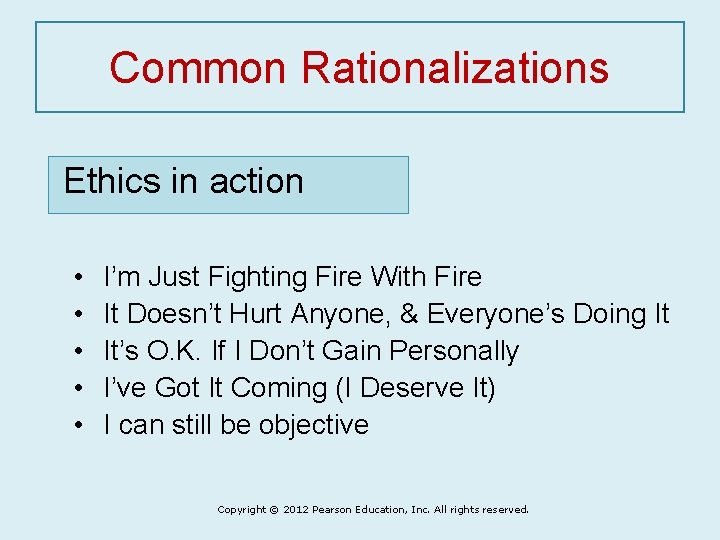
Common Rationalizations Ethics in action • • • I’m Just Fighting Fire With Fire It Doesn’t Hurt Anyone, & Everyone’s Doing It It’s O. K. If I Don’t Gain Personally I’ve Got It Coming (I Deserve It) I can still be objective Copyright © 2012 Pearson Education, Inc. All rights reserved.
Toulmin’s Model A Method for Discovering Assumptions Claims Reasons Warrants Copyright © 2012 Pearson Education, Inc. All rights reserved.
Toulmin’s Model: Claim • A statement of an individual’s belief or stand upon an issue Copyright © 2012 Pearson Education, Inc. All rights reserved.
Toulmin’s Model Warrant • The unstated but necessary link between reasons and claims Copyright © 2012 Pearson Education, Inc. All rights reserved.
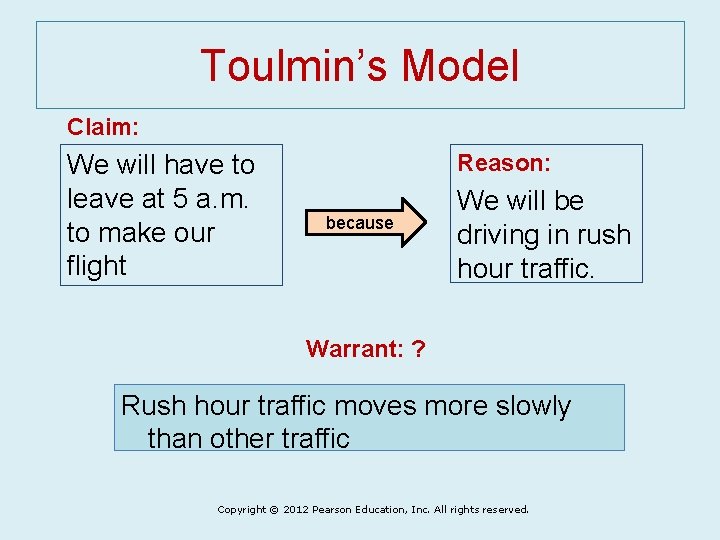
Toulmin’s Model Claim: We will have to leave at 5 a. m. to make our flight Reason: because We will be driving in rush hour traffic. Warrant: ? Rush hour traffic moves more slowly than other traffic Copyright © 2012 Pearson Education, Inc. All rights reserved.
Chapter 2: Values and Ethics Checkup • • What are value conflicts Name some ethics to use in an argument Difference between ideal and real values What are some common rationalizations Copyright © 2012 Pearson Education, Inc. All rights reserved.