
Chapter 2 Understanding Play Its Importance in Developmentally


- Slides: 8
Chapter 2 Understanding Play: Its Importance in Developmentally Appropriate Practice © 2007 Thomson Delmar Learning. All Rights Reserved.
What Is Play? a. Pleasurable b. Self-selected c. Intrinsically motivated and spontaneous d. Nonliteral or symbolic e. Actively engages children f. Encourages attention on the means, not the end © 2007 Thomson Delmar Learning. All Rights Reserved.
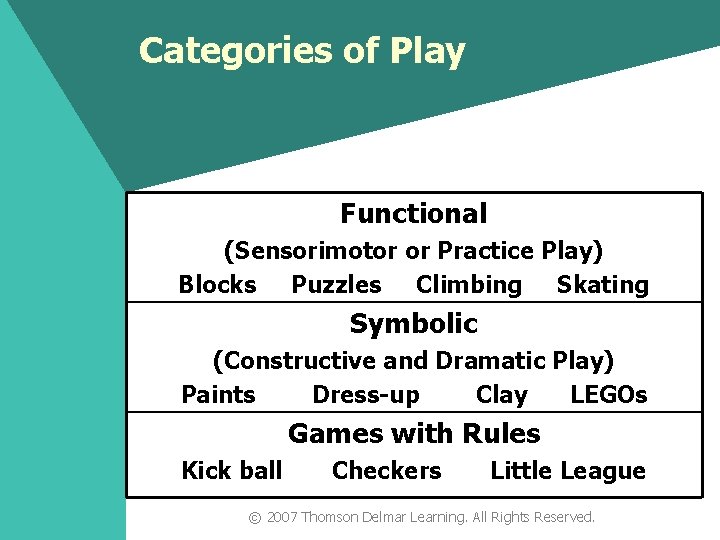
Categories of Play Functional (Sensorimotor or Practice Play) Blocks Puzzles Climbing Skating Symbolic (Constructive and Dramatic Play) Paints Dress-up Clay LEGOs Games with Rules Kick ball Checkers Little League © 2007 Thomson Delmar Learning. All Rights Reserved.
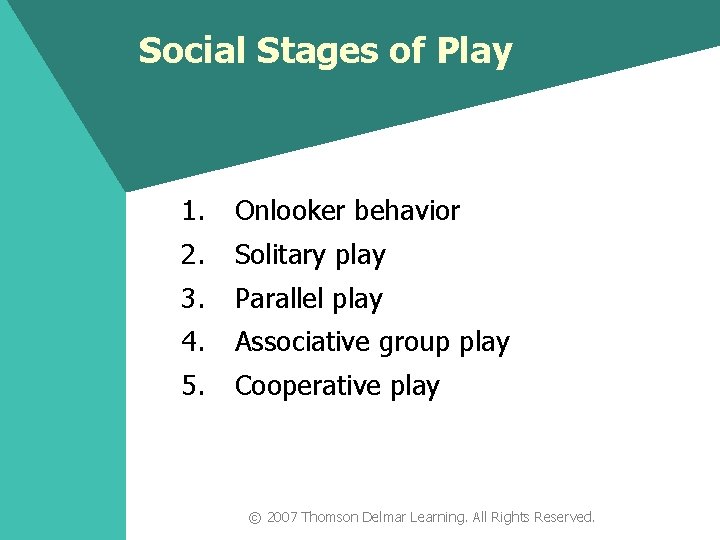
Social Stages of Play 1. Onlooker behavior 2. Solitary play 3. Parallel play 4. Associative group play 5. Cooperative play © 2007 Thomson Delmar Learning. All Rights Reserved.
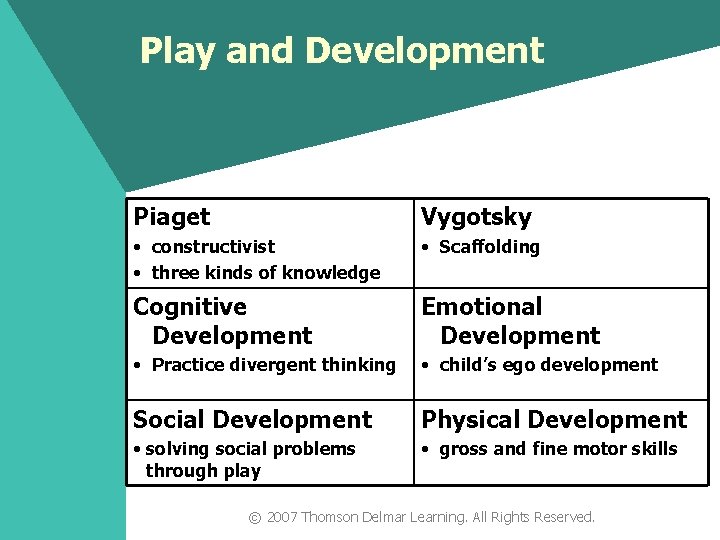
Play and Development Piaget Vygotsky • constructivist • three kinds of knowledge • Scaffolding Cognitive Development Emotional Development • Practice divergent thinking • child’s ego development Social Development Physical Development • solving social problems through play • gross and fine motor skills © 2007 Thomson Delmar Learning. All Rights Reserved.
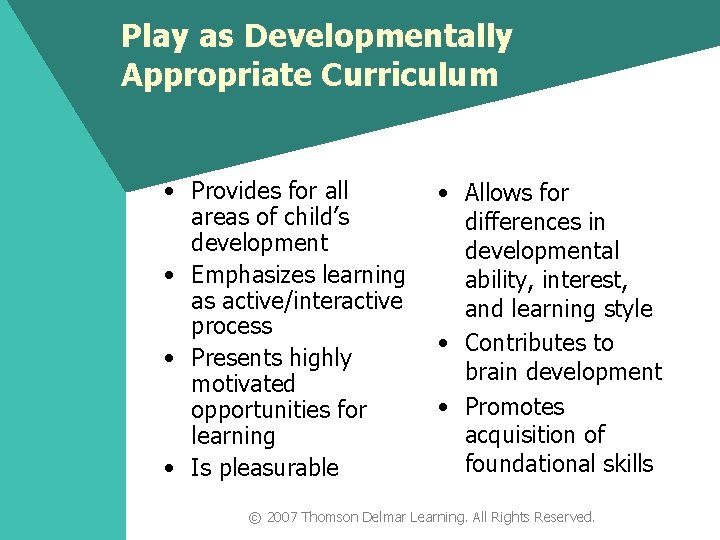
Play as Developmentally Appropriate Curriculum • Provides for all areas of child’s development • Emphasizes learning as active/interactive process • Presents highly motivated opportunities for learning • Is pleasurable • Allows for differences in developmental ability, interest, and learning style • Contributes to brain development • Promotes acquisition of foundational skills © 2007 Thomson Delmar Learning. All Rights Reserved.
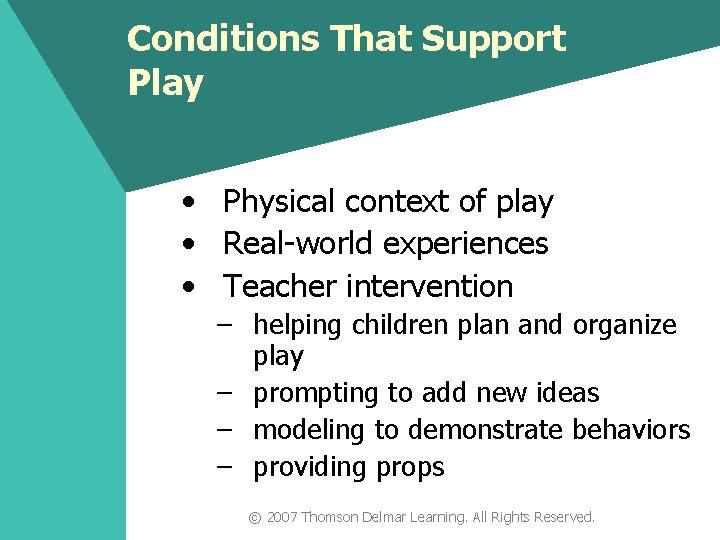
Conditions That Support Play • Physical context of play • Real-world experiences • Teacher intervention – helping children plan and organize play – prompting to add new ideas – modeling to demonstrate behaviors – providing props © 2007 Thomson Delmar Learning. All Rights Reserved.
Issues Involving Play • Violent play • Cultural influences on play • Play for children with special needs © 2007 Thomson Delmar Learning. All Rights Reserved.