
Chapter 2 Understanding Organizational Style and Its Impact
- Slides: 35
Chapter 2 Understanding Organizational Style and Its Impact on Information Systems Analysis and Design Kendall & Kendall Slide Design by Kendall & Kendall © Copyright Prentice Hall, 2005 Slide Design by Kendall & Kendall
Major Topics • Organizational environment • Nature of systems • Context-level data flow diagram • Entity-relationship diagram • Levels of management • Organizational culture 2
Organizations • Organizations are composed of interrelated and interdependent subsystems. • System and subsystem boundaries and environments impact on information system analysis and design. 3
Organizational Environment • Community environment • Geographical • Demographics (education, income) • Economic environment • Market factors • Competition • Political environment • State and local government 4
Open and Closed Systems are described as either • Open • Free-flowing information. • Output from one system becomes input to another. • Closed with restricted access to information • Limited by numerous rules. • Information on a need to know basis. 5
Tue 13 -10 Virtual Organizations • A virtual organization has parts of the organization in different physical locations. • Computer networks and communications technology are used to work on projects. 6
Virtual Organization Advantages of a virtual organization are: • Reduced costs of physical facilities. • More rapid response to customer needs. • Flexibility for employees to care for children or aging parents. 7
Enterprise Resource Planning • Enterprise Resource Planning (ERP) describes an integrated organizational information system. • The software helps the flow of information between the functional areas within the organization. 8
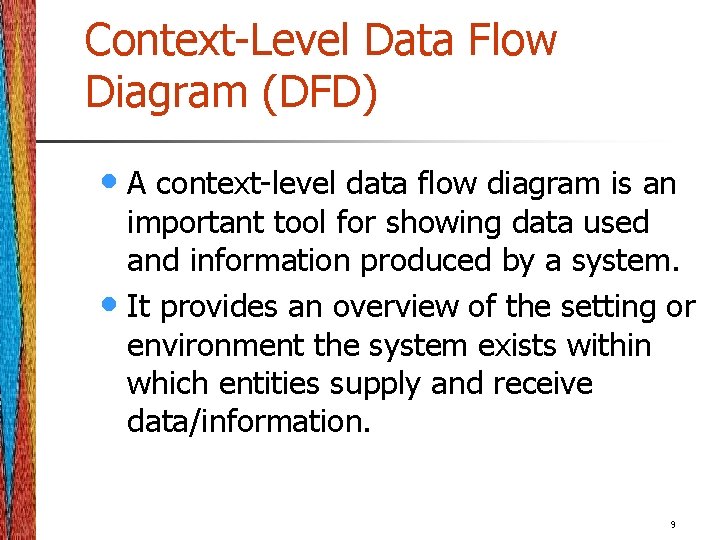
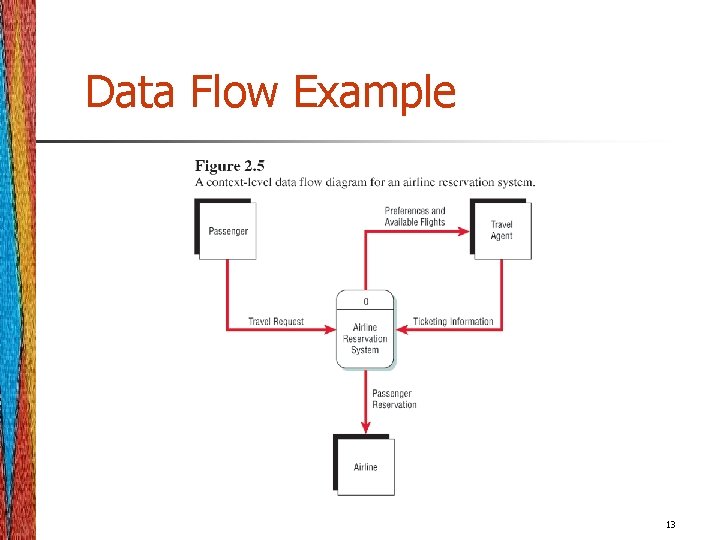
Context-Level Data Flow Diagram (DFD) • A context-level data flow diagram is an important tool for showing data used and information produced by a system. • It provides an overview of the setting or environment the system exists within which entities supply and receive data/information. 9
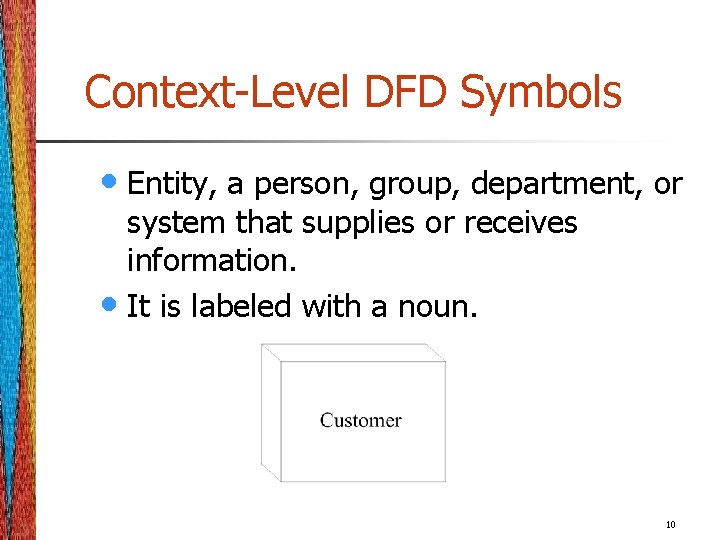
Context-Level DFD Symbols • Entity, a person, group, department, or system that supplies or receives information. • It is labeled with a noun. 10
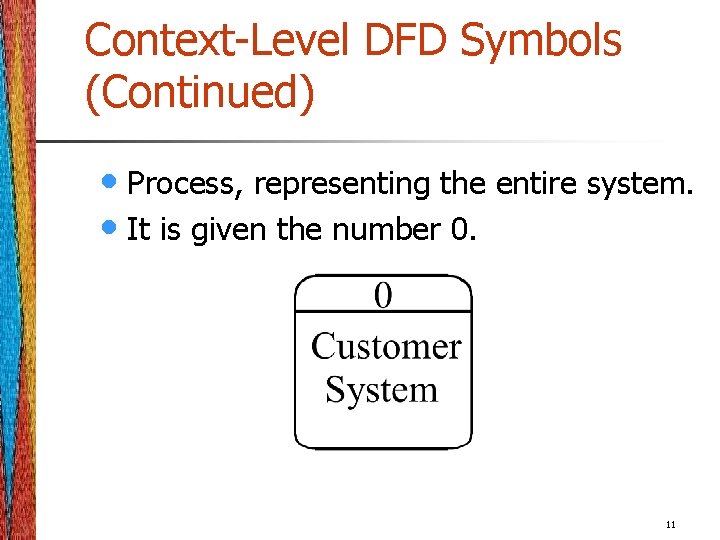
Context-Level DFD Symbols (Continued) • Process, representing the entire system. • It is given the number 0. 11
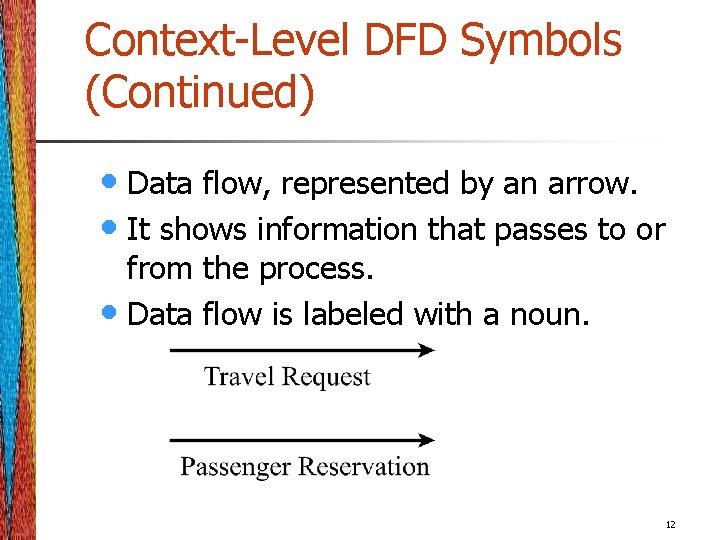
Context-Level DFD Symbols (Continued) • Data flow, represented by an arrow. • It shows information that passes to or from the process. • Data flow is labeled with a noun. 12
Data Flow Example 13
Wed 14 -10 Entity-Relationship Diagrams (E-R Diagrams) • Entity-relationship diagrams help the analyst understand the organizational system and the data stored by the organization. • Symbols are used to represent entities and relationships. 14
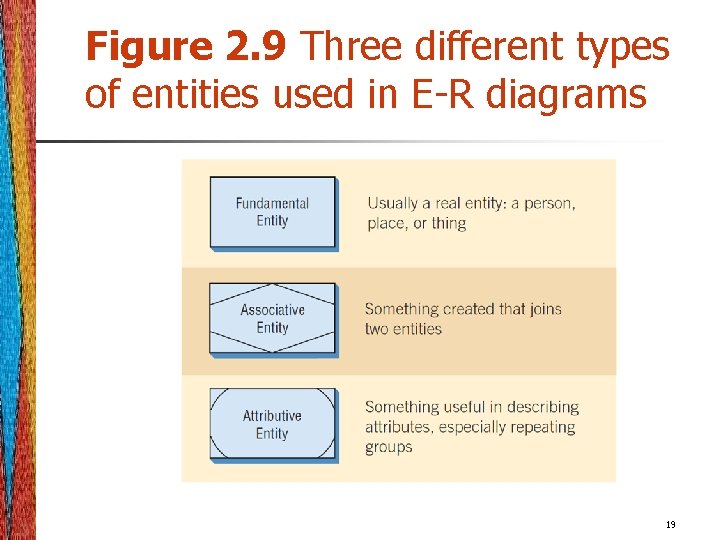
Entities There are three types of entities: • Fundamental entity, describing a person, place, or thing. • Associative entity, linking entities. • Attributive entity, to describe attributes and repeating groups. 15
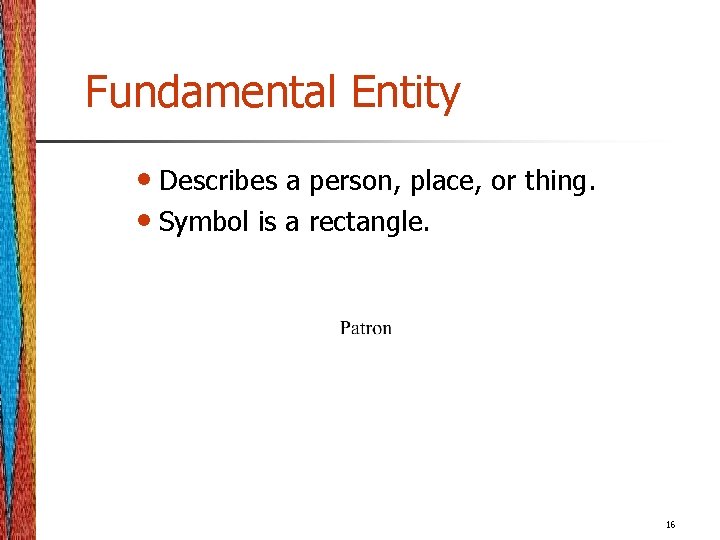
Fundamental Entity • Describes a person, place, or thing. • Symbol is a rectangle. 16
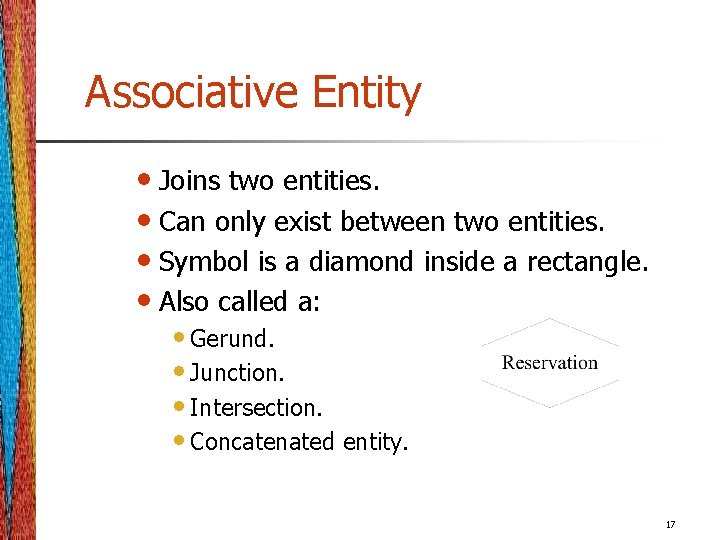
Associative Entity • Joins two entities. • Can only exist between two entities. • Symbol is a diamond inside a rectangle. • Also called a: • Gerund. • Junction. • Intersection. • Concatenated entity. 17
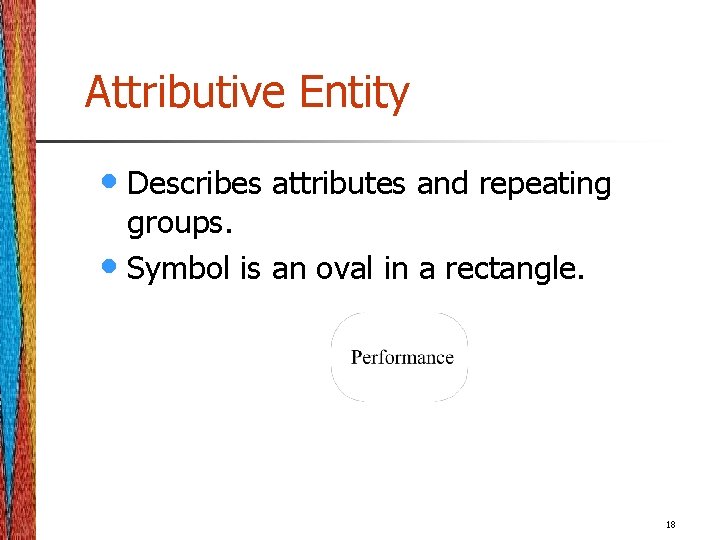
Attributive Entity • Describes attributes and repeating groups. • Symbol is an oval in a rectangle. 18
Figure 2. 9 Three different types of entities used in E-R diagrams 19
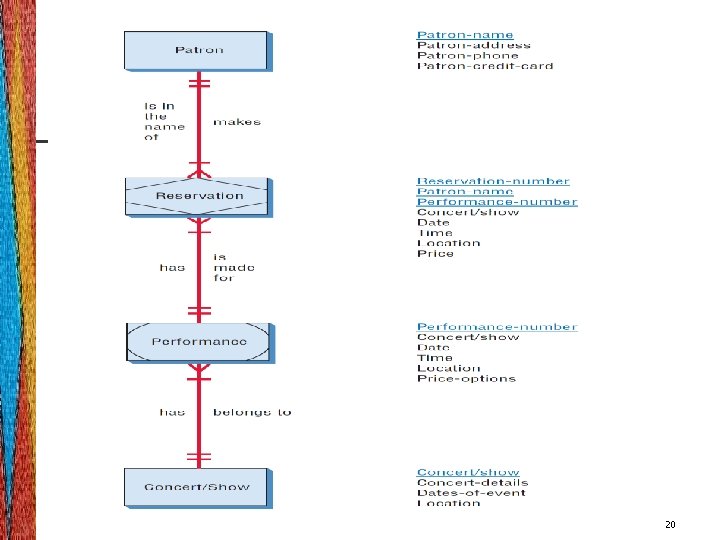
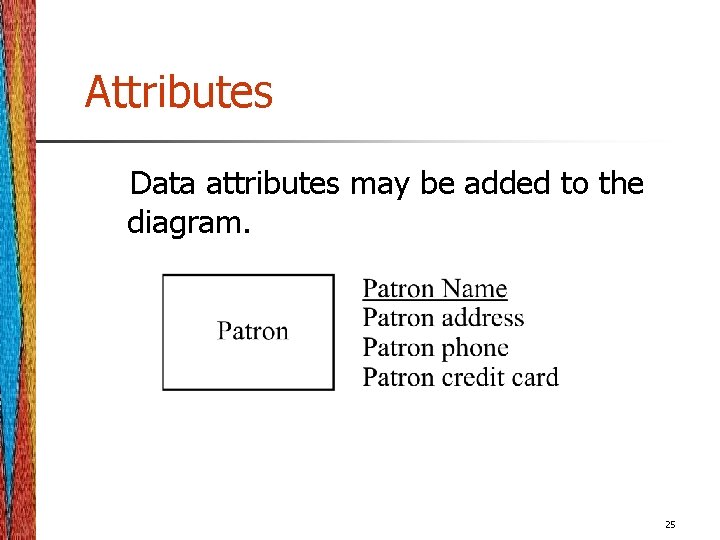
Figure 2 -12 A more complete E-R diagram showing data attributes of the entities 20
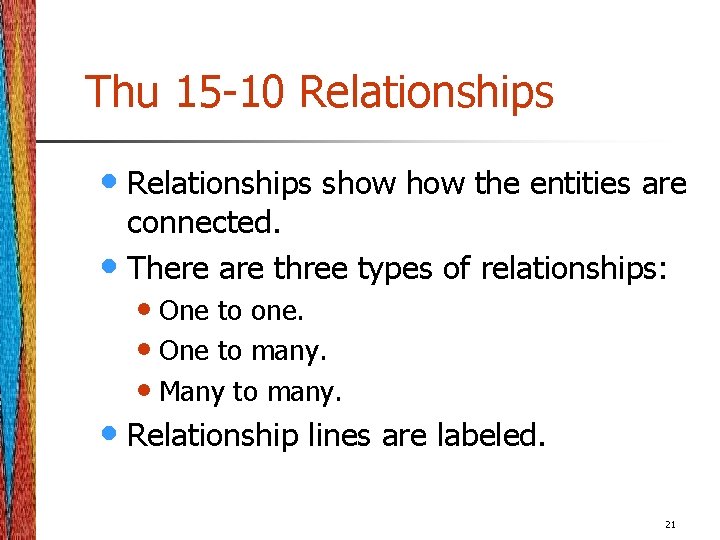
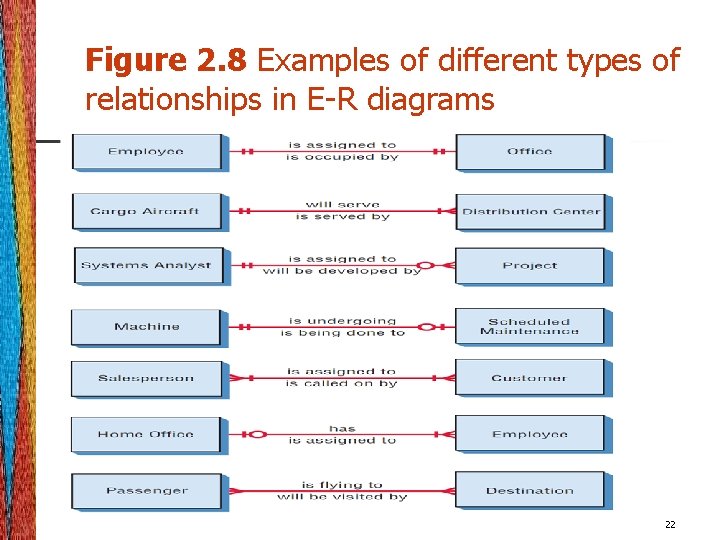
Thu 15 -10 Relationships • Relationships show the entities are connected. • There are three types of relationships: • One to one. • One to many. • Many to many. • Relationship lines are labeled. 21
Figure 2. 8 Examples of different types of relationships in E-R diagrams 22
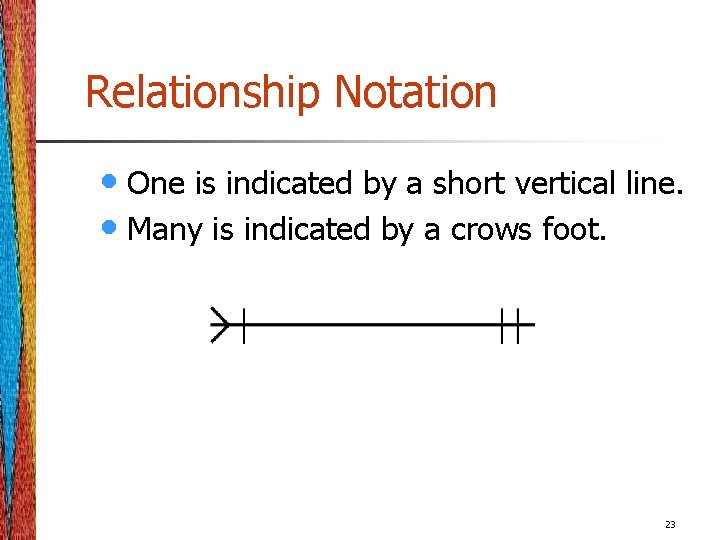
Relationship Notation • One is indicated by a short vertical line. • Many is indicated by a crows foot. 23
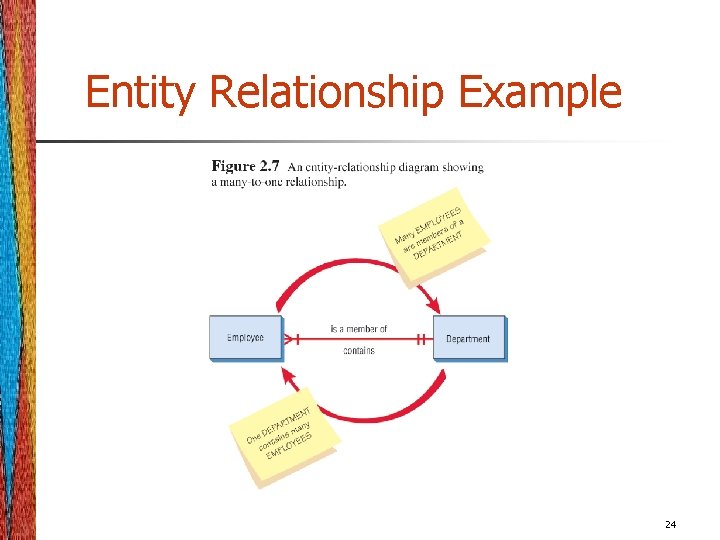
Entity Relationship Example 24
Attributes Data attributes may be added to the diagram. 25
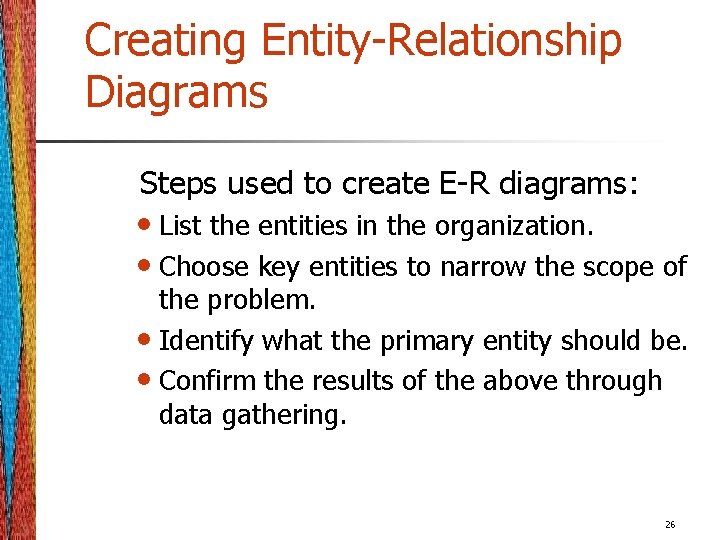
Creating Entity-Relationship Diagrams Steps used to create E-R diagrams: • List the entities in the organization. • Choose key entities to narrow the scope of the problem. • Identify what the primary entity should be. • Confirm the results of the above through data gathering. 26
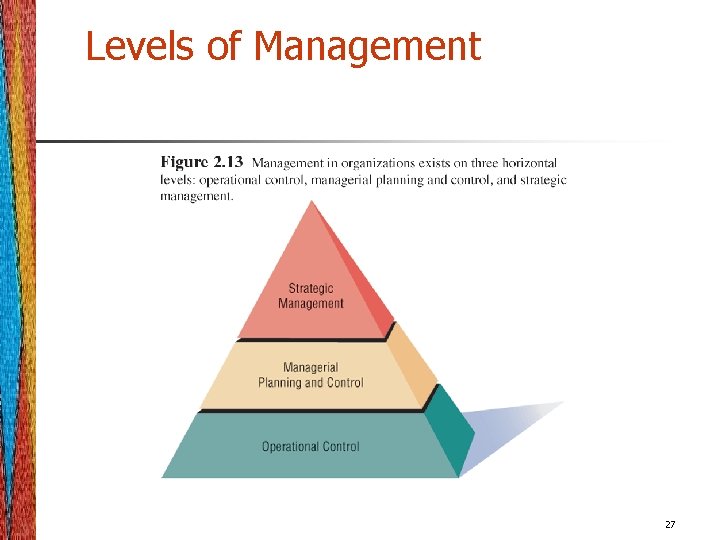
Levels of Management 27
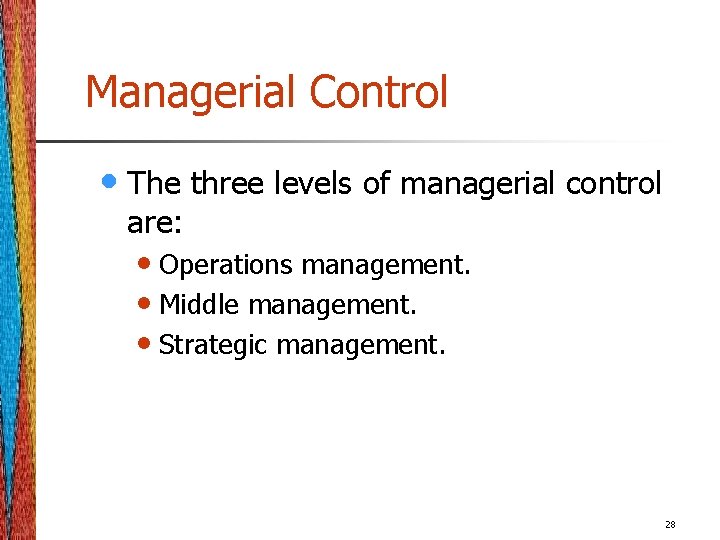
Managerial Control • The three levels of managerial control are: • Operations management. • Middle management. • Strategic management. 28
Operations Management • Make decisions using predetermined rules that have predictable outcomes make decisions. • Oversee the operating details of the organization. • dependent on internal information. 29
Middle Management • Make short-term planning and control decisions about resources and organizational objectives. • Decisions may be partly operational and partly strategic. • Decisions are dependent on internal information, both historical and prediction oriented. 30
Strategic Management • Look outward from the organization to the future. • Make decisions that will guide middle and operations managers. • Work in highly uncertain decisionmaking environment. • Define the organization as a whole. • Often make one-time decisions. 31
Managerial Levels Each of the three levels of management have: • Different organization structure. • Leadership style. • Technological considerations. • Organization culture. • Human interaction. • All carry implications for the analysis and design of information systems. 32
Organizational Culture • Organizations have cultures and subcultures. • Learn from verbal and nonverbal symbolism. 33
Verbal Symbolism Using language to convey: • Myths. • Metaphors. • Visions. • Humor. 34
Nonverbal Symbolism • Shared artifacts • Trophies, etc. • Rites and rituals • Promotions • Birthdays, etc. • Clothing worn • Office placement and decorations 35