
Chapter 2 UNDERSTANDING BALANCE SHEETS AND INCOME STATEMENTS
Chapter 2 UNDERSTANDING BALANCE SHEETS AND INCOME STATEMENTS Hawawini & Viallet Chapter 2 1
Background n n This chapter presents an overview of the balance sheet and the income statement from the perspective of the user of financial data After reading this chapter, students should understand: n n The terminology generally used in financial accounting How balance sheets and income statements are prepared and how they are interrelated The most important accounting principles used to prepare financial statements How business and financial decisions affect the balance sheet and income statement Hawawini & Viallet Chapter 2 2
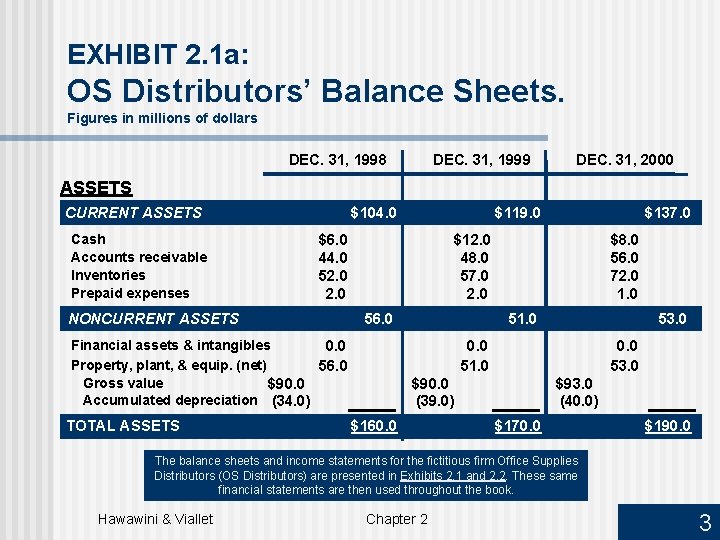
EXHIBIT 2. 1 a: OS Distributors’ Balance Sheets. Figures in millions of dollars DEC. 31, 1998 DEC. 31, 1999 DEC. 31, 2000 ASSETS $104. 0 CURRENT ASSETS Cash Accounts receivable Inventories Prepaid expenses $6. 0 44. 0 52. 0 NONCURRENT ASSETS $137. 0 $12. 0 48. 0 57. 0 2. 0 56. 0 Financial assets & intangibles 0. 0 Property, plant, & equip. (net) 56. 0 Gross value $90. 0 Accumulated depreciation (34. 0) TOTAL ASSETS $119. 0 $8. 0 56. 0 72. 0 1. 0 53. 0 0. 0 51. 0 0. 0 53. 0 $90. 0 (39. 0) $160. 0 $93. 0 (40. 0) $170. 0 $190. 0 The balance sheets and income statements for the fictitious firm Office Supplies Distributors (OS Distributors) are presented in Exhibits 2. 1 and 2. 2. These same financial statements are then used throughout the book. Hawawini & Viallet Chapter 2 3
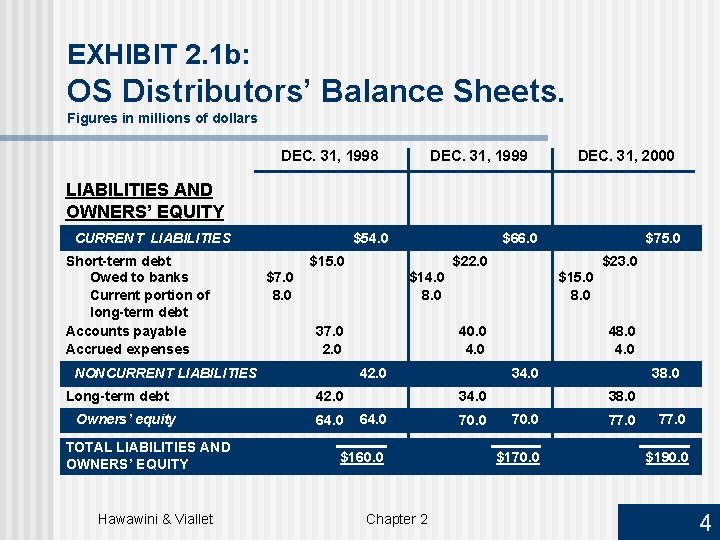
EXHIBIT 2. 1 b: OS Distributors’ Balance Sheets. Figures in millions of dollars DEC. 31, 1998 DEC. 31, 1999 DEC. 31, 2000 LIABILITIES AND OWNERS’ EQUITY $54. 0 CURRENT LIABILITIES Short-term debt Owed to banks Current portion of long-term debt Accounts payable Accrued expenses $15. 0 Owners’ equity TOTAL LIABILITIES AND OWNERS’ EQUITY Hawawini & Viallet $23. 0 $14. 0 8. 0 37. 0 2. 0 $15. 0 8. 0 40. 0 42. 0 64. 0 $75. 0 $22. 0 $7. 0 8. 0 NONCURRENT LIABILITIES Long-term debt $66. 0 48. 0 4. 0 34. 0 64. 0 $160. 0 Chapter 2 70. 0 38. 0 70. 0 $170. 0 77. 0 $190. 0 4
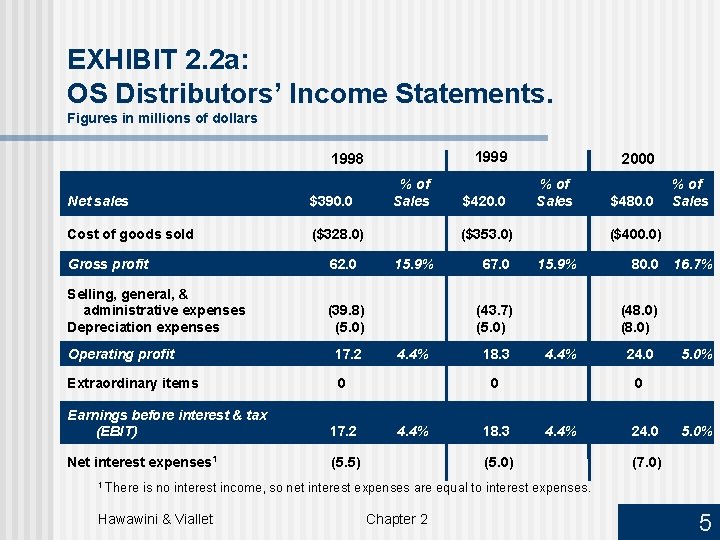
EXHIBIT 2. 2 a: OS Distributors’ Income Statements. Figures in millions of dollars 1999 1998 Net sales $390. 0 Cost of goods sold ($328. 0) Gross profit 62. 0 Selling, general, & administrative expenses Depreciation expenses (39. 8) (5. 0) Operating profit 17. 2 Extraordinary items 0 Earnings before interest & tax (EBIT) 17. 2 Net interest expenses 1 (5. 5) 1 There % of Sales $420. 0 2000 % of Sales ($353. 0) 15. 9% 67. 0 ($400. 0) 15. 9% (43. 7) (5. 0) 4. 4% 18. 3 80. 0 16. 7% (48. 0) (8. 0) 4. 4% 0 4. 4% $480. 0 % of Sales 24. 0 5. 0% 0 4. 4% (5. 0) 24. 0 5. 0% (7. 0) is no interest income, so net interest expenses are equal to interest expenses. Hawawini & Viallet Chapter 2 5
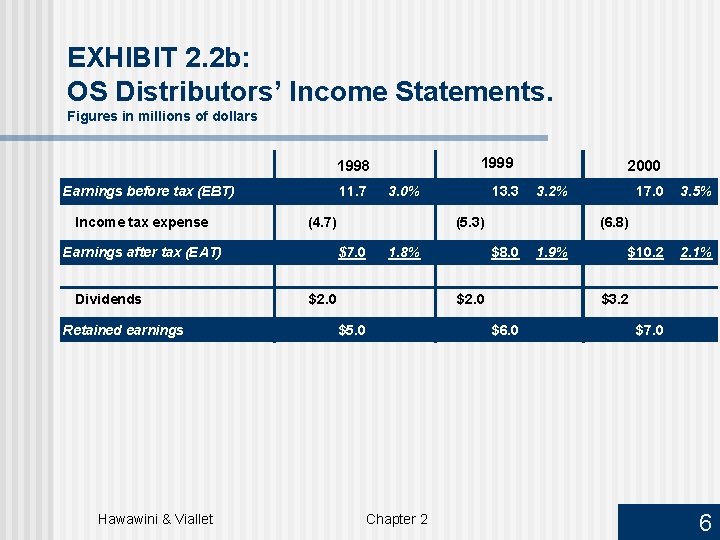
EXHIBIT 2. 2 b: OS Distributors’ Income Statements. Figures in millions of dollars 1999 1998 Earnings before tax (EBT) Income tax expense 11. 7 (4. 7) Earnings after tax (EAT) Dividends Retained earnings Hawawini & Viallet 3. 0% 13. 3 2000 3. 2% (5. 3) $7. 0 1. 8% $2. 0 $8. 0 1. 9% $10. 2 2. 1% $3. 2 $6. 0 Chapter 2 3. 5% (6. 8) $2. 0 $5. 0 17. 0 $7. 0 6
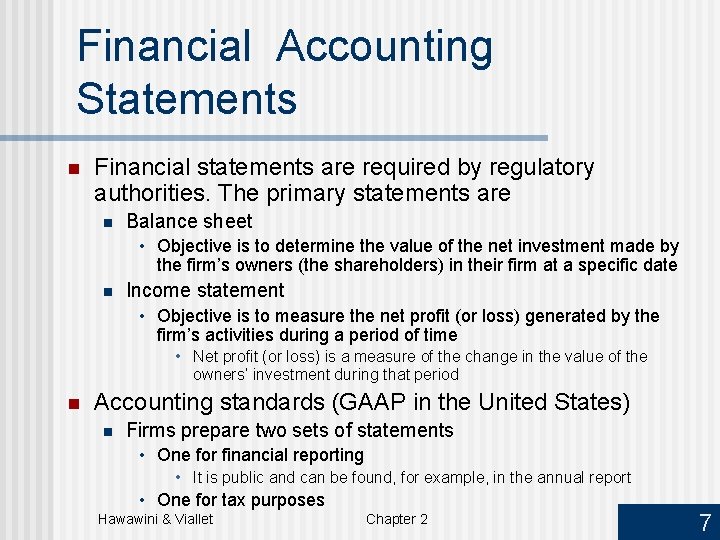
Financial Accounting Statements n Financial statements are required by regulatory authorities. The primary statements are n Balance sheet • Objective is to determine the value of the net investment made by the firm’s owners (the shareholders) in their firm at a specific date n Income statement • Objective is to measure the net profit (or loss) generated by the firm’s activities during a period of time • Net profit (or loss) is a measure of the change in the value of the owners’ investment during that period n Accounting standards (GAAP in the United States) n Firms prepare two sets of statements • One for financial reporting • It is public and can be found, for example, in the annual report • One for tax purposes Hawawini & Viallet Chapter 2 7
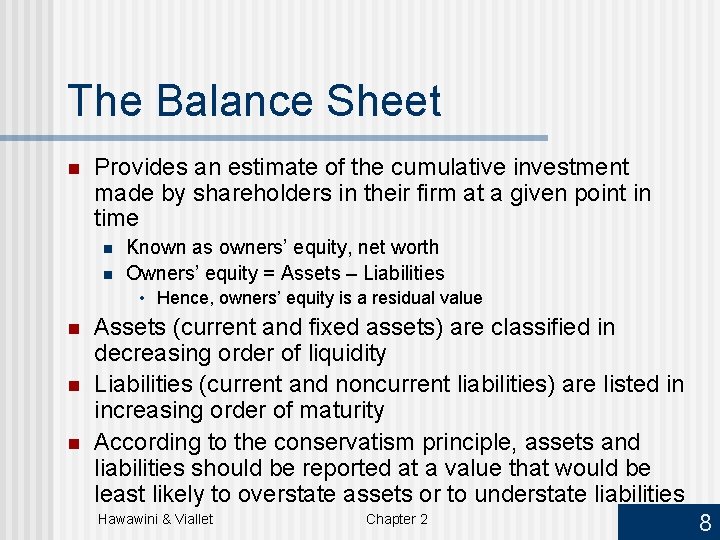
The Balance Sheet n Provides an estimate of the cumulative investment made by shareholders in their firm at a given point in time n n Known as owners’ equity, net worth Owners’ equity = Assets – Liabilities • Hence, owners’ equity is a residual value n n n Assets (current and fixed assets) are classified in decreasing order of liquidity Liabilities (current and noncurrent liabilities) are listed in increasing order of maturity According to the conservatism principle, assets and liabilities should be reported at a value that would be least likely to overstate assets or to understate liabilities Hawawini & Viallet Chapter 2 8
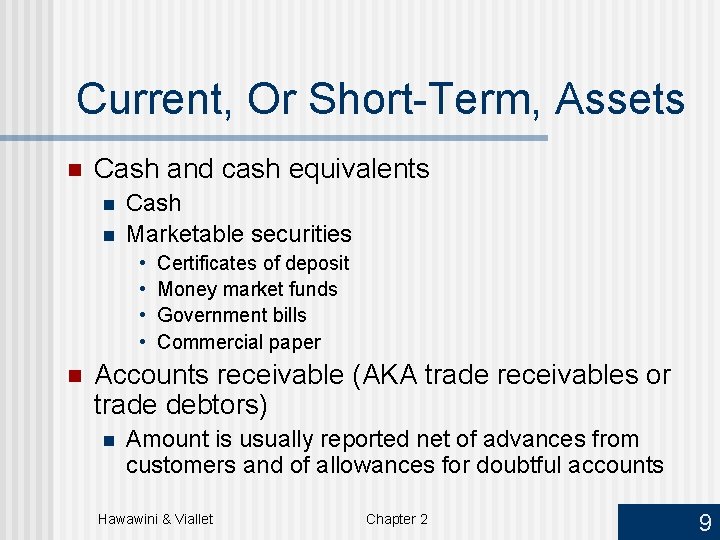
Current, Or Short-Term, Assets n Cash and cash equivalents n n Cash Marketable securities • • n Certificates of deposit Money market funds Government bills Commercial paper Accounts receivable (AKA trade receivables or trade debtors) n Amount is usually reported net of advances from customers and of allowances for doubtful accounts Hawawini & Viallet Chapter 2 9
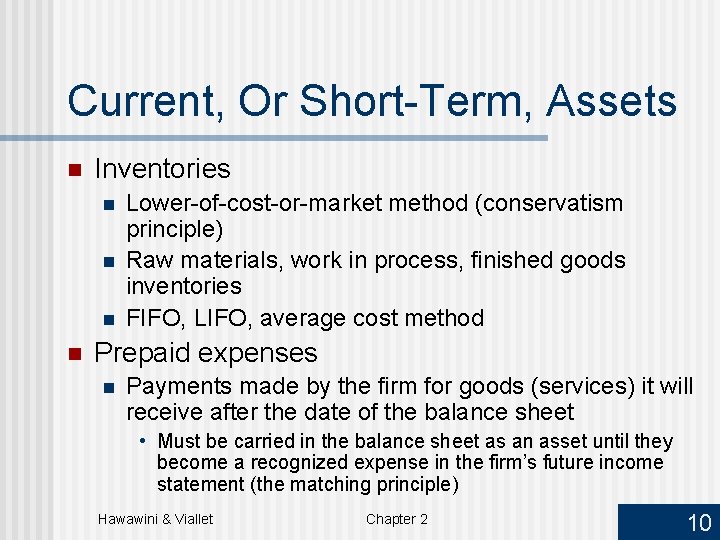
Current, Or Short-Term, Assets n Inventories n n Lower-of-cost-or-market method (conservatism principle) Raw materials, work in process, finished goods inventories FIFO, LIFO, average cost method Prepaid expenses n Payments made by the firm for goods (services) it will receive after the date of the balance sheet • Must be carried in the balance sheet as an asset until they become a recognized expense in the firm’s future income statement (the matching principle) Hawawini & Viallet Chapter 2 10
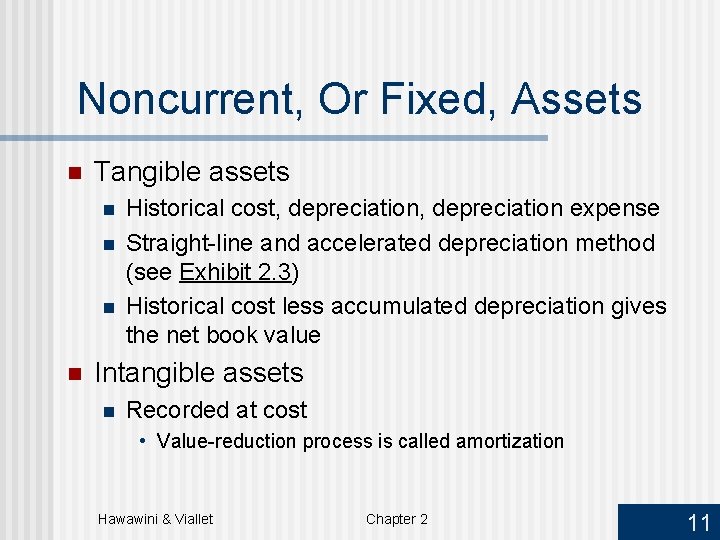
Noncurrent, Or Fixed, Assets n Tangible assets n n Historical cost, depreciation expense Straight-line and accelerated depreciation method (see Exhibit 2. 3) Historical cost less accumulated depreciation gives the net book value Intangible assets n Recorded at cost • Value-reduction process is called amortization Hawawini & Viallet Chapter 2 11
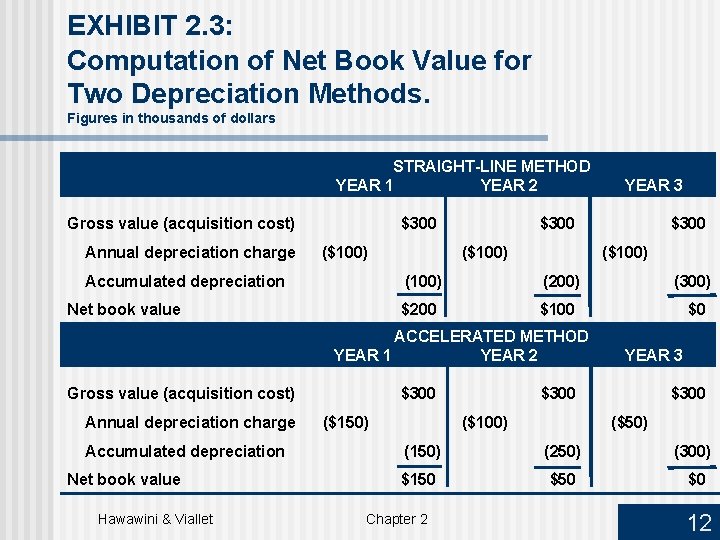
EXHIBIT 2. 3: Computation of Net Book Value for Two Depreciation Methods. Figures in thousands of dollars STRAIGHT-LINE METHOD YEAR 1 YEAR 2 Gross value (acquisition cost) Annual depreciation charge $300 ($100) Accumulated depreciation Net book value $300 ($100) Annual depreciation charge Accumulated depreciation Net book value Hawawini & Viallet $300 ($100) (200) (300) $200 $100 $0 ACCELERATED METHOD YEAR 1 YEAR 2 Gross value (acquisition cost) YEAR 3 $300 ($150) YEAR 3 $300 ($100) $300 ($50) (150) (250) (300) $150 $0 Chapter 2 12
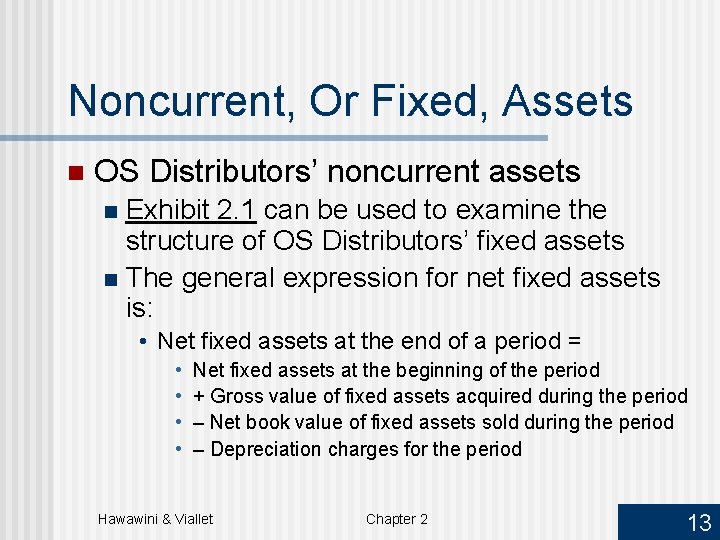
Noncurrent, Or Fixed, Assets n OS Distributors’ noncurrent assets Exhibit 2. 1 can be used to examine the structure of OS Distributors’ fixed assets n The general expression for net fixed assets is: n • Net fixed assets at the end of a period = • • Net fixed assets at the beginning of the period + Gross value of fixed assets acquired during the period – Net book value of fixed assets sold during the period – Depreciation charges for the period Hawawini & Viallet Chapter 2 13
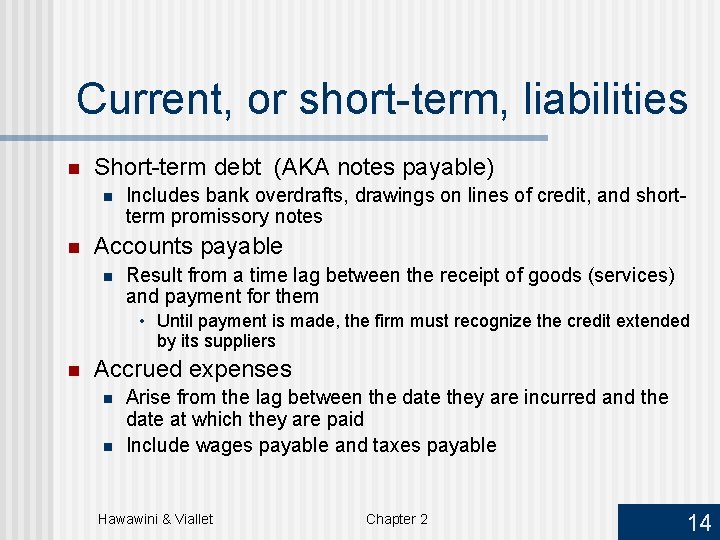
Current, or short-term, liabilities n Short-term debt (AKA notes payable) n n Includes bank overdrafts, drawings on lines of credit, and shortterm promissory notes Accounts payable n Result from a time lag between the receipt of goods (services) and payment for them • Until payment is made, the firm must recognize the credit extended by its suppliers n Accrued expenses n n Arise from the lag between the date they are incurred and the date at which they are paid Include wages payable and taxes payable Hawawini & Viallet Chapter 2 14
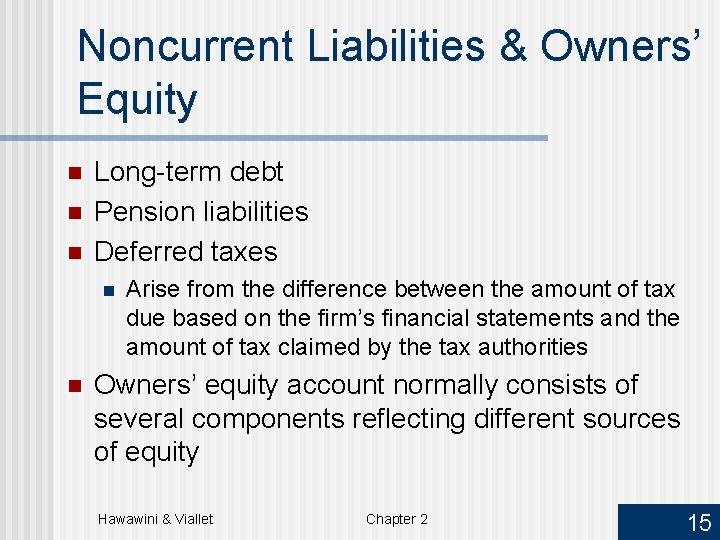
Noncurrent Liabilities & Owners’ Equity n n n Long-term debt Pension liabilities Deferred taxes n n Arise from the difference between the amount of tax due based on the firm’s financial statements and the amount of tax claimed by the tax authorities Owners’ equity account normally consists of several components reflecting different sources of equity Hawawini & Viallet Chapter 2 15
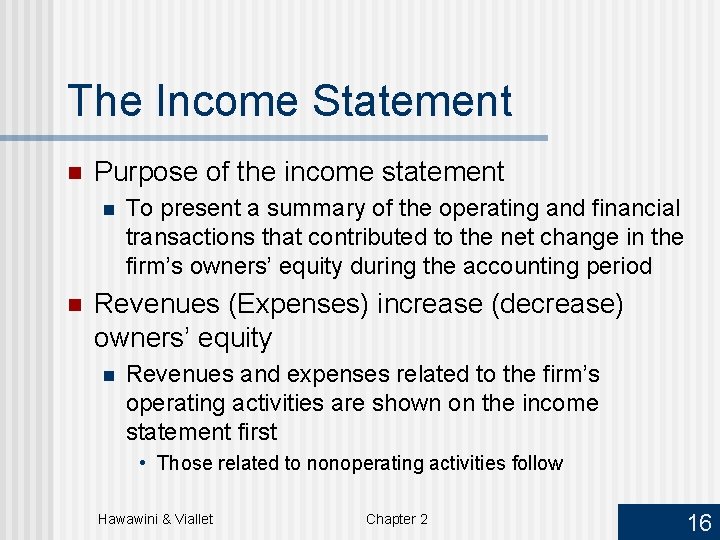
The Income Statement n Purpose of the income statement n n To present a summary of the operating and financial transactions that contributed to the net change in the firm’s owners’ equity during the accounting period Revenues (Expenses) increase (decrease) owners’ equity n Revenues and expenses related to the firm’s operating activities are shown on the income statement first • Those related to nonoperating activities follow Hawawini & Viallet Chapter 2 16
The Income Statement n Accrual accounting is built on two basic principles: n Realization principle • Revenue is recognized at the time of the transaction generating the revenue, not when the cash from the transaction is received n Matching principle • Expenses are recognized when the product is sold, not when the expense is actually paid • As a consequence, in accrual accounting expenses increase during the period when the product is sold, and a firm’s earnings after tax are not equal to its net cash flow Hawawini & Viallet Chapter 2 17
The Income Statement n Net Sales n n Represents the revenues net of any discounts and allowances for defective merchandise Cost of goods sold (COGS) n Often includes depreciation expenses, which are sometimes a separate account in the statement Hawawini & Viallet Chapter 2 18
The Income Statement n Gross profit n Net Sales – COGS • First and broadest measure of the firm’s profit n Selling, general, and administrative expenses (SG&A) n n Represents overhead expenses Depreciation expenses n Since a fixed asset generates benefits beyond the year in which it is purchased • The cost of the asset is “expensed” over the asset’s useful life to avoid a mismatch between expenses and revenues for a number of years Hawawini & Viallet Chapter 2 19
The Income Statement n Operating profit n n Measures the profit generated by the firm’s normal and recurrent activities before interest expenses and taxes Extraordinary items n Represent the balance of gains and losses resulting from infrequent transactions that are not directly related to the firm’s recurrent activities Hawawini & Viallet Chapter 2 20
The Income Statement n EBIT is the operating profit less any extraordinary losses plus any extraordinary gains n EBIT is shared among three claimants • Lenders • Tax authority • Owners n Net interest expenses n Difference between the interest expenses incurred by the firm and any income received from its financial investments Hawawini & Viallet Chapter 2 21
The Income Statement n Income tax expense n This tax provision frequently differs from the actual income tax to be paid • The difference being reflected in the deferred tax account in the balance sheet n Earnings after tax (EAT) n Measure of the net change in owners’ equity, when there is no cash dividend paid Hawawini & Viallet Chapter 2 22
Reconciling Balance Sheets And Income Statements n n n When a cash dividend is declared, the net increase in owners’ equity (called retained earnings) is the difference between earnings after tax and the dividend By the same logic, when the firm repurchases its shares, the owners’ equity is also decreased Conversely, when the firm sells its shares, the owners’ equity increases Hawawini & Viallet Chapter 2 23
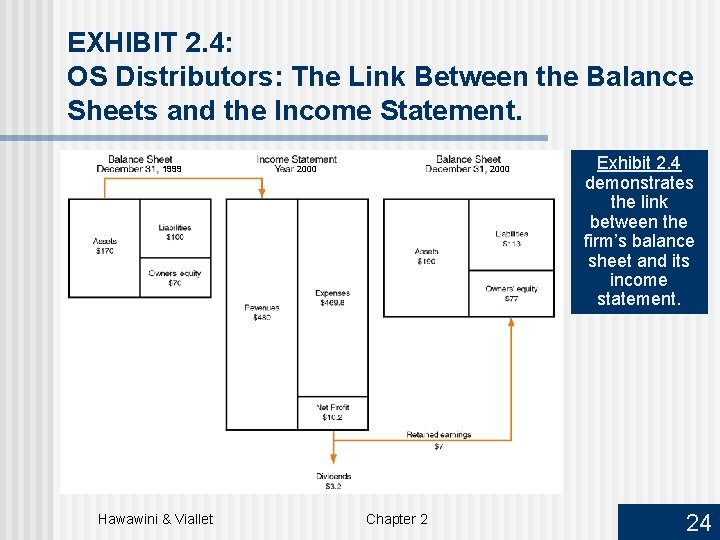
EXHIBIT 2. 4: OS Distributors: The Link Between the Balance Sheets and the Income Statement. 1999 Hawawini & Viallet 2000 Chapter 2 Exhibit 2. 4 demonstrates the link between the firm’s balance sheet and its income statement. 24
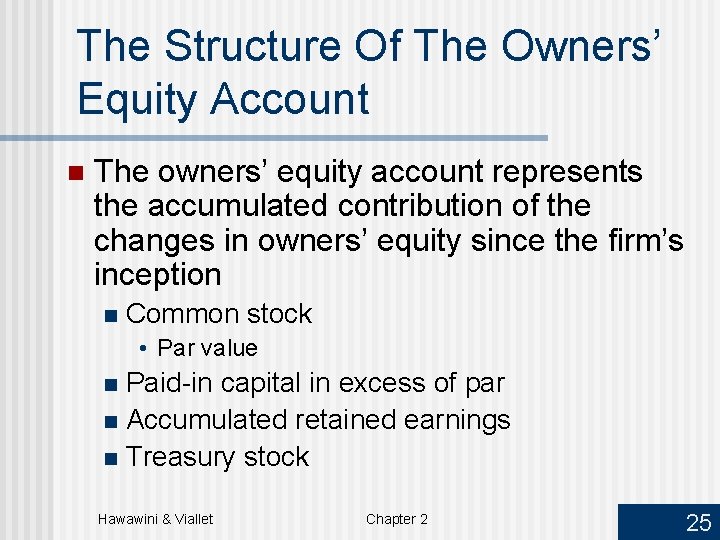
The Structure Of The Owners’ Equity Account n The owners’ equity account represents the accumulated contribution of the changes in owners’ equity since the firm’s inception n Common stock • Par value Paid-in capital in excess of par n Accumulated retained earnings n Treasury stock n Hawawini & Viallet Chapter 2 25
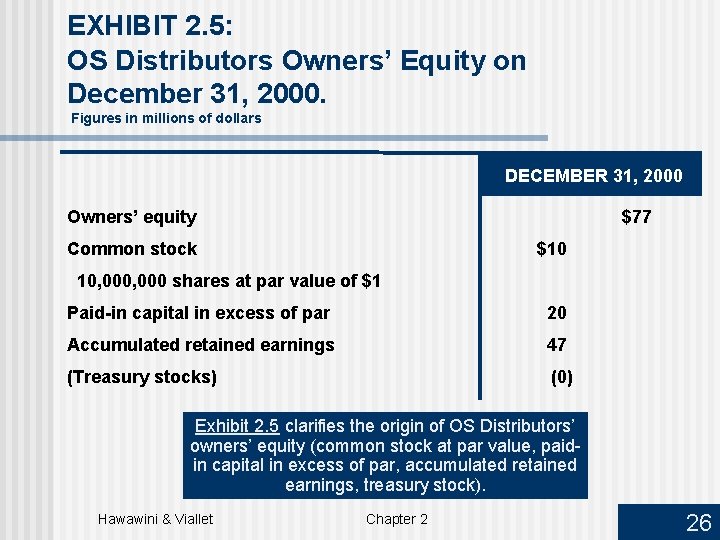
EXHIBIT 2. 5: OS Distributors Owners’ Equity on December 31, 2000. Figures in millions of dollars DECEMBER 31, 2000 Owners’ equity $77 Common stock $10 10, 000 shares at par value of $1 Paid-in capital in excess of par 20 Accumulated retained earnings 47 (Treasury stocks) (0) Exhibit 2. 5 clarifies the origin of OS Distributors’ owners’ equity (common stock at par value, paidin capital in excess of par, accumulated retained earnings, treasury stock). Hawawini & Viallet Chapter 2 26
- Slides: 26