
Chapter 2 Types of Construction and Exterior Walls

- Slides: 61
Chapter 2 Types of Construction and Exterior Walls Basic Construction Refresher 1
Chapter 2: Types of Construction and Exterior Walls Introduction • In this chapter, we will discuss types of construction and exterior wall materials used in residential construction. – There a number of building techniques, both new and old, found in the U. S. , and some methods of building and exterior materials are more commonly found in some areas than in others. – As the country was settled and permanent structures were built, people used whatever materials were found in their area. Basic Construction Refresher 2
Chapter 2: Types of Construction and Exterior Walls Introduction (cont. ) – Today, one of the trends in green building is to use materials that come from a 70 -mile radius of the house, to conserve energy used to transport exotic materials long distances. Basic Construction Refresher 3
Chapter 2: Types of Construction and Exterior Walls Chapter Objectives • Identify types of construction techniques. • Classify houses by the type of construction. • Identify exterior materials used on houses. Basic Construction Refresher 4
Chapter 2: Types of Construction and Exterior Walls • Once the foundation is in place, whether a slab, a crawl space, or a full basement, the next step is building exterior walls. • The majority of walls are frame, with siding over the framing; however, there are other options (e. g. , solid masonry, straw bale, stone). Basic Construction Refresher 5
Chapter 2: Types of Construction and Exterior Walls Wood • Wood houses include frame houses, post and beam houses, and log cabins. • On many frame dwellings, the wood is the centerpiece of the exterior, and may be stained, as opposite to painted, to allow the beauty of the wood to show through. Basic Construction Refresher 6
Chapter 2: Types of Construction and Exterior Walls Wood (cont. ) • Much of the U. S. , when settled, had virgin forests, which made building frame houses not only practical, but gave the settlers something to do with the forests they cleared to make farmland. • For example, houses located in Williamsport, PA, once known as “the Lumber Capital of the World, ” which date from the 19 th century have an amazing amount of wood, and quality wood in them. Basic Construction Refresher 7
Chapter 2: Types of Construction and Exterior Walls Wood (cont. ) • It is not unusual, along “Millionaire’s Row” in Williamsport, to see a basement where the floor joists are true 2 x 12 s, 12” on center, and made of solid oak! Basic Construction Refresher 8
Chapter 2: Types of Construction and Exterior Walls Special Types of Wood Houses • Double Plank: – Constructed in areas with a plentiful wood supply, with many of them as PA farmhouses. – Have planks that run vertically and horizontally, and the lath and plaster is applied directly to the interior plank. – These houses lack any cavity for insulation or wiring, so remodeling them can be challenging. Basic Construction Refresher 9
Chapter 2: Types of Construction and Exterior Walls Special Types of Wood Houses (cont. ) • Log: – Constructed of logs; can be found across the U. S. – Are not maintenance free; some issues include insect infestation and shrinkage of the logs over time. – Most have a wood interior, often yellow pine, which has a varnish or polyurethane finish. – Interior solid wood paneled walls will change color due to exposure to light. Basic Construction Refresher 10
Chapter 2: Types of Construction and Exterior Walls Special Types of Wood Houses (cont. ) • Log Veneer: – Developed as a less expensive home. – Offers the ‘log look’ for less money. – Interior is often drywall. – Can be treated with chemicals to prevent infestation. Basic Construction Refresher 11
Chapter 2: Types of Construction and Exterior Walls Special Types of Wood Houses (cont. ) • Post and Beam: – Constructed using post and beam construction methods (much like what is used in barn construction). – Rather than use studs in the side walls, uses posts that carry horizontal beams on which joists are supported. – Allows for fewer bearing partitions and, therefore, uses less material. Basic Construction Refresher 12
Chapter 2: Types of Construction and Exterior Walls Special Types of Wood Houses (cont. ) • Post and Beam (cont. ): – Purists will actually use pegs, as opposed to nails, to construct them. – Some Amish farmers still construct barns this way. Basic Construction Refresher 13
Chapter 2: Types of Construction and Exterior Walls Special Types of Wood Houses (cont. ) • Cedar: – Wood frame homes that are popular among buyers who like the look of cedar siding or shakes. – Are not maintenance free and may require staining; in New England, these homes are often not painted or stained but allowed to weather to a silvery grey. – Cedar shakes come in a variety of shapes and sizes. Basic Construction Refresher 14
Chapter 2: Types of Construction and Exterior Walls House Framing • Prior to the 1950 s, most frame houses built in the U. S. used balloon framing. In balloon framing, the long pieces go from the foundation to the attic, and the floors are added later. • Since the 1950 s, most houses use platform framing - the first floor is built on top of the foundation, up to the second floor, where another platform (floor) is added, and then the house is continued upward from there. Basic Construction Refresher 15
Chapter 2: Types of Construction and Exterior Walls House Framing (cont. ) • The walls are anchored to the foundation, and the roof system is anchored to the side walls. Note: In hurricane prone areas, specific building codes must be followed to ensure that the house, or a portion of it, will not lift off the foundation and become airborne. Basic Construction Refresher 16
Chapter 2: Types of Construction and Exterior Walls House Siding • When wood was plentiful, the sheathing placed on top of the framing, and under the siding, was strips of solid wood, often placed diagonally. • Today, the sheathing placed under any siding is usually a particle board material. Basic Construction Refresher 17
Chapter 2: Types of Construction and Exterior Walls House Siding (cont. ) • Many wood frame houses are subsequently covered with other kinds of siding, including: – – – Asbestos Adobe Composition asphalt Imitation stone veneer Steel siding Aluminum Basic Construction Refresher – – – Vinyl Brick and brick veneer Stucco Synthetic stucco (Dryvit®) Concrete siding 18
Chapter 2: Types of Construction and Exterior Walls Asbestos Siding • Asbestos siding was used from the 1920 s through the 1980 s, in the U. S. and Canada. • At that time, the carcinogenic properties of asbestos were not known; the product was durable, a natural insulator, fireproof, and widely used. • Asbestos was added to Portland cement, and the product was pressed into pieces of siding. It held paint well, and offered some degree of fire protection and insulation. Basic Construction Refresher 19
Chapter 2: Types of Construction and Exterior Walls Asbestos Siding (cont. ) • Asbestos siding was made to look like cedar shakes; some of the siding had a wood grain pattern on it, to make it look like wood. • Some asbestos siding, like this photo, had dye added to the Portland cement mixture, so the color went all the way through the product. Although it didn’t require painting, some homeowners painted it. Basic Construction Refresher 20
Chapter 2: Types of Construction and Exterior Walls Asbestos Siding (cont. ) • Most of the health risks associated with asbestos were in the factories where the products were manufactured, since the air was full of asbestos fibers. • Asbestos siding is generally not a health hazard, as it needs to be ‘friable’ to do harm, which means it can be crumbled when pressure is applied. Basic Construction Refresher 21
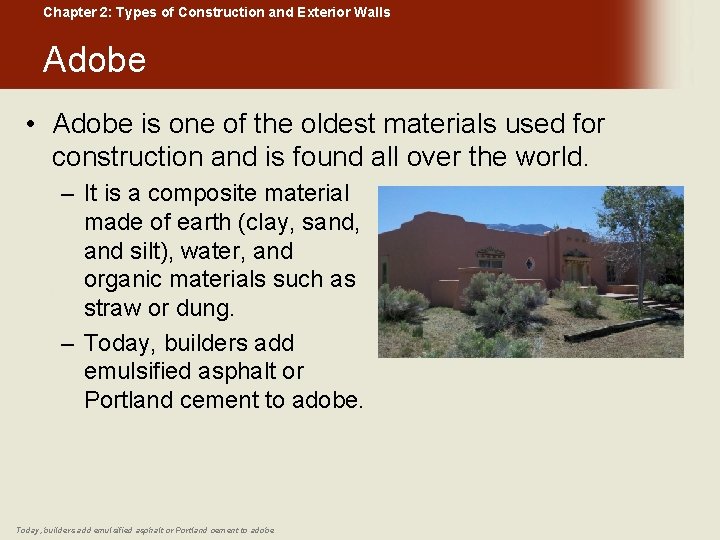
Chapter 2: Types of Construction and Exterior Walls Adobe • Adobe is one of the oldest materials used for construction and is found all over the world. – It is a composite material made of earth (clay, sand, and silt), water, and organic materials such as straw or dung. – Today, builders add emulsified asphalt or Portland cement to adobe
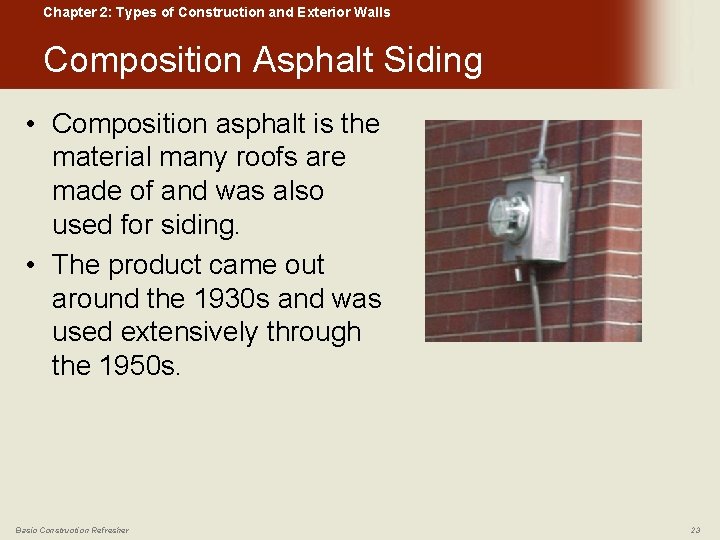
Chapter 2: Types of Construction and Exterior Walls Composition Asphalt Siding • Composition asphalt is the material many roofs are made of and was also used for siding. • The product came out around the 1930 s and was used extensively through the 1950 s. Basic Construction Refresher 23
Chapter 2: Types of Construction and Exterior Walls Composition Asphalt Siding (cont. ) • Colored mineral granules were bonded to a wood product base with asphalt. • Composition asphalt came in a variety of colors and styles, with patterns such as brick and stone. • The sheets were rigid when installed. • When composition asphalt wears out, the granules fall off and the black asphalt behind the granules shows; leaving a very unattractive exterior. Basic Construction Refresher 24
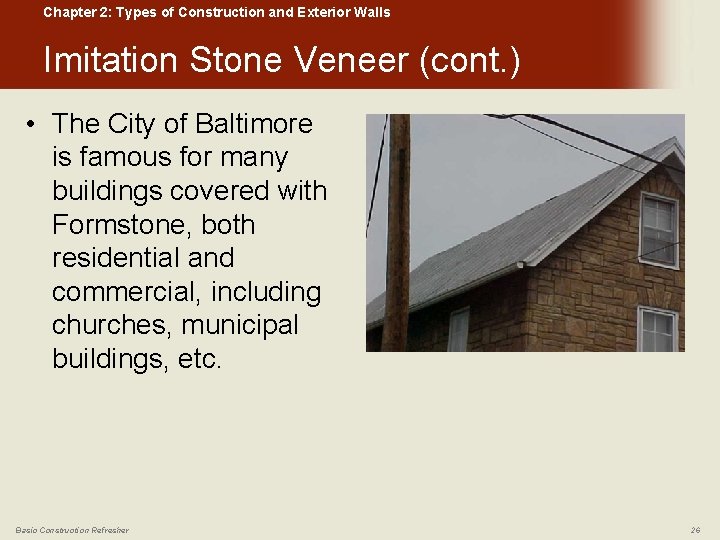
Chapter 2: Types of Construction and Exterior Walls Imitation Stone Veneer • Historic stone veneers are known by brand names such as Perma-Stone, Formstone, Rostone, and others. • The popularity of Formstone in Baltimore can be traced to Albert Knight, a native of the city, who patented it in 1937 for his Lasting Products Company. Basic Construction Refresher 25
Chapter 2: Types of Construction and Exterior Walls Imitation Stone Veneer (cont. ) • The City of Baltimore is famous for many buildings covered with Formstone, both residential and commercial, including churches, municipal buildings, etc. Basic Construction Refresher 26
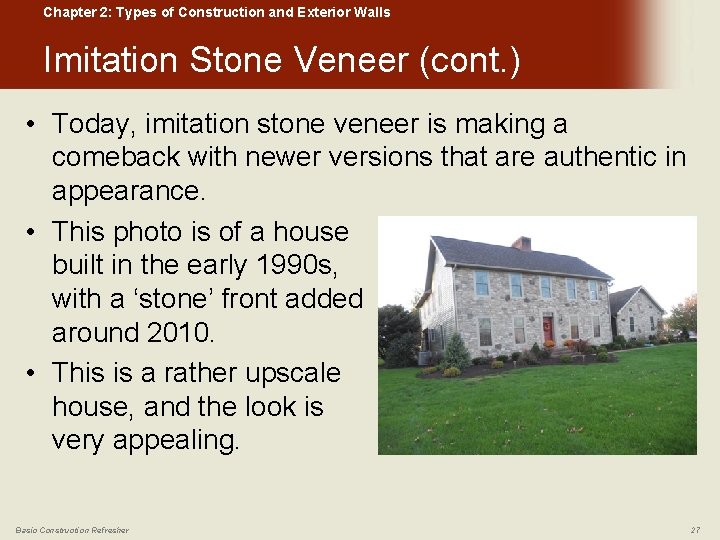
Chapter 2: Types of Construction and Exterior Walls Imitation Stone Veneer (cont. ) • Today, imitation stone veneer is making a comeback with newer versions that are authentic in appearance. • This photo is of a house built in the early 1990 s, with a ‘stone’ front added around 2010. • This is a rather upscale house, and the look is very appealing. Basic Construction Refresher 27
Chapter 2: Types of Construction and Exterior Walls Steel Siding • Steel siding can still be found, although because of the expense and weight, most owners gravitate towards vinyl or aluminum. • Early steel siding dented very easily. Basic Construction Refresher 28
Chapter 2: Types of Construction and Exterior Walls Masonite (Hardboard) Siding • Masonite® is actually a brand name, commonly used to refer to any siding fiberboard or hardboard siding. • Steam heat and pressure combine to make the boards dense, with a smooth finish. • It has long been popular because of the cost, which is less than vinyl, solid wood, or cement. Basic Construction Refresher 29
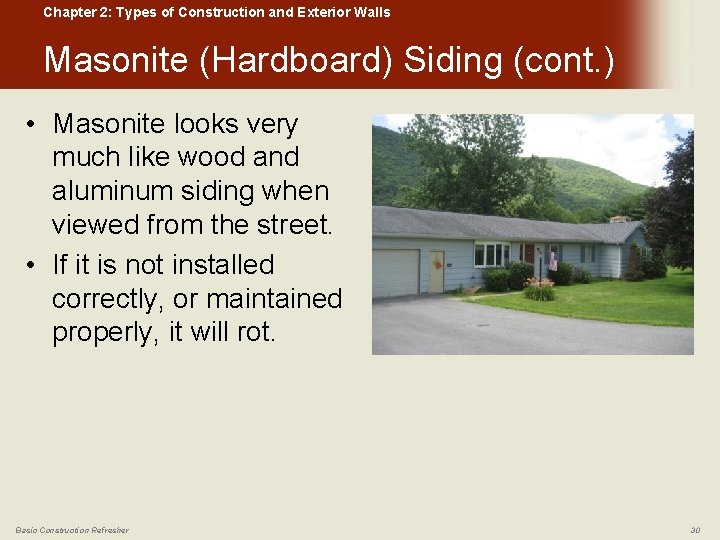
Chapter 2: Types of Construction and Exterior Walls Masonite (Hardboard) Siding (cont. ) • Masonite looks very much like wood and aluminum siding when viewed from the street. • If it is not installed correctly, or maintained properly, it will rot. Basic Construction Refresher 30
Chapter 2: Types of Construction and Exterior Walls Aluminum Siding • Aluminum siding was invented in 1947 by Jerome Kaufman, who observed how well paint adhered to aluminum planes. • Most people installed it to avoid having to paint; it develops a chalky finish and can be painted. • Still sold today, although more buyers gravitate toward vinyl or concrete (cement) siding. Basic Construction Refresher 31
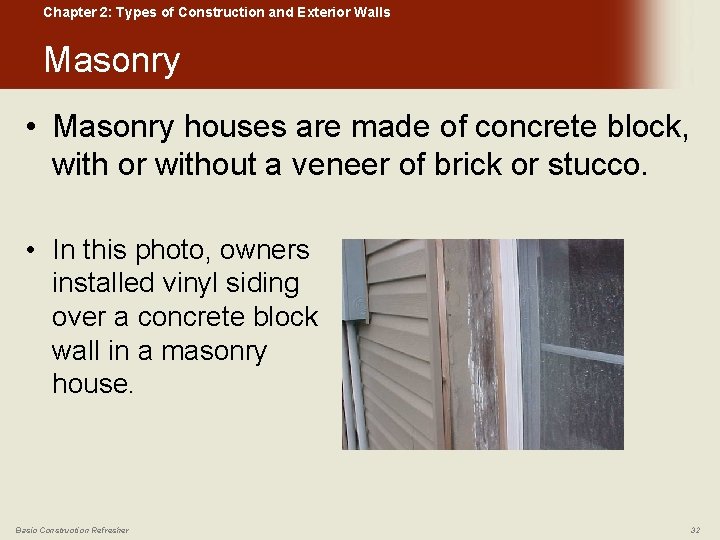
Chapter 2: Types of Construction and Exterior Walls Masonry • Masonry houses are made of concrete block, with or without a veneer of brick or stucco. • In this photo, owners installed vinyl siding over a concrete block wall in a masonry house. Basic Construction Refresher 32
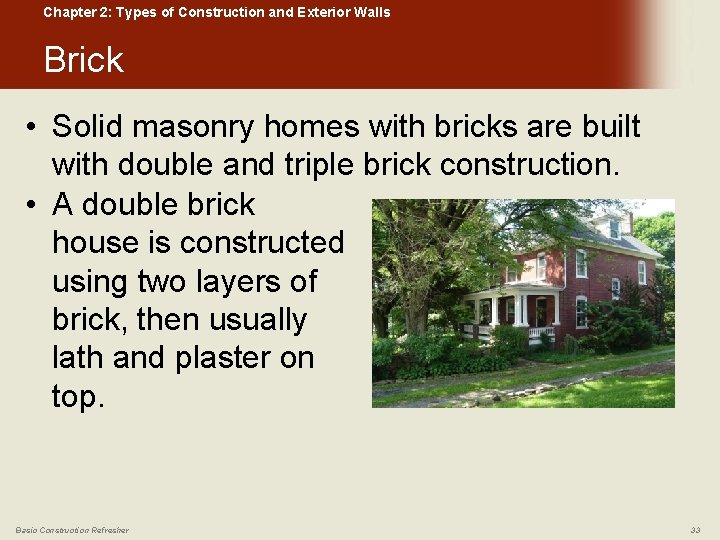
Chapter 2: Types of Construction and Exterior Walls Brick • Solid masonry homes with bricks are built with double and triple brick construction. • A double brick house is constructed using two layers of brick, then usually lath and plaster on top. Basic Construction Refresher 33
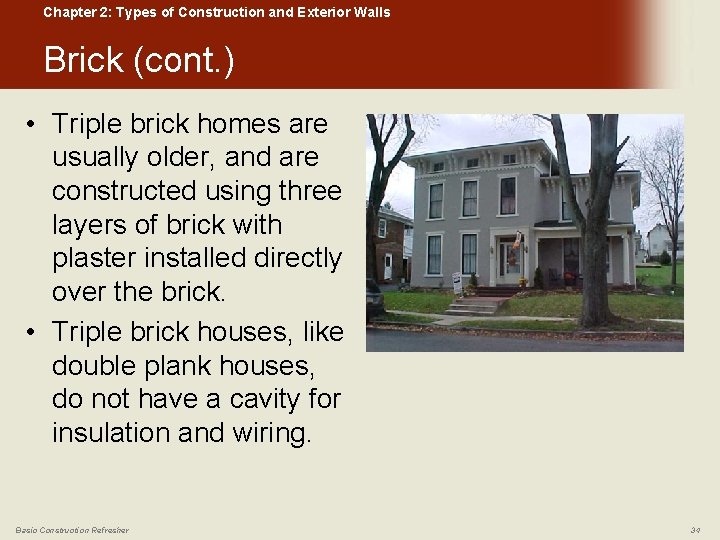
Chapter 2: Types of Construction and Exterior Walls Brick (cont. ) • Triple brick homes are usually older, and are constructed using three layers of brick with plaster installed directly over the brick. • Triple brick houses, like double plank houses, do not have a cavity for insulation and wiring. Basic Construction Refresher 34
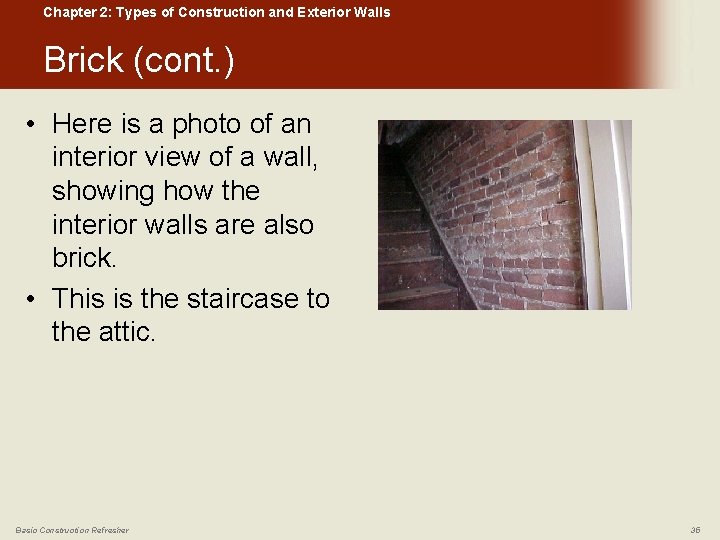
Chapter 2: Types of Construction and Exterior Walls Brick (cont. ) • Here is a photo of an interior view of a wall, showing how the interior walls are also brick. • This is the staircase to the attic. Basic Construction Refresher 35
Chapter 2: Types of Construction and Exterior Walls Brick Veneer • Brick veneer is a thin brick that can be applied to virtually any existing interior or exterior wall. – Installed over frame (most common) or masonry. – Has a deliberate gap for air between the framing and the brick. – Sheathing paper is installed over the framing to keep moisture out. – There is a “brick lug” in which the brick rests on. – Has weep holes to allow water to drain out and to equalize air pressure. Basic Construction Refresher 36
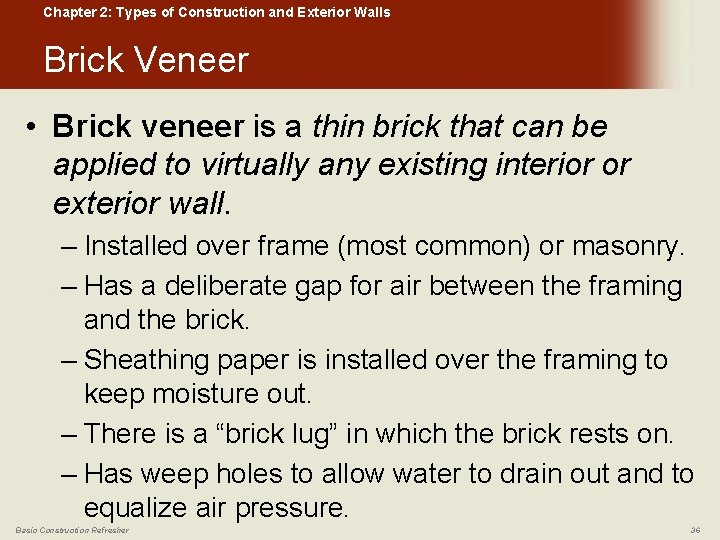
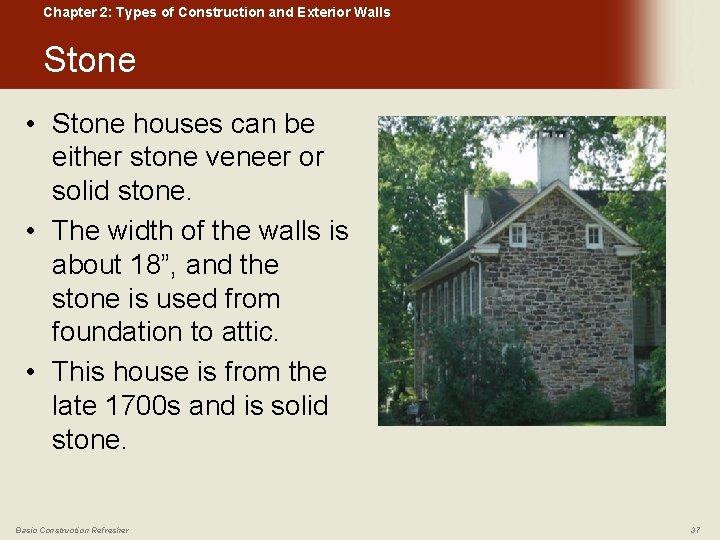
Chapter 2: Types of Construction and Exterior Walls Stone • Stone houses can be either stone veneer or solid stone. • The width of the walls is about 18”, and the stone is used from foundation to attic. • This house is from the late 1700 s and is solid stone. Basic Construction Refresher 37
Chapter 2: Types of Construction and Exterior Walls Stucco • Stucco is a type of finishing plaster used on the exterior of buildings, installed over wood sheathing. • There is a weep screed, which is a piece of metal at the base of the wall, designed to take water away from the wall. Basic Construction Refresher 38
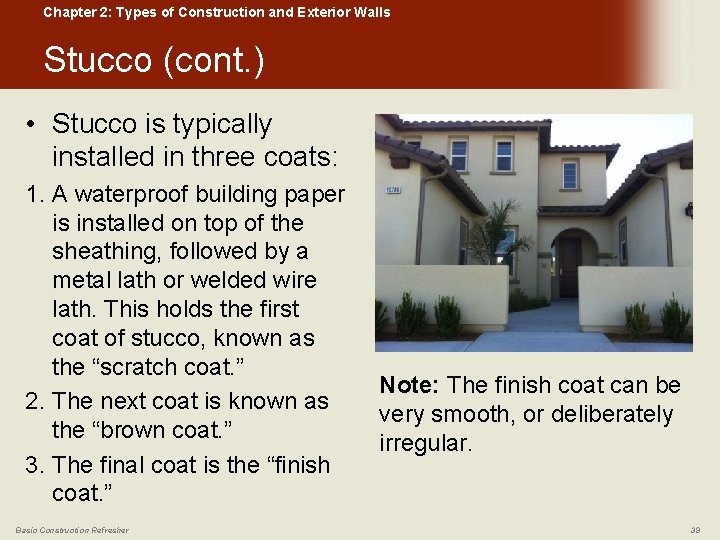
Chapter 2: Types of Construction and Exterior Walls Stucco (cont. ) • Stucco is typically installed in three coats: 1. A waterproof building paper is installed on top of the sheathing, followed by a metal lath or welded wire lath. This holds the first coat of stucco, known as the “scratch coat. ” 2. The next coat is known as the “brown coat. ” 3. The final coat is the “finish coat. ” Basic Construction Refresher Note: The finish coat can be very smooth, or deliberately irregular. 39
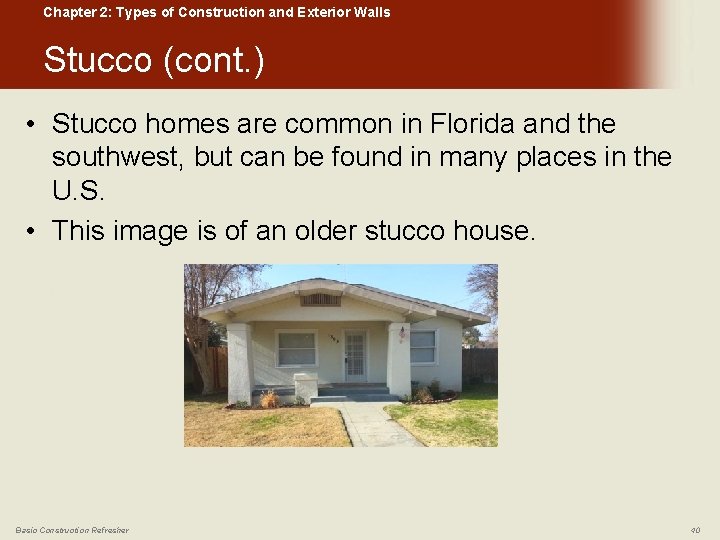
Chapter 2: Types of Construction and Exterior Walls Stucco (cont. ) • Stucco homes are common in Florida and the southwest, but can be found in many places in the U. S. • This image is of an older stucco house. Basic Construction Refresher 40
Chapter 2: Types of Construction and Exterior Walls EIFS Systems • Although similar in appearance but a different composition than stucco, EIFS (exterior insulation and finishing systems) are products that provide excellent insulation, waterproofing, and if installed correctly, are maintenance free • The most commonly known EIFS is “Dryvit®. ” Basic Construction Refresher 41
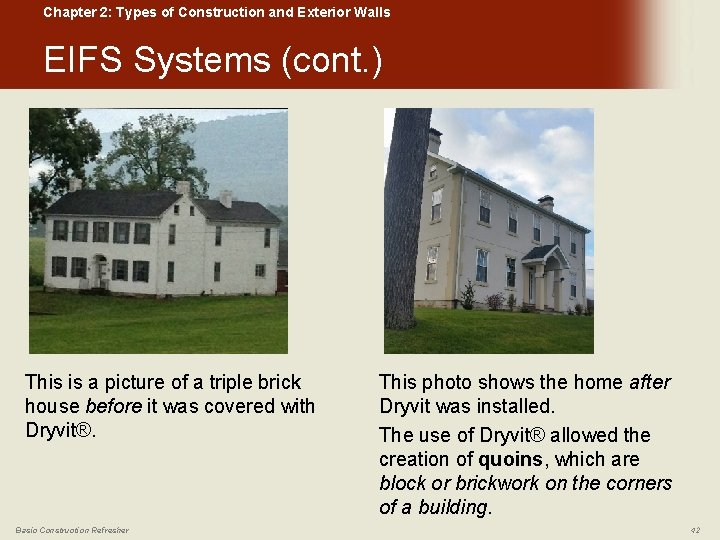
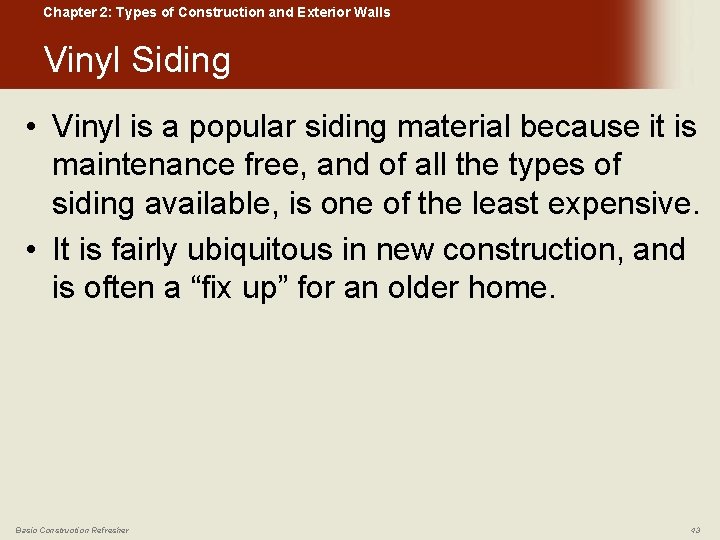
Chapter 2: Types of Construction and Exterior Walls EIFS Systems (cont. ) This is a picture of a triple brick house before it was covered with Dryvit®. Basic Construction Refresher This photo shows the home after Dryvit was installed. The use of Dryvit® allowed the creation of quoins, which are block or brickwork on the corners of a building. 42
Chapter 2: Types of Construction and Exterior Walls Vinyl Siding • Vinyl is a popular siding material because it is maintenance free, and of all the types of siding available, is one of the least expensive. • It is fairly ubiquitous in new construction, and is often a “fix up” for an older home. Basic Construction Refresher 43
Chapter 2: Types of Construction and Exterior Walls Metal Homes • Early metal homes, some of which are still around, include: – National Homes (identified by a metal sign outlining the home’s care instructions and serial number that was screwed into the wall of the small laundry area off the kitchen) – Lustron Homes (prefabricated enameled steel houses). • These homes were sold by two retail giants: Sears, Roebuck, & Co. and Montgomery Ward. Basic Construction Refresher 44
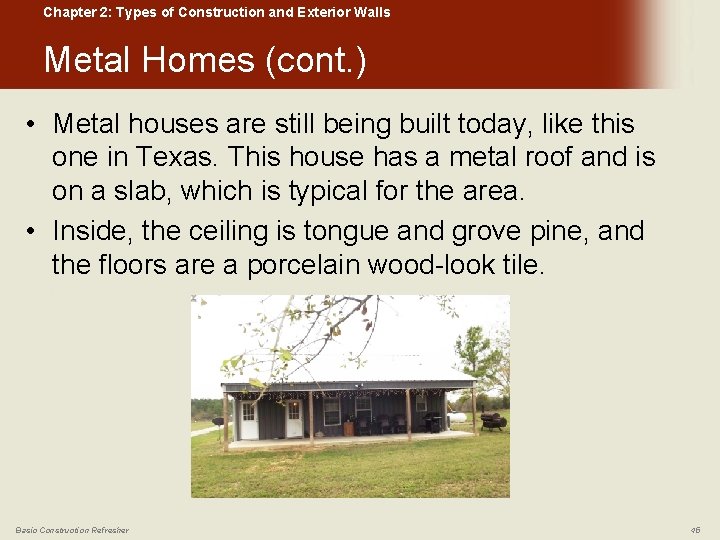
Chapter 2: Types of Construction and Exterior Walls Metal Homes (cont. ) • Metal houses are still being built today, like this one in Texas. This house has a metal roof and is on a slab, which is typical for the area. • Inside, the ceiling is tongue and grove pine, and the floors are a porcelain wood-look tile. Basic Construction Refresher 45
Chapter 2: Types of Construction and Exterior Walls National Homes • National Homes Corporation was founded in 1940, and built houses through the early 1970 s. • These homes were typically placed on a slab, with about five (5) floor plans. • Many are quite small (less than 800 square feet). • These homes were part of the post WWII building boom. Basic Construction Refresher 46
Chapter 2: Types of Construction and Exterior Walls National Homes (cont. ) • National Homes: – Used a stressed-skin panelized method of construction. – The houses were prefabricated. – The floor framing was steel. – The framing studs were 2 x 3, and 3/8 inch waterproof plywood was mounted on to these studs. – Doors and windows were pre-installed. Basic Construction Refresher 47
Chapter 2: Types of Construction and Exterior Walls Lustron Houses • Lustron houses were made of prefabricated porcelain enameled steel. • Lustron Corporation was only in business from 1948 to 1950, when bankruptcy forced them out of business. Basic Construction Refresher 48
Chapter 2: Types of Construction and Exterior Walls Lustron Houses (cont. ) • With Lustron Houses: – Panels were produced at the factory, then shipped for assembly on site. – Colors were generally pastels: yellow, light green, pink, blue and grey. – Their unique design made it possible to hang pictures using magnets, as both sides of the metal panels were exposed. Basic Construction Refresher 49
Chapter 2: Types of Construction and Exterior Walls Summary 1. Construction of wood houses include double plank, log veneer, post and beam, and cedar. 2. Wood framing for houses use balloon framing (prior to 1950 s) or platform framing (after the 1950 s). Basic Construction Refresher 50
Chapter 2: Types of Construction and Exterior Walls Summary (cont. ) 3. Siding for homes include asbestos, adobe, composition asphalt, imitation stone veneer, steel, Masonite, aluminum, masonry (block, brick veneer, stone, or stucco), EIFS, vinyl, and metal. 4. National Homes Corporation built steel framed houses in the 1940 s through 1970 s. 5. Lustron Corporation built prefabricated porcelain enameled steel houses in the post-WWII era, from 1948 to 1950. Basic Construction Refresher 51
Chapter 2: Types of Construction and Exterior Walls Chapter Quiz 1. Which is NOT an attribute of brick building material used in houses? A. composite B. double brick C. triple brick D. veneer Basic Construction Refresher 52
Chapter 2: Types of Construction and Exterior Walls Chapter Quiz (cont. ) 2. A construction technique that uses long pieces of wood running vertically and horizontally is known as A. balloon framing. B. double plank house. C. log construction. D. platform framing. Basic Construction Refresher 53
Chapter 2: Types of Construction and Exterior Walls Chapter Quiz (cont. ) 3. Stucco is normally applied in A. one coat. B. two coats. C. three coats. D. four coats. Basic Construction Refresher 54
Chapter 2: Types of Construction and Exterior Walls Chapter Quiz (cont. ) 4. Which type of construction is most commonly used for framing houses today? A. balloon framing B. double plank C. platform framing D. post and beam Basic Construction Refresher 55
Chapter 2: Types of Construction and Exterior Walls Chapter Quiz (cont. ) 5. For existing homes, _______ was (were) commonly installed as upgraded siding to reduce home maintenance. A. aluminum B. brick C. cedar shakes D. stucco Basic Construction Refresher 56
Chapter 2: Types of Construction and Exterior Walls Chapter Quiz (cont. ) 6. ______ has mineral granules affixed to it. A. Asbestos B. Composition asphalt C. Steel D. Stucco Basic Construction Refresher 57
Chapter 2: Types of Construction and Exterior Walls Chapter Quiz (cont. ) 7. Which of the following siding products is also known as hardboard? A. asbestos B. cedar shakes C. Masonite® D. stucco Basic Construction Refresher 58
Chapter 2: Types of Construction and Exterior Walls Chapter Quiz (cont. ) 8. EIFS, which is the technical name for the brand name Dryvit©, stands for A. External Imitation and Framing System. B. Exterior Inclusive Finishing Set Up. C. External Insulation and Finish System. D. Extra Insulation for Stucco. Basic Construction Refresher 59
Chapter 2: Types of Construction and Exterior Walls Chapter Quiz (cont. ) 9. All of these types of construction might cause difficulty with wiring and insulation because of the lack of a cavity in the walls EXCEPT A. double plank. B. masonry. C. solid stone. D. triple brick. Basic Construction Refresher 60
Chapter 2: Types of Construction and Exterior Walls Chapter Quiz (cont. ) 10. Which of these building materials is the oldest? A. adobe B. aluminum C. asbestos D. steel Basic Construction Refresher 61