
Chapter 2 Translating Research Evidence Into Nursing Practice

- Slides: 16
Chapter 2 Translating Research Evidence Into Nursing Practice: Evidence-Based Nursing Copyright © 2008 Wolters Kluwer Health | Lippincott Williams & Wilkins
Research Utilization (RU) Versus Evidence -Based Practice (EBP) Research utilization (RU) The use of study findings in a practical application unrelated to the original research Evidence-based practice (EBP) Basing clinical decisions on best possible evidence—especially highquality research Copyright © 2008 Wolters Kluwer Health | Lippincott Williams & Wilkins
Resources for Evidence-Based Practice • Systematic reviews • Clinical practice guidelines • Other preappraised evidence Copyright © 2008 Wolters Kluwer Health | Lippincott Williams & Wilkins
Research Integration and Synthesis Forms of integrative reviews: • Narrative, qualitative integration (traditional review of quantitative or qualitative results) • Meta-analysis (statistical integration of results) • Metasynthesis (theoretical integration of qualitative findings) Copyright © 2008 Wolters Kluwer Health | Lippincott Williams & Wilkins
Barriers to Using Research in Nursing Practice • Research-related barriers • Nurse-related barriers • Organizational barriers • Barriers related to the nursing profession Copyright © 2008 Wolters Kluwer Health | Lippincott Williams & Wilkins
Two Models for Evidence-Based Nursing Practice • The Stetler Model of research utilization to promote evidence-based practice • The Iowa Model of evidence-based practice to promote quality care Copyright © 2008 Wolters Kluwer Health | Lippincott Williams & Wilkins
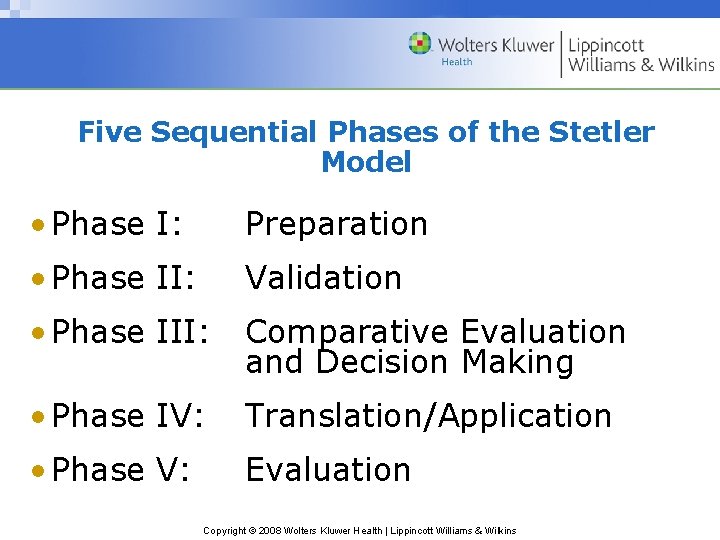
Five Sequential Phases of the Stetler Model • Phase I: Preparation • Phase II: Validation • Phase III: Comparative Evaluation and Decision Making • Phase IV: Translation/Application • Phase V: Evaluation Copyright © 2008 Wolters Kluwer Health | Lippincott Williams & Wilkins
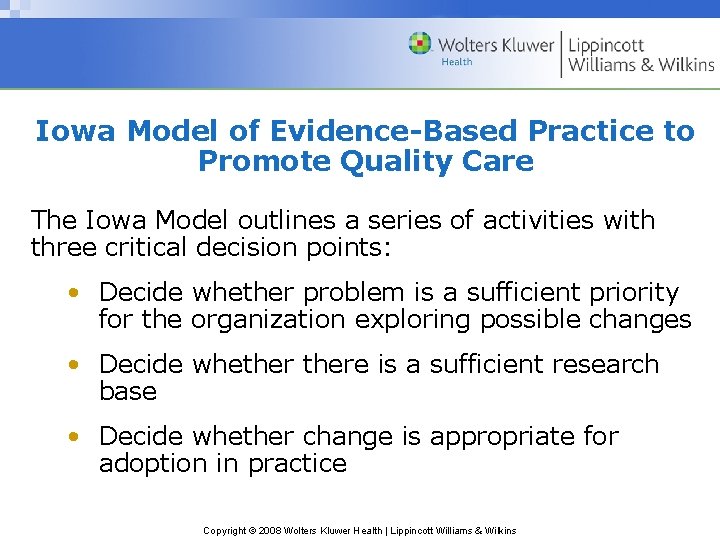
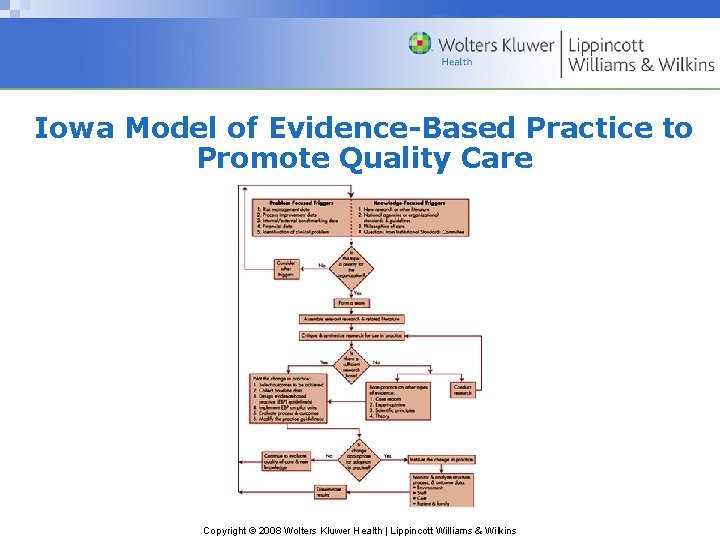
Iowa Model of Evidence-Based Practice to Promote Quality Care The Iowa Model outlines a series of activities with three critical decision points: • Decide whether problem is a sufficient priority for the organization exploring possible changes • Decide whethere is a sufficient research base • Decide whether change is appropriate for adoption in practice Copyright © 2008 Wolters Kluwer Health | Lippincott Williams & Wilkins
Iowa Model of Evidence-Based Practice to Promote Quality Care Copyright © 2008 Wolters Kluwer Health | Lippincott Williams & Wilkins
Steps of Individual EBP 1. Framing an answerable clinical question 2. Searching for relevant research-based evidence 3. Appraising and synthesizing the evidence 4. Integrating evidence with other factors 5. Assessing effectiveness Copyright © 2008 Wolters Kluwer Health | Lippincott Williams & Wilkins
Appraisal of Evidence • Validity of study findings • Clinical importance of findings • Precision of estimates of effects • Associated costs and risks • Utility in a particular clinical situation Copyright © 2008 Wolters Kluwer Health | Lippincott Williams & Wilkins
EBP in Organizational Context • More formalized than individual EBP • Must take organizational and interpersonal factors into account • “Triggers” include both pressing clinical problems and existing knowledge Copyright © 2008 Wolters Kluwer Health | Lippincott Williams & Wilkins
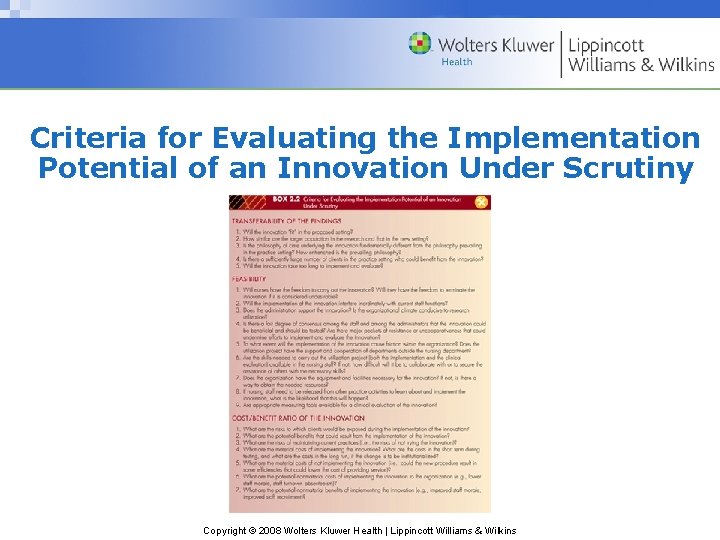
Organizational (Team-Based) EBP Projects • Involve the development or adaptation of clinical practice guidelines or clinical protocols • Assessment of implementation potential of the innovation Transferability Feasibility Cost/benefit ratio Copyright © 2008 Wolters Kluwer Health | Lippincott Williams & Wilkins
Criteria for Evaluating the Implementation Potential of an Innovation Under Scrutiny Copyright © 2008 Wolters Kluwer Health | Lippincott Williams & Wilkins
Implementing and Evaluating the Innovation Pilot Test • Develop an evaluation plan • Collect information on outcomes • Train staff in the use of the new guideline and, if necessary, “market” the innovation • Try the guideline out on one or more units or with a group of clients • Evaluate the pilot project Copyright © 2008 Wolters Kluwer Health | Lippincott Williams & Wilkins
Nurses’ Role in Using Research Evidence • Read widely and critically • Attend professional conferences • Learn to expect evidence that a procedure is effective • Become involved in a journal club • Pursue and participate in RU/EBP projects Copyright © 2008 Wolters Kluwer Health | Lippincott Williams & Wilkins