
Chapter 2 Transformer Operation Power Point slides ta
- Slides: 21
Chapter 2 Transformer Operation Power. Point slides t/a Jenneson and Harper, Electrical Principles for the Electrical Trades (Machines) 6 e, Vol 2 Slides prepared by Andrew O'Connell Copyright © 2012 Mc. Graw-Hill Australia Pty Ltd 2– 1
Purpose • This presentation describes the operating principles of a simple transformer. Including – Mutual Induction – Induced Voltage – Secondary Voltage and Current – Turns Ratio – Phasor Diagram of Current – The principle of Isolation Transformers Power. Point slides t/a Jenneson and Harper, Electrical Principles for the Electrical Trades (Machines) 6 e, Vol 2 Slides prepared by Andrew O'Connell Copyright © 2012 Mc. Graw-Hill Australia Pty Ltd 2– 2
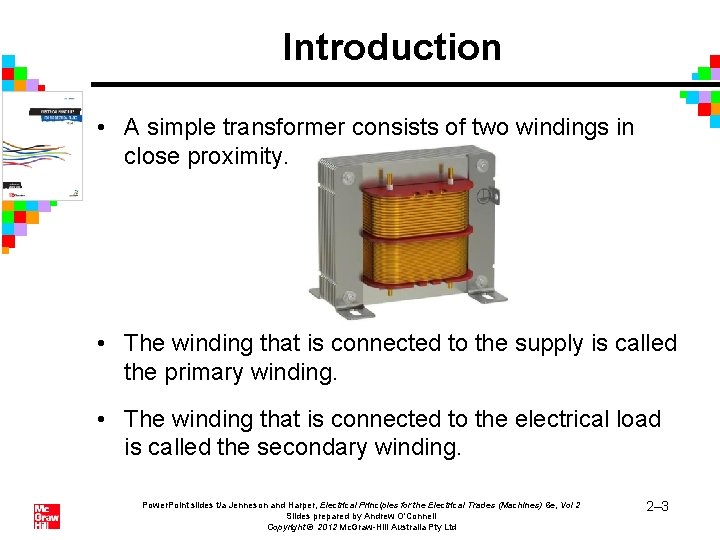
Introduction • A simple transformer consists of two windings in close proximity. • The winding that is connected to the supply is called the primary winding. • The winding that is connected to the electrical load is called the secondary winding. Power. Point slides t/a Jenneson and Harper, Electrical Principles for the Electrical Trades (Machines) 6 e, Vol 2 Slides prepared by Andrew O'Connell Copyright © 2012 Mc. Graw-Hill Australia Pty Ltd 2– 3
Introduction (continued) • Step up transformers have a higher voltage across the secondary winding. • Step down transformers have a higher voltage across the primary winding. • Transformers are available in a range of VA ratings and they are highly efficient electrical machines. Power. Point slides t/a Jenneson and Harper, Electrical Principles for the Electrical Trades (Machines) 6 e, Vol 2 Slides prepared by Andrew O'Connell Copyright © 2012 Mc. Graw-Hill Australia Pty Ltd 2– 4
Operating principle • The primary winding is connected to an AC supply which produces a changing electromagnetic field. • Both the primary and secondary windings are subjected to this changing electromagnetic field. Power. Point slides t/a Jenneson and Harper, Electrical Principles for the Electrical Trades (Machines) 6 e, Vol 2 Slides prepared by Andrew O'Connell Copyright © 2012 Mc. Graw-Hill Australia Pty Ltd 2– 5
Operating principle • The induced voltage in the turns of the secondary winding occurs across the terminals of the secondary winding. • The induced voltage in the turns of the primary winding oppose the applied voltage in the form of back emf. Power. Point slides t/a Jenneson and Harper, Electrical Principles for the Electrical Trades (Machines) 6 e, Vol 2 Slides prepared by Andrew O'Connell Copyright © 2012 Mc. Graw-Hill Australia Pty Ltd 2– 6
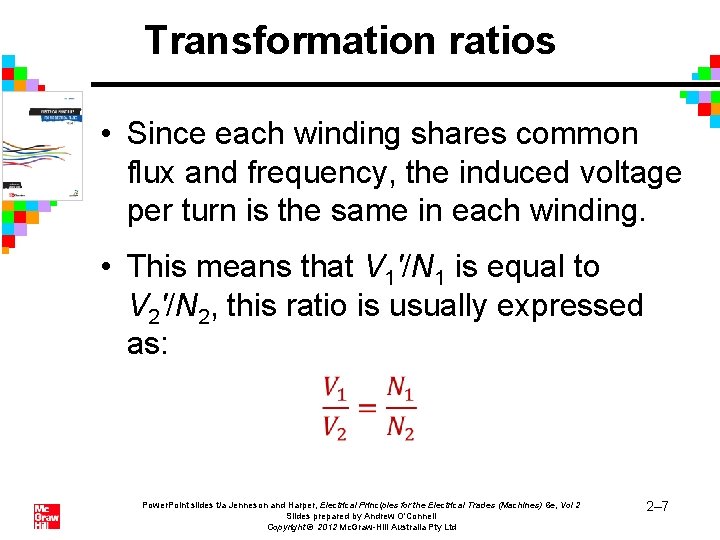
Transformation ratios • Since each winding shares common flux and frequency, the induced voltage per turn is the same in each winding. • This means that V 1'/N 1 is equal to V 2'/N 2, this ratio is usually expressed as: Power. Point slides t/a Jenneson and Harper, Electrical Principles for the Electrical Trades (Machines) 6 e, Vol 2 Slides prepared by Andrew O'Connell Copyright © 2012 Mc. Graw-Hill Australia Pty Ltd 2– 7
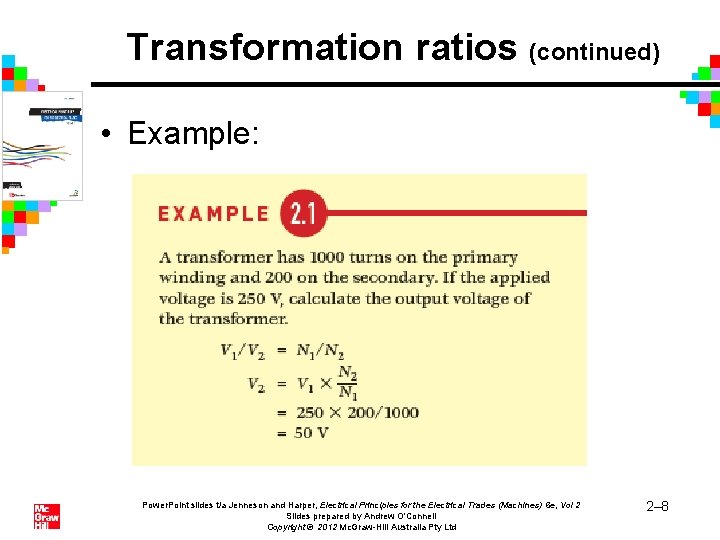
Transformation ratios (continued) • Example: Power. Point slides t/a Jenneson and Harper, Electrical Principles for the Electrical Trades (Machines) 6 e, Vol 2 Slides prepared by Andrew O'Connell Copyright © 2012 Mc. Graw-Hill Australia Pty Ltd 2– 8
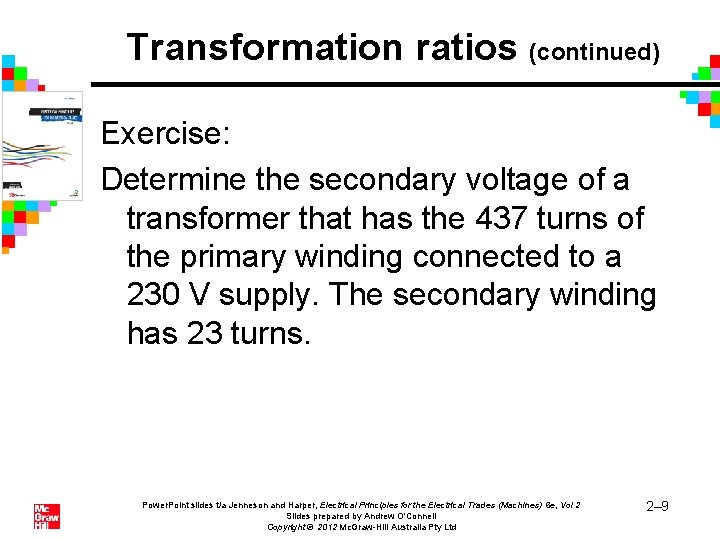
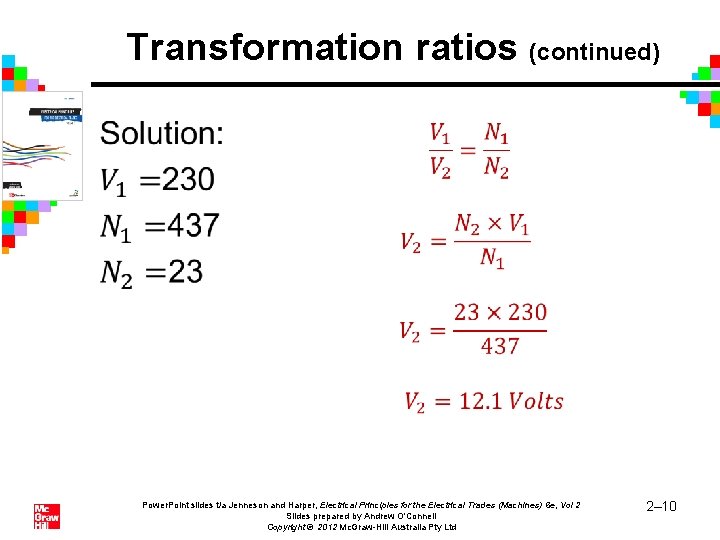
Transformation ratios (continued) Exercise: Determine the secondary voltage of a transformer that has the 437 turns of the primary winding connected to a 230 V supply. The secondary winding has 23 turns. Power. Point slides t/a Jenneson and Harper, Electrical Principles for the Electrical Trades (Machines) 6 e, Vol 2 Slides prepared by Andrew O'Connell Copyright © 2012 Mc. Graw-Hill Australia Pty Ltd 2– 9
Transformation ratios (continued) • Power. Point slides t/a Jenneson and Harper, Electrical Principles for the Electrical Trades (Machines) 6 e, Vol 2 Slides prepared by Andrew O'Connell Copyright © 2012 Mc. Graw-Hill Australia Pty Ltd 2– 10
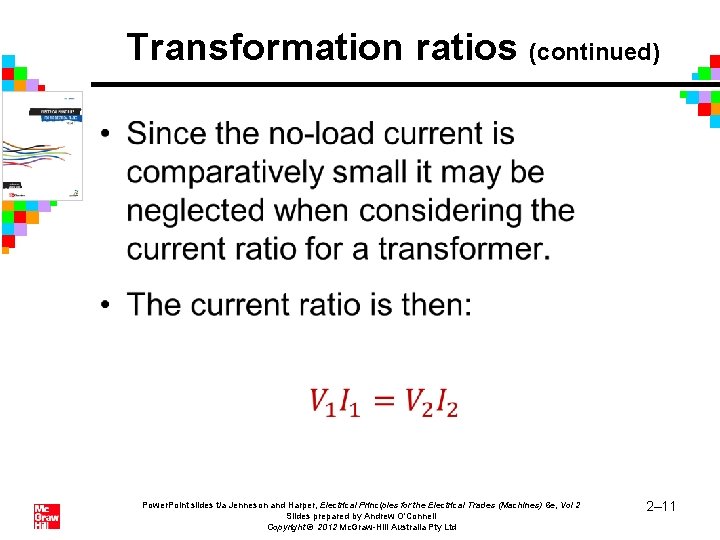
Transformation ratios (continued) • Power. Point slides t/a Jenneson and Harper, Electrical Principles for the Electrical Trades (Machines) 6 e, Vol 2 Slides prepared by Andrew O'Connell Copyright © 2012 Mc. Graw-Hill Australia Pty Ltd 2– 11
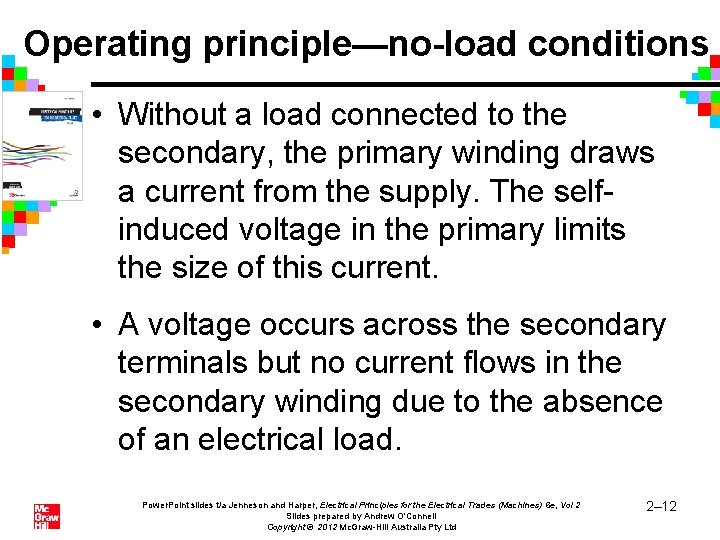
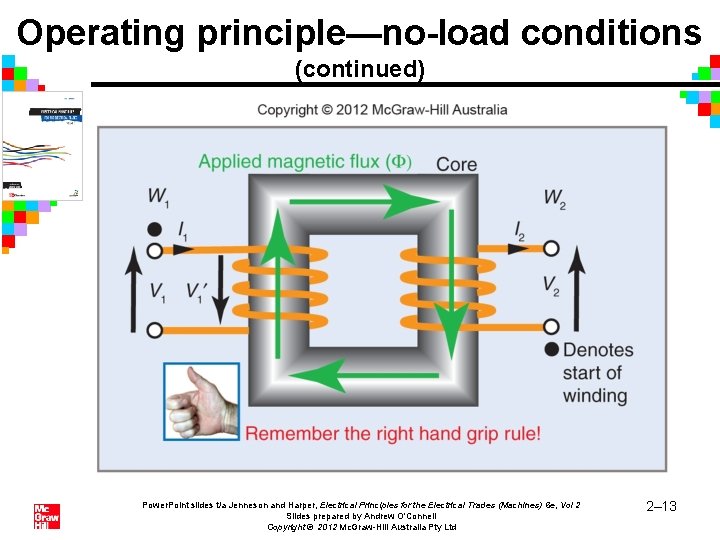
Operating principle—no-load conditions • Without a load connected to the secondary, the primary winding draws a current from the supply. The selfinduced voltage in the primary limits the size of this current. • A voltage occurs across the secondary terminals but no current flows in the secondary winding due to the absence of an electrical load. Power. Point slides t/a Jenneson and Harper, Electrical Principles for the Electrical Trades (Machines) 6 e, Vol 2 Slides prepared by Andrew O'Connell Copyright © 2012 Mc. Graw-Hill Australia Pty Ltd 2– 12
Operating principle—no-load conditions (continued) Power. Point slides t/a Jenneson and Harper, Electrical Principles for the Electrical Trades (Machines) 6 e, Vol 2 Slides prepared by Andrew O'Connell Copyright © 2012 Mc. Graw-Hill Australia Pty Ltd 2– 13
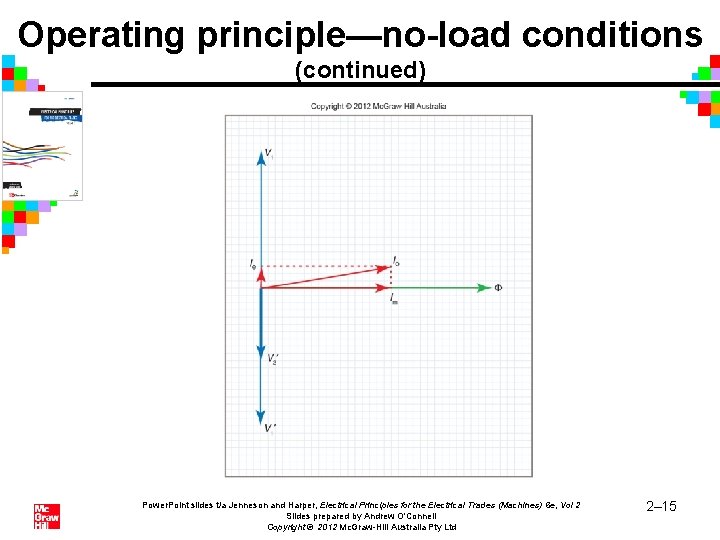
Operating principle—no-load conditions (continued) • The no-load primary current, I 0 consists of the magnetising current, Im (90 o. E lagging) and the energy component, Ie (in phase with the applied voltage). • The large angle between V 1 and I 0 shows a very poor power factor for a transformer on no load. Power. Point slides t/a Jenneson and Harper, Electrical Principles for the Electrical Trades (Machines) 6 e, Vol 2 Slides prepared by Andrew O'Connell Copyright © 2012 Mc. Graw-Hill Australia Pty Ltd 2– 14
Operating principle—no-load conditions (continued) Power. Point slides t/a Jenneson and Harper, Electrical Principles for the Electrical Trades (Machines) 6 e, Vol 2 Slides prepared by Andrew O'Connell Copyright © 2012 Mc. Graw-Hill Australia Pty Ltd 2– 15
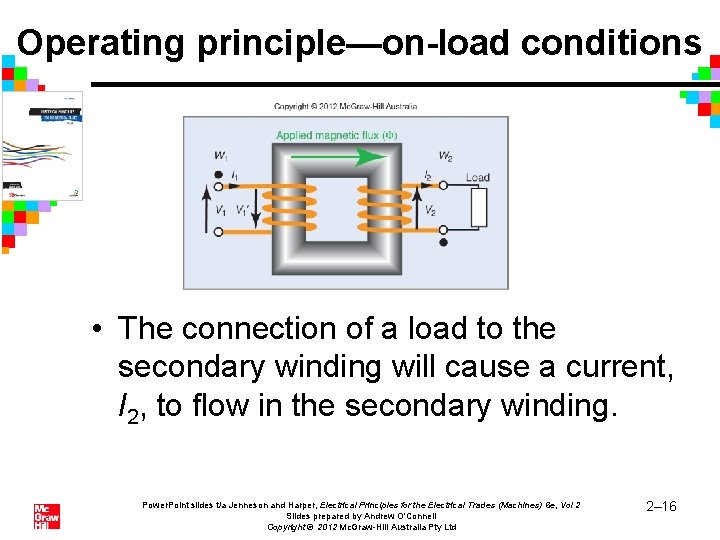
Operating principle—on-load conditions • The connection of a load to the secondary winding will cause a current, I 2, to flow in the secondary winding. Power. Point slides t/a Jenneson and Harper, Electrical Principles for the Electrical Trades (Machines) 6 e, Vol 2 Slides prepared by Andrew O'Connell Copyright © 2012 Mc. Graw-Hill Australia Pty Ltd 2– 16
Operating principle—on-load conditions (continued) • The current I 2 causes a change to the magnetic flux. Lenz's Law indicates that this change will be opposed. So the primary current increases and the flux returns to its previous value. • Thus an increase in the secondary load current, I 2, causes an increase in the primary line current, I 1’. • This is often referred to as reflected current because it is out of phase with the secondary current by 90 o Power. Point slides t/a Jenneson and Harper, Electrical Principles for the Electrical Trades (Machines) 6 e, Vol 2 Slides prepared by Andrew O'Connell Copyright © 2012 Mc. Graw-Hill Australia Pty Ltd 2– 17
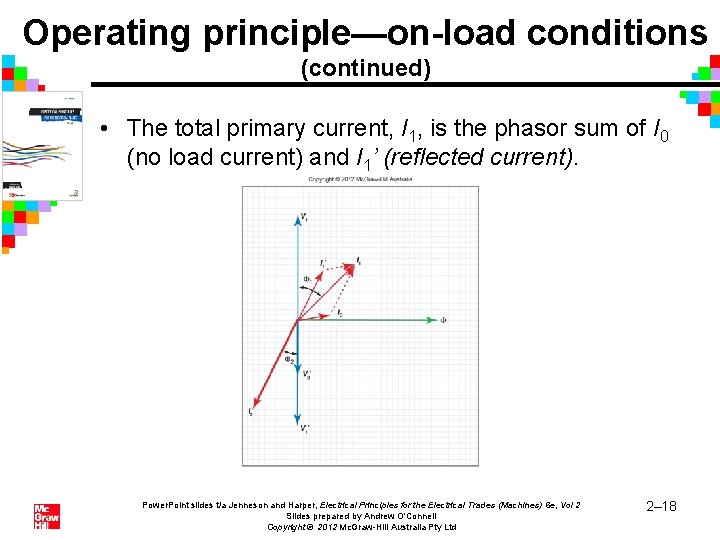
Operating principle—on-load conditions (continued) • The total primary current, I 1, is the phasor sum of I 0 (no load current) and I 1’ (reflected current). Power. Point slides t/a Jenneson and Harper, Electrical Principles for the Electrical Trades (Machines) 6 e, Vol 2 Slides prepared by Andrew O'Connell Copyright © 2012 Mc. Graw-Hill Australia Pty Ltd 2– 18
Operating principle—value of induced voltage • The value of an induced voltage in a transformer may be calculated using: V' = 4. 44Φmaxf N Where: V' = induced voltage, in volts Φmax = maximum flux, in webers f = frequency, in hertz N = number of turns Power. Point slides t/a Jenneson and Harper, Electrical Principles for the Electrical Trades (Machines) 6 e, Vol 2 Slides prepared by Andrew O'Connell Copyright © 2012 Mc. Graw-Hill Australia Pty Ltd 2– 19
Isolation transformers • The primary and secondary coils are isolated from each other because there is no electrical connection between them. • This is an effective way of separating a supply from earth when the energy source is from a grid that is earthed. • Your wiring rules specify that for this to happen the transformer must have no chance of the primary and secondary coils coming into contact with each other. • They must comply with standard AS/NZS: 61558 Power. Point slides t/a Jenneson and Harper, Electrical Principles for the Electrical Trades (Machines) 6 e, Vol 2 Slides prepared by Andrew O'Connell Copyright © 2012 Mc. Graw-Hill Australia Pty Ltd 2– 20
END Power. Point slides t/a Jenneson and Harper, Electrical Principles for the Electrical Trades (Machines) 6 e, Vol 2 Slides prepared by Andrew O'Connell Copyright © 2012 Mc. Graw-Hill Australia Pty Ltd 2– 21