
Chapter 2 Trait Approach Overview Great Person Theories
- Slides: 15
Chapter 2: Trait Approach
Overview Great Person Theories Historical Shifts in Trait Perspective What Traits Differentiate Leaders From Nonleaders? How Does the Trait Approach Work? Peter G. Northouse, Leadership: Theory and Practice, Seventh Edition. © 2016 SAGE Publications, Inc.
Great Person Theories Trait Approach: one of the first systematic attempts to study leadership “Great Man” Theories (early 1900 s) ®Focused on identifying innate qualities and characteristics possessed by great social, political, & military leaders Peter G. Northouse, Leadership: Theory and Practice, Seventh Edition. © 2016 SAGE Publications, Inc.
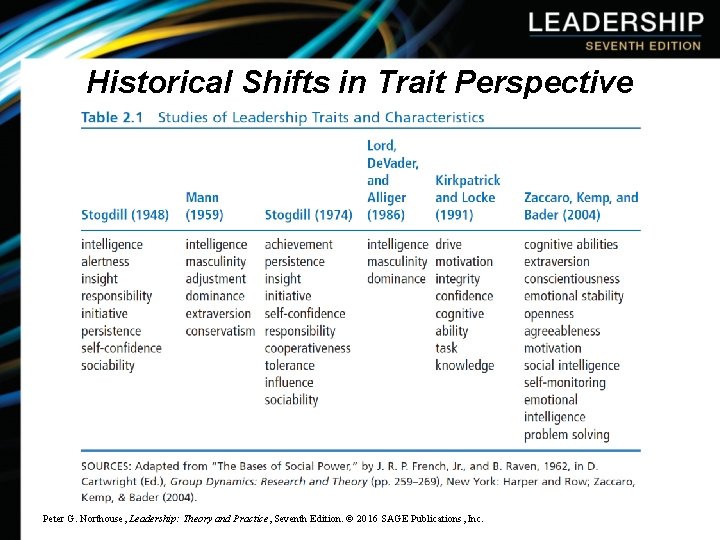
Historical Shifts in Trait Perspective Peter G. Northouse, Leadership: Theory and Practice, Seventh Edition. © 2016 SAGE Publications, Inc.
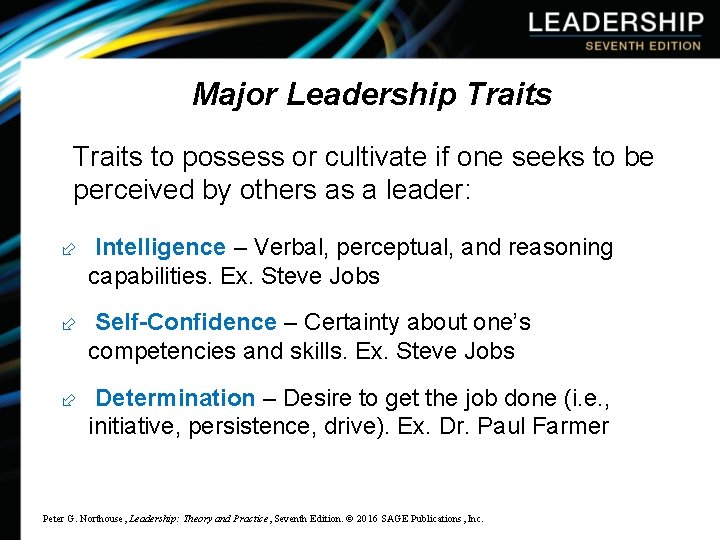
Major Leadership Traits to possess or cultivate if one seeks to be perceived by others as a leader: Intelligence – Verbal, perceptual, and reasoning capabilities. Ex. Steve Jobs Self-Confidence – Certainty about one’s competencies and skills. Ex. Steve Jobs Determination – Desire to get the job done (i. e. , initiative, persistence, drive). Ex. Dr. Paul Farmer Peter G. Northouse, Leadership: Theory and Practice, Seventh Edition. © 2016 SAGE Publications, Inc.
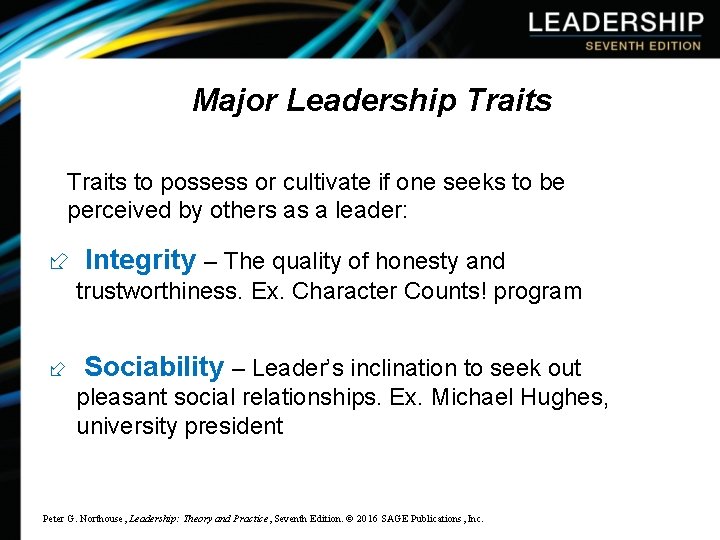
Major Leadership Traits to possess or cultivate if one seeks to be perceived by others as a leader: Integrity – The quality of honesty and trustworthiness. Ex. Character Counts! program Sociability – Leader’s inclination to seek out pleasant social relationships. Ex. Michael Hughes, university president Peter G. Northouse, Leadership: Theory and Practice, Seventh Edition. © 2016 SAGE Publications, Inc.
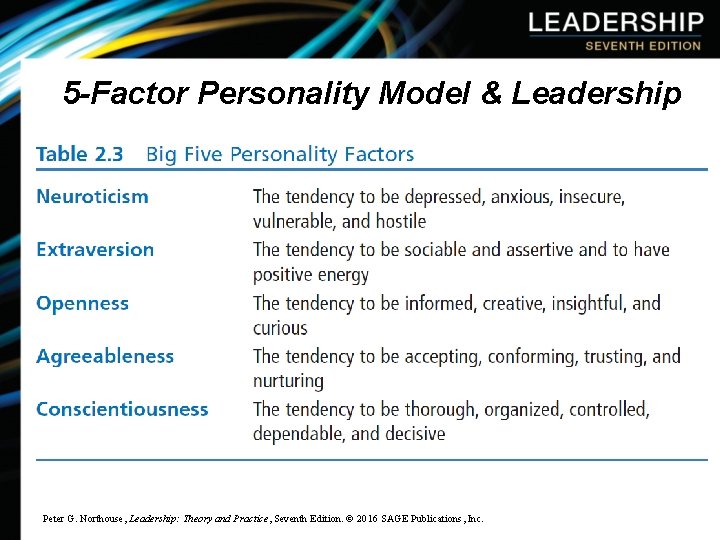
5 -Factor Personality Model & Leadership Peter G. Northouse, Leadership: Theory and Practice, Seventh Edition. © 2016 SAGE Publications, Inc.
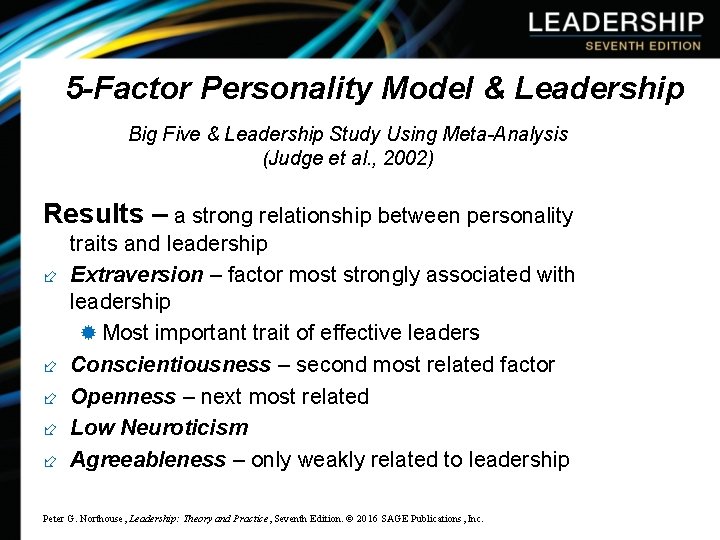
5 -Factor Personality Model & Leadership Big Five & Leadership Study Using Meta-Analysis (Judge et al. , 2002) Results – a strong relationship between personality traits and leadership Extraversion – factor most strongly associated with leadership ® Most important trait of effective leaders Conscientiousness – second most related factor Openness – next most related Low Neuroticism Agreeableness – only weakly related to leadership Peter G. Northouse, Leadership: Theory and Practice, Seventh Edition. © 2016 SAGE Publications, Inc.
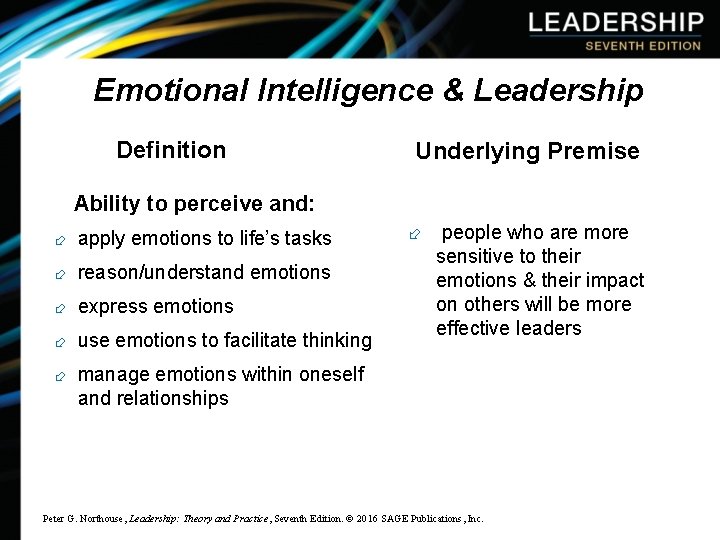
Emotional Intelligence & Leadership Definition Underlying Premise Ability to perceive and: apply emotions to life’s tasks reason/understand emotions express emotions use emotions to facilitate thinking manage emotions within oneself and relationships people who are more sensitive to their emotions & their impact on others will be more effective leaders Peter G. Northouse, Leadership: Theory and Practice, Seventh Edition. © 2016 SAGE Publications, Inc.
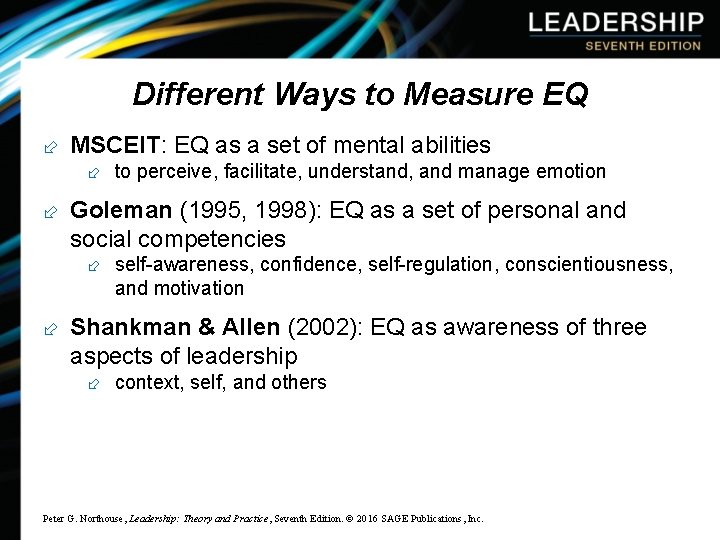
Different Ways to Measure EQ MSCEIT: EQ as a set of mental abilities to perceive, facilitate, understand, and manage emotion Goleman (1995, 1998): EQ as a set of personal and social competencies self-awareness, confidence, self-regulation, conscientiousness, and motivation Shankman & Allen (2002): EQ as awareness of three aspects of leadership context, self, and others Peter G. Northouse, Leadership: Theory and Practice, Seventh Edition. © 2016 SAGE Publications, Inc.
How Does the Trait Approach Work? Focus of Trait Approach Strengths Criticisms Application Peter G. Northouse, Leadership: Theory and Practice, Seventh Edition. © 2016 SAGE Publications, Inc.
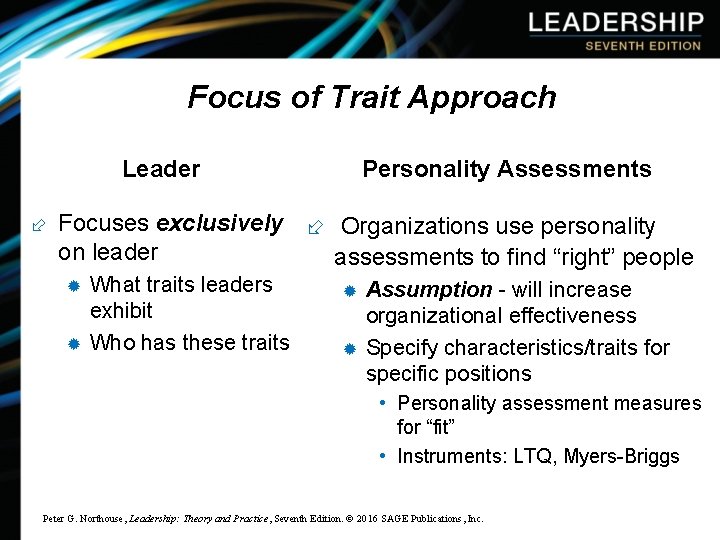
Focus of Trait Approach Leader Personality Assessments Focuses exclusively Organizations use personality assessments to find “right” people on leader ® ® What traits leaders exhibit Who has these traits ® ® Assumption - will increase organizational effectiveness Specify characteristics/traits for specific positions • Personality assessment measures for “fit” • Instruments: LTQ, Myers-Briggs Peter G. Northouse, Leadership: Theory and Practice, Seventh Edition. © 2016 SAGE Publications, Inc.
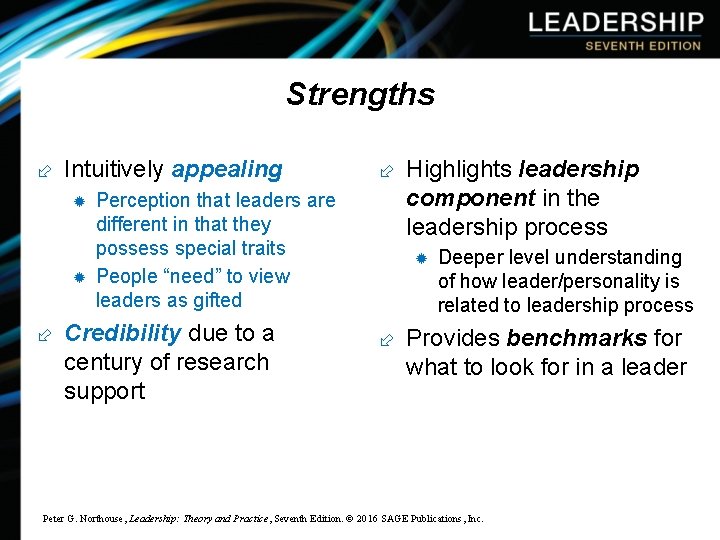
Strengths Intuitively appealing ® Perception that leaders are different in that they possess special traits ® People “need” to view leaders as gifted Highlights leadership Credibility due to a Provides benchmarks for century of research support component in the leadership process ® Deeper level understanding of how leader/personality is related to leadership process what to look for in a leader Peter G. Northouse, Leadership: Theory and Practice, Seventh Edition. © 2016 SAGE Publications, Inc.
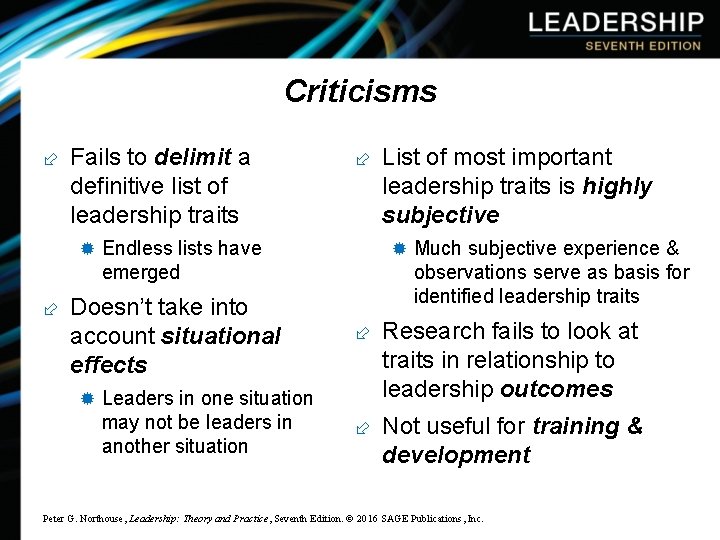
Criticisms Fails to delimit a definitive list of leadership traits ® Endless lists have emerged Doesn’t take into account situational effects ® Leaders in one situation may not be leaders in another situation List of most important leadership traits is highly subjective ® Much subjective experience & observations serve as basis for identified leadership traits Research fails to look at traits in relationship to leadership outcomes Not useful for training & development Peter G. Northouse, Leadership: Theory and Practice, Seventh Edition. © 2016 SAGE Publications, Inc.
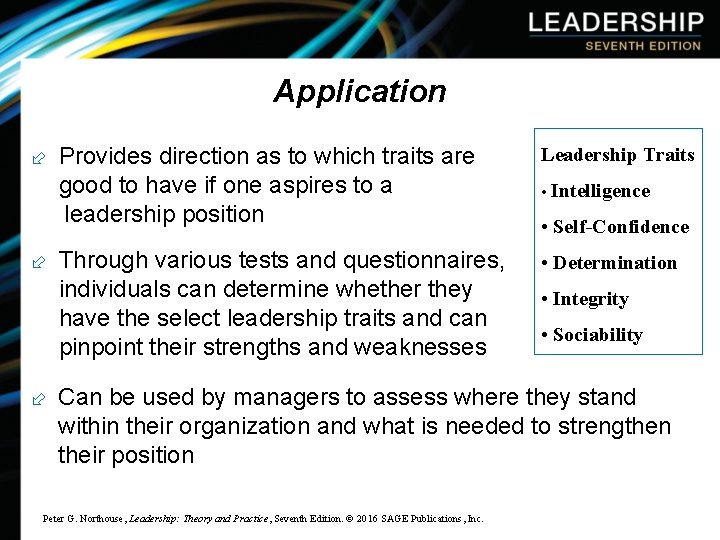
Application Provides direction as to which traits are good to have if one aspires to a leadership position Through various tests and questionnaires, individuals can determine whether they have the select leadership traits and can pinpoint their strengths and weaknesses Leadership Traits • Intelligence • Self-Confidence • Determination • Integrity • Sociability Can be used by managers to assess where they stand within their organization and what is needed to strengthen their position Peter G. Northouse, Leadership: Theory and Practice, Seventh Edition. © 2016 SAGE Publications, Inc.