
Chapter 2 Theory Research and EvidenceBased Practice Copyright

Chapter 2 Theory, Research, and Evidence-Based Practice Copyright © 2011 Wolters Kluwer Health | Lippincott Williams & Wilkins
Nursing Social Policy Statement of Issues Nurses Address • Promotion of health and wellness • Promotion of safety and quality of care • Care, self-care processes, and care coordination • Physical, emotional, and spiritual comfort, discomfort, and pain • Adaptation to physiologic and pathophysiologic processes • Emotions related to the experience of birth, growth and development, health, illness, disease, and death • Meanings ascribed to health, illness, and other concepts Copyright © 2019 Wolters Kluwer • All Rights Reserved
Nursing Social Policy Statement of Issues Nurses Address (cont. ) • Linguistic and cultural sensitivity • Health literacy • Decision making and the ability to make choices • Relationships, role performance, and change processes within relationships • Social policies and their effects on health • Health care systems and their relationships to access, cost, and quality of health care • The environment and the prevention of disease and injury Copyright © 2019 Wolters Kluwer • All Rights Reserved
Sources of Knowledge • Traditional—passed down from generation to generation • Authoritative—comes from an expert, accepted as truth based on person’s perceived expertise • Scientific—obtained through the scientific method (research) Copyright © 2019 Wolters Kluwer • All Rights Reserved
Question #1 Tell whether the following statement is true or false. Traditional and authoritative knowledge are practical to implement, but are often based on subjective data, limiting their usefulness in a wide variety of settings. A. True B. False Copyright © 2019 Wolters Kluwer • All Rights Reserved
Answer to Question #1 Answer: A. True Rationale: Traditional and authoritative knowledge are practical to implement but are often based on subjective data, limiting their usefulness in a wide variety of settings. Copyright © 2019 Wolters Kluwer • All Rights Reserved
Types of Nursing Knowledge and Influences on Nursing Knowledge • Types – Science—knowledge in and of nursing – Philosophy—the study of wisdom, fundamental knowledge, and processes used to construct life – Process—conceptual frameworks and theories • Influences – Historical influences—Florence Nightingale, societal changes – Societal influences—schools of nursing Copyright © 2019 Wolters Kluwer • All Rights Reserved
Question #2 Which of the following is a series of actions, changes, or functions intended to bring about a desired result? A. Process B. Science C. Philosophy D. Theory Copyright © 2019 Wolters Kluwer • All Rights Reserved
Answer to Question #2 Answer: A. Process Rationale: A process is a series of actions, changes, or functions to bring about a desired result taking systematic steps. A science implies a body of knowledge. A philosophy is the study of wisdom, fundamental knowledge, and the processes used to develop a perception of life. A theory is composed of a group of concepts that describe a pattern of reality. Copyright © 2019 Wolters Kluwer • All Rights Reserved
Framework of Nursing Theory • Theory: group of concepts that describe a pattern of reality – Can be tested, changed, or used to guide research • Concepts: abstract impressions organized into symbols of reality – Conceptual framework or model Copyright © 2019 Wolters Kluwer • All Rights Reserved
Question #3 Tell whether the following statement is true or false. A nurse who tests a nursing theory by examining theory itself and then considering the specific actions or ideas is using deductive reasoning. A. True B. False Copyright © 2019 Wolters Kluwer • All Rights Reserved
Answer to Question #3 Answer: A. True Rationale: A nurse who tests a nursing theory by examining theory itself and then considering the specific actions or ideas is using deductive reasoning. Copyright © 2019 Wolters Kluwer • All Rights Reserved
Types of Reasoning • Deductive reasoning—examines general ideas and considers specific actions or ideas • Inductive reasoning—builds from specific ideas or actions to conclusions about general ideas Copyright © 2019 Wolters Kluwer • All Rights Reserved
Interdisciplinary Base for Nursing Theories • General systems theory—theory for universal application; break whole things into parts to see how they work together in systems • Adaptation theory—adjustment of living matter to other living things and environment • Developmental theory—orderly and predictable growth and development from conception to death Copyright © 2019 Wolters Kluwer • All Rights Reserved
Benefits of Nursing Theory • Directs nurses toward common goal • Leads to improved patient care • Provides rational and knowledgeable reasons for nursing actions • Gives nurses knowledge base necessary for appropriate actions • Helps resolve current nursing issues • Prepares nurses to question assumptions and values • Serves research, education, and practice Copyright © 2019 Wolters Kluwer • All Rights Reserved

Question #4 Which of the following is the central theme in theoretical frameworks of nursing? A. The person receiving the care B. The health care environment C. The nursing care plan D. The person providing the care Copyright © 2019 Wolters Kluwer • All Rights Reserved
Answer to Question #4 Answer: A. The person receiving the care Rationale: Theoretical frameworks of nursing provide a focus for nursing care activities. The person receiving care is the central theme, but the way each theorist defines that person, the environment, health, and nursing gives a unique focus, specific to a particular theory. Copyright © 2019 Wolters Kluwer • All Rights Reserved
Goal of Theoretical Frameworks • Holistic patient care • Individualized care to meet needs of patients • Promotion of health • Prevention or treatment of illness Copyright © 2019 Wolters Kluwer • All Rights Reserved
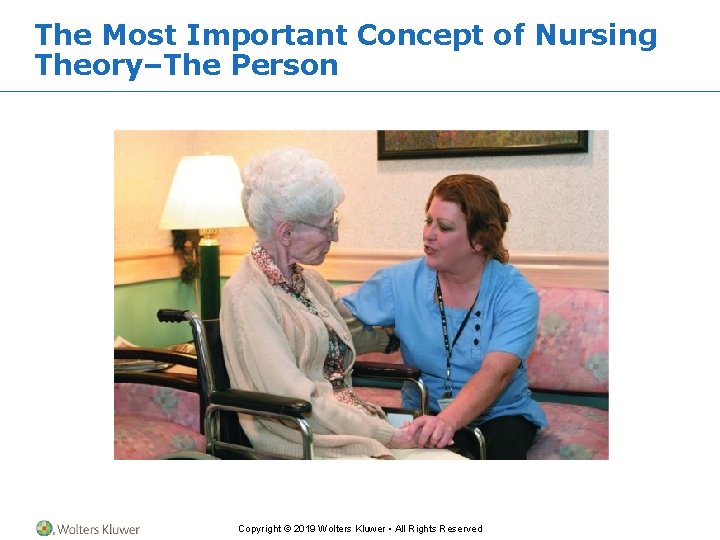
The Most Important Concept of Nursing Theory–The Person Copyright © 2019 Wolters Kluwer • All Rights Reserved
Goals of Research • Develop explanations (in theories) • Find solutions to problems Copyright © 2019 Wolters Kluwer • All Rights Reserved

Goals of Nursing Research • Improve care of people in clinical setting. • Study people and the nursing process. – Education – Policy development – Ethics – Nursing history • Develop greater autonomy and strength as a profession. • Provide evidence-based nursing practice. Copyright © 2019 Wolters Kluwer • All Rights Reserved

National Institute of Nursing Research Goals of Research • Build the scientific foundation for clinical practice. • Prevent disease and disability. • Manage and eliminate symptoms caused by illness. • Enhance end-of-life and palliative care. Copyright © 2019 Wolters Kluwer • All Rights Reserved
Methods of Nursing Research • Quantitative – Involves concepts of basic and applied research • Qualitative – Conducted to gain insight by discovering meanings – Based on belief that reality is based on perceptions that differ for each person and change over time Copyright © 2019 Wolters Kluwer • All Rights Reserved
Evaluating the Ethics of Clinical Research Studies • Value • Scientific validity • Fair subject selection • Favorable risk-benefit ratio • Independent review • Informed consent • Respect for enrolled subjects Copyright © 2019 Wolters Kluwer • All Rights Reserved
Types of Quantitative Research • Descriptive • Correlational • Quasi-experimental • Experimental Copyright © 2019 Wolters Kluwer • All Rights Reserved
Qualitative Research Methods • Phenomenology • Grounded theory • Ethnography • Historical Copyright © 2019 Wolters Kluwer • All Rights Reserved
Question #5 Tell whether the following statement is true or false. The basis of phenomenology is the discovery of how people describe their own reality and how their beliefs are related to their actions in a social scene. A. True B. False Copyright © 2019 Wolters Kluwer • All Rights Reserved
Answer to Question #5 Answer: B. False Rationale: The basis of grounded theory is the discovery of how people describe their own reality and how their beliefs are related to their actions in a social scene. Copyright © 2019 Wolters Kluwer • All Rights Reserved
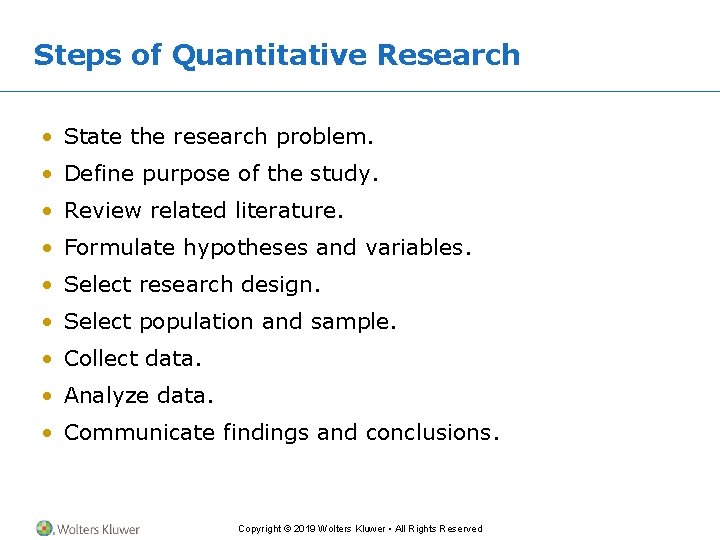
Steps of Quantitative Research • State the research problem. • Define purpose of the study. • Review related literature. • Formulate hypotheses and variables. • Select research design. • Select population and sample. • Collect data. • Analyze data. • Communicate findings and conclusions. Copyright © 2019 Wolters Kluwer • All Rights Reserved

Terms in Quantitative Research • Variable – Dependent variable – Independent variable • Hypothesis • Data • Instruments Copyright © 2019 Wolters Kluwer • All Rights Reserved

Impediments to Nursing Research • Restricted access to resources • Limited time to participate in research • Lack of educational preparation Copyright © 2019 Wolters Kluwer • All Rights Reserved
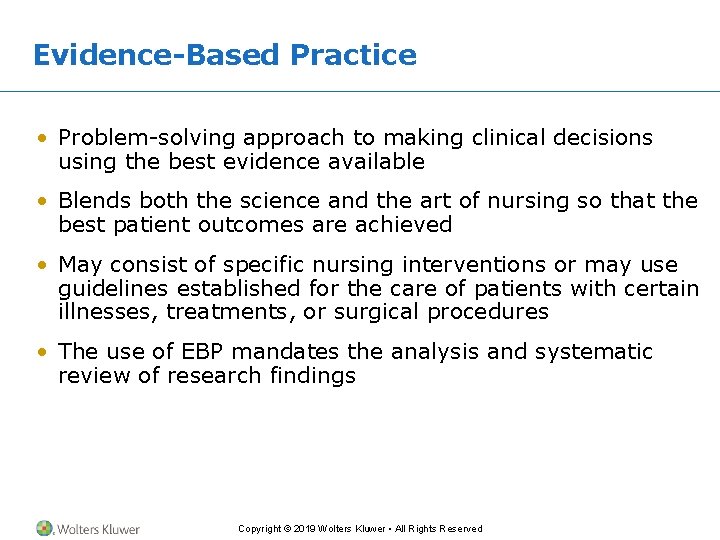
Evidence-Based Practice • Problem-solving approach to making clinical decisions using the best evidence available • Blends both the science and the art of nursing so that the best patient outcomes are achieved • May consist of specific nursing interventions or may use guidelines established for the care of patients with certain illnesses, treatments, or surgical procedures • The use of EBP mandates the analysis and systematic review of research findings Copyright © 2019 Wolters Kluwer • All Rights Reserved
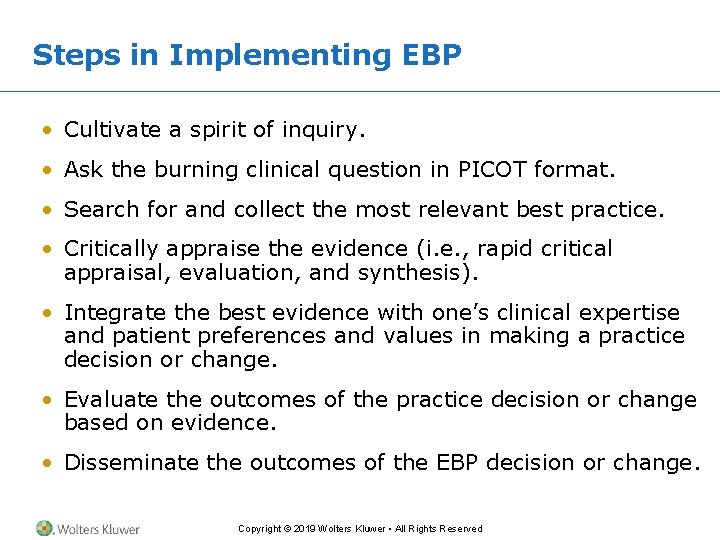
Steps in Implementing EBP • Cultivate a spirit of inquiry. • Ask the burning clinical question in PICOT format. • Search for and collect the most relevant best practice. • Critically appraise the evidence (i. e. , rapid critical appraisal, evaluation, and synthesis). • Integrate the best evidence with one’s clinical expertise and patient preferences and values in making a practice decision or change. • Evaluate the outcomes of the practice decision or change based on evidence. • Disseminate the outcomes of the EBP decision or change. Copyright © 2019 Wolters Kluwer • All Rights Reserved
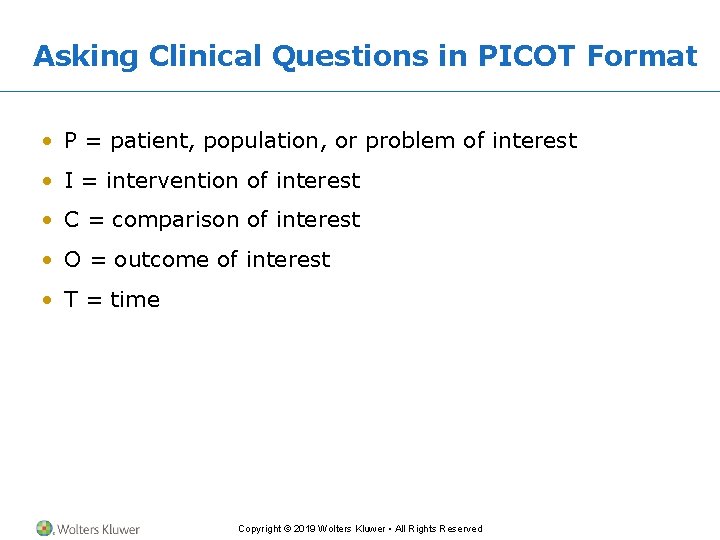
Asking Clinical Questions in PICOT Format • P = patient, population, or problem of interest • I = intervention of interest • C = comparison of interest • O = outcome of interest • T = time Copyright © 2019 Wolters Kluwer • All Rights Reserved

Components of a Research Journal • Abstract • Introduction • Method • Results • Discussion • References Copyright © 2019 Wolters Kluwer • All Rights Reserved

Reading and Critiquing a Research Article • Review the Elements of the article. • Determine the level and quality of the evidence using a scale. • Decide if the study is applicable to your practice. Copyright © 2019 Wolters Kluwer • All Rights Reserved
- Slides: 36