
Chapter 2 The Project Management Context Project Life
- Slides: 21
Chapter 2: The Project Management Context
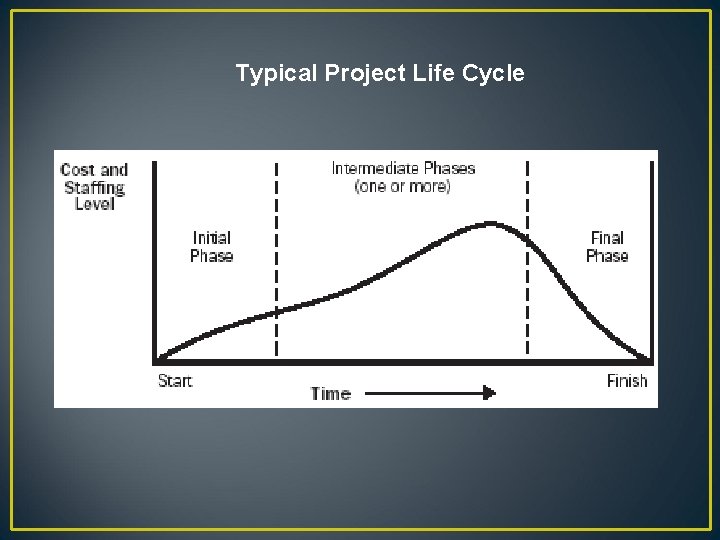
Project Life Cycle • The collection of phases that are performed in completing a project. • Each project phase is marked by completion of one or more deliverables. • The conclusion of a project phase is generally marked by a review of both key deliverables and project performance to date. • Determine if the project should continue into its next phase. • Detect and correct errors. • The project life cycle defines the beginning and the end of a project. • Project life cycles generally define: • What technical work should be done in each phase. • Who should be involved in each phase.
Typical Project Life Cycle
Project Phase Deliverables • A deliverable is a tangible, verifiable work product such as a feasibility study, a detail design, or a working prototype. • Deliverables from the preceding phase are usually approved before work starts on the next phase.
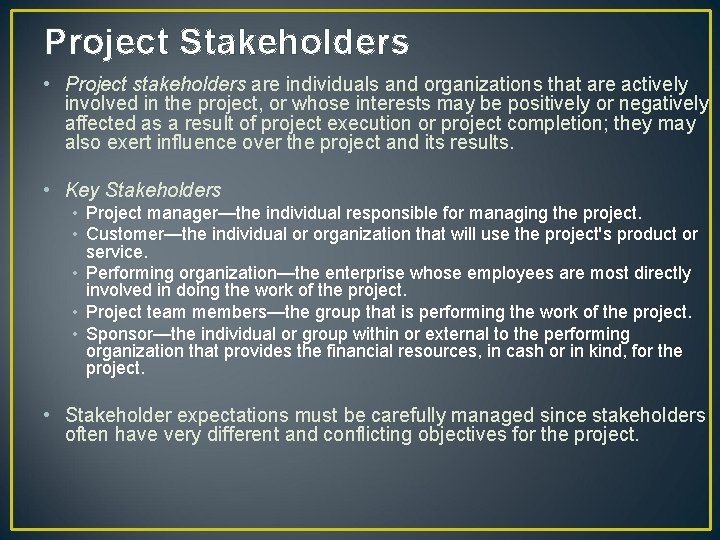
Project Stakeholders • Project stakeholders are individuals and organizations that are actively involved in the project, or whose interests may be positively or negatively affected as a result of project execution or project completion; they may also exert influence over the project and its results. • Key Stakeholders • Project manager—the individual responsible for managing the project. • Customer—the individual or organization that will use the project's product or service. • Performing organization—the enterprise whose employees are most directly involved in doing the work of the project. • Project team members—the group that is performing the work of the project. • Sponsor—the individual or group within or external to the performing organization that provides the financial resources, in cash or in kind, for the project. • Stakeholder expectations must be carefully managed since stakeholders often have very different and conflicting objectives for the project.
Organizational Influences to Projects • • Organizational Systems. Organizational Cultures and Styles. Organizational Structure. Project Office.
Project-based Organizations • Project-based organizations are organizations whose operations consist primarily of projects. • Organizations that derive their revenue primarily from performing projects for others. • Organizations that have adopted management by projects. • Nonproject-based organizations often lack management systems designed to support project needs efficiently and effectively.
Organizational Cultures/Styles • Organizational culture is reflected in their shared values, norms, beliefs, and expectations; in their policies and procedures; in their view of authority relationships; etc.
Organizational Structure • Functional Structure • Matrix Structure • Projectized Structure
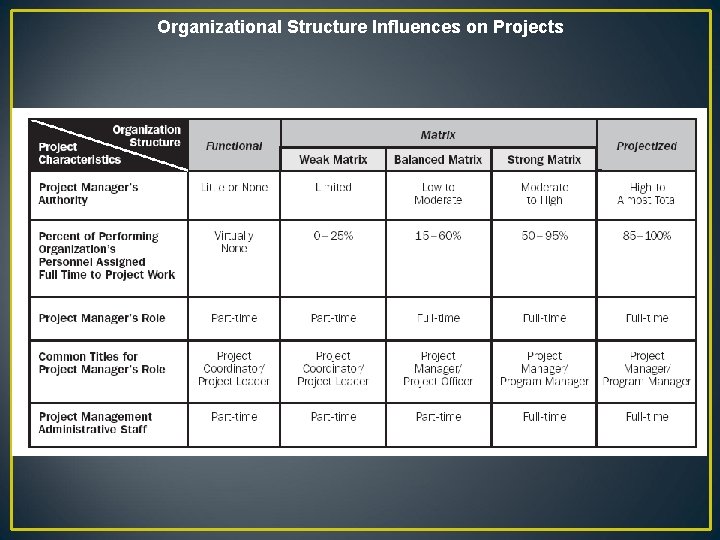
Matrix Organizational Structure • Matrix organizations are a blend of functional and projectized characteristics. • Weak matrices maintain many of the characteristics of a functional organization, and the project manager role is more of a coordinator or expediter than a manager. • Strong matrices have many of the characteristics of the projectized organization—full-time project managers with considerable authority and full-time project administrative staff.
Organizational Structure Influences on Projects
Key General Management Skills • Finance and accounting, sales and marketing, research and development, and manufacturing and distribution. • Strategic planning, tactical planning, and operational planning. • Organizational structures, organizational behavior, personnel administration, compensation, benefits, and career paths. • Managing work relationships through motivation, delegation, supervision, team building, conflict management, and other techniques. • Managing oneself through personal time management, stress management, and other techniques.
Leading • Establishing direction—developing both a vision of the future and strategies for producing the changes needed to achieve that vision. • Aligning people—communicating the vision by words and deeds to all those whose cooperation may be needed to achieve the vision. • Motivating and inspiring—helping people energize themselves to overcome political, bureaucratic, and resource barriers to change.
Communicating • Communicating involves the exchange of information. • Communicating Dimension Examples • Written and oral, listening and speaking. • Internal (within the project) and external (to the customer, the media, the public, etc. ). • Formal (reports, briefings, etc. ) and informal (memos, ad hoc conversations, etc. ). • Vertical (up and down the organization) and horizontal (with peers and partner organization).
Negotiating • Negotiating involves conferring with others to come to terms with them or reach an agreement. • Negotiation Item Examples • Scope, cost, and schedule objectives. • Changes to scope, cost, or schedule. • Contract terms and conditions. • Assignments. • Resources.
Problem Solving • Problem solving involves a combination of problem definition and decision-making. • Problem definition requires distinguishing between causes and symptoms to determine the essential reasons for a problem. • Decision-making includes analyzing the problem to identify viable solutions, and then making a choice from among them.
Influencing the Organization • Influencing the organization involves the ability to "get things done. " • Influencing the organization also requires an understanding of the mechanics of power and politics. • Power is the potential ability to influence behavior, to change the course of events, to overcome resistance, and to get people to do things that they would not otherwise do. • Politics is about getting collective action from a group of people who may have quite different interests.
Social-Economic-Environmental Influences • All projects exist within a social-economic-environmental setting that may influence various aspects of the project. • Prominent social-economic-environmental influences. • Standards and Regulations • Internationalization • Cultural Influences
Standard • A standard is a "document approved by a recognized body, that provides, for common and repeated use, rules, guidelines, or characteristics for products, processes or services with which compliance is not mandatory. "
Regulation • A regulation is a "document, which lays down product, process or service characteristics, including the applicable administrative provisions, with which compliance is mandatory. "
Culture • Culture is the "totality of socially transmitted behavior patterns, arts, beliefs, institutions, and all other products of human work and thought.