
Chapter 2 The Managerial Role Purpose and Overview


















- Slides: 56
Chapter 2 The Managerial Role
Purpose and Overview • Purpose – To understand roles of the health care manager • Executive leadership • Organizational management • Strategic management • Business enterprises • Clinical and business service components Copyright © 2006 by Thomson Delmar Learning. ALL RIGHTS RESERVED. 2
Purpose and Overview • Overview – Behavioral Perspective – The Practice of Management: Integrating Organizational Process Management and Leadership Roles and Skills Copyright © 2006 by Thomson Delmar Learning. ALL RIGHTS RESERVED. 3
Purpose and Overview • Overview – Strategic Perspective of Health Care Management – Health Care’s Distinctive Context and Executive Leadership Requirements Copyright © 2006 by Thomson Delmar Learning. ALL RIGHTS RESERVED. 4
Purpose and Overview • Overview – Crossing the Quality Chasm: Distinctive Challenges – Developing a Standardized Knowledge Base for Professional Leadership and Health Care Managers Copyright © 2006 by Thomson Delmar Learning. ALL RIGHTS RESERVED. 5
Behavioral Perspective of the Managerial Role • Integrated and applied activity within a dynamic and evolving system Copyright © 2006 by Thomson Delmar Learning. ALL RIGHTS RESERVED. 6
Mintzberg’s Managerial Roles • Interpersonal – Figurehead – Leader – Liaison Copyright © 2006 by Thomson Delmar Learning. ALL RIGHTS RESERVED. 7
Mintzberg’s Managerial Roles • Informational Roles – Monitor – Disseminator – Spokesperson Copyright © 2006 by Thomson Delmar Learning. ALL RIGHTS RESERVED. 8
Mintzberg’s Managerial Roles • Decisional Roles – Entrepreneur – Disturbance Handler – Resource Allocator – Negotiator Copyright © 2006 by Thomson Delmar Learning. ALL RIGHTS RESERVED. 9
Mintzberg’s Model of Management • Person • Frame of job • Agenda of work Copyright © 2006 by Thomson Delmar Learning. ALL RIGHTS RESERVED. 10
Behavioral Perspective of Managerial Styles • Managerial Roles – Conceptual – Administrative – Interpersonal – Action Copyright © 2006 by Thomson Delmar Learning. ALL RIGHTS RESERVED. 11
Behavioral Perspective of Managerial Styles • How Managers Perform Roles – Linking – Conceiving – Leading Copyright © 2006 by Thomson Delmar Learning. ALL RIGHTS RESERVED. 12
Behavioral Perspective of Managerial Styles • Managerial Approaches to Action – Deductive – Inductive Copyright © 2006 by Thomson Delmar Learning. ALL RIGHTS RESERVED. 13
Behavioral Perspective of Managerial Styles • Management Mind-Sets – Reflective – Analytic – Worldly – Collaborative – Action Copyright © 2006 by Thomson Delmar Learning. ALL RIGHTS RESERVED. 14
Integrating Management and Leadership Skills • Systemic Organization Structure – Mission – Strategies, goals, and accountabilities – Production function – Strategic affiliations – Organizational culture Copyright © 2006 by Thomson Delmar Learning. ALL RIGHTS RESERVED. 15
Integrating Management and Leadership Skills Copyright © 2006 by Thomson Delmar Learning. ALL RIGHTS RESERVED. 16
Integrating Management and Leadership Skills • Direction-Setting Processes – Learning about the organization – Framing an agenda – Aligning individuals – Framing, testing, and revising initiatives Copyright © 2006 by Thomson Delmar Learning. ALL RIGHTS RESERVED. 17
Integrating Management and Leadership Skills • Negotiating and Selling Processes – Framing issues – Soliciting help and presenting proposals – Building and maintaining contacts and communication – Building and managing coalitions Copyright © 2006 by Thomson Delmar Learning. ALL RIGHTS RESERVED. 18
Integrating Management and Leadership Skills • Monitoring and Controlling Processes – Ensuring organizational operation as planned – Detect unexpected shocks and disturbances – Initiation of corrective action – Restoration of organizational equilibrium Copyright © 2006 by Thomson Delmar Learning. ALL RIGHTS RESERVED. 19
Integrating Management and Leadership Skills • Work Processes – Customers – Transformations – Supply-chain systems serving customers requiring alignment to achieve mutual support Copyright © 2006 by Thomson Delmar Learning. ALL RIGHTS RESERVED. 20
Integrating Management and Leadership Skills • Work Processes – Quality control – Cost containment – Reduce cycle times Copyright © 2006 by Thomson Delmar Learning. ALL RIGHTS RESERVED. 21
Integrating Management and Leadership Skills • Work Processes – Enhance operating performance – Decrease fragmentation – Improve cross-functional integration Copyright © 2006 by Thomson Delmar Learning. ALL RIGHTS RESERVED. 22
Integrating Management and Leadership Skills • Organizational & Behavioral Processes – Decision making – Communication – Organizational learning Copyright © 2006 by Thomson Delmar Learning. ALL RIGHTS RESERVED. 23
Integrating Management and Leadership Skills • Organizational & Change Processes – Creation – Growth – Transformation – Decline Copyright © 2006 by Thomson Delmar Learning. ALL RIGHTS RESERVED. 24
Integrating Management and Leadership Skills • Organizational Management Work – Coping with complexity: good management helps to ensure organization’s survival Copyright © 2006 by Thomson Delmar Learning. ALL RIGHTS RESERVED. 25
Integrating Management and Leadership Skills • Executive Leader Roles – “Organizational system manager-in chief”’ – “Boundary spanner-in chief” – “Resource developer/investor-in chief” – “Transformation manager-in chief” Copyright © 2006 by Thomson Delmar Learning. ALL RIGHTS RESERVED. 26
Integrating Management and Leadership Skills Copyright © 2006 by Thomson Delmar Learning. ALL RIGHTS RESERVED. 27
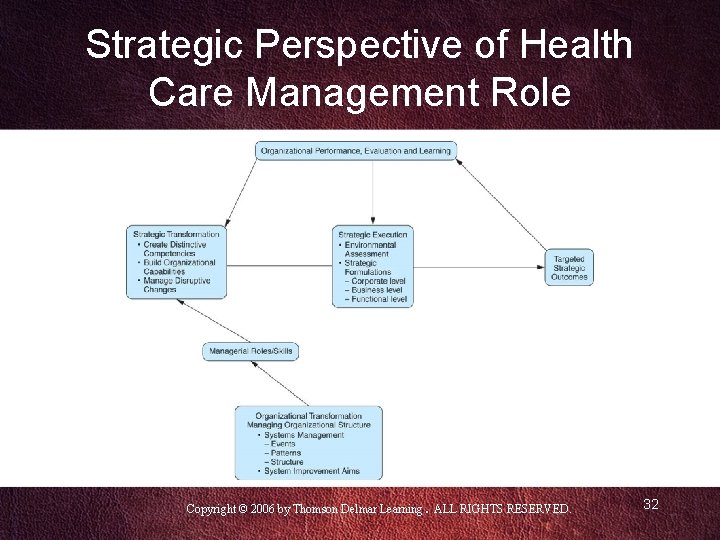
Strategic Perspective of Health Care Management Role • Defines strategic goals for organization’s survival and growth • Apply strategic management concepts Copyright © 2006 by Thomson Delmar Learning. ALL RIGHTS RESERVED. 28
Strategic Perspective of Health Care Management Role • Organizational Transformation – Strategic planning to manage evolution of organization over time – Apply continuous judgment in ongoing operations Copyright © 2006 by Thomson Delmar Learning. ALL RIGHTS RESERVED. 29
Strategic Perspective of Health Care Management Role • Strategic Transformation – Identify opportunities to develop new competencies – Allow organization to create and experiment – Maintain sustainable competitive advantage Copyright © 2006 by Thomson Delmar Learning. ALL RIGHTS RESERVED. 30
Strategic Perspective of Health Care Management Role • Strategic Execution – Select and execute appropriate strategies to achieve goals Copyright © 2006 by Thomson Delmar Learning. ALL RIGHTS RESERVED. 31
Strategic Perspective of Health Care Management Role Copyright © 2006 by Thomson Delmar Learning. ALL RIGHTS RESERVED. 32
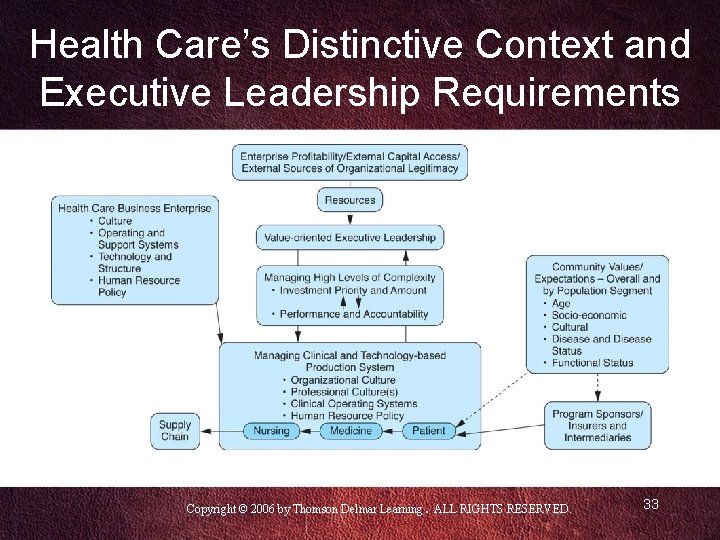
Health Care’s Distinctive Context and Executive Leadership Requirements Copyright © 2006 by Thomson Delmar Learning. ALL RIGHTS RESERVED. 33
Health Care’s Distinctive Context and Executive Leadership Requirements • Managing Clinical and Technology-Based Production Systems – Core “production work” to provide safe, effective, efficient clinical services Copyright © 2006 by Thomson Delmar Learning. ALL RIGHTS RESERVED. 34
Health Care’s Distinctive Context and Executive Leadership Requirements • Managing Organizational Complexity – Complex and strongly resource-dependent organizations – Monitor and evaluate safety, effectiveness, and efficiency – Intervene to improve services and ensure accountability Copyright © 2006 by Thomson Delmar Learning. ALL RIGHTS RESERVED. 35
Health Care’s Distinctive Context and Executive Leadership Requirements • Providing Value-Oriented Leadership – Health delivery organizations – Executive leadership Copyright © 2006 by Thomson Delmar Learning. ALL RIGHTS RESERVED. 36
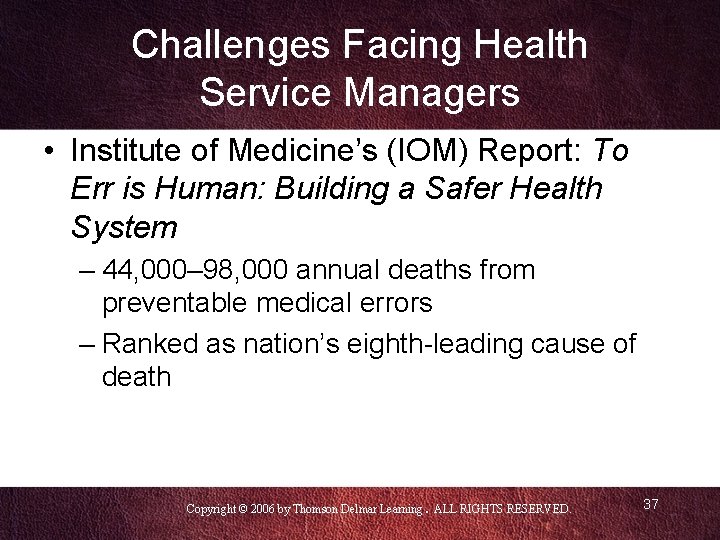
Challenges Facing Health Service Managers • Institute of Medicine’s (IOM) Report: To Err is Human: Building a Safer Health System – 44, 000– 98, 000 annual deaths from preventable medical errors – Ranked as nation’s eighth-leading cause of death Copyright © 2006 by Thomson Delmar Learning. ALL RIGHTS RESERVED. 37
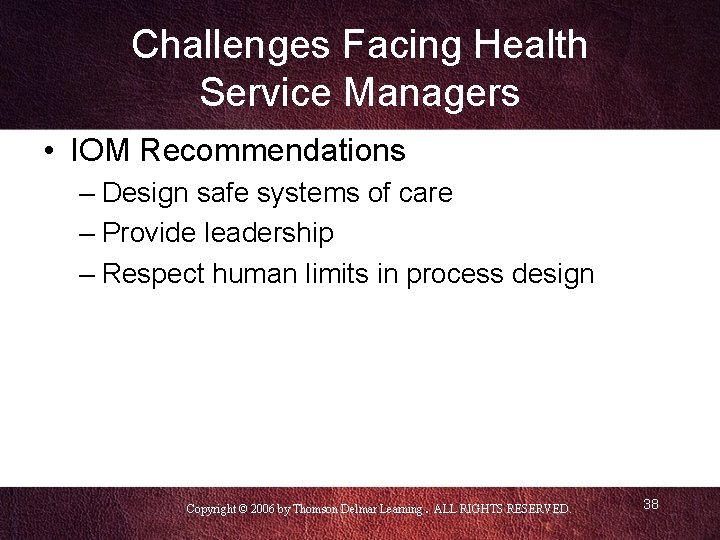
Challenges Facing Health Service Managers • IOM Recommendations – Design safe systems of care – Provide leadership – Respect human limits in process design Copyright © 2006 by Thomson Delmar Learning. ALL RIGHTS RESERVED. 38
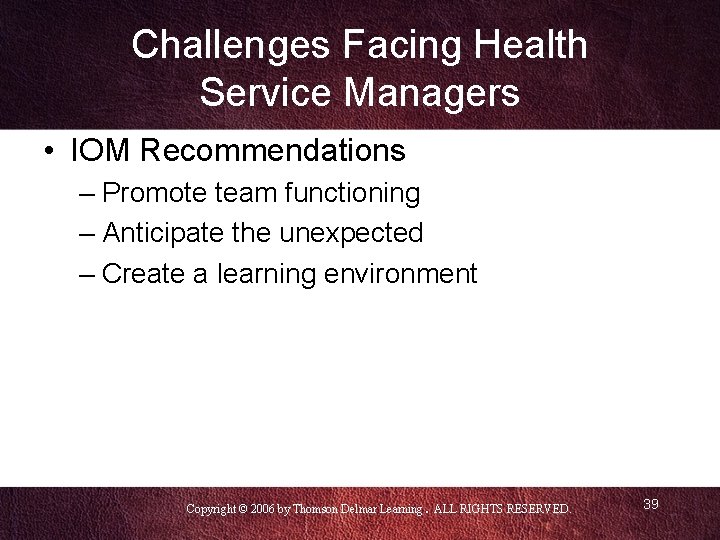
Challenges Facing Health Service Managers • IOM Recommendations – Promote team functioning – Anticipate the unexpected – Create a learning environment Copyright © 2006 by Thomson Delmar Learning. ALL RIGHTS RESERVED. 39
Challenges Facing Health Service Managers • IOM Design Principles – Standardize and simplify equipment, supplies, and processes – Establish team training programs – Implement non-punitive systems for reporting and analyzing errors Copyright © 2006 by Thomson Delmar Learning. ALL RIGHTS RESERVED. 40
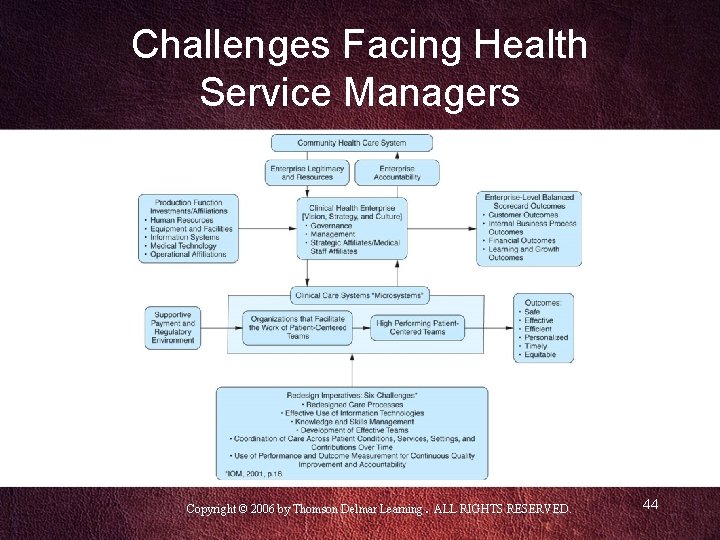
Challenges Facing Health Service Managers • IOM Report: Crossing the Quality Chasm: A New Health System for the 21 st Century • Health care services should be safe, effective, patient-centered, timely, efficient, and equitable Copyright © 2006 by Thomson Delmar Learning. ALL RIGHTS RESERVED. 41
Challenges Facing Health Service Managers • • IOM Report: Crossing the Quality Chasm Six challenges: 1) Redesign care processes 2) Use information technologies 3) Manage clinical knowledge and skills Copyright © 2006 by Thomson Delmar Learning. ALL RIGHTS RESERVED. 42
Challenges Facing Health Service Managers • • IOM Report: Crossing the Quality Chasm Six challenges: 4) Develop effective teams 5) Coordinate care 6) Incorporate performance and outcome measurements throughout operations Copyright © 2006 by Thomson Delmar Learning. ALL RIGHTS RESERVED. 43
Challenges Facing Health Service Managers Copyright © 2006 by Thomson Delmar Learning. ALL RIGHTS RESERVED. 44
Developing Standardized Knowledge for Leadership • Adaptation and transformation require development of leadership competencies Copyright © 2006 by Thomson Delmar Learning. ALL RIGHTS RESERVED. 45
Developing Standardized Knowledge for Leadership • Skill Sets Managers Need to Succeed – Technical – Human relations – Team management – Facilitating and managing groups – Conceptual Copyright © 2006 by Thomson Delmar Learning. ALL RIGHTS RESERVED. 46
Developing Standardized Knowledge for Leadership • Chief Executive Officer Must – Effectively balance conflict – Effectively strategize – Adapt to change Copyright © 2006 by Thomson Delmar Learning. ALL RIGHTS RESERVED. 47
Developing Standardized Knowledge for Leadership • Competencies for Leadership Transformation – Achievement Orientation – Analytical Thinking – Community Orientation – Information Seeking Copyright © 2006 by Thomson Delmar Learning. ALL RIGHTS RESERVED. 48
Developing Standardized Knowledge for Leadership • Competencies for Leadership Transformation – Innovative Thinking – Strategic Orientation – Financial Skills Copyright © 2006 by Thomson Delmar Learning. ALL RIGHTS RESERVED. 49
Developing Standardized Knowledge for Leadership • Execution – Accountability – Change Leadership – Collaboration – Impact and Influence – Initiative – Organizational Awareness Copyright © 2006 by Thomson Delmar Learning. ALL RIGHTS RESERVED. 50
Developing Standardized Knowledge for Leadership • Execution – Performance Measurement – Information Technology Management – Communication – Process Management and Organizational Design – Project Management Copyright © 2006 by Thomson Delmar Learning. ALL RIGHTS RESERVED. 51
Developing Standardized Knowledge for Leadership • People – Interpersonal Understanding – Professionalism – Relationship Building – Self-Confidence Copyright © 2006 by Thomson Delmar Learning. ALL RIGHTS RESERVED. 52
Developing Standardized Knowledge for Leadership • People – Self Development – Talent Development – Team Leadership – Human Resources Management Copyright © 2006 by Thomson Delmar Learning. ALL RIGHTS RESERVED. 53
Developing Standardized Knowledge for Leadership Copyright © 2006 by Thomson Delmar Learning. ALL RIGHTS RESERVED. 54
Developing Standardized Knowledge for Leadership • Competency Development – Career-long action-based reflective activity – Gained through a life-long process of experience-based reflection and growth Copyright © 2006 by Thomson Delmar Learning. ALL RIGHTS RESERVED. 55
Developing Standardized Knowledge for Leadership • Five Mind-Sets 1) Reflective 2) Worldly 3) Analytical 4) Collaborative 5) Action Copyright © 2006 by Thomson Delmar Learning. ALL RIGHTS RESERVED. 56