
Chapter 2 The Labor Market Definitions Facts and

Chapter 2. The Labor Market: Definitions, Facts, and Trends.

Labor Force Measures • (Adult) Civilian noninstitutional population. – persons 16 years of age and older – residing in the 50 States & DC – not inmates of institutions (e. g. , penal and mental facilities, homes for the aged), – not on active duty in the Armed Forces.
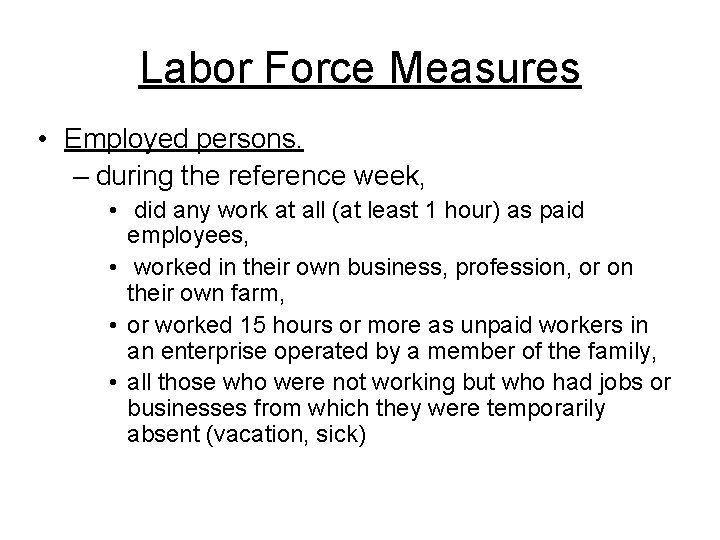
Labor Force Measures • Employed persons. – during the reference week, • did any work at all (at least 1 hour) as paid employees, • worked in their own business, profession, or on their own farm, • or worked 15 hours or more as unpaid workers in an enterprise operated by a member of the family, • all those who were not working but who had jobs or businesses from which they were temporarily absent (vacation, sick)
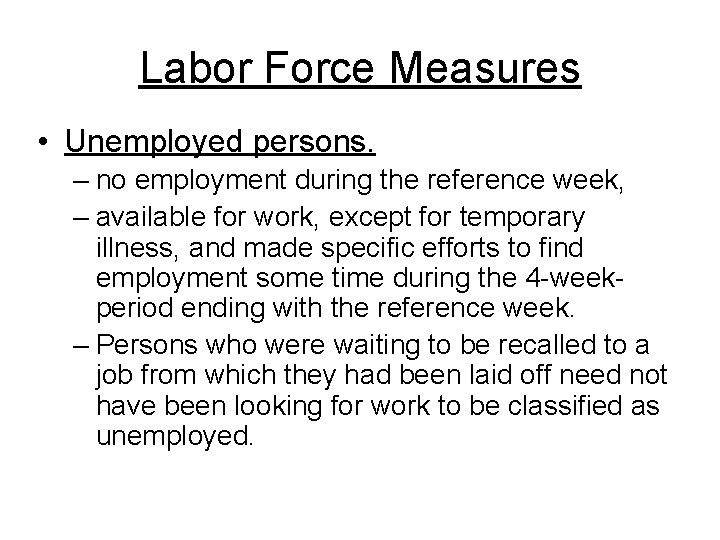
Labor Force Measures • Unemployed persons. – no employment during the reference week, – available for work, except for temporary illness, and made specific efforts to find employment some time during the 4 -weekperiod ending with the reference week. – Persons who were waiting to be recalled to a job from which they had been laid off need not have been looking for work to be classified as unemployed.
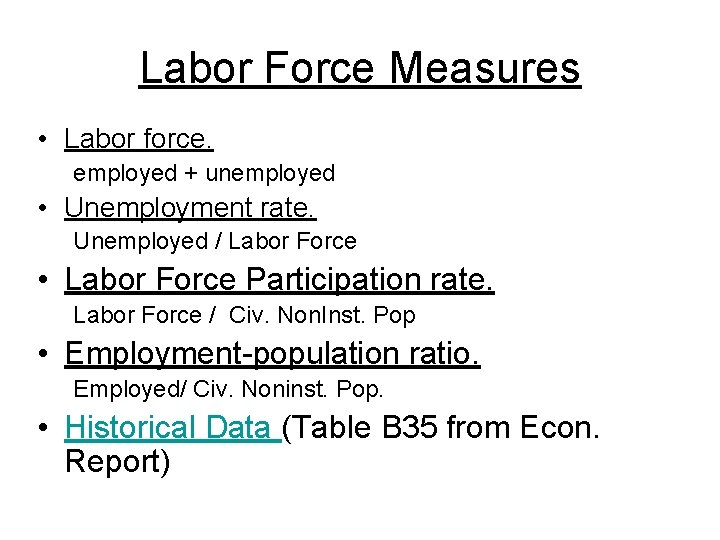
Labor Force Measures • Labor force. employed + unemployed • Unemployment rate. Unemployed / Labor Force • Labor Force Participation rate. Labor Force / Civ. Non. Inst. Pop • Employment-population ratio. Employed/ Civ. Noninst. Pop. • Historical Data (Table B 35 from Econ. Report)
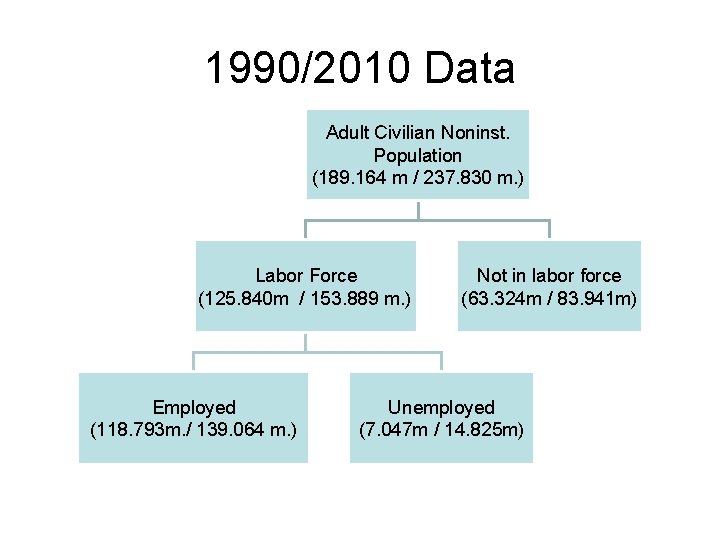
1990/2010 Data Adult Civilian Noninst. Population (189. 164 m / 237. 830 m. ) Labor Force (125. 840 m / 153. 889 m. ) Employed (118. 793 m. / 139. 064 m. ) Not in labor force (63. 324 m / 83. 941 m) Unemployed (7. 047 m / 14. 825 m)
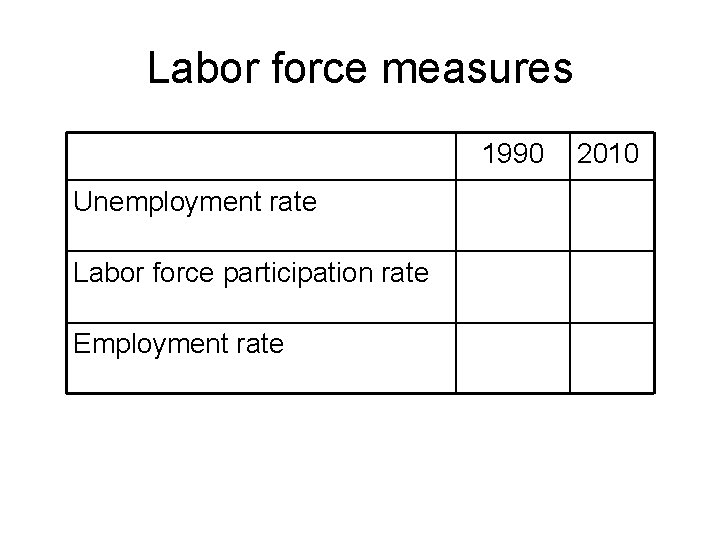
Labor force measures 1990 Unemployment rate Labor force participation rate Employment rate 2010
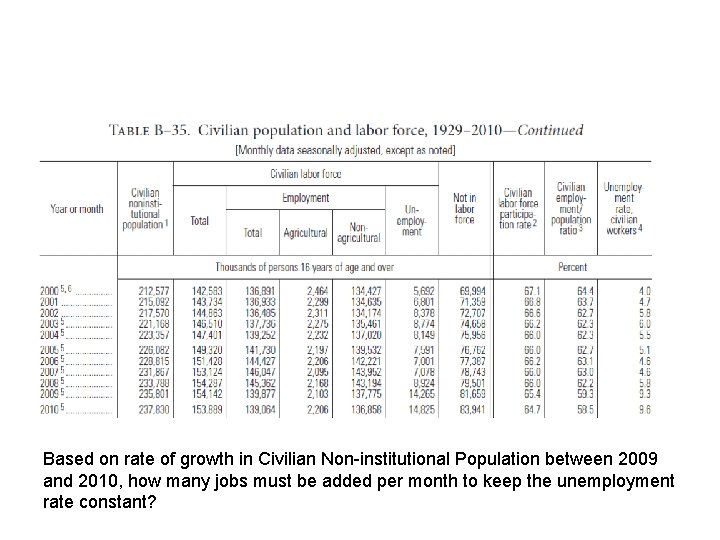
Based on rate of growth in Civilian Non-institutional Population between 2009 and 2010, how many jobs must be added per month to keep the unemployment rate constant?
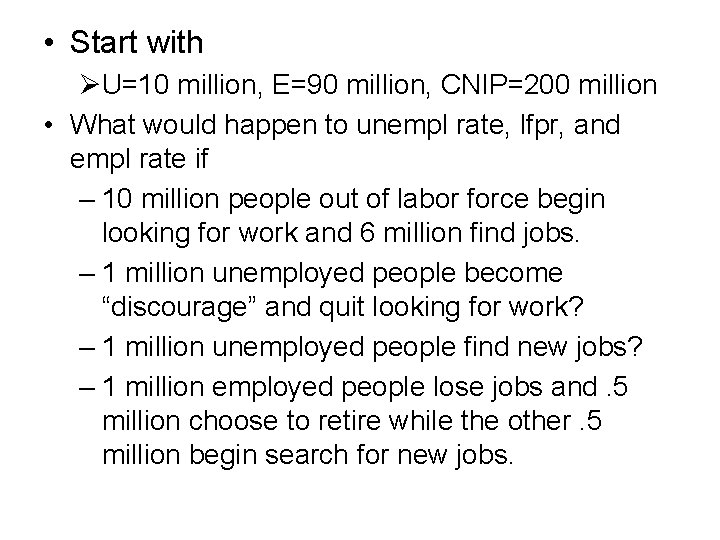
• Start with ØU=10 million, E=90 million, CNIP=200 million • What would happen to unempl rate, lfpr, and empl rate if – 10 million people out of labor force begin looking for work and 6 million find jobs. – 1 million unemployed people become “discourage” and quit looking for work? – 1 million unemployed people find new jobs? – 1 million employed people lose jobs and. 5 million choose to retire while the other. 5 million begin search for new jobs.
Variation in unemployment rates • Employment Situation from bls. gov – Sex – Age – Education • Why is there a correlation between these characteristics and unemployment rates? • Unemployment rates by state.
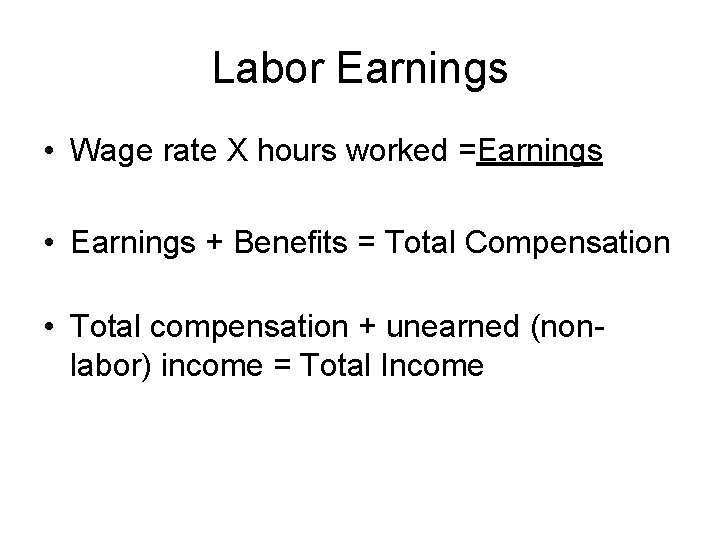
Labor Earnings • Wage rate X hours worked =Earnings • Earnings + Benefits = Total Compensation • Total compensation + unearned (nonlabor) income = Total Income

Earnings Measures
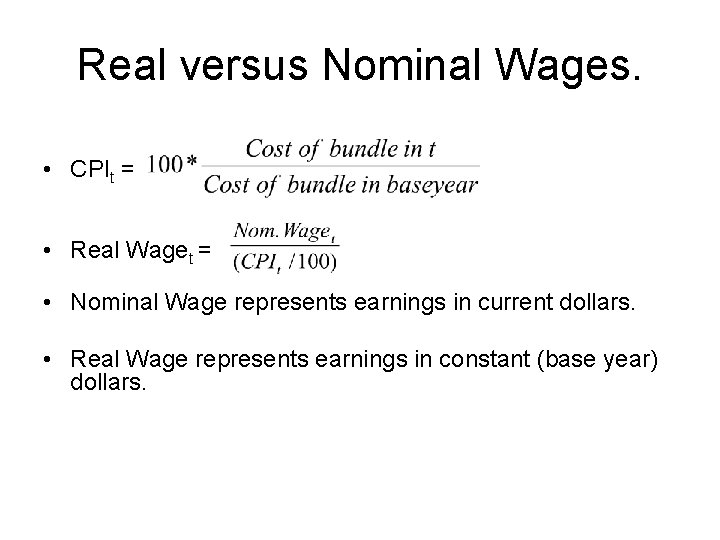
Real versus Nominal Wages. • CPIt = • Real Waget = • Nominal Wage represents earnings in current dollars. • Real Wage represents earnings in constant (base year) dollars.
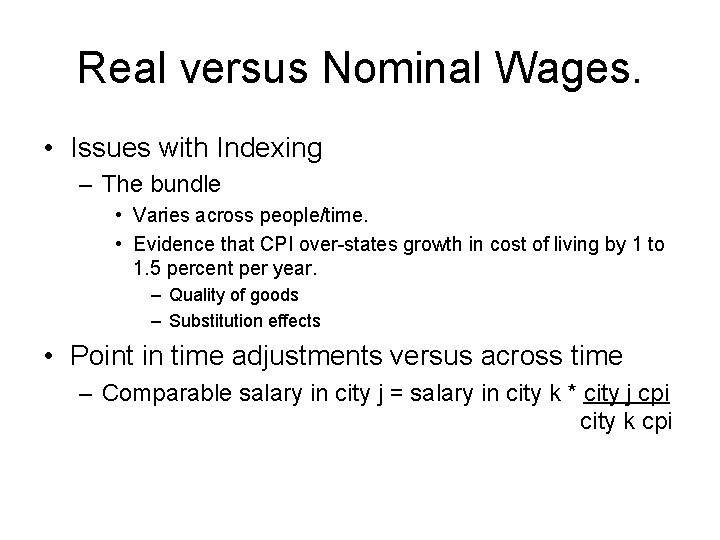
Real versus Nominal Wages. • Issues with Indexing – The bundle • Varies across people/time. • Evidence that CPI over-states growth in cost of living by 1 to 1. 5 percent per year. – Quality of goods – Substitution effects • Point in time adjustments versus across time – Comparable salary in city j = salary in city k * city j cpi city k cpi
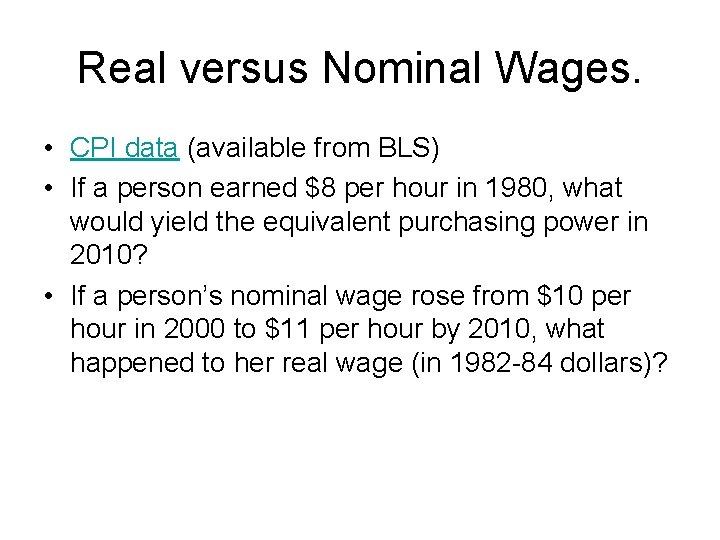
Real versus Nominal Wages. • CPI data (available from BLS) • If a person earned $8 per hour in 1980, what would yield the equivalent purchasing power in 2010? • If a person’s nominal wage rose from $10 per hour in 2000 to $11 per hour by 2010, what happened to her real wage (in 1982 -84 dollars)?
Earnings Measures • Cost of Living by City (ACCRA) • If a person moved from Cincinnati to San Francisco and his earnings rose from $50, 000 to $70, 000, did his real earnings rise or fall? • What are some of the problems with the Cinci/San Francisco comparison?
Labor Demand • Changes in wages (move along D-curve) – scale effect – substitution effect • Changes in other factors (shift D-curve) – demand for product • scale effect, no substitution effect – supply of other inputs (e. g. capital) • scale effect and substitution effect
Labor Demand • Market, Industry, and Firm Demand. – different ways of measuring labor demand. • Long run versus short run demand. – substitution effects tend to be larger in the long run, making labor demand more elastic in the long run.
Labor Supply • Labor supply curve. – Market supply curve: upward sloping. – Firm supply curve: horizontal in competitive market. • Factors shifting labor supply: – population. – alternative opportunities (other employment, nonemployment) – taxes – non-pecuniary aspects of job (fringes, risk, night shifts, etc. )
Labor Market Equilibrium • If wage is below equilibrium: shortage. • If wage is above equilibrium: surplus (unemployment). • Shortages put upward pressure on wages. Surpluses put downward pressure on wages.
Labor Market Equilibrium • Effect of – Increased population – Increased tax on employers – Increased tax on employees – Cheaper capital – Cheaper imports – Increased demand for product
- Slides: 21