
Chapter 2 The International Monetary System EVOLUTION OF
- Slides: 32
Chapter 2 The International Monetary System § EVOLUTION OF THE INTERNATIONAL MONETARY SYSTEM § CURRENT EXCHANGE RATE ARRANGEMENTS § EUROPEAN MONETARY SYSTEM § EURO AND THE EUROPEAN MONETARY UNION § THE MEXICAN PESO CRISIS § THE ASIAN CURRENCY CRISIS § THE ARGENTINE PESO CRISIS § FIXED VERSUS FLEXIBLE EXCHANGE RATE REGIMES Dr. Yaqoub Alabdullah Kuwait University - College of Business Administration 1
Evolution of the International Monetary System § Bimetallism: Before 1875 § Classical Gold Standard: 1875 -1914 § Interwar Period: 1915 -1944 § Bretton Woods System: 1945 -1972 § The Flexible Exchange Rate Regime: 1973 -Present Dr. Yaqoub Alabdullah Kuwait University - College of Business Administration 2 © Mc. Graw-Hill Inc.
Bimetallism: Before 1875 § Bimetallism was a “double standard” in the sense that both gold and silver were used as money. § Some countries were on the gold standard, some on the silver standard, and some on both. § Both gold and silver were used as an international means of payment, and the exchange rates among currencies were determined by either their gold or silver contents. Dr. Yaqoub Alabdullah Kuwait University - College of Business Administration 3 © Mc. Graw-Hill Inc.
Classical Gold Standard: 1875 -1914 § During this period in most major countries: § Gold alone was assured of unrestricted coinage. § There was two-way convertibility between gold and national currencies at a stable ratio. § Gold could be freely exported or imported. § The exchange rate between two country’s currencies would be determined by their relative gold contents. Dr. Yaqoub Alabdullah Kuwait University - College of Business Administration 4 © Mc. Graw-Hill Inc.
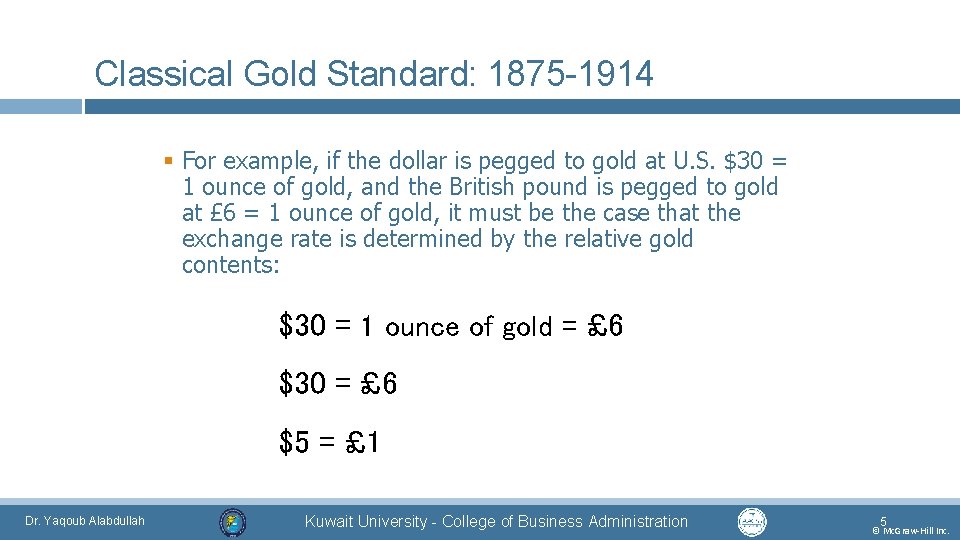
Classical Gold Standard: 1875 -1914 § For example, if the dollar is pegged to gold at U. S. $30 = 1 ounce of gold, and the British pound is pegged to gold at £ 6 = 1 ounce of gold, it must be the case that the exchange rate is determined by the relative gold contents: $30 = 1 ounce of gold = £ 6 $30 = £ 6 $5 = £ 1 Dr. Yaqoub Alabdullah Kuwait University - College of Business Administration 5 © Mc. Graw-Hill Inc.
Gold/Currency arbitrage § Under gold standard, any misalignment in the exchange rate will be corrected by cross border flow of gold. § Example: Dr. Yaqoub Alabdullah Kuwait University - College of Business Administration 6 © Mc. Graw-Hill Inc.
Classical Gold Standard: 1875 -1914 § Highly stable exchange rates under the classical gold standard provided an environment that was conducive to international trade and investment. § If gold is used as the sole international means of payment, then no country may have a persistent trade deficit or surplus. § The gold standard has no mechanism to compel each country to abide by the rules of the game. Dr. Yaqoub Alabdullah Kuwait University - College of Business Administration 7 © Mc. Graw-Hill Inc.
Interwar Period: 1915 -1944 § Exchange rates fluctuated as countries widely used “predatory” depreciations of their currencies as a means of gaining advantage in the world export market. § Attempts were made to restore the gold standard, but participants lacked the political will to “follow the rules of the game. ” § The result for international trade and investment was profoundly harmful. Dr. Yaqoub Alabdullah Kuwait University - College of Business Administration 9 © Mc. Graw-Hill Inc.
Bretton Woods System: 1945 -1972 § Named for a 1944 meeting of 44 nations at Bretton Woods, New Hampshire. § The purpose was to design a postwar international monetary system. § The goal was exchange rate stability without the gold standard. § The result was the creation of the IMF and the World Bank. Dr. Yaqoub Alabdullah Kuwait University - College of Business Administration 10 © Mc. Graw-Hill Inc.
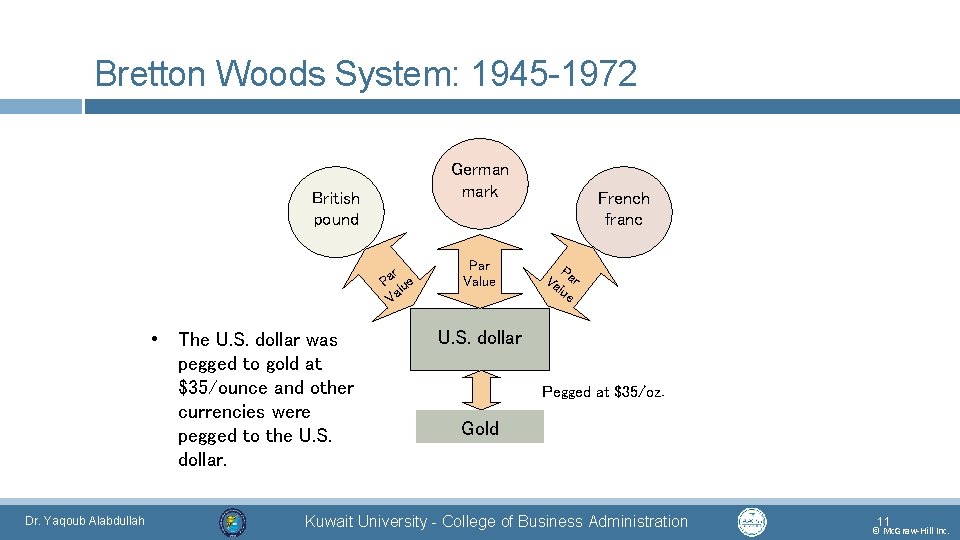
Bretton Woods System: 1945 -1972 German mark British pound r Pa lue Va • The U. S. dollar was pegged to gold at $35/ounce and other currencies were pegged to the U. S. dollar. Dr. Yaqoub Alabdullah Par Value French franc P Va ar lue U. S. dollar Pegged at $35/oz. Gold Kuwait University - College of Business Administration 11 © Mc. Graw-Hill Inc.
The Flexible Exchange Rate Regime: 1973 Present § Flexible exchange rates were declared acceptable to the IMF members. § Central banks were allowed to intervene in the exchange rate markets to iron out unwarranted volatilities. § Gold was abandoned as an international reserve asset. § Non-oil-exporting countries and less-developed countries were given greater access to IMF funds. Dr. Yaqoub Alabdullah Kuwait University - College of Business Administration 12 © Mc. Graw-Hill Inc.
Current Exchange Rate Arrangements § Free Float § Allow market forces to determine their currency’s value. § E. g. , Australia, Canada, Japan, the United Kingdom, the euro area, and the United States § Managed Float § Combine government intervention with market forces to set exchange rates. § Pegged to another currency or a currency basket § E. g. , Saudi Arabia, UAE, and Kuwait. § No national currency § Some countries do not bother printing their own currency. For example, Ecuador, Panama, and El Salvador have dollarized. Montenegro and San Marino use the euro. Dr. Yaqoub Alabdullah Kuwait University - College of Business Administration 13 © Mc. Graw-Hill Inc.
Current Exchange Rate Arrangements § Currency Board § Fixed exchange rates combined with restrictions on the issuing government. § Eliminates central bank functions such as monetary policy and lender of last resort (e. g. , Hong Kong). § Conventional Peg § Exchange rate publicly fixed to another currency or basket of currencies. § Country buys or sells foreign exchange or uses other means to control the price of the currency (e. g. , Saudi Arabia, Jordan, and Morocco). Dr. Yaqoub Alabdullah Kuwait University - College of Business Administration 14 © Mc. Graw-Hill Inc.
Current Exchange Rate Arrangements § Stabilized Arrangement § A spot market exchange rate that remains within a margin of 2 percent for six months or more and is not floating (e. g. , China, Angola, and Lebanon). § Crawling Peg § Like the conventional peg, but the crawling peg is adjusted in small amounts at a fixed rate of change or in response to changes in macro indicators, (e. g. , Bolivia, Iraq, and Nicaragua). Dr. Yaqoub Alabdullah Kuwait University - College of Business Administration 15 © Mc. Graw-Hill Inc.
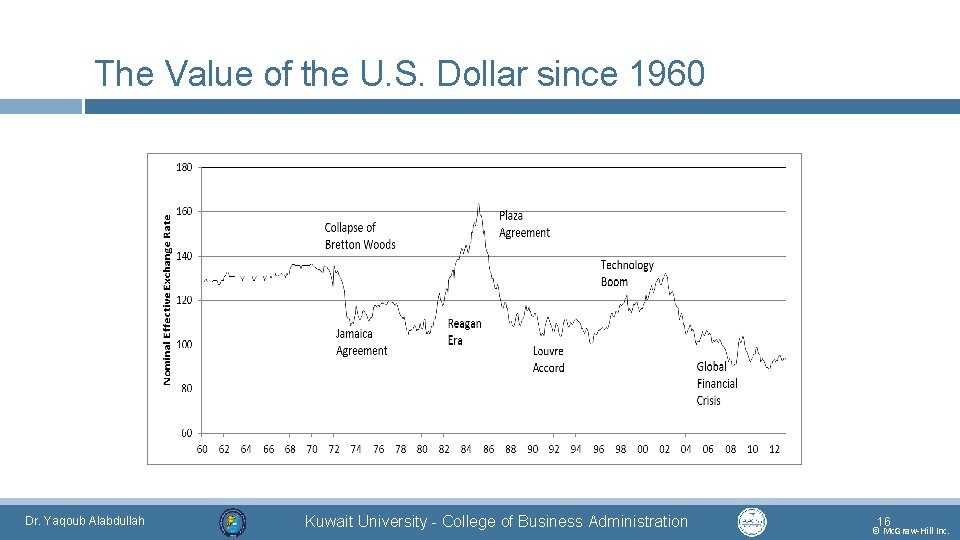
The Value of the U. S. Dollar since 1960 Dr. Yaqoub Alabdullah Kuwait University - College of Business Administration 16 © Mc. Graw-Hill Inc.
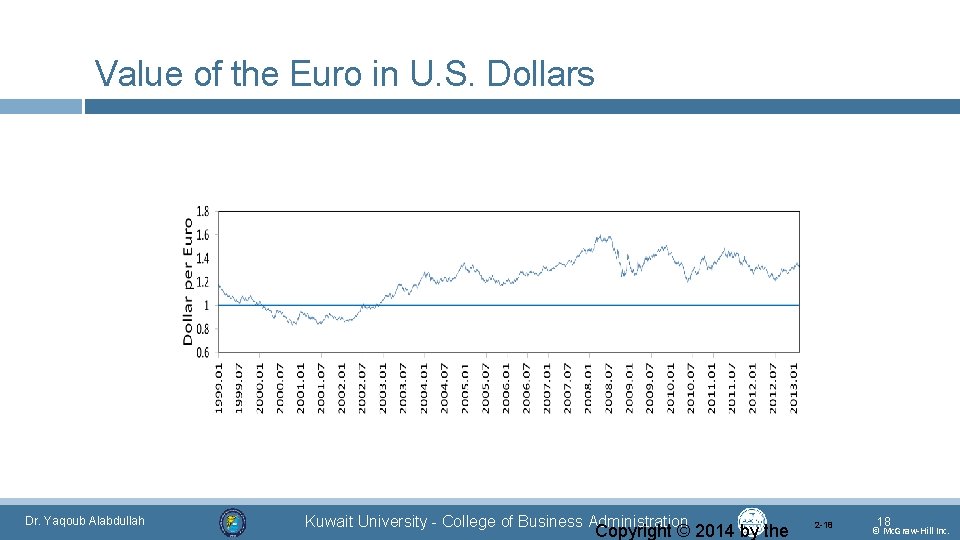
The Euro § The euro is the currency of the European Monetary Union, adopted by 11 Member States on January 1, 1999. § Monetary policy for the euro zone countries is now conducted by the European Central Bank (ECB). § The original euro-11: Austria, Belgium, Finland, France, Germany, Ireland, Italy, Luxembourg, Netherlands, Portugal, and Spain. § At first, four member countries of the European Union—Denmark, Greece, Sweden, and the United Kingdom—did not join the first wave. § Greece, Slovenia, Cyprus, Malta, Slovakia, and Estonia eventually adopted the euro at different years. Dr. Yaqoub Alabdullah Kuwait University - College of Business Administration 17 © Mc. Graw-Hill Inc.
Value of the Euro in U. S. Dollars Dr. Yaqoub Alabdullah Kuwait University - College of Business Administration Copyright © 2014 by the 2 -18 18 © Mc. Graw-Hill Inc.
The Long-Term Impact of the Euro § As the euro proves successful, it will advance the political integration of Europe in a major way, eventually making a “United States of Europe” feasible. § It is possible that the U. S. dollar will lose its place as the dominant world currency. § The euro and the U. S. dollar will be the two major currencies. Dr. Yaqoub Alabdullah Kuwait University - College of Business Administration 19 © Mc. Graw-Hill Inc.
Benefits of Monetary Union 1. The most direct and immediate benefits are reduced transaction costs and the elimination of exchange rate uncertainty. 2. Promote cross-border investment and trade within the euro zone. 3. Enhance efficiency and competitiveness of the European economy. 4. It will advance the political integration of Europe in a major way, eventually making a “United States of Europe” feasible. Dr. Yaqoub Alabdullah Kuwait University - College of Business Administration 20
Costs of Monetary Union § The main cost of monetary union is the loss of national monetary and exchange rate policy independence. § The more trade-dependent and less diversified a country’s economy is, the more prone to asymmetric shocks that country’s economy would be. Dr. Yaqoub Alabdullah Kuwait University - College of Business Administration 21 © Mc. Graw-Hill Inc.
The Mexican Peso Crisis § On December 20, 1994, the Mexican government announced a plan to devalue the peso against the dollar by 14 percent. § This decision changed currency trader’s expectations about the future value of the peso, and they rushed to sell pesos as well as Mexican stocks and bonds. § In their rush to get out the peso fell by as much as 40 percent. § As the peso fell, fund managers quickly liquidated their holdings of Mexican securities as well as other emerging market securities. This had a highly destabilizing, contagious effect on the world financial system. Dr. Yaqoub Alabdullah Kuwait University - College of Business Administration 2 -22 22 © Mc. Graw-Hill Inc.
The Mexican Peso Crisis § The Mexican Peso crisis is unique in that it represents the first serious international financial crisis touched off by cross -border flight of portfolio capital. § Two lessons emerge: § It is essential to have a multinational safety net in place to safeguard the world financial system from such crises. § An influx of foreign capital can lead to an overvaluation in the first place. Dr. Yaqoub Alabdullah Kuwait University - College of Business Administration 23 © Mc. Graw-Hill Inc.
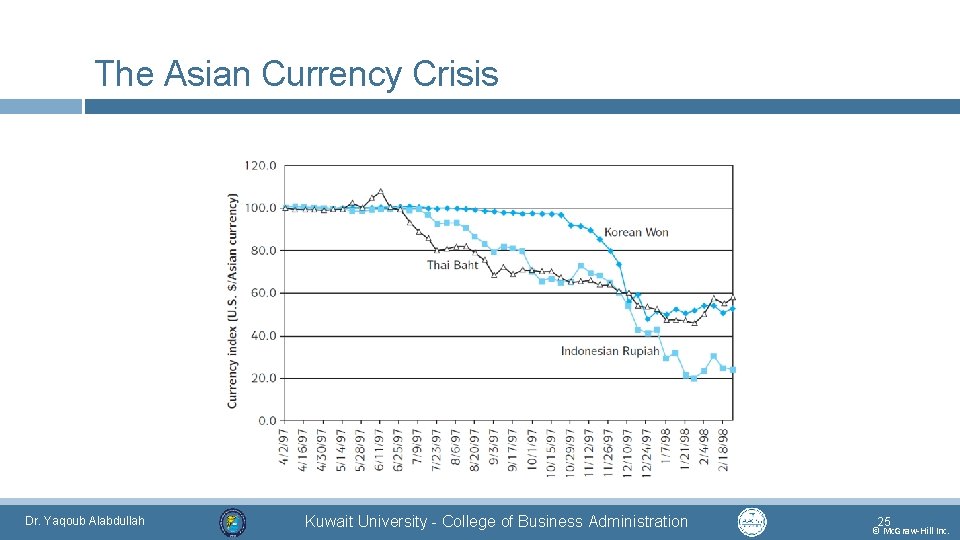
The Asian Currency Crisis § The Asian currency crisis turned out to be far more serious than the Mexican peso crisis in terms of the extent of the contagion and the severity of the resultant economic and social costs. § Many firms with foreign currency bonds were forced into bankruptcy. § The region experienced a deep, widespread recession. Dr. Yaqoub Alabdullah Kuwait University - College of Business Administration 24 © Mc. Graw-Hill Inc.
The Asian Currency Crisis Dr. Yaqoub Alabdullah Kuwait University - College of Business Administration 25 © Mc. Graw-Hill Inc.
Origins of the Asian Currency Crisis § As capital markets were opened, large inflows of private capital resulted in a credit boom in the Asian countries. § Fixed or stable exchange rates also encouraged unhedged financial transactions and excessive risk-taking by both borrowers and lenders. § The real exchange rate rose, which led to a slowdown in export growth. § Also, Japan’s recession (and yen depreciation) hurt. Dr. Yaqoub Alabdullah Kuwait University - College of Business Administration 26 © Mc. Graw-Hill Inc.
The Asian Currency Crisis § If the Asian currencies had been allowed to depreciate in real terms (not possible due to the fixed exchange rates), the sudden and catastrophic changes in exchange rates observed in 1997 might have been avoided § Eventually something had to give—it was the Thai bhat. § The sudden collapse of the bhat touched off a panicky flight of capital from other Asian countries. Dr. Yaqoub Alabdullah Kuwait University - College of Business Administration 27 © Mc. Graw-Hill Inc.
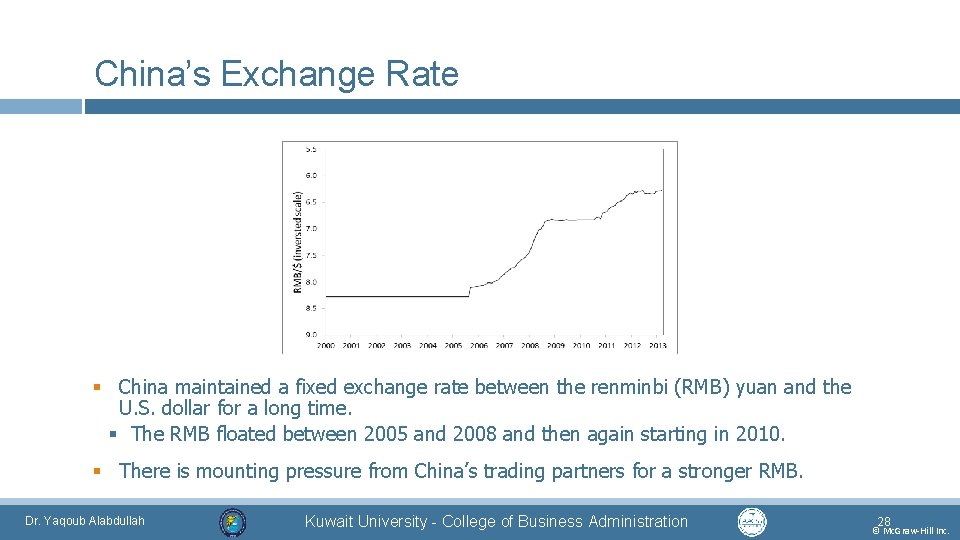
China’s Exchange Rate § China maintained a fixed exchange rate between the renminbi (RMB) yuan and the U. S. dollar for a long time. § The RMB floated between 2005 and 2008 and then again starting in 2010. § There is mounting pressure from China’s trading partners for a stronger RMB. Dr. Yaqoub Alabdullah Kuwait University - College of Business Administration 28 © Mc. Graw-Hill Inc.
Potential as a Global Currency § For the RMB to become a full-fledged global currency, China will need to satisfy these conditions: § Full convertibility of its currency. § Open capital markets with depth and liquidity. § The rule of law and protection of property rights. § The United States and the euro zone satisfy these conditions. Dr. Yaqoub Alabdullah Kuwait University - College of Business Administration 29 © Mc. Graw-Hill Inc.
The Argentinean Peso Crisis § In 1991 the Argentine government passed a convertibility law that linked the peso to the U. S. dollar at parity. § The initial economic effects were positive: § Argentina’s chronic inflation was curtailed. § Foreign investment poured in. § As the U. S. dollar appreciated on the world market the Argentine peso became stronger as well. Dr. Yaqoub Alabdullah Kuwait University - College of Business Administration 30 © Mc. Graw-Hill Inc.
The Argentinean Peso Crisis § However, the strong peso hurt exports from Argentina and caused a protracted economic downturn that led to the abandonment of peso–dollar parity in January 2002. § The unemployment rate rose above 20 percent. § The inflation rate reached a monthly rate of 20 percent. Dr. Yaqoub Alabdullah Kuwait University - College of Business Administration 31 © Mc. Graw-Hill Inc.
Currency Crisis Explanations § In theory, a currency’s value mirrors the fundamental strength of its underlying economy, relative to other economies, in the long run. § In the short run, currency trader expectations play a much more important role. § In today’s environment, traders and lenders, using the most modern communications, act on fight-or-flight instincts. For example, if they expect others are about to sell Brazilian reals for U. S. dollars, they want to “get to the exits first. ” § Thus, fears of depreciation become self-fulfilling prophecies. Dr. Yaqoub Alabdullah Kuwait University - College of Business Administration 32 © Mc. Graw-Hill Inc.
Fixed versus Flexible Exchange Rate Regimes § Arguments in favor of flexible exchange rates: § Rapidly incorporates trade information into currency prices, reflecting “true” values in exchange and interest rates § Arguments against flexible exchange rates: § Exchange rate uncertainty may hamper international trade. § No safeguards to prevent crises. § Arguments in favor of fixed exchange rates: § Reduce volatility and uncertainty. § Arguments against fixed exchange rates: § Large government cost of maintenance, along with possible inefficiencies in private investment and resource allocation. Dr. Yaqoub Alabdullah Kuwait University - College of Business Administration 33