
Chapter 2 The Human Factor Models of the
- Slides: 82
Chapter 2 The Human Factor
Models of the Human • Descriptive models are tools for thinking (see Chapter 7) • It would be useful to have a descriptive model for the human • In fact, there are many (e. g. , Model Human Processor, Chapter 1) • We begin with two useful models for the human… 2
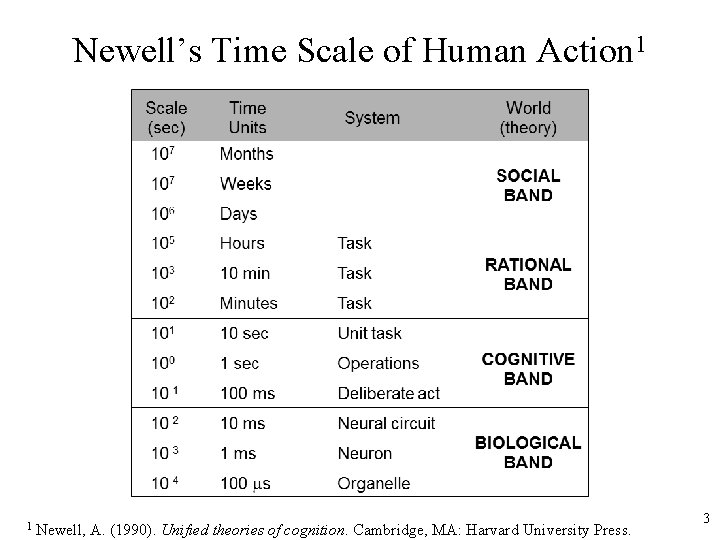
Newell’s Time Scale of Human Action 1 1 Newell, A. (1990). Unified theories of cognition. Cambridge, MA: Harvard University Press. 3
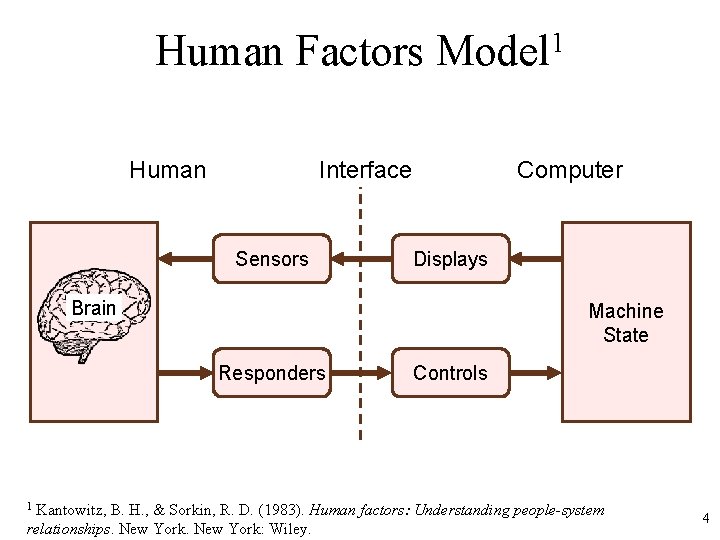
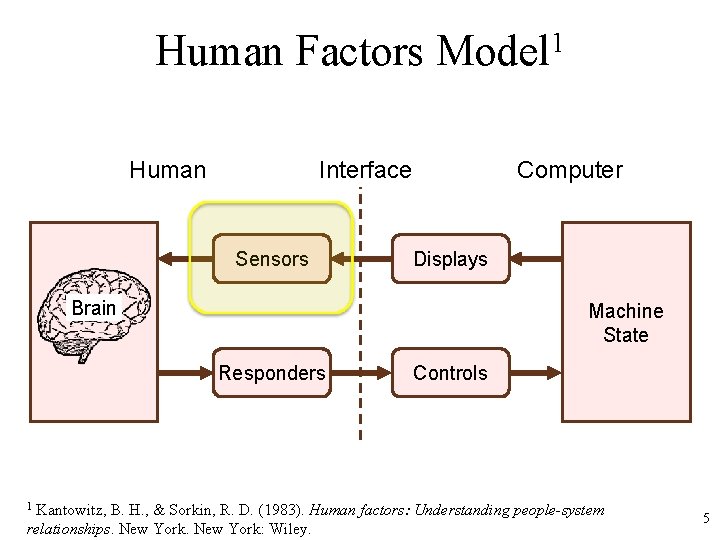
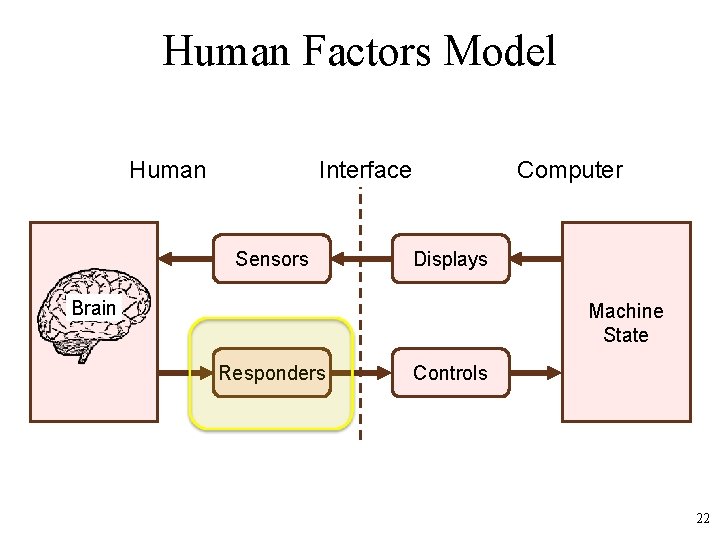
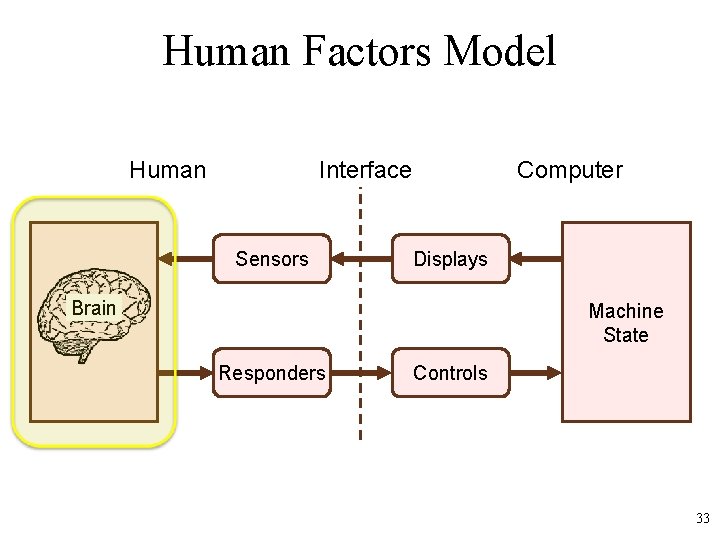
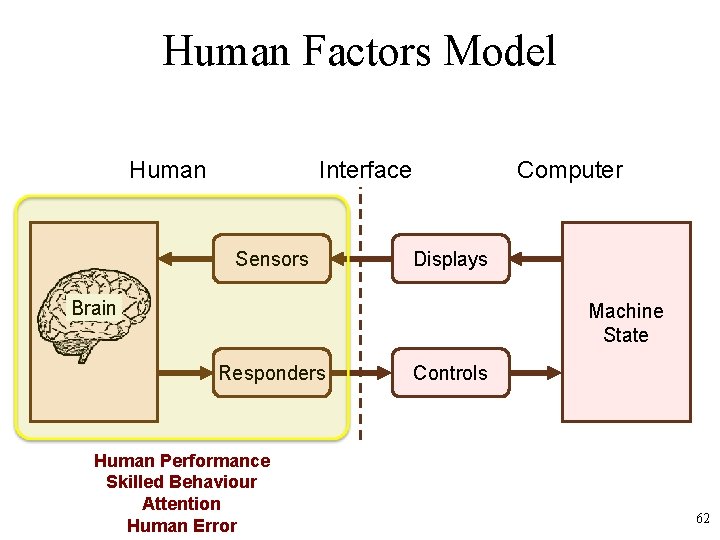
Human Factors Model 1 Human Interface Sensors Computer Displays Brain Machine State Responders Controls Kantowitz, B. H. , & Sorkin, R. D. (1983). Human factors: Understanding people-system relationships. New York: Wiley. 1 4
Human Factors Model 1 Human Interface Sensors Computer Displays Brain Machine State Responders Controls Kantowitz, B. H. , & Sorkin, R. D. (1983). Human factors: Understanding people-system relationships. New York: Wiley. 1 5
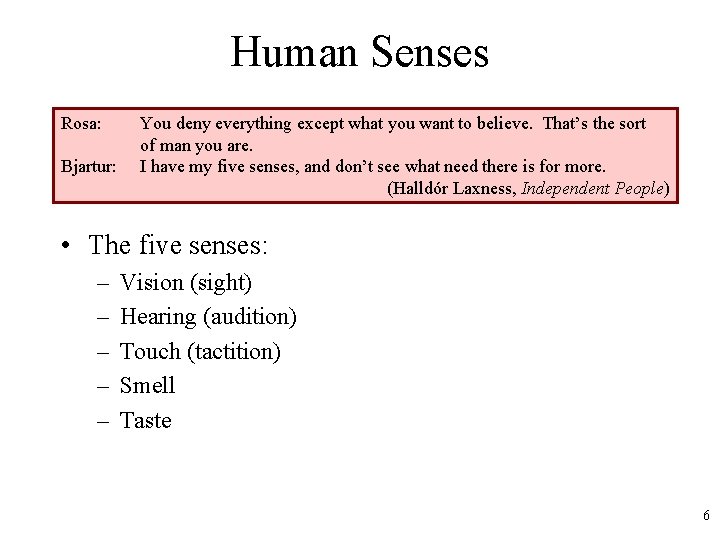
Human Senses Rosa: Bjartur: You deny everything except what you want to believe. That’s the sort of man you are. I have my five senses, and don’t see what need there is for more. (Halldór Laxness, Independent People) • The five senses: – – – Vision (sight) Hearing (audition) Touch (tactition) Smell Taste 6
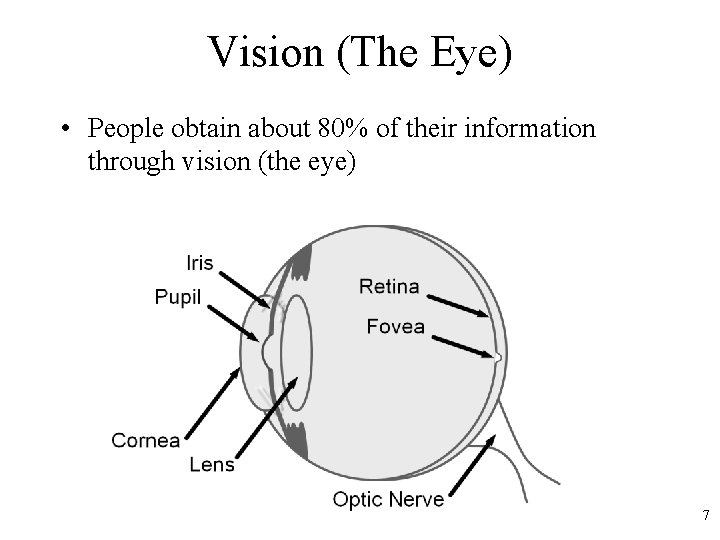
Vision (The Eye) • People obtain about 80% of their information through vision (the eye) 7
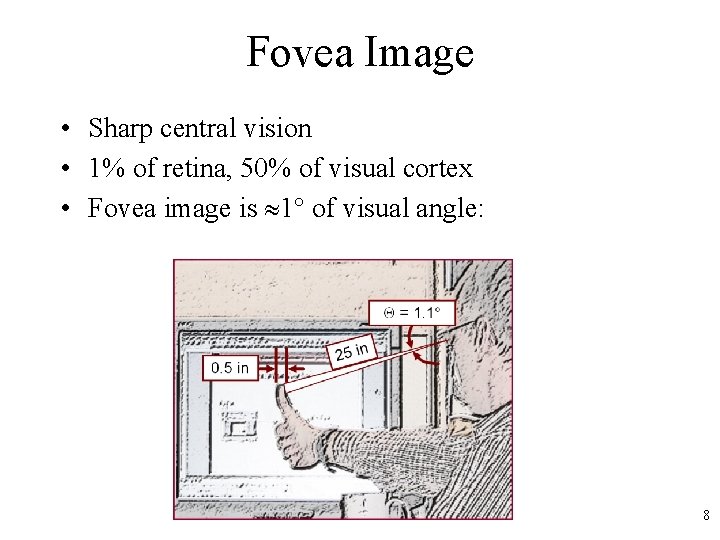
Fovea Image • Sharp central vision • 1% of retina, 50% of visual cortex • Fovea image is 1 of visual angle: 8
Visual Stimulus • Physical properties of light… – Frequency – Intensity (luminance) • Create subjective properties of vision… – Colour (next slide) – Brightness 9
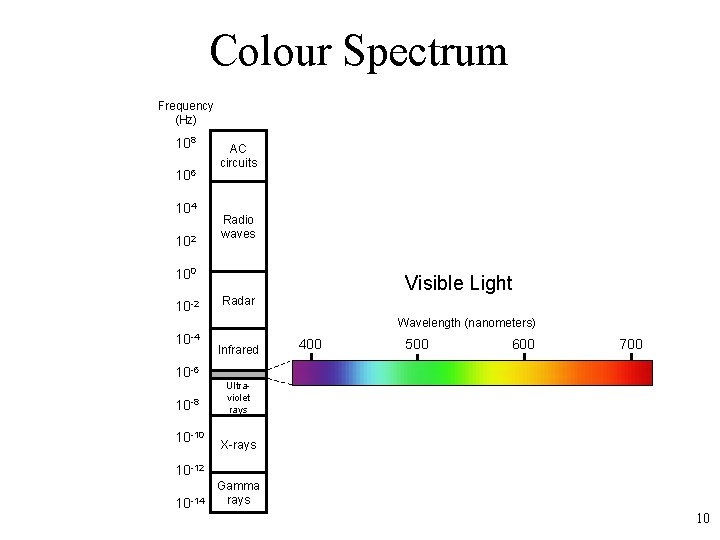
Colour Spectrum Frequency (Hz) 108 106 104 102 AC circuits Radio waves 100 10 -2 Visible Light Radar Wavelength (nanometers) 10 -4 10 -6 10 -8 10 -10 Infrared 400 500 600 700 Ultraviolet rays X-rays 10 -12 10 -14 Gamma rays 10
Fixations and Saccades • Fixation – Eyes are stationary (dwell) – Take in visual detail from the environment – Long or short, but typically at least 200 ms • Saccade – Rapid repositioning of the eye to fixate on a new location – Quick: 120 ms 11
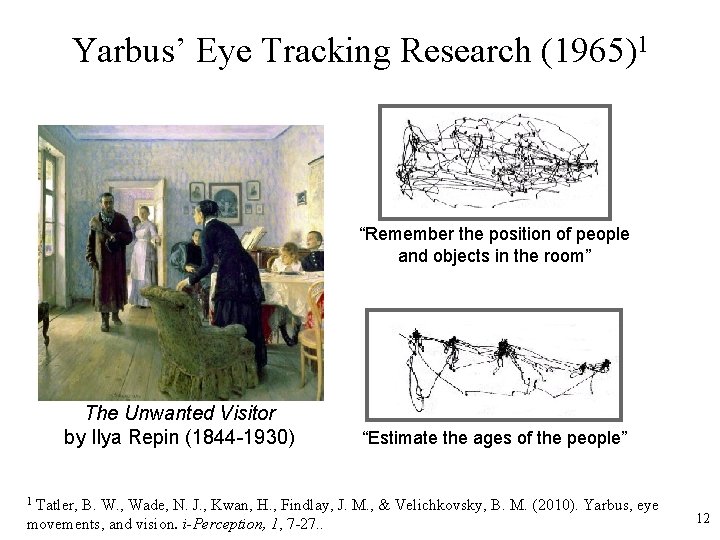
Yarbus’ Eye Tracking Research (1965)1 “Remember the position of people and objects in the room” The Unwanted Visitor by Ilya Repin (1844 -1930) “Estimate the ages of the people” Tatler, B. W. , Wade, N. J. , Kwan, H. , Findlay, J. M. , & Velichkovsky, B. M. (2010). Yarbus, eye movements, and vision. i-Perception, 1, 7 -27. . 1 12
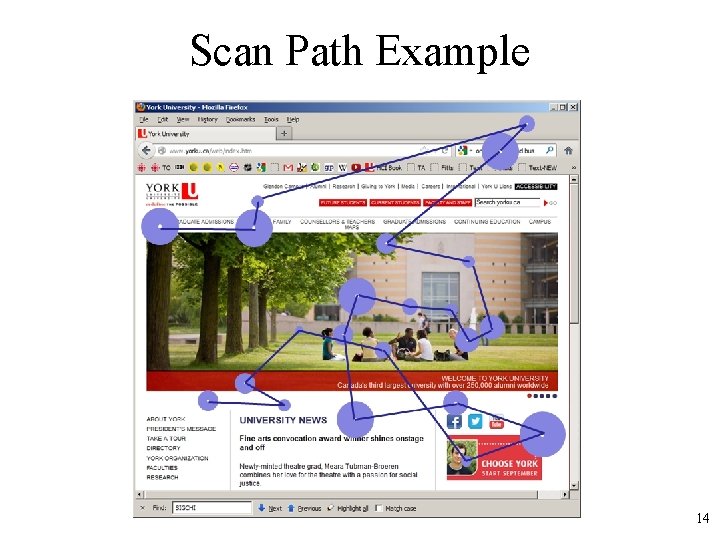
Scan Paths • Visual depiction of saccades and fixations • Saccades straight lines • Fixations circles – Diameter of circle duration of fixation • Applications – User behaviour research (e. g. , reading patterns) – Marketing research (e. g. , ad placement) 13
Scan Path Example 14
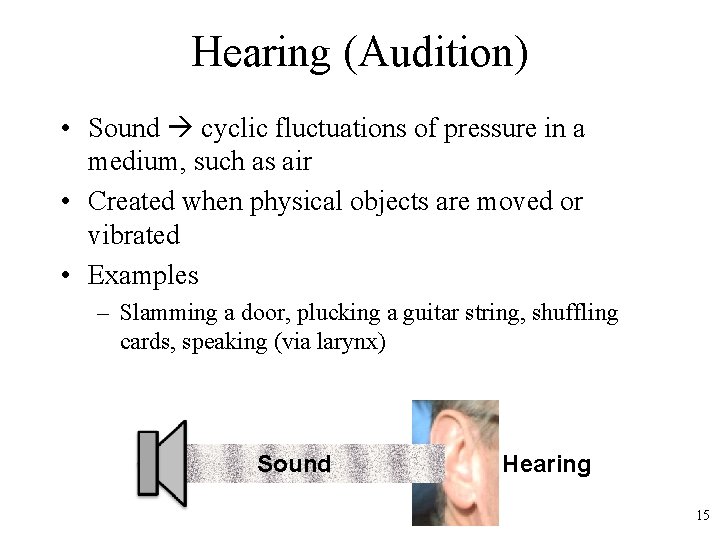
Hearing (Audition) • Sound cyclic fluctuations of pressure in a medium, such as air • Created when physical objects are moved or vibrated • Examples – Slamming a door, plucking a guitar string, shuffling cards, speaking (via larynx) Sound Hearing 15
Auditory Stimulus • Physical properties of sound… – Frequency – Intensity • Create subjective properties of hearing… – Pitch – Loudness 16
Properties of Sounds • • Loudness Pitch Timbre (next slide) Attack (after next slide) 17
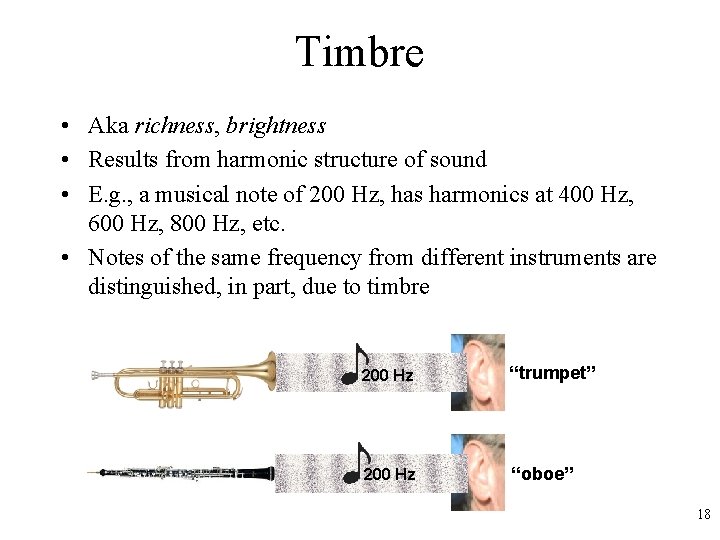
Timbre • Aka richness, brightness • Results from harmonic structure of sound • E. g. , a musical note of 200 Hz, has harmonics at 400 Hz, 600 Hz, 800 Hz, etc. • Notes of the same frequency from different instruments are distinguished, in part, due to timbre 200 Hz “trumpet” 200 Hz “oboe” 18
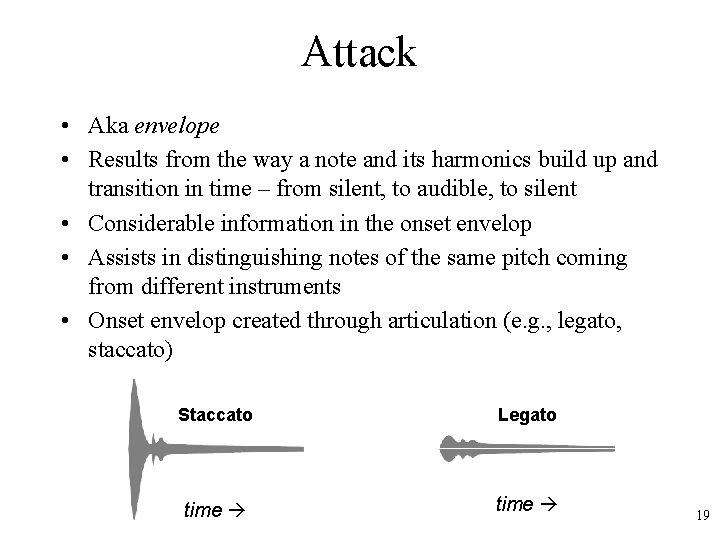
Attack • Aka envelope • Results from the way a note and its harmonics build up and transition in time – from silent, to audible, to silent • Considerable information in the onset envelop • Assists in distinguishing notes of the same pitch coming from different instruments • Onset envelop created through articulation (e. g. , legato, staccato) Staccato Legato time 19
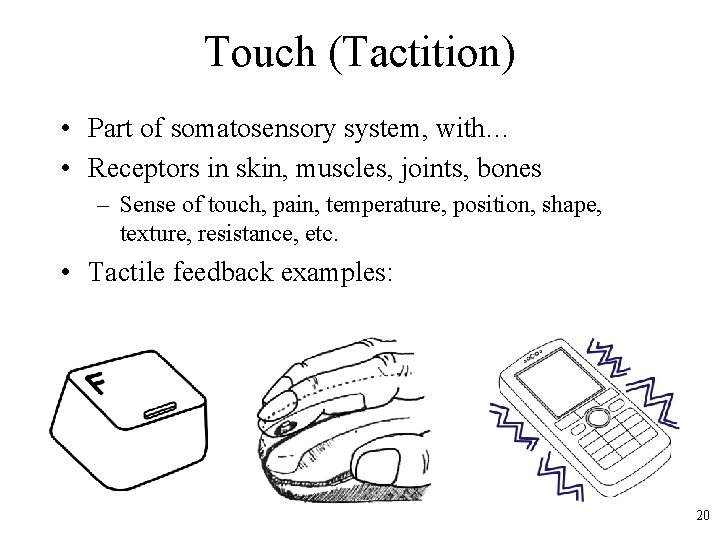
Touch (Tactition) • Part of somatosensory system, with… • Receptors in skin, muscles, joints, bones – Sense of touch, pain, temperature, position, shape, texture, resistance, etc. • Tactile feedback examples: 20
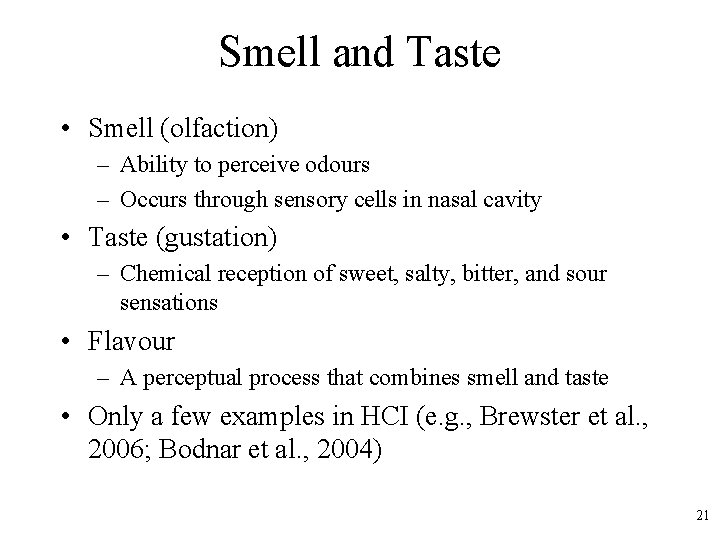
Smell and Taste • Smell (olfaction) – Ability to perceive odours – Occurs through sensory cells in nasal cavity • Taste (gustation) – Chemical reception of sweet, salty, bitter, and sour sensations • Flavour – A perceptual process that combines smell and taste • Only a few examples in HCI (e. g. , Brewster et al. , 2006; Bodnar et al. , 2004) 21
Human Factors Model Human Interface Sensors Computer Displays Brain Machine State Responders Controls 22
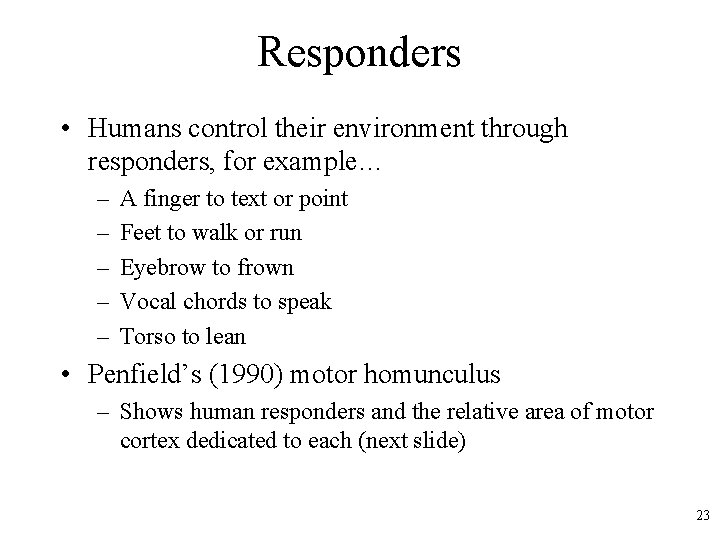
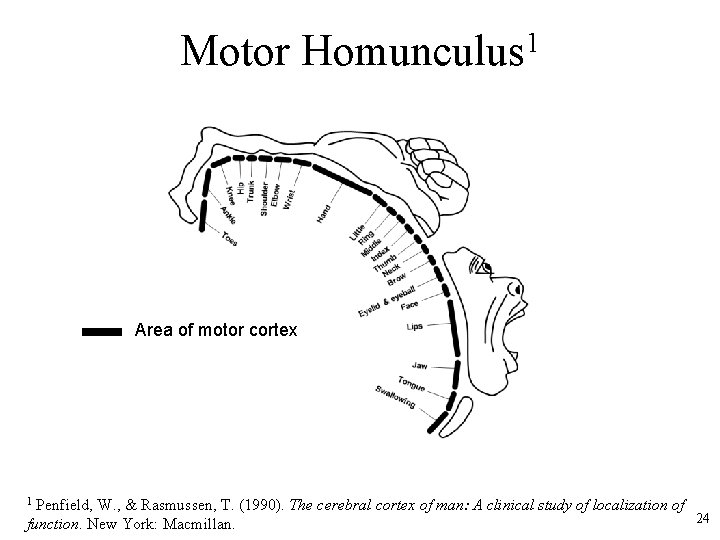
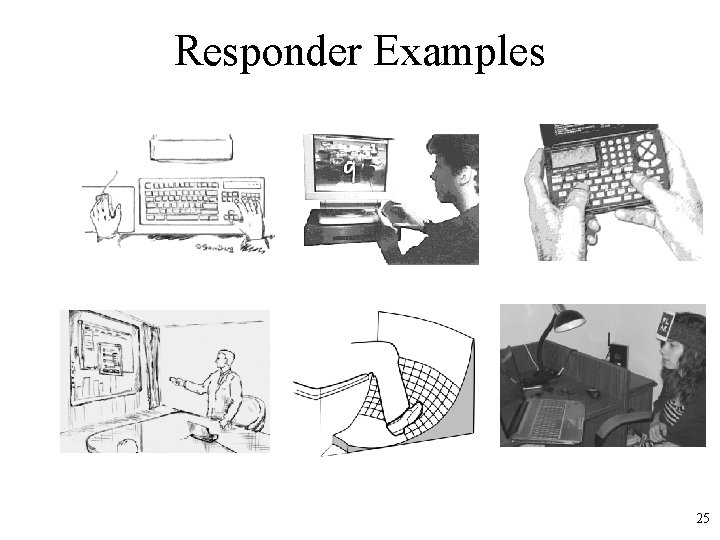
Responders • Humans control their environment through responders, for example… – – – A finger to text or point Feet to walk or run Eyebrow to frown Vocal chords to speak Torso to lean • Penfield’s (1990) motor homunculus – Shows human responders and the relative area of motor cortex dedicated to each (next slide) 23
Motor Homunculus 1 Area of motor cortex Penfield, W. , & Rasmussen, T. (1990). The cerebral cortex of man: A clinical study of localization of 24 function. New York: Macmillan. 1
Responder Examples 25
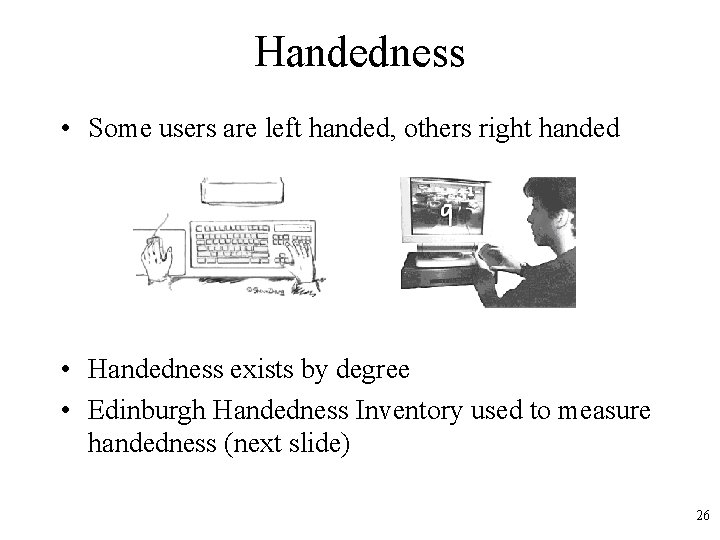
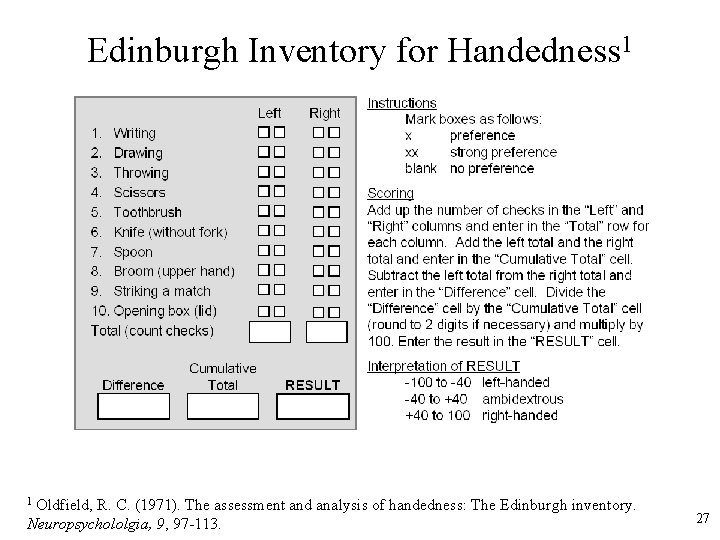
Handedness • Some users are left handed, others right handed • Handedness exists by degree • Edinburgh Handedness Inventory used to measure handedness (next slide) 26
Edinburgh Inventory for Handedness 1 Oldfield, R. C. (1971). The assessment and analysis of handedness: The Edinburgh inventory. Neuropsychololgia, 9, 97 -113. 1 27
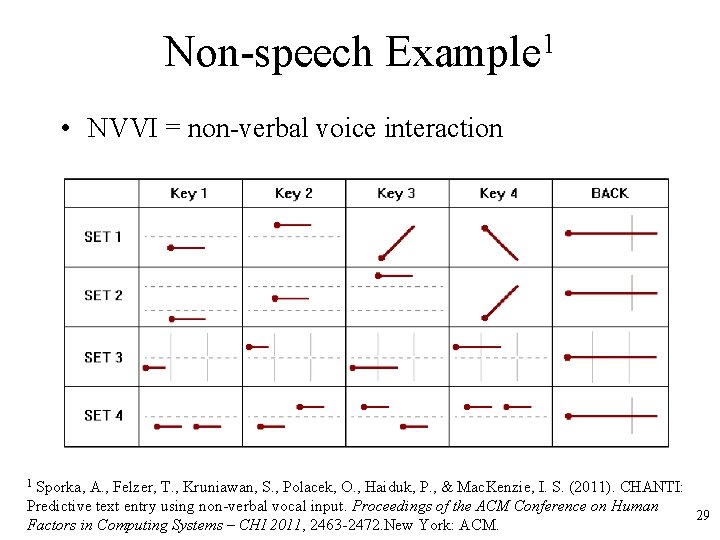
Human Voice • Human vocal chords are responders • Sounds created through combination of… – Movement in the larynx – Pulmonary pressure in the lungs • Two kinds of vocalized sounds: 1. Speech 2. Non-speech • Both with potential for computer control – Speech + speech recognition – Non-speech + signal detection (e. g. , frequency, loudness, duration, change direction, etc. ) 28
Non-speech Example 1 • NVVI = non-verbal voice interaction Sporka, A. , Felzer, T. , Kruniawan, S. , Polacek, O. , Haiduk, P. , & Mac. Kenzie, I. S. (2011). CHANTI: Predictive text entry using non-verbal vocal input. Proceedings of the ACM Conference on Human 29 Factors in Computing Systems – CHI 2011, 2463 -2472. New York: ACM. 1
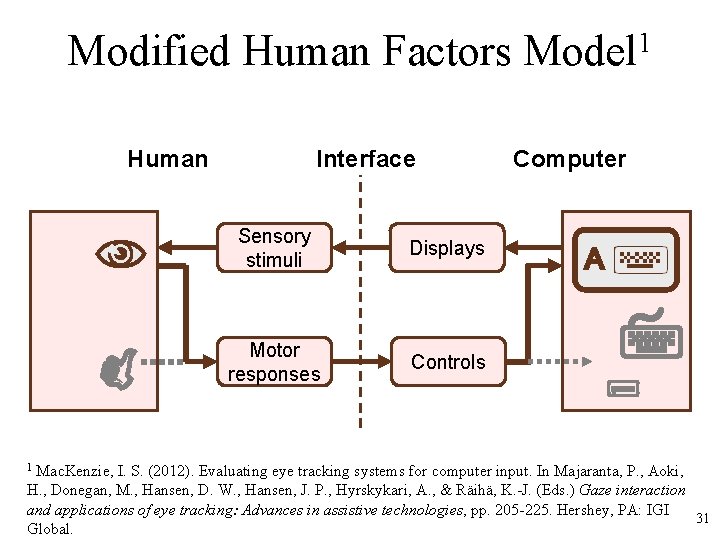
The Eye as a Responder • As a controller, the eye is called upon to do “double duty” 1. Sense and perceive the environment/computer 2. Act as a controller via saccades and fixations • This suggests a modification to the human factors model presented earlier (next slide) 30
Modified Human Factors Model 1 Human Interface Sensory stimuli Displays Motor responses Controls Computer AA Mac. Kenzie, I. S. (2012). Evaluating eye tracking systems for computer input. In Majaranta, P. , Aoki, H. , Donegan, M. , Hansen, D. W. , Hansen, J. P. , Hyrskykari, A. , & Räihä, K. -J. (Eds. ) Gaze interaction and applications of eye tracking: Advances in assistive technologies, pp. 205 -225. Hershey, PA: IGI 31 Global. 1
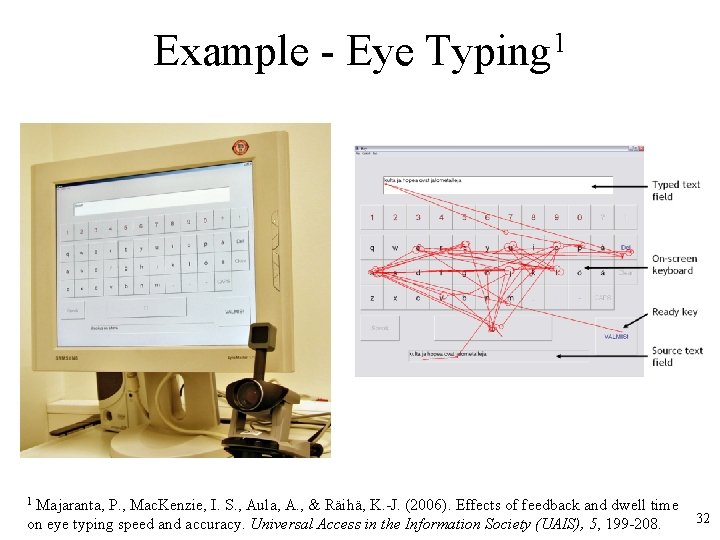
Example - Eye Typing 1 Majaranta, P. , Mac. Kenzie, I. S. , Aula, A. , & Räihä, K. -J. (2006). Effects of feedback and dwell time on eye typing speed and accuracy. Universal Access in the Information Society (UAIS), 5, 199 -208. 1 32
Human Factors Model Human Interface Sensors Computer Displays Brain Machine State Responders Controls 33
The Brain • Most complex biological structure known • Billions of neurons • Enables human capacity for… – Pondering, remembering, recalling, reasoning, deciding, communicating, etc. • Sensors (human inputs) and responders (human outputs) are nicely mirrored, but it is the brain that connects them 34
Human Uniqueness • With associations and meaning attached to sensory input, humans are vastly superior to the machines they interact with: People excel at perception, at creativity, at the ability to go beyond the information given, making sense of otherwise chaotic events. We often have to interpret events far beyond the information available, and our ability to do this efficiently and effortlessly, usually without even being aware that we are doing so, greatly adds to our ability to function. 1 1 Norman, D. A. (1988). The design of everyday things. New York: Basic Books. 35
Perception • 1 st stage of processing for sensory input • Associations formed… – – – Auditory stimulus harmonious, discordant Visual stimulus familiar, strange Tactile stimulus warm, hot Smell stimulus pleasurable, abhorrent Taste stimulus sweet, sour 36
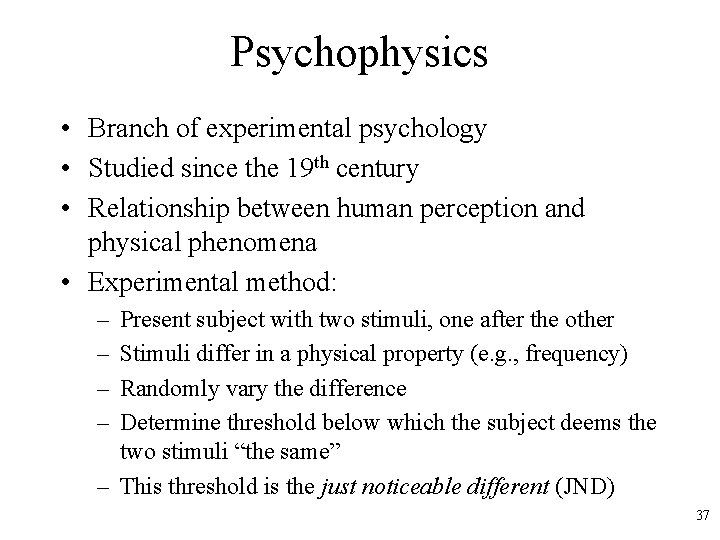
Psychophysics • Branch of experimental psychology • Studied since the 19 th century • Relationship between human perception and physical phenomena • Experimental method: – – Present subject with two stimuli, one after the other Stimuli differ in a physical property (e. g. , frequency) Randomly vary the difference Determine threshold below which the subject deems the two stimuli “the same” – This threshold is the just noticeable different (JND) 37
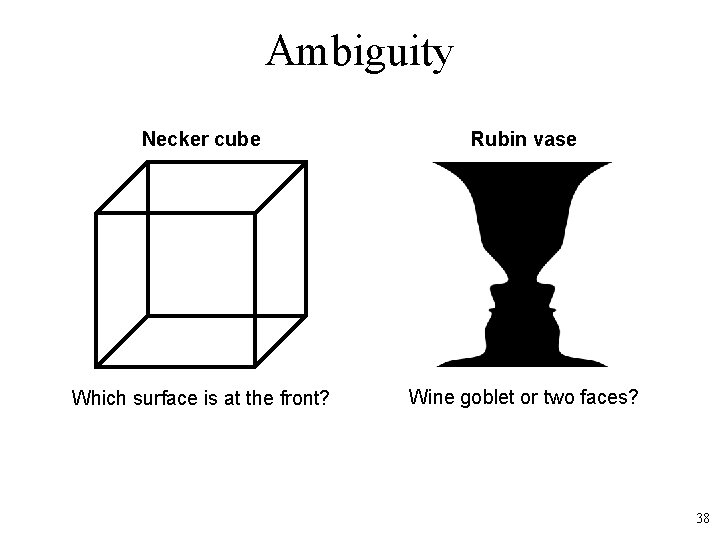
Ambiguity Necker cube Rubin vase Which surface is at the front? Wine goblet or two faces? 38
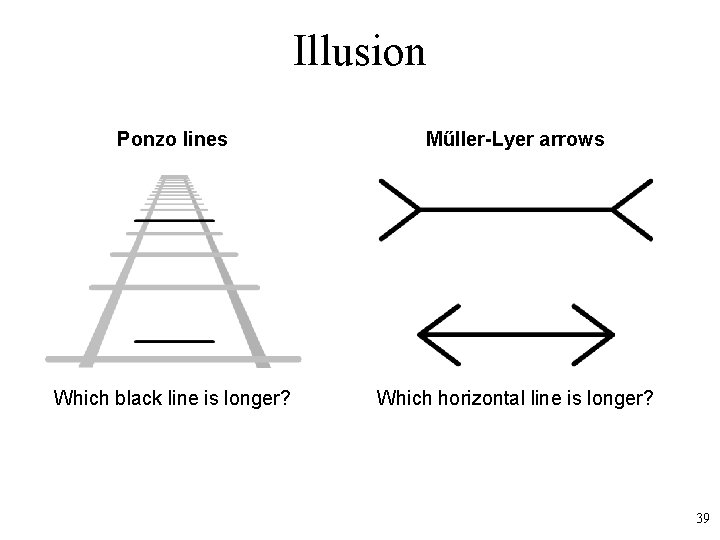
Illusion Ponzo lines Műller-Lyer arrows Which black line is longer? Which horizontal line is longer? 39
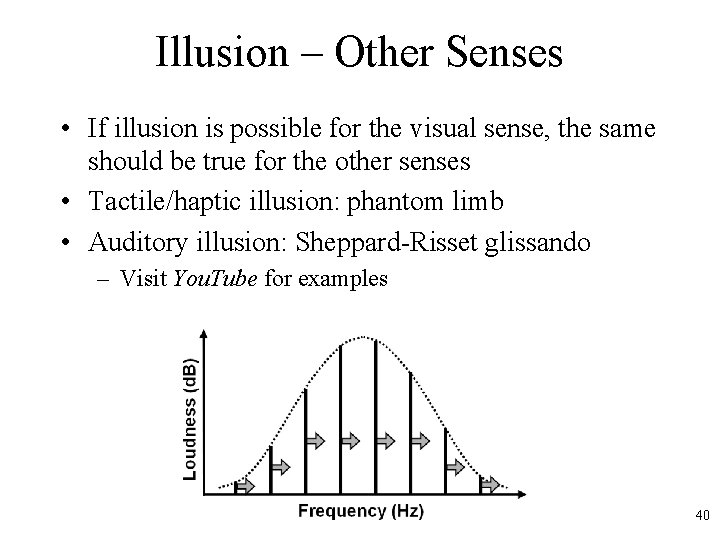
Illusion – Other Senses • If illusion is possible for the visual sense, the same should be true for the other senses • Tactile/haptic illusion: phantom limb • Auditory illusion: Sheppard-Risset glissando – Visit You. Tube for examples 40
Cognition • Cognition is the human process of conscious intellectual activity – E. g. , thinking, reasoning, deciding • Spans many fields – E. g. , neurology, linguistics, anthropology • Sensory phenomena easy to study because they exist in the physical world • Cognitive phenomena hard to study because they exist within the human brain 41
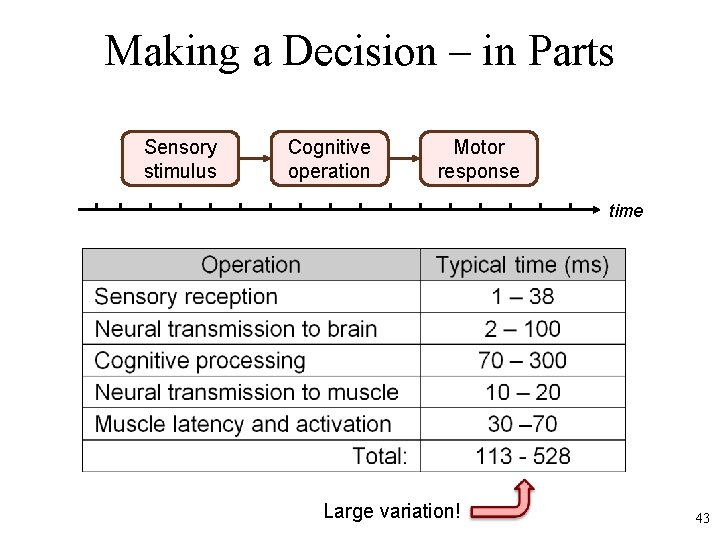
“Making a Decision” • Not possible to directly measure the time for a human to “make a decision” • When does the measurement begin and end? • Where is it measured? • On what input is the human deciding? • Through what output is the decision conveyed? • There is a sensory stimulus and motor response that bracket the decision (next slide) 42
Making a Decision – in Parts Sensory stimulus Cognitive operation Motor response time Large variation! 43
Examples of Simple Decisions • Driving a car decision to depress the brake pedal in response to a changing signal light • Using a mobile phone decision to press REJECT-CALL in response to an incoming call • Reading news online decision to click the CLOSE button on a popup ad • These are reaction time tasks (discussed shortly) 44
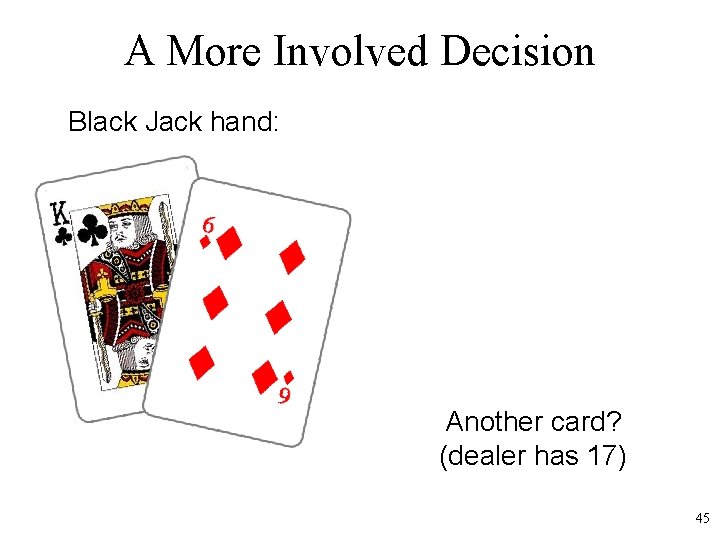
A More Involved Decision Black Jack hand: Another card? (dealer has 17) 45
Memory • Vast repository • Long-term memory – Declarative/explicit area information about events in time and objects in the external world – Implicit/procedural area information about how to use objects and how to do things • Short-term memory – Aka working memory – Information is active and readily available for access – Amount of working memory is small, about 7 (± 2) units or chunks 1 Miller, G. A. (1956). The magical number seven plus or minus two: Some limits on our capacity for processing information. Psychological Review, 63, 81 -97. 1 46
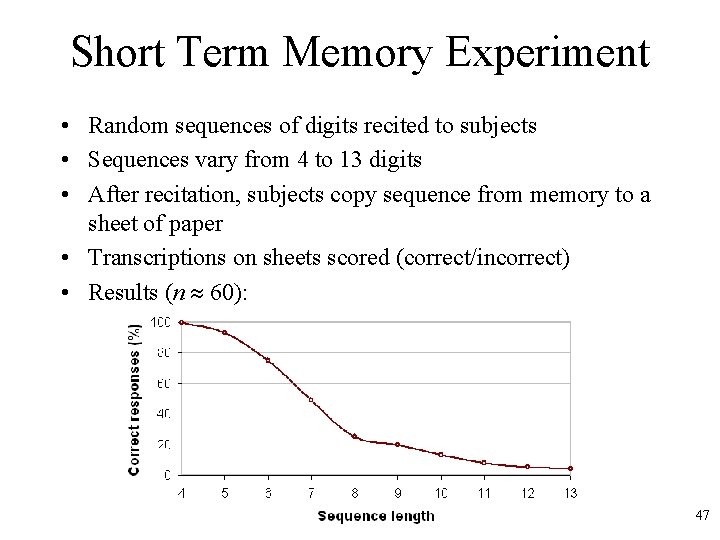
Short Term Memory Experiment • Random sequences of digits recited to subjects • Sequences vary from 4 to 13 digits • After recitation, subjects copy sequence from memory to a sheet of paper • Transcriptions on sheets scored (correct/incorrect) • Results (n 60): 47
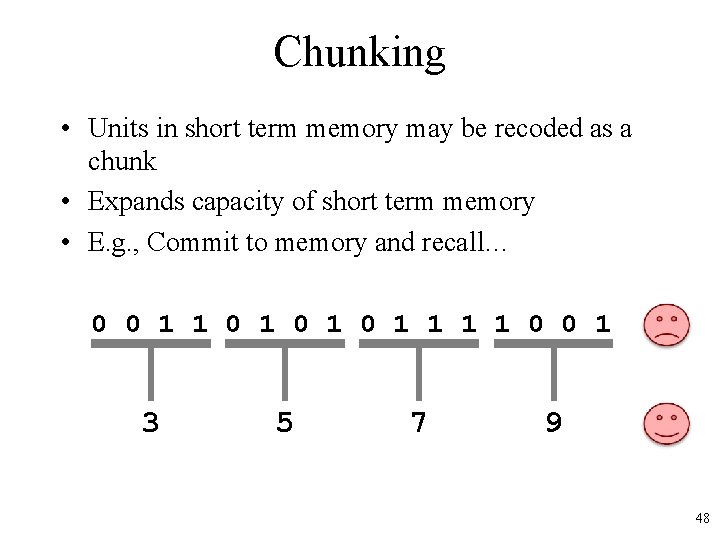
Chunking • Units in short term memory may be recoded as a chunk • Expands capacity of short term memory • E. g. , Commit to memory and recall… 0 0 1 1 0 1 0 1 1 0 0 1 3 5 7 9 48
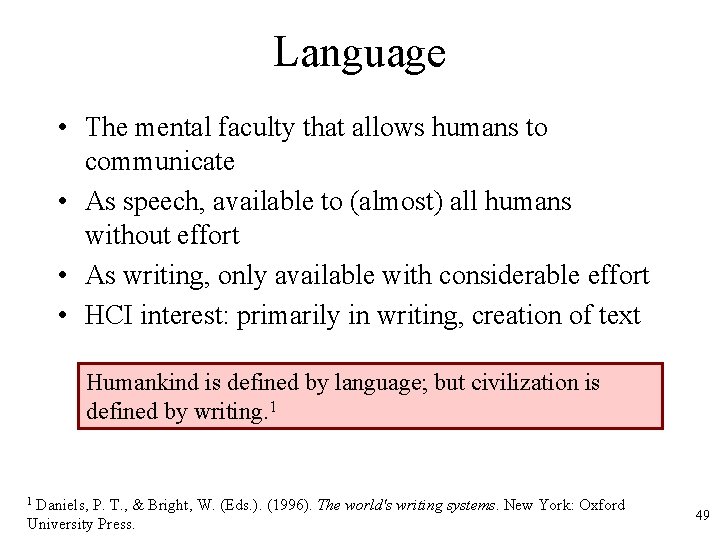
Language • The mental faculty that allows humans to communicate • As speech, available to (almost) all humans without effort • As writing, only available with considerable effort • HCI interest: primarily in writing, creation of text Humankind is defined by language; but civilization is defined by writing. 1 Daniels, P. T. , & Bright, W. (Eds. ). (1996). The world's writing systems. New York: Oxford University Press. 1 49
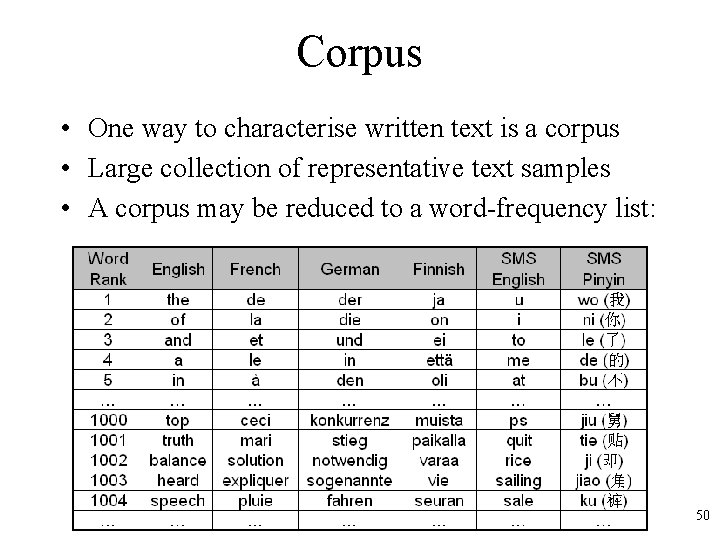
Corpus • One way to characterise written text is a corpus • Large collection of representative text samples • A corpus may be reduced to a word-frequency list: 50
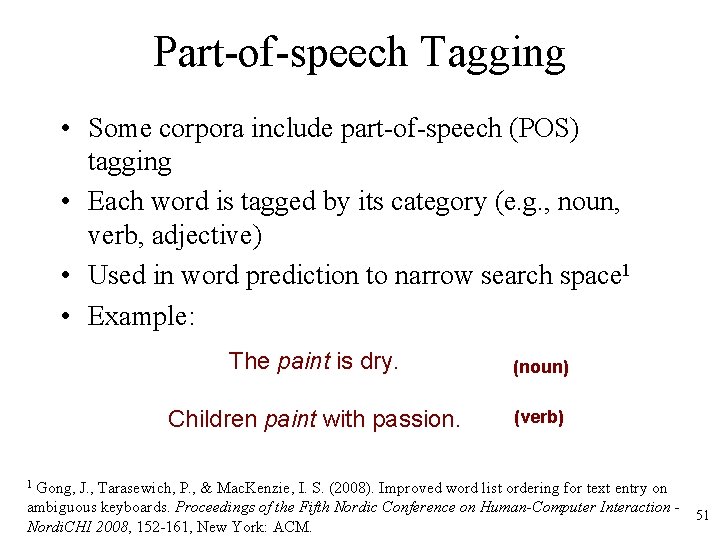
Part-of-speech Tagging • Some corpora include part-of-speech (POS) tagging • Each word is tagged by its category (e. g. , noun, verb, adjective) • Used in word prediction to narrow search space 1 • Example: The paint is dry. (noun) Children paint with passion. (verb) Gong, J. , Tarasewich, P. , & Mac. Kenzie, I. S. (2008). Improved word list ordering for text entry on ambiguous keyboards. Proceedings of the Fifth Nordic Conference on Human-Computer Interaction - 51 Nordi. CHI 2008, 152 -161, New York: ACM. 1
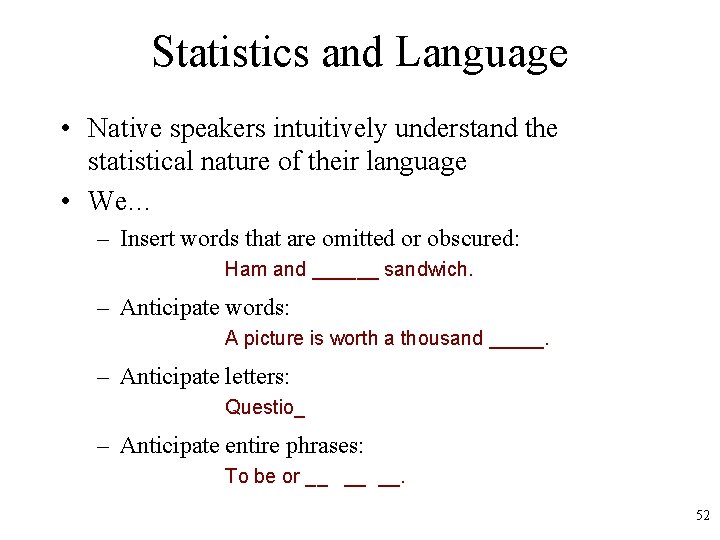
Statistics and Language • Native speakers intuitively understand the statistical nature of their language • We… – Insert words that are omitted or obscured: Ham and ______ sandwich. – Anticipate words: A picture is worth a thousand _____. – Anticipate letters: Questio_ – Anticipate entire phrases: To be or __ __ __. 52
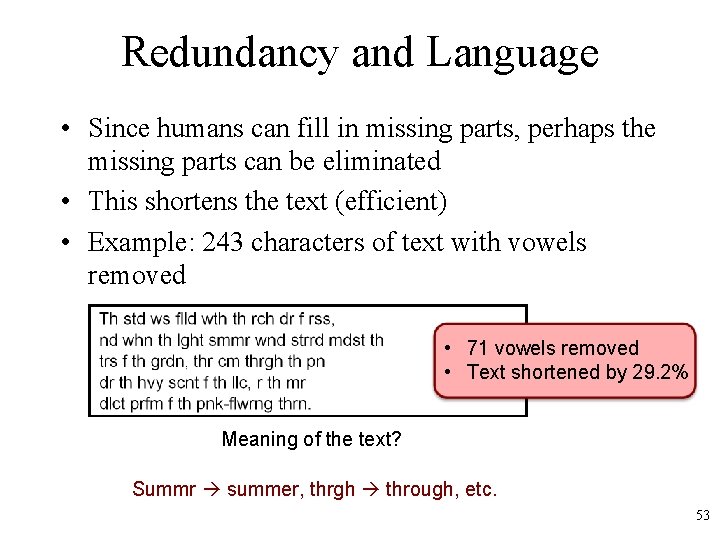
Redundancy and Language • Since humans can fill in missing parts, perhaps the missing parts can be eliminated • This shortens the text (efficient) • Example: 243 characters of text with vowels removed • 71 vowels removed • Text shortened by 29. 2% Meaning of the text? Summr summer, thrgh through, etc. 53
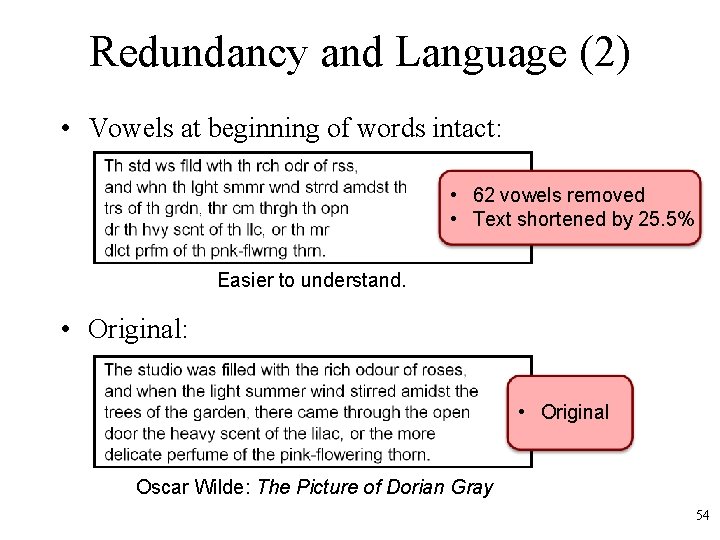
Redundancy and Language (2) • Vowels at beginning of words intact: • 62 vowels removed • Text shortened by 25. 5% Easier to understand. • Original: • Original Oscar Wilde: The Picture of Dorian Gray 54
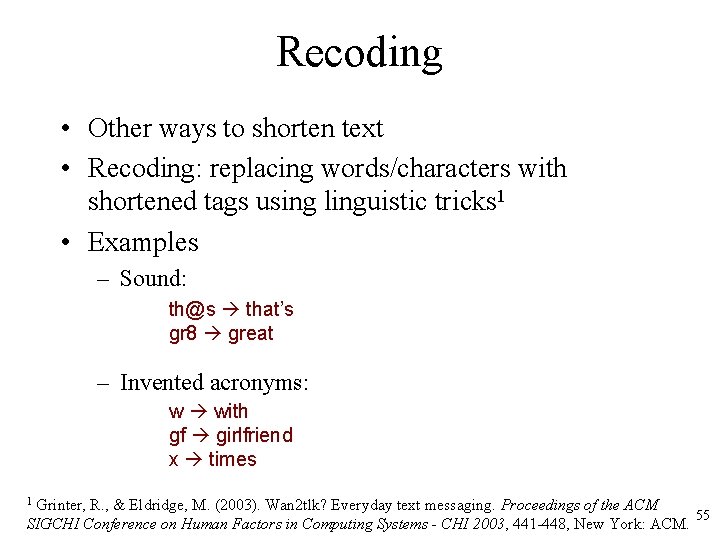
Recoding • Other ways to shorten text • Recoding: replacing words/characters with shortened tags using linguistic tricks 1 • Examples – Sound: th@s that’s gr 8 great – Invented acronyms: w with gf girlfriend x times Grinter, R. , & Eldridge, M. (2003). Wan 2 tlk? Everyday text messaging. Proceedings of the ACM 55 SIGCHI Conference on Human Factors in Computing Systems - CHI 2003, 441 -448, New York: ACM. 1
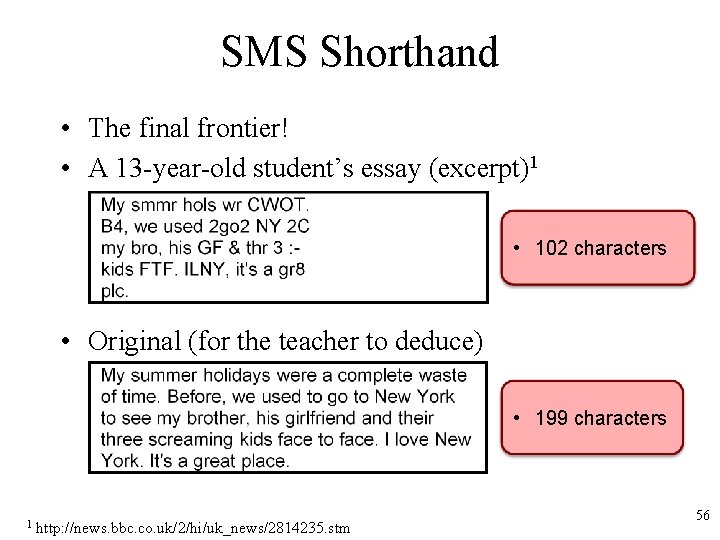
SMS Shorthand • The final frontier! • A 13 -year-old student’s essay (excerpt)1 • 102 characters • Original (for the teacher to deduce) • 199 characters 1 http: //news. bbc. co. uk/2/hi/uk_news/2814235. stm 56
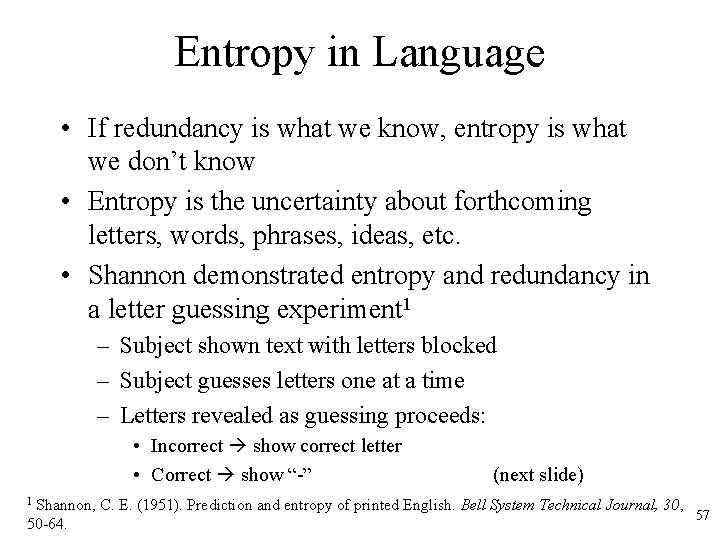
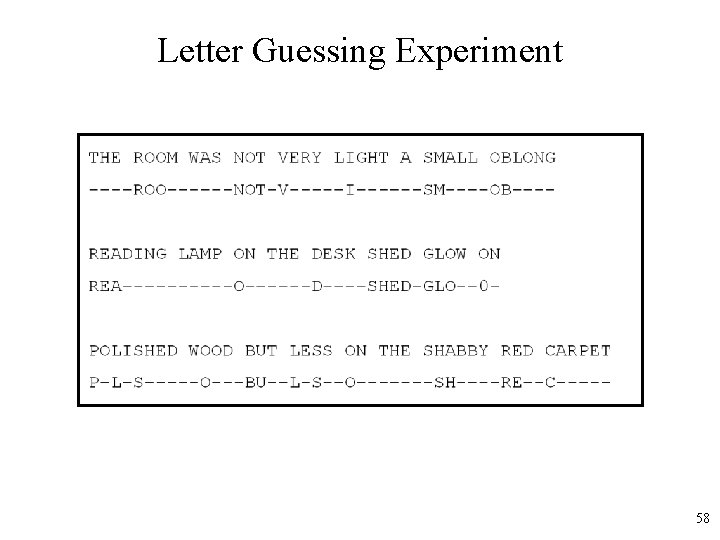
Entropy in Language • If redundancy is what we know, entropy is what we don’t know • Entropy is the uncertainty about forthcoming letters, words, phrases, ideas, etc. • Shannon demonstrated entropy and redundancy in a letter guessing experiment 1 – Subject shown text with letters blocked – Subject guesses letters one at a time – Letters revealed as guessing proceeds: • Incorrect show correct letter • Correct show “-” (next slide) Shannon, C. E. (1951). Prediction and entropy of printed English. Bell System Technical Journal, 30, 57 50 -64. 1
Letter Guessing Experiment 58
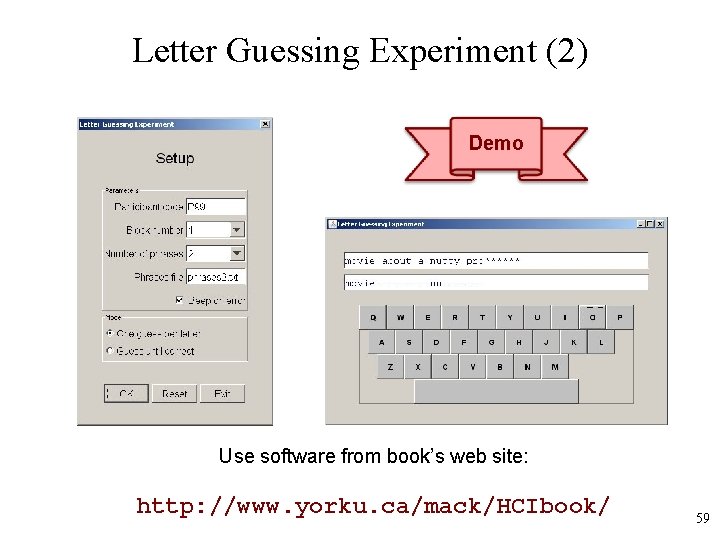
Letter Guessing Experiment (2) Demo Use software from book’s web site: http: //www. yorku. ca/mack/HCIbook/ 59
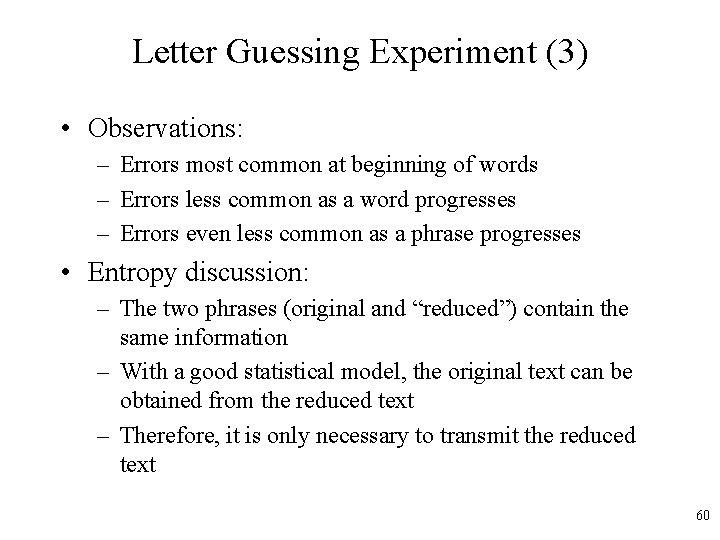
Letter Guessing Experiment (3) • Observations: – Errors most common at beginning of words – Errors less common as a word progresses – Errors even less common as a phrase progresses • Entropy discussion: – The two phrases (original and “reduced”) contain the same information – With a good statistical model, the original text can be obtained from the reduced text – Therefore, it is only necessary to transmit the reduced text 60
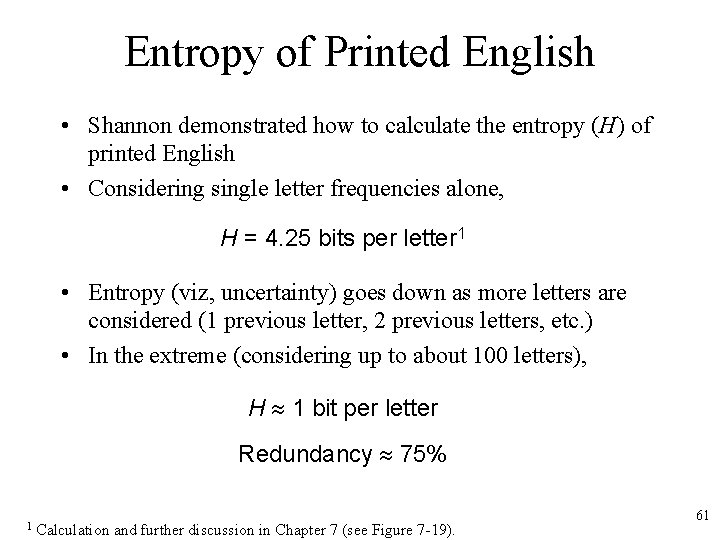
Entropy of Printed English • Shannon demonstrated how to calculate the entropy (H) of printed English • Considering single letter frequencies alone, H = 4. 25 bits per letter 1 • Entropy (viz, uncertainty) goes down as more letters are considered (1 previous letter, 2 previous letters, etc. ) • In the extreme (considering up to about 100 letters), H 1 bit per letter Redundancy 75% 1 Calculation and further discussion in Chapter 7 (see Figure 7 -19). 61
Human Factors Model Human Interface Sensors Computer Displays Brain Machine State Responders Human Performance Skilled Behaviour Attention Human Error Controls 62
Human Performance • Humans uses their sensors, brain, and responders to do things • When the three work together to achieve a goal, human performance arises • Examples: – – Tying shoelaces Folding clothes Searching the web Entering a text message on a mobile phone 63
Speed-accuracy Trade-off • • Fundamental property of human performance Go faster and errors increase Slow down and accuracy improves HCI research on a new interface or interaction technique must consider both the speed in doing tasks (achieving the goal!) and the accompanying accuracy 64
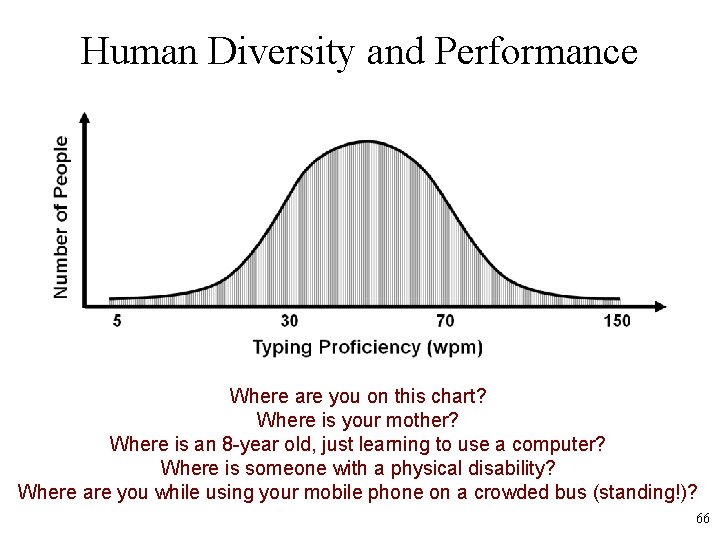
Human Diversity • Human performance is highly complex: – Humans differ (age, gender, skill, motivation, etc. ) – Environmental conditions affect performance – Secondary tasks often present • Human diversity and human performance often shown in a distribution (next slide) 65
Human Diversity and Performance Where are you on this chart? Where is your mother? Where is an 8 -year old, just learning to use a computer? Where is someone with a physical disability? Where are you while using your mobile phone on a crowded bus (standing!)? 66
Reaction Time • One of the most primitive manifestations of human performance is simple reaction time • Definition: The delay between the occurrence of a single fixed stimulus and the initiation of a response assigned to it 1 • Example: pressing a button in response to the onset of a stimulus light Fitts, P. M. , & Posner, M. I. (1968). Human performance. Belmont, CA. Brooks/Cole Publishing Company. 1 67
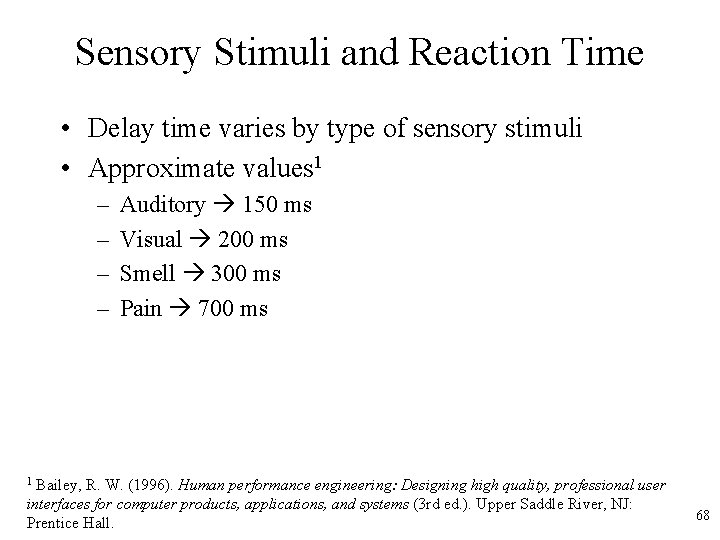
Sensory Stimuli and Reaction Time • Delay time varies by type of sensory stimuli • Approximate values 1 – – Auditory 150 ms Visual 200 ms Smell 300 ms Pain 700 ms Bailey, R. W. (1996). Human performance engineering: Designing high quality, professional user interfaces for computer products, applications, and systems (3 rd ed. ). Upper Saddle River, NJ: Prentice Hall. 1 68
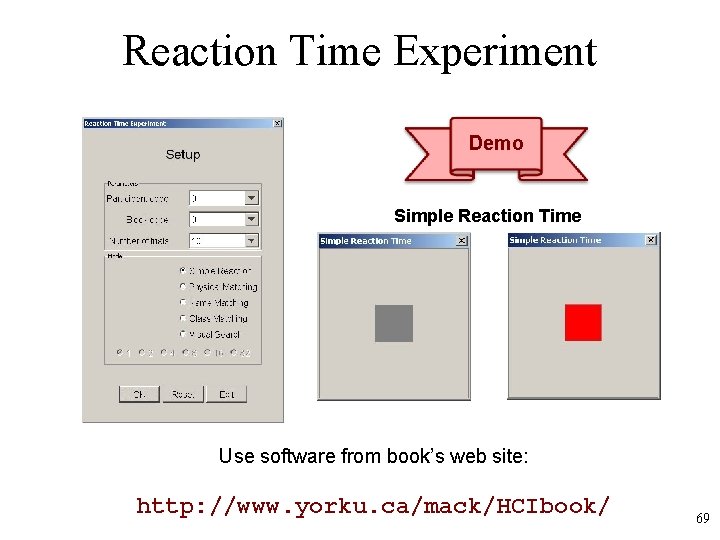
Reaction Time Experiment Demo Simple Reaction Time Use software from book’s web site: http: //www. yorku. ca/mack/HCIbook/ 69
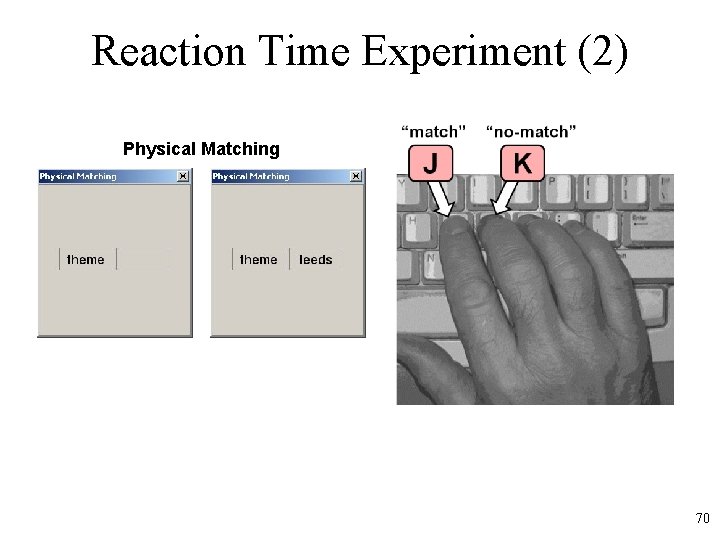
Reaction Time Experiment (2) Physical Matching 70
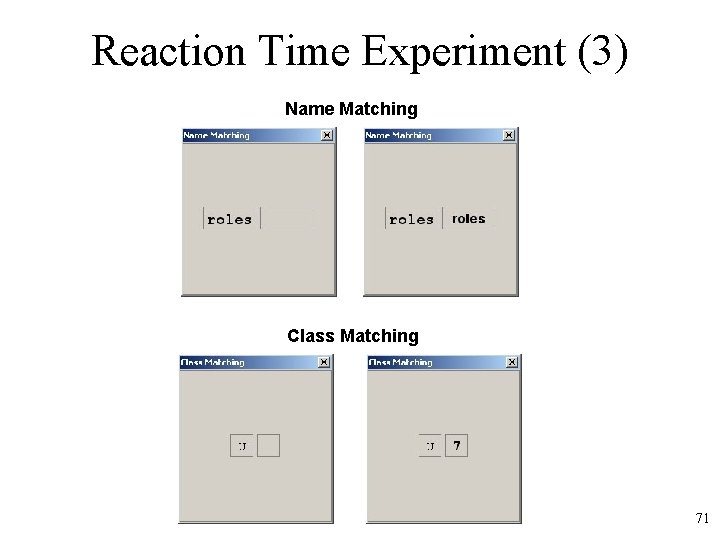
Reaction Time Experiment (3) Name Matching Class Matching 71
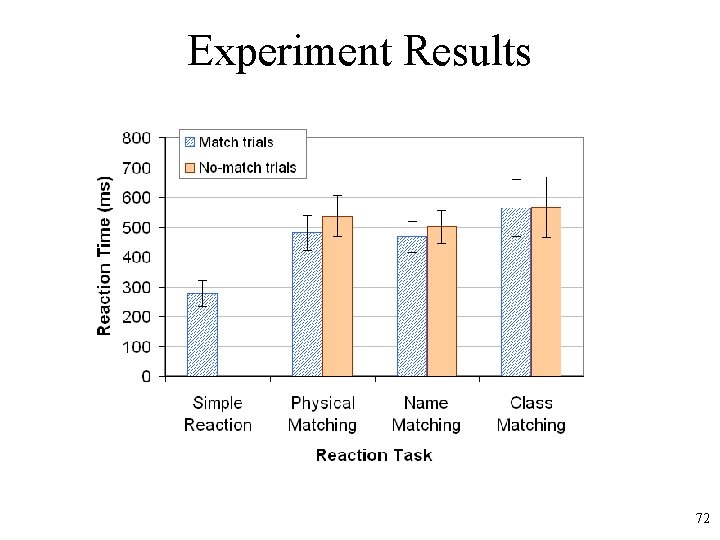
Experiment Results 72
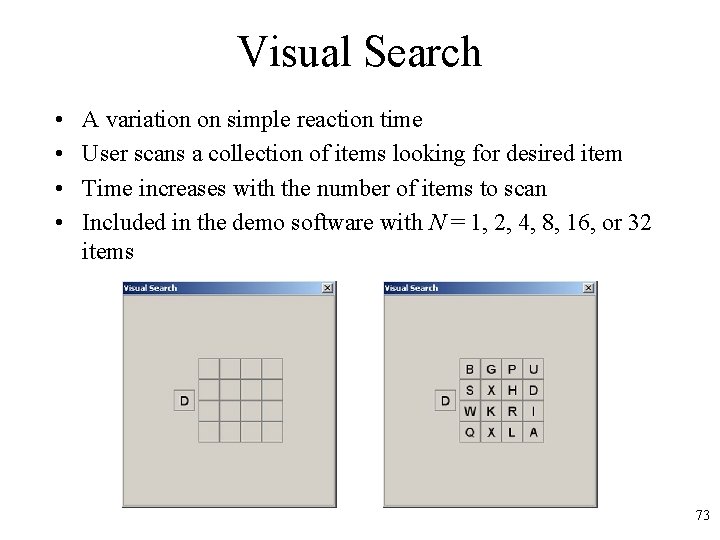
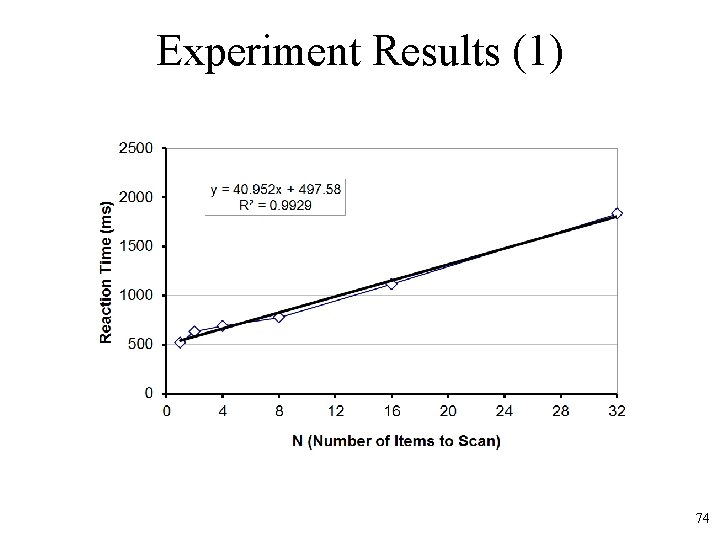
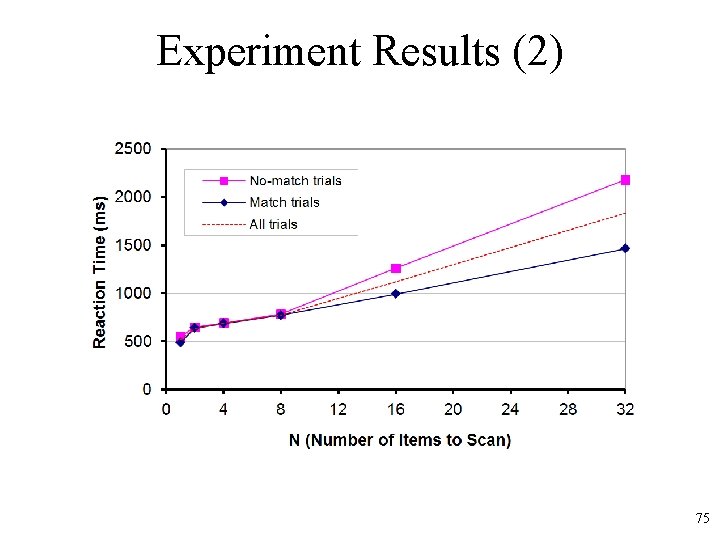
Visual Search • • A variation on simple reaction time User scans a collection of items looking for desired item Time increases with the number of items to scan Included in the demo software with N = 1, 2, 4, 8, 16, or 32 items 73
Experiment Results (1) 74
Experiment Results (2) 75
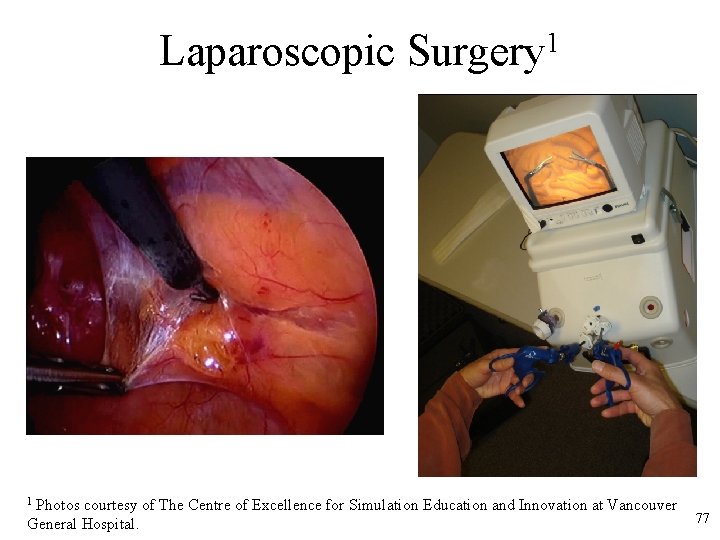
Skilled Behaviour • For many tasks, human performance improves considerably and continuously with practice • (Note: Very little improvement with practice in the simple reaction time tasks) • In these tasks, there is interest in studying the progression of learning and the performance achieved according to the amount of practice • Categories of skilled behavior: 1. Sensory-motor skill (e. g. , darts, gaming) 2. Mental skill (e. g. , chess, programming) – Some tasks required a lot of both (next slide) 76
Laparoscopic Surgery 1 Photos courtesy of The Centre of Excellence for Simulation Education and Innovation at Vancouver General Hospital. 1 77
Attention • Texting while driving! • Attention is complex: – Divided attention, secondary tasks – Which tasks require attention? • Can’t talk and type – Which tasks do not require attention? • Can talk and walk – What are the human limits? What is attention? • Two categories of attention – Divided attention (attending to more than one task) – Selected attention (attending to one task to the exclusion of others) 78
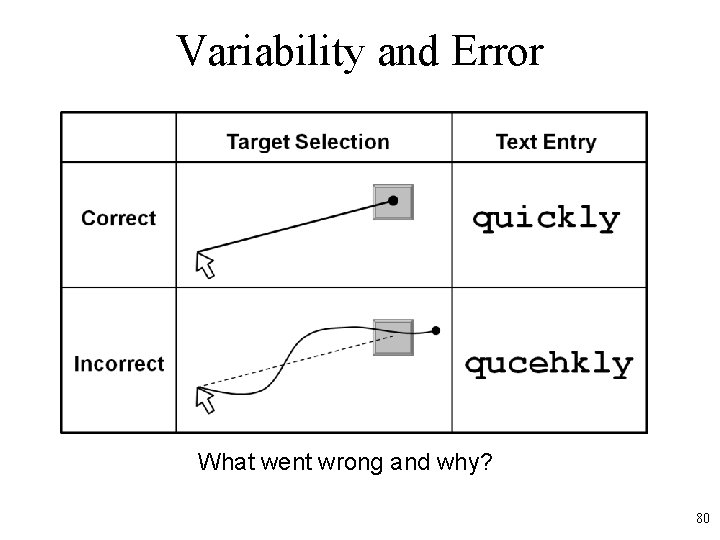
Human Error • Human error can be studied from many levels • Simple view: An error is a discrete event where the outcome deviated from the desired outcome • But, tasks that are performed in error are often at least partly correct (next slide) 79
Variability and Error What went wrong and why? 80
Accidents • A broader perspective is often necessary • Serious accidents causing significant damage or loss of life are often attributed to human error • But the fault may be a design induced error • Interaction errors (e. g. , an operator pressing the wrong button or entering a wrong value) are not only possible, they are, in time, likely and must be anticipated in the design 81
Thank You 82