
Chapter 2 The First Law Unit 3 adiabatic
Chapter 2 The First Law Unit 3 adiabatic process Spring 2009

2. 6 Adiabatic changes When a perfect gas expands adiabatically, a decrease in temperature should be expected: • because work is done but no heat enters the system, the internal energy falls, and therefore the temperature of the working gas also falls. • In molecular terms, the kinetic energy of the molecules falls as work is done, so their average speed decreases, and hence the temperature falls.

Adiabatic changes Step 1, change volume and the temperature is held constant at its initial value. DU=0 Step 2, change temperature at constant volume. DU = CV ( Tf-Ti )

Adiabatic changes the work done by the system during an adiabatic expansion of a perfect gas is proportional to the temperature difference between the initial and final states.

Final Temperature (Tf) in adiabatic change • The initial and final temperatures of a perfect gas that undergoes reversible adiabatic expansion (reversible expansion in a thermally insulated container) can be calculated c = CV, m/R Ti : temperature of initial state Tf : temperature of final state Vi : volume of initial state VT c = constant Vf : volume of final state

Illustration 2. 5 Work of adiabatic expansion • Consider the adiabatic, reversible expansion of 0. 020 mol Ar, initially at 25°C, from 0. 50 dm 3 to 1. 00 dm 3. The molar heat capacity of argon at constant volume is 12. 48 J K− 1 mol− 1
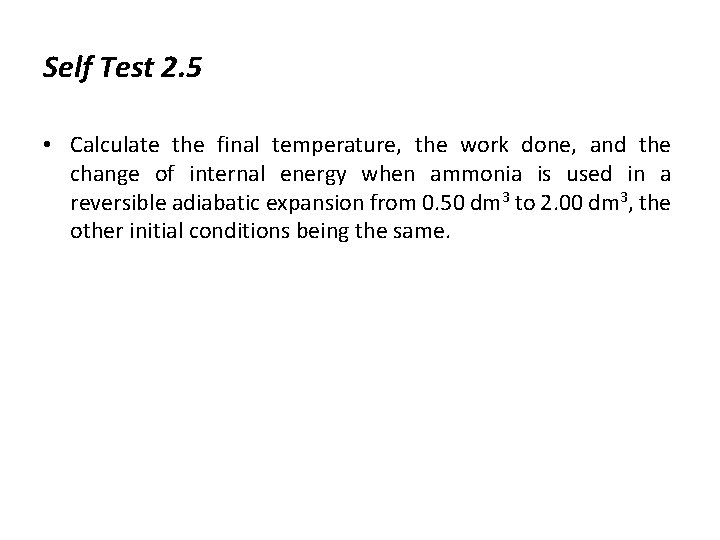
Self Test 2. 5 • Calculate the final temperature, the work done, and the change of internal energy when ammonia is used in a reversible adiabatic expansion from 0. 50 dm 3 to 2. 00 dm 3, the other initial conditions being the same.

• the pressure of a perfect gas that undergoes reversible adiabatic expansion from a volume Vi to a volume Vf is related to its initial pressure by g = Cp, m/CV, m p. Vg = constant For a monatomic perfect gas, CV, m = 3/2 R and Cp, m = 5/2 R; so g = 5/3. For a gas of nonlinear polyatomic molecules , CV, m = 3 R and Cp, m =4 R , so g = 4/3.

Illustration 2. 6 The pressure change accompanying adiabatic expansion • When a sample of argon (for which g = 5/3) at 100 k. Pa expands reversibly and adiabatically to twice its initial volume, estimate the final pressure. For an isothermal doubling of volume, the final pressure would be … ?
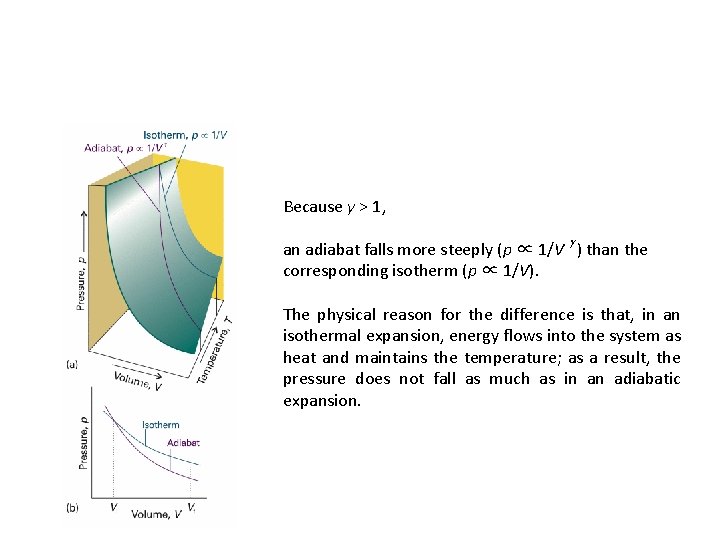
Because γ > 1, an adiabat falls more steeply (p ∝ 1/V g ) than the corresponding isotherm (p ∝ 1/V). The physical reason for the difference is that, in an isothermal expansion, energy flows into the system as heat and maintains the temperature; as a result, the pressure does not fall as much as in an adiabatic expansion.
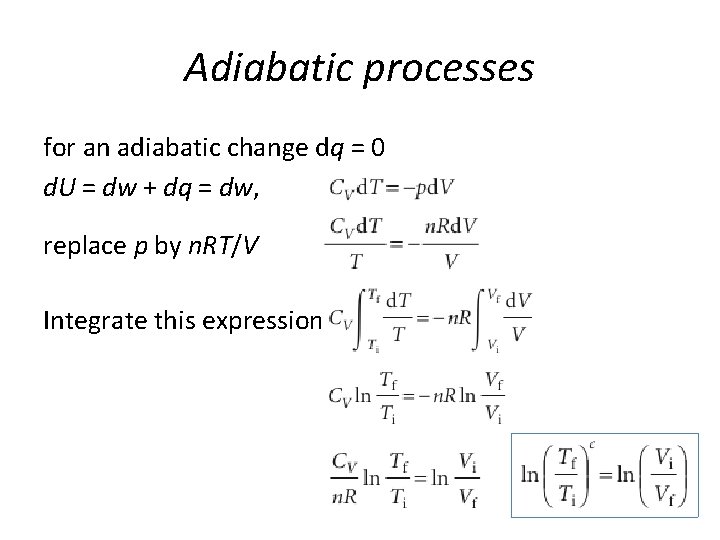
Adiabatic processes for an adiabatic change dq = 0 d. U = dw + dq = dw, replace p by n. RT/V Integrate this expression

Adiabatic processes Since p. V = n. RT g = Cp, m/CV, m for a perfect gas, Cp, m – CV, m = R p i V i γ = p f. V fγ
Exercise 2. 4 b • A sample consisting of 2. 00 mol of perfect gas molecules, for which CV, m = 5/2 R, initially at p 1 = 111 k. Pa and T 1 = 277 K, is heated reversibly to 356 K at constant volume. Calculate the final pressure, ∆U, q, and w.
Exercise 2. 9 b • Calculate the final temperature of a sample of argon of mass 12. 0 g that is expanded reversibly and adiabatically from 1. 0 dm 3 at 273. 15 K to 3. 0 dm 3.
Exercise 2. 14 b • A sample of 5. 0 mol CO 2 is originally confined in 15 dm 3 at 280 K and then undergoes adiabatic expansion against a constant pressure of 78. 5 k. Pa until the volume has increased by a factor of 4. 0. Calculate q, w, ∆T, ∆U, and ∆H. (The final pressure of the gas is not necessarily 78. 5 k. Pa. )
- Slides: 15