
Chapter 2 The External Environment Why External Analysis

- Slides: 35
Chapter 2 The External Environment
Why External Analysis? External analysis allows firms to: • discover threats and opportunities • see if above normal profits are likely in an industry • better understand the nature of competition in an industry • make more informed strategic choices 2 -2
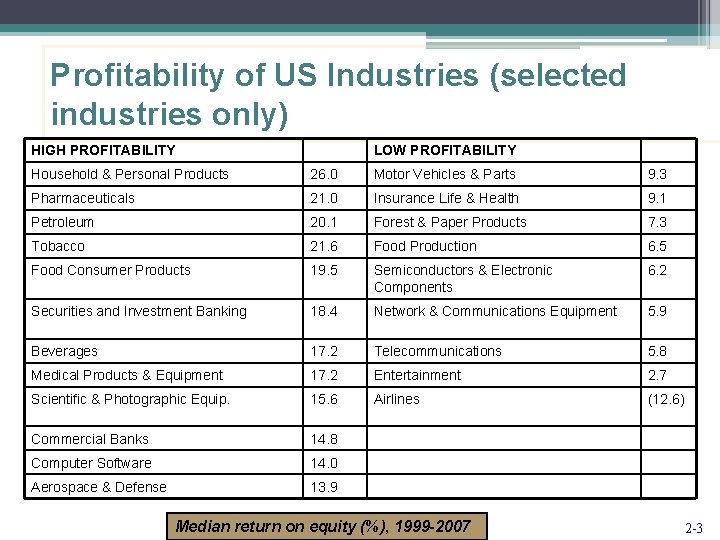
Profitability of US Industries (selected industries only) HIGH PROFITABILITY LOW PROFITABILITY Household & Personal Products 26. 0 Motor Vehicles & Parts 9. 3 Pharmaceuticals 21. 0 Insurance Life & Health 9. 1 Petroleum 20. 1 Forest & Paper Products 7. 3 Tobacco 21. 6 Food Production 6. 5 Food Consumer Products 19. 5 Semiconductors & Electronic Components 6. 2 Securities and Investment Banking 18. 4 Network & Communications Equipment 5. 9 Beverages 17. 2 Telecommunications 5. 8 Medical Products & Equipment 17. 2 Entertainment 2. 7 Scientific & Photographic Equip. 15. 6 Airlines (12. 6) Commercial Banks 14. 8 Computer Software 14. 0 Aerospace & Defense 13. 9 Median return on equity (%), 1999 -2007 2 -3
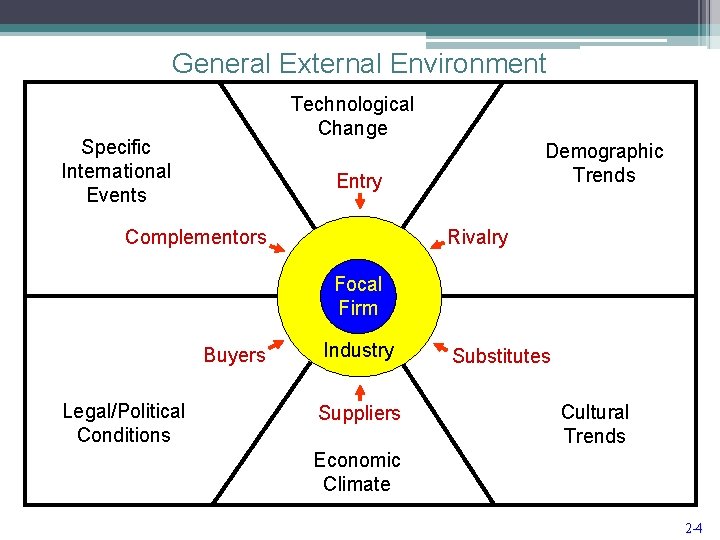
General External Environment Technological Change Specific International Events Demographic Trends Entry Complementors Rivalry Focal Firm Buyers Legal/Political Conditions Industry Suppliers Substitutes Cultural Trends Economic Climate 2 -4
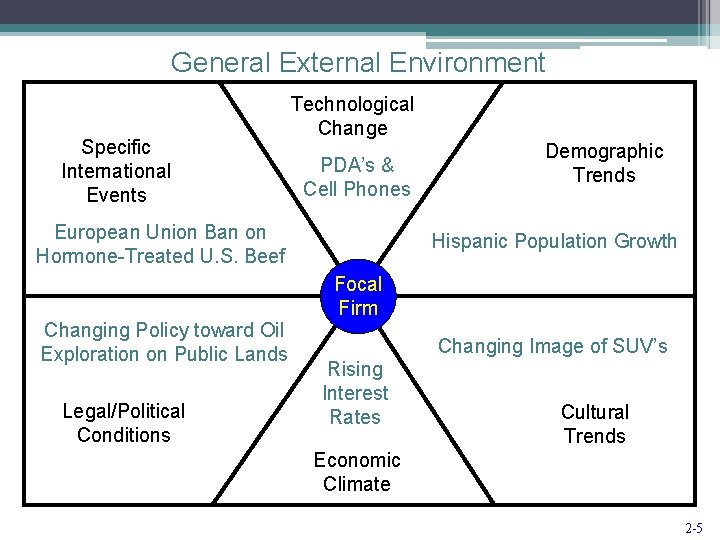
General External Environment Specific International Events Technological Change PDA’s & Cell Phones European Union Ban on Hormone-Treated U. S. Beef Changing Policy toward Oil Exploration on Public Lands Legal/Political Conditions Demographic Trends Hispanic Population Growth Focal Firm Changing Image of SUV’s Rising Interest Rates Cultural Trends Economic Climate 2 -5
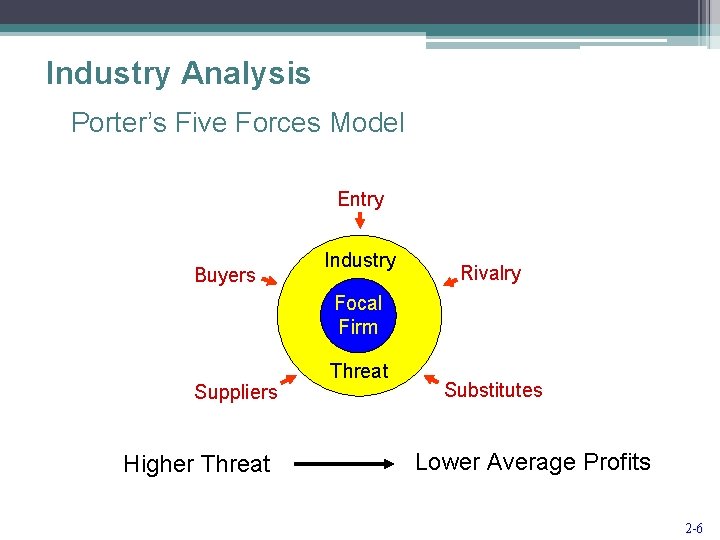
Industry Analysis Porter’s Five Forces Model Entry Buyers Industry Rivalry Focal Firm Suppliers Higher Threat Substitutes Lower Average Profits 2 -6
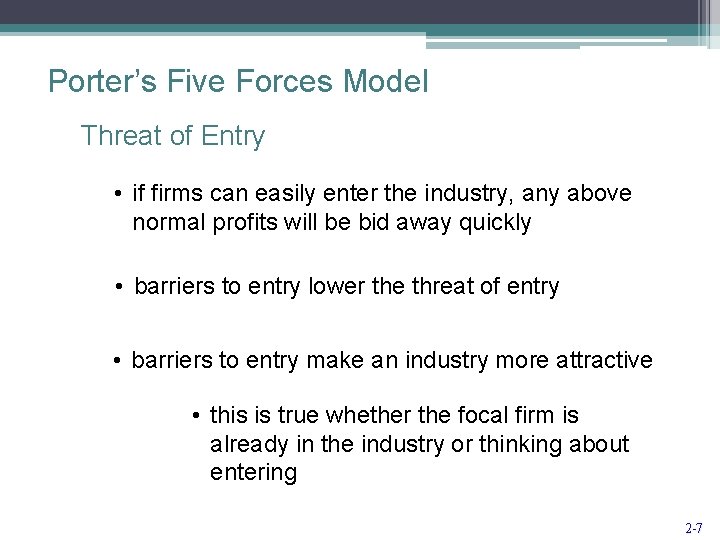
Porter’s Five Forces Model Threat of Entry • if firms can easily enter the industry, any above normal profits will be bid away quickly • barriers to entry lower the threat of entry • barriers to entry make an industry more attractive • this is true whether the focal firm is already in the industry or thinking about entering 2 -7
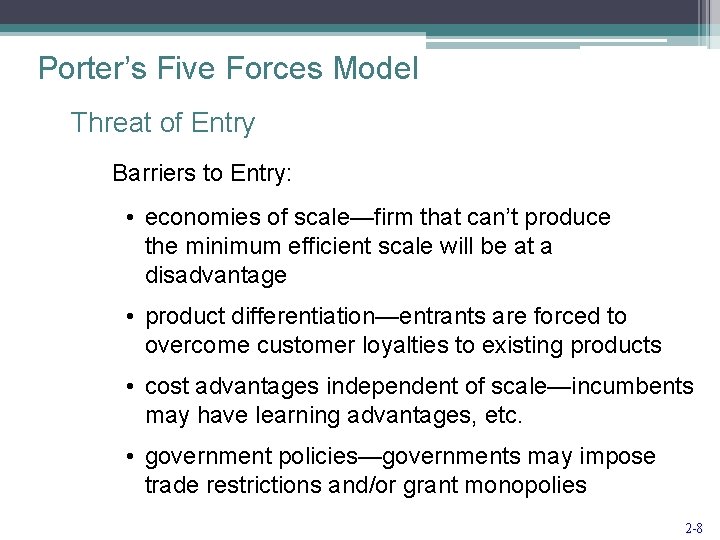
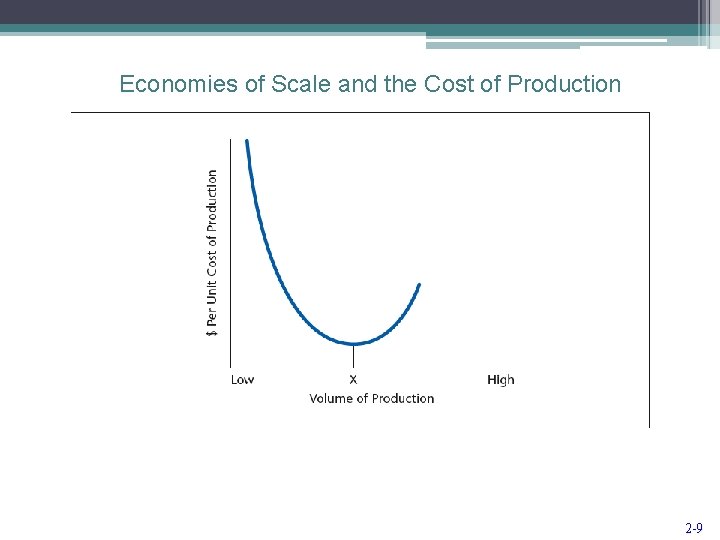
Porter’s Five Forces Model Threat of Entry Barriers to Entry: • economies of scale—firm that can’t produce the minimum efficient scale will be at a disadvantage • product differentiation—entrants are forced to overcome customer loyalties to existing products • cost advantages independent of scale—incumbents may have learning advantages, etc. • government policies—governments may impose trade restrictions and/or grant monopolies 2 -8
Economies of Scale and the Cost of Production 2 -9
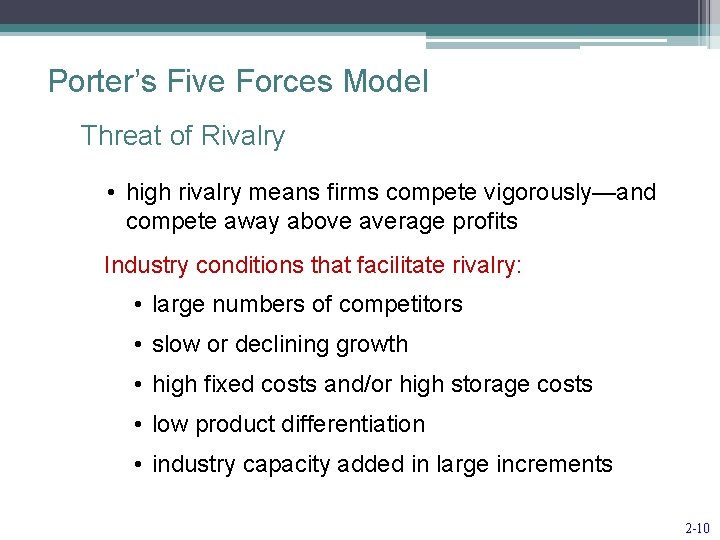
Porter’s Five Forces Model Threat of Rivalry • high rivalry means firms compete vigorously—and compete away above average profits Industry conditions that facilitate rivalry: • large numbers of competitors • slow or declining growth • high fixed costs and/or high storage costs • low product differentiation • industry capacity added in large increments 2 -10
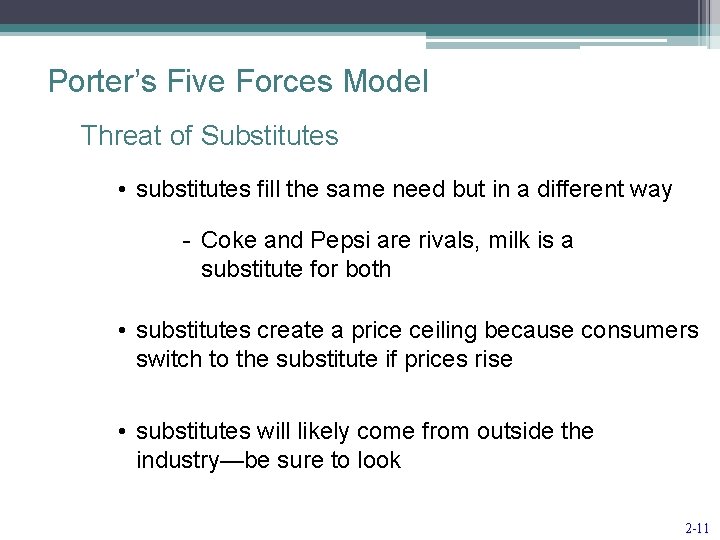
Porter’s Five Forces Model Threat of Substitutes • substitutes fill the same need but in a different way - Coke and Pepsi are rivals, milk is a substitute for both • substitutes create a price ceiling because consumers switch to the substitute if prices rise • substitutes will likely come from outside the industry—be sure to look 2 -11
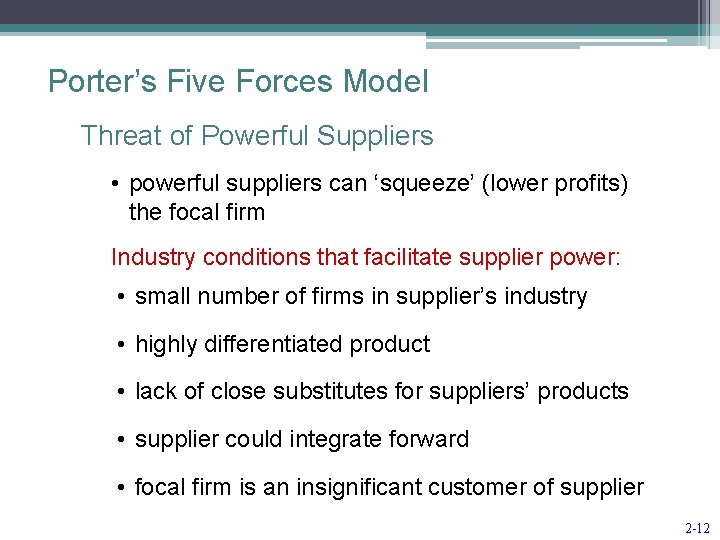
Porter’s Five Forces Model Threat of Powerful Suppliers • powerful suppliers can ‘squeeze’ (lower profits) the focal firm Industry conditions that facilitate supplier power: • small number of firms in supplier’s industry • highly differentiated product • lack of close substitutes for suppliers’ products • supplier could integrate forward • focal firm is an insignificant customer of supplier 2 -12
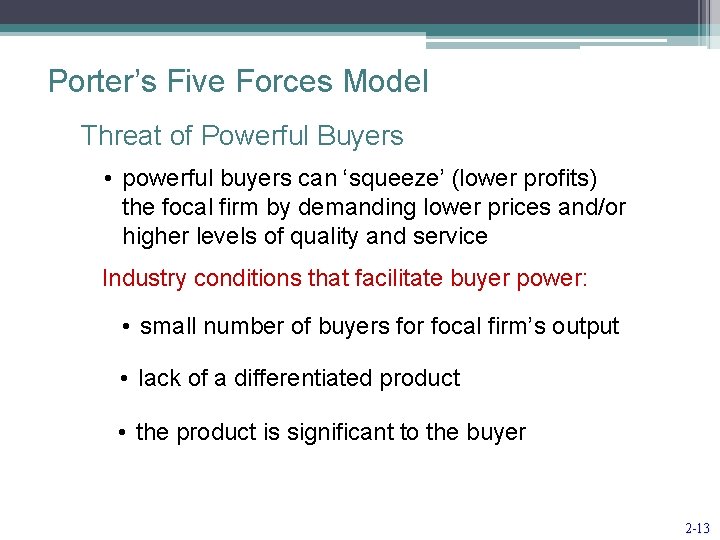
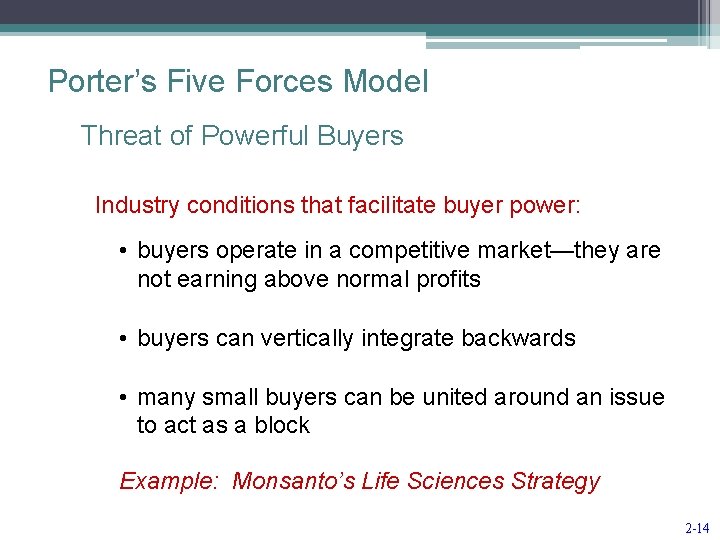
Porter’s Five Forces Model Threat of Powerful Buyers • powerful buyers can ‘squeeze’ (lower profits) the focal firm by demanding lower prices and/or higher levels of quality and service Industry conditions that facilitate buyer power: • small number of buyers for focal firm’s output • lack of a differentiated product • the product is significant to the buyer 2 -13
Porter’s Five Forces Model Threat of Powerful Buyers Industry conditions that facilitate buyer power: • buyers operate in a competitive market—they are not earning above normal profits • buyers can vertically integrate backwards • many small buyers can be united around an issue to act as a block Example: Monsanto’s Life Sciences Strategy 2 -14
Using Porter’s Forces Wal-Mart’s Bargaining Power over Suppliers 2 -15
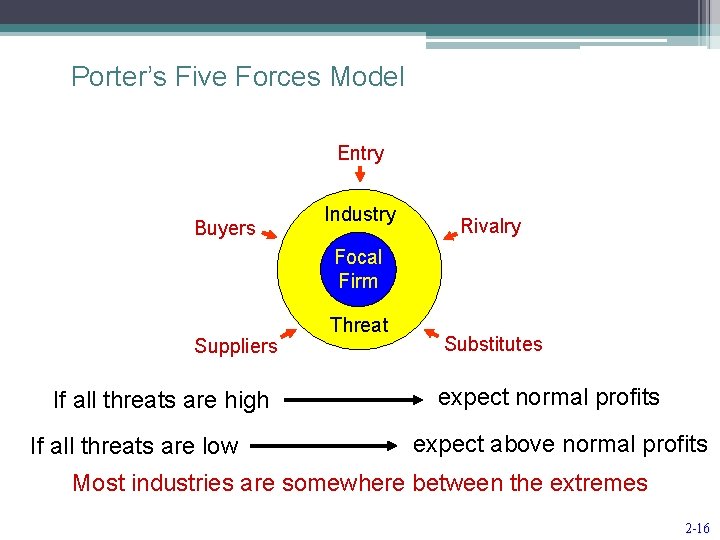
Porter’s Five Forces Model Entry Buyers Industry Rivalry Focal Firm Suppliers If all threats are high If all threats are low Threat Substitutes expect normal profits expect above normal profits Most industries are somewhere between the extremes 2 -16
Drawing Industry Boundaries: What is the Relevant Market? • What industry is Jaguar Ltd. in: o The Motor Vehicle industry (SIC 371) o The Automobile industry (SIC 3712) o The luxury car industry? o Is its industry global, regional (Europe) or national (UK)? • Key criterion: SUBSTITUTABILITY o On the demand side : are buyers willing to substitute between types of cars and across countries o On the supply side : are manufacturers able to switch production between types of cars and across countries • We may need to draw industry boundaries differently for different types of decision 2 -17
Complementors As Another Force Complementors Increase the Value of the Focal Firms Product • customers perceive more value in the focal firm’s product when it is combined with the complementor’s product • complementors may be found outside the focal firm’s industry Example: Goodyear Tires on Corvette 2 -18
Responding to Environmental Threats Neutralizing Threats • most firms cannot unilaterally change threats in an industry • by altering relationships in an industry, firms may reduce threats and/or create opportunities, thereby increasing profits Examples: Regional Healthcare System, Building Contractor, and the Bakery 2 -19
He looks very much like Andy Warhol Michael Porter you say? 2 -20
End Segment 1 2 -21
Segment 2 Industry Structure Dynamics 2 -22
Exploiting Industry Structure Opportunities Generic Industry Structures • at any point in time, the structure of most industries fits into one of four generic categories • each industry structure presents opportunities that may be exploited • firms can choose to exploit an industry structure, continue business as usual, or exit the industry 2 -23
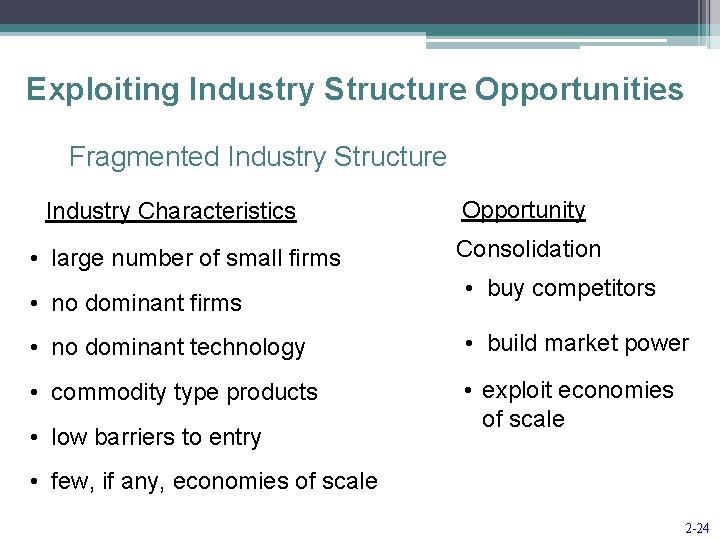
Exploiting Industry Structure Opportunities Fragmented Industry Structure Industry Characteristics • large number of small firms • no dominant firms Opportunity Consolidation • buy competitors • no dominant technology • build market power • commodity type products • exploit economies of scale • low barriers to entry • few, if any, economies of scale 2 -24
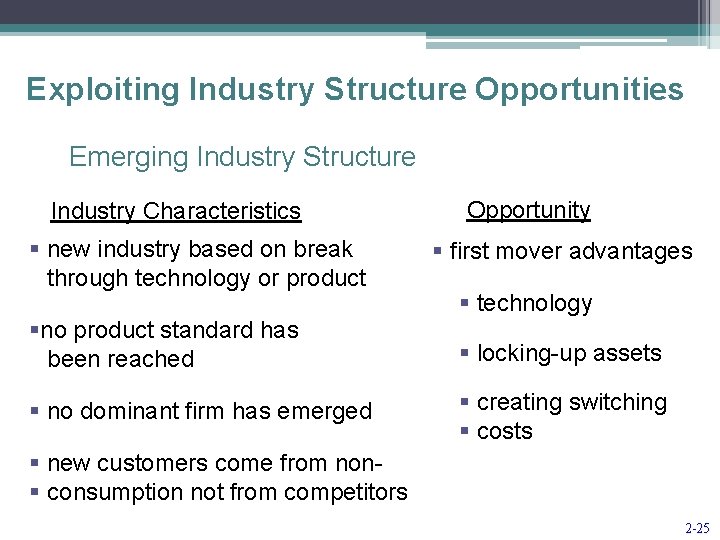
Exploiting Industry Structure Opportunities Emerging Industry Structure Industry Characteristics § new industry based on break through technology or product §no product standard has been reached § no dominant firm has emerged Opportunity § first mover advantages § technology § locking-up assets § creating switching § costs § new customers come from non§ consumption not from competitors 2 -25
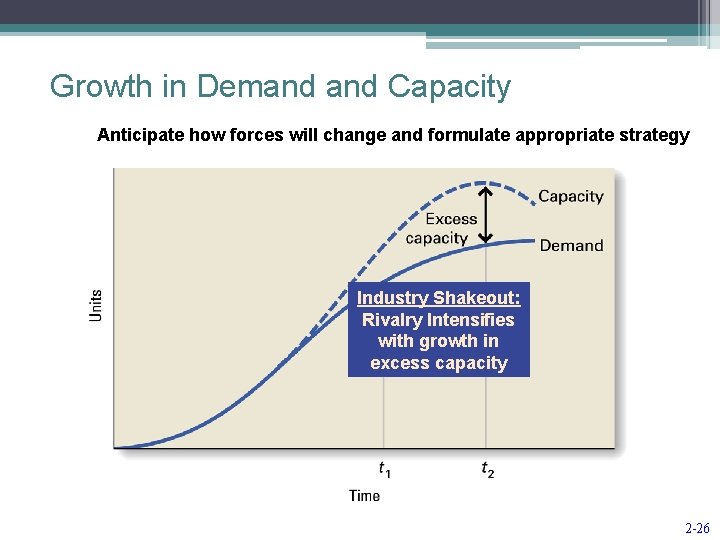
Growth in Demand Capacity Anticipate how forces will change and formulate appropriate strategy Industry Shakeout: Rivalry Intensifies with growth in excess capacity 2 -26
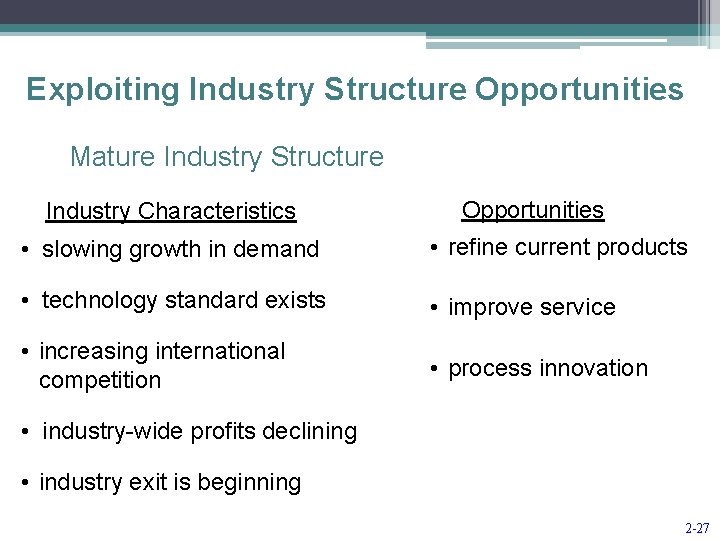
Exploiting Industry Structure Opportunities Mature Industry Structure Industry Characteristics Opportunities • slowing growth in demand • refine current products • technology standard exists • improve service • increasing international competition • process innovation • industry-wide profits declining • industry exit is beginning 2 -27
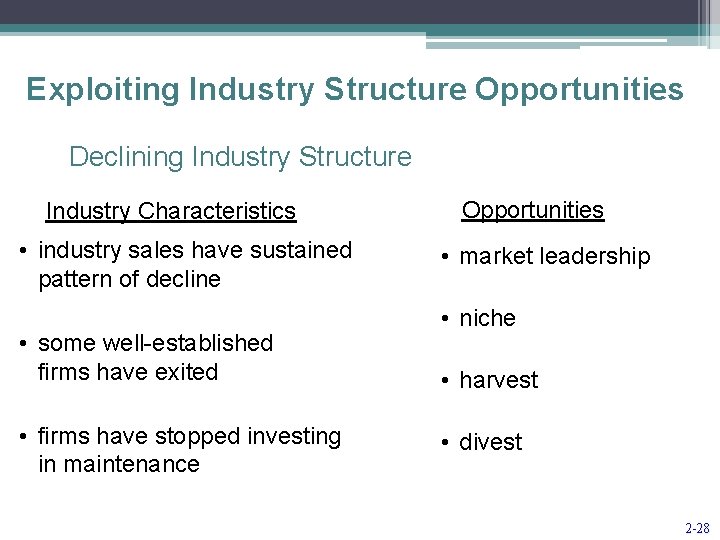
Exploiting Industry Structure Opportunities Declining Industry Structure Industry Characteristics • industry sales have sustained pattern of decline • some well-established firms have exited • firms have stopped investing in maintenance Opportunities • market leadership • niche • harvest • divest 2 -28
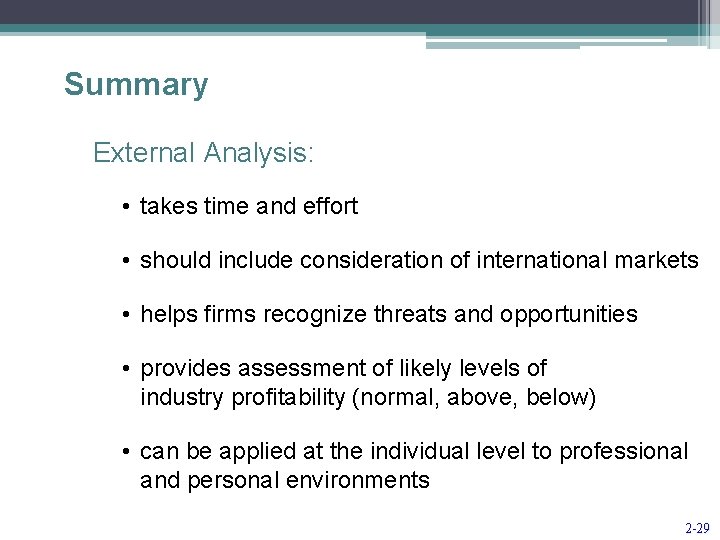
Summary External Analysis: • takes time and effort • should include consideration of international markets • helps firms recognize threats and opportunities • provides assessment of likely levels of industry profitability (normal, above, below) • can be applied at the individual level to professional and personal environments 2 -29
Segment 3 Critiques and concerns with Industry Analysis 2 -30
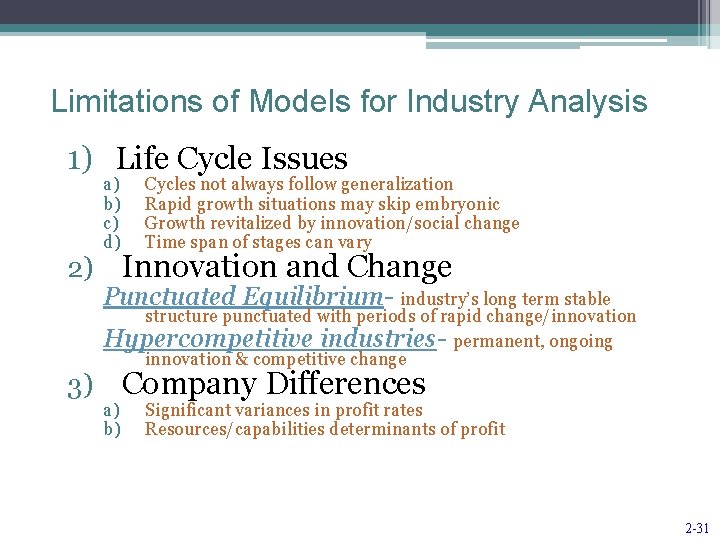
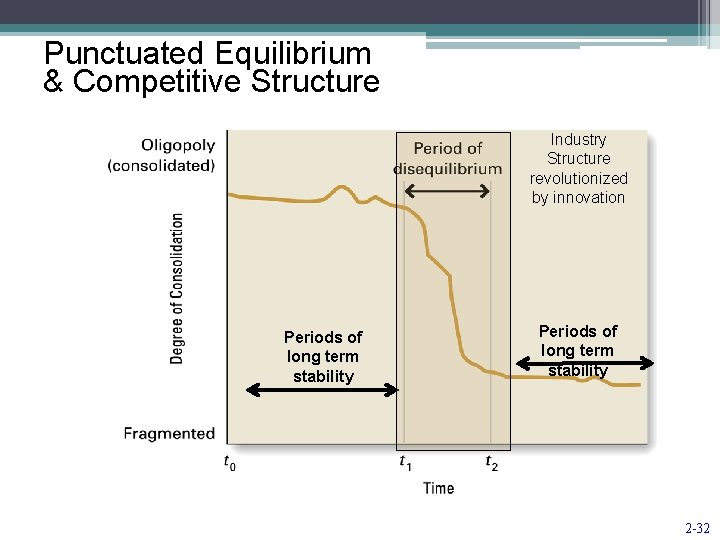
Limitations of Models for Industry Analysis 1) Life Cycle Issues a) b) c) d) Cycles not always follow generalization Rapid growth situations may skip embryonic Growth revitalized by innovation/social change Time span of stages can vary 2) Innovation and Change Punctuated Equilibrium- industry’s long term stable structure punctuated with periods of rapid change/innovation Hypercompetitive industries- permanent, ongoing innovation & competitive change 3) Company Differences a) b) Significant variances in profit rates Resources/capabilities determinants of profit 2 -31
Punctuated Equilibrium & Competitive Structure Industry Structure revolutionized by innovation Periods of long term stability 2 -32
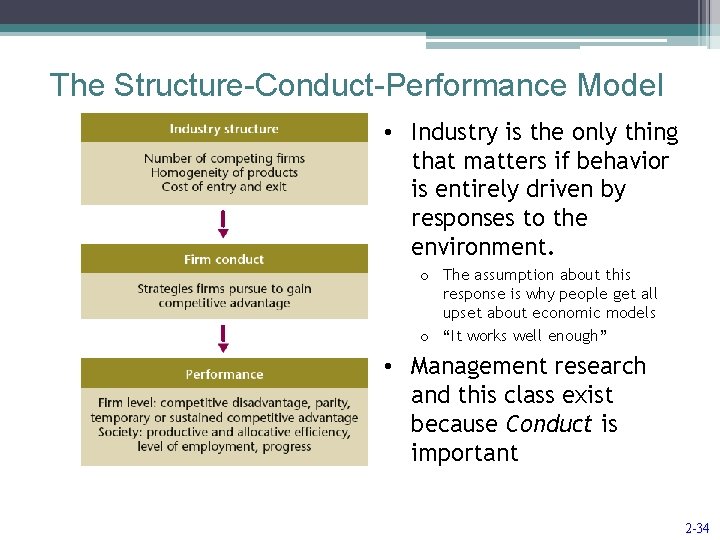
Industry Analysis The Structure – Conduct – Performance Model • originally developed to spot anti-competitive conditions for anti-trust purposes • came to be used to assess the possibilities for above normal profits for firms within an industry • Porter’s Five Forces Model was developed from this economic tradition 2 -33
The Structure-Conduct-Performance Model • Industry is the only thing that matters if behavior is entirely driven by responses to the environment. o The assumption about this response is why people get all upset about economic models o “It works well enough” • Management research and this class exist because Conduct is important 2 -34
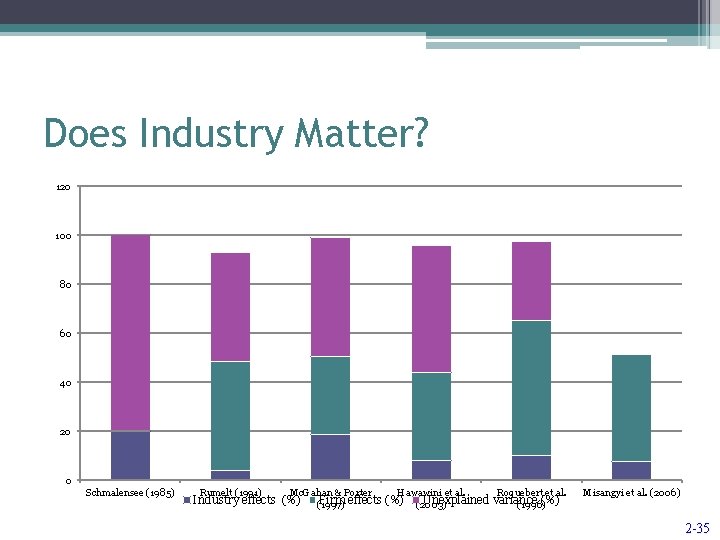
Does Industry Matter? 120 100 80 60 40 20 0 Schmalensee (1985) Rumelt (1991) Mc. Gahan & Porter Hawawini et al. Roquebert et al. Firm effects (%) (2003) Unexplained variance (%) (1997) (1996) Industry effects (%) Misangyi et al. (2006) 2 -35