
Chapter 2 The External Environment Opportunities Threats Industry

- Slides: 43
Chapter 2 The External Environment: Opportunities, Threats, Industry Competition, and Competitor Analysis © 2000 South-Western College Publishing Ch 2 -1
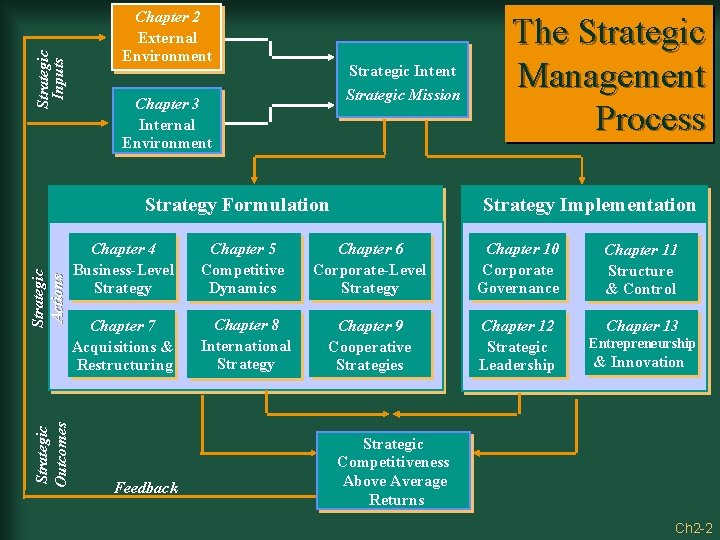
Strategic Inputs Chapter 2 External Environment Strategic Intent Strategic Mission Chapter 3 Internal Environment Strategic Outcomes Strategic Actions Strategy Formulation The Strategic Management Process Strategy Implementation Chapter 4 Business-Level Strategy Chapter 5 Competitive Dynamics Chapter 6 Corporate-Level Strategy Chapter 10 Corporate Governance Chapter 11 Structure & Control Chapter 7 Acquisitions & Restructuring Chapter 8 International Strategy Chapter 9 Cooperative Strategies Chapter 12 Strategic Leadership Chapter 13 Feedback Entrepreneurship & Innovation Strategic Competitiveness Above Average Returns Ch 2 -2
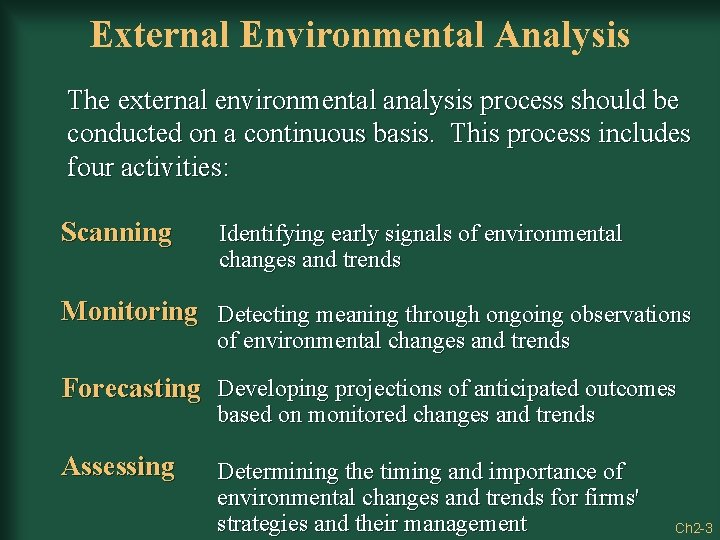
External Environmental Analysis The external environmental analysis process should be conducted on a continuous basis. This process includes four activities: Scanning Identifying early signals of environmental changes and trends Monitoring Detecting meaning through ongoing observations of environmental changes and trends Forecasting Developing projections of anticipated outcomes based on monitored changes and trends Assessing Determining the timing and importance of environmental changes and trends for firms' strategies and their management Ch 2 -3
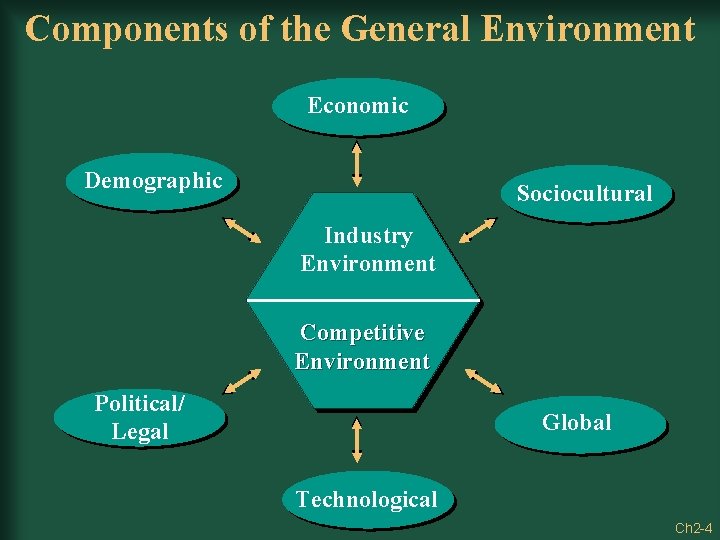
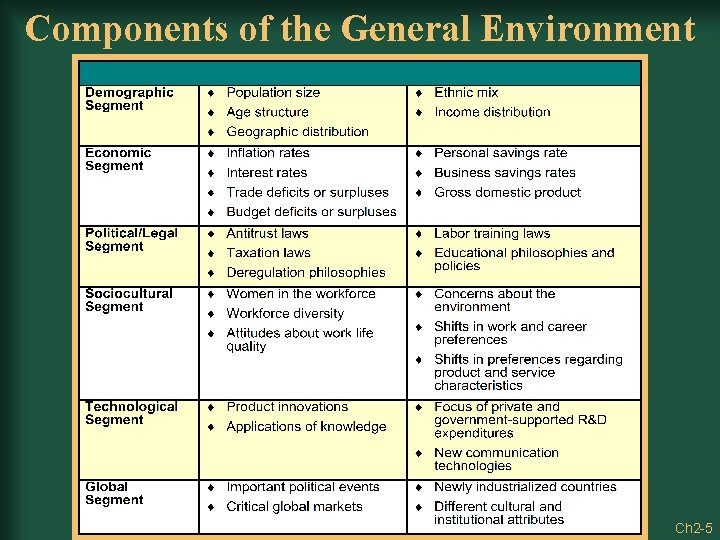
Components of the General Environment Economic Demographic Sociocultural Industry Environment Competitive Environment Political/ Legal Global Technological Ch 2 -4
Components of the General Environment Ch 2 -5
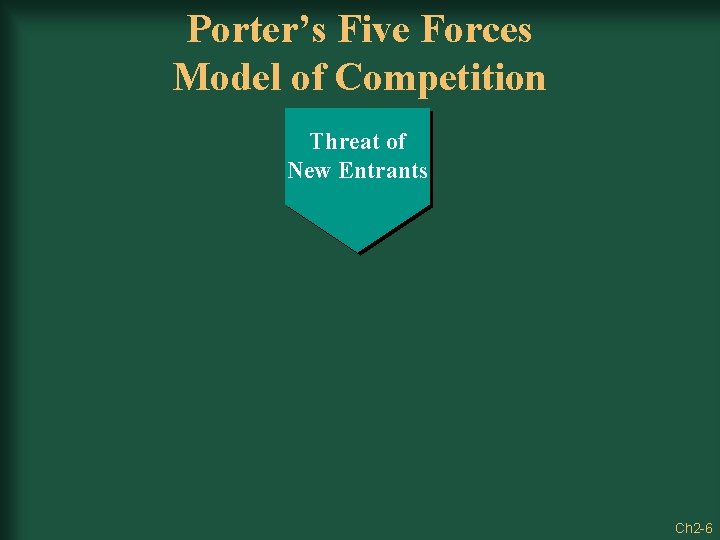
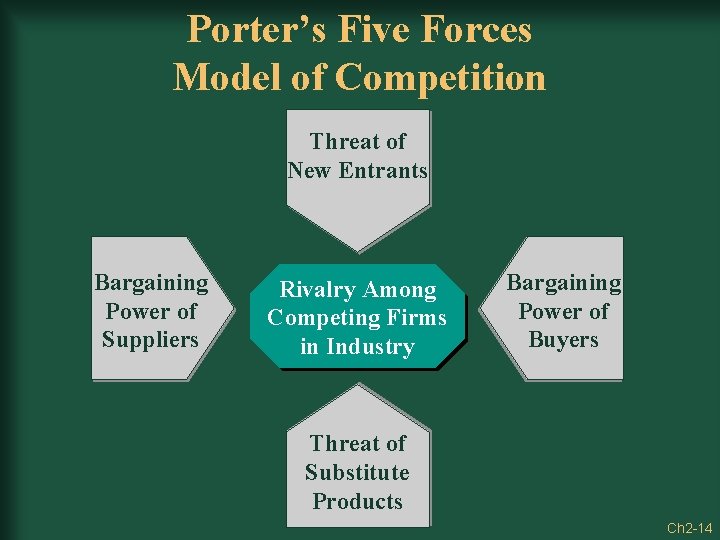
Porter’s Five Forces Model of Competition Threat of New Entrants Ch 2 -6
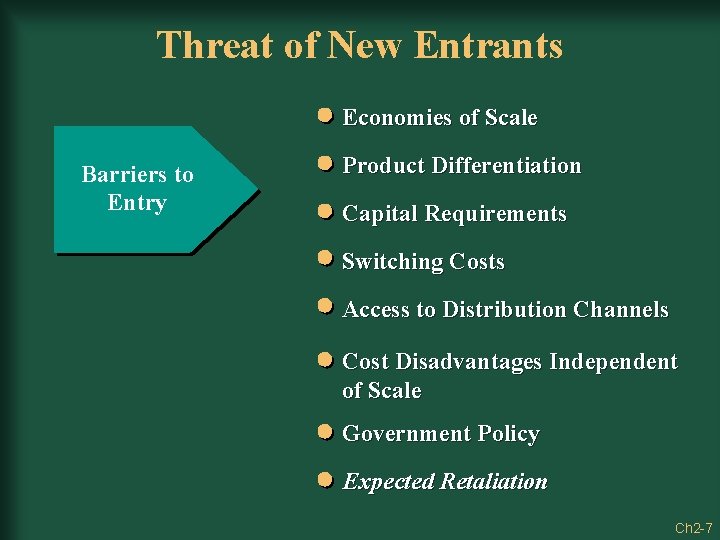
Threat of New Entrants Economies of Scale Barriers to Entry Product Differentiation Capital Requirements Switching Costs Access to Distribution Channels Cost Disadvantages Independent of Scale Government Policy Expected Retaliation Ch 2 -7
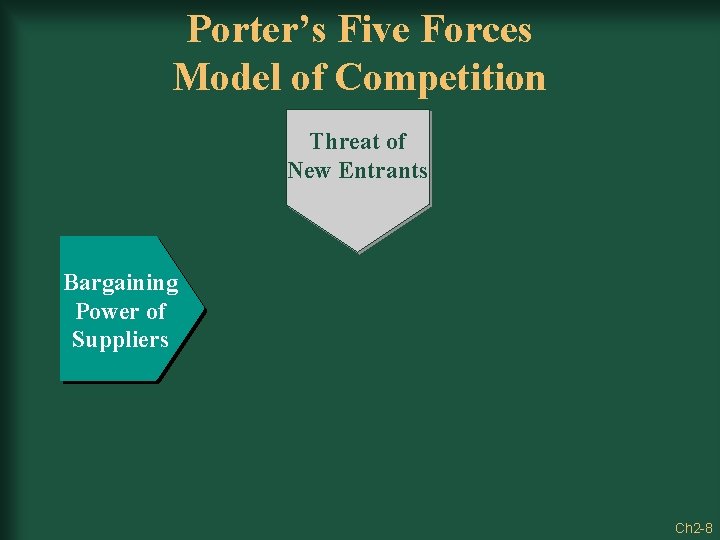
Porter’s Five Forces Model of Competition Threat of New Entrants Bargaining Power of Suppliers Ch 2 -8
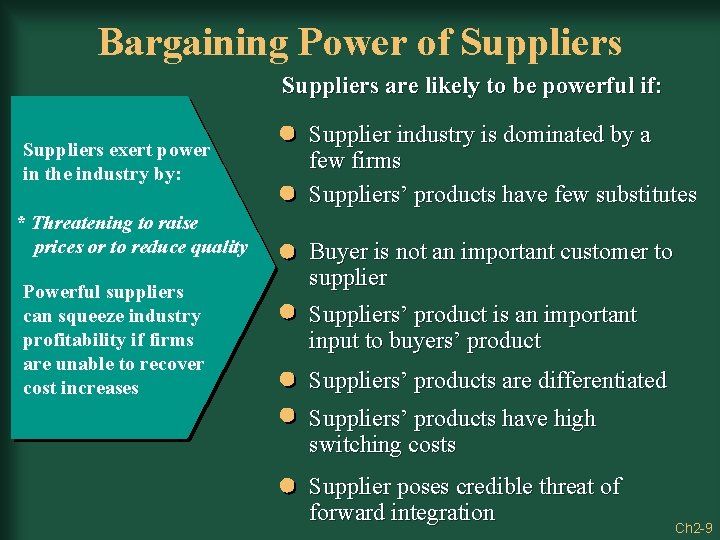
Bargaining Power of Suppliers are likely to be powerful if: Suppliers exert power in the industry by: * Threatening to raise prices or to reduce quality Powerful suppliers can squeeze industry profitability if firms are unable to recover cost increases Supplier industry is dominated by a few firms Suppliers’ products have few substitutes Buyer is not an important customer to supplier Suppliers’ product is an important input to buyers’ product Suppliers’ products are differentiated Suppliers’ products have high switching costs Supplier poses credible threat of forward integration Ch 2 -9
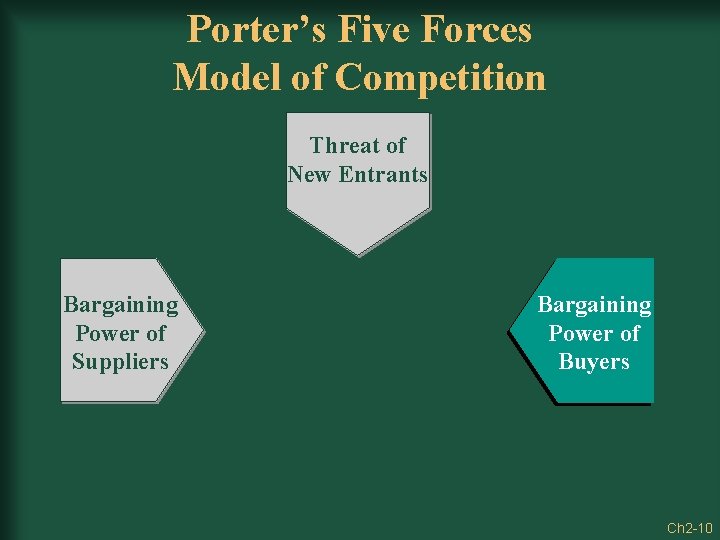
Porter’s Five Forces Model of Competition Threat of New Entrants Bargaining Power of Suppliers Bargaining Power of Buyers Ch 2 -10
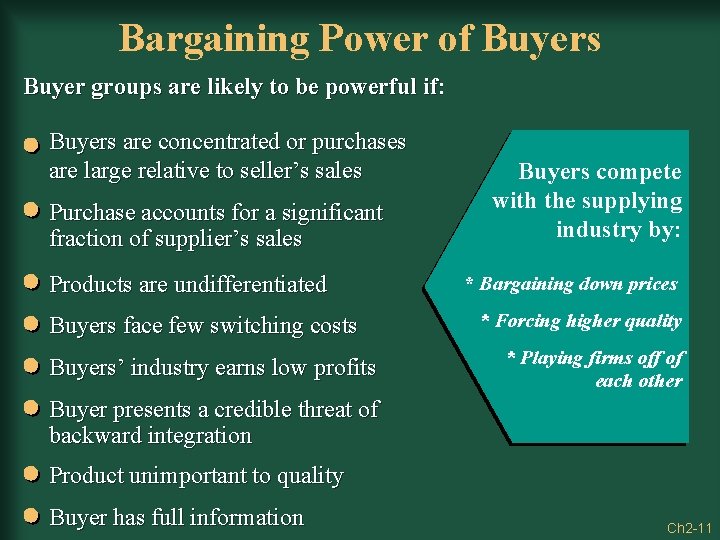
Bargaining Power of Buyers Buyer groups are likely to be powerful if: Buyers are concentrated or purchases are large relative to seller’s sales Purchase accounts for a significant fraction of supplier’s sales Products are undifferentiated Buyers face few switching costs Buyers’ industry earns low profits Buyers compete with the supplying industry by: * Bargaining down prices * Forcing higher quality * Playing firms off of each other Buyer presents a credible threat of backward integration Product unimportant to quality Buyer has full information Ch 2 -11
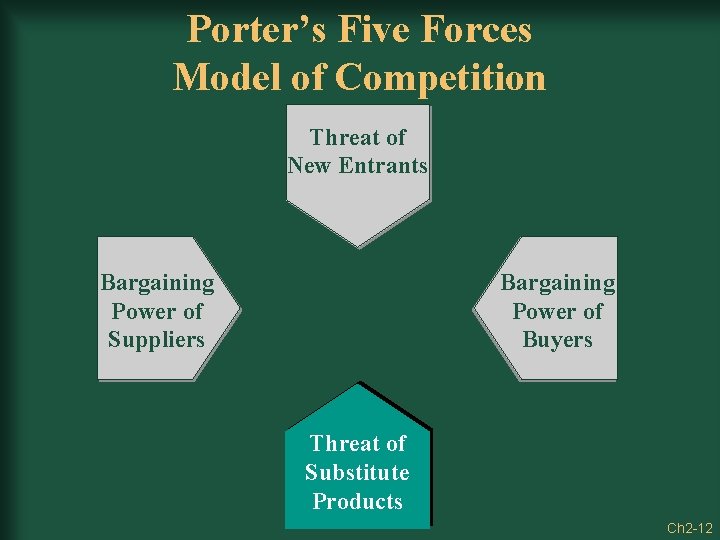
Porter’s Five Forces Model of Competition Threat of New Entrants Bargaining Power of Suppliers Bargaining Power of Buyers Threat of Substitute Products Ch 2 -12
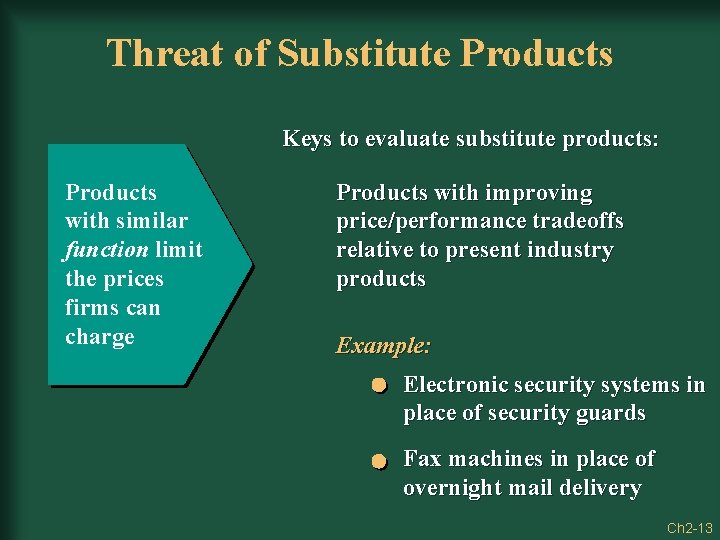
Threat of Substitute Products Keys to evaluate substitute products: Products with similar function limit the prices firms can charge Products with improving price/performance tradeoffs relative to present industry products Example: Electronic security systems in place of security guards Fax machines in place of overnight mail delivery Ch 2 -13
Porter’s Five Forces Model of Competition Threat of New Entrants Bargaining Power of Suppliers Rivalry Among Competing Firms in Industry Bargaining Power of Buyers Threat of Substitute Products Ch 2 -14
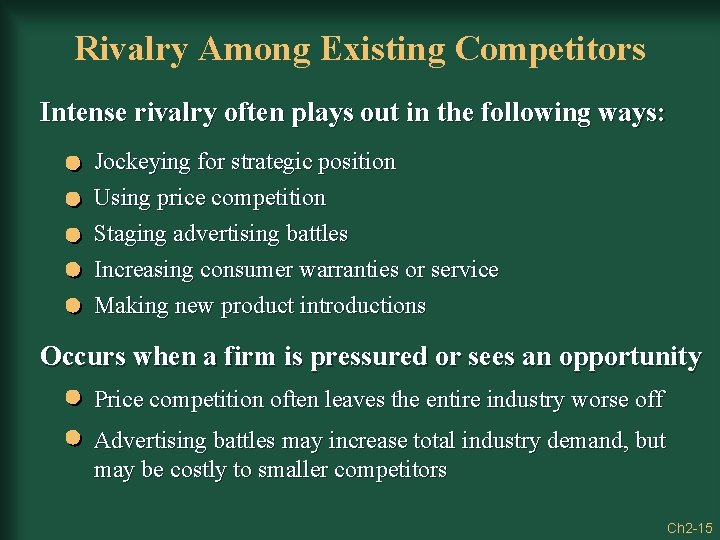
Rivalry Among Existing Competitors Intense rivalry often plays out in the following ways: Jockeying for strategic position Using price competition Staging advertising battles Increasing consumer warranties or service Making new product introductions Occurs when a firm is pressured or sees an opportunity Price competition often leaves the entire industry worse off Advertising battles may increase total industry demand, but may be costly to smaller competitors Ch 2 -15
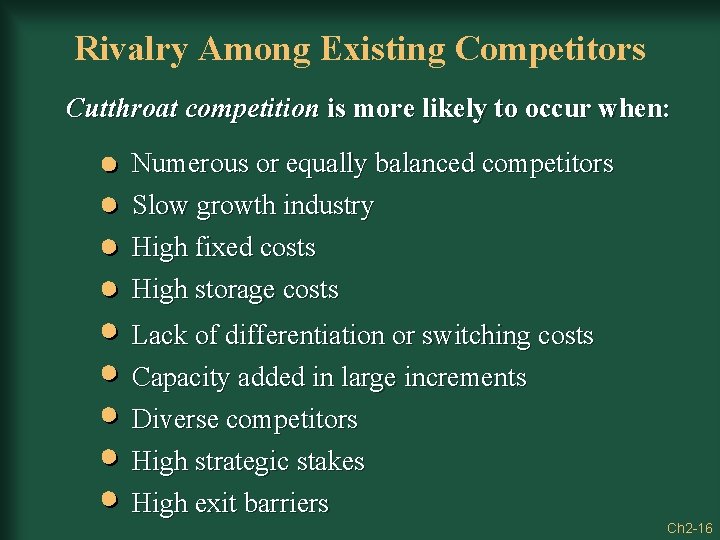
Rivalry Among Existing Competitors Cutthroat competition is more likely to occur when: Numerous or equally balanced competitors Slow growth industry High fixed costs High storage costs Lack of differentiation or switching costs Capacity added in large increments Diverse competitors High strategic stakes High exit barriers Ch 2 -16
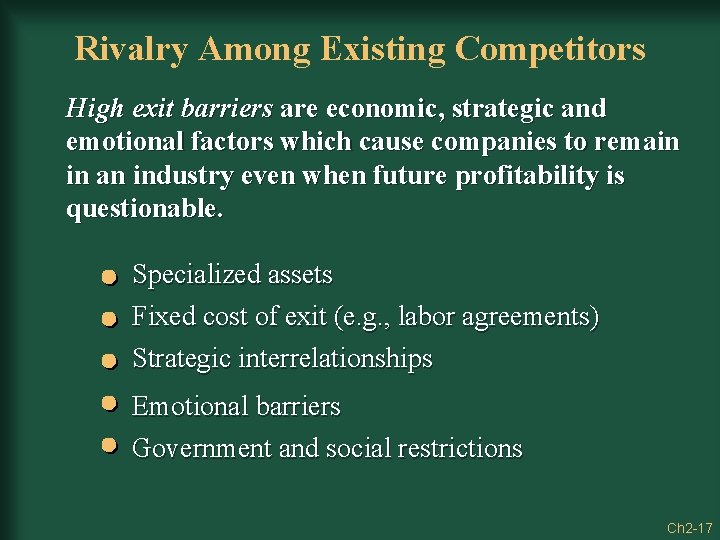
Rivalry Among Existing Competitors High exit barriers are economic, strategic and emotional factors which cause companies to remain in an industry even when future profitability is questionable. Specialized assets Fixed cost of exit (e. g. , labor agreements) Strategic interrelationships Emotional barriers Government and social restrictions Ch 2 -17
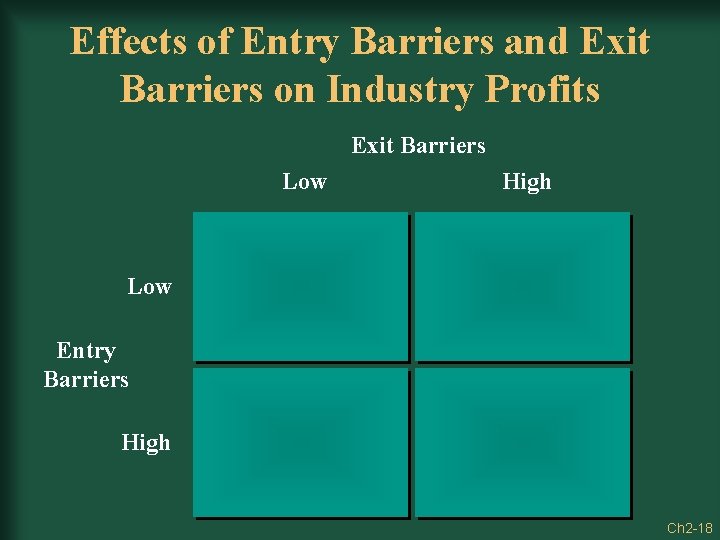
Effects of Entry Barriers and Exit Barriers on Industry Profits Exit Barriers Low High Low Entry Barriers High Ch 2 -18
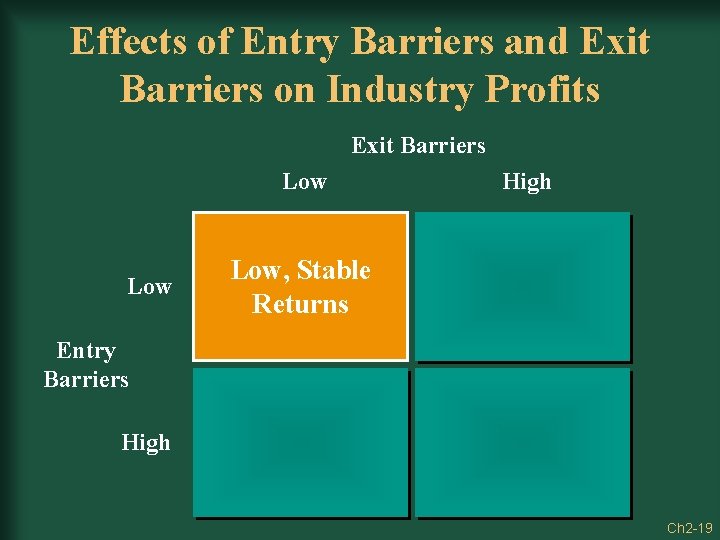
Effects of Entry Barriers and Exit Barriers on Industry Profits Exit Barriers Low High Low, Stable Returns Entry Barriers High Ch 2 -19
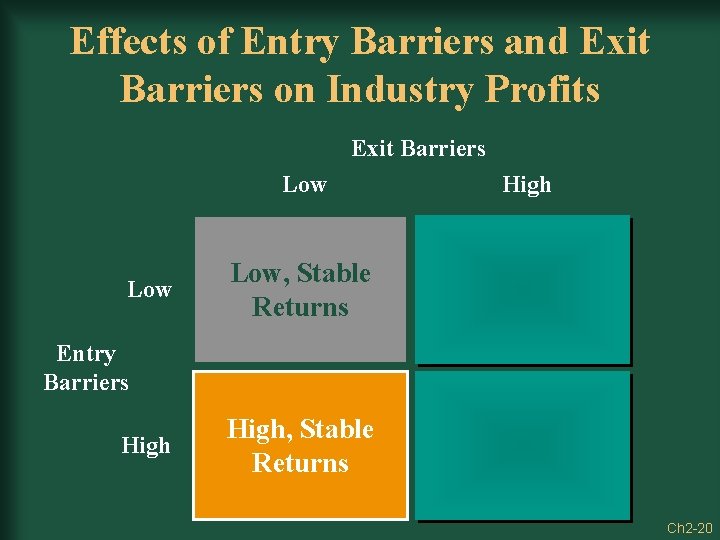
Effects of Entry Barriers and Exit Barriers on Industry Profits Exit Barriers Low High Low, Stable Returns Entry Barriers High, Stable Returns Ch 2 -20
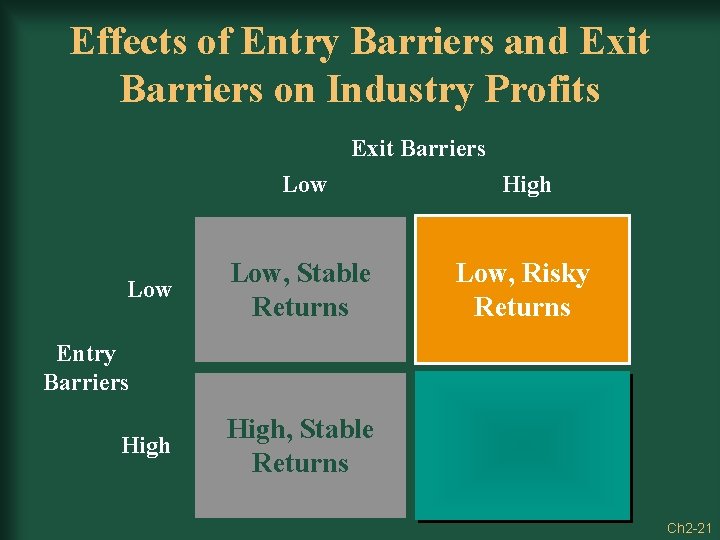
Effects of Entry Barriers and Exit Barriers on Industry Profits Exit Barriers Low High Low, Stable Returns Low, Risky Returns Entry Barriers High, Stable Returns Ch 2 -21
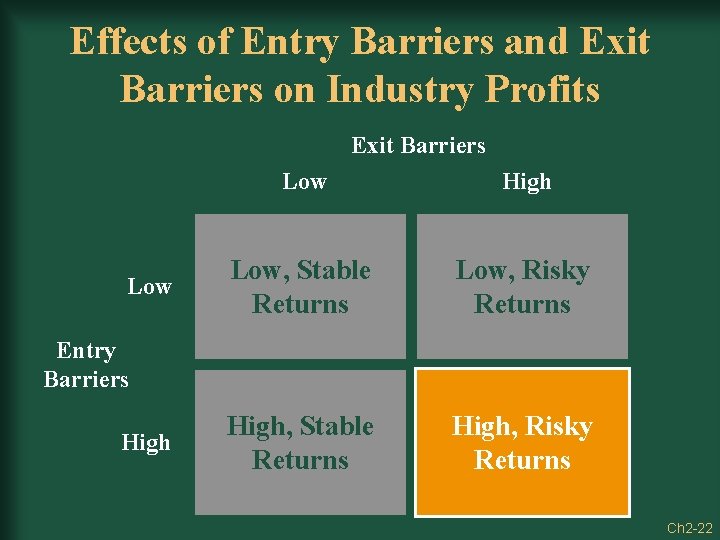
Effects of Entry Barriers and Exit Barriers on Industry Profits Exit Barriers Low High Low, Stable Returns Low, Risky Returns High, Stable Returns High, Risky Returns Entry Barriers High Ch 2 -22
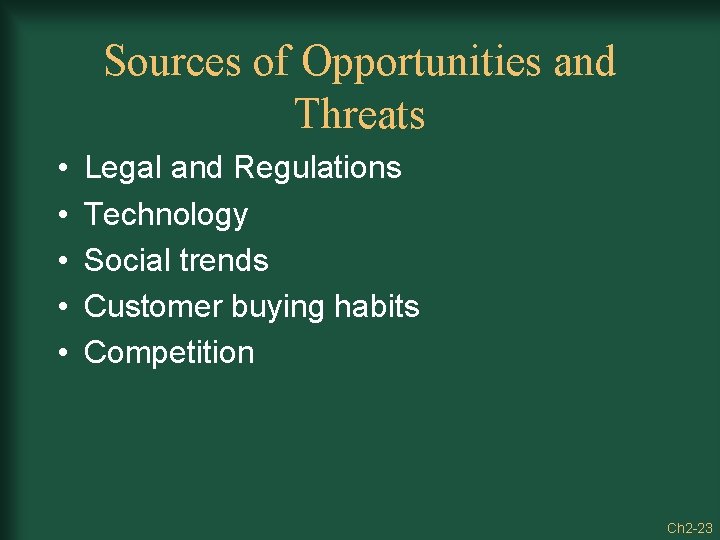
Sources of Opportunities and Threats • • • Legal and Regulations Technology Social trends Customer buying habits Competition Ch 2 -23
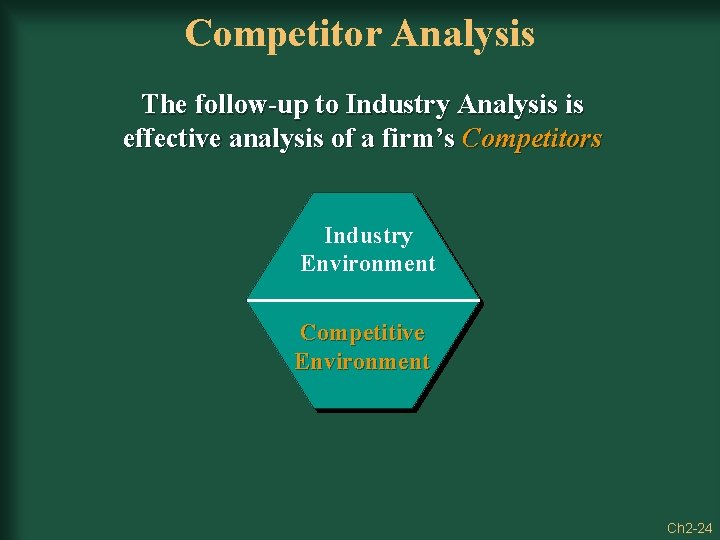
Competitor Analysis The follow-up to Industry Analysis is effective analysis of a firm’s Competitors Industry Environment Competitive Environment Ch 2 -24
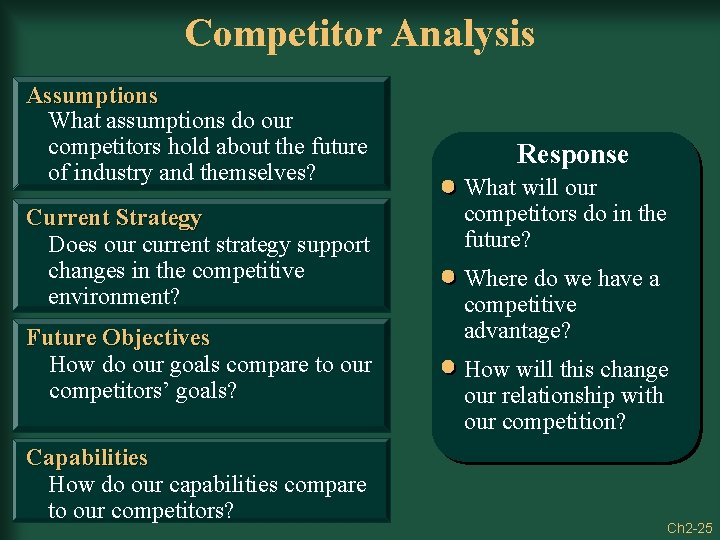
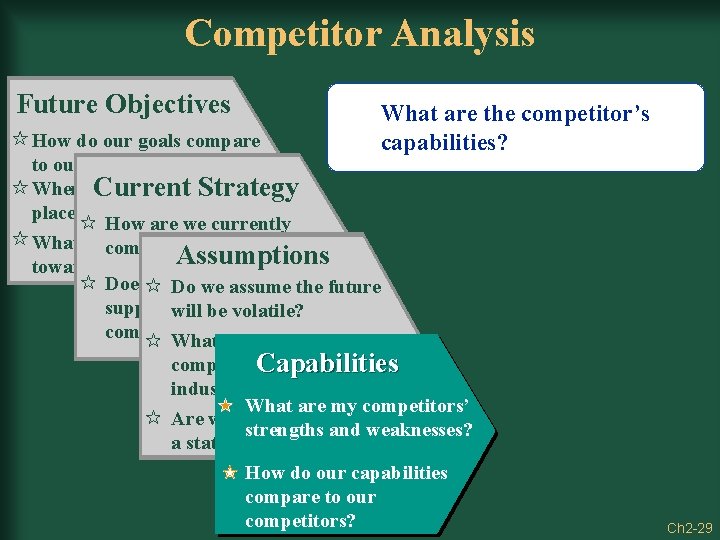
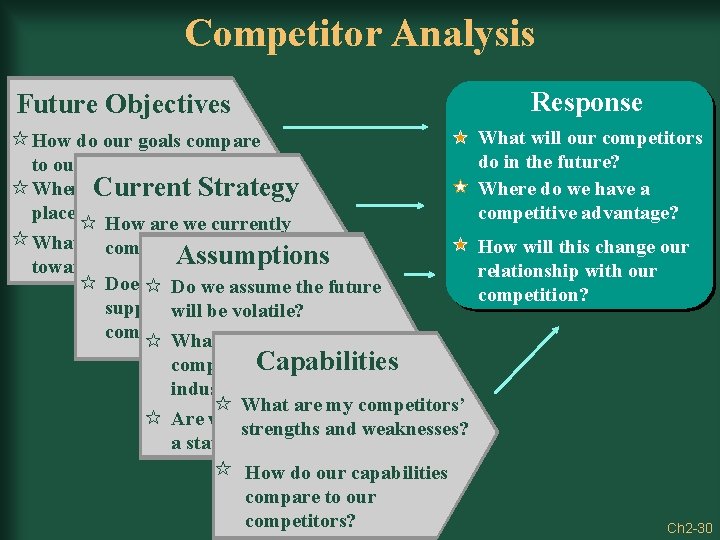
Competitor Analysis Assumptions What assumptions do our competitors hold about the future of industry and themselves? Current Strategy Does our current strategy support changes in the competitive environment? Future Objectives How do our goals compare to our competitors’ goals? Capabilities How do our capabilities compare to our competitors? Response What will our competitors do in the future? Where do we have a competitive advantage? How will this change our relationship with our competition? Ch 2 -25
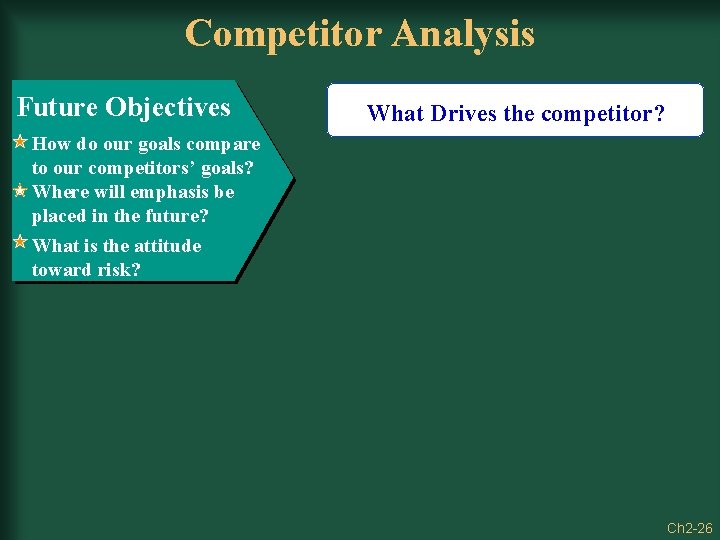
Competitor Analysis Future Objectives What Drives the competitor? How do our goals compare to our competitors’ goals? Where will emphasis be placed in the future? What is the attitude toward risk? Ch 2 -26
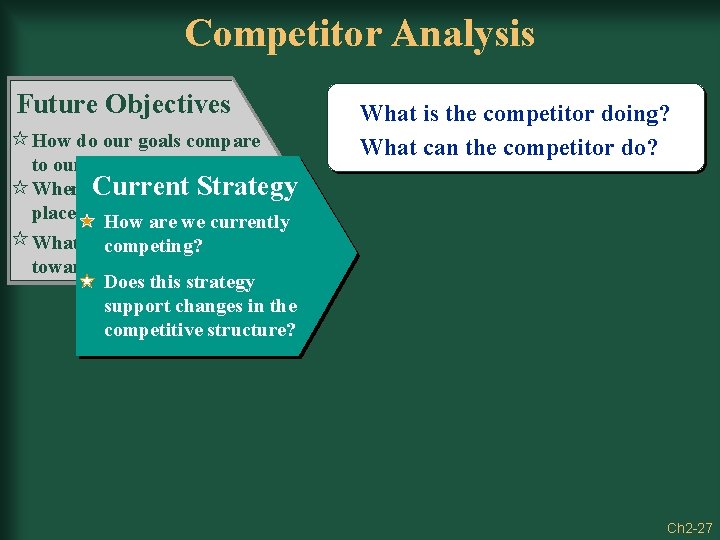
Competitor Analysis Future Objectives How do our goals compare to our competitors’ goals? Where Current will emphasis be Strategy placed in. How the future? are we currently What is the attitude competing? toward risk? Does this strategy support changes in the competitive structure? What is the competitor doing? What can the competitor do? Ch 2 -27
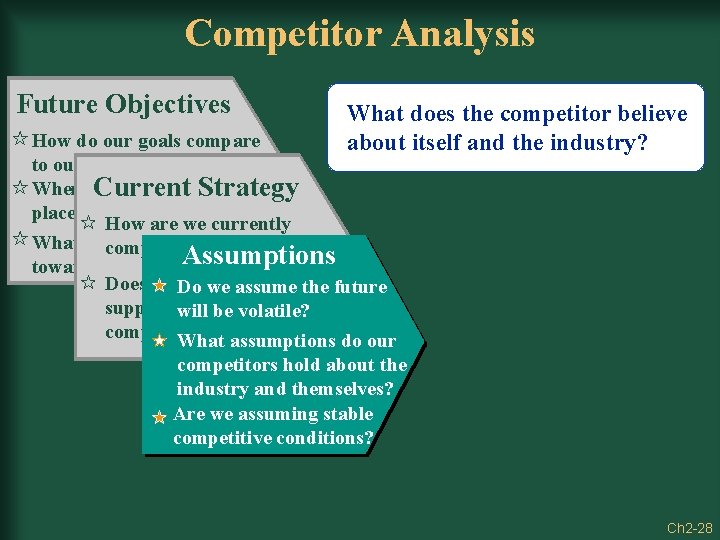
Competitor Analysis Future Objectives What does the competitor believe about itself and the industry? How do our goals compare to our competitors’ goals? Where Current will emphasis be Strategy placed in the future? How are we currently What is the attitude competing? Assumptions toward risk? Does this. Do strategy we assume the future support changes in the will be volatile? competition structure? What assumptions do our competitors hold about the industry and themselves? Are we assuming stable competitive conditions? Ch 2 -28
Competitor Analysis Future Objectives What are the competitor’s capabilities? How do our goals compare to our competitors’ goals? Where Current will emphasis be Strategy placed in the future? How are we currently What is the attitude competing? Assumptions toward risk? Does this Dostrategy we assume the future supportwill changes in the be volatile? competition Whatstructure? assumptions do our competitors hold about the Capabilities industry and themselves? What are my competitors’ Are we operating under strengths and weaknesses? a status quo? How do our capabilities compare to our competitors? Ch 2 -29
Competitor Analysis Response Future Objectives How do our goals compare to our competitors’ goals? Where Current will emphasis be Strategy placed in the future? How are we currently What is the attitude competing? Assumptions toward risk? Does this Dostrategy we assume the future supportwill changes in the be volatile? competition Whatstructure? assumptions do our Capabilities competitors hold about the industry and themselves? What are my competitors’ Are we operating strengths under and weaknesses? a status quo? How do our capabilities compare to our competitors? What will our competitors do in the future? Where do we have a competitive advantage? How will this change our relationship with our competition? Ch 2 -30
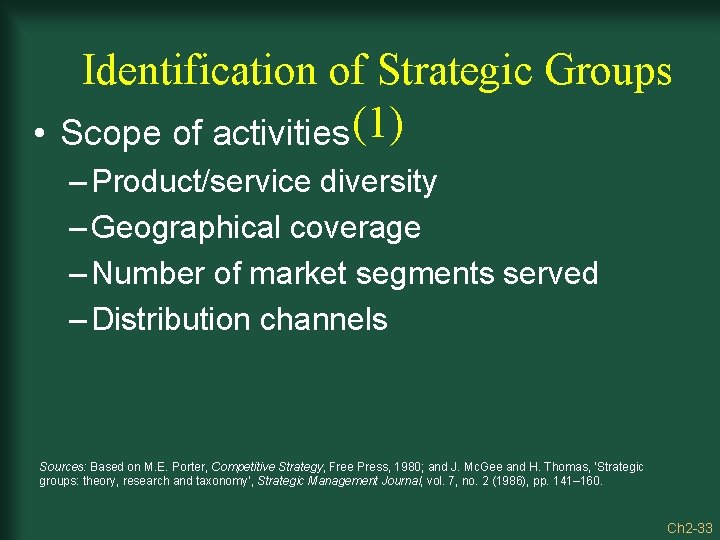
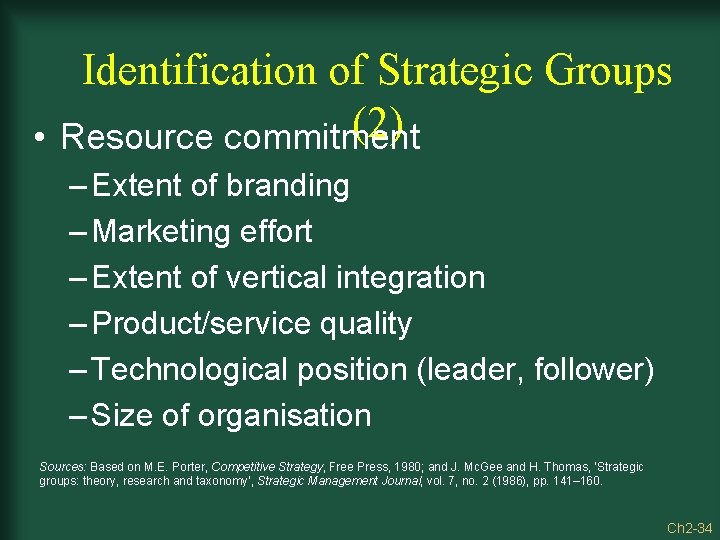
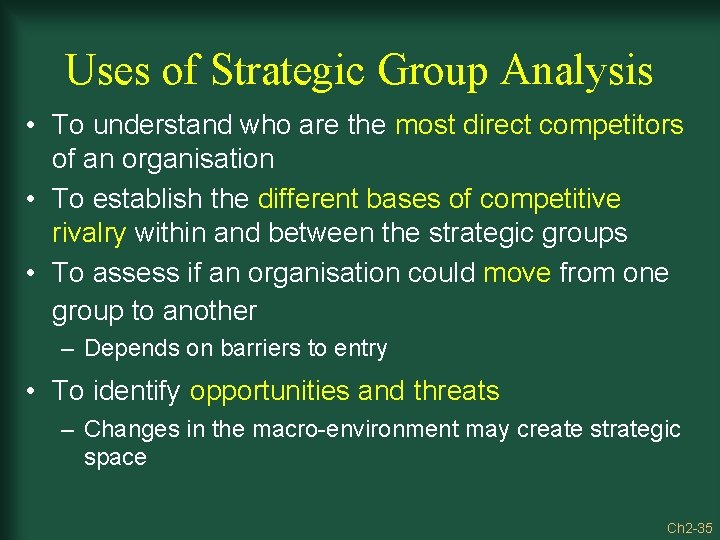
Strategic Groups Strategic groups are organisations within an industry with similar strategic characteristics, following similar strategies or competing on similar bases Ch 2 -31
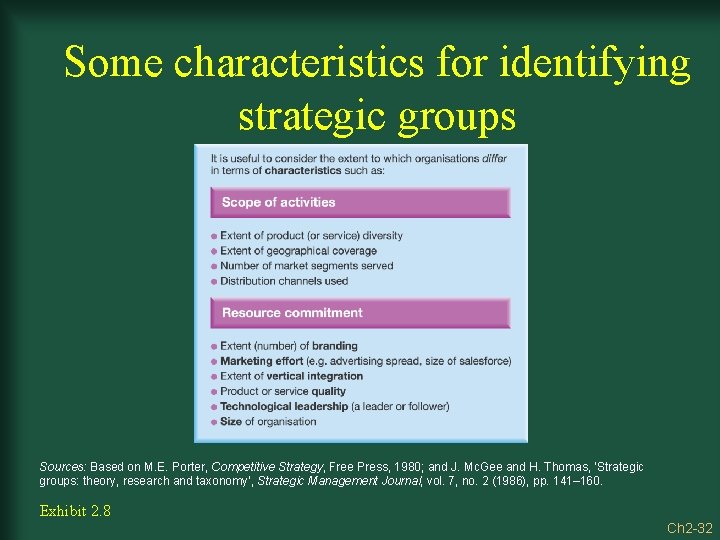
Some characteristics for identifying strategic groups Sources: Based on M. E. Porter, Competitive Strategy, Free Press, 1980; and J. Mc. Gee and H. Thomas, ‘Strategic groups: theory, research and taxonomy’, Strategic Management Journal, vol. 7, no. 2 (1986), pp. 141– 160. Exhibit 2. 8 Ch 2 -32
Identification of Strategic Groups • Scope of activities (1) – Product/service diversity – Geographical coverage – Number of market segments served – Distribution channels Sources: Based on M. E. Porter, Competitive Strategy, Free Press, 1980; and J. Mc. Gee and H. Thomas, ‘Strategic groups: theory, research and taxonomy’, Strategic Management Journal, vol. 7, no. 2 (1986), pp. 141– 160. Ch 2 -33
Identification of Strategic Groups (2) • Resource commitment – Extent of branding – Marketing effort – Extent of vertical integration – Product/service quality – Technological position (leader, follower) – Size of organisation Sources: Based on M. E. Porter, Competitive Strategy, Free Press, 1980; and J. Mc. Gee and H. Thomas, ‘Strategic groups: theory, research and taxonomy’, Strategic Management Journal, vol. 7, no. 2 (1986), pp. 141– 160. Ch 2 -34
Uses of Strategic Group Analysis • To understand who are the most direct competitors of an organisation • To establish the different bases of competitive rivalry within and between the strategic groups • To assess if an organisation could move from one group to another – Depends on barriers to entry • To identify opportunities and threats – Changes in the macro-environment may create strategic space Ch 2 -35
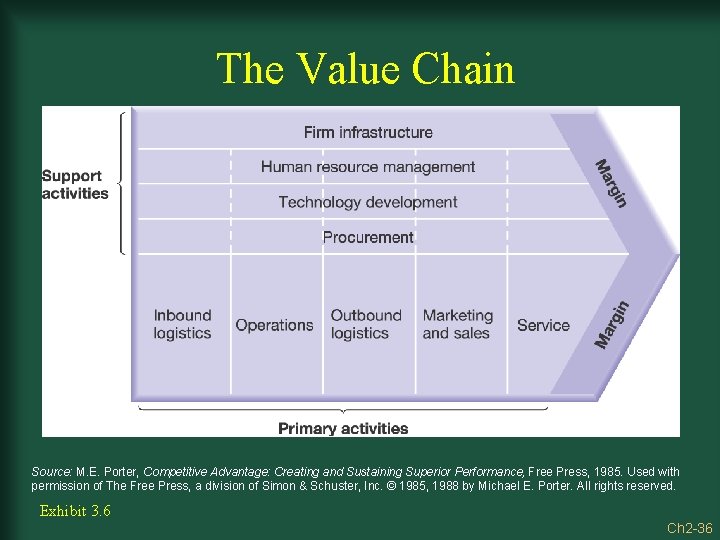
The Value Chain Source: M. E. Porter, Competitive Advantage: Creating and Sustaining Superior Performance, Free Press, 1985. Used with permission of The Free Press, a division of Simon & Schuster, Inc. © 1985, 1988 by Michael E. Porter. All rights reserved. Exhibit 3. 6 Ch 2 -36
Value Chain and Value Network • To diagnose strategic capability • To understand how value is created or lost in terms of the activities undertaken The value chain describes the activities within and around an organisation which together create a product or service Ch 2 -37
Value Chain Analysis • Identifies clusters of activities providing particular benefit to customers • Highlights activities which are less efficient and which might be de-emphasised or outsourced • Requires managers to think about the role of such activities • Can be used to identify the cost and value of activities Ch 2 -38
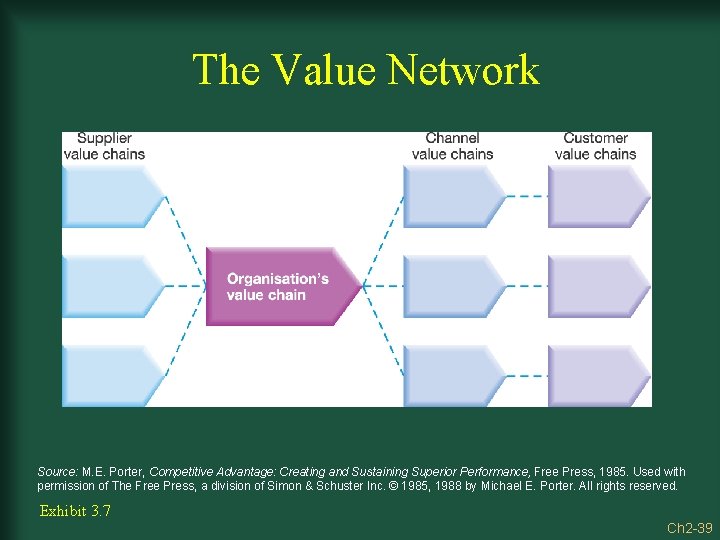
The Value Network Source: M. E. Porter, Competitive Advantage: Creating and Sustaining Superior Performance, Free Press, 1985. Used with permission of The Free Press, a division of Simon & Schuster Inc. © 1985, 1988 by Michael E. Porter. All rights reserved. Exhibit 3. 7 Ch 2 -39
The Value Network • The value network – Set of inter-organisational links/relationships necessary to create a product or service • Specialisation of roles – Underpins excellence in creating best-value products • Need to understand whole process – Where cost/value is created in supply/distribution chains – How to manage links to improve customer value – How product quality is a function of linked activities of manufacturer, suppliers and distributors Ch 2 -40
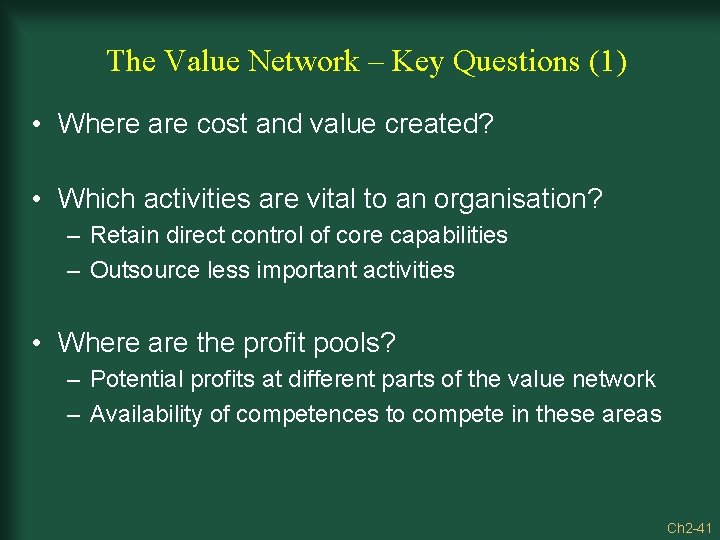
The Value Network – Key Questions (1) • Where are cost and value created? • Which activities are vital to an organisation? – Retain direct control of core capabilities – Outsource less important activities • Where are the profit pools? – Potential profits at different parts of the value network – Availability of competences to compete in these areas Ch 2 -41
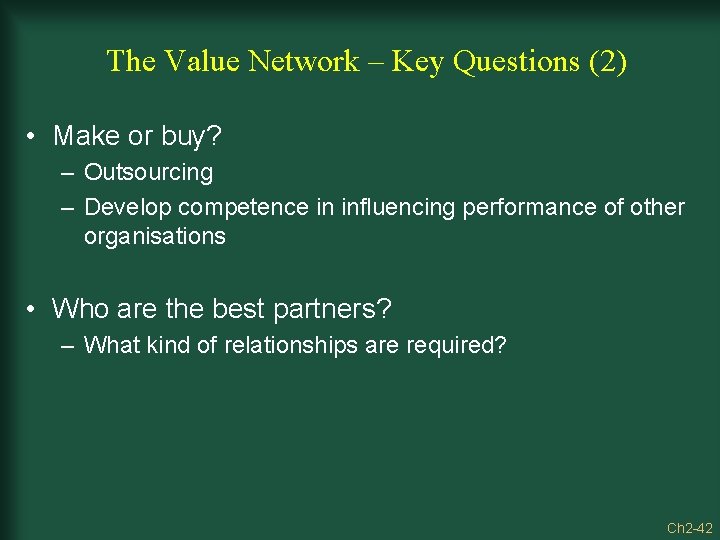
The Value Network – Key Questions (2) • Make or buy? – Outsourcing – Develop competence in influencing performance of other organisations • Who are the best partners? – What kind of relationships are required? Ch 2 -42
Ch 2 -43