
Chapter 2 The Court System 1 2001 West
![The Trial [2] The Defendant will attempt to introduce a preponderance of competent evidence](https://slidetodoc.com/presentation_image_h2/d19497de5eaf614572c2eff2e276695e/image-35.jpg "The Trial [2] The Defendant will attempt to introduce a preponderance of competent evidence")
![The Trial [3] • Bench Trial (no jury). • Jury Selection process involves: –](https://slidetodoc.com/presentation_image_h2/d19497de5eaf614572c2eff2e276695e/image-36.jpg "The Trial [3] • Bench Trial (no jury). • Jury Selection process involves: –")
![The Trial [4] • Opening Statements (Plaintiff first). • Plaintiff’s Case--Evidence: – Witnesses- Direct](https://slidetodoc.com/presentation_image_h2/d19497de5eaf614572c2eff2e276695e/image-37.jpg "The Trial [4] • Opening Statements (Plaintiff first). • Plaintiff’s Case--Evidence: – Witnesses- Direct")
![The Trial [5] • Plaintiff’s Case (cont’d). – Party may impeach the testimony or](https://slidetodoc.com/presentation_image_h2/d19497de5eaf614572c2eff2e276695e/image-38.jpg "The Trial [5] • Plaintiff’s Case (cont’d). – Party may impeach the testimony or")
![The Trial [6] • Verdict: – Criminal case--burden of proof is “beyond a reasonable](https://slidetodoc.com/presentation_image_h2/d19497de5eaf614572c2eff2e276695e/image-39.jpg "The Trial [6] • Verdict: – Criminal case--burden of proof is “beyond a reasonable")
- Slides: 46
Chapter 2: The Court System 1 © 2001 West Legal Studies in Business. All Rights Reserved.
§ 1: Judicial Review was established in Marbury v. Madison (1803): “It is emphatically the province and duty of the Judicial Department to say what the law is…. ” Today the judicial power is exercised by both federal and state courts. 2 © 2001 West Legal Studies in Business. All Rights Reserved.
§ 2: Jurisdiction “Juris” (law) “diction” (to speak) is the power of a court to hear a dispute and to “speak the law” into a controversy and render a verdict that is legally binding on the parties to the dispute. 3 © 2001 West Legal Studies in Business. All Rights Reserved.
Types of Jurisdiction-State • • • In Personam Jurisdiction. In Rem Jurisdiction. Quasi In Rem Jurisdiction. Subject Matter Jurisdiction. Amount in Controversy. Concurrent. 4 © 2001 West Legal Studies in Business. All Rights Reserved.
In Personam or “Personal” Jurisdiction • Power of a court to compel the presence of the parties (including corporations) to a dispute to appear before the court and litigate. • Courts use long-arm statutes for nonresident parties based on “minimum contacts” with state. • Case 2. 1: Cole v. Mileti (1998). 5 © 2001 West Legal Studies in Business. All Rights Reserved.
In Rem Jurisdiction The power to decide issues relating to property, whether the property is real, personal, tangible, or intangible. A court generally has in rem jurisdiction over any property situated within its geographical borders. 6 © 2001 West Legal Studies in Business. All Rights Reserved.
Quasi-in Rem Jurisdiction Limited in personam jurisdiction over an absent person by asserting in rem jurisdiction over any of the absent person’s property which is situated within the state in which the action is filed. 7 © 2001 West Legal Studies in Business. All Rights Reserved.
Other Jurisdiction • Courts can also exercise jurisdiction over: – The Subject Matter of the Case (e. g. , bankruptcy, family or criminal cases). – The Amount in Controversy (the amount of damages) – Original and Appellate. 8 © 2001 West Legal Studies in Business. All Rights Reserved.
Federal Court Jurisdiction • “Federal Question” cases involve rights or obligations of a party that are created or defined by some federal law. • “Diversity” cases exist where: – The parties are not from the same state, and – The amount in controversy is greater than $75, 000. 9 © 2001 West Legal Studies in Business. All Rights Reserved.
Venue • Venue is concerned with the most appropriate location for the trial. • Generally, proper venue is whether the injury occurred. 10 © 2001 West Legal Studies in Business. All Rights Reserved.
Standing • In order to bring a lawsuit, a party must have “standing” to sue. • Standing is sufficient “stake” in the controversy; party must have suffered a legal injury. – Case 2. 2: Friends of the Earth vs. Crown Central Petroleum (1996). 11 © 2001 West Legal Studies in Business. All Rights Reserved.
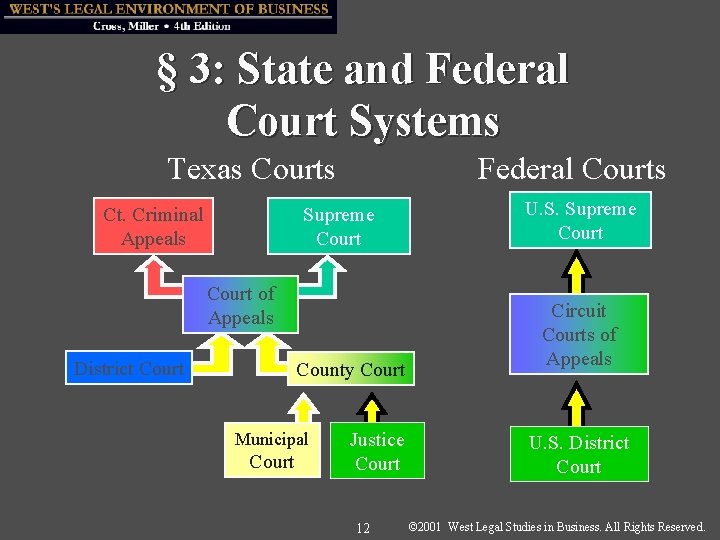
§ 3: State and Federal Court Systems Texas Courts Ct. Criminal Appeals Federal Courts Supreme Court of Appeals District Court County Court Municipal Court Justice Court 12 U. S. Supreme Court Circuit Courts of Appeals U. S. District Court © 2001 West Legal Studies in Business. All Rights Reserved.
Trial Courts • • “Courts of record”-court reporters. Opening and closing arguments. Juries are selected. Evidence, such as witness testimony, physical objects, documents, and pictures, is introduced. • Witnesses are examined and cross-examined. • Verdicts and Judgments are rendered. 13 © 2001 West Legal Studies in Business. All Rights Reserved.
Appellate Courts • Middle level of the court systems. • Review proceedings conducted in the trial court to determine whether the trial was according to the procedural and substantive rules of law. • Generally, appellate courts will consider questions of law, but not questions of fact. 14 © 2001 West Legal Studies in Business. All Rights Reserved.
Supreme Courts • Also known as courts of last resort. • The two most fundamental ways to have your case heard in a supreme court are: – Appeals of Right. – By Writ of Certiorari. • See the U. S. Supreme Court (official site) and Oyez! Site; and the Texas Supreme Court. 15 © 2001 West Legal Studies in Business. All Rights Reserved.
§ 4: Judicial Procedures — Following a Case through the Courts American and English court systems follow the adversarial system of justice. 16 © 2001 West Legal Studies in Business. All Rights Reserved.
Procedural Rules Court systems developed around the common law concept of “due process” which requires adequate notice and a fair and impartial hearing. 17 © 2001 West Legal Studies in Business. All Rights Reserved.
Stages of Litigation • • • Pleadings Discovery Pre-Trial Post-Trial 18 © 2001 West Legal Studies in Business. All Rights Reserved.
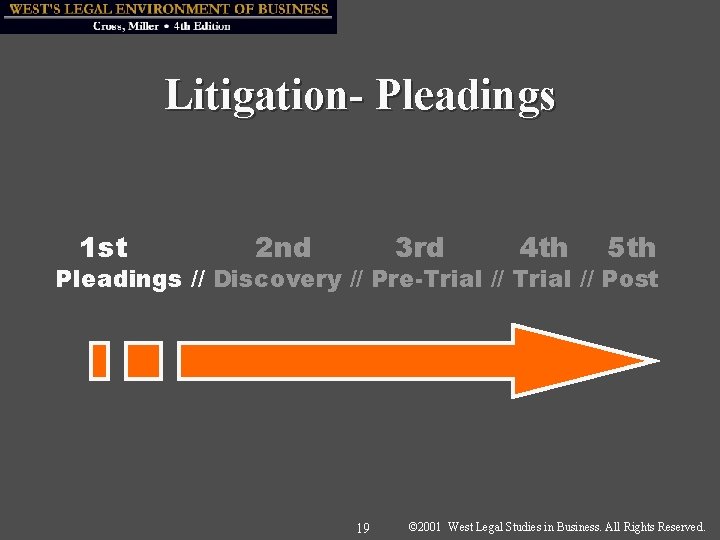
Litigation- Pleadings 1 st 2 nd 3 rd 4 th 5 th Pleadings // Discovery // Pre-Trial // Post 19 © 2001 West Legal Studies in Business. All Rights Reserved.
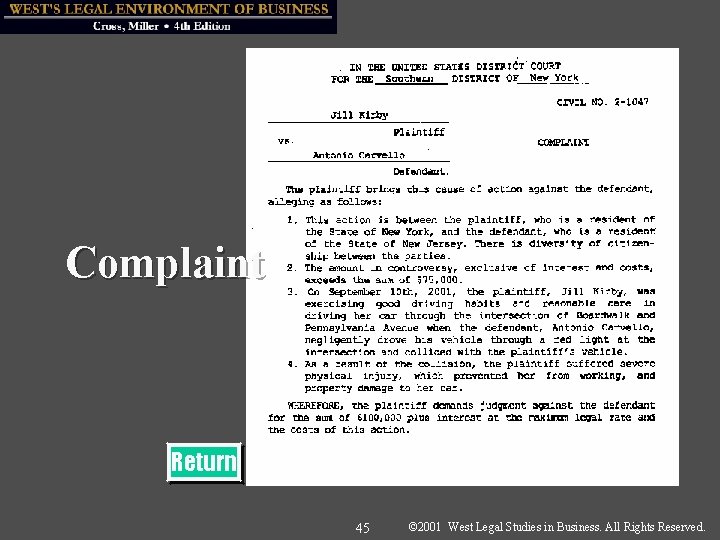
Pleadings • Consult an Attorney. • Prepare Pleadings. – File Petition/Complaint. » Court acquires jurisdiction over subject matter and Plaintiff. » Facts: what happened? » Prayer: Court relief. 20 © 2001 West Legal Studies in Business. All Rights Reserved.
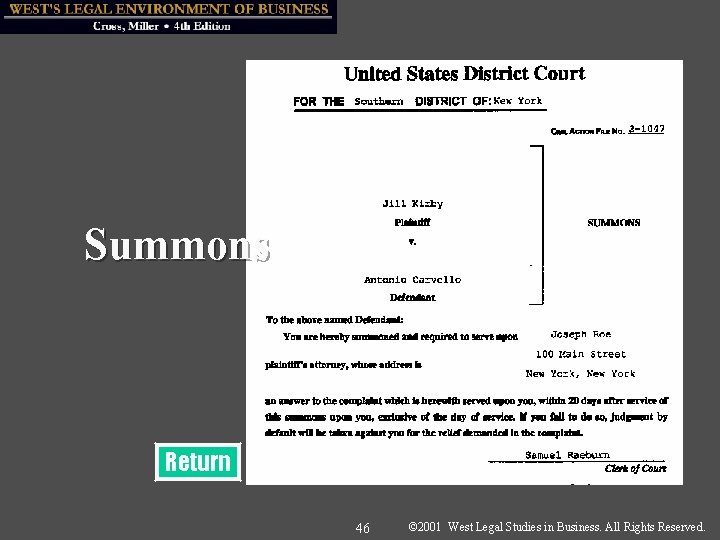
Pleadings-Service of Process • Defendant served with Complaint and Summons. • Court acquires Personal Jurisdiction over Defendant (person or corporation). • Corporate Defendants served via Registered Agent. 21 © 2001 West Legal Studies in Business. All Rights Reserved.
Pleadings-Answer • The Answer is the Defendant’s response to the allegations stated in the Plaintiff’s Complaint. • In the Answer, the Defendant must specifically admit or deny each allegation in the Complaint. 22 © 2001 West Legal Studies in Business. All Rights Reserved.
Pleadings-Answer Defendant’s Answer: – May state General Denial. – Move for Change of Venue. – Allege Affirmative Defenses. – Counter Claim against Plaintiff. 23 © 2001 West Legal Studies in Business. All Rights Reserved.
Answer-Affirmative Defenses in which the defendant essentially claims that even if all of the plaintiff’s allegations are true, the plaintiff cannot win because there is a more powerful law on the defendant’s side that will allow the defendant to win. 24 © 2001 West Legal Studies in Business. All Rights Reserved.
Answer--Affirmative Defense • Fraud is an example of an affirmative defense that might be asserted in a breach of contract case. • Burden of proof is on the Defendant to show fraud actually took place. 25 © 2001 West Legal Studies in Business. All Rights Reserved.
Answer-Counter Claim A counterclaim is a lawsuit filed by the defendant against the plaintiff, in response to the original complaint. 26 © 2001 West Legal Studies in Business. All Rights Reserved.
Answer-Motion to Dismiss Defendant can move the Court to dismiss the Action for various reasons, such as: – The Court lacks jurisdiction. – The Plaintiff has failed to make all of the allegations, in his Complaint, that the law requires (i. e. , the plaintiff has failed to state a cause of action). 27 © 2001 West Legal Studies in Business. All Rights Reserved.
Pleadings-Answer • Motion to Dismiss. • Motion for Judgment on Pleadings. • Motion for Summary Judgment. – Case 3. 1: Ausley v. Bishop (1999). 28 © 2001 West Legal Studies in Business. All Rights Reserved.
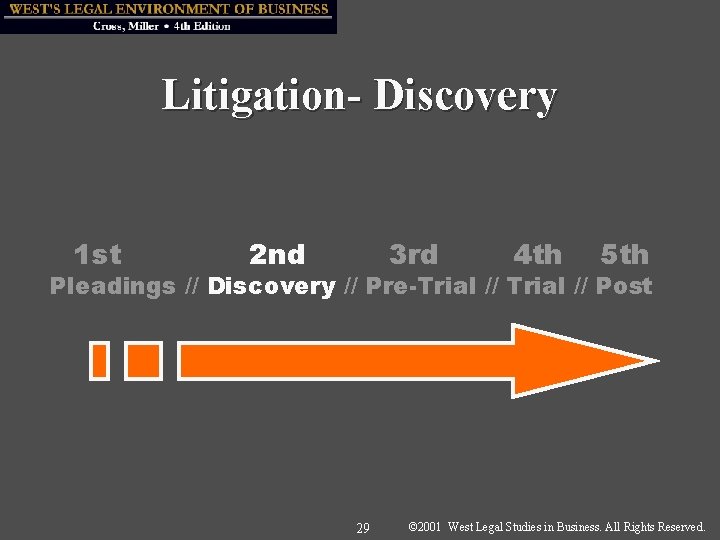
Litigation- Discovery 1 st 2 nd 3 rd 4 th 5 th Pleadings // Discovery // Pre-Trial // Post 29 © 2001 West Legal Studies in Business. All Rights Reserved.
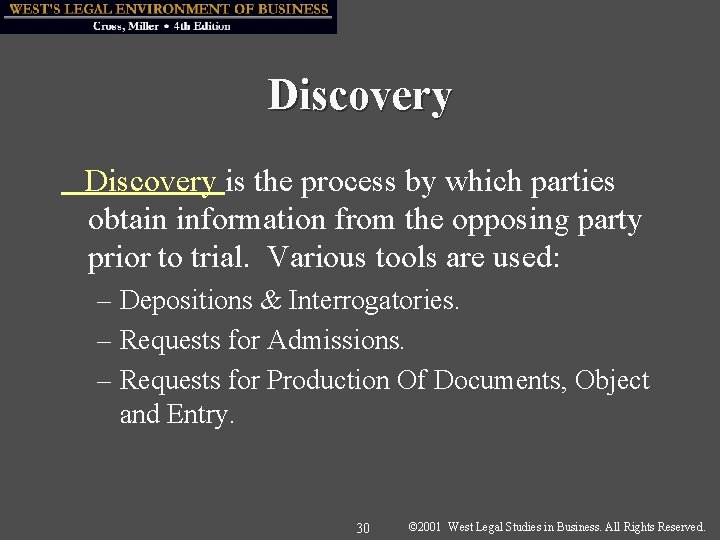
Discovery is the process by which parties obtain information from the opposing party prior to trial. Various tools are used: – Depositions & Interrogatories. – Requests for Admissions. – Requests for Production Of Documents, Object and Entry. 30 © 2001 West Legal Studies in Business. All Rights Reserved.
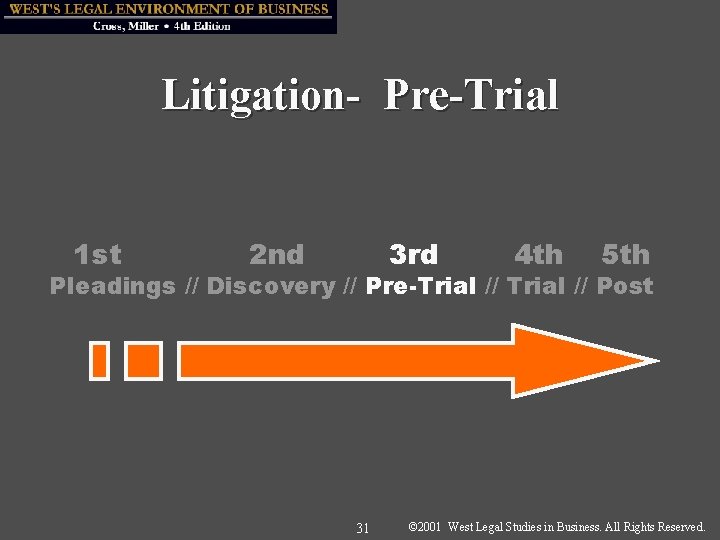
Litigation- Pre-Trial 1 st 2 nd 3 rd 4 th 5 th Pleadings // Discovery // Pre-Trial // Post 31 © 2001 West Legal Studies in Business. All Rights Reserved.
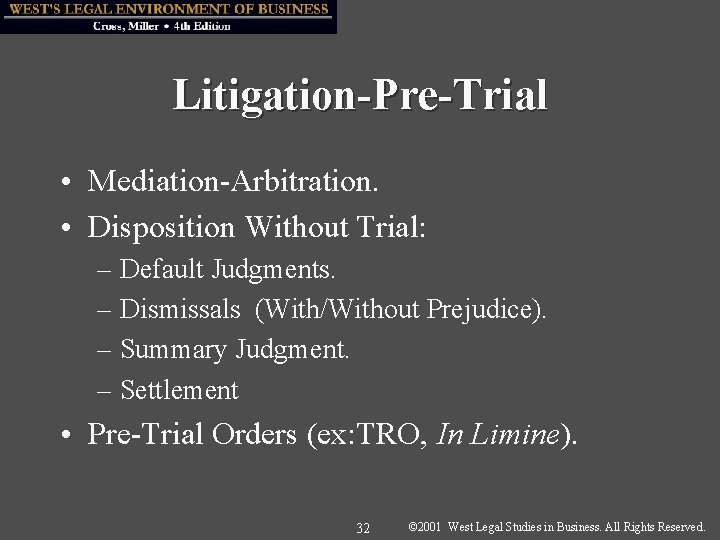
Litigation-Pre-Trial • Mediation-Arbitration. • Disposition Without Trial: – Default Judgments. – Dismissals (With/Without Prejudice). – Summary Judgment. – Settlement • Pre-Trial Orders (ex: TRO, In Limine). 32 © 2001 West Legal Studies in Business. All Rights Reserved.
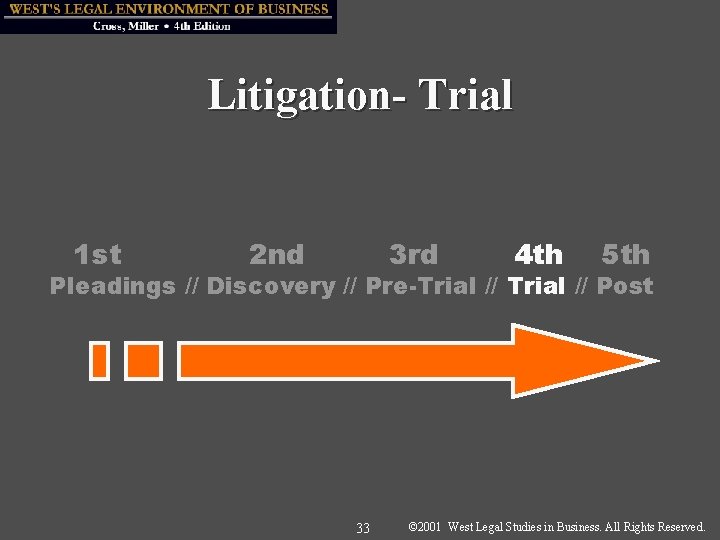
Litigation- Trial 1 st 2 nd 3 rd 4 th 5 th Pleadings // Discovery // Pre-Trial // Post 33 © 2001 West Legal Studies in Business. All Rights Reserved.
The Trial • Trial is fundamentally an evidence presentation and authentication procedure. • To prevail, Plaintiff must introduce a preponderance of competent, relevant evidence with respect to each disputed allegation in order to prove it. 34 © 2001 West Legal Studies in Business. All Rights Reserved.
The Trial [2] The Defendant will attempt to introduce a preponderance of competent evidence to disprove at least one of the disputed allegations. 35 © 2001 West Legal Studies in Business. All Rights Reserved.
The Trial [3] • Bench Trial (no jury). • Jury Selection process involves: – Voire Dire; – Challenges to biased jurors; – Pick and Impanel the Jury; and – Selection of an Alternate Juror. 36 © 2001 West Legal Studies in Business. All Rights Reserved.
The Trial [4] • Opening Statements (Plaintiff first). • Plaintiff’s Case--Evidence: – Witnesses- Direct examination vs. Cross X. – Admissibility of evidence decided by judge. Parties object to admission of evidence and judge decides, as a matter of law, whether evidence may be admitted into the trial. 37 © 2001 West Legal Studies in Business. All Rights Reserved.
The Trial [5] • Plaintiff’s Case (cont’d). – Party may impeach the testimony or credibility of opposing witness by showing prior inconsistent statements and/or perjury. • Defendant’s Case is next. • Closing Arguments (Plaintiff first). • Jury Instructions, Deliberations and Verdict. 38 © 2001 West Legal Studies in Business. All Rights Reserved.
The Trial [6] • Verdict: – Criminal case--burden of proof is “beyond a reasonable doubt” and the verdict (for guilty or acquittal) must be unanimous. If not, mistrial/hung jury. – Civil Cases—generally, burden of proof is by “preponderance” of the evidence and a majority of jurors must agree on verdict. If not, then mistrial/ hung jury. 39 © 2001 West Legal Studies in Business. All Rights Reserved.
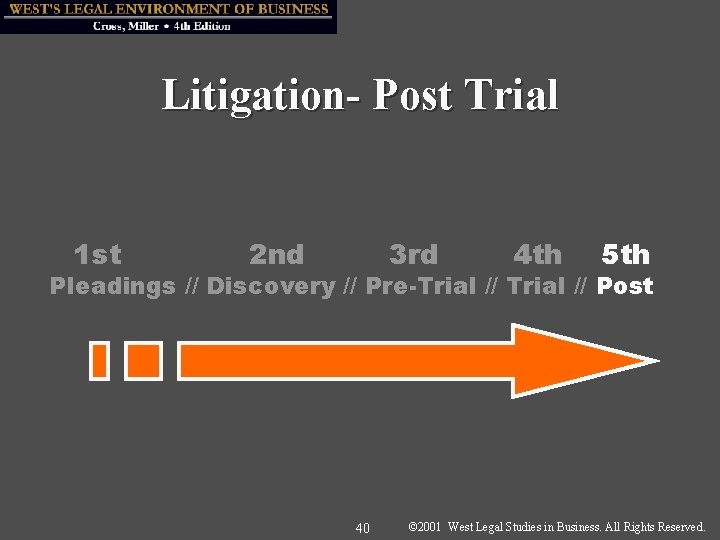
Litigation- Post Trial 1 st 2 nd 3 rd 4 th 5 th Pleadings // Discovery // Pre-Trial // Post 40 © 2001 West Legal Studies in Business. All Rights Reserved.
Post Trial • Judgment: Jury verdict is entered by the Clerk of Court. • A party may move for a New Trial. – Case 3. 2: Le. Blanc v. American Honda (1997). • A party may file a Motion for Judgment N. O. V. . • Sentencing (criminal). 41 © 2001 West Legal Studies in Business. All Rights Reserved.
Post Trial-Enforcement • Once a judgment becomes final (i. e. , subject to no further judicial review) the defendant is legally required to comply with its terms. • Defendants who will not voluntarily comply with a judgment can be compelled to do so by seizure and sale of the Defendant’s assets. 42 © 2001 West Legal Studies in Business. All Rights Reserved.
Post Trial-Appeal • A party may appeal not only the jury’s verdict by any legal issue, motion or court ruling during the trial. • The party filing the appeal (Appellant) files a brief that contains a short statement of the facts, issues, rulings by the trial court, grounds to reverse the judgment, applicable law and arguments on Appellant’s behalf. • Appeals court can affirm (agree with) or reverse (disagree with) the lower court’s decision. 43 © 2001 West Legal Studies in Business. All Rights Reserved.
Law on the Web • • Federal Court Locator at Villanova U. . Oyez! U. S. Supreme Court website. Federal Court System. National Center for State Courts. Rules of Civil Procedure at Cornell U. . Rules of Professional Conduct. Legal Research Exercises on the Web. 44 © 2001 West Legal Studies in Business. All Rights Reserved.
Complaint Return 45 © 2001 West Legal Studies in Business. All Rights Reserved.
Summons Return 46 © 2001 West Legal Studies in Business. All Rights Reserved.