
Chapter 2 The Chemistry of Life Atomsbasic unit
Chapter 2 The Chemistry of Life
� Atoms-basic unit of matter. � What three subatomic particles make up atoms? � This section is mainly about how an atom got its name and who thought about it. � The concept of an atom came first from a Greek philosopher named Democritus about 2, 500 years ago. � The three subatomic particles that make up atoms are protons, neutrons, and electrons. 2. 1 The Nature of Matter SC. 912. N. 1. 1
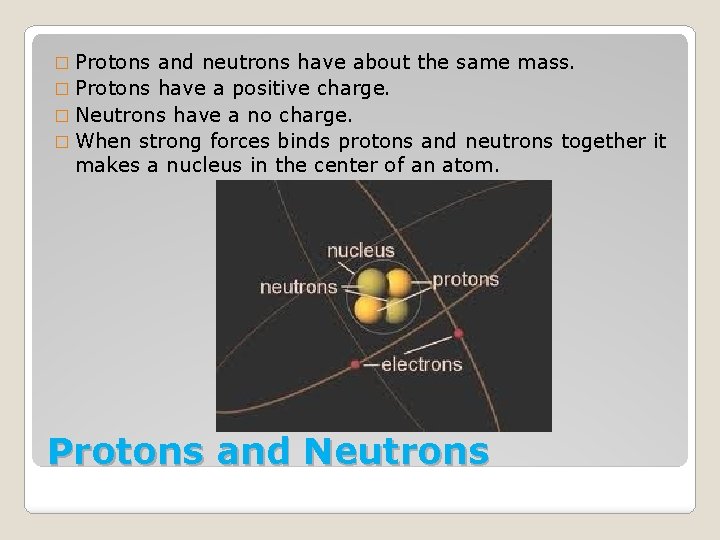
� Protons and neutrons have about the same mass. � Protons have a positive charge. � Neutrons have a no charge. � When strong forces binds protons and neutrons together it makes a nucleus in the center of an atom. Protons and Neutrons
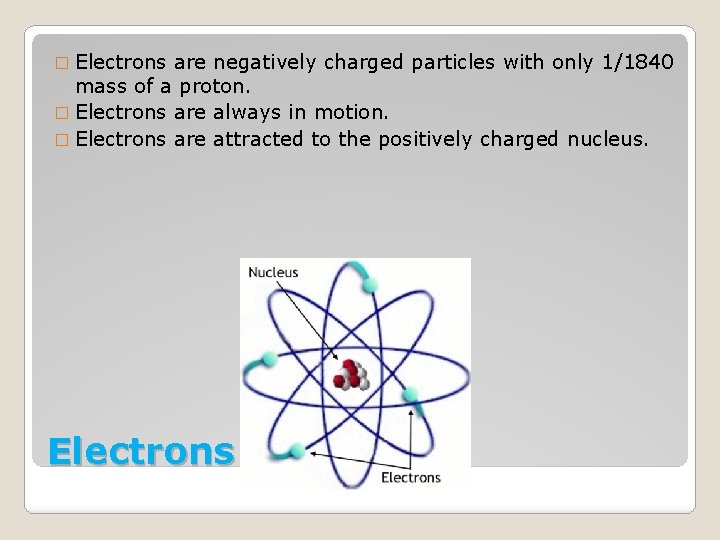
� Electrons are negatively charged particles with only 1/1840 mass of a proton. � Electrons are always in motion. � Electrons are attracted to the positively charged nucleus. Electrons
� How are all of the isotopes of an element similar? � Mainly about Elements and how they are represented. � An element is a pure substance that consist entirely of one type of atom. � The number of protons in the nucleus of an element is called the atomic number. � There are more than 100 elements are known, but only about two dozen are commonly found in living organisms. Elements and Isotopes
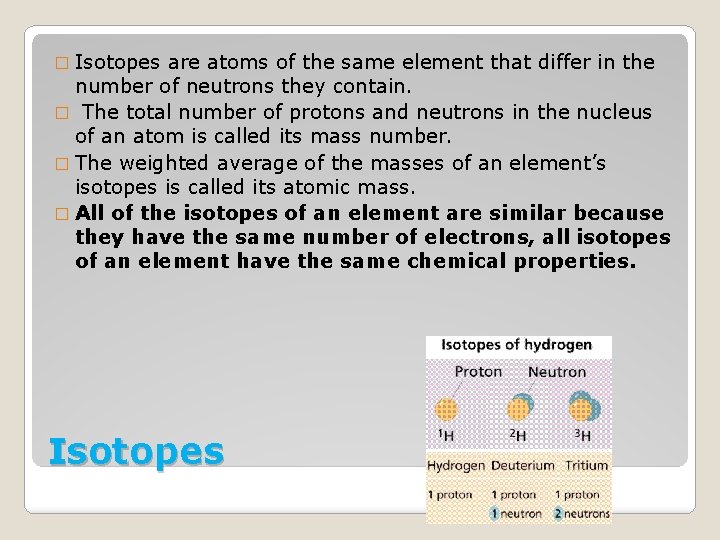
� Isotopes are atoms of the same element that differ in the number of neutrons they contain. � The total number of protons and neutrons in the nucleus of an atom is called its mass number. � The weighted average of the masses of an element’s isotopes is called its atomic mass. � All of the isotopes of an element are similar because they have the same number of electrons, all isotopes of an element have the same chemical properties. Isotopes
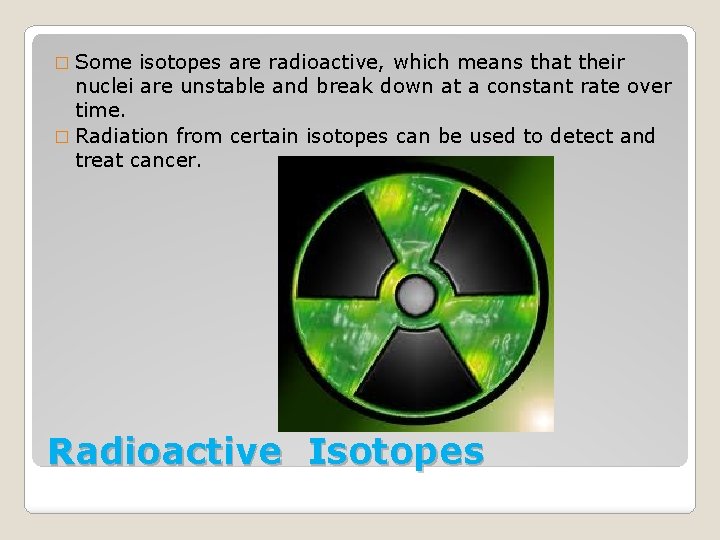
� Some isotopes are radioactive, which means that their nuclei are unstable and break down at a constant rate over time. � Radiation from certain isotopes can be used to detect and treat cancer. Radioactive Isotopes
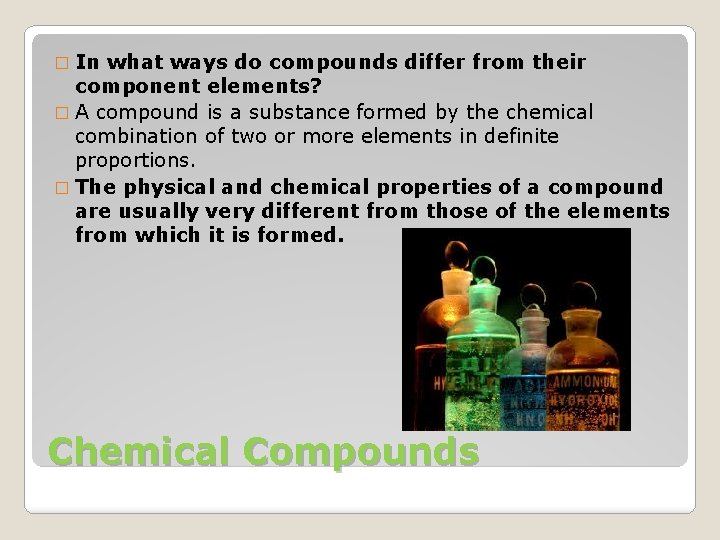
� In what ways do compounds differ from their component elements? � A compound is a substance formed by the chemical combination of two or more elements in definite proportions. � The physical and chemical properties of a compound are usually very different from those of the elements from which it is formed. Chemical Compounds
� What are the main types of chemical bonds? � The electrons that are available to form bonds are called valence electrons. � The main types of chemical bonds are ionic bonds and covalent bonds. Chemical Bonds
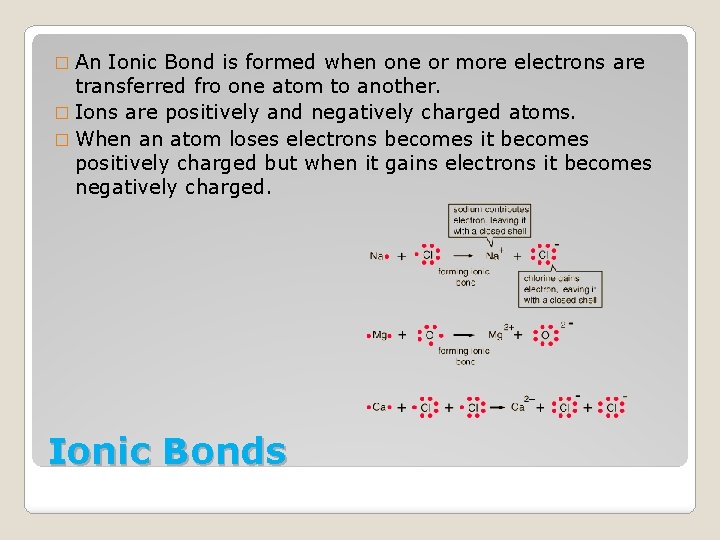
� An Ionic Bond is formed when one or more electrons are transferred fro one atom to another. � Ions are positively and negatively charged atoms. � When an atom loses electrons becomes it becomes positively charged but when it gains electrons it becomes negatively charged. Ionic Bonds
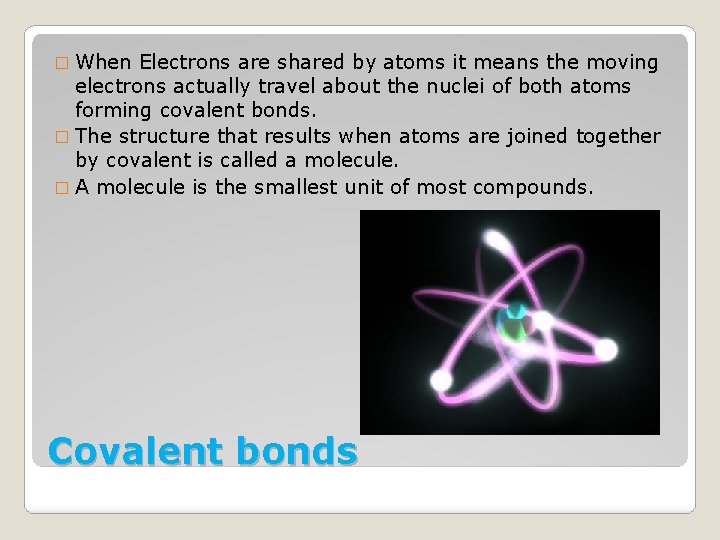
� When Electrons are shared by atoms it means the moving electrons actually travel about the nuclei of both atoms forming covalent bonds. � The structure that results when atoms are joined together by covalent is called a molecule. � A molecule is the smallest unit of most compounds. Covalent bonds
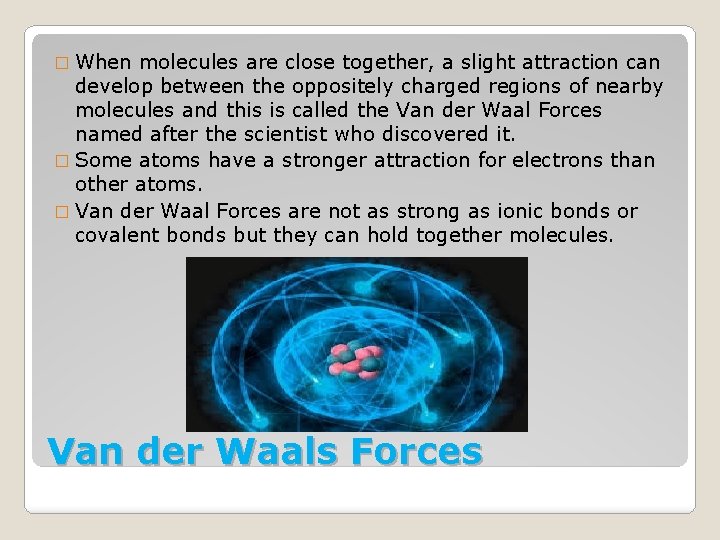
� When molecules are close together, a slight attraction can develop between the oppositely charged regions of nearby molecules and this is called the Van der Waal Forces named after the scientist who discovered it. � Some atoms have a stronger attraction for electrons than other atoms. � Van der Waal Forces are not as strong as ionic bonds or covalent bonds but they can hold together molecules. Van der Waals Forces
� The Water Molecule � How does the structure of water contribute to its unique properties? � Water has a neutral charge. � Waters 10 protons balance out its negative charges from its 10 electrons. 2. 2 Properties of Water SC. 912. L. 18. 12
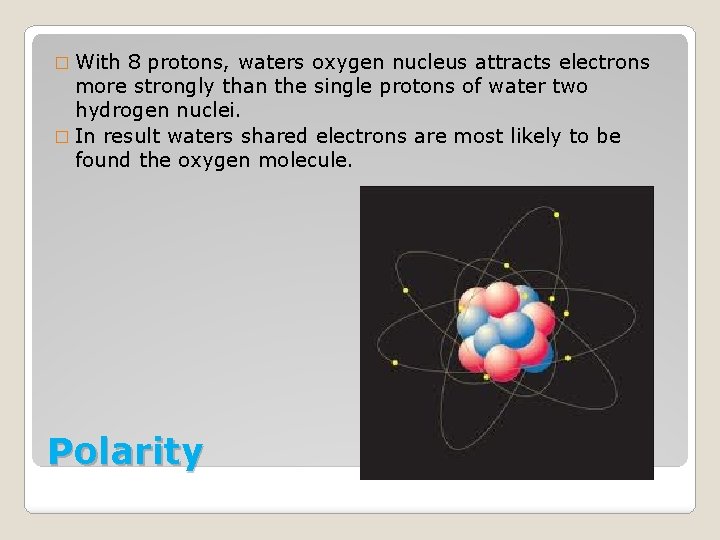
� With 8 protons, waters oxygen nucleus attracts electrons more strongly than the single protons of water two hydrogen nuclei. � In result waters shared electrons are most likely to be found the oxygen molecule. Polarity
� The attraction between a hydrogen atom with a partial positive charge and another atom with a partial negative charge is known as hydrogen bond. � Because of partial positive and negative charges polar molecules such as water can attract each other. � Because water is a polar molecule, it is able to form multiple hydrogen bonds which account for many of waters special properties. Hydrogen bonding
� How does water’s polarity influence its properties as a solvent? � Water is not pure it is often found as part of a mixture. � A mixture is a material composed of two or more elements or compounds that are physically mixed together but not chemically combined. Solutions and Suspensions
� All the components of a solution are evenly distributed throughout the solution. � Solute the substance that is dissolved. � Solvent is the substance in which the solute dissolves. � Waters polarity gives it the ability to dissolve both ionic compounds and other polar molecules. Solutions
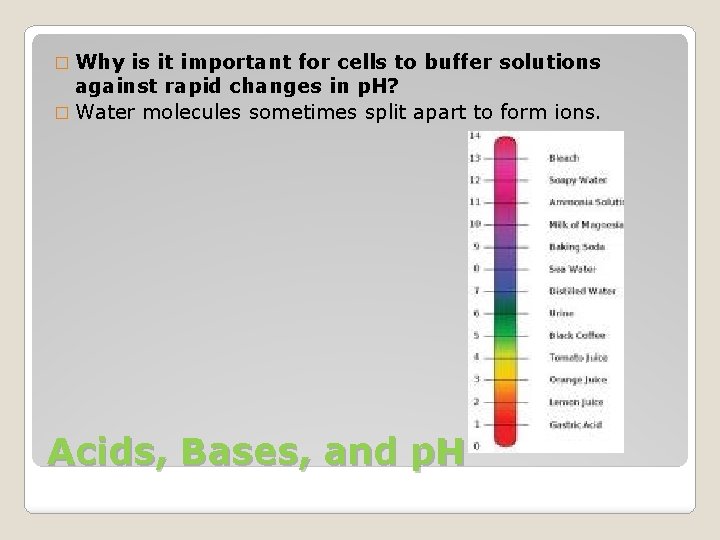
� Why is it important for cells to buffer solutions against rapid changes in p. H? � Water molecules sometimes split apart to form ions. Acids, Bases, and p. H
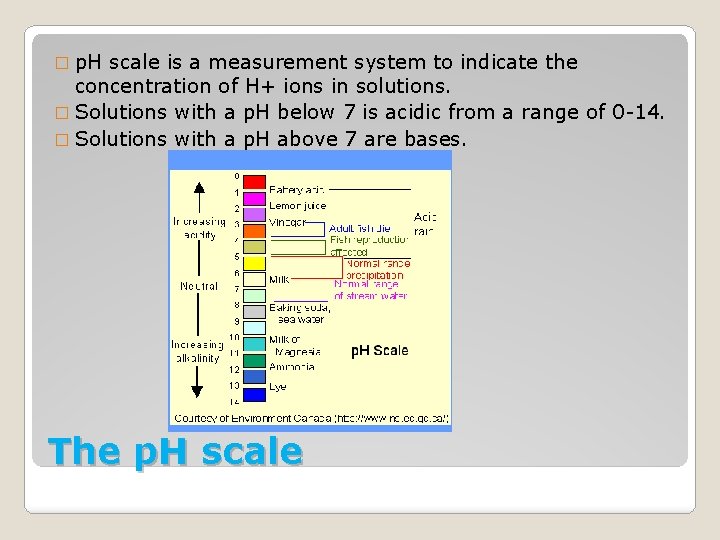
� p. H scale is a measurement system to indicate the concentration of H+ ions in solutions. � Solutions with a p. H below 7 is acidic from a range of 0 -14. � Solutions with a p. H above 7 are bases. The p. H scale
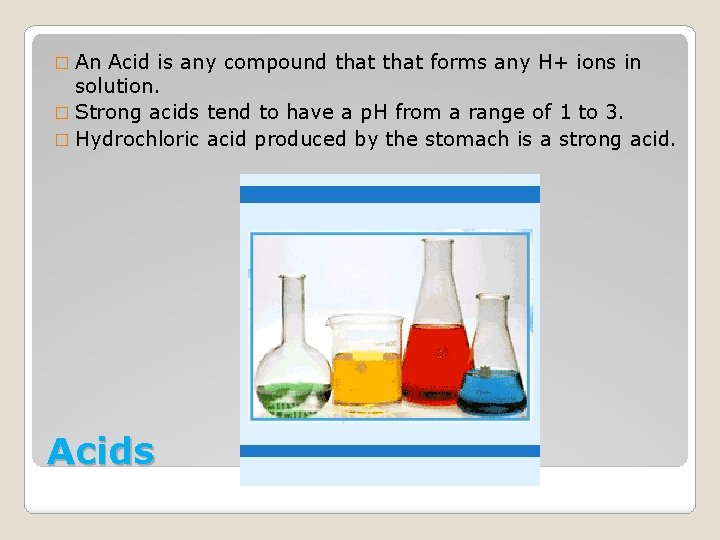
� An Acid is any compound that forms any H+ ions in solution. � Strong acids tend to have a p. H from a range of 1 to 3. � Hydrochloric acid produced by the stomach is a strong acid. Acids
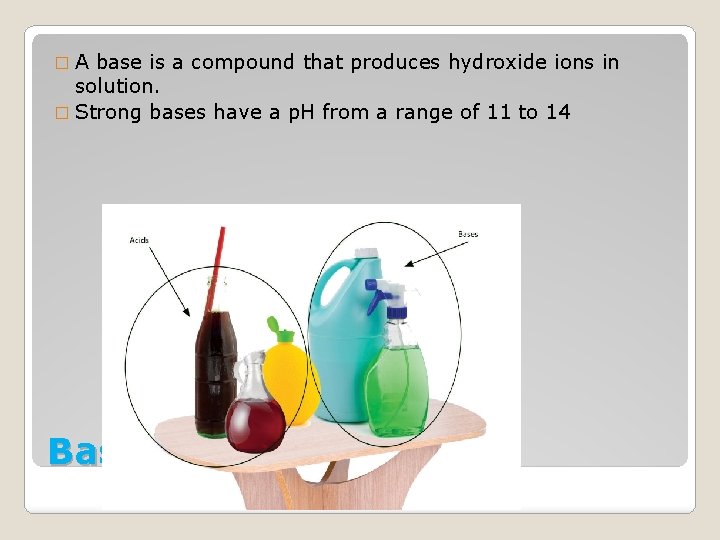
�A base is a compound that produces hydroxide ions in solution. � Strong bases have a p. H from a range of 11 to 14 Bases
� Buffers are weak acids or bases that can react with strong acids or bases to prevent sharp, sudden changes in p. H. � Buffers dissolved in life's fluids play an important role in maintaining homeostasis in organisms. Buffers
� The Chemistry of Carbon � What elements does carbon bond with to make up life’s molecules? � Carbon can bond with many elements, including hydrogen, oxygen, phosphorus, sulfur, and nitrogen to form the molecules of life. � One carbon atom can bond to another, which gives carbon the ability to form chains that are almost unlimited in length. 2. 3 Carbon Compounds SC. 912. L. 18. 1
� What are the functions of each of the four groups of molecules? � Monomers join together to form polymers. � Most macromolecules are formed by a process known as polymerization. Macromolecules
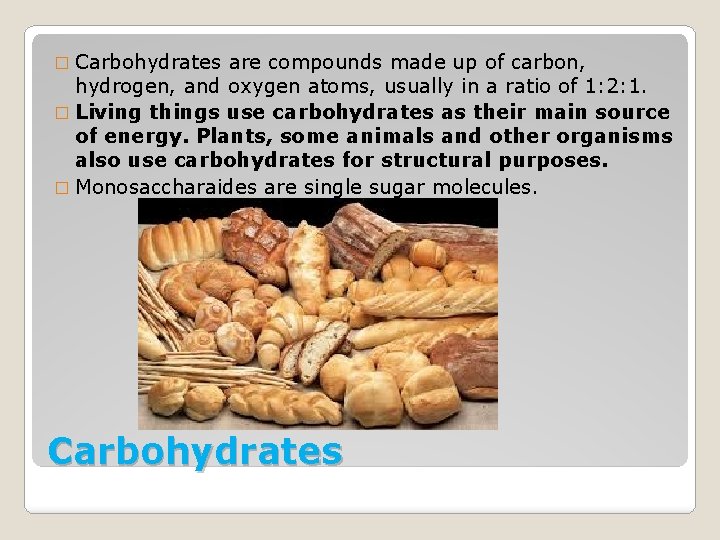
� Carbohydrates are compounds made up of carbon, hydrogen, and oxygen atoms, usually in a ratio of 1: 2: 1. � Living things use carbohydrates as their main source of energy. Plants, some animals and other organisms also use carbohydrates for structural purposes. � Monosaccharaides are single sugar molecules. Carbohydrates
� Lipids are made mostly from carbon and hydrogen atoms. � Lipids can be used to store energy. Some lipids are important parts of biological membranes and waterproof coverings. � Lipids are formed when a glycerol molecule combines with compounds called fatty acids. Lipids
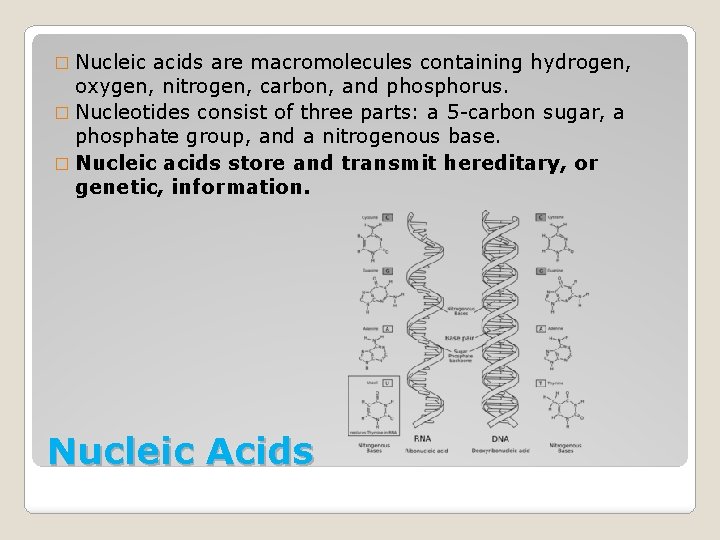
� Nucleic acids are macromolecules containing hydrogen, oxygen, nitrogen, carbon, and phosphorus. � Nucleotides consist of three parts: a 5 -carbon sugar, a phosphate group, and a nitrogenous base. � Nucleic acids store and transmit hereditary, or genetic, information. Nucleic Acids
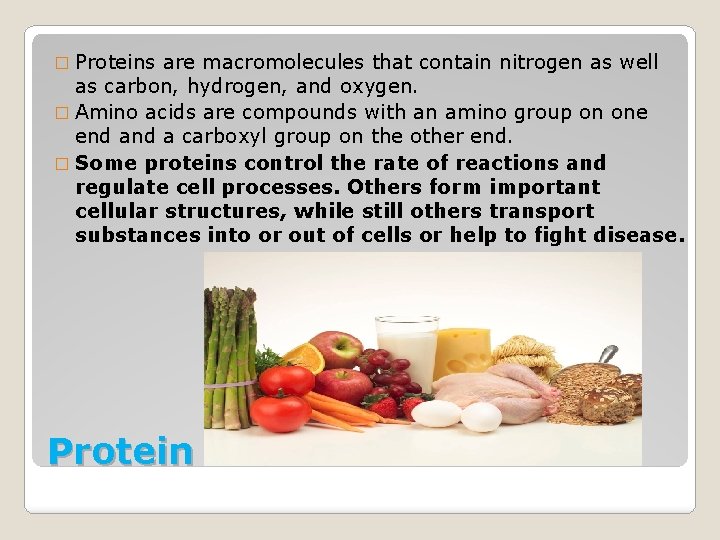
� Proteins are macromolecules that contain nitrogen as well as carbon, hydrogen, and oxygen. � Amino acids are compounds with an amino group on one end a carboxyl group on the other end. � Some proteins control the rate of reactions and regulate cell processes. Others form important cellular structures, while still others transport substances into or out of cells or help to fight disease. Protein
� Chemical Reactions � What happens to chemical bonds during chemical reactions? � A chemical reaction is a process that changes, or transforms, one set of chemicals into another. � Chemical reactions involve changes in the chemical bonds that join atoms in compounds. 2. 4 Chemical Reactions and Enzymes SC. 912. L. 18. 11
� How do energy changes affect whether a chemical reaction will occur? � Energy is released or absorbed whenever chemical bonds are formed or broken. Energy in Reactions
� Chemical reactions that release energy often occur on their own, or spontaneously. Chemical reactions that absorb energy will not occur without a source of energy. � Energy changes are one of the most important factors in determining whether a chemical reaction will occur. Energy Changes
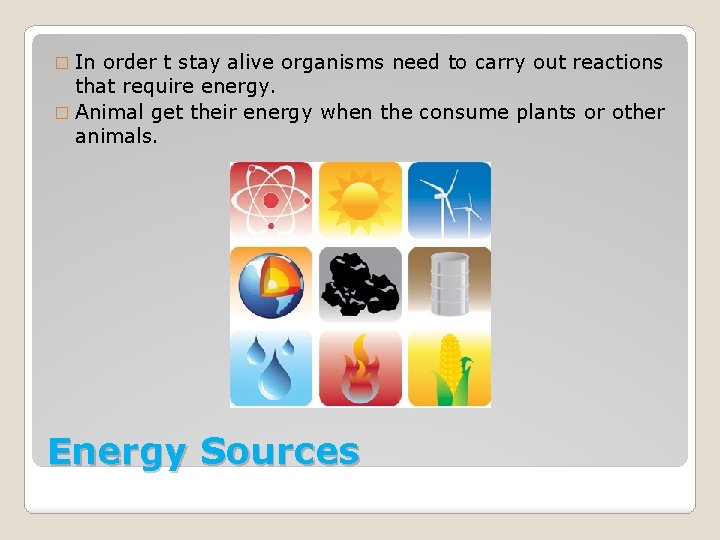
� In order t stay alive organisms need to carry out reactions that require energy. � Animal get their energy when the consume plants or other animals. Energy Sources
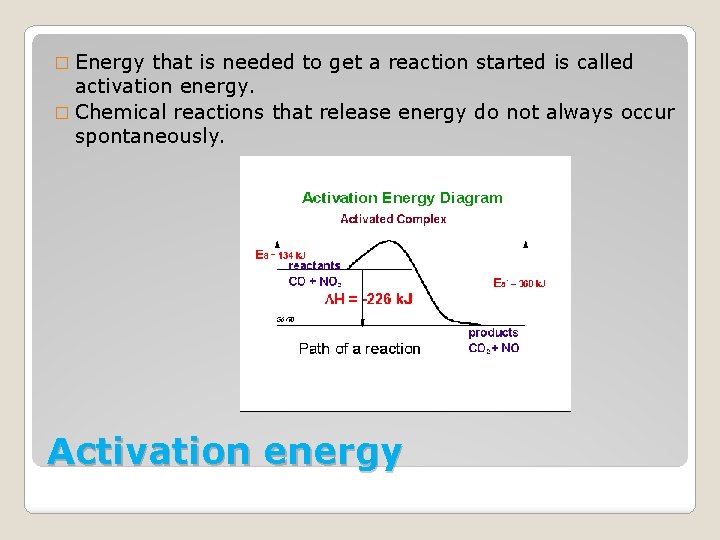
� Energy that is needed to get a reaction started is called activation energy. � Chemical reactions that release energy do not always occur spontaneously. Activation energy
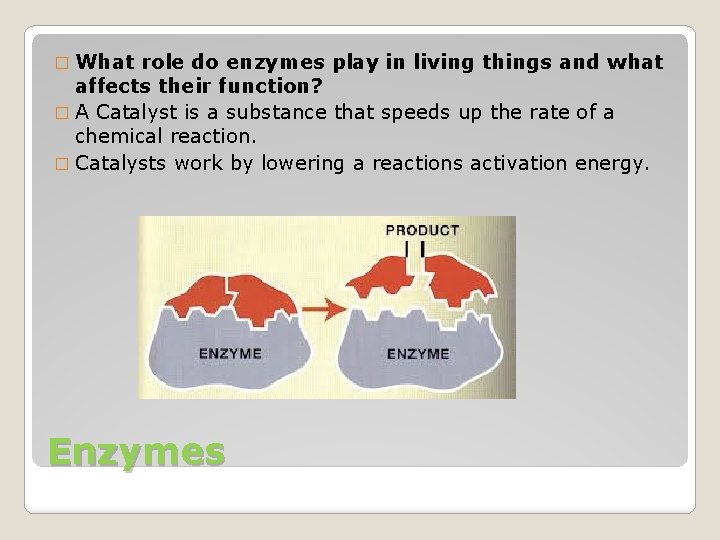
� What role do enzymes play in living things and what affects their function? � A Catalyst is a substance that speeds up the rate of a chemical reaction. � Catalysts work by lowering a reactions activation energy. Enzymes
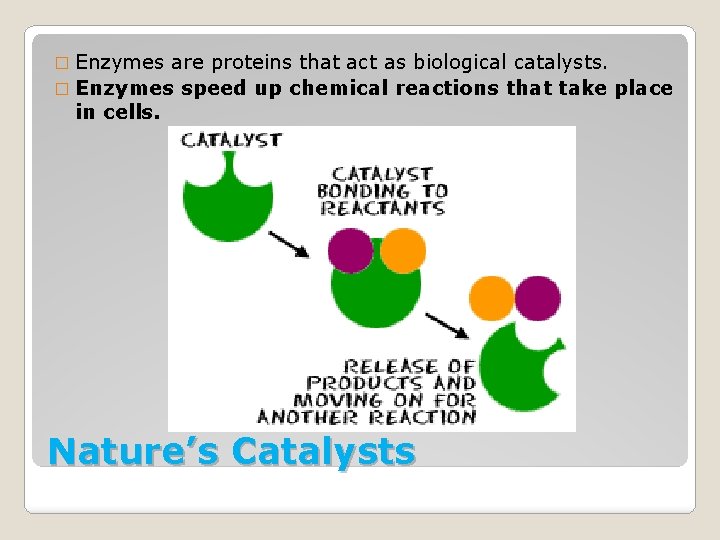
� Enzymes are proteins that act as biological catalysts. � Enzymes speed up chemical reactions that take place in cells. Nature’s Catalysts
� The reactants of enzyme-catalyzed reactions are known as substrates. � For a chemical reaction to take place the reactants must collide with enough energy so that existing bonds will be broken and new bonds will form. The Enzyme-Substrate Complex
� Temperature, p. H, and regularity molecules can affect the activity of enzymes. � Enzymes produced by human cells generally work best at temperature 37 degrees Celsius. Regulation of Enzyme Activity
- Slides: 37