
Chapter 2 The Chemistry of Life AP Biology
Chapter 2 The Chemistry of Life AP Biology 2007 -2008
Objectives: You should be able to… § Identify the most common elements § § found in living organisms (and what types of molecules they are found in) Compare and contrast different types of bonds/forces – ionic, covalent, hydrogen, Van der Waals, hydrophobic/hydrophillic interactions Define – polar, non-polar, hydrophobic, hydrophillic AP Biology
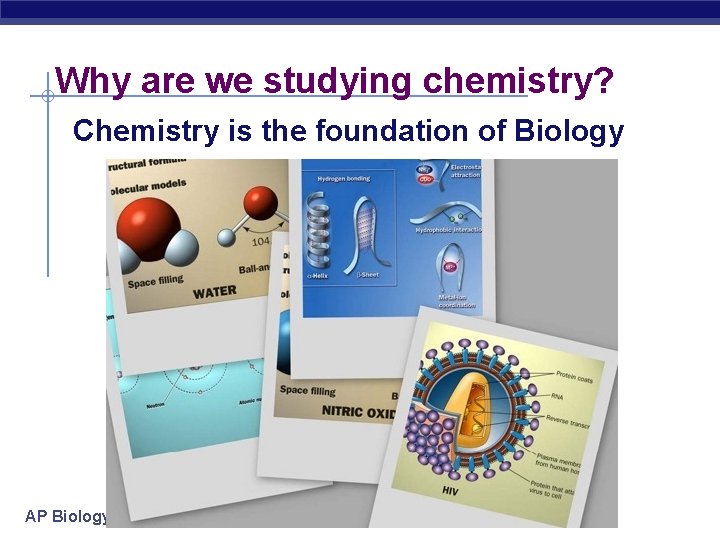
Why are we studying chemistry? Chemistry is the foundation of Biology AP Biology
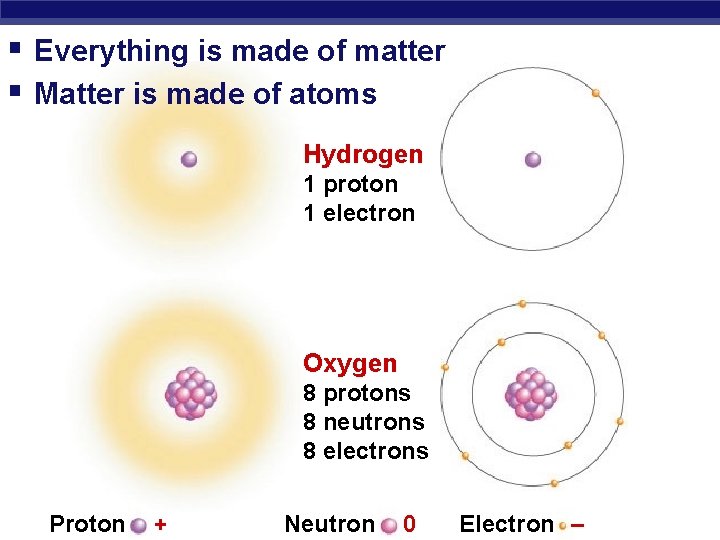
§ Everything is made of matter § Matter is made of atoms Hydrogen 1 proton 1 electron Oxygen 8 protons 8 neutrons 8 electrons AP Biology Proton + Neutron 0 Electron –
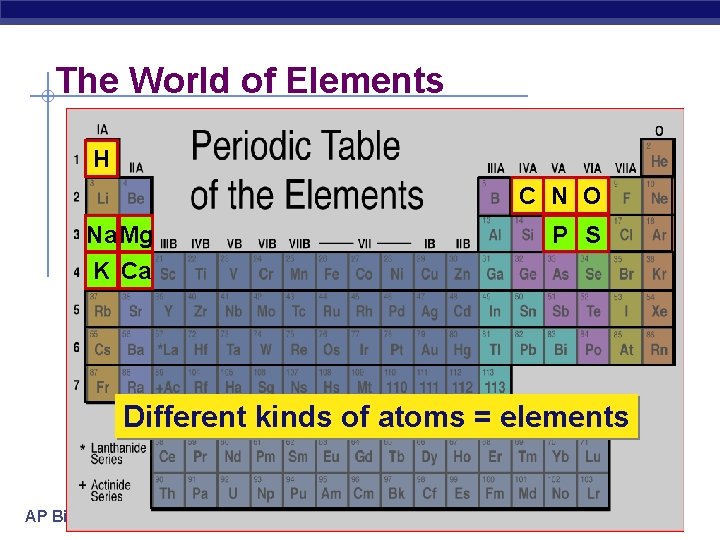
The World of Elements H C N O Na Mg P S K Ca Different kinds of atoms = elements AP Biology
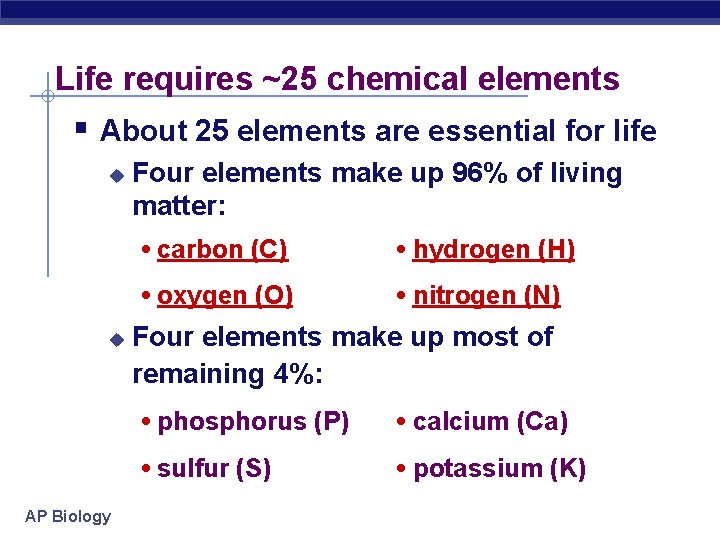
Life requires ~25 chemical elements § About 25 elements are essential for life u u AP Biology Four elements make up 96% of living matter: • carbon (C) • hydrogen (H) • oxygen (O) • nitrogen (N) Four elements make up most of remaining 4%: • phosphorus (P) • calcium (Ca) • sulfur (S) • potassium (K)
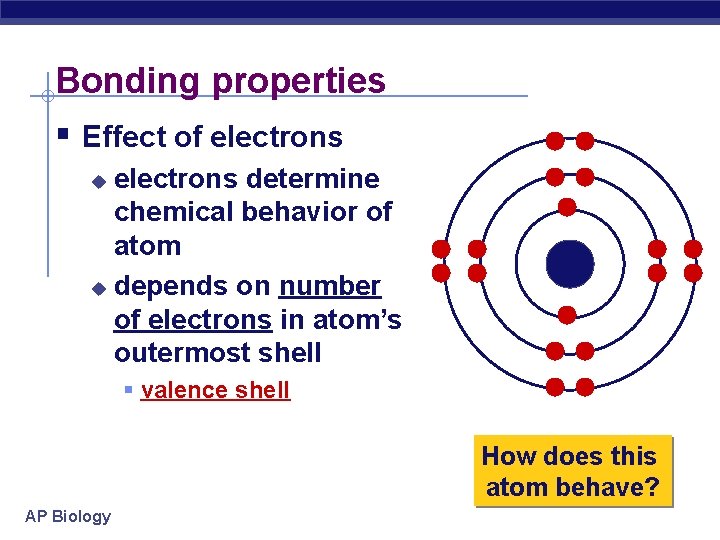
Bonding properties § Effect of electrons determine chemical behavior of atom u depends on number of electrons in atom’s outermost shell u § valence shell How does this atom behave? AP Biology
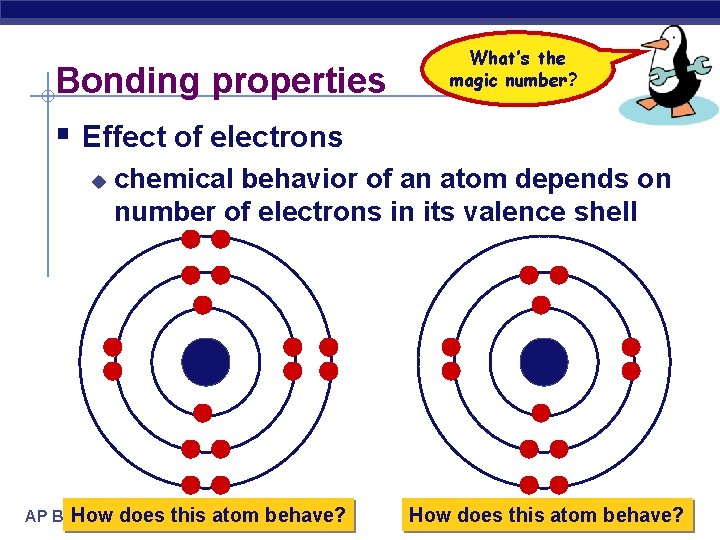
Bonding properties What’s the magic number? § Effect of electrons u How AP Biology chemical behavior of an atom depends on number of electrons in its valence shell does this atom behave? How does this atom behave?
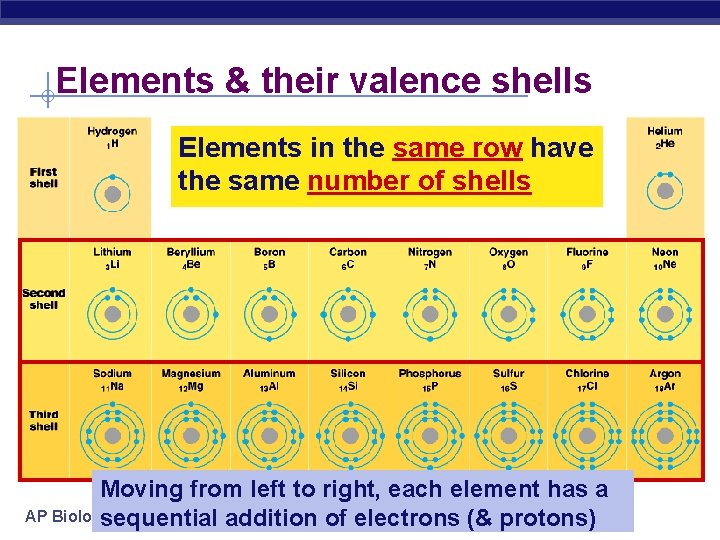
Elements & their valence shells Elements in the same row have the same number of shells Moving from left to right, each element has a AP Biology sequential addition of electrons (& protons)
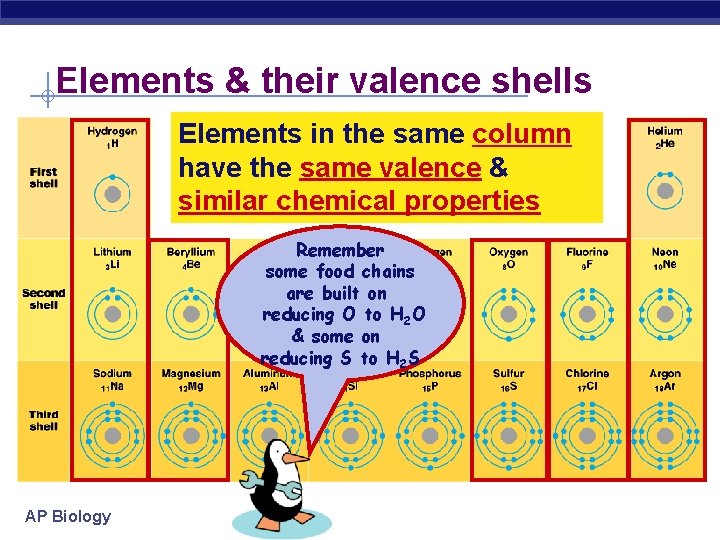
Elements & their valence shells Elements in the same column have the same valence & similar chemical properties Remember some food chains are built on reducing O to H 2 O & some on reducing S to H 2 S AP Biology
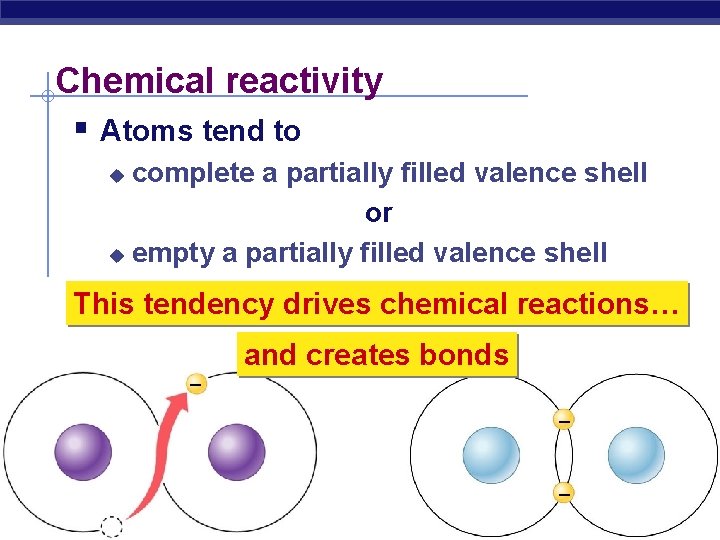
Chemical reactivity § Atoms tend to complete a partially filled valence shell or u empty a partially filled valence shell u This tendency drives chemical reactions… and creates bonds – – – AP Biology
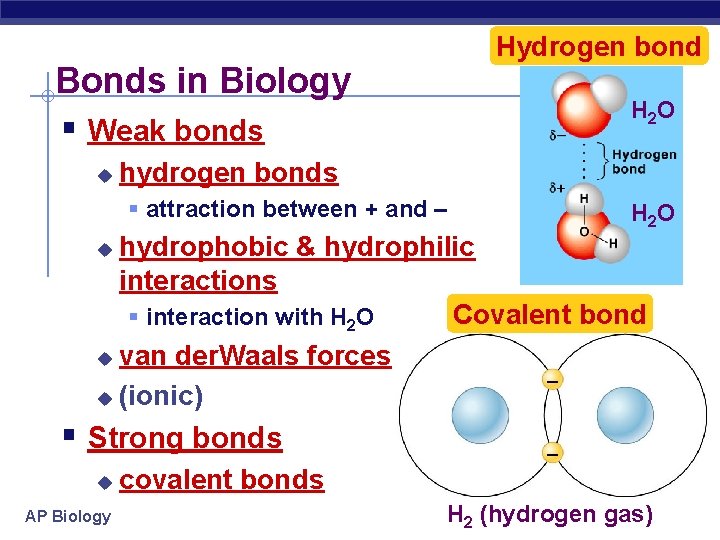
Hydrogen bond Bonds in Biology § Weak bonds u H 2 O hydrogen bonds § attraction between + and – H 2 O hydrophobic & hydrophilic interactions Covalent bond § interaction with H 2 O u van der. Waals forces – u (ionic) u § Strong bonds u AP Biology covalent bonds – H 2 (hydrogen gas)
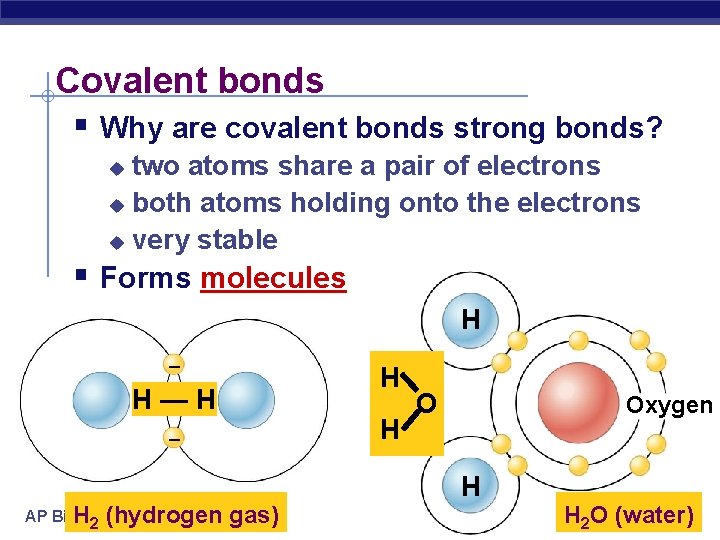
Covalent bonds § Why are covalent bonds strong bonds? two atoms share a pair of electrons u both atoms holding onto the electrons u very stable u § Forms molecules H – H H—H H – AP Biology H 2 (hydrogen gas) O Oxygen H H 2 O (water)
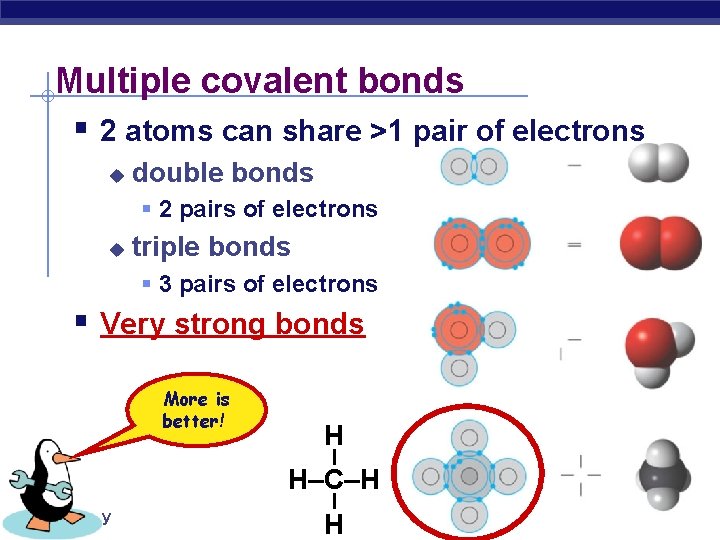
Multiple covalent bonds § 2 atoms can share >1 pair of electrons u double bonds § 2 pairs of electrons u triple bonds § 3 pairs of electrons § Very strong bonds H – More is better! AP Biology – H–C–H H
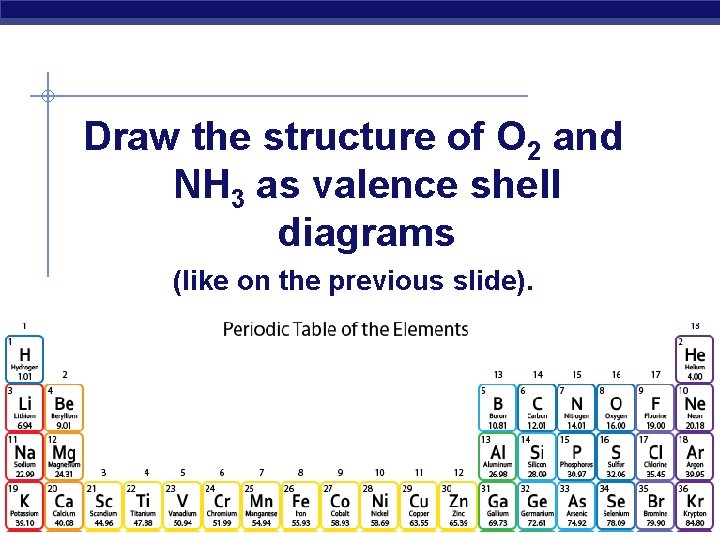
Draw the structure of O 2 and NH 3 as valence shell diagrams (like on the previous slide). AP Biology
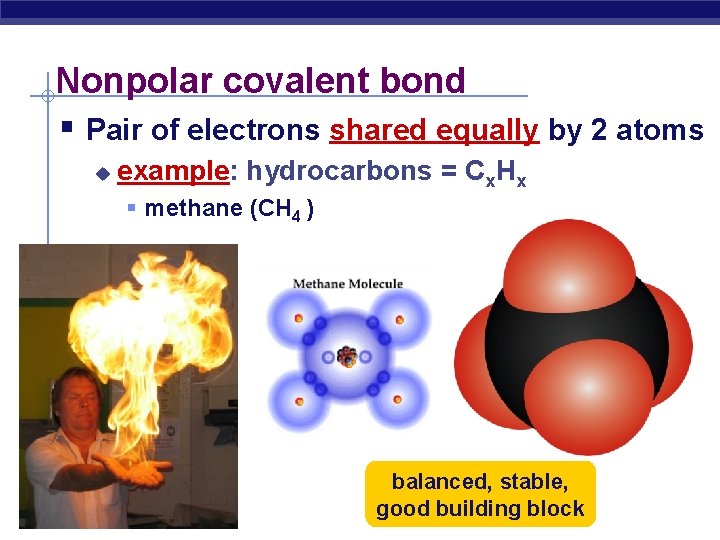
Nonpolar covalent bond § Pair of electrons shared equally by 2 atoms u example: hydrocarbons = Cx. Hx § methane (CH 4 ) AP Biology balanced, stable, good building block
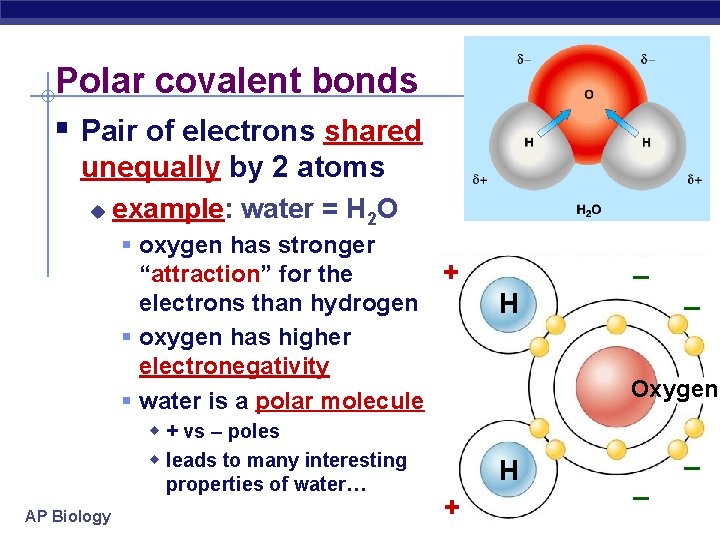
Polar covalent bonds § Pair of electrons shared unequally by 2 atoms u example: water = H 2 O § oxygen has stronger “attraction” for the electrons than hydrogen § oxygen has higher electronegativity § water is a polar molecule w + vs – poles w leads to many interesting properties of water… AP Biology + H – – Oxygen H + – –
Going back to your diagrams, does NH 3 contain polar or nonpolar covalent bonds? Justify your answer. What about O 2? AP Biology
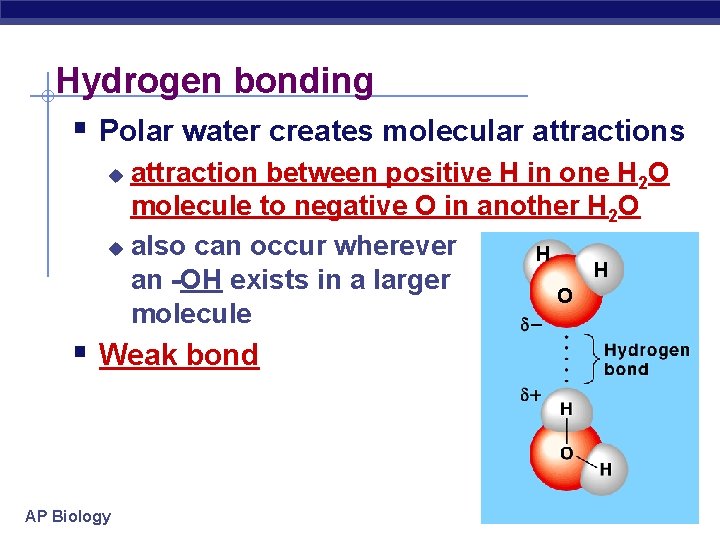
Hydrogen bonding § Polar water creates molecular attractions attraction between positive H in one H 2 O molecule to negative O in another H 2 O u also can occur wherever H H an -OH exists in a larger O molecule u § Weak bond AP Biology
Chemistry of Life Chapter 3 Properties of Water AP Biology 2007 -2008
Objectives: You should be able to… § Explain why water is a polar molecule § Draw hydrogen bonds between water § § § molecules Analyze the solubility of substances in water Describe the unique properties of water and how they benefit living organisms Define: electronegativity, cohesion, adhesion, solute, solvent, solution, p. H AP Biology
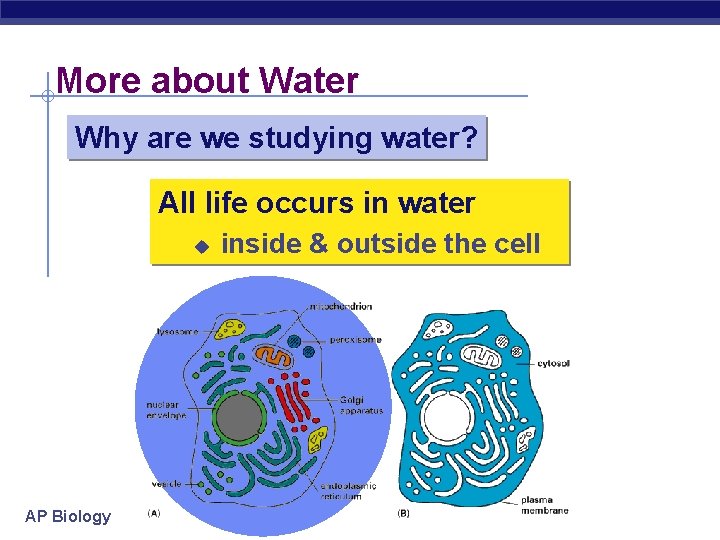
More about Water Why are we studying water? All life occurs in water u AP Biology inside & outside the cell
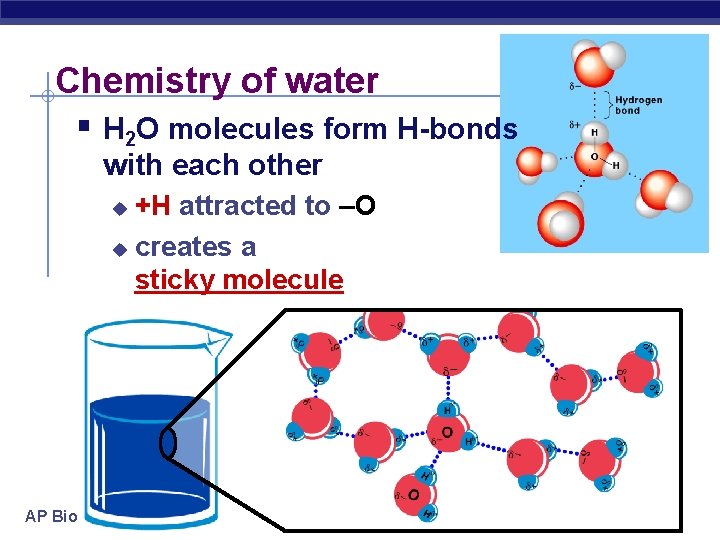
Chemistry of water § H 2 O molecules form H-bonds with each other +H attracted to –O u creates a sticky molecule u AP Biology
Elixir of Life All of the special properties of water are due to its polarity, which leads to its ability to form hydrogen bonds. AP Biology Ice! I could use more ice!
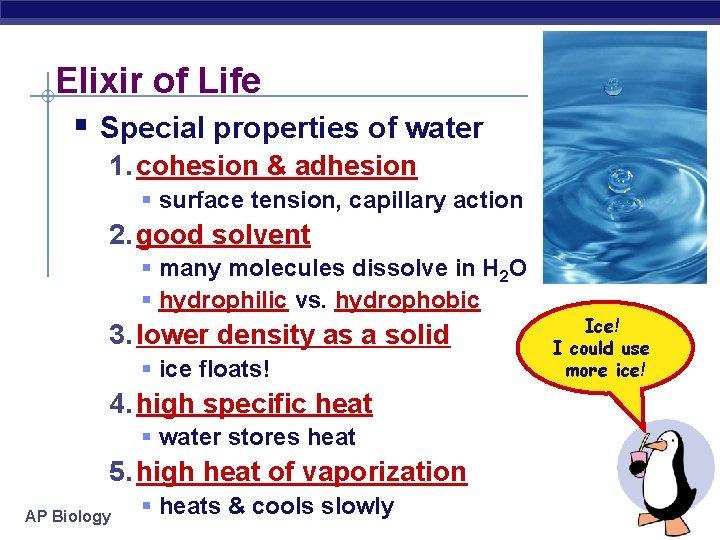
Elixir of Life § Special properties of water 1. cohesion & adhesion § surface tension, capillary action 2. good solvent § many molecules dissolve in H 2 O § hydrophilic vs. hydrophobic 3. lower density as a solid § ice floats! 4. high specific heat § water stores heat 5. high heat of vaporization AP Biology § heats & cools slowly Ice! I could use more ice!
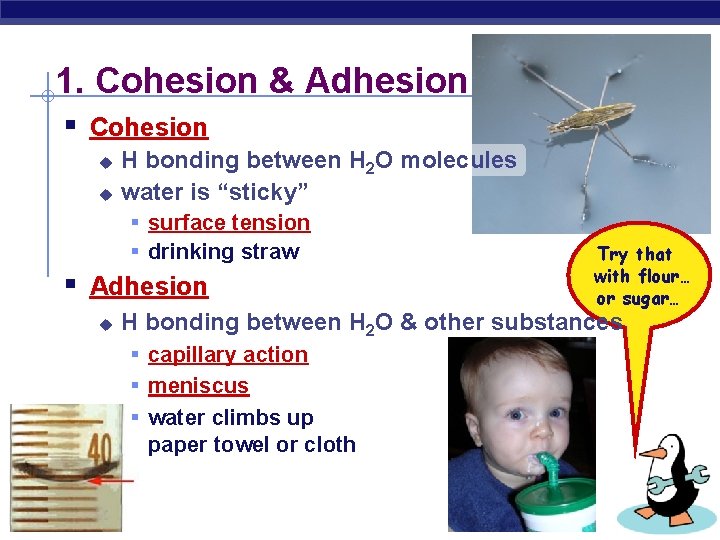
1. Cohesion & Adhesion § Cohesion u u H bonding between H 2 O molecules water is “sticky” § surface tension § drinking straw § Adhesion u H bonding between H 2 O & other substances § capillary action § meniscus § water climbs up paper towel or cloth AP Biology Try that with flour… or sugar…
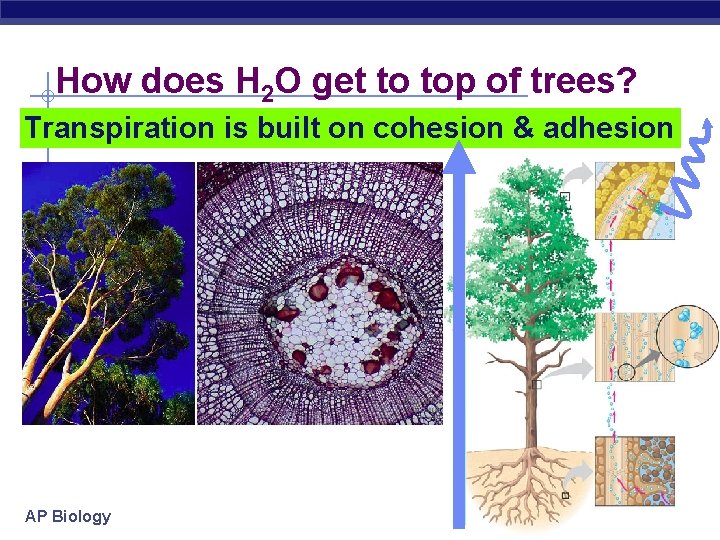
How does H 2 O get to top of trees? Transpiration is built on cohesion & adhesion AP Biology
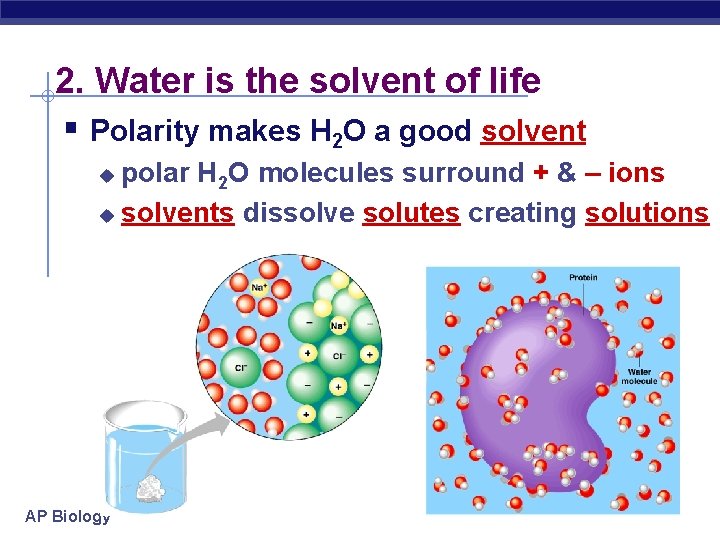
2. Water is the solvent of life § Polarity makes H 2 O a good solvent polar H 2 O molecules surround + & – ions u solvents dissolve solutes creating solutions u AP Biology
Which molecule, NH 3 or O 2, is more soluble in water? Justify your answer. AP Biology
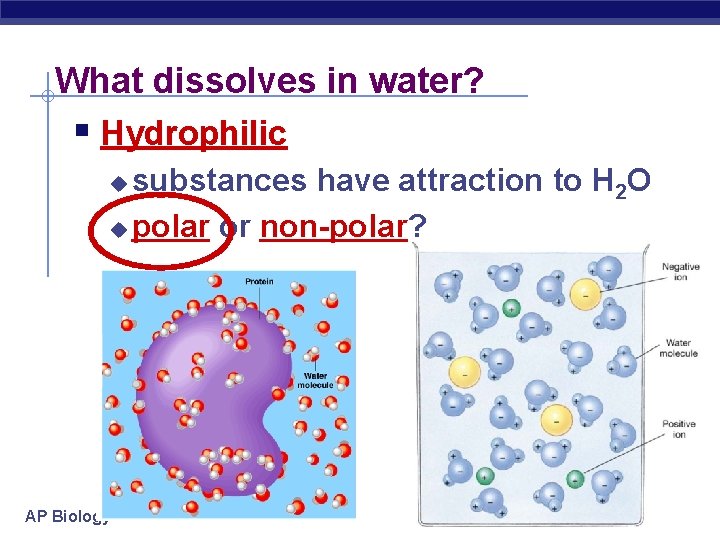
What dissolves in water? § Hydrophilic substances have attraction to H 2 O u polar or non-polar? u AP Biology
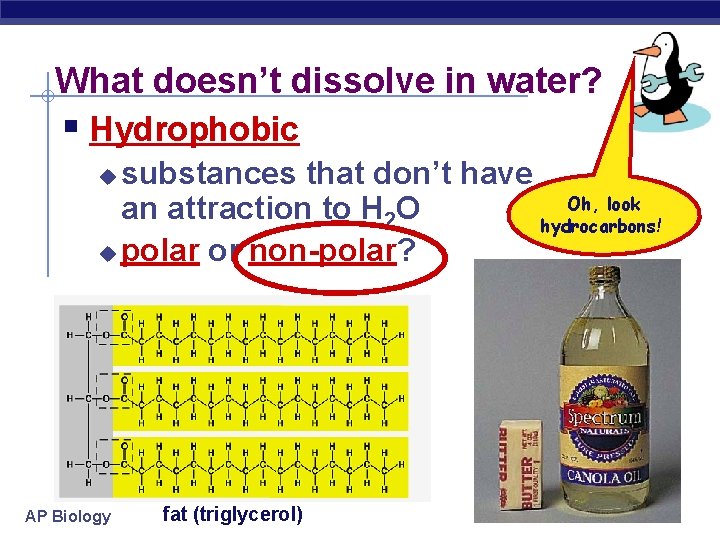
What doesn’t dissolve in water? § Hydrophobic substances that don’t have Oh, look an attraction to H 2 O hydrocarbons! u polar or non-polar? u AP Biology fat (triglycerol)
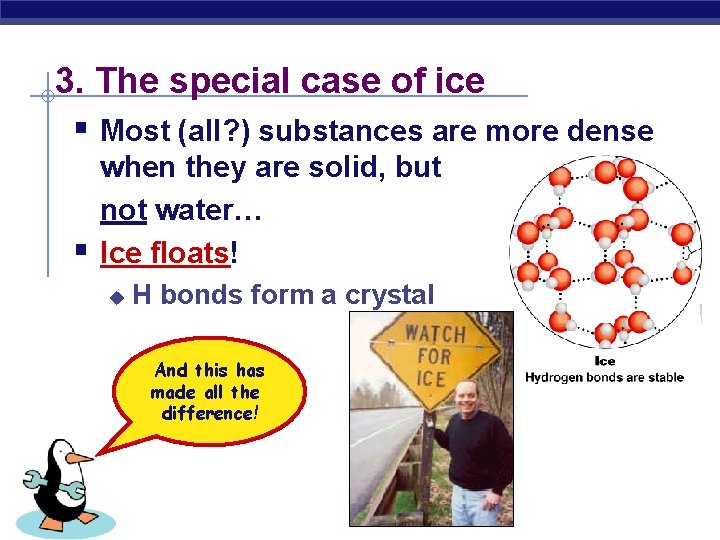
3. The special case of ice § Most (all? ) substances are more dense § when they are solid, but not water… Ice floats! u H bonds form a crystal And this has made all the difference! AP Biology
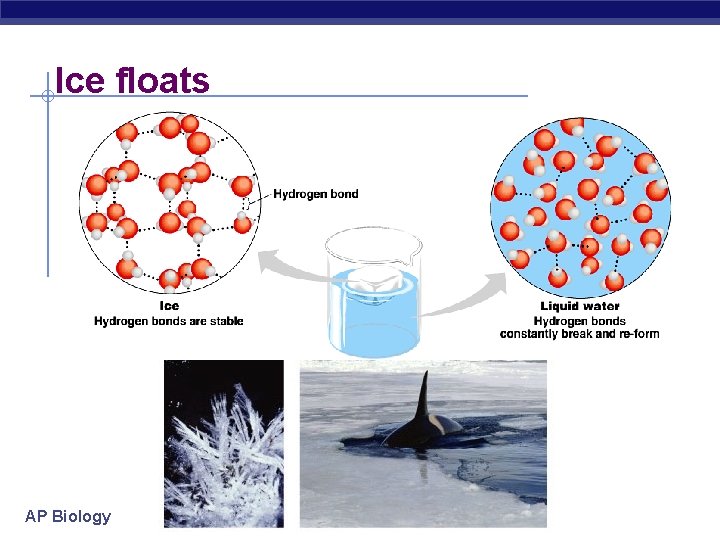
Ice floats AP Biology
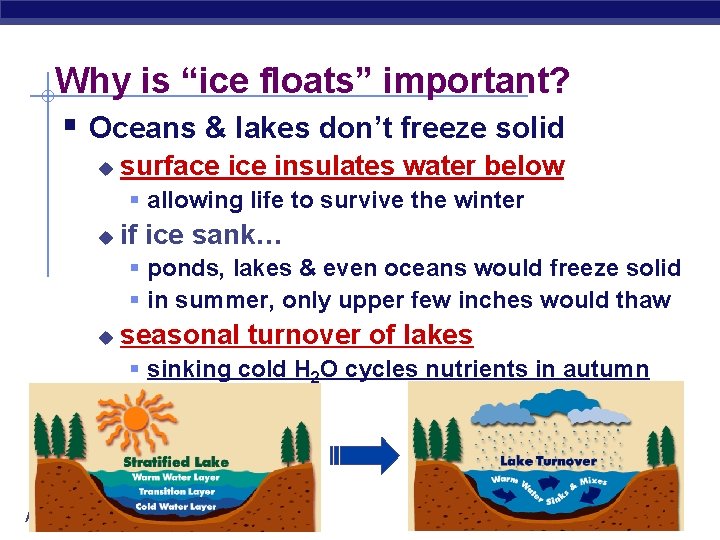
Why is “ice floats” important? § Oceans & lakes don’t freeze solid u surface insulates water below § allowing life to survive the winter u if ice sank… § ponds, lakes & even oceans would freeze solid § in summer, only upper few inches would thaw u seasonal turnover of lakes § sinking cold H 2 O cycles nutrients in autumn AP Biology
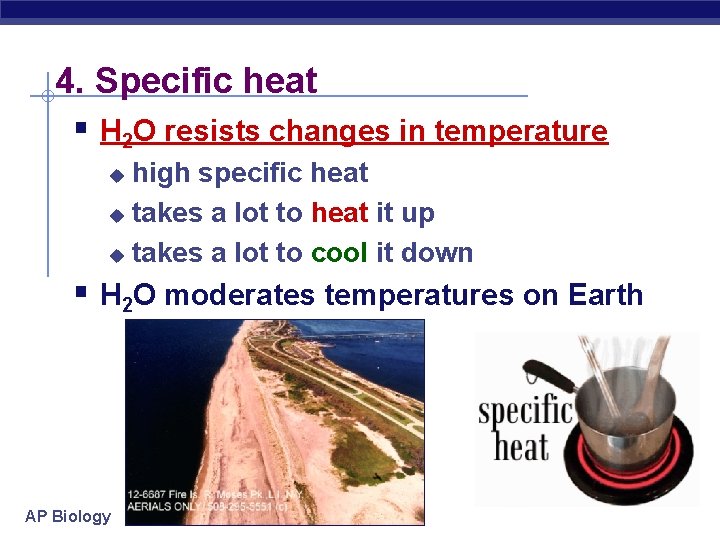
4. Specific heat § H 2 O resists changes in temperature high specific heat u takes a lot to heat it up u takes a lot to cool it down u § H 2 O moderates temperatures on Earth AP Biology
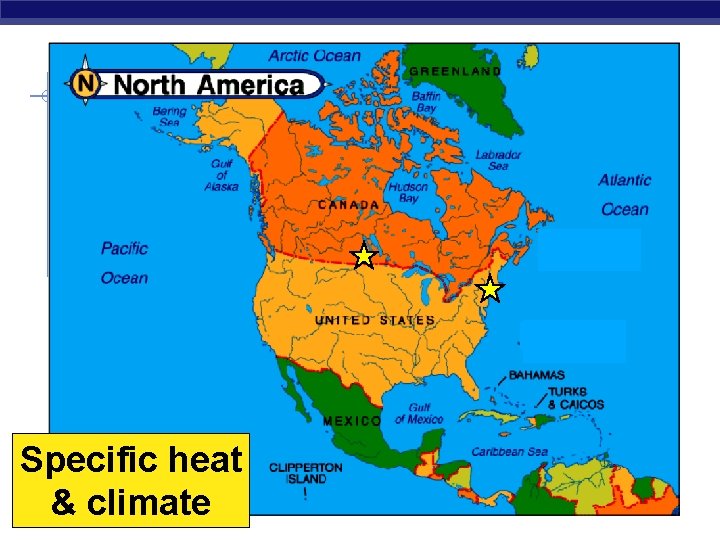
Specific heat climate AP & Biology
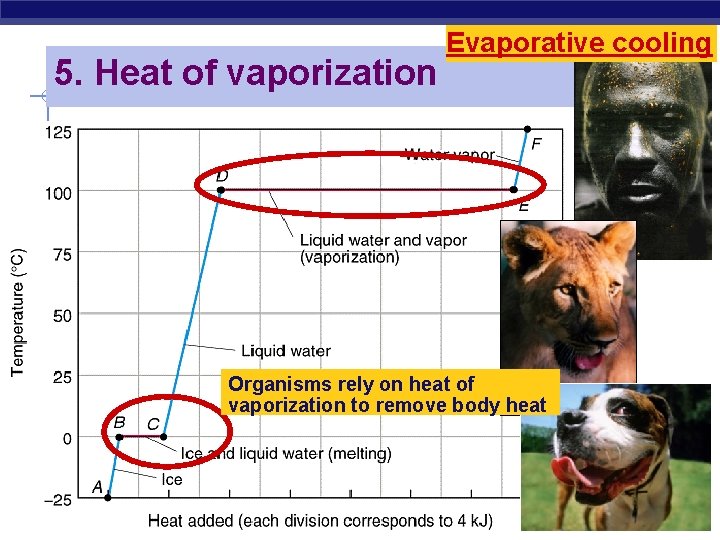
5. Heat of vaporization Evaporative cooling Organisms rely on heat of vaporization to remove body heat AP Biology
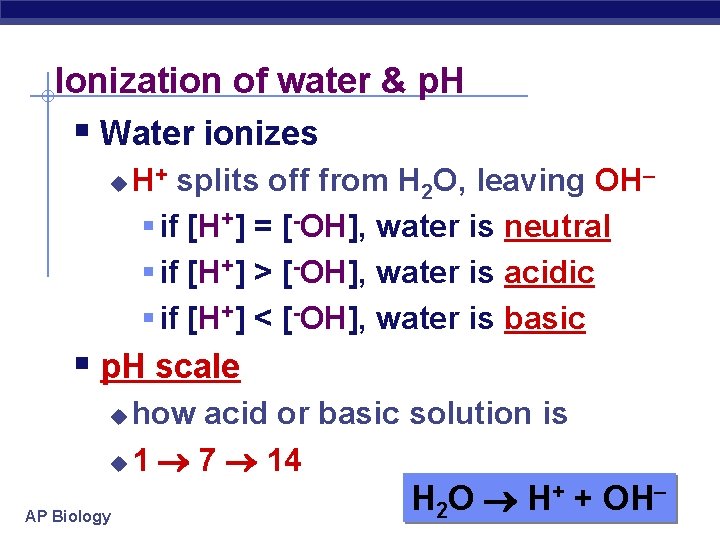
Ionization of water & p. H § Water ionizes u H+ splits off from H 2 O, leaving OH– § if [H+] = [-OH], water is neutral § if [H+] > [-OH], water is acidic § if [H+] < [-OH], water is basic § p. H scale how acid or basic solution is u 1 7 14 u AP Biology H 2 O H+ + OH–
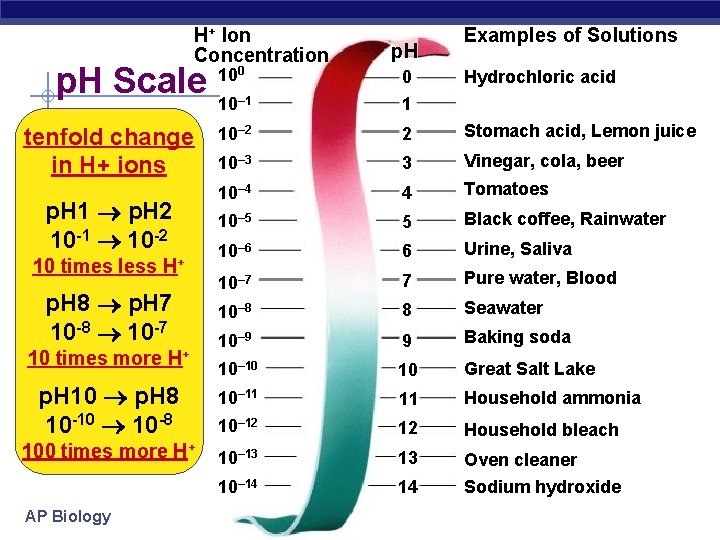
H+ Ion Concentration p. H Scale tenfold change in H+ ions p. H 1 p. H 2 10 -1 10 -2 10 times less H+ p. H 8 p. H 7 10 -8 10 -7 10 times more H+ p. H 10 p. H 8 10 -10 10 -8 100 times more AP Biology H+ p. H Examples of Solutions 100 0 10– 1 1 10– 2 2 Stomach acid, Lemon juice 10– 3 3 Vinegar, cola, beer 10– 4 4 Tomatoes 10– 5 5 Black coffee, Rainwater 10– 6 6 Urine, Saliva 10– 7 7 Pure water, Blood 10– 8 8 Seawater 10– 9 9 Baking soda 10– 10 10 Great Salt Lake 10– 11 11 Household ammonia 10– 12 12 Household bleach 10– 13 13 Oven cleaner 10– 14 14 Sodium hydroxide Hydrochloric acid
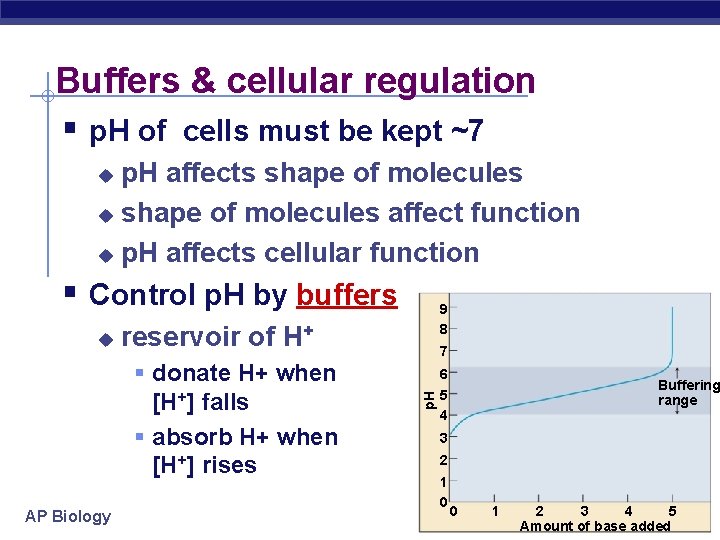
Buffers & cellular regulation § p. H of cells must be kept ~7 p. H affects shape of molecules u shape of molecules affect function u p. H affects cellular function u § Control p. H by buffers reservoir of H+ § donate H+ when [H+] falls § absorb H+ when [H+] rises AP Biology 7 6 p. H u 9 8 Buffering range 5 4 3 2 1 0 0 1 2 3 4 5 Amount of base added
He’s gonna earn a Darwin Award! Any Questions? Do one brave thing today…then run like hell! AP Biology 2007 -2008
- Slides: 41