
Chapter 2 The Chemical Basis of Life Power
Chapter 2 The Chemical Basis of Life Power. Point Lectures for Campbell Biology: Concepts & Connections, Seventh Edition Reece, Taylor, Simon, and Dickey © 2012 Pearson Education, Inc. Lecture by Edward J. Zalisko
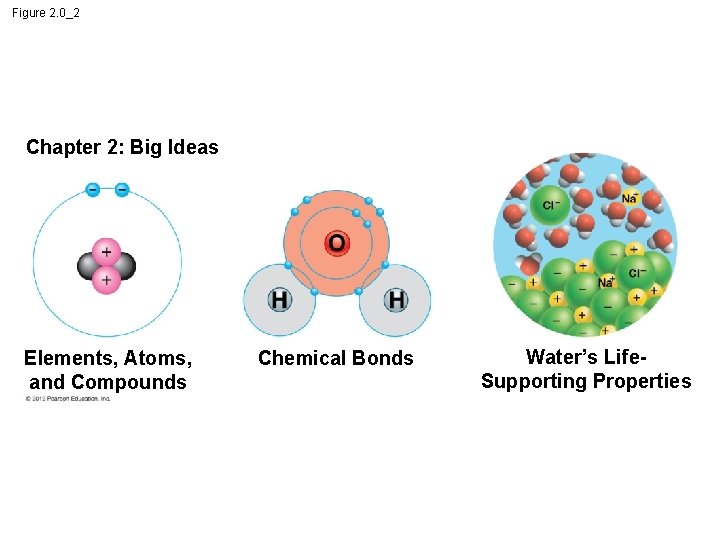
Figure 2. 0_2 Chapter 2: Big Ideas Elements, Atoms, and Compounds Chemical Bonds Water’s Life. Supporting Properties
Introduction § Chemicals are the stuff that make up – our bodies, – the bodies of other organisms, and – the physical environment. © 2012 Pearson Education, Inc.
Introduction § Life’s chemistry is tied to water. – Life first evolved in water. – All living organisms require water. – The chemical reactions of your body occur in cells consisting of 70– 95% water. © 2012 Pearson Education, Inc.
ELEMENTS, ATOMS, AND COMPOUNDS © 2012 Pearson Education, Inc.

2. 1 Organisms are composed of elements, in combinations called compounds § Living organisms are composed of matter, which is anything that occupies space and has mass (weight). § Matter is composed of chemical elements. – An element is a substance that cannot be broken down to other substances. – There are 92 elements in nature—only a few exist in a pure state. © 2012 Pearson Education, Inc.
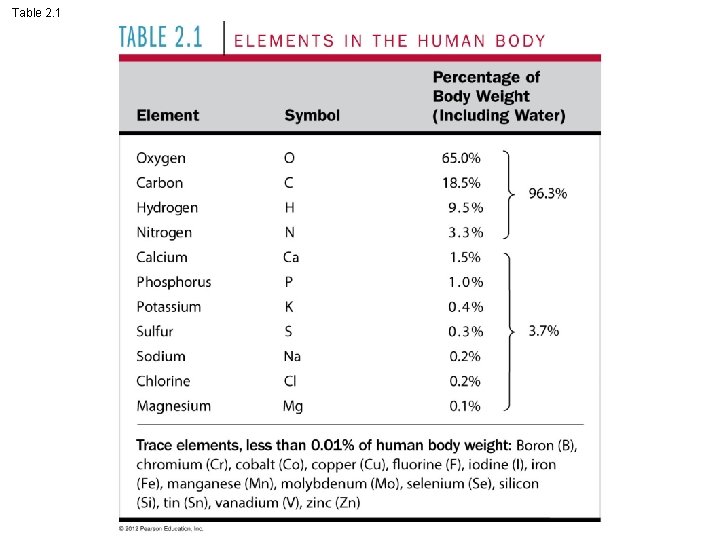
Table 2. 1
2. 1 Organisms are composed of elements, in combinations called compounds § A compound is a substance consisting of two or more different elements in a fixed ratio. § Compounds are more common than pure elements. § Sodium chloride, table salt, is a common compound of equal parts of sodium (Na) and chlorine (Cl). © 2012 Pearson Education, Inc.
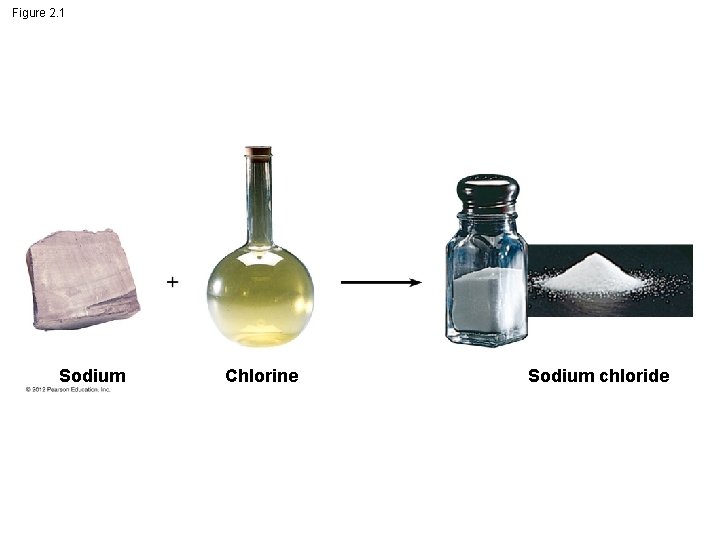
Figure 2. 1 Sodium Chlorine Sodium chloride
2. 1 Organisms are composed of elements, in combinations called compounds § About 25 elements are essential to life. § Four elements make up about 96% of the weight of most living organisms. These are – oxygen, – carbon, – hydrogen, and – nitrogen. § Trace elements are essential but are only needed in minute quantities. © 2012 Pearson Education, Inc.
2. 2 CONNECTION: Trace elements are common additives to food and water § Some trace elements are required to prevent disease. – Without iron, your body cannot transport oxygen. – An iodine deficiency prevents production of thyroid hormones, resulting in goiter. © 2012 Pearson Education, Inc.

Figure 2. 2 A
2. 2 CONNECTION: Trace elements are common additives to food and water § Fluoride is added to municipal water and dental products to help reduce tooth decay. © 2012 Pearson Education, Inc.
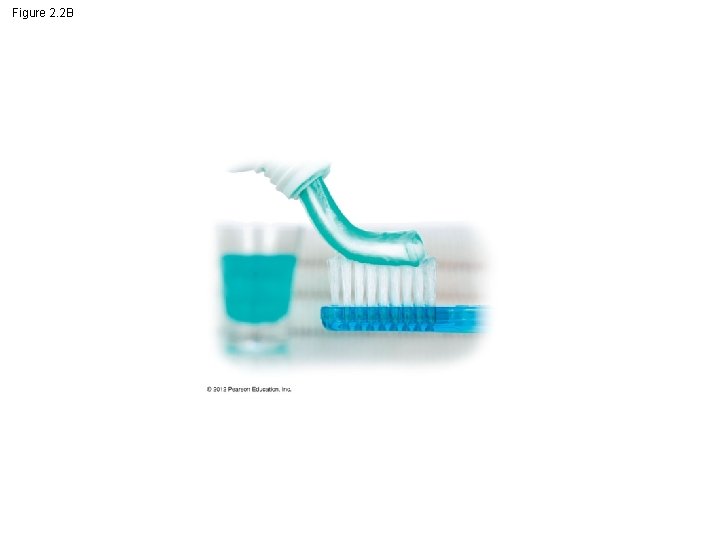
Figure 2. 2 B
2. 2 CONNECTION: Trace elements are common additives to food and water § Several chemicals are added to food to – help preserve it, – make it more nutritious, and/or – make it look better. § Check out the “Nutrition Facts” label on foods and drinks you purchase. © 2012 Pearson Education, Inc.
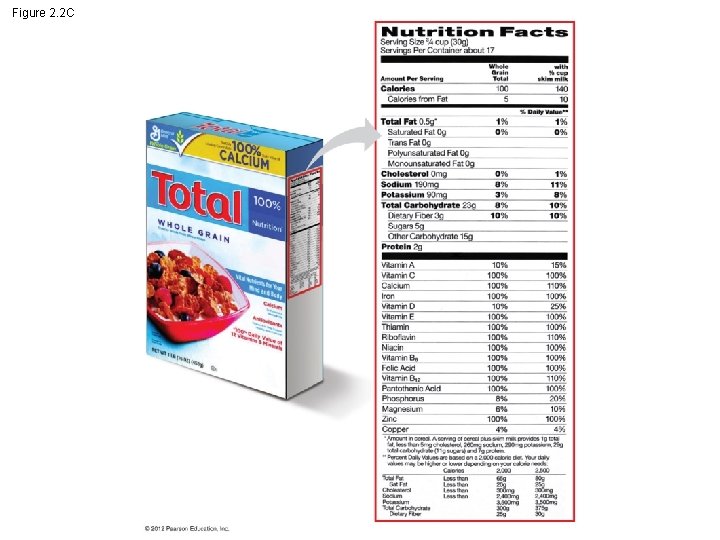
Figure 2. 2 C
2. 3 Atoms consist of protons, neutrons, and electrons § Each element consists of one kind of atom. § An atom is the smallest unit of matter that still retains the properties of an element. § Three subatomic particles in atoms are relevant to our discussion of the properties of elements. – Protons are positively charged. – Electrons are negatively charged. – Neutrons are electrically neutral. © 2012 Pearson Education, Inc.
2. 3 Atoms consist of protons, neutrons, and electrons § Neutrons and protons are packed into an atom’s nucleus. § Electrons orbit the nucleus. § The negative charge of electrons and the positive charge of protons keep electrons near the nucleus. © 2012 Pearson Education, Inc.
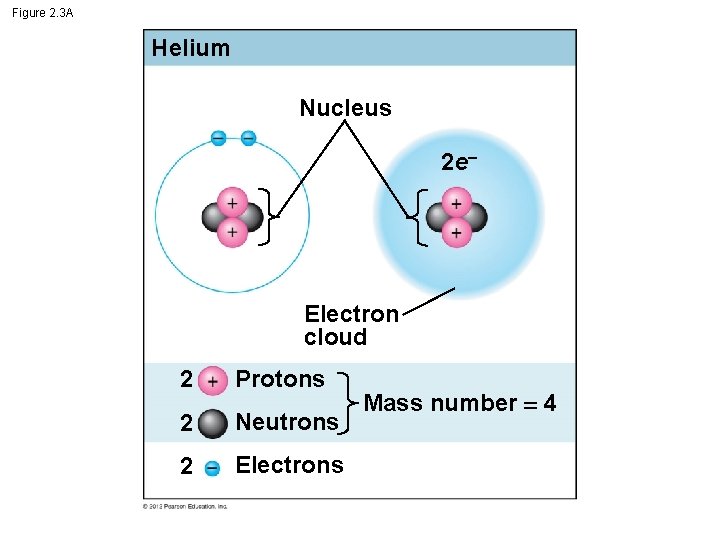
Figure 2. 3 A Helium Nucleus 2 e Electron cloud 2 Protons 2 Neutrons 2 Electrons Mass number 4
2. 3 Atoms consist of protons, neutrons, and electrons § The number of protons is the atom’s atomic number. § An atom’s mass number is the sum of the number of protons and neutrons in the nucleus. § The atomic mass is approximately equal to its mass number. © 2012 Pearson Education, Inc.
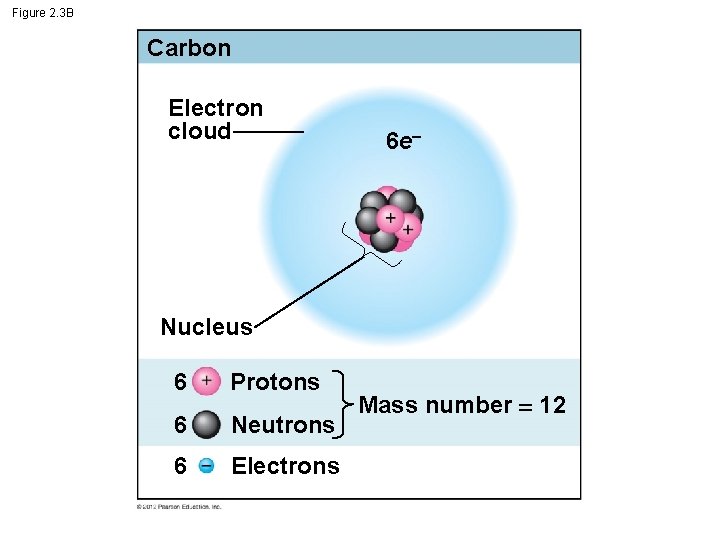
Figure 2. 3 B Carbon Electron cloud 6 e Nucleus 6 Protons 6 Neutrons 6 Electrons Mass number 12
2. 3 Atoms consist of protons, neutrons, and electrons § Although all atoms of an element have the same atomic number, some differ in mass number. § Different isotopes of an element have – the same number of protons, – but different numbers of neutrons. § Different isotopes of an element behave identically in chemical reactions. § In radioactive isotopes, the nucleus decays spontaneously, giving off particles and energy. © 2012 Pearson Education, Inc.
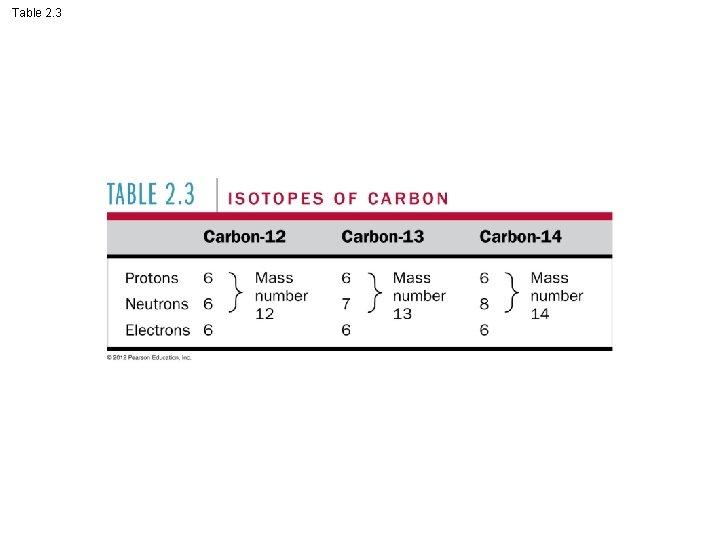
Table 2. 3
2. 4 CONNECTION: Radioactive isotopes can help or harm us § Living cells cannot distinguish between isotopes of the same element. – Therefore, radioactive compounds in metabolic processes can act as tracers. – This radioactivity can be detected by instruments. – Using these instruments, the fate of radioactive tracers can be monitored in living organisms. © 2012 Pearson Education, Inc.
2. 4 CONNECTION: Radioactive isotopes can help or harm us § Radioactive tracers are frequently used in medical diagnosis. § Sophisticated imaging instruments are used to detect them. – An imaging instrument that uses positron-emission tomography (PET) detects the location of injected radioactive materials. – PET is useful for diagnosing heart disorders, cancer, and in brain research. © 2012 Pearson Education, Inc.
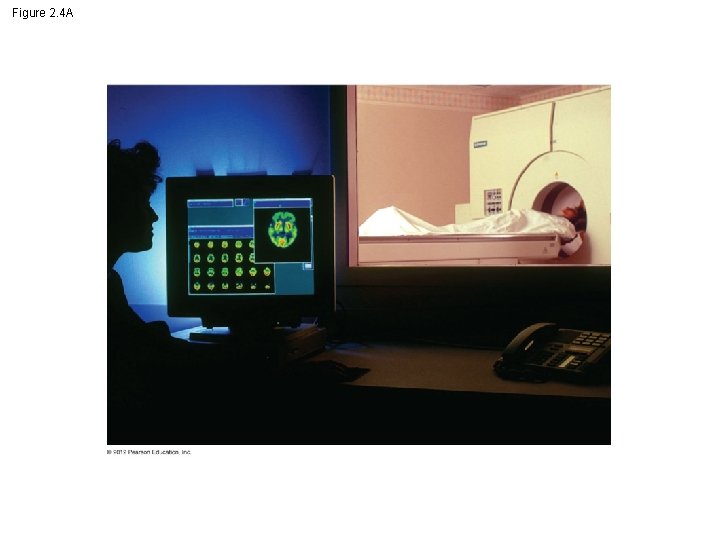
Figure 2. 4 A
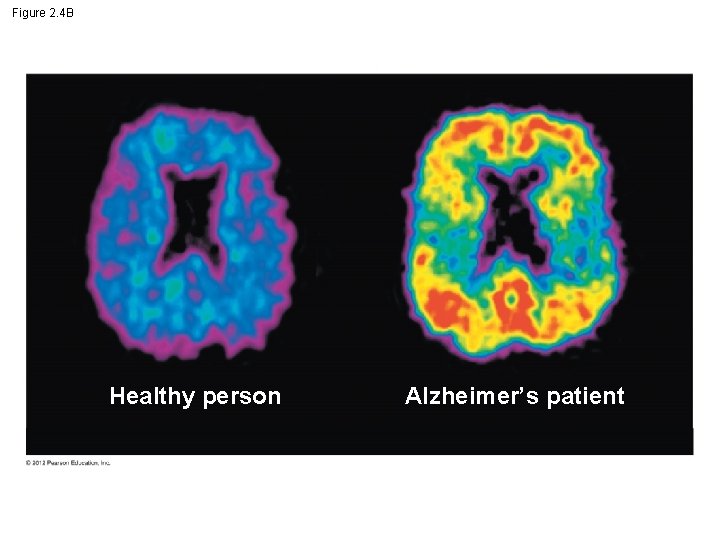
Figure 2. 4 B Healthy person Alzheimer’s patient
2. 4 CONNECTION: Radioactive isotopes can help or harm us § In addition to benefits, there also dangers associated with using radioactive substances. – Uncontrolled exposure can cause damage to some molecules in a living cell, especially DNA. – Chemical bonds are broken by the emitted energy, which causes abnormal bonds to form. © 2012 Pearson Education, Inc.
CHEMICAL BONDS © 2012 Pearson Education, Inc.
2. 5 The distribution of electrons determines an atom’s chemical properties § Of the three subatomic particles—protons, neutrons, and electrons—only electrons are directly involved in chemical activity. § Electrons occur in energy levels called electron shells. – Information about the distribution of electrons is found in the periodic table of the elements. © 2012 Pearson Education, Inc.
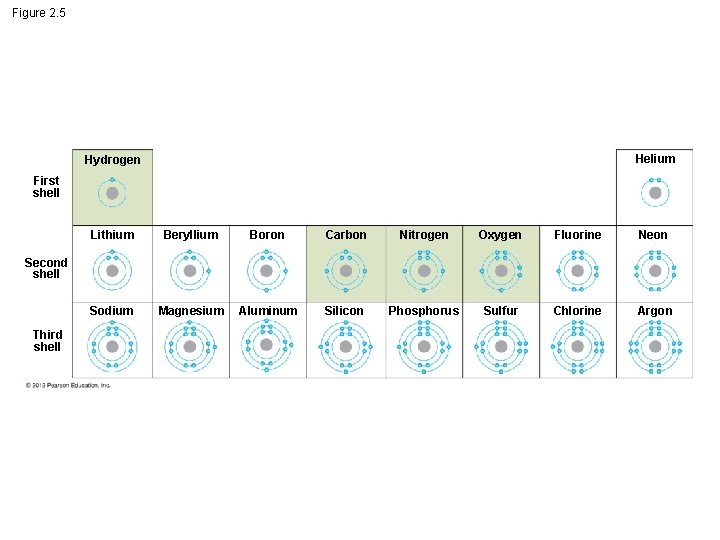
Figure 2. 5 Helium Hydrogen First shell Lithium Beryllium Boron Carbon Nitrogen Oxygen Fluorine Neon Sodium Magnesium Aluminum Silicon Phosphorus Sulfur Chlorine Argon Second shell Third shell
2. 5 The distribution of electrons determines an atom’s chemical properties § An atom may have one, two, or three electron shells surrounding the nucleus. – The number of electrons in the outermost shell determines the chemical properties of the atom. – Atoms whose outer shells are not full tend to interact with other atoms, participating in chemical reactions. © 2012 Pearson Education, Inc.
2. 5 The distribution of electrons determines an atom’s chemical properties § Atoms with incomplete outer shells tend to react so that both atoms end up with completed outer shells. § These atoms may react with each other by sharing, donating, or receiving electrons. § These interactions usually result in atoms staying close together, held by attractions called chemical bonds. © 2012 Pearson Education, Inc.
2. 6 Covalent bonds join atoms into molecules through electron sharing § The strongest kind of chemical bond is a covalent bond in which two atoms share one or more outershell electrons. § Two or more atoms held together by covalent bonds form a molecule. © 2012 Pearson Education, Inc.
2. 6 Covalent bonds join atoms into molecules through electron sharing § A covalent bond connects two hydrogen atoms in a molecule of the gas H 2. § There are four alternative ways to represent common molecules. © 2012 Pearson Education, Inc.
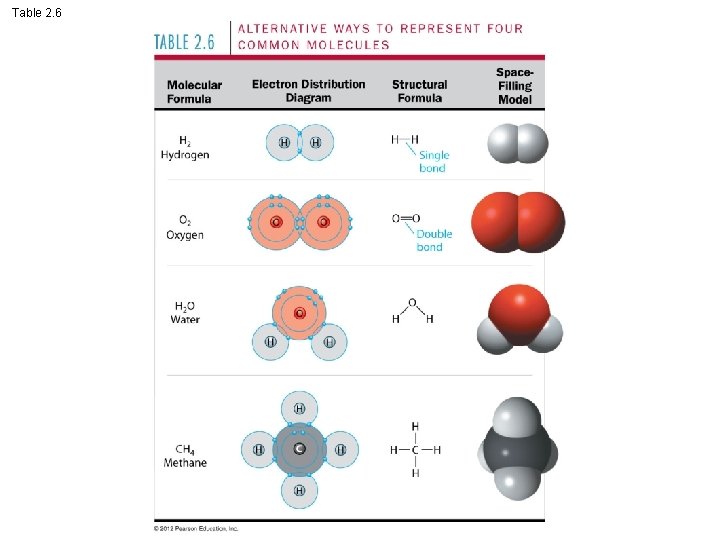
Table 2. 6
2. 6 Covalent bonds join atoms into molecules through electron sharing § Atoms in a covalently bonded molecule continually compete for shared electrons. – The attraction (pull) for shared electrons is called electronegativity. – More electronegative atoms pull harder. © 2012 Pearson Education, Inc.
2. 6 Covalent bonds join atoms into molecules through electron sharing § In molecules of only one element, the pull toward each atom is equal, because each atom has the same electronegativity. § The bonds formed are called nonpolar covalent bonds. © 2012 Pearson Education, Inc.
2. 6 Covalent bonds join atoms into molecules through electron sharing § Water has atoms with different electronegativities. – Oxygen attracts the shared electrons more strongly than hydrogen. – So, the shared electrons spend more time near oxygen. – The oxygen atom has a slightly negative charge and the hydrogen atoms have a slightly positive charge. – The result is a polar covalent bond. – Because of these polar covalent bonds, water is a polar molecule. © 2012 Pearson Education, Inc.
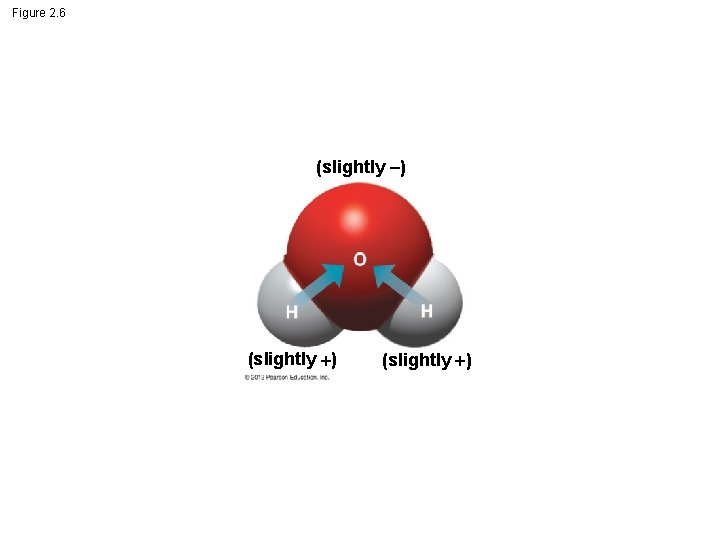
Figure 2. 6 (slightly )
2. 7 Ionic bonds are attractions between ions of opposite charge § An ion is an atom or molecule with an electrical charge resulting from gain or loss of electrons. – When an electron is lost, a positive charge results. – When an electron is gained, a negative charge results. § Two ions with opposite charges attract each other. – When the attraction holds the ions together, it is called an ionic bond. – Salt is a synonym for an ionic compound. © 2012 Pearson Education, Inc.
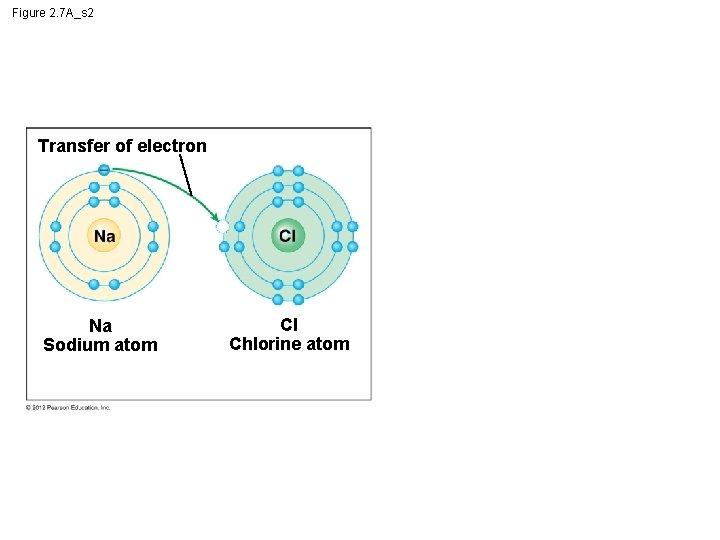
Figure 2. 7 A_s 2 Transfer of electron Na Sodium atom Cl Chlorine atom
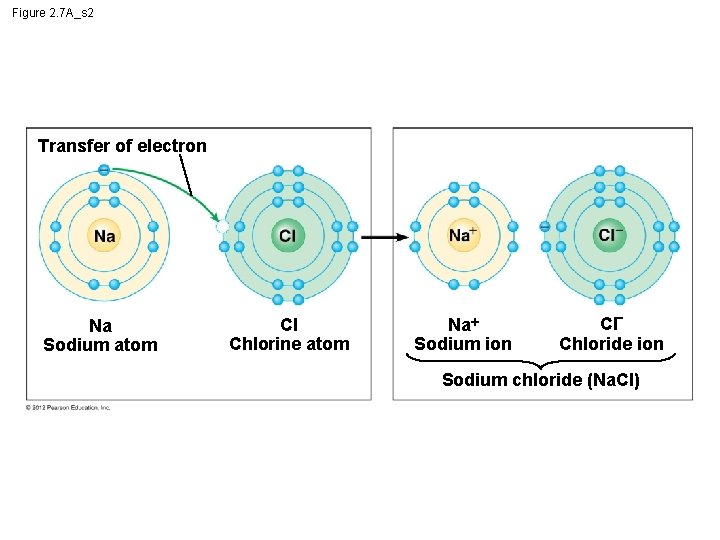
Figure 2. 7 A_s 2 Transfer of electron Na Sodium atom Cl Chlorine atom Na Sodium ion Cl Chloride ion Sodium chloride (Na. Cl)
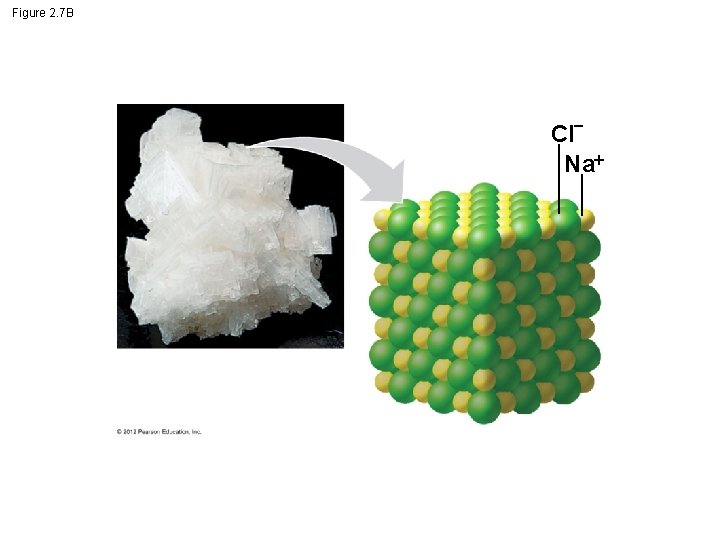
Figure 2. 7 B Cl Na
2. 8 Hydrogen bonds are weak bonds important in the chemistry of life § Most large molecules are held in their threedimensional functional shape by weak bonds. § Hydrogen, as part of a polar covalent bond, has a partial positive charge. § The charged regions on molecules are electrically attracted to oppositely charged regions on neighboring molecules. § Because the positively charged region is always a hydrogen atom, the bond is called a hydrogen bond. © 2012 Pearson Education, Inc.
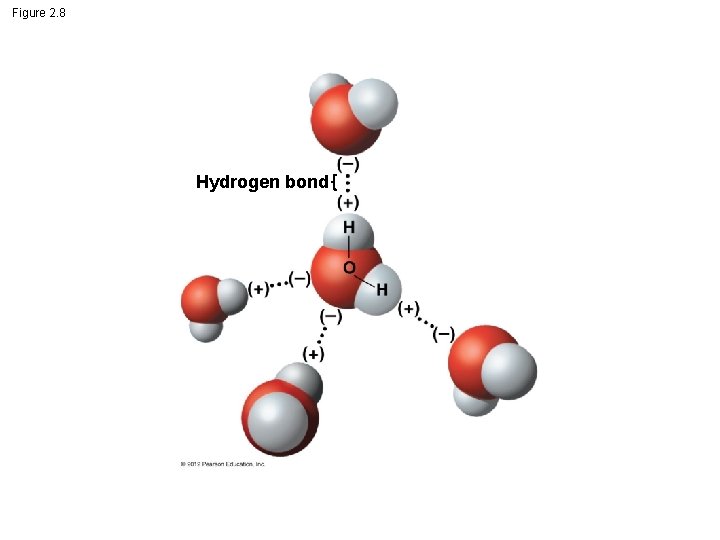
Figure 2. 8 Hydrogen bond
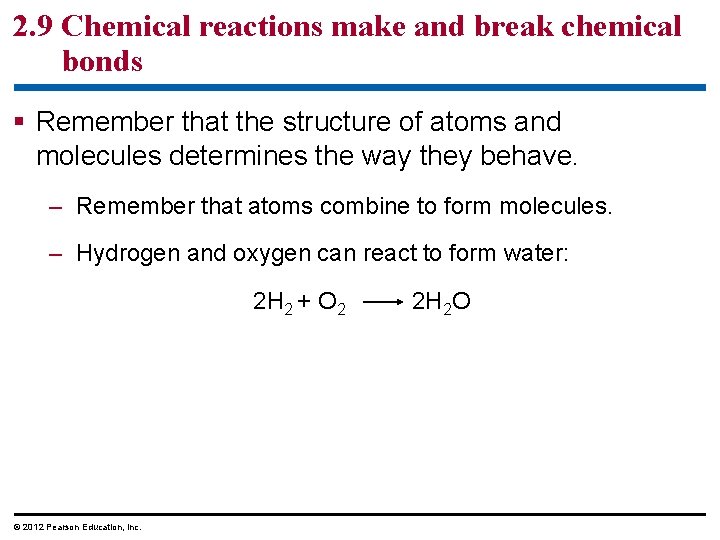
2. 9 Chemical reactions make and break chemical bonds § Remember that the structure of atoms and molecules determines the way they behave. – Remember that atoms combine to form molecules. – Hydrogen and oxygen can react to form water: 2 H 2 + O 2 © 2012 Pearson Education, Inc. 2 H 2 O
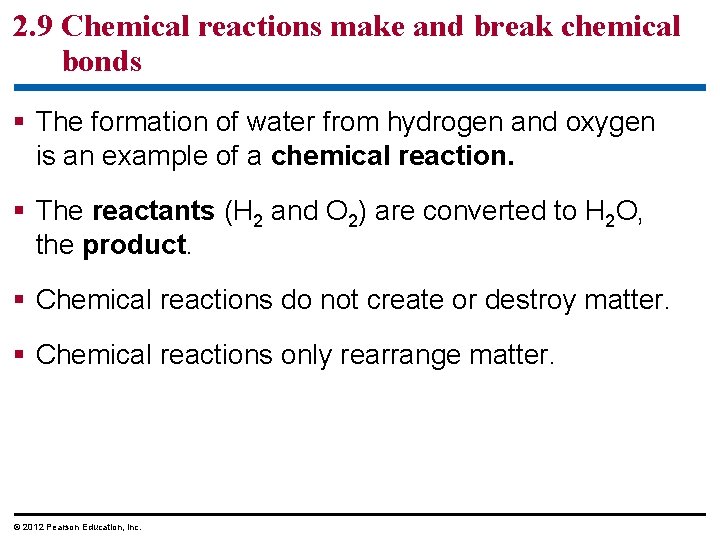
2. 9 Chemical reactions make and break chemical bonds § The formation of water from hydrogen and oxygen is an example of a chemical reaction. § The reactants (H 2 and O 2) are converted to H 2 O, the product. § Chemical reactions do not create or destroy matter. § Chemical reactions only rearrange matter. © 2012 Pearson Education, Inc.
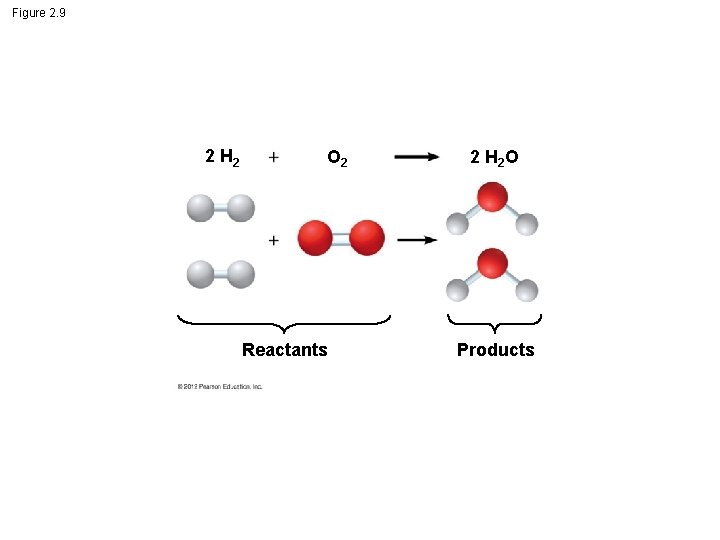
Figure 2. 9 2 H 2 O 2 Reactants 2 H 2 O Products
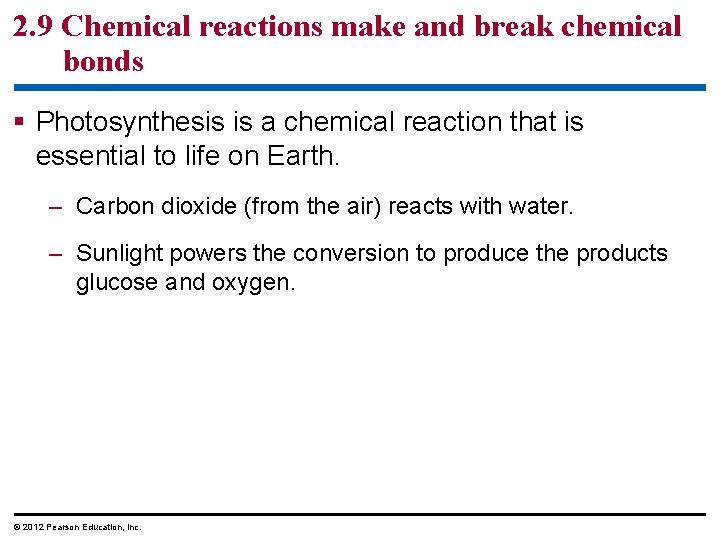
2. 9 Chemical reactions make and break chemical bonds § Photosynthesis is a chemical reaction that is essential to life on Earth. – Carbon dioxide (from the air) reacts with water. – Sunlight powers the conversion to produce the products glucose and oxygen. © 2012 Pearson Education, Inc.
WATER’S LIFE-SUPPORTING PROPERTIES © 2012 Pearson Education, Inc.
2. 10 Hydrogen bonds make liquid water cohesive § The tendency of molecules of the same kind to stick together is cohesion. – Cohesion is much stronger for water than other liquids. – Most plants depend upon cohesion to help transport water and nutrients from their roots to their leaves. § The tendency of two kinds of molecules to stick together is adhesion. © 2012 Pearson Education, Inc.
2. 10 Hydrogen bonds make liquid water cohesive § Cohesion is related to surface tension—a measure of how difficult it is to break the surface of a liquid. – Hydrogen bonds give water high surface tension, making it behave as if it were coated with an invisible film. – Water striders stand on water without breaking the water surface. © 2012 Pearson Education, Inc.
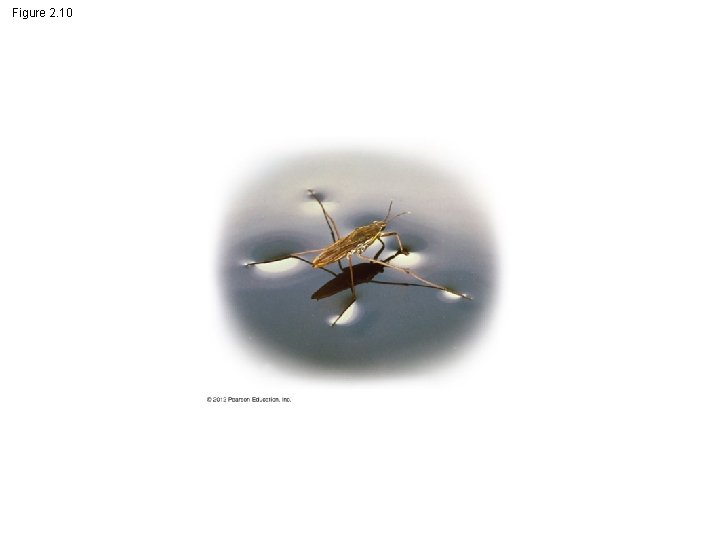
Figure 2. 10
2. 11 Water’s hydrogen bonds moderate temperature § Because of hydrogen bonding, water has a greater ability to resist temperature change than other liquids. – Heat is the energy associated with movement of atoms and molecules in matter. – Temperature measures the intensity of heat. § Heat is released when hydrogen bonds form. § Heat must be absorbed to break hydrogen bonds. © 2012 Pearson Education, Inc.
2. 11 Water’s hydrogen bonds moderate temperature § When a substance evaporates, the surface of the liquid that remains behind cools down, in the process of evaporative cooling. § This cooling occurs because the molecules with the greatest energy leave the surface. © 2012 Pearson Education, Inc.
2. 12 Ice is less dense than liquid water § Water can exist as a gas, liquid, or solid. § Water is less dense as a solid than a liquid because of hydrogen bonding. § When water freezes, each molecule forms a stable hydrogen bond with its neighbors. – As ice crystals form, the molecules are less densely packed than in liquid water. – Because ice is less dense than water, it floats. © 2012 Pearson Education, Inc.
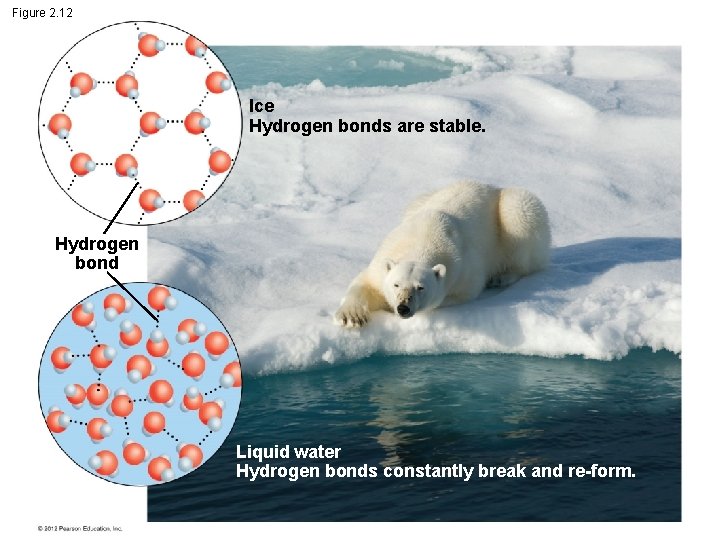
Figure 2. 12 Ice Hydrogen bonds are stable. Hydrogen bond Liquid water Hydrogen bonds constantly break and re-form.
2. 13 Water is the solvent of life § A solution is a liquid consisting of a uniform mixture of two or more substances. – The dissolving agent is the solvent. – The substance that is dissolved is the solute. – An aqueous solution is one in which water is the solvent. © 2012 Pearson Education, Inc.
2. 13 Water is the solvent of life § Water’s versatility as a solvent results from the polarity of its molecules. § Polar or charged solutes dissolve when water molecules surround them, forming aqueous solutions. § Table salt is an example of a solute that will go into solution in water. © 2012 Pearson Education, Inc.
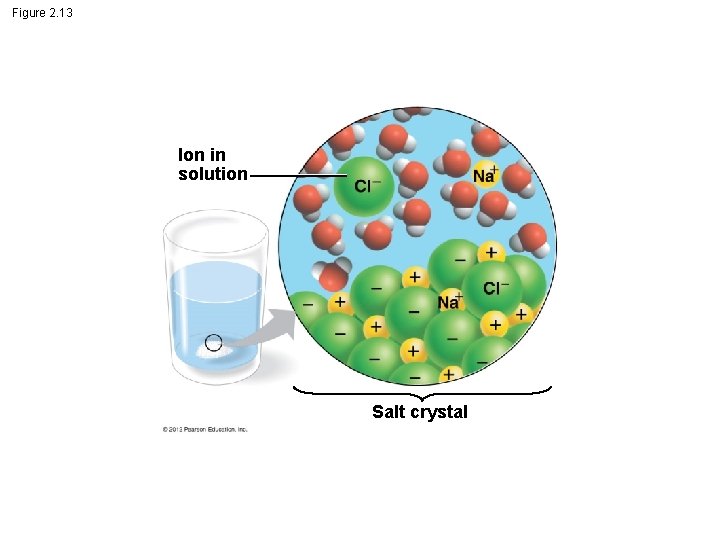
Figure 2. 13 Ion in solution Salt crystal
2. 14 The chemistry of life is sensitive to acidic and basic conditions § In aqueous solutions, a small percentage of water molecules break apart into ions. – Some are hydrogen ions (H+). – Some are hydroxide ions (OH–). – Both types are very reactive. © 2012 Pearson Education, Inc.
2. 14 The chemistry of life is sensitive to acidic and basic conditions § A compound that releases H+ to a solution is an acid. § A compound that accepts H+ is a base. § The p. H scale describes how acidic or basic a solution is. – The p. H scale ranges from 0 to 14, with zero the most acidic and 14 the most basic. – Each p. H unit represents a tenfold change in the concentration of H+. © 2012 Pearson Education, Inc.
2. 14 The chemistry of life is sensitive to acidic and basic conditions § A buffer is a substance that minimizes changes in p. H. Buffers – accept H+ when it is in excess and – donate H+ when it is depleted. © 2012 Pearson Education, Inc.
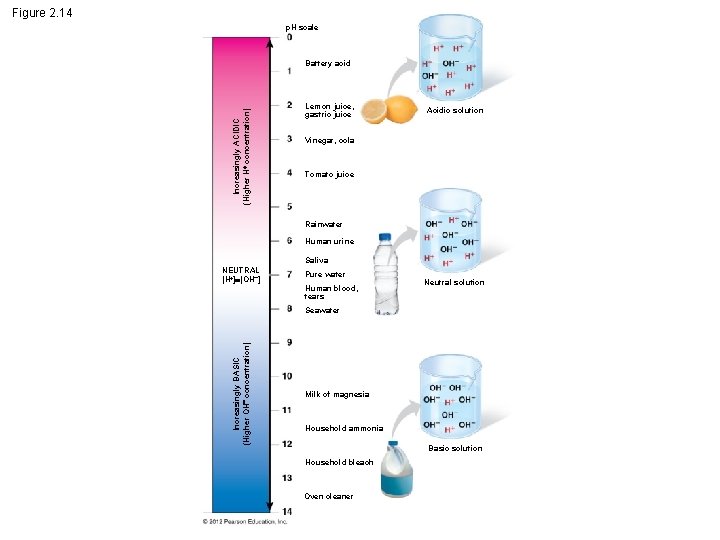
Figure 2. 14 p. H scale Increasingly ACIDIC (Higher H concentration) Battery acid Lemon juice, gastric juice Acidic solution Vinegar, cola Tomato juice Rainwater Human urine Saliva NEUTRAL [H ] [OH ] Pure water Human blood, tears Neutral solution Increasingly BASIC (Higher OH concentration) Seawater Milk of magnesia Household ammonia Basic solution Household bleach Oven cleaner
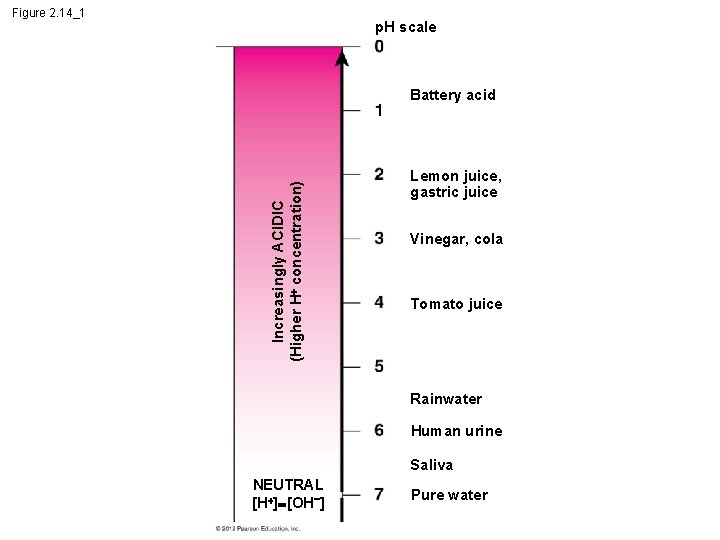
Figure 2. 14_1 p. H scale Increasingly ACIDIC (Higher H concentration) Battery acid Lemon juice, gastric juice Vinegar, cola Tomato juice Rainwater Human urine Saliva NEUTRAL [H ] [OH ] Pure water
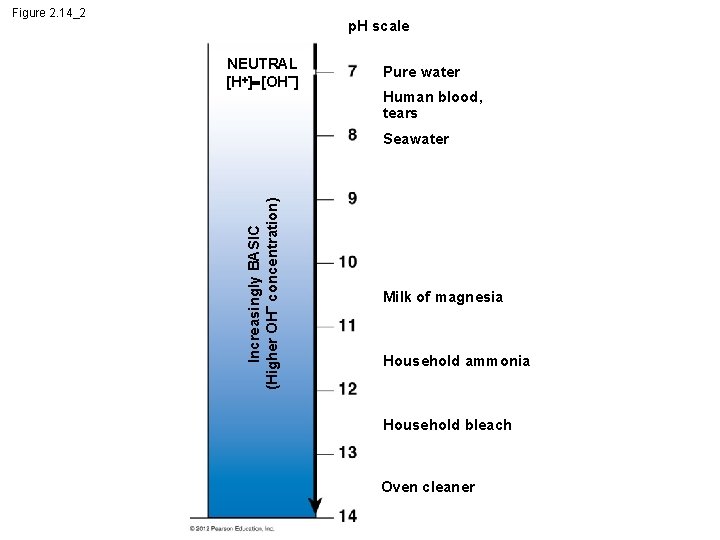
Figure 2. 14_2 p. H scale NEUTRAL [H ] [OH ] Pure water Human blood, tears Increasingly BASIC (Higher OH concentration) Seawater Milk of magnesia Household ammonia Household bleach Oven cleaner
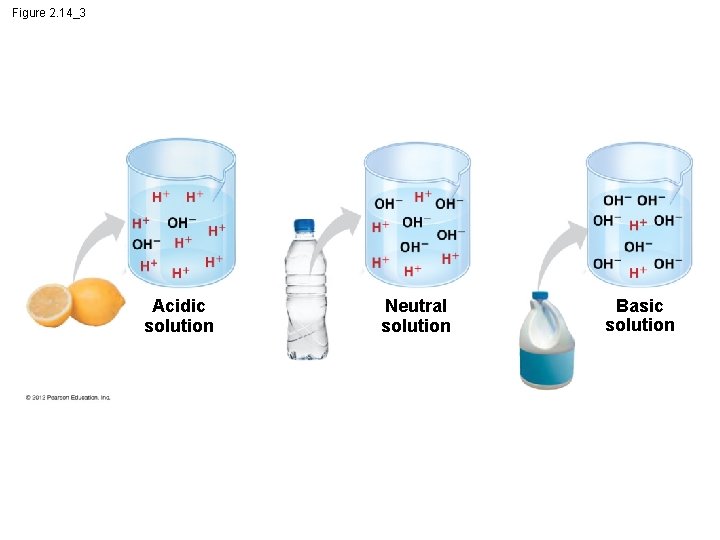
Figure 2. 14_3 Acidic solution Neutral solution Basic solution
- Slides: 68