
Chapter 2 The Behaviour of Gases Section 2
Chapter 2 – The Behaviour of Gases – Section 2. 4 CHM 1111 Section 04 Instructor: Dr. Jules Carlson Class Time: M/W/F 1: 30 -2: 20
Housekeeping • Chapter 2 practice problems should be completed by Friday, we won’t have covered all the material to do all of the problems until Friday. Do not worry if you could not do them all yet. • Textbooks, I>clickers, as long as the bookstore is out this is not your responsibility. We will count I>clickers for marks once the new ones arrive at the bookstore. • Also, lab manuals are in stock at the Petrified Sole bookstore (Basement of Bulman) • First lets register I>clickers and finally do the first question.
Course Registration • I have recently received information about Course Registration and changes. • If you are truly not registered and need to register, you need to see Murielle in the Chemistry office. • If you really need to switch lecture sections, it is next to impossible, and only the most critical will be considered. We cannot move large numbers of people due to fire restrictions. It is important to attend the section you are registered in. • Switching lab sections is next to impossible because they are all nearly full but I advise you see Murielle or the Lab Coordinator Theresa Baran (2 RC 046)

Mole and Mole Fraction Relationships Substance Relationship Pure Liquid or solid Moles = Mass/Molar mass ppm = mg/kg ppb = μg/kg Liquid Solution Moles = (Molarity)(Volume) ppm = mg/L ppb = μg/L in water Gas Equation Fraction (ppm, ppb) ppm = moles/106 moles ppb = moles/109 moles
Gas Stoichiometry Problems • To solve stoichiometry problems, follow these steps. 1. Understand the problem and what physical process is happening, if it helps draw a picture. 2. Write down all pertinent information. Also, look for assumptions that will simplify a question, or make information not pertinent. 3. Think about what you need to solve for, what information you have, and what equations are available. 4. Balance the relevant equation(s).
Gas Stoichiometry Problems 5. Determine the limiting reagent. 6. Build an ICE (textbook uses ICF) table. 7. Determine the final number of moles or concentrations of all compounds 8. Solve for the measurement needed (check for correct units). 9. Look at your answer, is it reasonable?
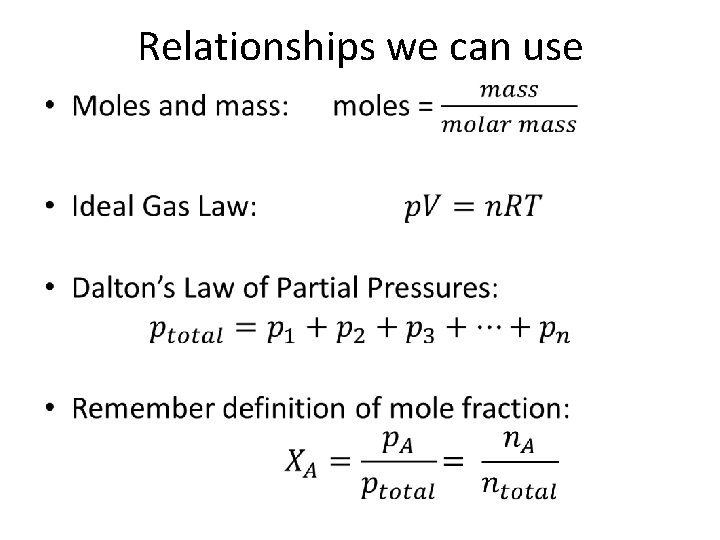
Relationships we can use •
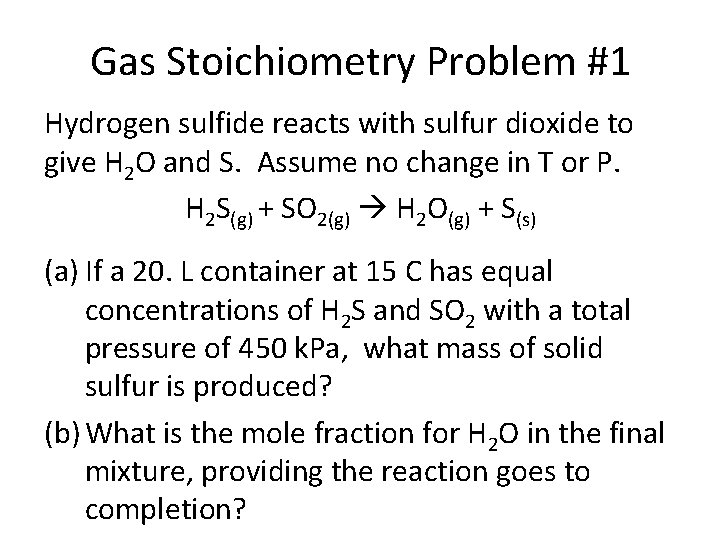
Gas Stoichiometry Problem #1 Hydrogen sulfide reacts with sulfur dioxide to give H 2 O and S. Assume no change in T or P. H 2 S(g) + SO 2(g) H 2 O(g) + S(s) (a) If a 20. L container at 15 C has equal concentrations of H 2 S and SO 2 with a total pressure of 450 k. Pa, what mass of solid sulfur is produced? (b) What is the mole fraction for H 2 O in the final mixture, providing the reaction goes to completion?
- Slides: 8