
Chapter 2 The Basics of Supply and Demand
Chapter 2 The Basics of Supply and Demand
Topics to Be Discussed • Supply and Demand • The Market Mechanism • Changes in Market Equilibrium • Elasticities of Supply and Demand • Short-Run Versus Long-Run Elasticities Chapter 1 2

Topics to Be Discussed • Understanding and Predicting the Effects of Changing Market Conditions • Effects of Government Intervention--Price Controls Chapter 1 3
Introduction • Applications of Supply and Demand Analysis – – Understanding and predicting how world economic conditions affect market price and production Analyzing the impact of government price controls, minimum wages, price supports, and production incentives Chapter 1 4
Introduction • Applications of Supply and Demand Analysis – Analyzing how taxes, subsidies, and import restrictions affect consumers and producers Chapter 1 5
Supply and Demand • The Supply Curve – The supply curve shows how much of a good producers are willing to sell at a given price, holding constant other factors that might affect quantity supplied Chapter 1 6
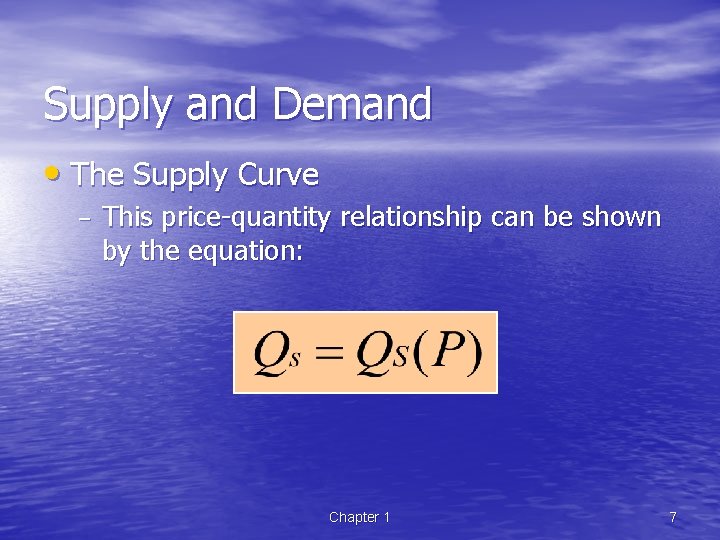
Supply and Demand • The Supply Curve – This price-quantity relationship can be shown by the equation: Chapter 1 7
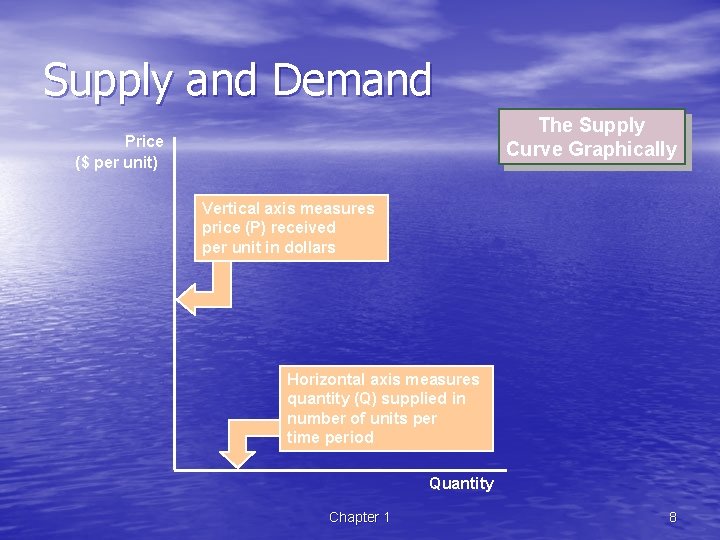
Supply and Demand The Supply Curve Graphically Price ($ per unit) Vertical axis measures price (P) received per unit in dollars Horizontal axis measures quantity (Q) supplied in number of units per time period Quantity Chapter 1 8
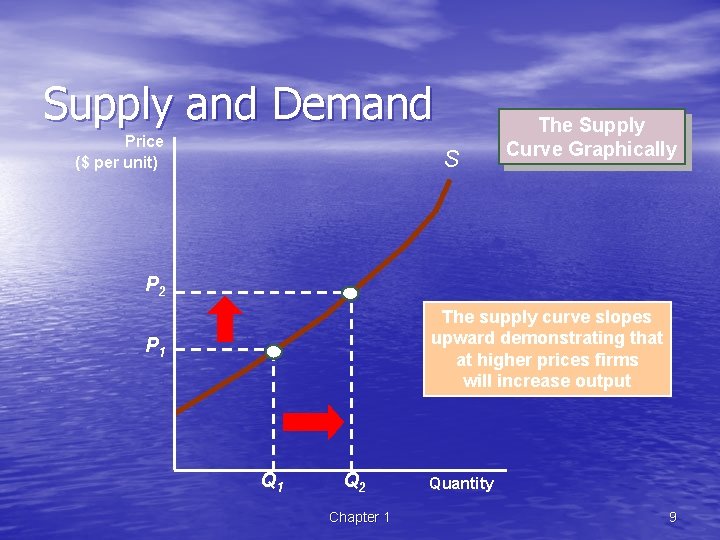
Supply and Demand Price ($ per unit) S The Supply Curve Graphically P 2 The supply curve slopes upward demonstrating that at higher prices firms will increase output P 1 Q 2 Chapter 1 Quantity 9
Supply and Demand • Non-price Determining Variables of Supply – Costs of Production • Labor • Capital • Raw Materials Chapter 1 10
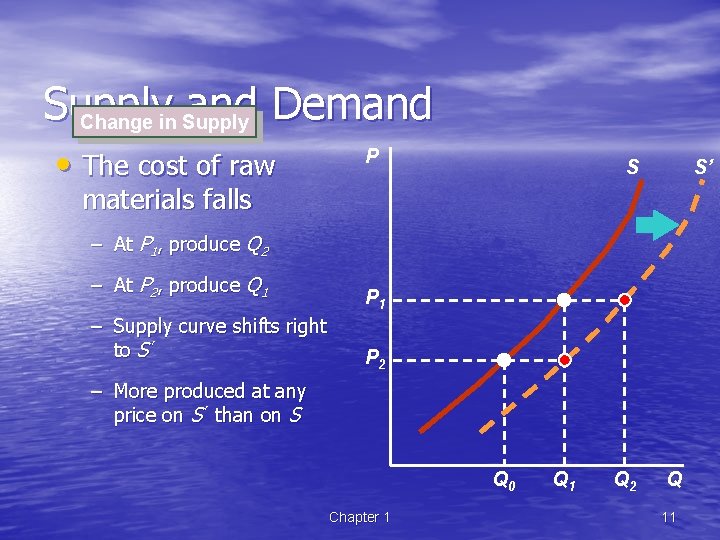
Supply and Demand Change in Supply • The cost of raw P S S’ materials falls – At P 1, produce Q 2 – At P 2, produce Q 1 – Supply curve shifts right to S’ P 1 P 2 – More produced at any price on S’ than on S Q 0 Chapter 1 Q 2 Q 11
Supply and Demand • Supply - A Review – – Supply is determined by non-price supplydetermining variables as such as the cost of labor, capital, and raw materials. Changes in supply are shown by shifting the entire supply curve. Chapter 1 12
Supply and Demand • Supply - A Review – Changes in quantity supplied are shown by movements along the supply curve and are caused by a change in the price of the product. Chapter 1 13
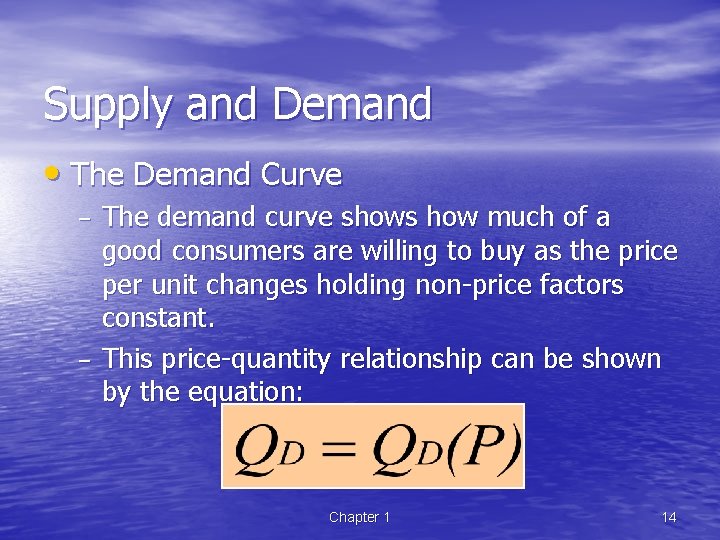
Supply and Demand • The Demand Curve – – The demand curve shows how much of a good consumers are willing to buy as the price per unit changes holding non-price factors constant. This price-quantity relationship can be shown by the equation: Chapter 1 14
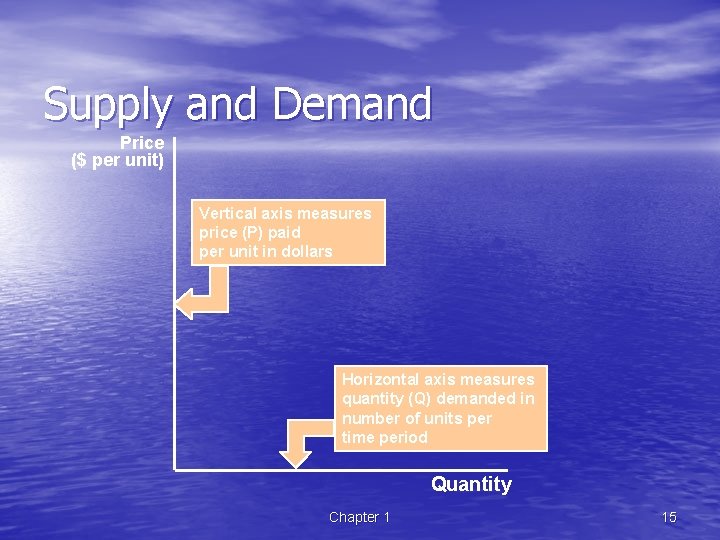
Supply and Demand Price ($ per unit) Vertical axis measures price (P) paid per unit in dollars Horizontal axis measures quantity (Q) demanded in number of units per time period Quantity Chapter 1 15
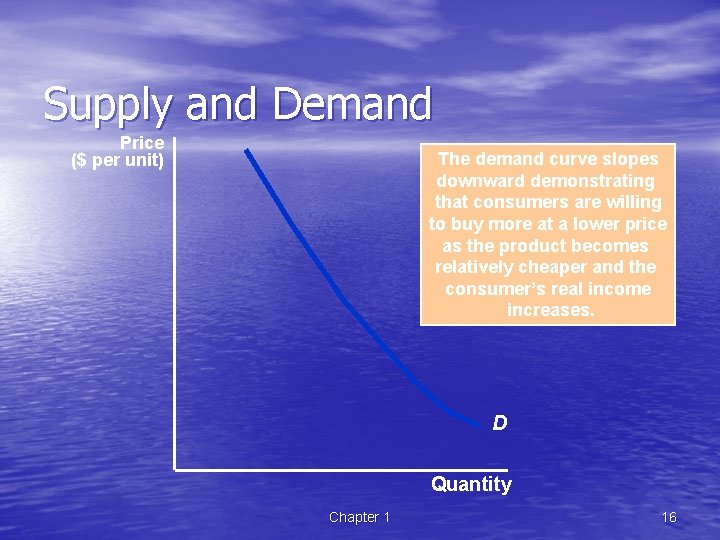
Supply and Demand Price ($ per unit) The demand curve slopes downward demonstrating that consumers are willing to buy more at a lower price as the product becomes relatively cheaper and the consumer’s real income increases. D Quantity Chapter 1 16
Supply and Demand • Non-price Determining Variables of Demand – – – Income Consumer Tastes Price of Related Goods • Substitutes • Complements Chapter 1 17
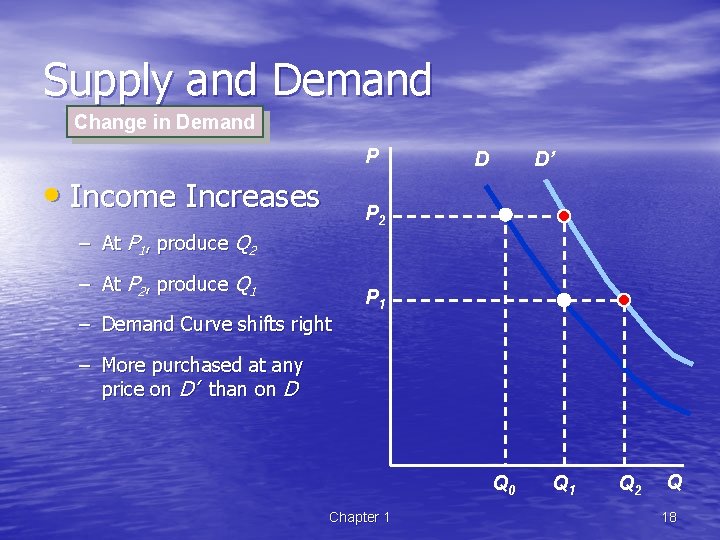
Supply and Demand Change in Demand P • Income Increases D D’ P 2 – At P 1, produce Q 2 – At P 2, produce Q 1 – Demand Curve shifts right P 1 – More purchased at any price on D’ than on D Q 0 Chapter 1 Q 2 Q 18
Shifts in Supply and Demand • Demand - A Review – – – Demand is determined by non-price demanddetermining variables, such as, income, price of related goods, and tastes. Changes in demand are shown by shifting the entire demand curve. Changes in quantity demanded are shown by movements along the demand curve. Chapter 1 19
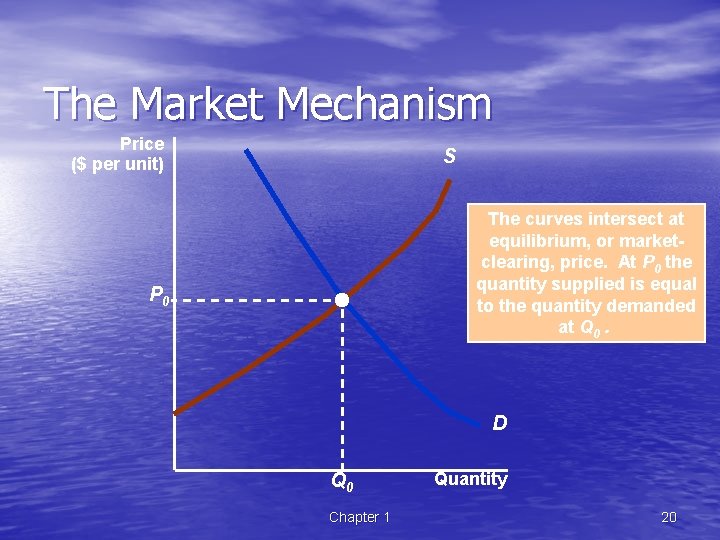
The Market Mechanism Price ($ per unit) S The curves intersect at equilibrium, or marketclearing, price. At P 0 the quantity supplied is equal to the quantity demanded at Q 0. P 0 D Q 0 Chapter 1 Quantity 20
The Market Mechanism • Characteristics of the equilibrium or market clearing price: – QD = Q S – No shortage – No excess supply – No pressure on the price to change Chapter 1 21
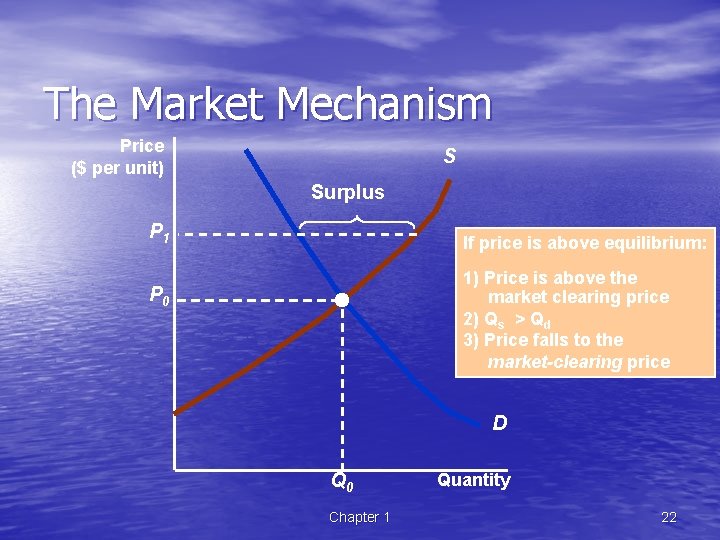
The Market Mechanism Price ($ per unit) S Surplus P 1 If price is above equilibrium: 1) Price is above the market clearing price 2) Qs > Qd 3) Price falls to the market-clearing price P 0 D Q 0 Chapter 1 Quantity 22
The Market Mechanism A Surplus • The market price is above equilibrium – – There is excess supply Producers lower prices Quantity demanded increases and quantity supplied decreases The market continues to adjust until the equilibrium price is reached. Chapter 1 23
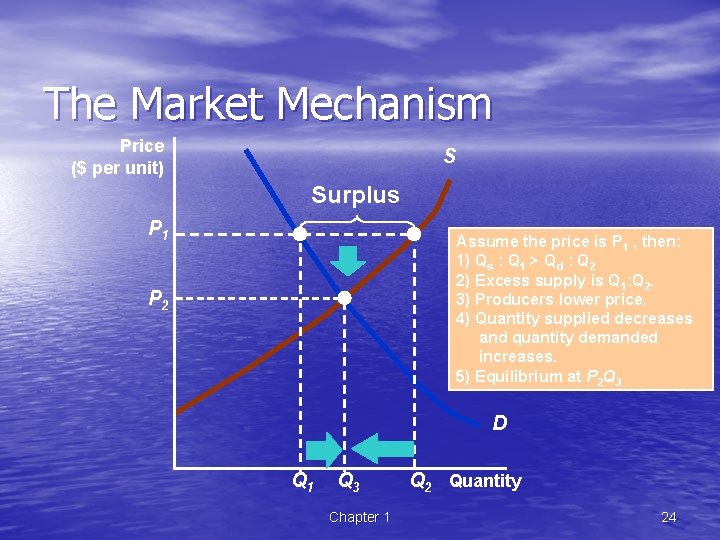
The Market Mechanism Price ($ per unit) S Surplus P 1 Assume the price is P 1 , then: 1) Qs : Q 1 > Qd : Q 2 2) Excess supply is Q 1: Q 2. 3) Producers lower price. 4) Quantity supplied decreases and quantity demanded increases. 5) Equilibrium at P 2 Q 3 P 2 D Q 1 Q 3 Chapter 1 Q 2 Quantity 24
The Market Mechanism Surplus - Review: • The market price is above equilibrium: – – There is excess supply Producers lower prices Quantity demanded increases and quantity supplied decreases The market continues to adjust until the equilibrium price is reached Chapter 1 25
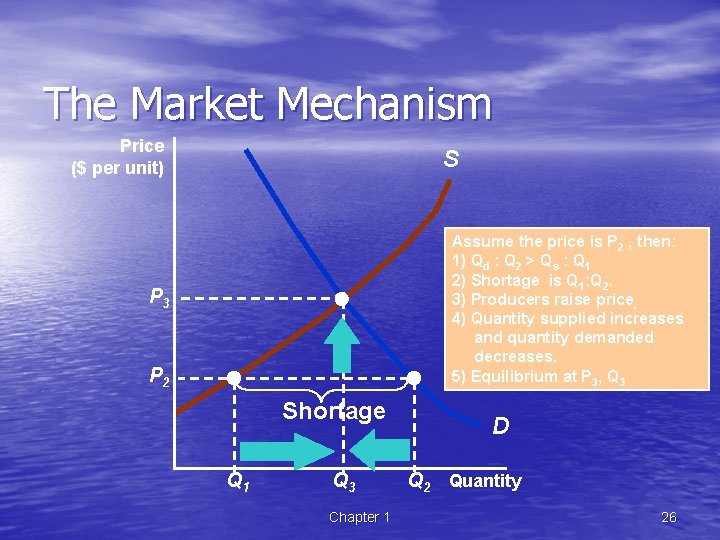
The Market Mechanism Price ($ per unit) S Assume the price is P 2 , then: 1) Qd : Q 2 > Qs : Q 1 2) Shortage is Q 1: Q 2. 3) Producers raise price. 4) Quantity supplied increases and quantity demanded decreases. 5) Equilibrium at P 3, Q 3 P 2 Shortage Q 1 Q 3 Chapter 1 D Q 2 Quantity 26
The Market Mechanism Shortage • The market price is below equilibrium: – – There is a shortage Producers raise prices Quantity demanded decreases and quantity supplied increases The market continues to adjust until the new equilibrium price is reached. Chapter 1 27
The Market Mechanism • Market Mechanism Summary 1) Supply and demand interact to determine the market-clearing price. 2) When not in equilibrium, the market will adjust to alleviate a shortage or surplus and return the market to equilibrium. 3) Markets must be competitive for the Chapter 1 mechanism to be efficient. 28
Changes In Market Equilibrium • Equilibrium prices are determined by the relative level of supply and demand. • Supply and demand are determined by particular values of supply and demand determining variables. • Changes in any one or combination of these variables can cause a change in the equilibrium price and/or quantity. Chapter 1 29
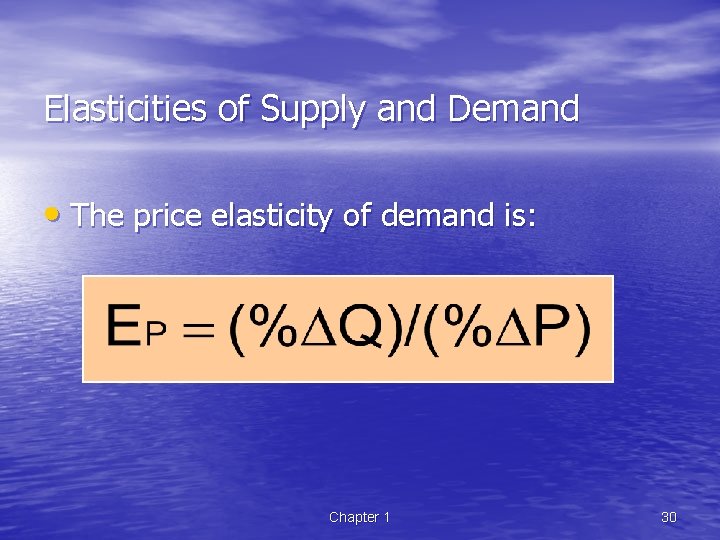
Elasticities of Supply and Demand • The price elasticity of demand is: Chapter 1 30
Elasticities of Supply and Demand Price Elasticity of Demand • The percentage change in a variable is the absolute change in the variable divided by the original level of the variable. Chapter 1 31
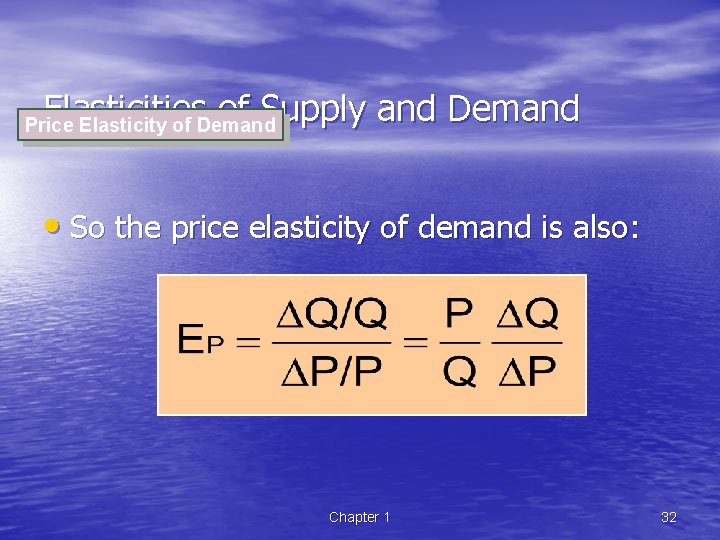
Elasticities of Supply and Demand Price Elasticity of Demand • So the price elasticity of demand is also: Chapter 1 32
End of Chapter 2 The Basics of Supply and Demand
- Slides: 33