
Chapter 2 The Basic Concepts of Set Theory
Chapter 2 The Basic Concepts of Set Theory Copyright © 2016, 2012, and 2008 Pearson Education, Inc.
Chapter 2: The Basic Concepts of Set Theory 2. 1 Symbols and Terminology 2. 2 Venn Diagrams and Subsets 2. 3 Set Operations 2. 4 Surveys and Cardinal Numbers Copyright © 2016, 2012, and 2008 Pearson Education, Inc. 2
Section 2 -4 Surveys and Cardinal Numbers Copyright © 2016, 2012, and 2008 Pearson Education, Inc. 3
Surveys and Cardinal Numbers • Analyze survey results. • Apply the cardinal number formula. • Interpret information from tables. Copyright © 2016, 2012, and 2008 Pearson Education, Inc. 4
Surveys Problems involving sets of people (or other objects) sometimes require analyzing known information about certain subsets to obtain cardinal numbers of other subsets. The “known information” is often obtained by administering a survey. Copyright © 2016, 2012, and 2008 Pearson Education, Inc. 5
Example: Analyzing a Survey Suppose that a group of 140 people were questioned about particular sports that they watch regularly and the following information was produced. 93 like football 70 like baseball 40 like hockey 40 like football and baseball 25 like baseball and hockey 28 like football and hockey 20 like all three a) How many people like only football? b) How many people don’t like any of the sports? Copyright © 2016, 2012, and 2008 Pearson Education, Inc. 6
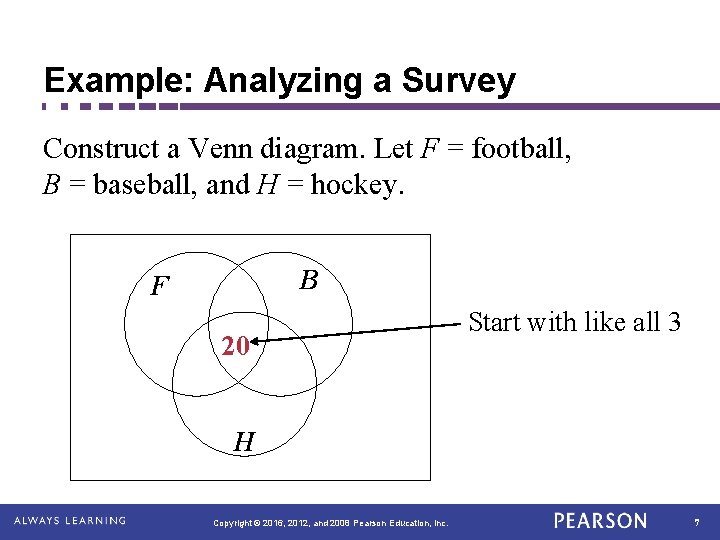
Example: Analyzing a Survey Construct a Venn diagram. Let F = football, B = baseball, and H = hockey. B F 20 Start with like all 3 H Copyright © 2016, 2012, and 2008 Pearson Education, Inc. 7
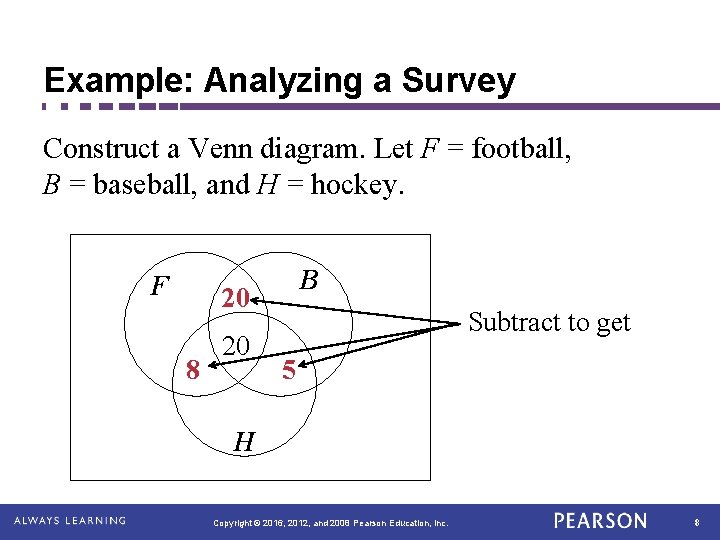
Example: Analyzing a Survey Construct a Venn diagram. Let F = football, B = baseball, and H = hockey. F B 20 8 20 Subtract to get 5 H Copyright © 2016, 2012, and 2008 Pearson Education, Inc. 8
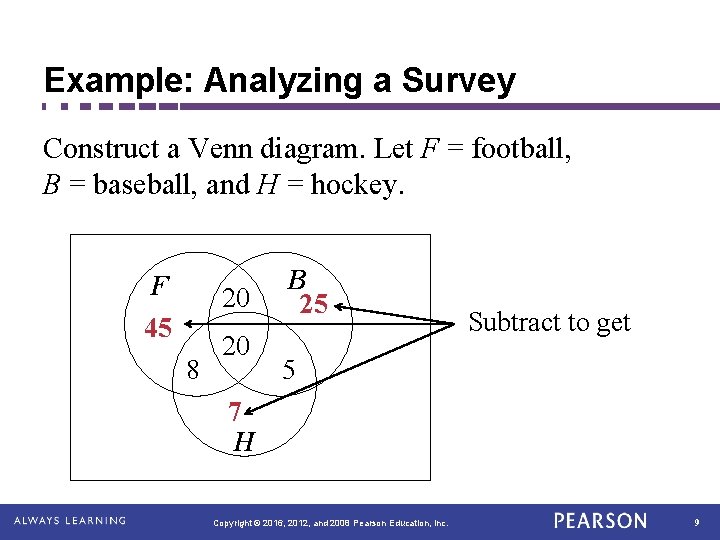
Example: Analyzing a Survey Construct a Venn diagram. Let F = football, B = baseball, and H = hockey. F 45 20 8 20 B 25 Subtract to get 5 7 H Copyright © 2016, 2012, and 2008 Pearson Education, Inc. 9
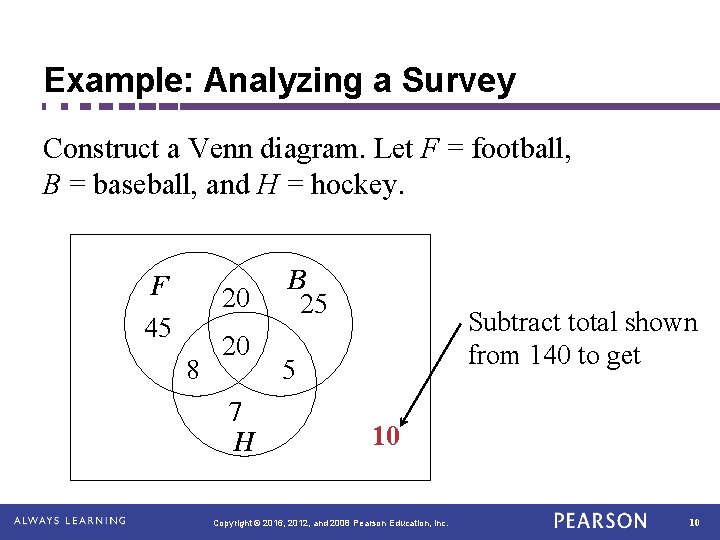
Example: Analyzing a Survey Construct a Venn diagram. Let F = football, B = baseball, and H = hockey. F 45 20 8 20 7 H B 25 Subtract total shown from 140 to get 5 10 Copyright © 2016, 2012, and 2008 Pearson Education, Inc. 10
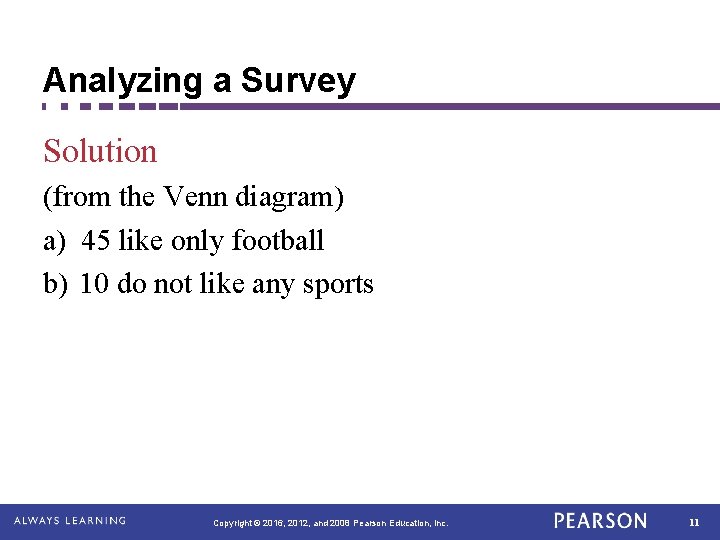
Analyzing a Survey Solution (from the Venn diagram) a) 45 like only football b) 10 do not like any sports Copyright © 2016, 2012, and 2008 Pearson Education, Inc. 11
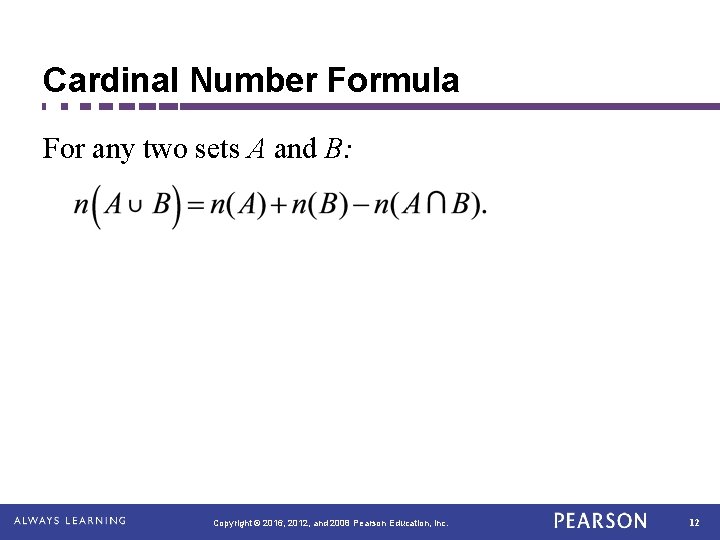
Cardinal Number Formula For any two sets A and B: Copyright © 2016, 2012, and 2008 Pearson Education, Inc. 12
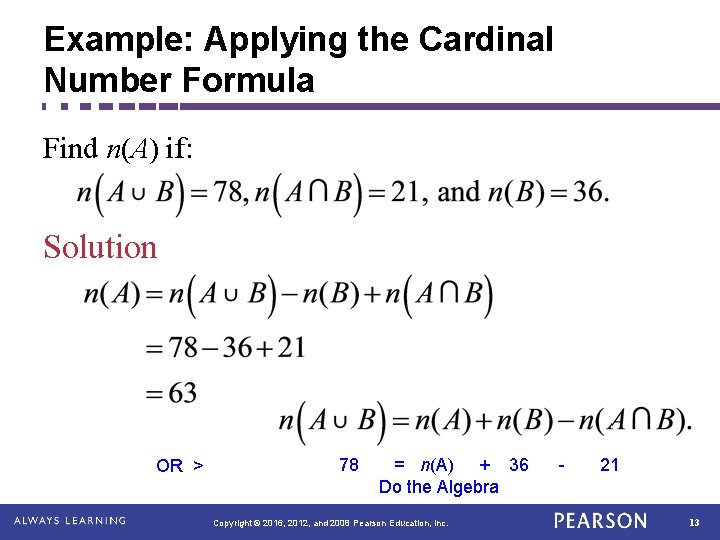
Example: Applying the Cardinal Number Formula Find n(A) if: Solution OR > 78 = n(A) + 36 Do the Algebra Copyright © 2016, 2012, and 2008 Pearson Education, Inc. - 21 13
Example: Analyzing Data in a Table On a given day, breakfast patrons were categorized according to age and preferred beverage. The results are summarized on the next slide. There will be questions to follow. Copyright © 2016, 2012, and 2008 Pearson Education, Inc. 14
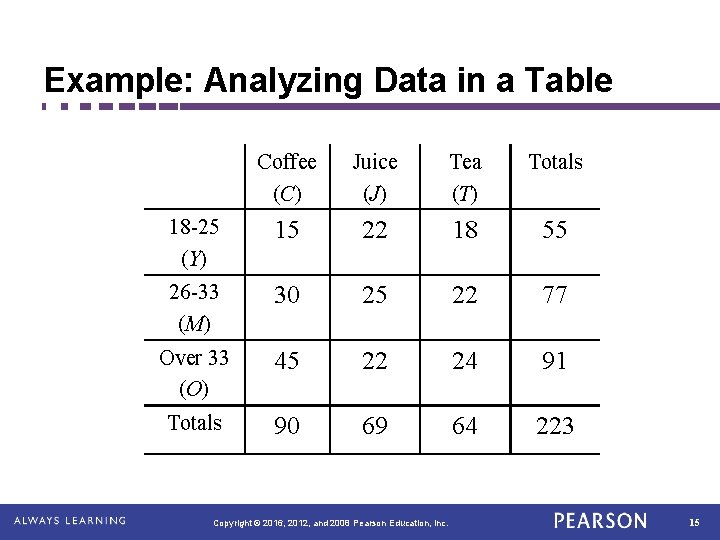
Example: Analyzing Data in a Table Coffee (C) Juice (J) Tea (T) Totals 18 -25 (Y) 15 22 18 55 26 -33 (M) 30 25 22 77 Over 33 (O) 45 22 24 91 Totals 90 69 64 223 Copyright © 2016, 2012, and 2008 Pearson Education, Inc. 15
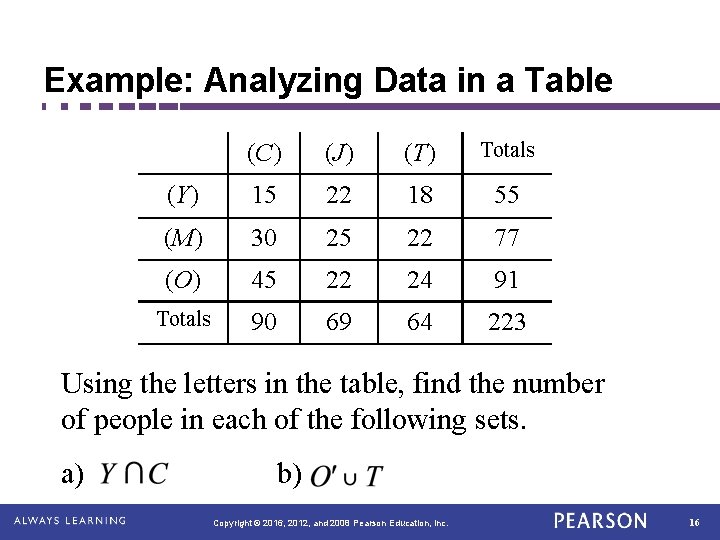
Example: Analyzing Data in a Table (C) (J) (T) Totals (Y) 15 22 18 55 (M) 30 25 22 77 (O) 45 22 24 91 Totals 90 69 64 223 Using the letters in the table, find the number of people in each of the following sets. a) b) Copyright © 2016, 2012, and 2008 Pearson Education, Inc. 16
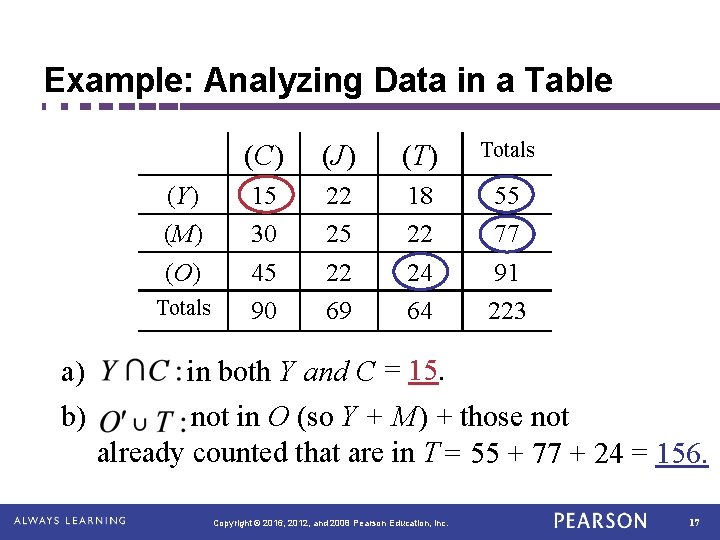
Example: Analyzing Data in a Table (Y) (M) (O) Totals a) b) (C) (J) (T) Totals 15 30 45 90 22 25 22 69 18 22 24 64 55 77 91 223 in both Y and C = 15. not in O (so Y + M) + those not already counted that are in T = 55 + 77 + 24 = 156. Copyright © 2016, 2012, and 2008 Pearson Education, Inc. 17
- Slides: 17