
Chapter 2 SW Process Models 1 Objectives o
Chapter 2 SW Process Models 1
Objectives o o o Understand various process models Understand the pros and cons of each model Evaluate the applicability of each model for a certain type of software development 2
Overview o o o o Why SW process models? What are SW process models? The waterfall model Evolutionary models The Spiral CBSE Which is best? 3
Why SW process models? o Some problems with ad-hoc development n n n o o Difficult to distinguish between tasks and therefore some important tasks may be ignored Problem if multiple people are involved, as it is not easy to review their work. If problems are found late, the more costly it is to fix. Division of work Helps in managing the process 4
What is it? o A SW process is a structured set of activities required to develop a software system n n o o Specification; Design and Implementation; Validation; Evolution. A software process model is an abstract representation of a process. It presents a description of a process from some particular perspective. May take months or years to complete. 5
SW Process Models o Waterfall model n o Separate and distinct phases of specification and development. Evolutionary models n Specification, development and validation are interleaved. o o o Exploratory development The incremental model The prototyping model The spiral model Component-based development model n The system is assembled from existing components 6
The Waterfall Model o o Oldest model Called “linear sequential model” Most widely used model for SW engineering Documentation is produced at each stage. 7
The Waterfall model phases o o o Requirements analysis and definition System and software design Implementation and unit testing Integration and system testing Operation and maintenance 8
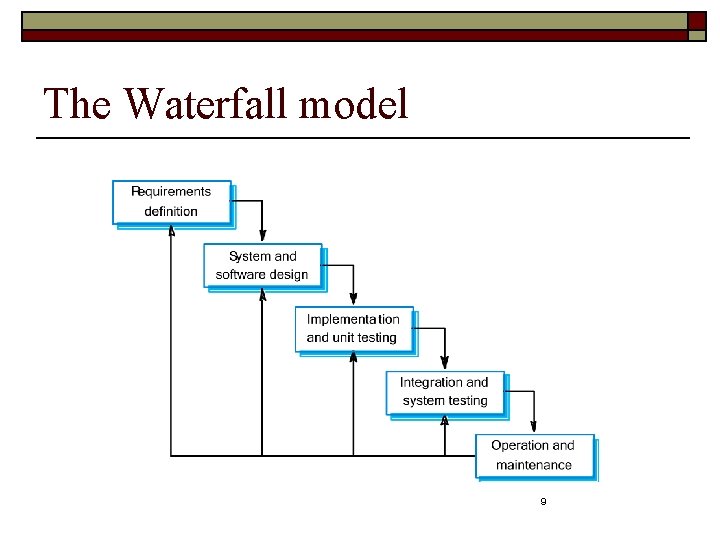
The Waterfall model 9
The Waterfall model Disadvantages o o o Inflexible partitioning of the project into distinct stages makes it difficult to respond to changing customer requirements. Only appropriate when the requirements are well-understood and changes will be fairly limited during the design process. The waterfall model is mostly used for large systems engineering projects. 10
Evolutionary Models o The Exploratory Model n o The Incremental Model n o Rather than deliver the system as a single delivery, the development and delivery is broken down into increments with each increment delivering part of the required functionality. The Prototyping Model n o Objective is to work with customers and to evolve a final system from an initial outline specification. Should start with well-understood requirements and add new features as proposed by the customer. Objective is to understand the system requirements. Should start with poorly understood requirements to clarify what is really needed. The Spiral Model n Process is represented as a spiral rather than as a sequence of activities with backtracking 11
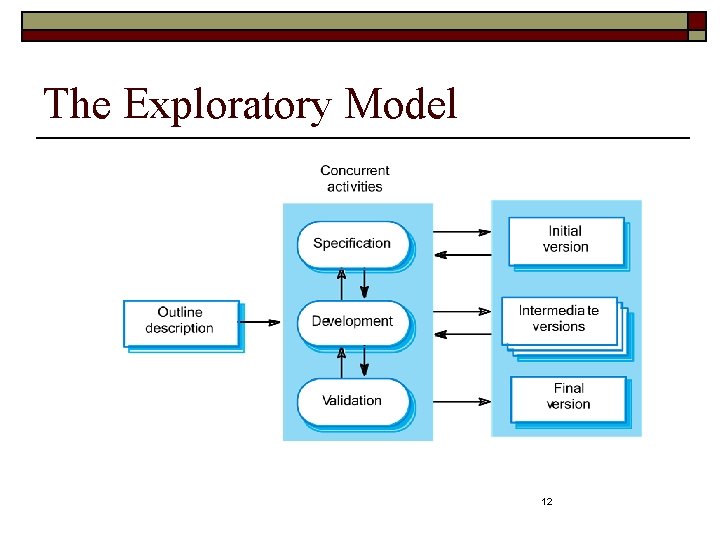
The Exploratory Model 12

The Exploratory Model o Problems n n o Lack of process visibility; Systems are often poorly structured; Applicability n n n For small or medium-size interactive systems; For parts of large systems (e. g. the user interface); For short-lifetime systems. 13
The Incremental Model o o User requirements are prioritised and the highest priority requirements are included in early increments. Once the development of an increment is started, the requirements are frozen though requirements for later increments can continue to evolve. 14
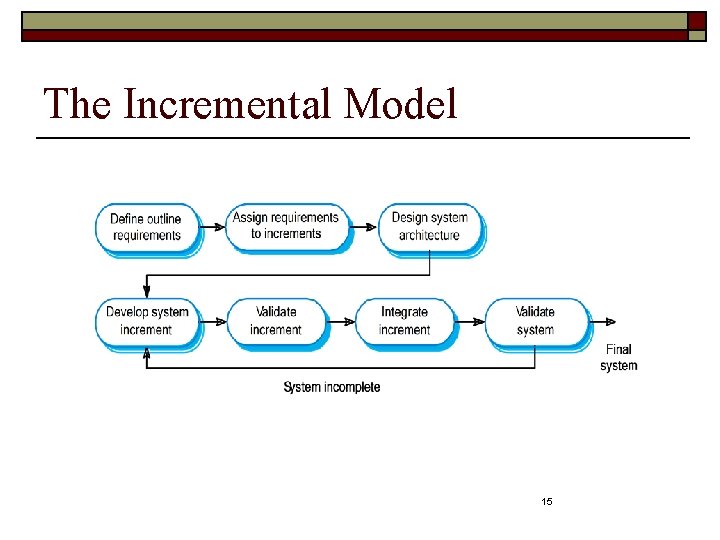
The Incremental Model 15
The Incremental Model- Advantages o o Customer value can be delivered with each increment so system functionality is available earlier. Early increments act as a prototype to help elicit requirements for later increments. Lower risk of overall project failure. The highest priority system services tend to receive the most testing. 16
The Incremental Model- Disadvantages o o o Increments should be relatively small (20, 000 lines of code) Can be difficult to map the customer’s requirements onto increments of the right size Hard to identify common functions 17
The Prototyping Model o o When a customer defines a set of general objectives for a software but does not identify detailed input, processing, or output requirement. It consists of the iterating phases: n n Requirements gathering Design and build SW prototype Evaluate prototype with customer Refine requirements 18
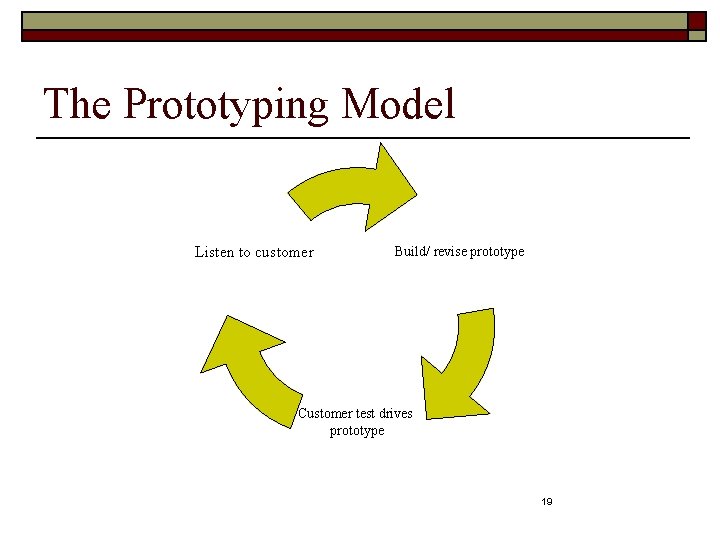
The Prototyping Model Listen to customer Build/ revise prototype Customer test drives prototype 19
The Prototyping Model o Advantages n n n o Users get a feel for the actual system Developers get to build something immediately Specifications can be developed incrementally Disadvantages n n n The developer may make implementation compromises in order to get a prototype working quickly. The process in not visible (few documents that reflect every version of the system) Systems poorly structured 20
The Spiral Model o o Defined by Barry Boehm in his 1988 article A Spiral Model of Software Development and Enhancement. Process is represented as a spiral rather than as a sequence of activities with backtracking. Each loop in the spiral represents a phase in the process. Suitable for large, expensive and complicated projects 21
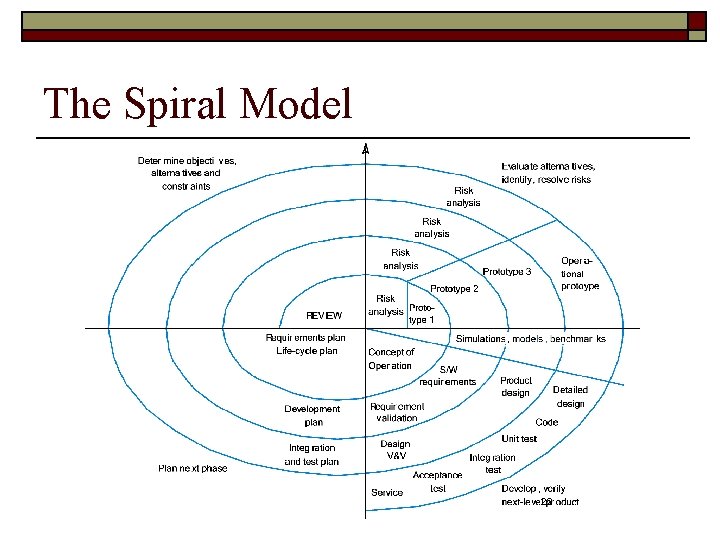
The Spiral Model 22
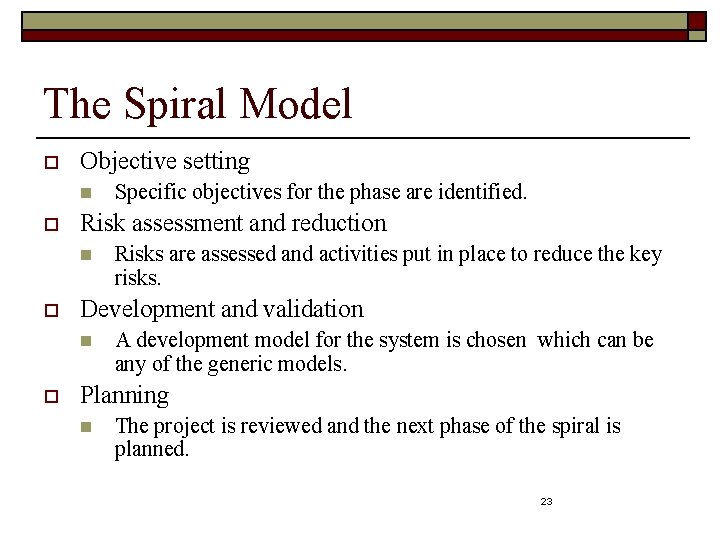
The Spiral Model o Objective setting n o Risk assessment and reduction n o Risks are assessed and activities put in place to reduce the key risks. Development and validation n o Specific objectives for the phase are identified. A development model for the system is chosen which can be any of the generic models. Planning n The project is reviewed and the next phase of the spiral is planned. 23
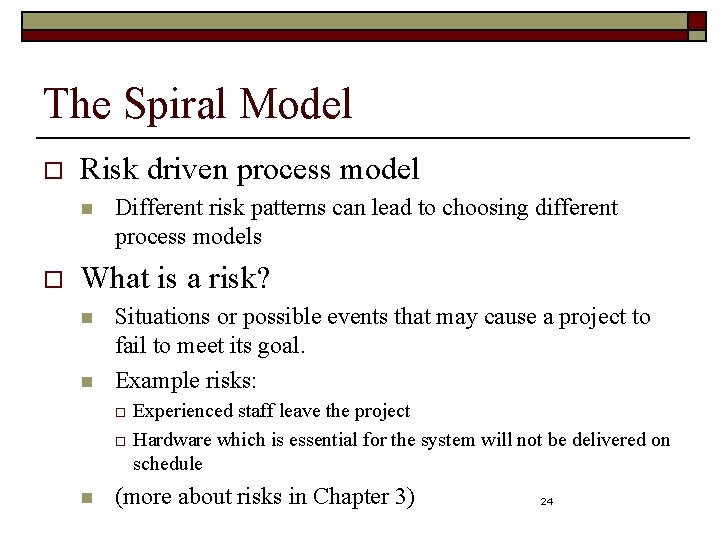
The Spiral Model o Risk driven process model n o Different risk patterns can lead to choosing different process models What is a risk? n n Situations or possible events that may cause a project to fail to meet its goal. Example risks: Experienced staff leave the project o Hardware which is essential for the system will not be delivered on schedule o n (more about risks in Chapter 3) 24
The Spiral Model- Advantages o o Risks are explicitly assessed and resolved throughout the process. Software engineers can start working on the project earlier rather than wading through a lengthy early design process. 25
The Spiral Model- Disadvantages o o o Requires highly skilled people in risk analysis and planning Requires more time, and is more expensive Estimates of budget and time are harder to judge at the beginning of the project since the requirements evolve through the process 26
Component Based Software Engineering (CBSE) o o Based on systematic reuse where systems are integrated from existing components or COTS (Commercial-off-the-shelf) systems. Process stages n n o Component analysis; Requirements modification; System design with reuse; Development and integration. This approach is becoming increasingly used as component standards have emerged. 27
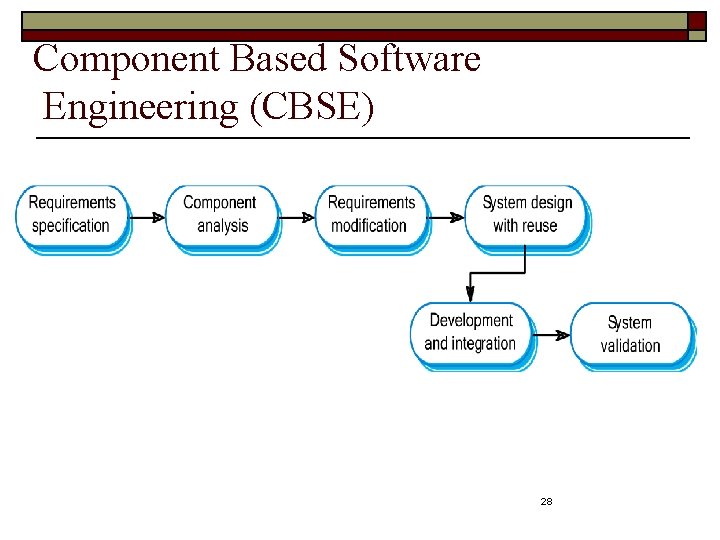
Component Based Software Engineering (CBSE) 28
Component Based Software Engineering (CBSE) o Advantages: n n n o Reduce amount of software to be developed Reduce costs and risks Faster delivery Disadvantages: n n Requirements compromises, system does not meet real needs of users Control over system evolution is lost 29
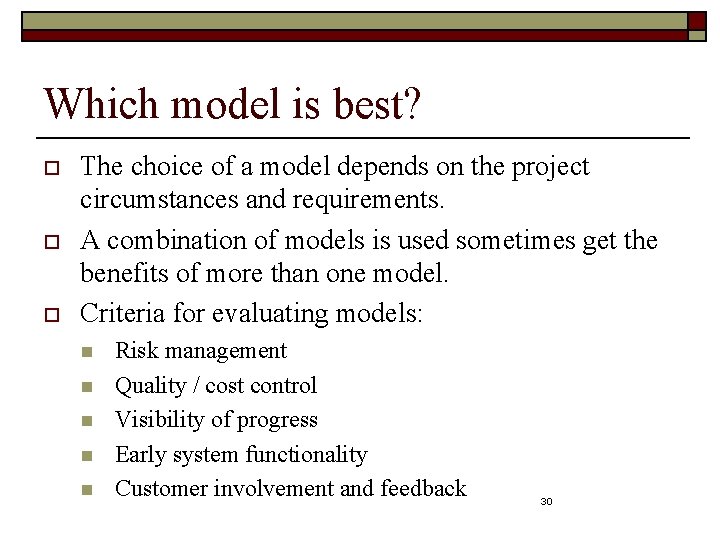
Which model is best? o o o The choice of a model depends on the project circumstances and requirements. A combination of models is used sometimes get the benefits of more than one model. Criteria for evaluating models: n n n Risk management Quality / cost control Visibility of progress Early system functionality Customer involvement and feedback 30
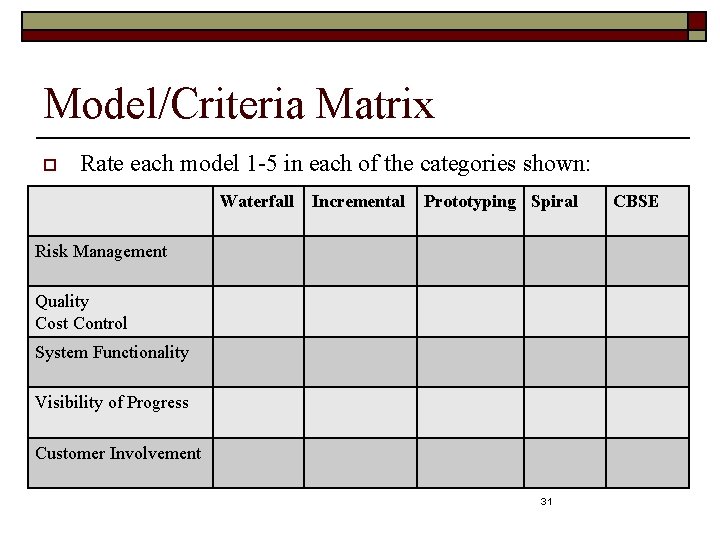
Model/Criteria Matrix o Rate each model 1 -5 in each of the categories shown: Waterfall Incremental Prototyping Spiral Risk Management Quality Cost Control System Functionality Visibility of Progress Customer Involvement 31 CBSE
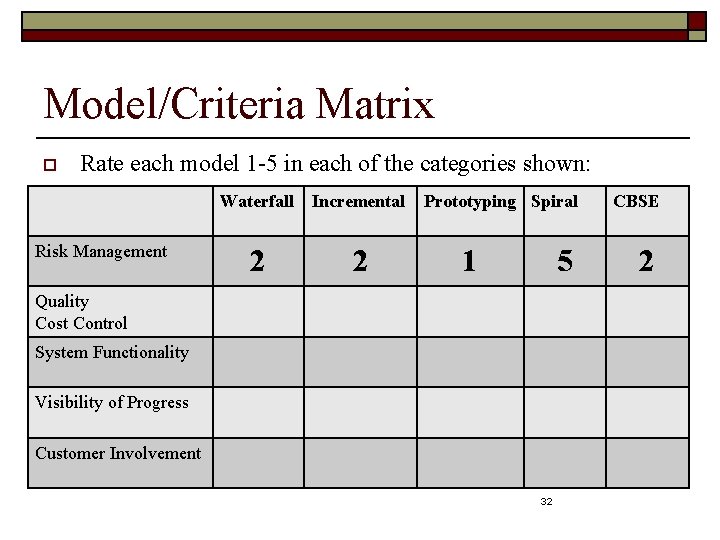
Model/Criteria Matrix o Rate each model 1 -5 in each of the categories shown: Waterfall Incremental Risk Management 2 2 Prototyping Spiral 1 5 Quality Cost Control System Functionality Visibility of Progress Customer Involvement 32 CBSE 2
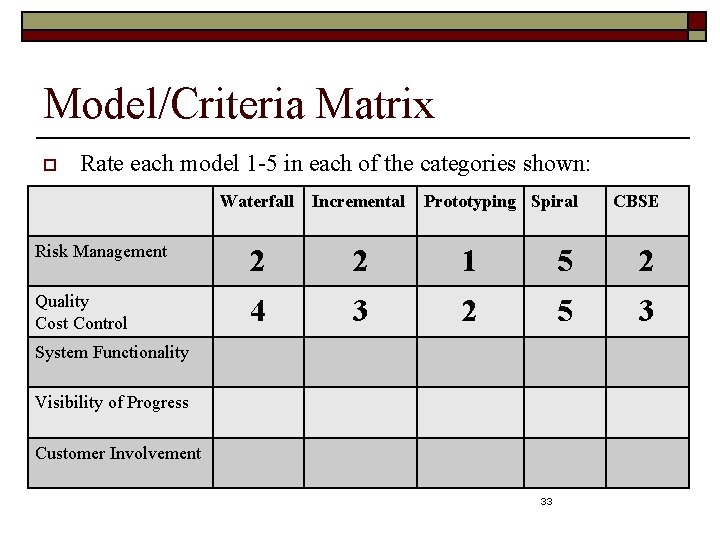
Model/Criteria Matrix o Rate each model 1 -5 in each of the categories shown: Waterfall Incremental Prototyping Spiral CBSE Risk Management 2 2 1 5 2 Quality Cost Control 4 3 2 5 3 System Functionality Visibility of Progress Customer Involvement 33
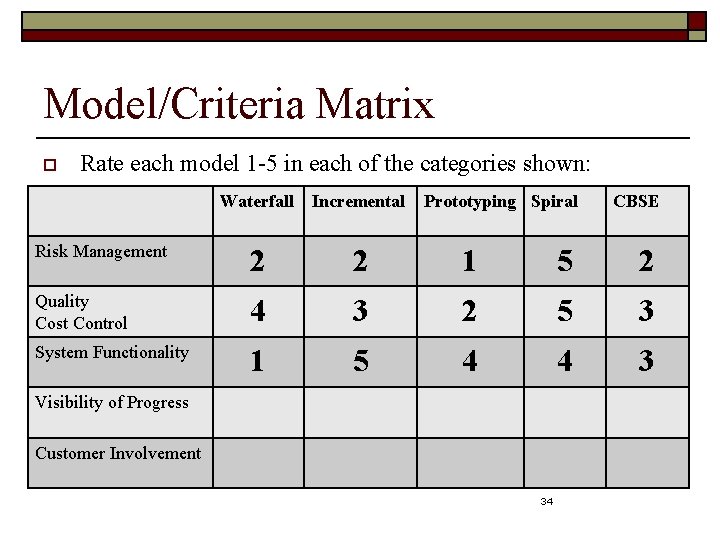
Model/Criteria Matrix o Rate each model 1 -5 in each of the categories shown: Waterfall Incremental Prototyping Spiral CBSE Risk Management 2 2 1 5 2 Quality Cost Control 4 3 2 5 3 System Functionality 1 5 4 4 3 Visibility of Progress Customer Involvement 34
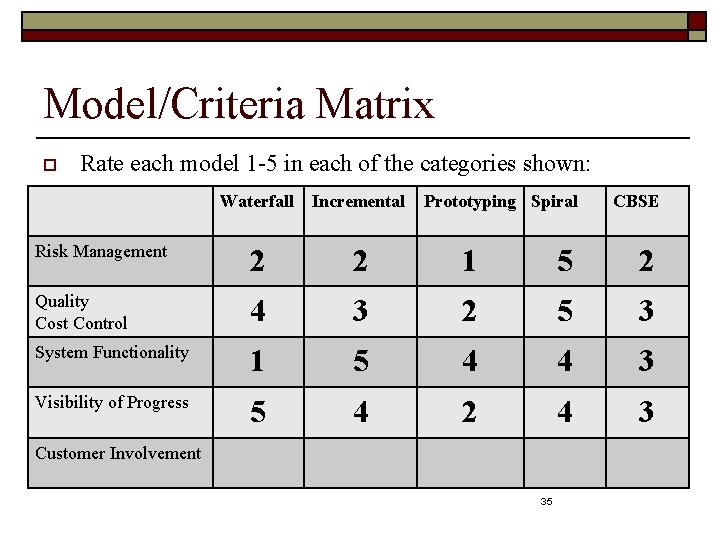
Model/Criteria Matrix o Rate each model 1 -5 in each of the categories shown: Waterfall Incremental Prototyping Spiral CBSE Risk Management 2 2 1 5 2 Quality Cost Control 4 3 2 5 3 System Functionality 1 5 4 4 3 Visibility of Progress 5 4 2 4 3 Customer Involvement 35
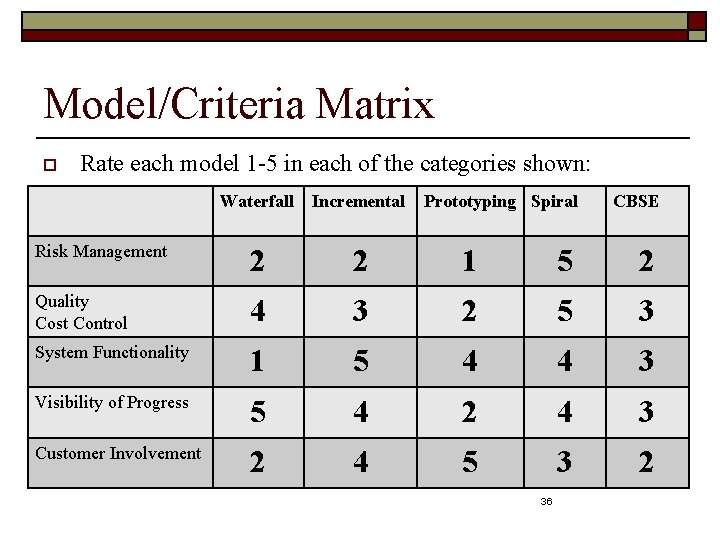
Model/Criteria Matrix o Rate each model 1 -5 in each of the categories shown: Waterfall Incremental Prototyping Spiral CBSE Risk Management 2 2 1 5 2 Quality Cost Control 4 3 2 5 3 System Functionality 1 5 4 4 3 Visibility of Progress 5 4 2 4 3 Customer Involvement 2 4 5 3 2 36
Assignment 1 o Please check the weblog and download Assignment 1. 37
- Slides: 37