
CHAPTER 2 Supervised Learning Learning a Class from
- Slides: 18
CHAPTER 2: Supervised Learning
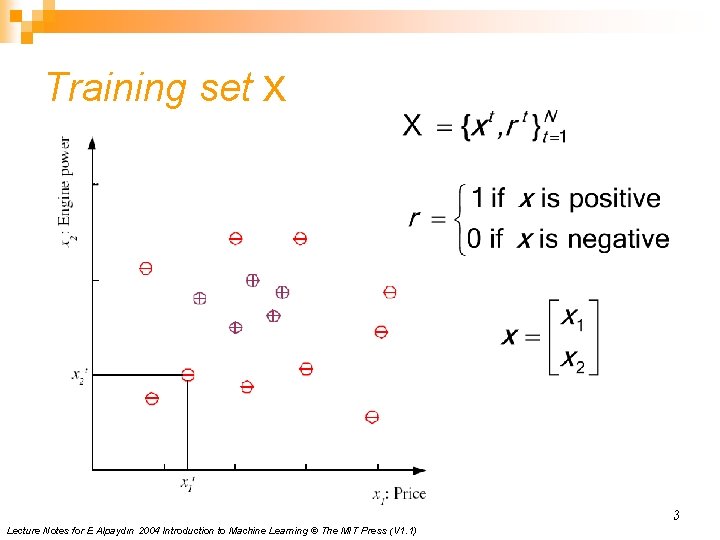
Learning a Class from Examples n Class C of a “family car” ¨ Prediction: n n n Is car x a family car? ¨ Knowledge extraction: What do people expect from a family car? Output: Positive (+) and negative (–) examples Input representation: x 1: price, x 2 : engine power Learn a model f: Rx. R {+, -} 2 Lecture Notes for E Alpaydın 2004 Introduction to Machine Learning © The MIT Press (V 1. 1)
Training set X 3 Lecture Notes for E Alpaydın 2004 Introduction to Machine Learning © The MIT Press (V 1. 1)
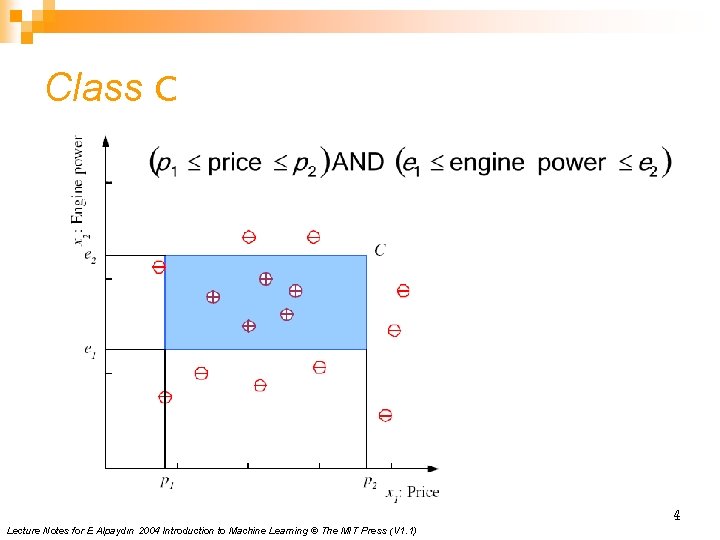
Class C 4 Lecture Notes for E Alpaydın 2004 Introduction to Machine Learning © The MIT Press (V 1. 1)
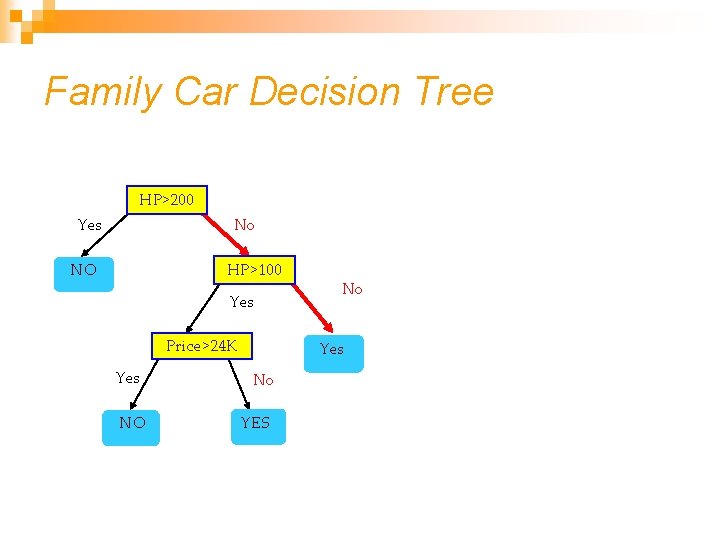
Family Car Decision Tree HP>200 Yes No NO HP>100 Yes Price>24 K Yes NO No Yes No YES
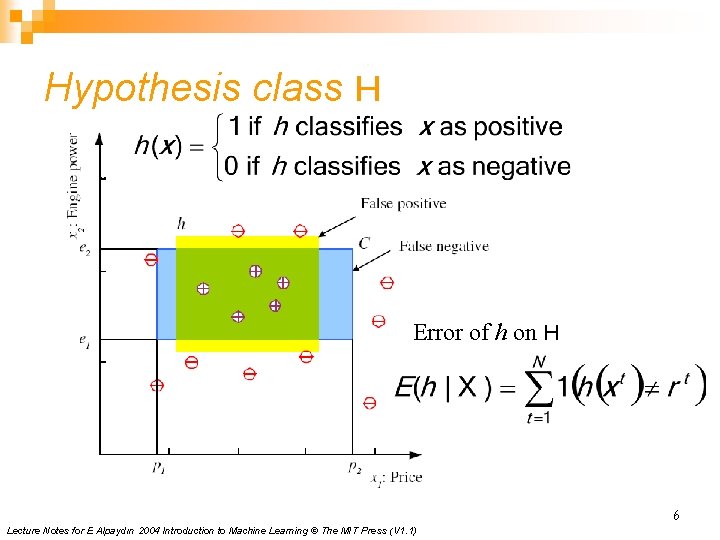
Hypothesis class H Error of h on H 6 Lecture Notes for E Alpaydın 2004 Introduction to Machine Learning © The MIT Press (V 1. 1)
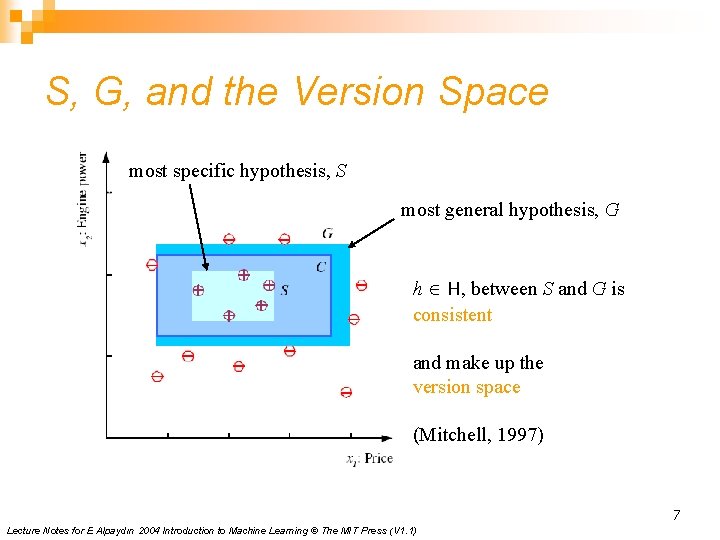
S, G, and the Version Space most specific hypothesis, S most general hypothesis, G h Î H, between S and G is consistent and make up the version space (Mitchell, 1997) 7 Lecture Notes for E Alpaydın 2004 Introduction to Machine Learning © The MIT Press (V 1. 1)
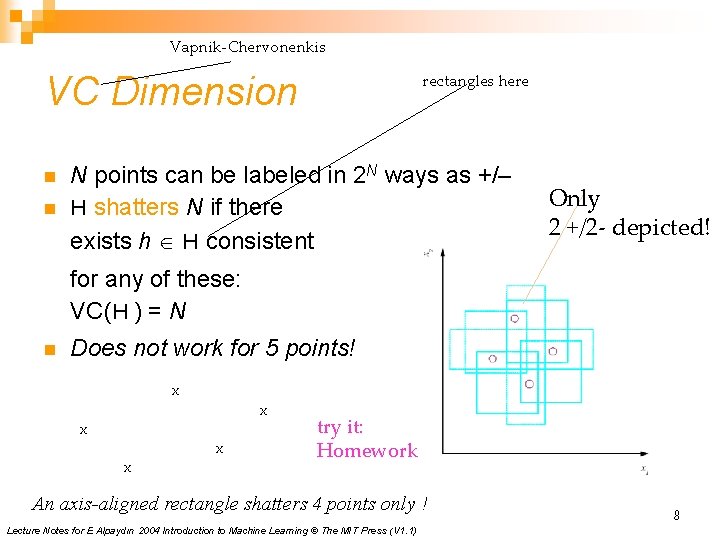
Vapnik-Chervonenkis VC Dimension n n rectangles here N points can be labeled in 2 N ways as +/– H shatters N if there exists h Î H consistent Only 2 +/2 - depicted! for any of these: VC(H ) = N n Does not work for 5 points! x x x try it: Homework An axis-aligned rectangle shatters 4 points only ! Lecture Notes for E Alpaydın 2004 Introduction to Machine Learning © The MIT Press (V 1. 1) 8
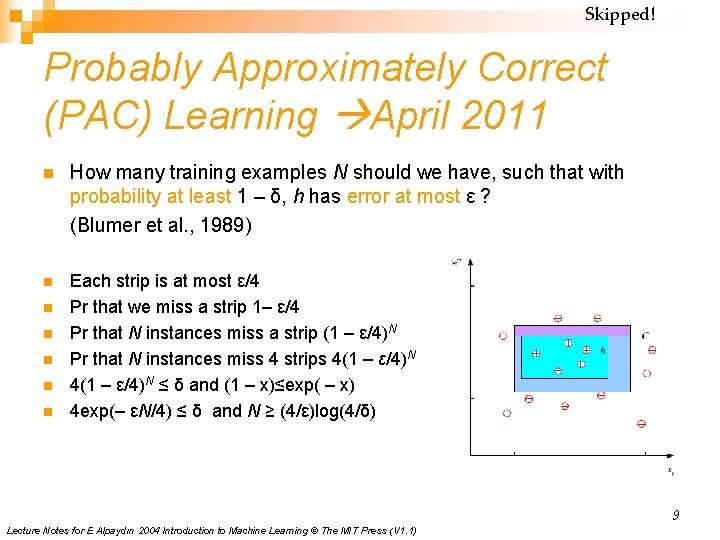
Skipped! Probably Approximately Correct (PAC) Learning April 2011 n How many training examples N should we have, such that with probability at least 1 ‒ δ, h has error at most ε ? (Blumer et al. , 1989) n Each strip is at most ε/4 Pr that we miss a strip 1‒ ε/4 Pr that N instances miss a strip (1 ‒ ε/4)N Pr that N instances miss 4 strips 4(1 ‒ ε/4)N ≤ δ and (1 ‒ x)≤exp( ‒ x) 4 exp(‒ εN/4) ≤ δ and N ≥ (4/ε)log(4/δ) n n n 9 Lecture Notes for E Alpaydın 2004 Introduction to Machine Learning © The MIT Press (V 1. 1)
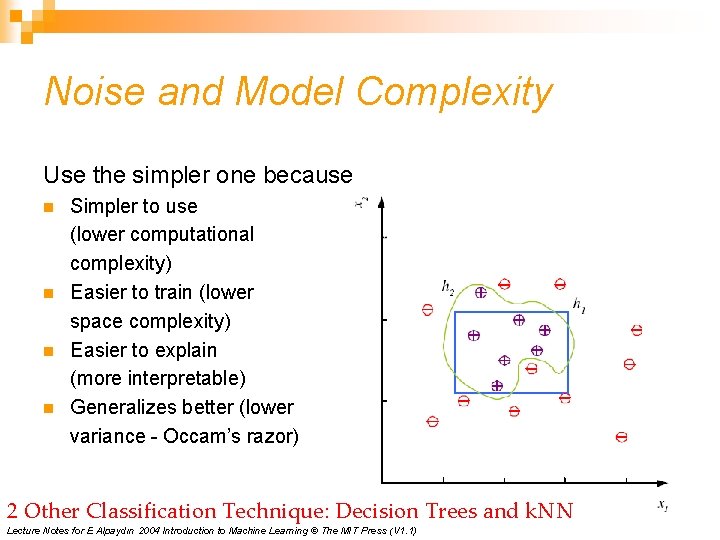
Noise and Model Complexity Use the simpler one because n n Simpler to use (lower computational complexity) Easier to train (lower space complexity) Easier to explain (more interpretable) Generalizes better (lower variance - Occam’s razor) 2 Other Classification Technique: Decision Trees and k. NN Lecture Notes for E Alpaydın 2004 Introduction to Machine Learning © The MIT Press (V 1. 1) 10
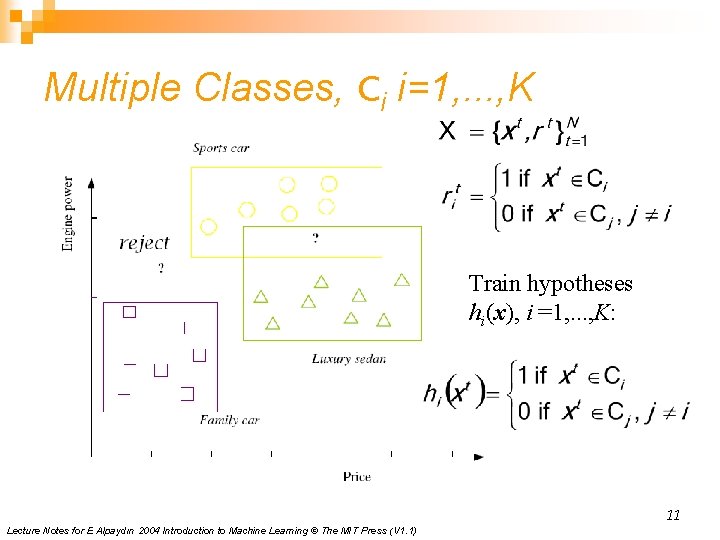
Multiple Classes, Ci i=1, . . . , K Train hypotheses hi(x), i =1, . . . , K: 11 Lecture Notes for E Alpaydın 2004 Introduction to Machine Learning © The MIT Press (V 1. 1)
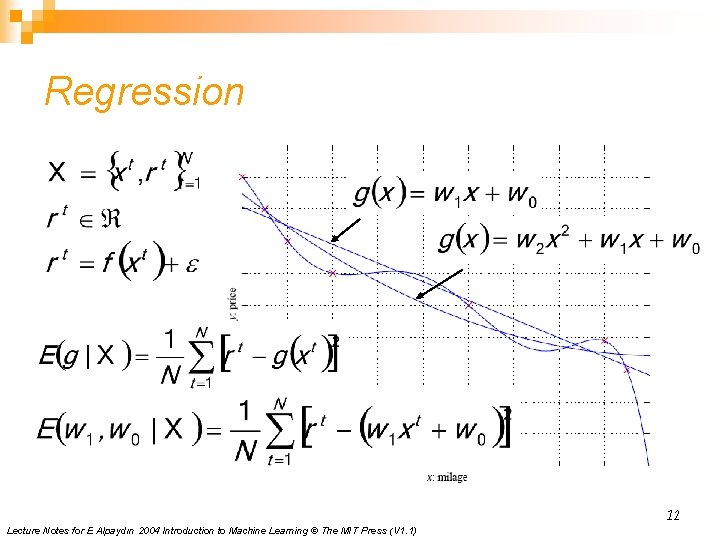
Regression 12 Lecture Notes for E Alpaydın 2004 Introduction to Machine Learning © The MIT Press (V 1. 1)
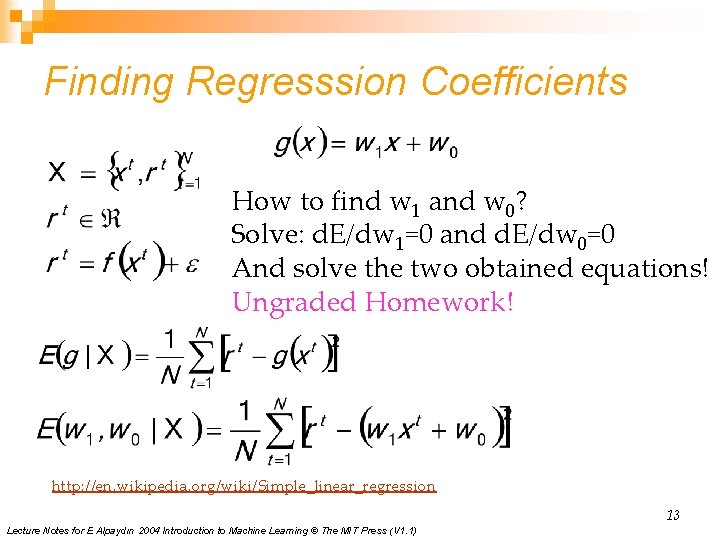
Finding Regresssion Coefficients How to find w 1 and w 0? Solve: d. E/dw 1=0 and d. E/dw 0=0 And solve the two obtained equations! Ungraded Homework! http: //en. wikipedia. org/wiki/Simple_linear_regression 13 Lecture Notes for E Alpaydın 2004 Introduction to Machine Learning © The MIT Press (V 1. 1)
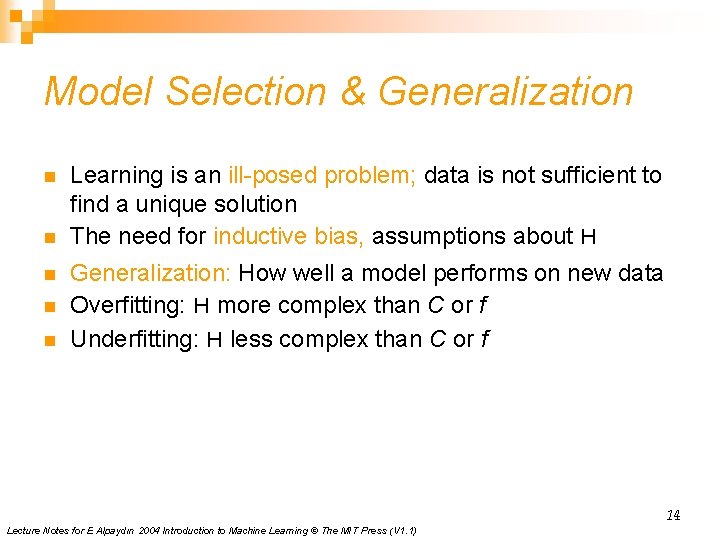
Model Selection & Generalization n n Learning is an ill-posed problem; data is not sufficient to find a unique solution The need for inductive bias, assumptions about H Generalization: How well a model performs on new data Overfitting: H more complex than C or f Underfitting: H less complex than C or f 14 Lecture Notes for E Alpaydın 2004 Introduction to Machine Learning © The MIT Press (V 1. 1)
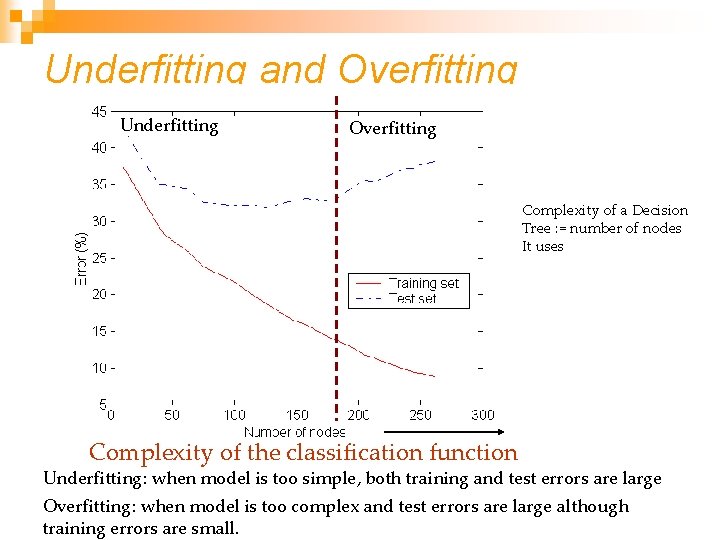
Underfitting and Overfitting Underfitting Overfitting Complexity of a Decision Tree : = number of nodes It uses Complexity of the classification function Underfitting: when model is too simple, both training and test errors are large Overfitting: when model is too complex and test errors are large although training errors are small.
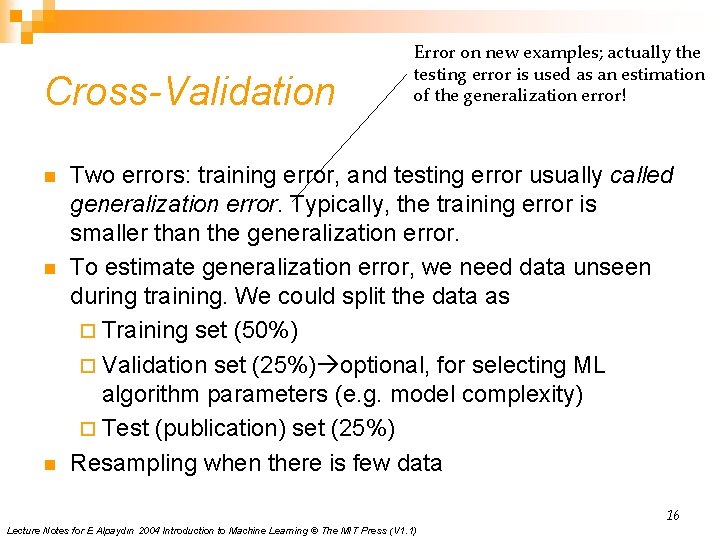
Cross-Validation n Error on new examples; actually the testing error is used as an estimation of the generalization error! Two errors: training error, and testing error usually called generalization error. Typically, the training error is smaller than the generalization error. To estimate generalization error, we need data unseen during training. We could split the data as ¨ Training set (50%) ¨ Validation set (25%) optional, for selecting ML algorithm parameters (e. g. model complexity) ¨ Test (publication) set (25%) Resampling when there is few data 16 Lecture Notes for E Alpaydın 2004 Introduction to Machine Learning © The MIT Press (V 1. 1)
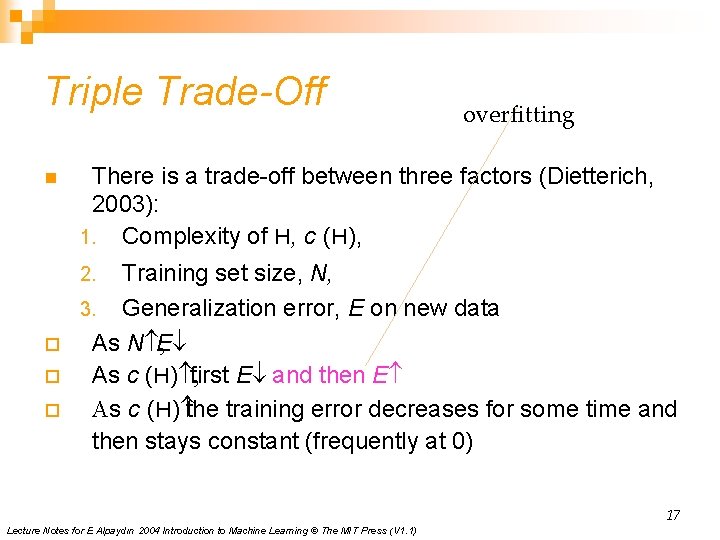
Triple Trade-Off n overfitting There is a trade-off between three factors (Dietterich, 2003): 1. Complexity of H, c (H), Training set size, N, 3. Generalization error, E on new data As N , E¯ As c (H) , first E¯ and then E As c (H) the training error decreases for some time and then stays constant (frequently at 0) 2. ¨ ¨ ¨ 17 Lecture Notes for E Alpaydın 2004 Introduction to Machine Learning © The MIT Press (V 1. 1)
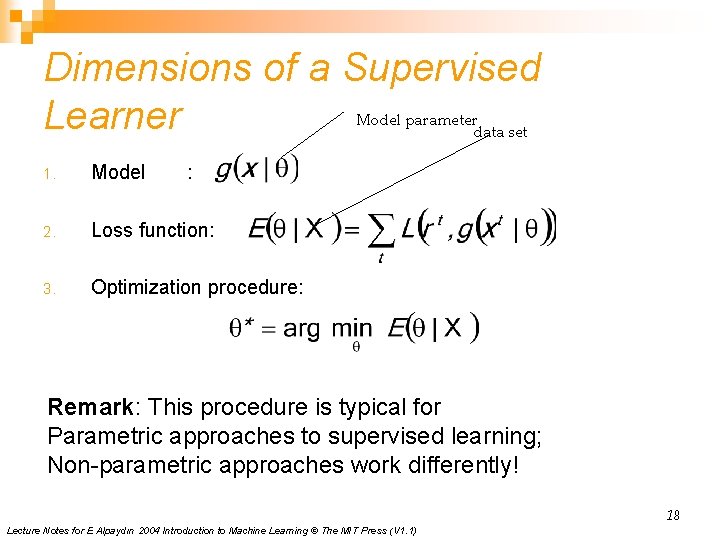
Dimensions of a Supervised Learner Model parameter data set 1. Model : 2. Loss function: 3. Optimization procedure: Remark: This procedure is typical for Parametric approaches to supervised learning; Non-parametric approaches work differently! 18 Lecture Notes for E Alpaydın 2004 Introduction to Machine Learning © The MIT Press (V 1. 1)