
CHAPTER 2 STEAM POWER PLANT INTRODUCTION l The


- Slides: 32
CHAPTER 2: STEAM POWER PLANT
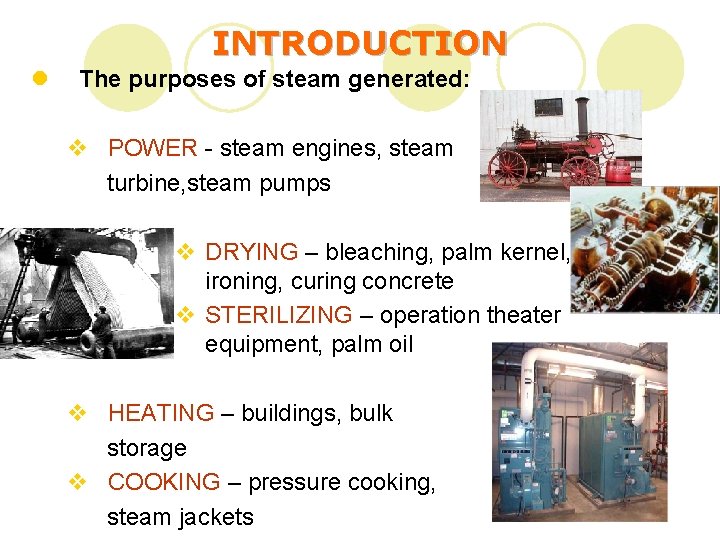
INTRODUCTION l The purposes of steam generated: v POWER - steam engines, steam turbine, steam pumps v DRYING – bleaching, palm kernel, ironing, curing concrete v STERILIZING – operation theater equipment, palm oil v HEATING – buildings, bulk storage v COOKING – pressure cooking, steam jackets
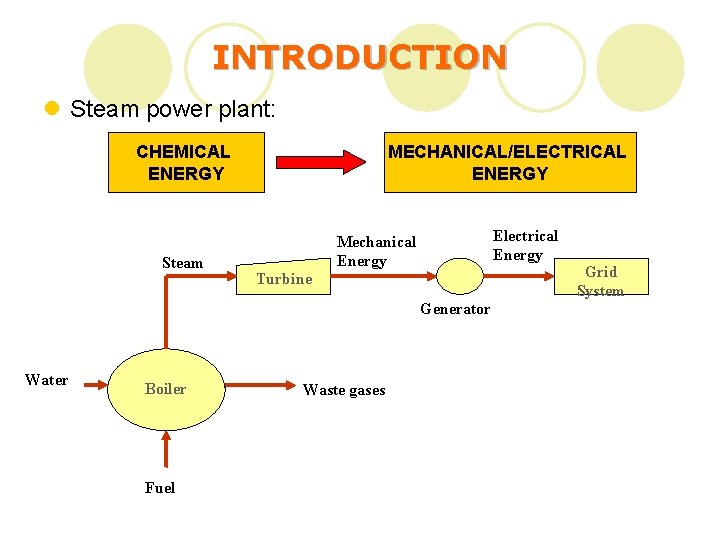
INTRODUCTION l Steam power plant: CHEMICAL ENERGY Steam MECHANICAL/ELECTRICAL ENERGY Electrical Energy Mechanical Energy Turbine Generator Water Boiler Fuel Waste gases Grid System
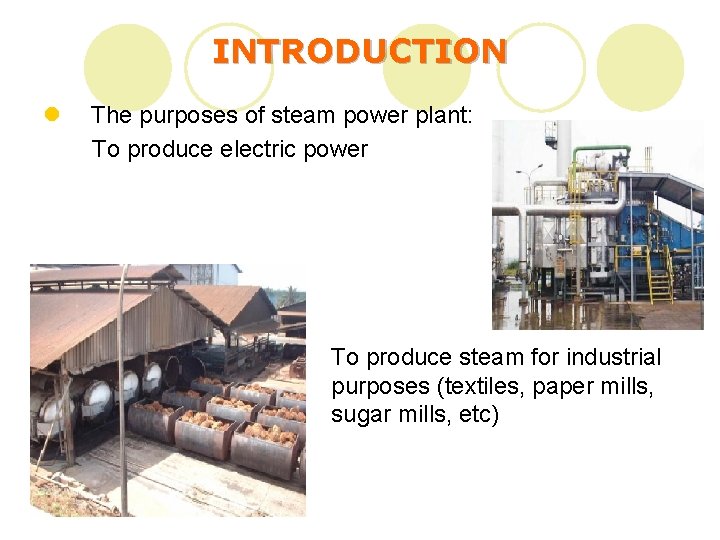
INTRODUCTION l The purposes of steam power plant: To produce electric power To produce steam for industrial purposes (textiles, paper mills, sugar mills, etc)
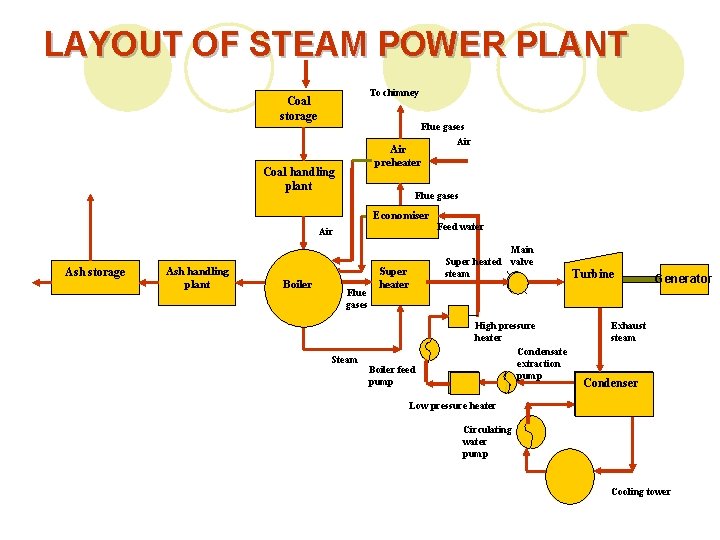
LAYOUT OF STEAM POWER PLANT To chimney Coal storage Flue gases Air preheater Coal handling plant Flue gases Economiser Air Ash storage Ash handling plant Boiler Air Flue gases Steam Feed water Main Super heated valve steam Super heater Boiler feed pump High pressure heater Condensate extraction pump Turbine Generator Exhaust steam Condenser Low pressure heater Circulating water pump Cooling tower
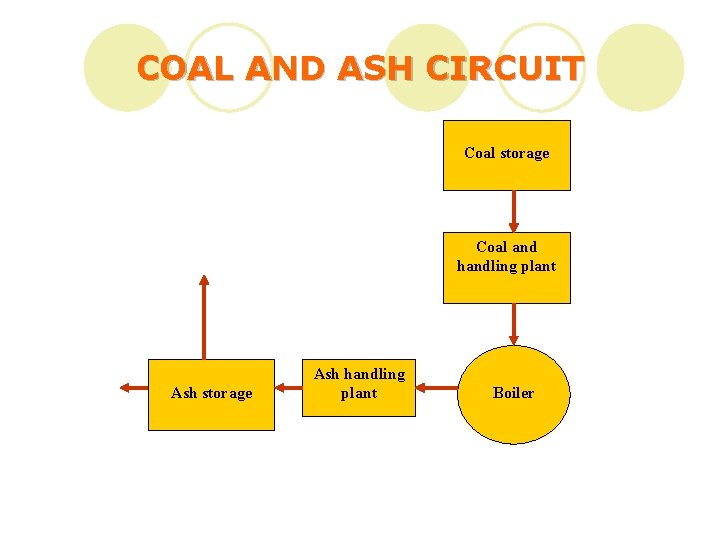
COAL AND ASH CIRCUIT Coal storage Coal and handling plant Ash storage Ash handling plant Boiler
ASH AND GAS CIRCUIT To chimney Flue gases Air preheater Flue gases Economiser Boiler Superheater Flue gases
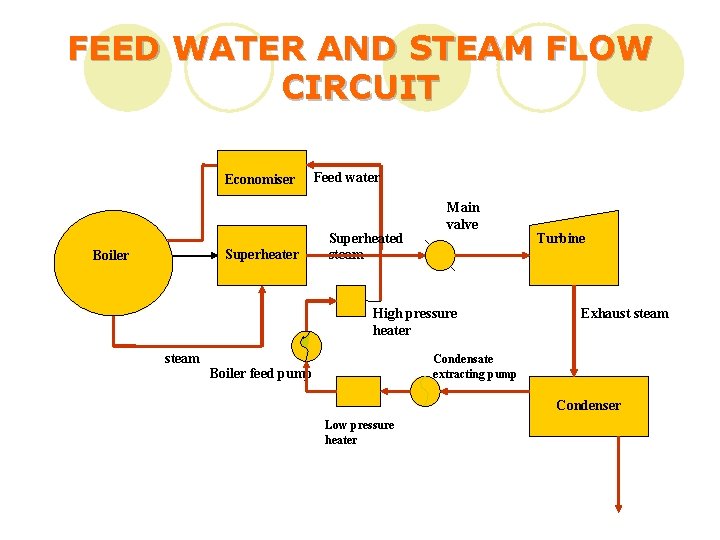
FEED WATER AND STEAM FLOW CIRCUIT Economiser Superheater Boiler Feed water Superheated steam Main valve High pressure heater steam Turbine Exhaust steam Condensate extracting pump Boiler feed pump Condenser Low pressure heater
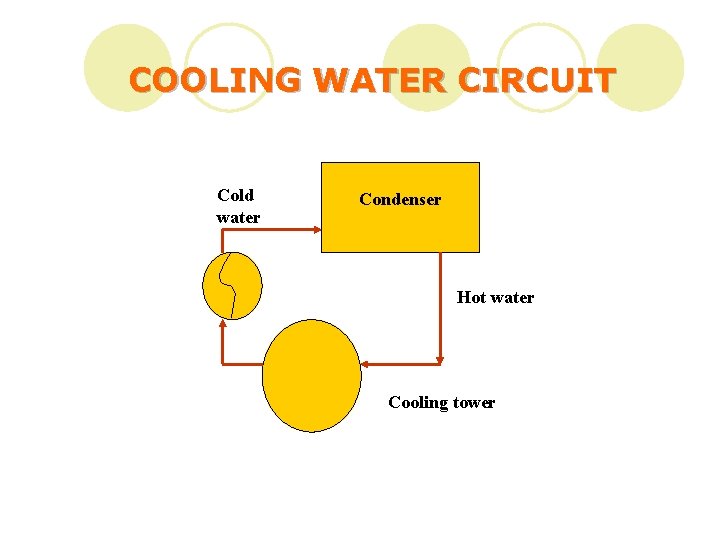
COOLING WATER CIRCUIT Cold water Circulating water pump Condenser Hot water Cooling tower
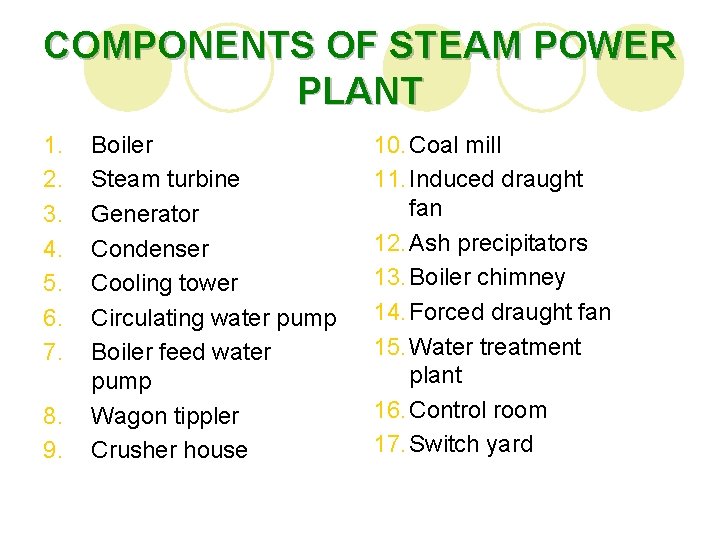
COMPONENTS OF STEAM POWER PLANT 1. 2. 3. 4. 5. 6. 7. 8. 9. Boiler Steam turbine Generator Condenser Cooling tower Circulating water pump Boiler feed water pump Wagon tippler Crusher house 10. Coal mill 11. Induced draught fan 12. Ash precipitators 13. Boiler chimney 14. Forced draught fan 15. Water treatment plant 16. Control room 17. Switch yard
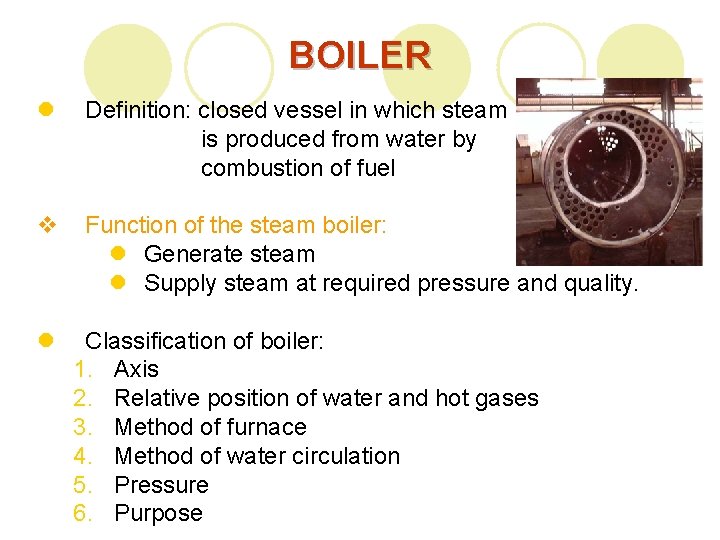
BOILER l Definition: closed vessel in which steam is produced from water by combustion of fuel v Function of the steam boiler: l Generate steam l Supply steam at required pressure and quality. l Classification of boiler: 1. Axis 2. Relative position of water and hot gases 3. Method of furnace 4. Method of water circulation 5. Pressure 6. Purpose
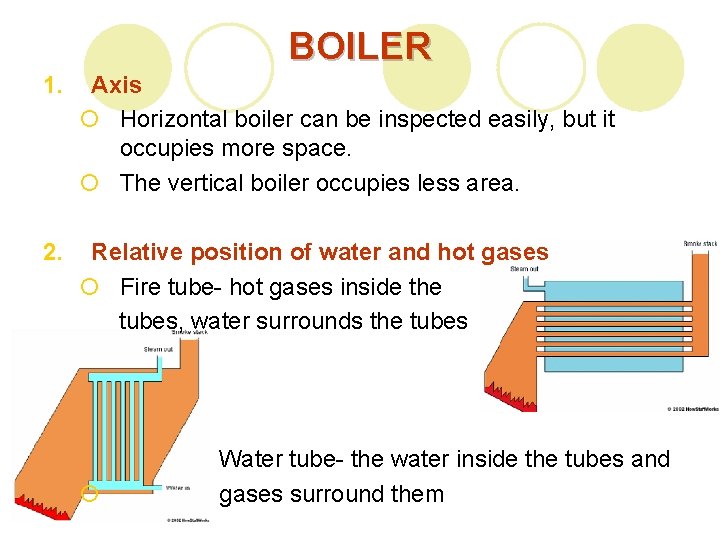
BOILER 1. Axis ¡ Horizontal boiler can be inspected easily, but it occupies more space. ¡ The vertical boiler occupies less area. 2. Relative position of water and hot gases ¡ Fire tube- hot gases inside the tubes, water surrounds the tubes ¡ Water tube- the water inside the tubes and gases surround them
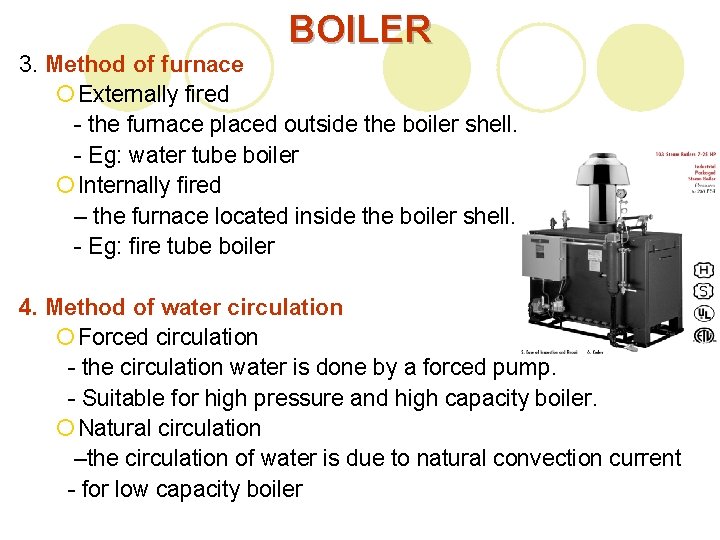
BOILER 3. Method of furnace ¡ Externally fired - the furnace placed outside the boiler shell. - Eg: water tube boiler ¡ Internally fired – the furnace located inside the boiler shell. - Eg: fire tube boiler 4. Method of water circulation ¡ Forced circulation - the circulation water is done by a forced pump. - Suitable for high pressure and high capacity boiler. ¡ Natural circulation –the circulation of water is due to natural convection current - for low capacity boiler
BOILER 5. Pressure ¡High pressure – produced steam at 80 bar or above ¡Low pressure – produced steam below 80 bar 6. Purpose ¡Stationary boiler (land) – used for power plant steam, for central station utility or for plant process steam ¡Mobile boiler (portable) – small units boiler for temporary use
Choice of Fuel / Heating Medium : l Gas : Natural gas, LPG l Liquid : Diesel, kerosene, light fuel oil, medium fuel oil, heavy fuel oil l Solid : Coal, wood, fibre and shell, other agricultural waste such as bagasse. l Waste heat : from gas turbine, diesel engine exhaust, reactors l Electricity l Hot oil
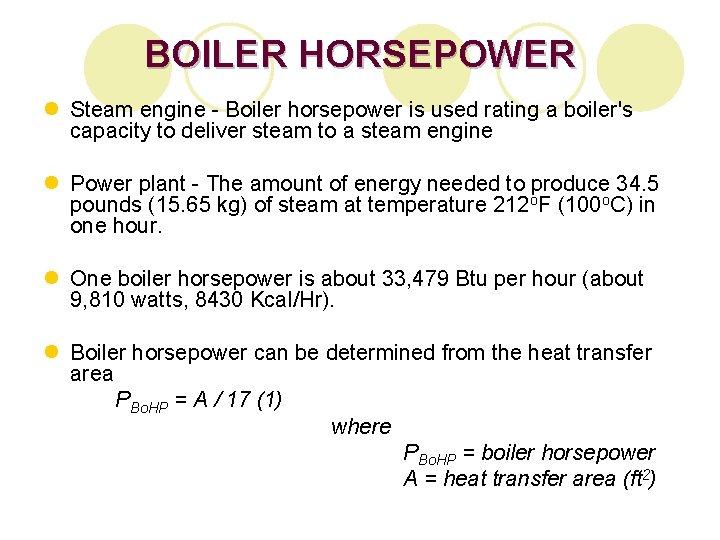
BOILER HORSEPOWER l Steam engine - Boiler horsepower is used rating a boiler's capacity to deliver steam to a steam engine l Power plant - The amount of energy needed to produce 34. 5 pounds (15. 65 kg) of steam at temperature 212 o. F (100 o. C) in one hour. l One boiler horsepower is about 33, 479 Btu per hour (about 9, 810 watts, 8430 Kcal/Hr). l Boiler horsepower can be determined from the heat transfer area PBo. HP = A / 17 (1) where PBo. HP = boiler horsepower A = heat transfer area (ft 2)
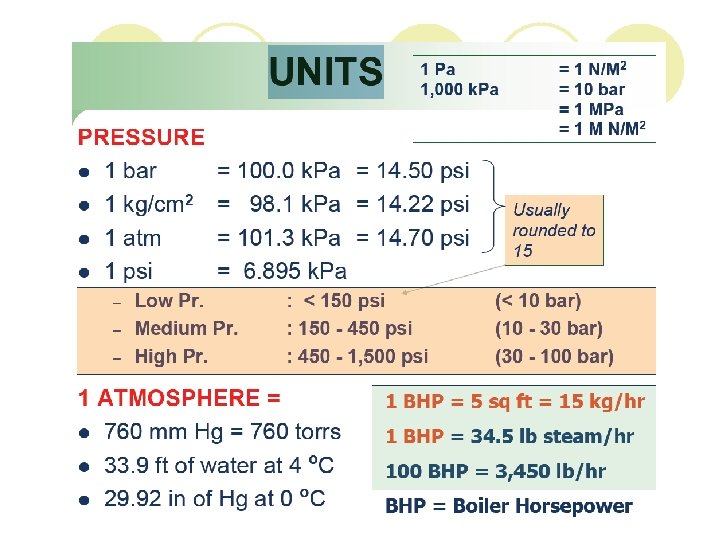
UNITS
SELECTION OF BOILER While selecting a boiler the following factors should be considered: l l l l l The working pressure and quality of steam required Steam generation rate Floor area available Accessibility for repair and inspection Comparative initial cost Erection facilities The probable load factor The fuel and water available Operating and maintenance costs
ESSENTIALS OF A GOOD STEAM BOILER A good boiler should posses the following features: 1) 2) 3) 4) 5) 6) 7) 8) 9) Produce the maximum weight of steam. Reliable. Occupy minimum space. Light in weight. Quick starting. Simple installation Easy for repairs and inspection. The boiler components should be transportable without difficulty. The tubes of the boiler should not accumulate soot or water deposits and should be sufficiently strong to allow for wear and corrosion.
DESIGN APPROVALS l “Steam. Boiler”: closed vessel in which steam is generated under pressure greater than atmospheric pressure, and includes economizer and superheater. l Section 18 FMA : 1)No person shall manufacture, repair or install machinery in such a manner that it does not comply with the provisions of this Act and regulations 2)No person shall importany machinery other than transmission machinery which does not comply with any regulations made under this Act.
BOILER FABRICATION
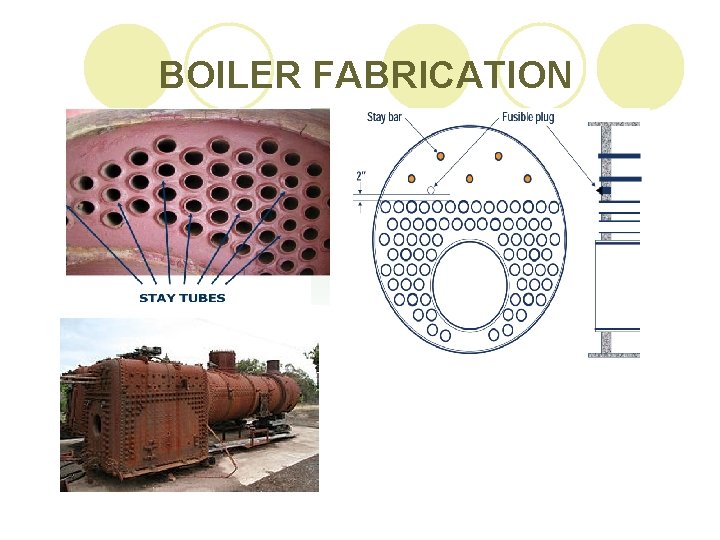
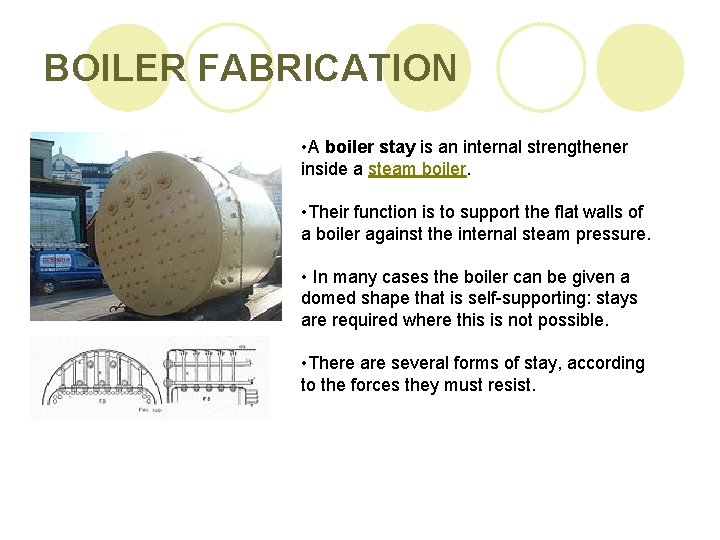
BOILER FABRICATION • A boiler stay is an internal strengthener inside a steam boiler. • Their function is to support the flat walls of a boiler against the internal steam pressure. • In many cases the boiler can be given a domed shape that is self-supporting: stays are required where this is not possible. • There are several forms of stay, according to the forces they must resist.
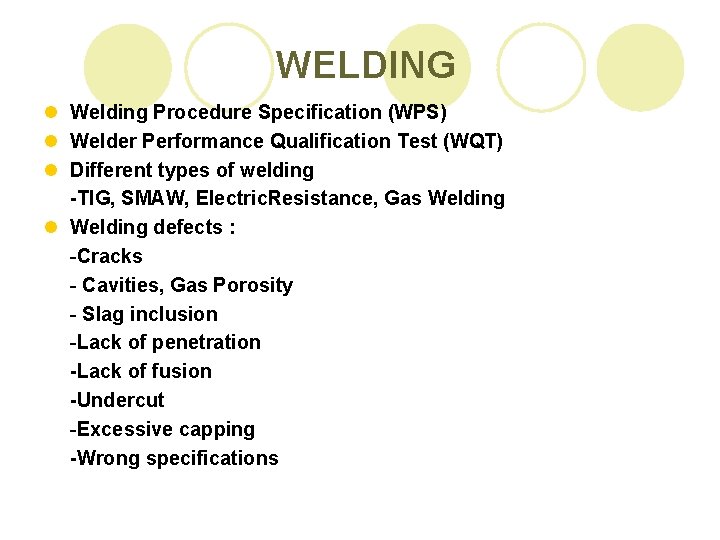
WELDING l Welding Procedure Specification (WPS) l Welder Performance Qualification Test (WQT) l Different types of welding -TIG, SMAW, Electric. Resistance, Gas Welding l Welding defects : -Cracks - Cavities, Gas Porosity - Slag inclusion -Lack of penetration -Lack of fusion -Undercut -Excessive capping -Wrong specifications
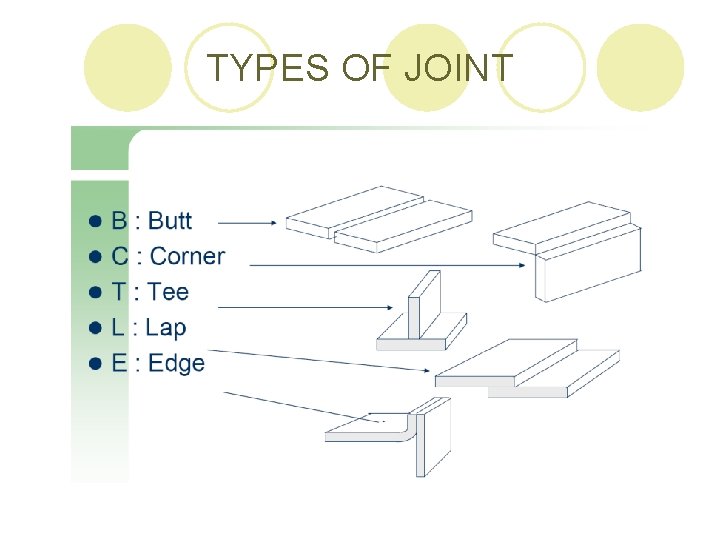
TYPES OF JOINT
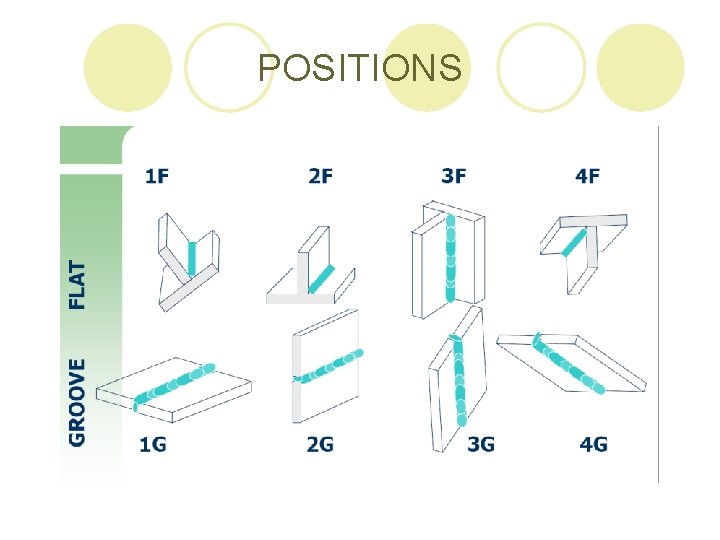
POSITIONS
INSTALLATION AND CERTIFICATION l No person shall buy, install, repair, modifyor sell any boiler without approval of DOSH. (Section 17, FMA 1967). l No person shall operate a boiler without a valid certificate of fitness(Section 19, FMA 1967)and boiler attendantand steam engineeras required. (Section 29, FMA 1967). l All boilers have to be opened up for inspection before the certificate of fitnesscan be renewed. (Regn 10&14, Notification, Certificate of Fitness and Inspection Regn, 1970) l Boilers can only be repaired by approved Boiler Repaircompanies after the repair procedure has been approved by DOSH.
INSTALLATION & TESTING l Application to local DOSH office for permission to install any steam boiler. –Form JKJ 105 –Layout plan, and –Copy oft he design approval. l Hydrostatic Test (Regulation 72 Steam Boiler and UPV Regulation): ¡ Purpose : To check leakage ¡ 1 st service during installation at site ¡ Every 7 years ¡ After repair ¡ 1. 5 x authorised safe working pressure and hold for 20 min. l Steam test ¡ Purpose : To check functioning of boiler equipment and safety features e. g : water alarm, blowdown, relief valve etc ¡ 1 st time service during commissioning after hydrostatic test ¡ When the authorised safe working pressure has been altered or safety valve change
HYDROSTATIC TEST l Spading (isolating) the boiler attachments e. g. safety valves and water gauge, except for the feed water inlet and blowdown valves l Use appropriate pressure gauge l Leave one vent open at the top to ensure water pumped in completely fills the boiler l Raise pressure to design pressure. Check. l Raise pressure to 1. 5 x design pressure, maintain for at least 20 mins. Check for leaks. l Slight weeping is acceptable (expanded tubes only). l Fill in the hydrostatic test Form. JKJ 127 (newboiler).
STEAM TEST l Warm up the boiler. l Fire the boiler –adequate slow firing. Check. l Raise the pressure to the operating pressure; Check. Increase the pressure; l Bypass thefire cut-off if necessary, to test the pressure relief valves. The highest pressure setting should not exceed the design pressure. Note the seating pressure. l If provided with superheater, test the superheater relief valvefirst; it should have the lowest setting. l Test the high water and low water alarms. l Ensure safe blowdown; check blowdown pit or tank
ANNUAL INSPECTION l The boiler has to be shut down and allowed to cool. l Water is drained and all the fittings including caps in headers and mud drums are dismantled. l The boiler is effectively disconnected from any other steam boiler or source of steam. l The fireside is thoroughly cleaned l The internals are cleaned as necessary -by hydrojet, and wirebrushed clear of scales and deposits l Fittings such as cocks and valves, floats and gauge glasses are cleaned and serviced l Temporary scaffolds or ladders must be provided if permanent ones are not available -for inspection of remote areas l The boiler is empty, cool and dry
Statutory Inspection l l l l l �� What the DOSH inspectors look for: –Signs of shell wall thinning. –Cracks at welds and at connections. –Damage to the shell by impact. –Leaking gaskets and seals. –Soundness of foundation. –Protective coatings. –Safety relief valve functions. –Alarm functions –Pressure gauge calibration l –Hazards such as sumps and blowdowns .