
Chapter 2 Sound Section 1 The Nature of

- Slides: 17
Chapter 2: Sound Section 1: The Nature of Sound Do Now: 1. Put your name on your new study guide 2. Home Learning – Unit Test tomorrow 3. Cornell Notes – 12/7/15 Nature of Sound FQ: How are sound waves and how do we use them to learn about our world?
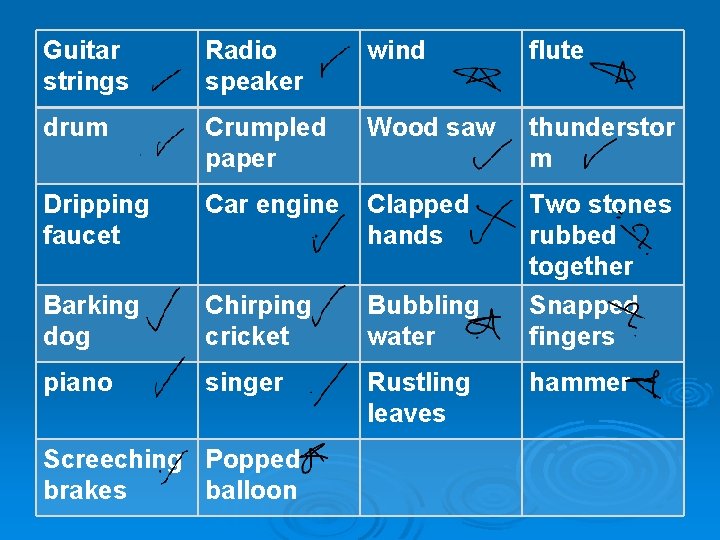
MAKING SOUND Team Activity: Ø All of the objects on the next slide make sounds. Which objects do you think vibrate to produce sounds?
Guitar strings Radio speaker wind flute drum Crumpled paper Wood saw thunderstor m Dripping faucet Car engine Clapped hands Barking dog Chirping cricket Bubbling water Two stones rubbed together Snapped fingers piano singer Rustling leaves Screeching Popped brakes balloon hammer
MAKING SOUND Ø All of the objects make sounds. Decide with your team which objects you think vibrate to produce sounds. Ø Explain your thinking. What “rule” or reasoning did you use to decide which objects involve vibrations in producing sound?
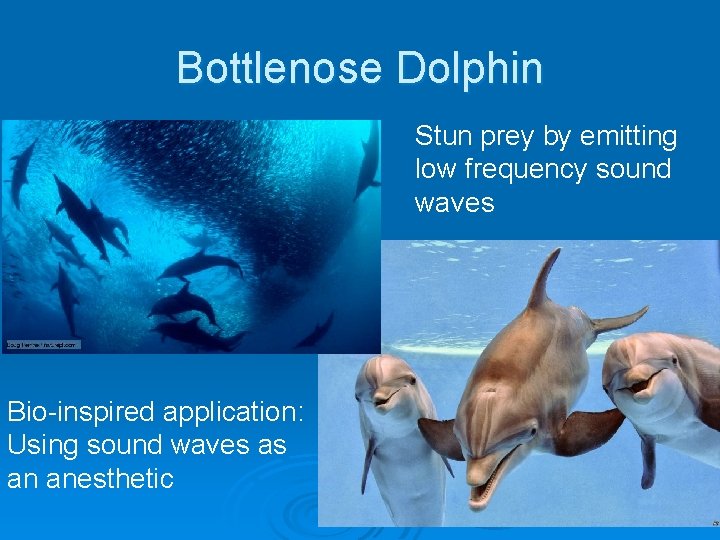
Bottlenose Dolphin Stun prey by emitting low frequency sound waves Bio-inspired application: Using sound waves as an anesthetic
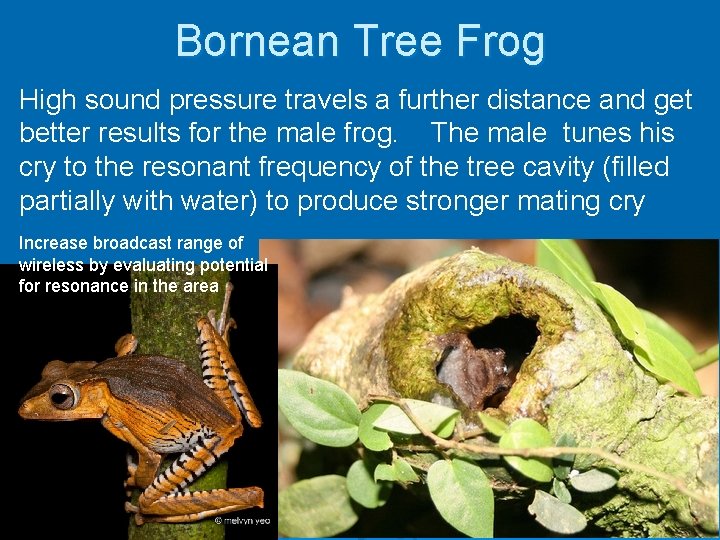
Bornean Tree Frog High sound pressure travels a further distance and get better results for the male frog. The male tunes his cry to the resonant frequency of the tree cavity (filled partially with water) to produce stronger mating cry Increase broadcast range of wireless by evaluating potential for resonance in the area
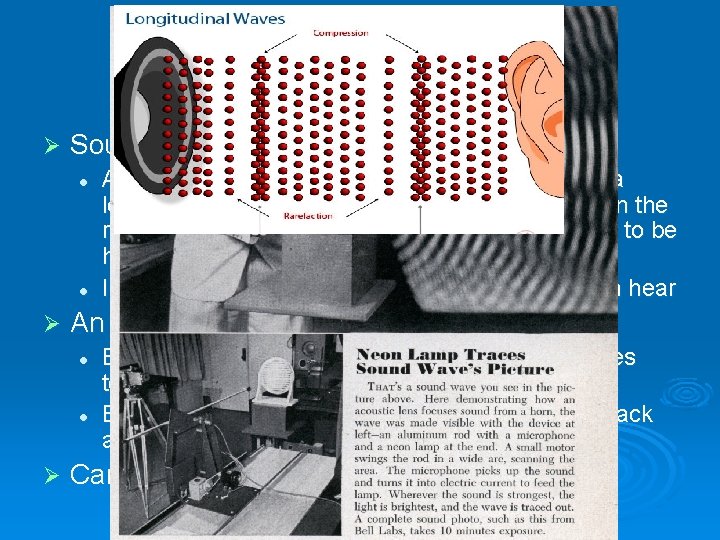
Sound Waves Ø Sound: l l Ø An object vibrates l l Ø A disturbance that travels through a medium as a longitudinal wave composed of frequencies within the range of hearing and of a level sufficiently strong to be heard In other words – a longitudinal wave that you can hear Every time it moves forward, it pushes air particles together (compression) Every time it moves back, the particles bounce back and spread out (rarefaction) Can travel through solids, liquids, or gases
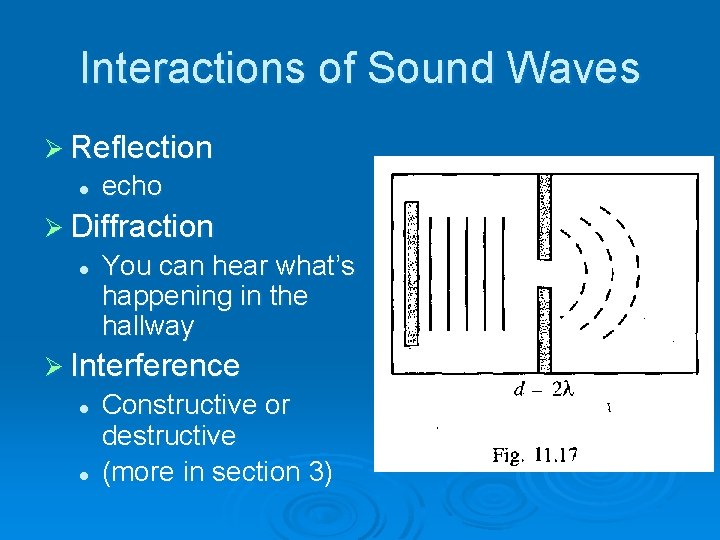
Interactions of Sound Waves Ø Reflection l echo Ø Diffraction l You can hear what’s happening in the hallway Ø Interference l l Constructive or destructive (more in section 3)
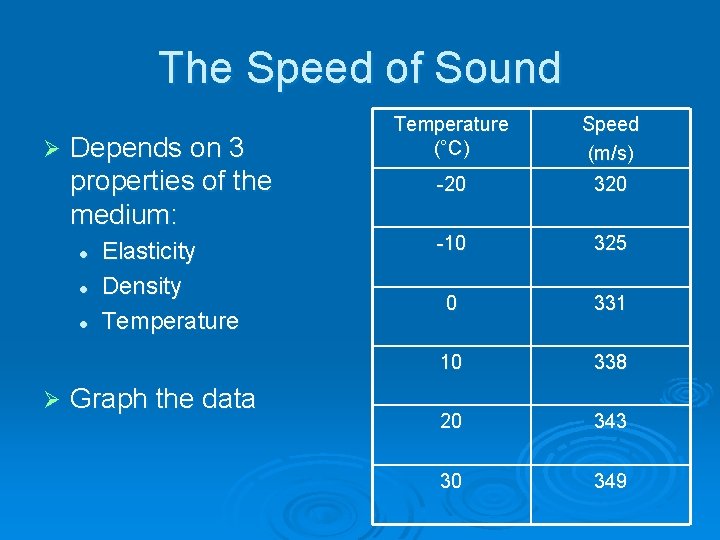
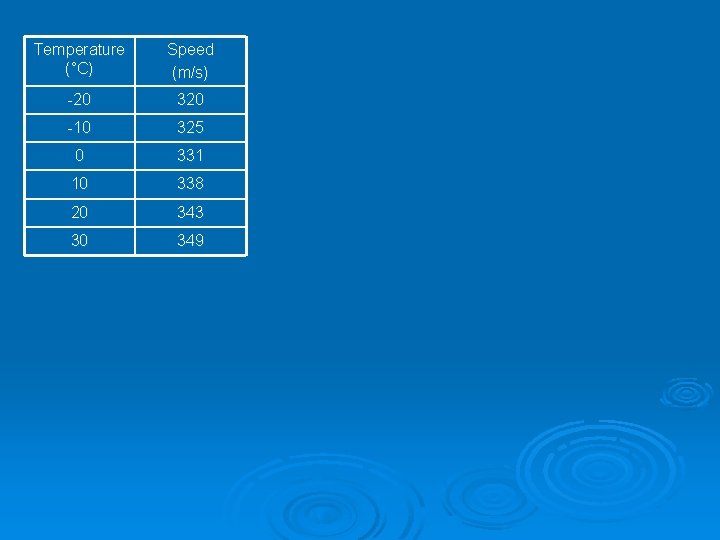
The Speed of Sound Ø Depends on 3 properties of the medium: l l l Ø Elasticity Density Temperature Graph the data Temperature (°C) Speed (m/s) -20 320 -10 325 0 331 10 338 20 343 30 349
Temperature (°C) Speed (m/s) -20 320 -10 325 0 331 10 338 20 343 30 349
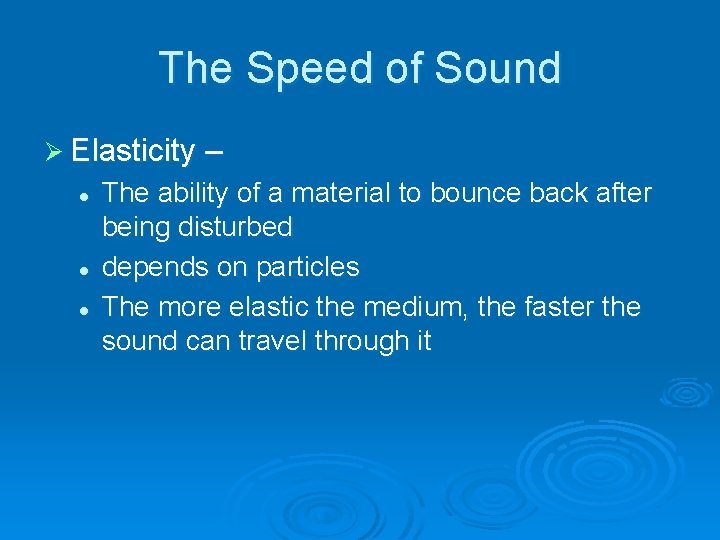
The Speed of Sound Ø Elasticity – l l l The ability of a material to bounce back after being disturbed depends on particles The more elastic the medium, the faster the sound can travel through it
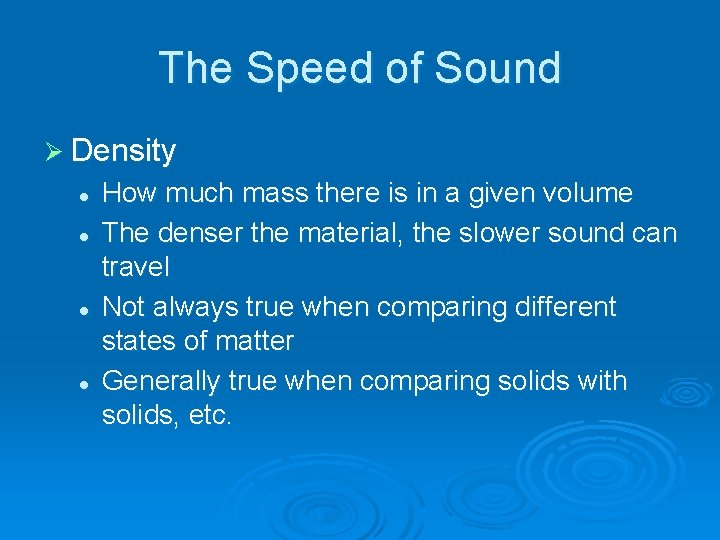
The Speed of Sound Ø Density l l How much mass there is in a given volume The denser the material, the slower sound can travel Not always true when comparing different states of matter Generally true when comparing solids with solids, etc.
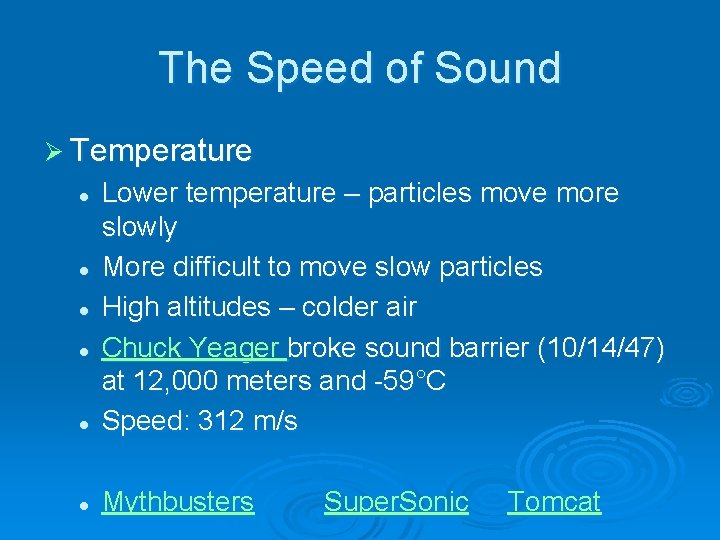
The Speed of Sound Ø Temperature l Lower temperature – particles move more slowly More difficult to move slow particles High altitudes – colder air Chuck Yeager broke sound barrier (10/14/47) at 12, 000 meters and -59°C Speed: 312 m/s l Mythbusters Super. Sonic Tomcat l l
Sound Movies Ø Click here for Sound Movie (16 minutes) Ø Click here for deaf baby with cochlear implant hearing for the first time (tear!)
Suppose you’re watching a science fiction movie and one of the scenes involves a spaceship battle in outer space. Spaceship A launches a successful strike on spaceship B. The scene is presented from the perspective of spaceship A. The occupants of spaceship A view spaceship B blowing up as the result of the successful missile strike. They see the flames of the explosion and shortly thereafter hear the thunderous sound of the explosion. Ø Ø While the scene is definitely exciting, there is a significant fault with it in terms of the physics. What scientific fact was violated in the filming of the scene? Explain. Ø