
Chapter 2 Some Tools of the Economist Slides


- Slides: 28
Chapter 2 Some Tools of the Economist Slides to Accompany “Economics: Public and Private Choice 9 th ed. ” James Gwartney, Richard Stroup, and Russell Sobel Next page Copyright (c) 2000 by Harcourt Inc. All rights reserved.
1. What Shall We Give Up? Jump to first page Copyright (c) 2000 by Harcourt Inc. All rights reserved.
Opportunity Cost n Opportunity cost: The highest valued activity sacrificed in making a choice. u n Opportunity costs are subjective and vary across individuals. The opportunity cost of college: Monetary cost: tuition, books. u Non-monetary cost: forgone earnings. u If opportunity cost of college rises (e. g. tuition rises), then one will be less likely to attend college. u Jump to first page Copyright (c) 2000 by Harcourt Inc. All rights reserved.
Trade n Mutual gain is the foundation of trade. u n Value can be created by exchanges that move goods to individuals who value them more. Transactions costs: -- the time, effort, and other resources needed to search out, negotiate, and consummate an exchange. u Transactions costs reduce our ability to produce gains from potential trades. Jump to first page Copyright (c) 2000 by Harcourt Inc. All rights reserved.
Trade n Middleman: -- a person who buys and sells, or arranges trades. u Middleman reduce transactions costs. Jump to first page Copyright (c) 2000 by Harcourt Inc. All rights reserved.
2. The Importance of Property Rights Jump to first page Copyright (c) 2000 by Harcourt Inc. All rights reserved.
Private Property Rights n n Property rights: -- the right to use, control, and obtain benefits from a good or service. Private property rights involve: the right to exclusive use u legal protection against invaders. u the right to transfer to another. u Jump to first page Copyright (c) 2000 by Harcourt Inc. All rights reserved.
Private Property and Incentives n n n Private owners can gain by employing their resources in ways that are beneficial to others. The private owner has a strong incentive to care for and properly manage what he or she owns. The private owner has an incentive to conserve for the future if the property’s value is expected to rise. Jump to first page Copyright (c) 2000 by Harcourt Inc. All rights reserved.
Private Property and Incentives n With private property rights, the private owner is accountable for damage to others through misuse of the property. u Private ownership links responsibility with the right of control. Jump to first page Copyright (c) 2000 by Harcourt Inc. All rights reserved.
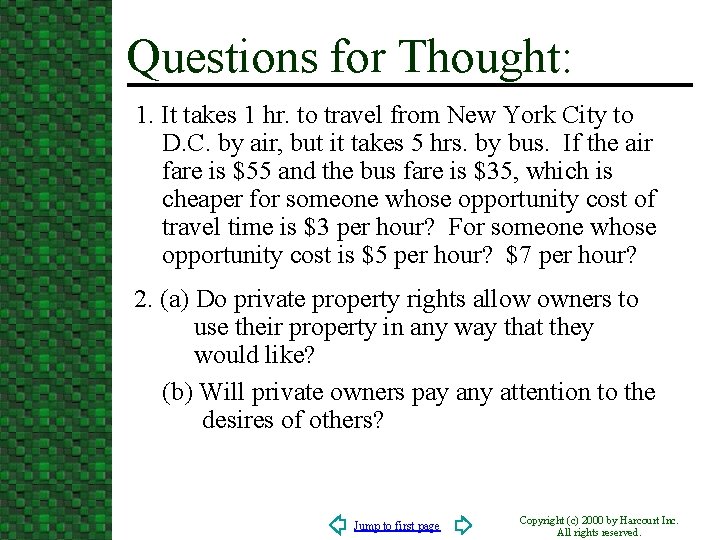
Questions for Thought: 1. It takes 1 hr. to travel from New York City to D. C. by air, but it takes 5 hrs. by bus. If the air fare is $55 and the bus fare is $35, which is cheaper for someone whose opportunity cost of travel time is $3 per hour? For someone whose opportunity cost is $5 per hour? $7 per hour? 2. (a) Do private property rights allow owners to use their property in any way that they would like? (b) Will private owners pay any attention to the desires of others? Jump to first page Copyright (c) 2000 by Harcourt Inc. All rights reserved.
3. Production Possibilities Curve Jump to first page Copyright (c) 2000 by Harcourt Inc. All rights reserved.
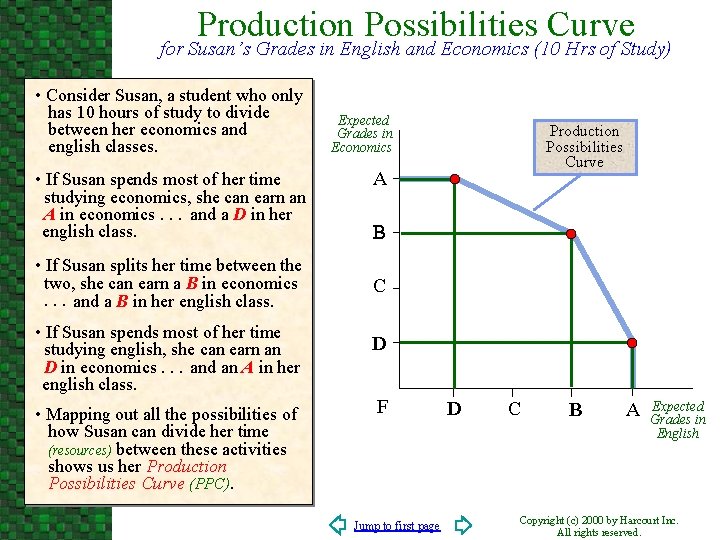
Production Possibilities Curve for Susan’s Grades in English and Economics (10 Hrs of Study) • Consider Susan, a student who only has 10 hours of study to divide between her economics and english classes. • If Susan spends most of her time studying economics, she can earn an A in economics. . . and a D in her english class. • If Susan splits her time between the two, she can earn a B in economics. . . and a B in her english class. • If Susan spends most of her time studying english, she can earn an D in economics. . . and an A in her english class. • Mapping out all the possibilities of how Susan can divide her time (resources) between these activities shows us her Production Possibilities Curve (PPC). Expected Grades in Economics Production Possibilities Curve A B C D F Jump to first page D C B A Expected Grades in English Copyright (c) 2000 by Harcourt Inc. All rights reserved.
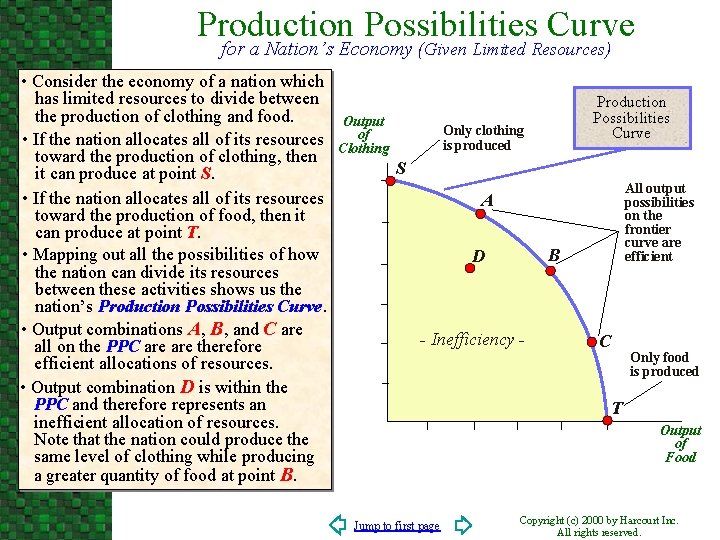
Production Possibilities Curve for a Nation’s Economy (Given Limited Resources) • Consider the economy of a nation which has limited resources to divide between the production of clothing and food. • If the nation allocates all of its resources toward the production of clothing, then it can produce at point S. • If the nation allocates all of its resources toward the production of food, then it can produce at point T. • Mapping out all the possibilities of how the nation can divide its resources between these activities shows us the nation’s Production Possibilities Curve. • Output combinations A, B, and C are all on the PPC are therefore efficient allocations of resources. • Output combination D is within the PPC and therefore represents an inefficient allocation of resources. Note that the nation could produce the same level of clothing while producing a greater quantity of food at point B. Output of Clothing Production Possibilities Curve Only clothing is produced S All output possibilities on the frontier curve are efficient A B D - Inefficiency - C Only food is produced T Output of Food Jump to first page Copyright (c) 2000 by Harcourt Inc. All rights reserved.
Shifting the Production Possibilities Curve Outward n n An increase in the economy’s resource base would expand our ability to produce goods and services. Advancements in technology can expand the economy’s production possibilities. Jump to first page Copyright (c) 2000 by Harcourt Inc. All rights reserved.
Shifting the Production Possibilities Curve Outward n n An improvement in the rules (laws, institutions, and policies) of the economy can increase output. By working harder and giving up current leisure, we could increase our production of goods and services. Jump to first page Copyright (c) 2000 by Harcourt Inc. All rights reserved.
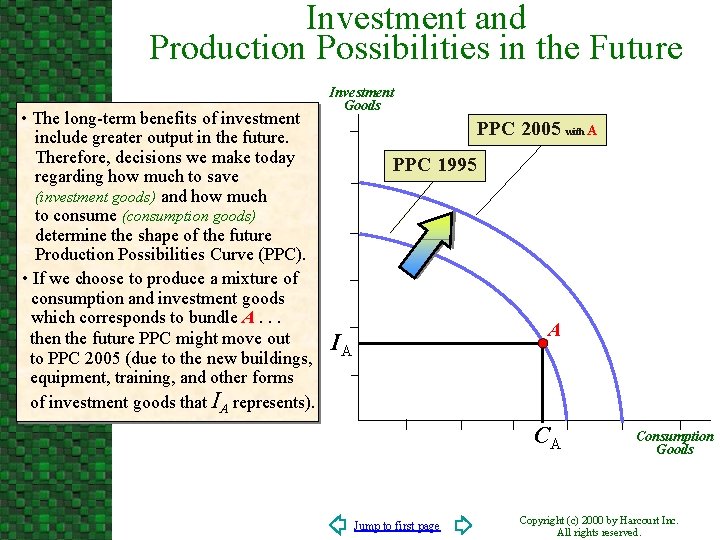
Investment and Production Possibilities in the Future • The long-term benefits of investment include greater output in the future. Therefore, decisions we make today regarding how much to save (investment goods) and how much to consume (consumption goods) determine the shape of the future Production Possibilities Curve (PPC). • If we choose to produce a mixture of consumption and investment goods which corresponds to bundle A. . . then the future PPC might move out to PPC 2005 (due to the new buildings, equipment, training, and other forms of investment goods that IA represents). Investment Goods PPC 2005 with A PPC 1995 A IA CA Jump to first page Consumption Goods Copyright (c) 2000 by Harcourt Inc. All rights reserved.
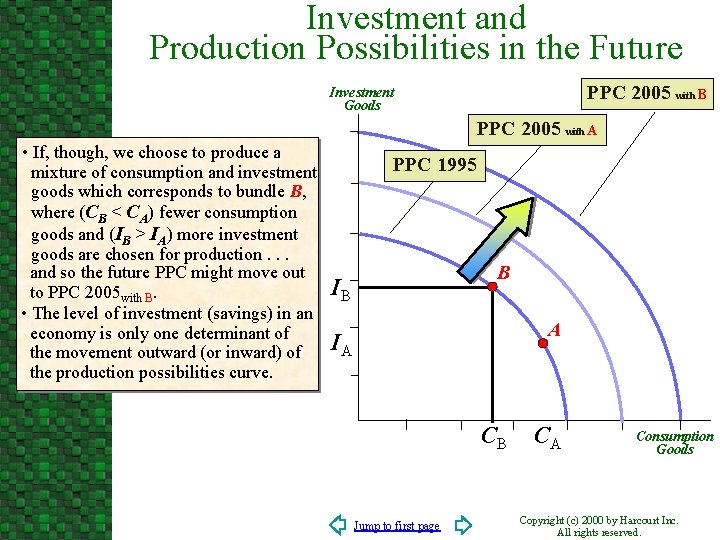
Investment and Production Possibilities in the Future PPC 2005 with B Investment Goods PPC 2005 with A • If, though, we choose to produce a mixture of consumption and investment goods which corresponds to bundle B, where (CB < CA) fewer consumption goods and (IB > IA) more investment goods are chosen for production. . . and so the future PPC might move out to PPC 2005 with B. • The level of investment (savings) in an economy is only one determinant of the movement outward (or inward) of the production possibilities curve. PPC 1995 B IB A IA CB Jump to first page CA Consumption Goods Copyright (c) 2000 by Harcourt Inc. All rights reserved.
4. Division of Labor, Specialization, and Production Possibilities Jump to first page Copyright (c) 2000 by Harcourt Inc. All rights reserved.
Division of Labor n Division of labor: -- breaks down the production of a commodity into a series of specific tasks performed by different workers. Jump to first page Copyright (c) 2000 by Harcourt Inc. All rights reserved.
Division of Labor n Specialization and division of labor increase output for three reasons: Specialization permits individuals to take advantage of their existing skills. u Specialized workers become more skilled with time. u Division of labor allows for the adoption of mass-production technology. u Jump to first page Copyright (c) 2000 by Harcourt Inc. All rights reserved.
Law of Comparative Advantage n Law of comparative advantage: -- proposition that the joint output of trading partners will be greatest when each good is produced by the low opportunity cost producer. Implies that trading partners can gain by specializing in the production of goods they can produce at a relatively low cost and trade for goods they could only produce at a relatively high cost. u The principle of comparative advantage is universal as it applies across individuals, firms, regions and countries. u Jump to first page Copyright (c) 2000 by Harcourt Inc. All rights reserved.
Voluntary Exchange n Voluntary exchange channels goods toward those who value them most and permits us to realize gains from specialization, division of labor, mass production, and cooperative effort among individuals. u These elements underlie our modern living standards. Jump to first page Copyright (c) 2000 by Harcourt Inc. All rights reserved.
5. Economic Organization Jump to first page Copyright (c) 2000 by Harcourt Inc. All rights reserved.
Methods of Economic Organization n Market organization: -- A method or organization that allows unregulated prices and the decentralized decisions of private property owners to resolve the basic economic problems. u Sometimes market organization is called capitalism. Jump to first page Copyright (c) 2000 by Harcourt Inc. All rights reserved.
Methods of Economic Organization n Collective decision making: -- Organizational method that relies on public-sector decision making to resolve basic economic issues. u An economic system in which the government owns the income-producing assets and directly determines what goods they produce is called socialism. Jump to first page Copyright (c) 2000 by Harcourt Inc. All rights reserved.
Exit and Voice n Individuals have two major methods for sending messages. u Voice: -- communicating complaints, desires, and suggestions directly to decision makers. u Exit: -- the ability to withdraw from an economic relationship. F Exit is easier to exercise in a market setting. F Voice will be more effective if exit is also available. Jump to first page Copyright (c) 2000 by Harcourt Inc. All rights reserved.
Questions for Thought: 1. What does a production possibilities curve demonstrate? 2. In many states, the resale of tickets to sporting events at prices above the original purchase price (“ticket scalping”) is prohibited. Is this a good idea? Who is hurt and who is helped by the prohibition? 3. (a) Suppose that grades in this class were going to be determined by a random draw at the end of the course. How would this influence your study habits? (b) Do you think the total output of goods in a country would be influenced by whethere was a close relationship between productive contribution and individual reward? Jump to first page Copyright (c) 2000 by Harcourt Inc. All rights reserved.
End Chapter 2 Jump to first page Copyright (c) 2000 by Harcourt Inc. All rights reserved.