
Chapter 2 Socialization and the creation of social
- Slides: 47
Chapter 2 Socialization and the creation of social identity
Nature v. Nurture Debate • How human behavior can be explained. - nature – biological/genetic - nurture – cultural terms • Roles – expected patterns of behavior associated with our status - i. e. – teacher, student, friend, parent • Values – beliefs or ideas that are important to the people who hold them - expresses how something should be • Norms – socially acceptable ways of behaving when playing a particular role
Domain Assumptions • Domain Assumptions: assumptions on which a particular perspective or ideology is based ex – domain assumptions for Marxism include economic exploitation and class conflict. ex – domain assumption for Post Modernism assumes that… ex – domain assumption for Positivism assumes that…
Structuralist + Functionalist • Structuralist (macro)- Originated from Durkheim and Marx - Social Action is beyond individual control, structure of systems dictates our actions. i. e. - capitalism • Functionalist (opposite of Marxist Structuralist) – Arrangements between institutions make for a smooth running of society - ex – family, education, and government make for smoothly running society
Interactionism • Interactionism – microsociological approach – sociology focused on individuals and small groups. • 3 types of interactionism 1. Phenomenology – the social world consists of phenomena whose meaning is both negotiated and interpreted through interaction.
Interactionism • 2. Ethnomethodology – all social interaction is underpinned by a search for meaning. If we can understand the meanings people give to a situation we can understand their behavior in such situations. • 3. Symbolic Interactionism –analyzes society and situations in terms of the meanings that people impose on objects, events and behaviours.
Over-Socialized Conception of Man • The Over-Socialized Conception of Man - a criticism of the claim that human beings are simply the product of their socialization. Behavior can be understood merely as a response to external stimulation.
Labeling • Interactionists view labeling as the product of social interaction. • Male / Female – We associate certain characteristics and roles. These may change over time because they are based on interactions.
Structuration • Structuration – both structure and action are equally significant in our ability to understand the relationship between the individual and society. - people develop relationships, practices towards one another become normalized, then we conform to the structure we have developed
Rules in Society • Negotiated – friendship - unwritten, unspoken • Non-Negotiable – murder – imposed by powerful groups
Key Terms p 32 -35 • • • Socialization Feral Children Social Self Looking-Glass Self Action Theory Social Engineering
Socialization – people learn various forms of behavior consistent with membership of a particular culture - Young children learn roles, norms, and values so they can become fully functioning members of society. These things do not occur naturally.
Feral Children (wild child) • a human child who has lived isolated from human contact from a very young age, and has little or no experience of human care, behavior, crucially, of human language. - walking upright, talking, using eating implements – not picked up quickly or easily. What does this tell us about socialization?
Social Self • Mead argued – our ability to see ourselves as others see us separates us from animals. • Social Self – an awareness of how others expect us to behave in given situations means that our sense of self – who we believe ourselves to be – is created through social interaction and exchange
Social Self • “I” – our opinion of ourselves (unsocialized) • “Me” – awareness of how others expect us to behave in a given situation - who you are male/female, adult/child, etc. - where you are – alone at home or a public place - who you are with – family, friends, strangers
Looking-Glass Self • Looking Glass Self – argues that our sense of self develops from how we are seen by others. We understand who we are by looking in the “mirror” of how other behave towards us. • Goffman – We adopt a particular identity and “perform” to “manage” the image that others have of us.
Action Theory • Action Theory – perspective focusing on individuals and how their interactions create and re-create a sense of society. -negotiation, what it means to be young, old, male, female is constantly changing.
Social Engineering • Social Engineering – cultural manipulation of individuals to produce particular social outcomes, such as gender equality. • Attempts to limit the effects of biological differences.
Key Terms p 36 -41 • • • Social Control Positive / Negative Sanctions Formal / Informal Controls Primary Agencies of Socialization Secondary Agencies of Socialization Sub Culture Social Sanctions Consumerism Customs
Social Control • Social Control – the process of brining order, stability, and predictability to people’s behavior. - a lifelong process of rule learning. • If there is a “right” way to do something, there is also a “deviant” way.
Sanctions • Positive Sanctions – rewards – ie: smiling, praise, encouragement, gifts • Negative Sanctions – punishments – ie: ignore someone, prision
Types of Controls • Formal Control – written rules, laws, code of conduct • Informal Control – unofficial rules of how to act
Agencies of Socialization • Primary Agencies of Socialization - family - peers • Secondary Agencies of Socialization - Education - Mass Media - Religion
Sub-Culture • Sub-Culture – a culture within a larger group - religious groups - gangs - fans of a particular band (DMB, Phish)
Social Sanctions • Social Sanctions – rewards or punishments designed to exert social control and enforce conformity to roles, norms, and values. This Big Bang Theory episode where Sheldon was giving Penny chocolate for acceptable behavior (Positive Sanction)
Consumerism • Consumerism – repeated exposure to affluent lifestyles and desirable consumer goods. The idea that “happiness can be bought”
Customs • Established and accepted cultural practices and behaviors. • Lets list some examples…. .
Key Terms p 42 -45 • Social Construction of Reality • Critical Theory • Power
Social Construction of Reality • Material Culture – cars, books, phones (artifacts) that reflect our cultural knowledge, skills, and preoccupation • Non-Material Culture – beliefs that we value – religion, science • Social Construction of Reality – our perception of what is real is created by historical and cultural processes. i. e. – different societies construct male and female identities differently
Roles / Values / Ideologies • Roles – played in relation to other roles • Values – specific to specific roles • Ideologies – focused around fundamental beliefs, trying to explain something - meaning of life - family organization - superiority / inferiority
Critical Theory • Critical Theory – argues that ideologies have a manipulative element. - associated with Marxism - i. e. - capitalist-controlled media which shapes a favorable reality for the elite
Power • Power - The ability to make others do what you want. - coercive – forced to obey, threat of punishment - consensus – people obey because they believe it “right” to do so • Leaders in Power - Charisma – obey because they trust the person in power - Traditional – custom and practice, this is how things have been done - Regional/Legal – position allows them to demand complicane Lets come up with examples of each method of exerting power
Key Terms p 46 -50 • • Social Identity Class Identities – Lower, Upper, Blurring Gender Identities Ethnic Identities
Social Identity • Social Identity – collective or group identities - how a particular group is expected to behave ie – class/gender/ethnicity
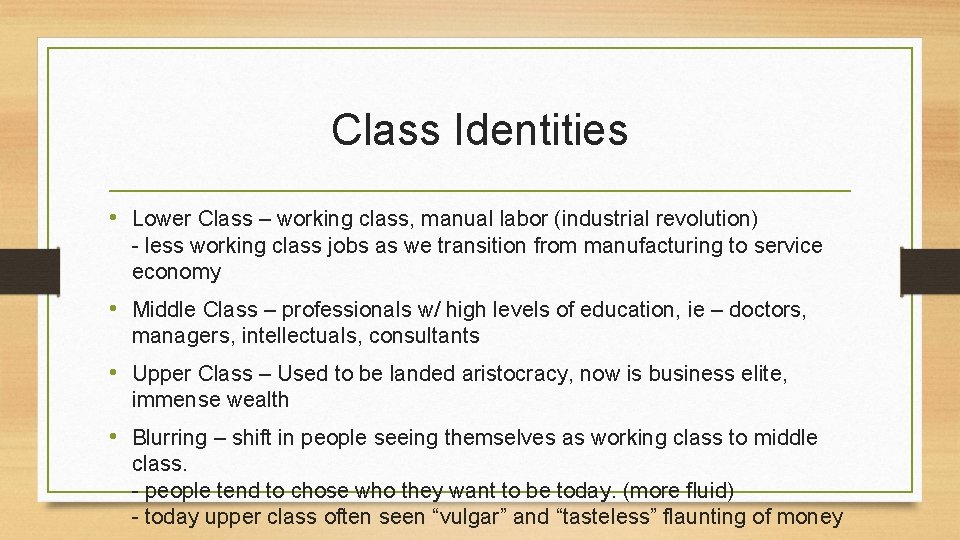
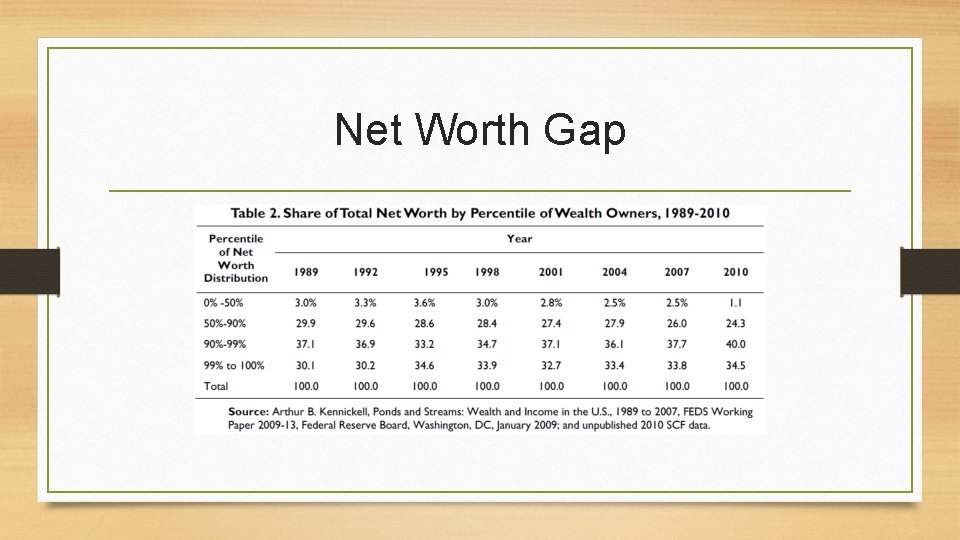
Class Identities • Lower Class – working class, manual labor (industrial revolution) - less working class jobs as we transition from manufacturing to service economy • Middle Class – professionals w/ high levels of education, ie – doctors, managers, intellectuals, consultants • Upper Class – Used to be landed aristocracy, now is business elite, immense wealth • Blurring – shift in people seeing themselves as working class to middle class. - people tend to chose who they want to be today. (more fluid) - today upper class often seen “vulgar” and “tasteless” flaunting of money
Income Gap • http: //www. cnn. com/2015/01/19/world/wealth-inequality/
Net Worth Gap
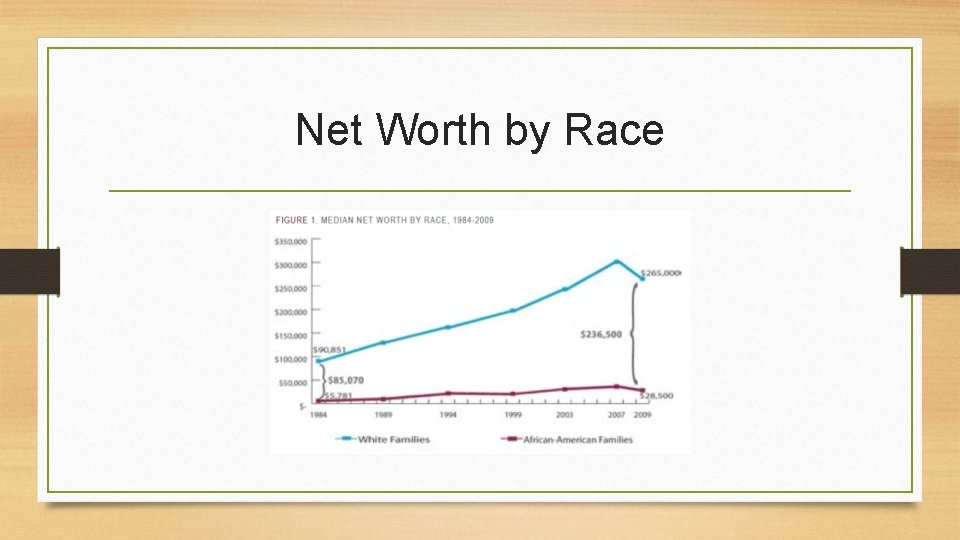
Net Worth by Race
Gender Identities • Gender – social characteristics associates with men and women. • Connell: we are not born man or woman, we become men and women through the social construction of gender identities. • Male: physical strength, physique, leaders, providers, being unemotional • Female: passive, emotional, provide service to others
Male Identities / Female Identities • Activity – Girls will present “Male Identities” and “Crisis” (p 47 -48) - Boys will present “Female Identities” (p 48 -49)
Ethnic Identities • Ethnicity is different from race. - Race – man-created. No Scientific evidence of a difference between racial groups. - Ethnicity – a combination of cultural differences. - ie – religion, family structure, beliefs, values, norms - a shared cultural background and history, “memories of a shared past” - symbolic elements – family, kinship, religion, language, territory. - a cultural and social identity
Key Terms p 51 -54 • • Function High Culture Low Culture Postmodernism
Modernity • Modernist Perspective – what culture and identity do, how are they used, and what they mean. • Fisher – culture systemizes the way people do things, avoiding confusion and allowing “cooperation” (functionalism)
Functions of Culture • • • Communication – common language Perception – how we see the world, “predestination? ” Identity – how we see ourselves and others Value Systems – education, media, religion… sources of values Motivation – sanctions, encourage of discourage behaviour Stratification – ie - class. . Functional because incentives motivate people • Production/Consumption – what we need, use and value
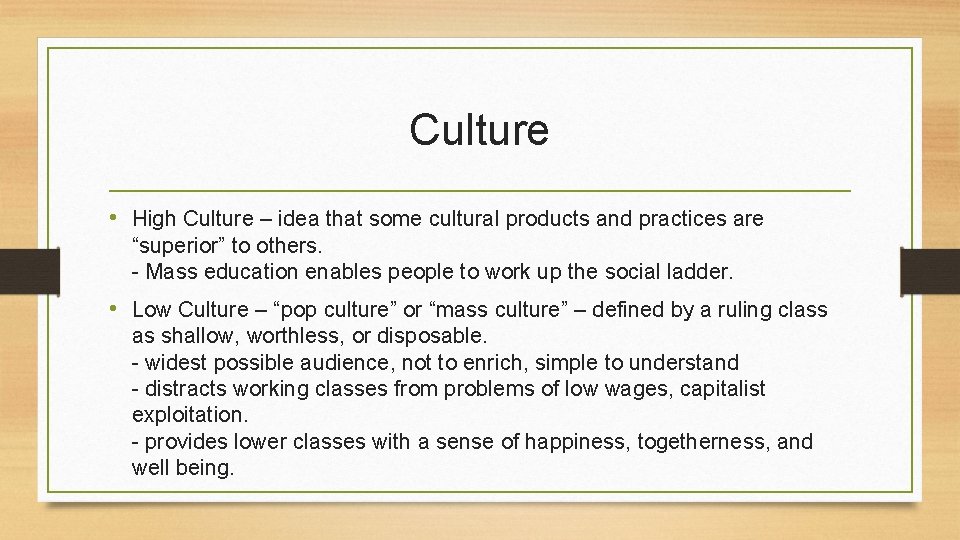
Culture • High Culture – idea that some cultural products and practices are “superior” to others. - Mass education enables people to work up the social ladder. • Low Culture – “pop culture” or “mass culture” – defined by a ruling class as shallow, worthless, or disposable. - widest possible audience, not to enrich, simple to understand - distracts working classes from problems of low wages, capitalist exploitation. - provides lower classes with a sense of happiness, togetherness, and well being.
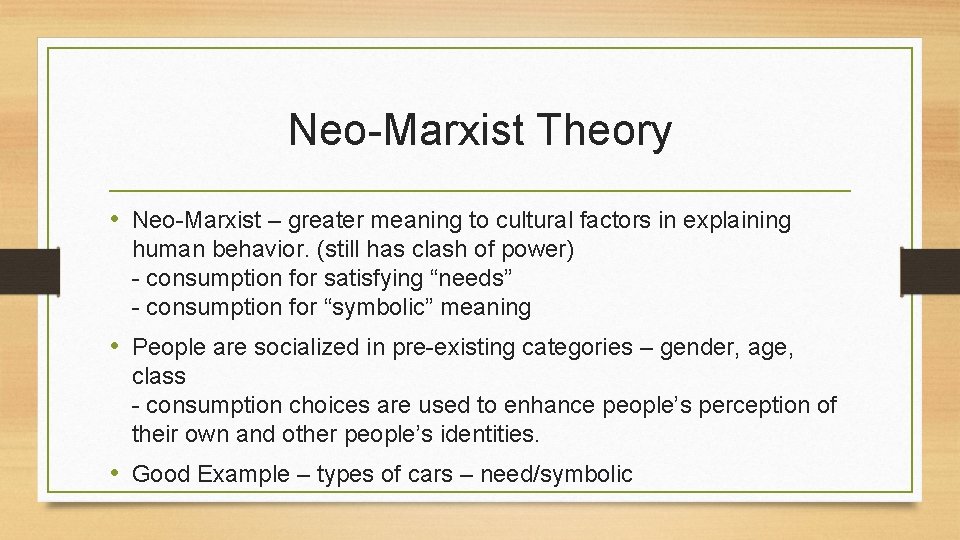
Neo-Marxist Theory • Neo-Marxist – greater meaning to cultural factors in explaining human behavior. (still has clash of power) - consumption for satisfying “needs” - consumption for “symbolic” meaning • People are socialized in pre-existing categories – gender, age, class - consumption choices are used to enhance people’s perception of their own and other people’s identities. • Good Example – types of cars – need/symbolic
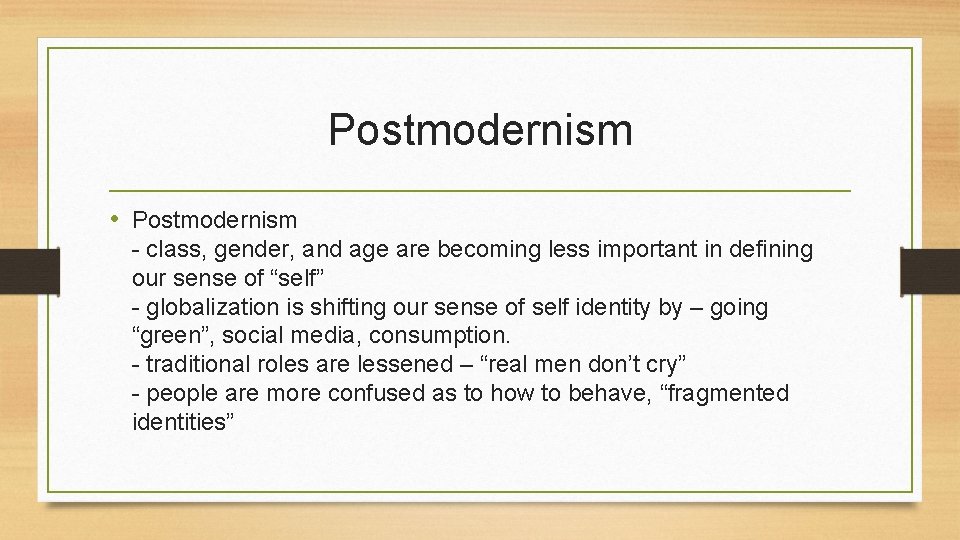
Postmodernism • Postmodernism - class, gender, and age are becoming less important in defining our sense of “self” - globalization is shifting our sense of self identity by – going “green”, social media, consumption. - traditional roles are lessened – “real men don’t cry” - people are more confused as to how to behave, “fragmented identities”