
Chapter 2 Small Group Communication Theory This multimedia

- Slides: 18
Chapter 2 Small Group Communication Theory This multimedia product and its contents are protected under copyright law: any public performance or display, including transmission of any image over network; preparation of any derivative work including the extraction, in whole or in part, of any images; any rental, lease, or lending of the program. Copyright © Allyn & Bacon 2006
Central issues • Nature of theory and theory building • Practicality of theory to small group and teams • Five theoretical perspectives Copyright © Allyn & Bacon 2006
Theory building • Observe a phenomenon • Witness repeated pattern • Develop explanation Copyright © Allyn & Bacon 2006
Definition of theory • Way of binding together multitude of facts so that one may comprehend them all at once • Enables us to make reasonably precise predictions that may be termed scientific. • Crucial to the study of small groups Copyright © Allyn & Bacon 2006
Theory is crucial to study of small group and team communication Functions of theory • Explanatory • Predictive Copyright © Allyn & Bacon 2006
Explanatory Function Explanation power of good theory helps make sense of processes involved when people interact with others in group. Copyright © Allyn & Bacon 2006
Predictive Function Predictive precision allows people to anticipate probable outcomes of communicative behaviors in group. Copyright © Allyn & Bacon 2006
Theory informs communicative behavior • Process theories: descriptive • Method theories: prescriptive Copyright © Allyn & Bacon 2006
Theoretical Perspective • Complexity is pervasive characteristic of small groups • Speech communication is driving force that moves groups towards their goals Copyright © Allyn & Bacon 2006
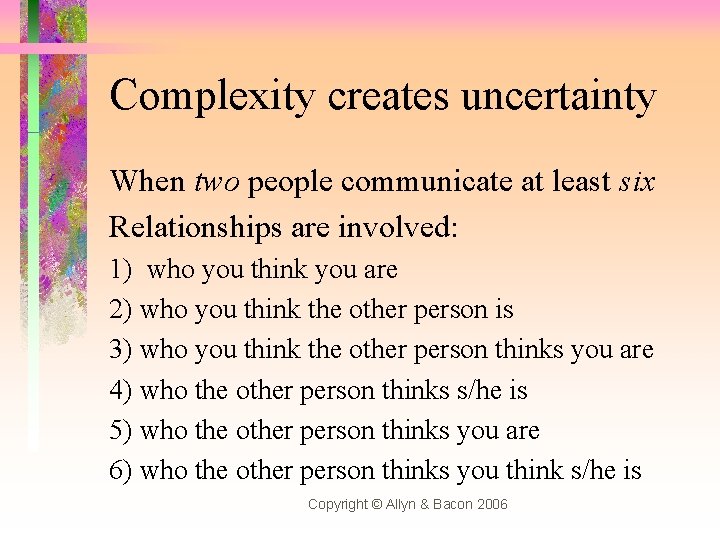
Complexity creates uncertainty When two people communicate at least six Relationships are involved: 1) who you think you are 2) who you think the other person is 3) who you think the other person thinks you are 4) who the other person thinks s/he is 5) who the other person thinks you are 6) who the other person thinks you think s/he is Copyright © Allyn & Bacon 2006
Five theories for group • Social exchange • Systems • Symbolic convergence • Structuration theory • Functional theory Copyright © Allyn & Bacon 2006
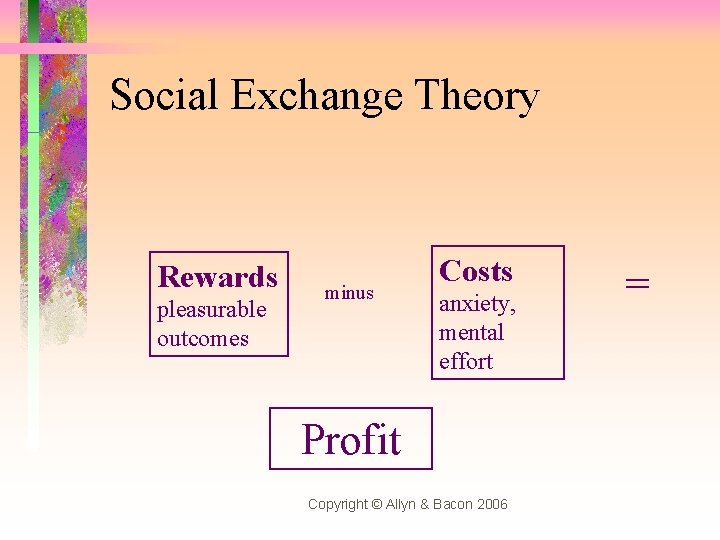
Social Exchange Theory Rewards pleasurable outcomes minus Costs anxiety, mental effort Profit Copyright © Allyn & Bacon 2006 =
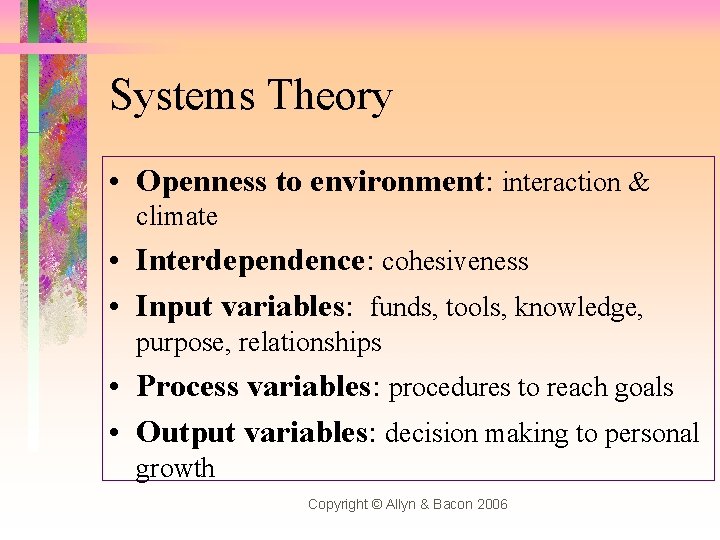
Systems Theory • Openness to environment: interaction & climate • Interdependence: cohesiveness • Input variables: funds, tools, knowledge, purpose, relationships • Process variables: procedures to reach goals • Output variables: decision making to personal growth Copyright © Allyn & Bacon 2006
Open Systems’ properties • Openness to environment • Interdependence • Input variables • Process variables • Output variables Copyright © Allyn & Bacon 2006
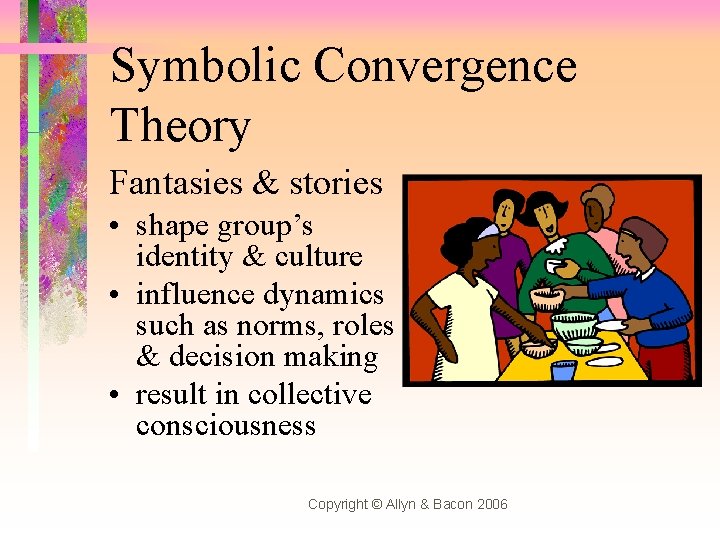
Symbolic Convergence Theory Fantasies & stories • shape group’s identity & culture • influence dynamics such as norms, roles & decision making • result in collective consciousness Copyright © Allyn & Bacon 2006
Structuration Theory • Rules: implied prescription; learned from previous group encounters • Resources • Interaction Copyright © Allyn & Bacon 2006
Functional Theory • Helps conceptualize connections among behaviors and outcomes • Aids in decision making & conflict management • Identifies behaviors that help attain goal Copyright © Allyn & Bacon 2006
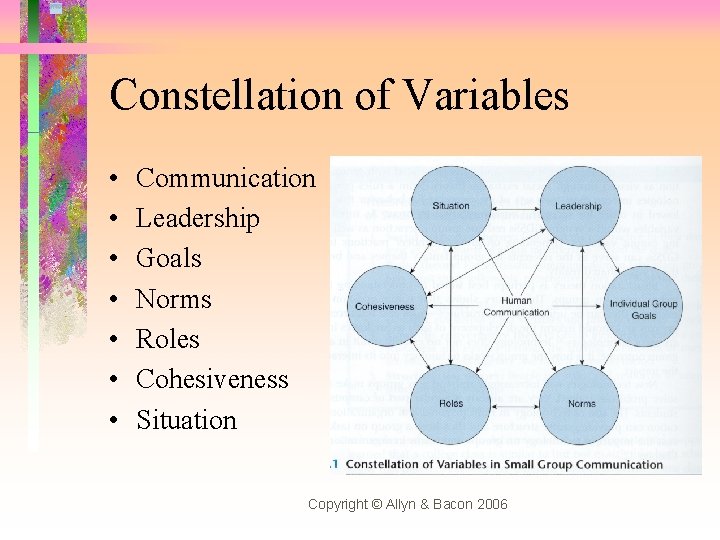
Constellation of Variables • • Communication Leadership Goals Norms Roles Cohesiveness Situation Copyright © Allyn & Bacon 2006