
Chapter 2 Simple Comparative Experiments RayBing Chen Institute
Chapter 2 Simple Comparative Experiments Ray-Bing Chen Institute of Statistics National University of Kaohsiung

2. 1 Introduction • Consider experiments to compare two conditions • Simple comparative experiments • Example: – The strength of portland cement mortar – Two different formulations: modified v. s. unmodified – Collect 10 observations for each formulations – Formulations = Treatments (levels)
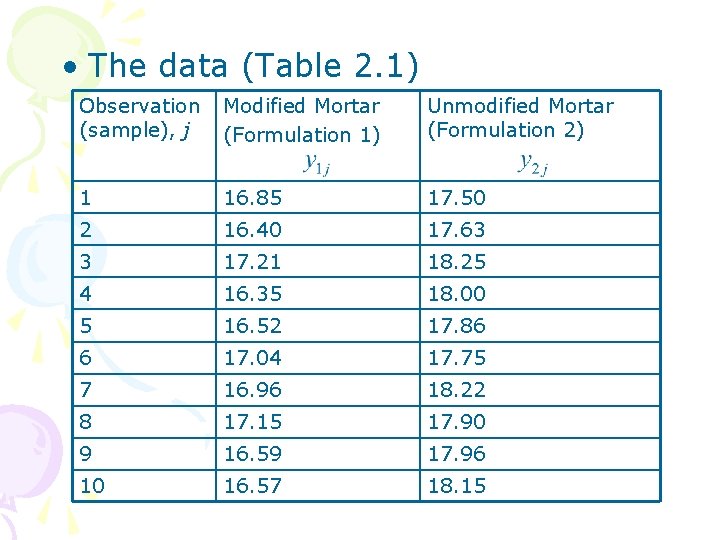
• The data (Table 2. 1) Observation (sample), j Modified Mortar (Formulation 1) Unmodified Mortar (Formulation 2) 1 16. 85 17. 50 2 16. 40 17. 63 3 17. 21 18. 25 4 16. 35 18. 00 5 16. 52 17. 86 6 17. 04 17. 75 7 16. 96 18. 22 8 17. 15 17. 90 9 16. 59 17. 96 10 16. 57 18. 15
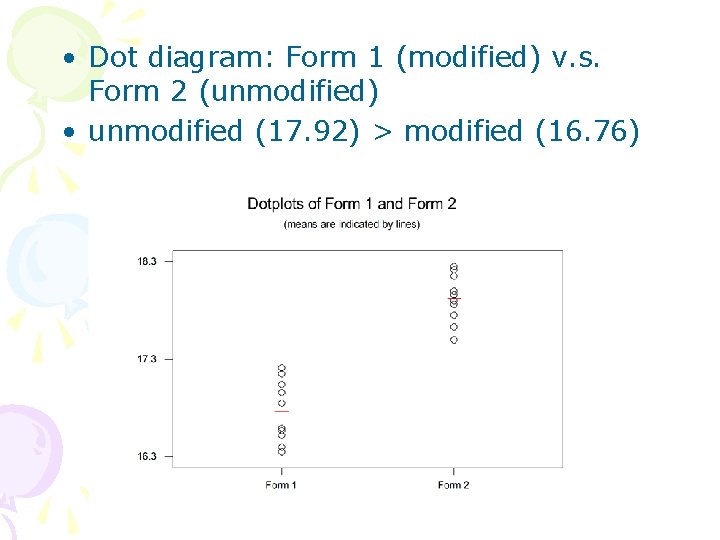
• Dot diagram: Form 1 (modified) v. s. Form 2 (unmodified) • unmodified (17. 92) > modified (16. 76)
• Hypothesis testing (significance testing): a technique to assist the experiment in comparing these two formulations.
2. 2 Basic Statistical Concepts • Run = each observations in the experiment • Error = random variable • Graphical Description of Variability – Dot diagram: the general location or central tendency of observations – Histogram: central tendency, spread and general shape of the distribution of the data (Fig. 2 -2)
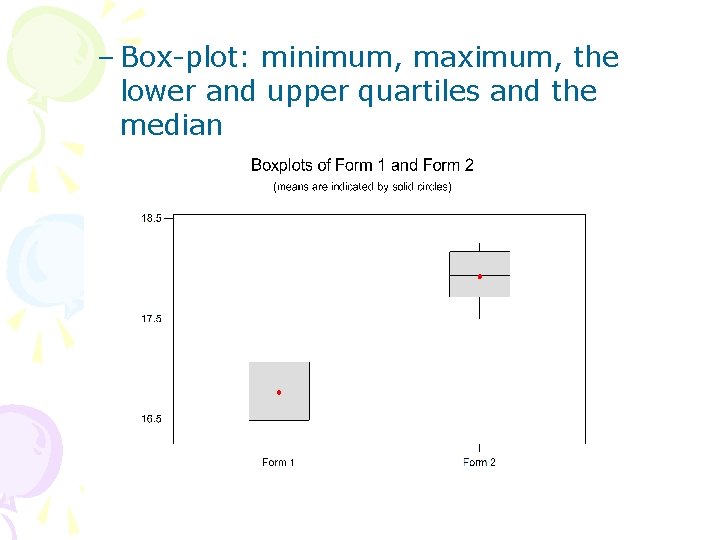
– Box-plot: minimum, maximum, the lower and upper quartiles and the median
• Probability Distributions • Mean, Variance and Expected Values
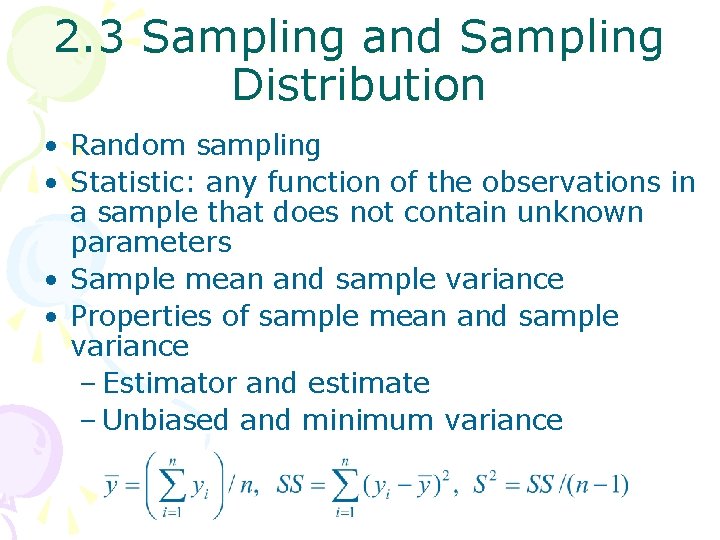
2. 3 Sampling and Sampling Distribution • Random sampling • Statistic: any function of the observations in a sample that does not contain unknown parameters • Sample mean and sample variance • Properties of sample mean and sample variance – Estimator and estimate – Unbiased and minimum variance
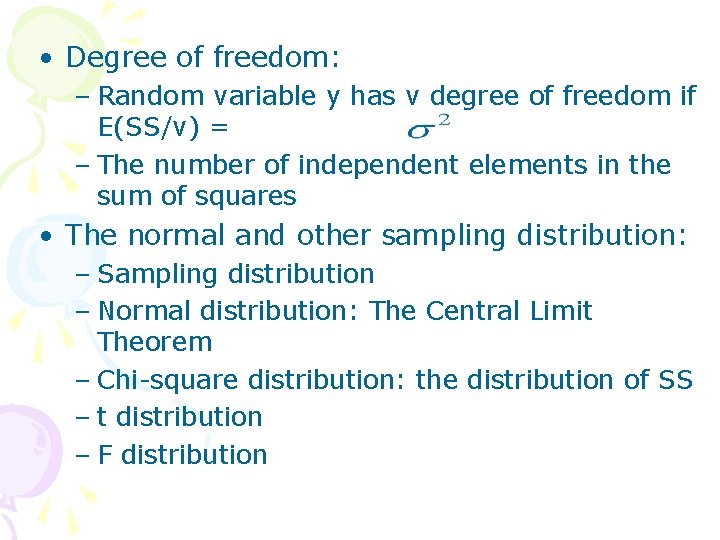
• Degree of freedom: – Random variable y has v degree of freedom if E(SS/v) = – The number of independent elements in the sum of squares • The normal and other sampling distribution: – Sampling distribution – Normal distribution: The Central Limit Theorem – Chi-square distribution: the distribution of SS – t distribution – F distribution
2. 4 Inferences about the Differences in Means, Randomized Designs • Use hypothesis testing and confidence interval procedures for comparing two treatment means. • Assume a completely randomized experimental design is used. (a random sample from a normal distribution)
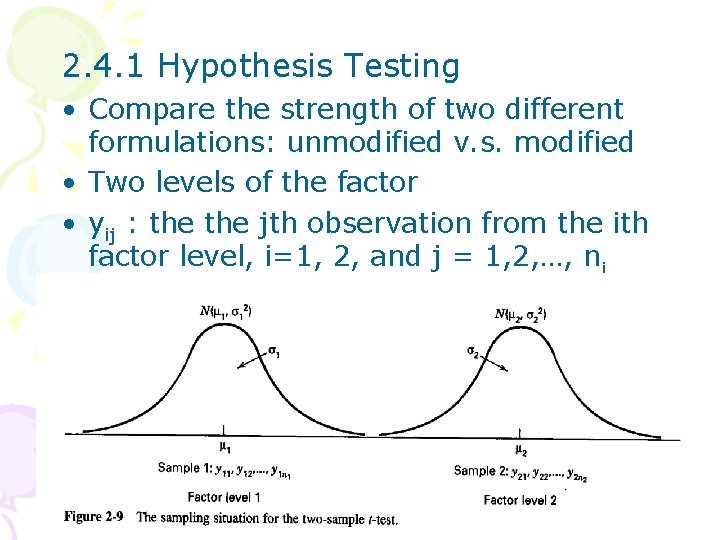
2. 4. 1 Hypothesis Testing • Compare the strength of two different formulations: unmodified v. s. modified • Two levels of the factor • yij : the jth observation from the ith factor level, i=1, 2, and j = 1, 2, …, ni
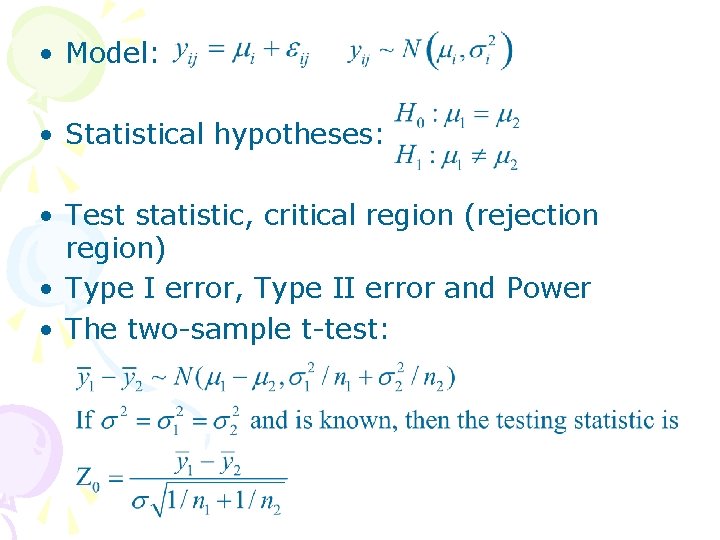
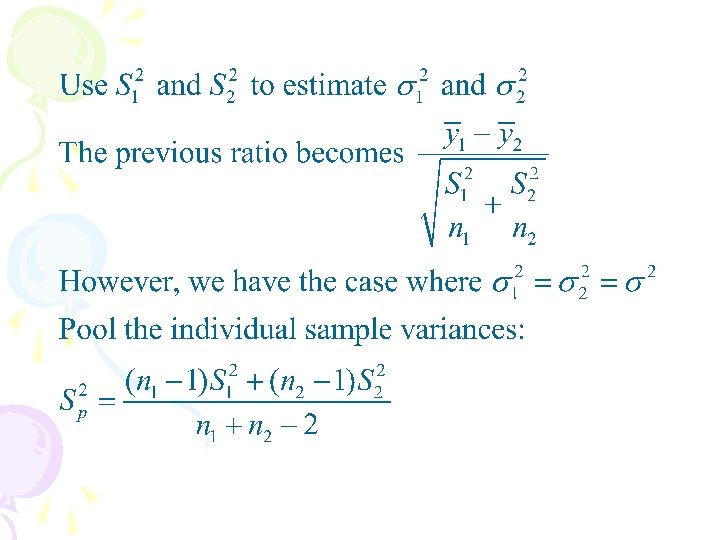
• Model: • Statistical hypotheses: • Test statistic, critical region (rejection region) • Type I error, Type II error and Power • The two-sample t-test:
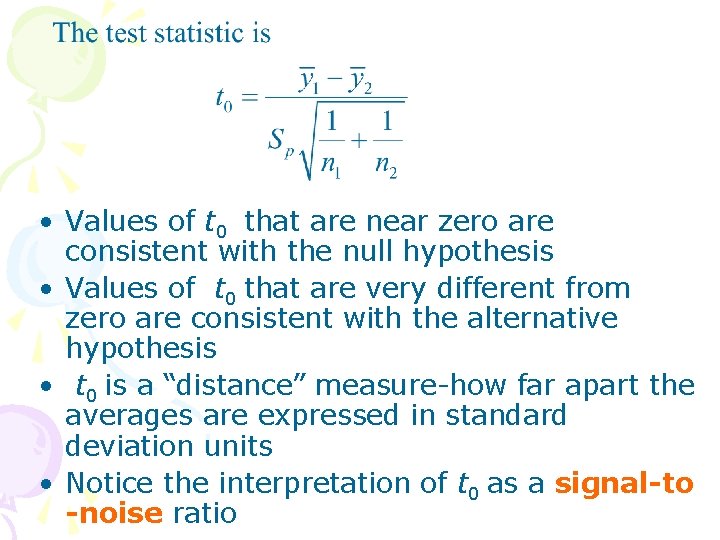
• Values of t 0 that are near zero are consistent with the null hypothesis • Values of t 0 that are very different from zero are consistent with the alternative hypothesis • t 0 is a “distance” measure-how far apart the averages are expressed in standard deviation units • Notice the interpretation of t 0 as a signal-to -noise ratio
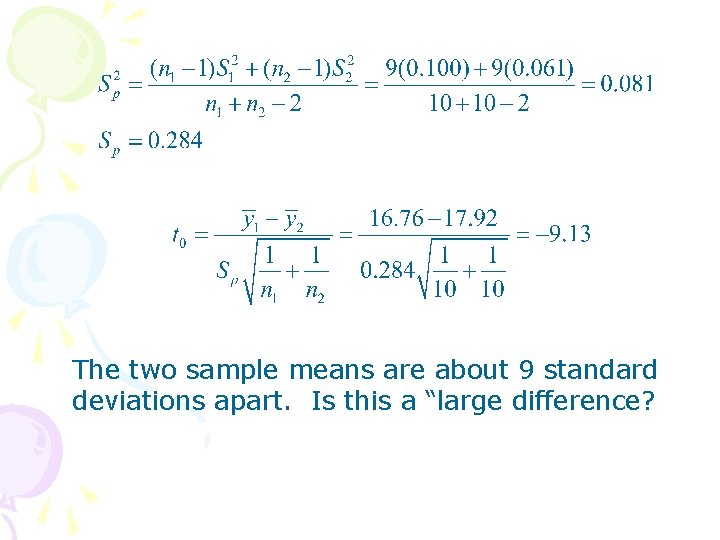
The two sample means are about 9 standard deviations apart. Is this a “large difference?
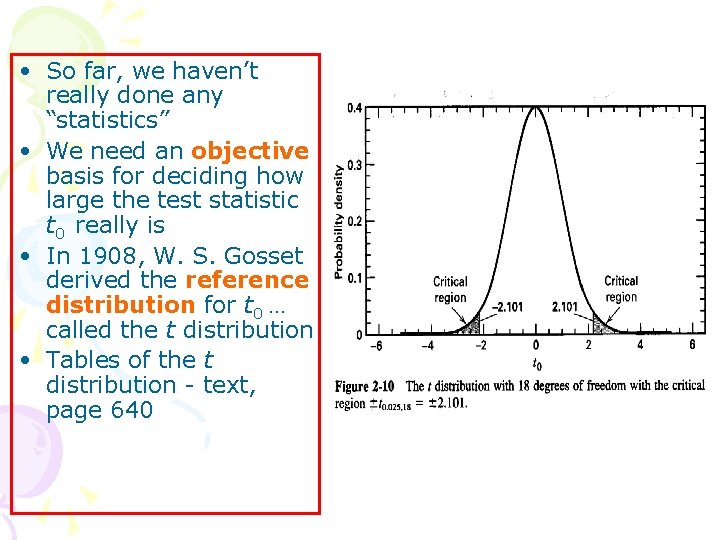
• So far, we haven’t really done any “statistics” • We need an objective basis for deciding how large the test statistic t 0 really is • In 1908, W. S. Gosset derived the reference distribution for t 0 … called the t distribution • Tables of the t distribution - text, page 640
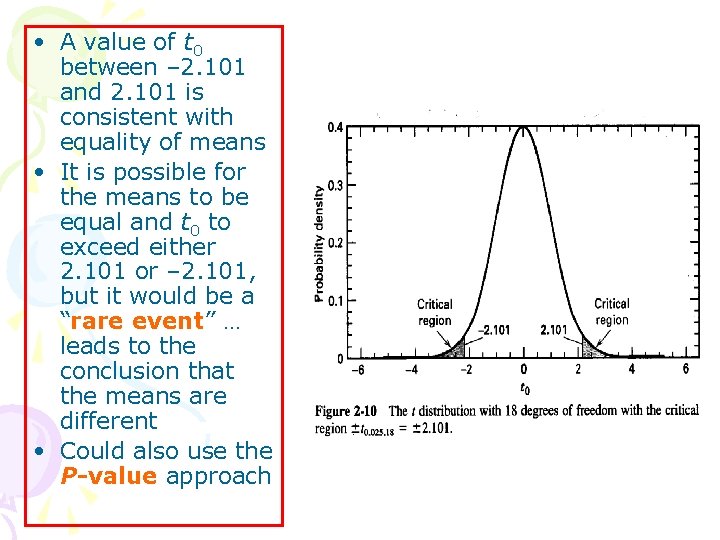
• A value of t 0 between – 2. 101 and 2. 101 is consistent with equality of means • It is possible for the means to be equal and t 0 to exceed either 2. 101 or – 2. 101, but it would be a “rare event” … leads to the conclusion that the means are different • Could also use the P-value approach
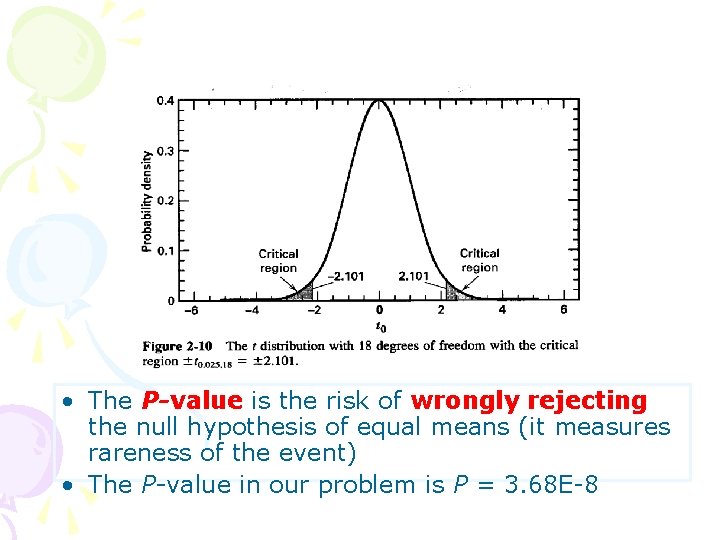
• The P-value is the risk of wrongly rejecting the null hypothesis of equal means (it measures rareness of the event) • The P-value in our problem is P = 3. 68 E-8
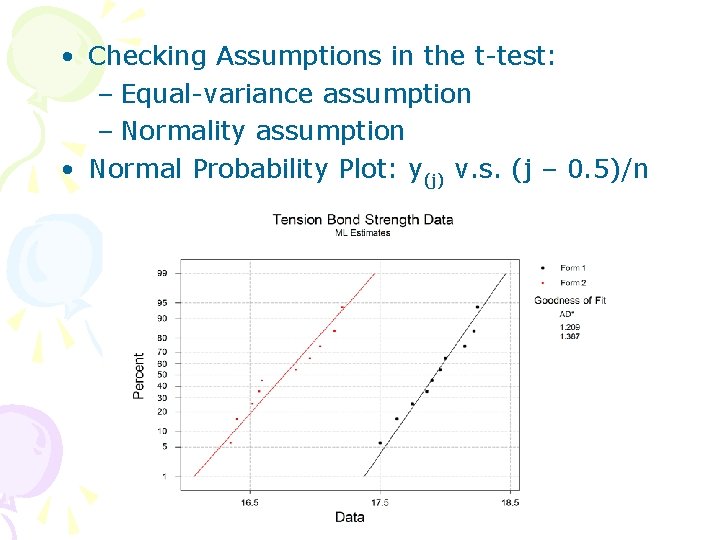
• Checking Assumptions in the t-test: – Equal-variance assumption – Normality assumption • Normal Probability Plot: y(j) v. s. (j – 0. 5)/n
• Estimate mean and variance from normal probability plot: – Mean: 50 percentile – Variance: the difference between 84 th and 50 th percentile • Transformations
2. 4. 2 Choice of Sample Size • Type II error in the hypothesis testing • Operating Characteristic curve (O. C. curve) – Assume two population have the same variance (unknown) and sample size. – For a specified sample size and , larger differences are more easily detected – To detect a specified difference , the more powerful test, the more sample size we need.
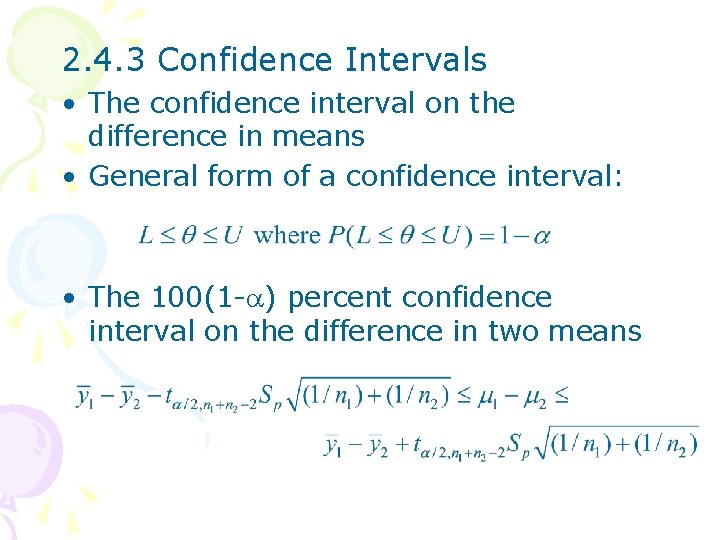
2. 4. 3 Confidence Intervals • The confidence interval on the difference in means • General form of a confidence interval: • The 100(1 - ) percent confidence interval on the difference in two means
2. 5 Inferences about the Differences in Means, Paired Comparison Designs • Example: Two different tips for a hardness testing machine • 20 metal specimens • Completely randomized design (10 for tip 1 and 10 for tip 2) • Lack of homogeneity between specimens • An alternative experiment design: 10 specimens and divide each specimen into two parts.
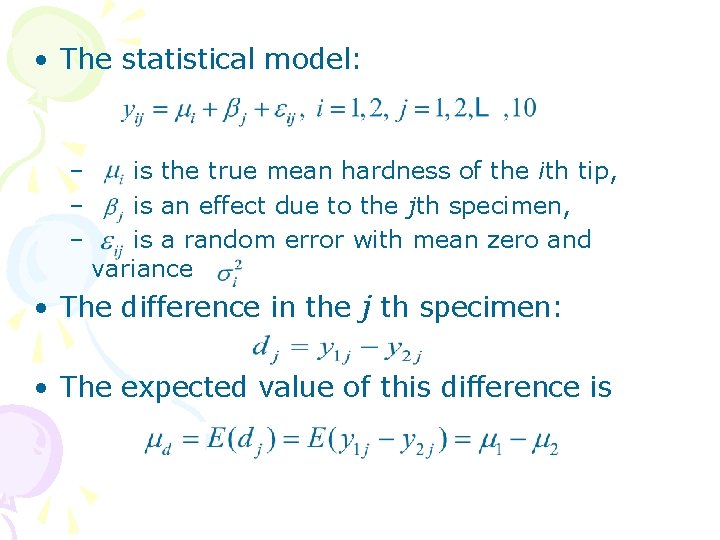
• The statistical model: – – – is the true mean hardness of the ith tip, is an effect due to the jth specimen, is a random error with mean zero and variance • The difference in the j th specimen: • The expected value of this difference is
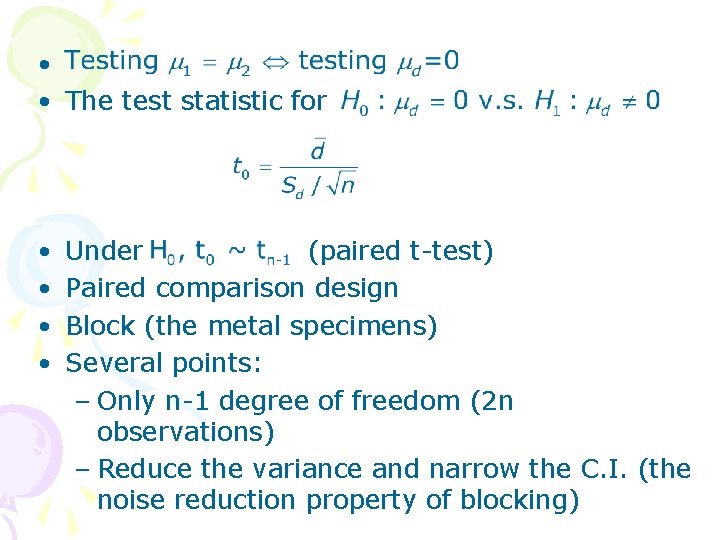
• • The test statistic for • • Under (paired t-test) Paired comparison design Block (the metal specimens) Several points: – Only n-1 degree of freedom (2 n observations) – Reduce the variance and narrow the C. I. (the noise reduction property of blocking)
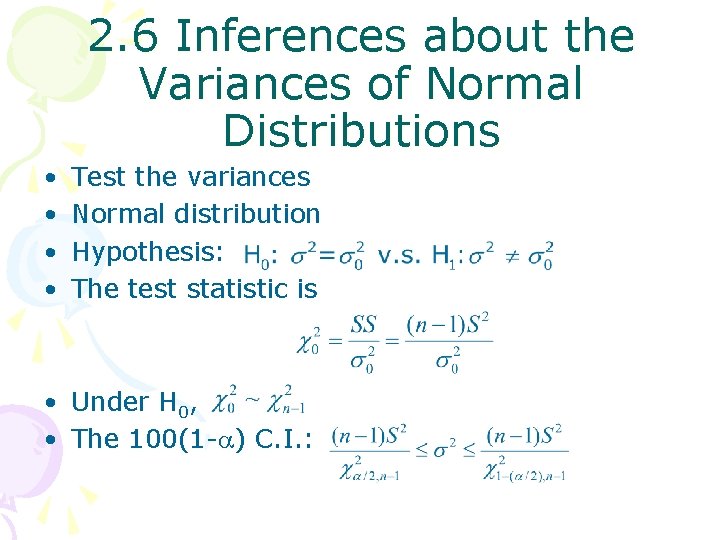
2. 6 Inferences about the Variances of Normal Distributions • • Test the variances Normal distribution Hypothesis: The test statistic is • Under H 0, • The 100(1 - ) C. I. :
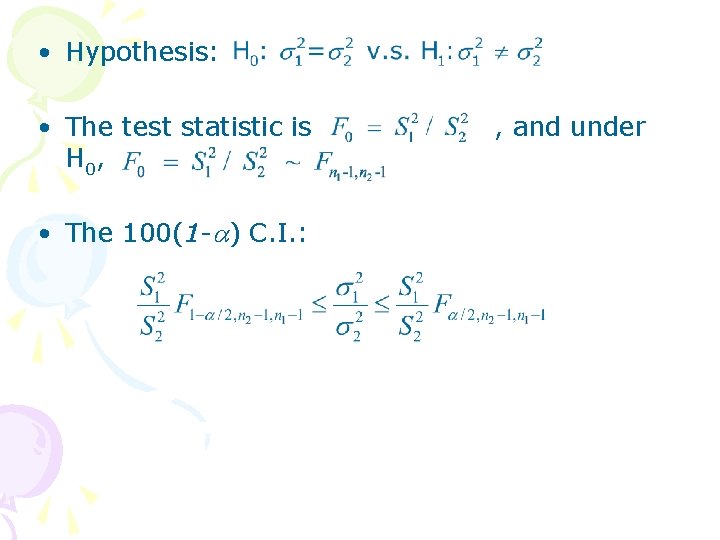
• Hypothesis: • The test statistic is H 0, • The 100(1 - ) C. I. : , and under
- Slides: 28