
Chapter 2 Section 3 Using Scientific Measurements Objectives
Chapter 2 Section 3 Using Scientific Measurements Objectives- after viewing this lesson you should be able to do the following: • Convert measurements into scientific notation. • Perform mathematical operations involving scientific notation. • Distinguish between inversely and directly proportional relationships. Chapter menu Resources Copyright © by Holt, Rinehart and Winston. All rights reserved.
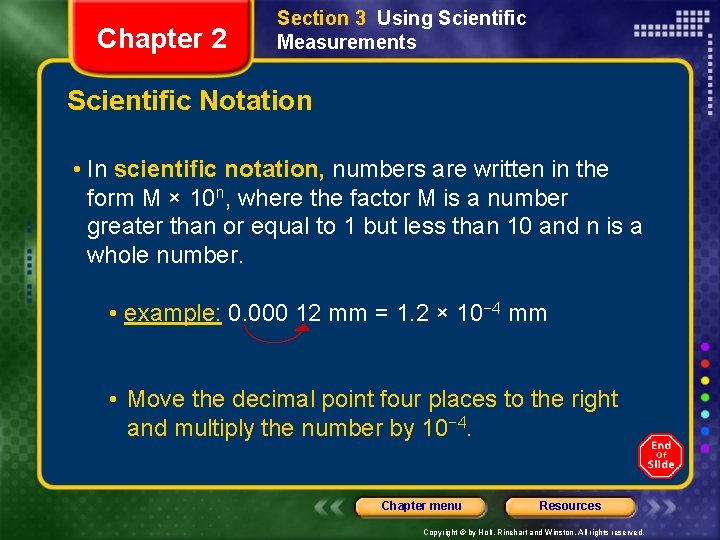
Chapter 2 Section 3 Using Scientific Measurements Scientific Notation • In scientific notation, numbers are written in the form M × 10 n, where the factor M is a number greater than or equal to 1 but less than 10 and n is a whole number. • example: 0. 000 12 mm = 1. 2 × 10− 4 mm • Move the decimal point four places to the right and multiply the number by 10− 4. Chapter menu Resources Copyright © by Holt, Rinehart and Winston. All rights reserved.
Chapter 2 Section 3 Using Scientific Measurements Scientific Notation, continued 1. Determine M by moving the decimal point in the original number to the left or the right so that only one nonzero digit remains to the left of the decimal point. 2. Determine n by counting the number of places that you moved the decimal point. If you moved it to the left, n is positive. If you moved it to the right, n is negative. Chapter menu Resources Copyright © by Holt, Rinehart and Winston. All rights reserved.

Chapter 2 Section 3 Using Scientific Measurements Scientific Notation, continued Mathematical Operations Using Scientific Notation 1. Addition and subtraction —These operations can be performed only if the values have the same exponent (n factor). example: 4. 2 × 10⁴ kg + 7. 9 × 10³ kg or Chapter menu Resources Copyright © by Holt, Rinehart and Winston. All rights reserved.
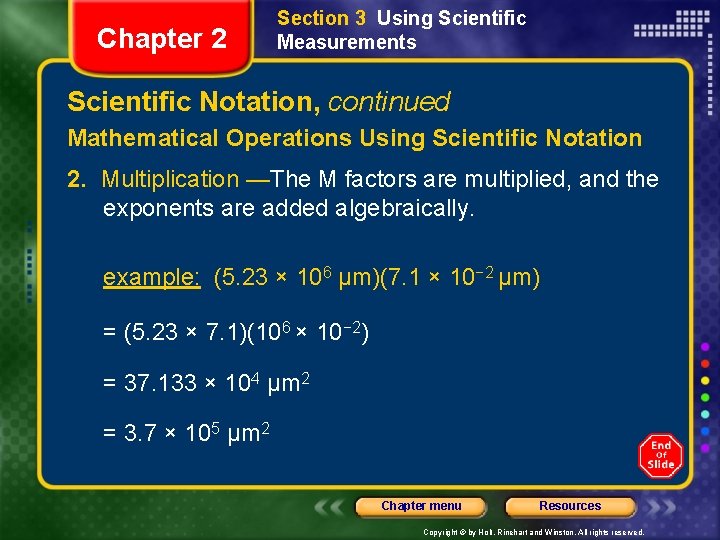
Chapter 2 Section 3 Using Scientific Measurements Scientific Notation, continued Mathematical Operations Using Scientific Notation 2. Multiplication —The M factors are multiplied, and the exponents are added algebraically. example: (5. 23 × 106 µm)(7. 1 × 10− 2 µm) = (5. 23 × 7. 1)(106 × 10− 2) = 37. 133 × 104 µm 2 = 3. 7 × 105 µm 2 Chapter menu Resources Copyright © by Holt, Rinehart and Winston. All rights reserved.
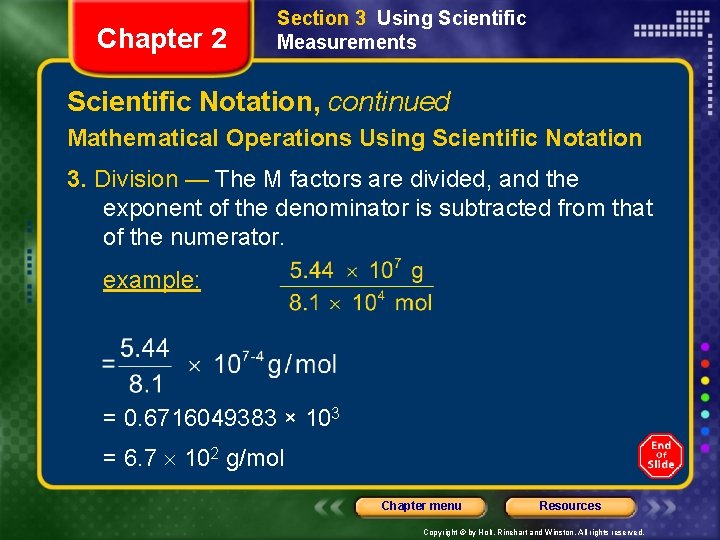
Chapter 2 Section 3 Using Scientific Measurements Scientific Notation, continued Mathematical Operations Using Scientific Notation 3. Division — The M factors are divided, and the exponent of the denominator is subtracted from that of the numerator. example: = 0. 6716049383 × 103 = 6. 7 102 g/mol Chapter menu Resources Copyright © by Holt, Rinehart and Winston. All rights reserved.
Chapter 2 Visual Concepts Scientific Notation Chapter menu Resources Copyright © by Holt, Rinehart and Winston. All rights reserved.
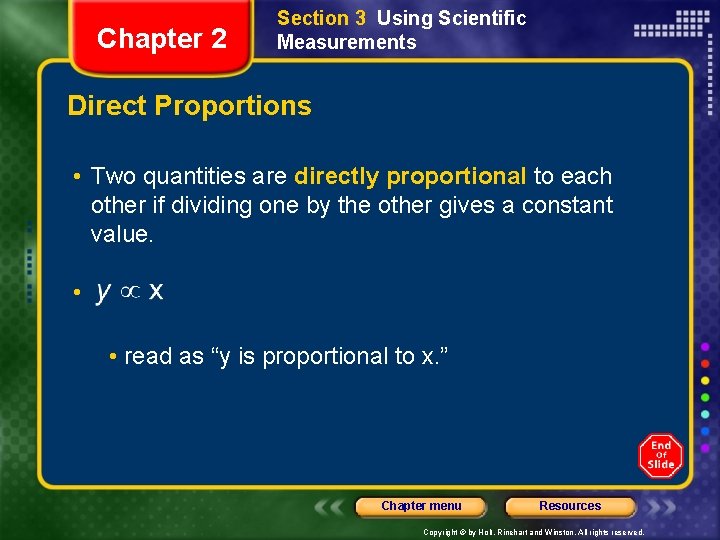
Chapter 2 Section 3 Using Scientific Measurements Direct Proportions • Two quantities are directly proportional to each other if dividing one by the other gives a constant value. • • read as “y is proportional to x. ” Chapter menu Resources Copyright © by Holt, Rinehart and Winston. All rights reserved.

Chapter 2 Section 3 Using Scientific Measurements Direct Proportion Chapter menu Resources Copyright © by Holt, Rinehart and Winston. All rights reserved.
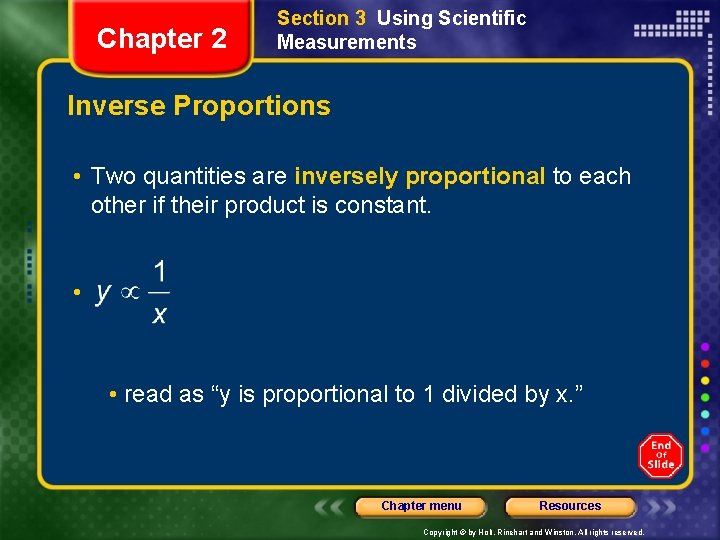
Chapter 2 Section 3 Using Scientific Measurements Inverse Proportions • Two quantities are inversely proportional to each other if their product is constant. • • read as “y is proportional to 1 divided by x. ” Chapter menu Resources Copyright © by Holt, Rinehart and Winston. All rights reserved.

Chapter 2 Section 3 Using Scientific Measurements Inverse Proportion Chapter menu Resources Copyright © by Holt, Rinehart and Winston. All rights reserved.
Chapter 2 Visual Concepts Direct and Inverse Proportions Chapter menu Resources Copyright © by Holt, Rinehart and Winston. All rights reserved.
- Slides: 12