
Chapter 2 Section 3 Notes Properties of Matter
- Slides: 21
Chapter 2 Section 3 Notes Properties of Matter
Chemical Properties � Chemical Properties: how a substance changes into a new substance by combining with something or breaking into a new substance. › Only observable in a chemical reaction › Describes how a substance acts when it changes (either combines with another substance or breaks apart into a new substance)
Chemical Properties � Each element & compound has its own chemical properties › Steel and plastic have their own chemical properties
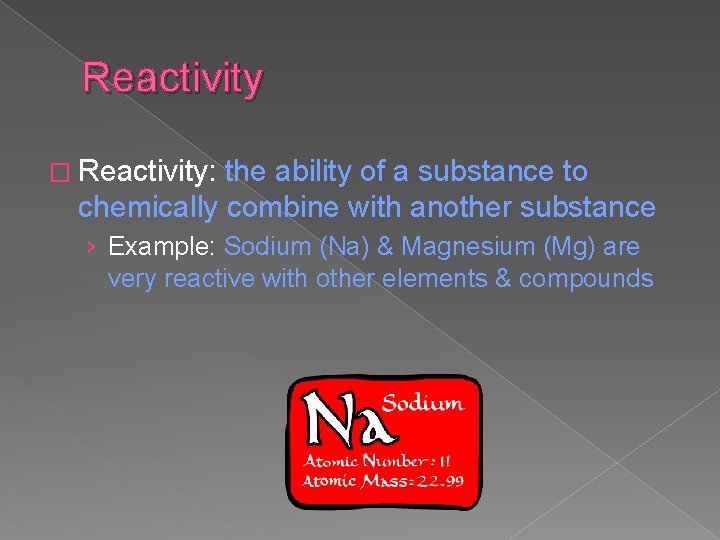
Reactivity � Reactivity: the ability of a substance to chemically combine with another substance › Example: Sodium (Na) & Magnesium (Mg) are very reactive with other elements & compounds
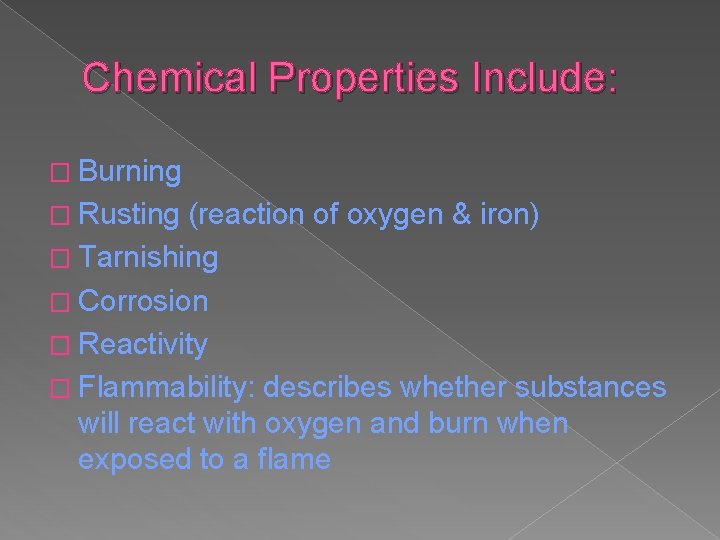
Chemical Properties Include: � Burning � Rusting (reaction of oxygen & iron) � Tarnishing � Corrosion � Reactivity � Flammability: describes whether substances will react with oxygen and burn when exposed to a flame
Physical Properties � Physical Properties: can be observed or measured without a change in composition
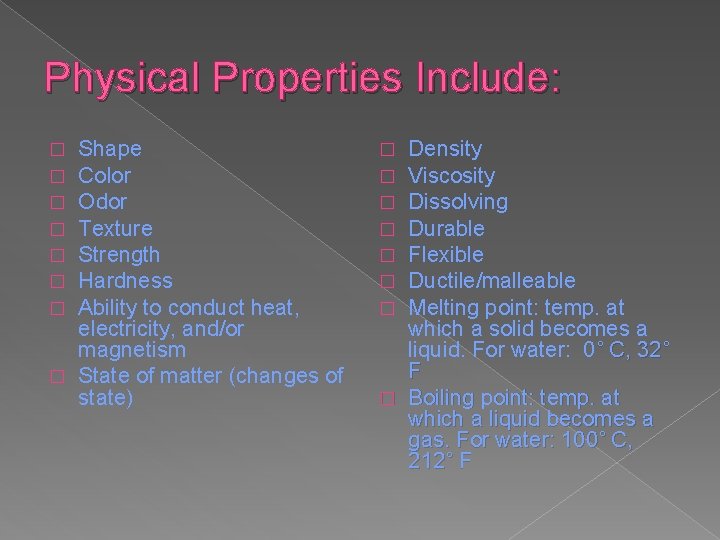
Physical Properties Include: Shape Color Odor Texture Strength Hardness Ability to conduct heat, electricity, and/or magnetism � State of matter (changes of state) � � � � Density Viscosity Dissolving Durable Flexible Ductile/malleable Melting point: temp. at which a solid becomes a liquid. For water: 0˚ C, 32˚ F � Boiling point: temp. at which a liquid becomes a gas. For water: 100˚ C, 212˚ F � � � �
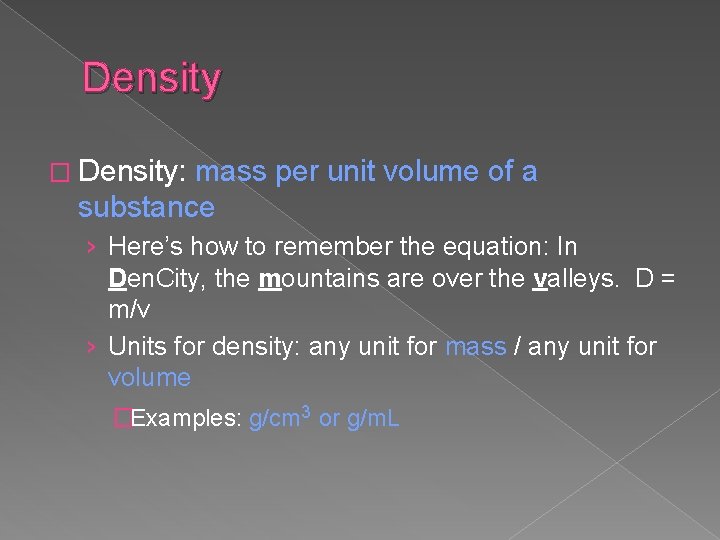
Density � Density: mass per unit volume of a substance › Here’s how to remember the equation: In Den. City, the mountains are over the valleys. D = m/v › Units for density: any unit for mass / any unit for volume �Examples: g/cm 3 or g/m. L
Density � Density of water: 1. 0 g/cm 3 � Low density: “light” example: piece of wood � High density: “heavy” example: lead � Knowing density tells you if a substance sinks or floats: › Density greater than 1. 0 g/cm 3 – sink › Density less than 1. 0 g/cm 3 - float
Sample Problem � 10. 0 cm 3 of ice has a mass of 9. 17 g. What is the density of ice? › D = m/v › 9. 17 g/10. 0 cm 3 = 0. 917 g/cm 3 › Ahha! That’s why ice floats!
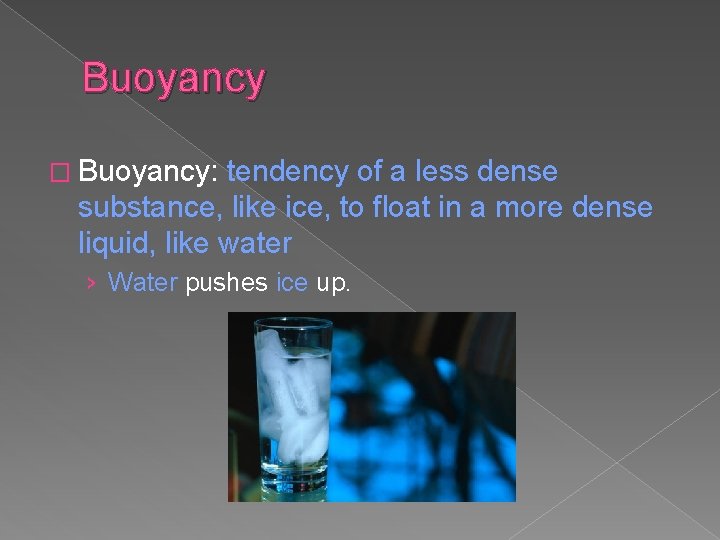
Buoyancy � Buoyancy: tendency of a less dense substance, like ice, to float in a more dense liquid, like water › Water pushes ice up.
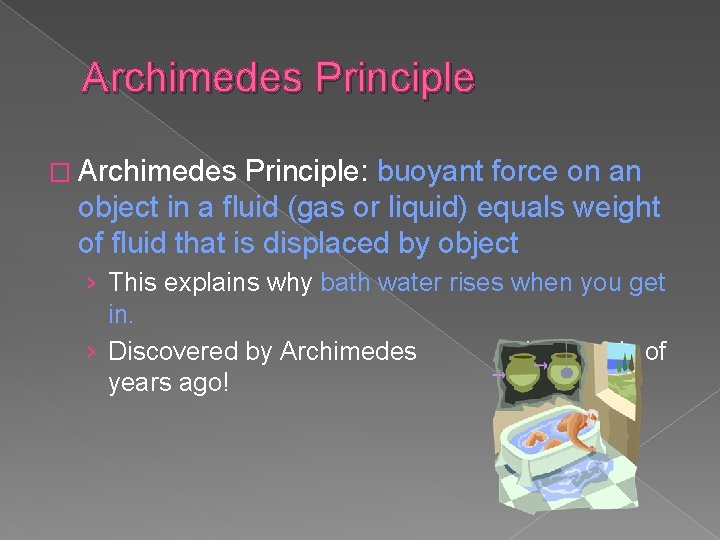
Archimedes Principle � Archimedes Principle: buoyant force on an object in a fluid (gas or liquid) equals weight of fluid that is displaced by object › This explains why bath water rises when you get in. › Discovered by Archimedes thousands of years ago!
Chemical Change � Chemical Change: occurs when 1 or more substances change into NEW substances with completely different properties › A chemical change is a change in composition; it CANNOT be reversed by physical changes.
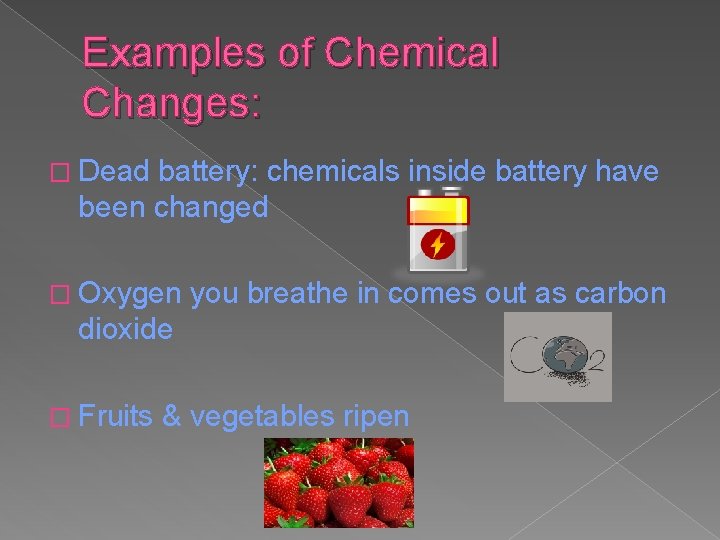
Examples of Chemical Changes: � Dead battery: chemicals inside battery have been changed � Oxygen you breathe in comes out as carbon dioxide � Fruits & vegetables ripen
Chemical Changes � The law of conservation of mass is still upheld › Think of a burning match � Signs that a chemical reaction has taken place: › Change in color or odor › Fizzing or foaming › Production of heat, light, sound (energy)
Physical Change Physical Change: change in physical form or properties › Not a change in composition › Substance may look different (ice vs. water), but the atoms that make up the substances are NOT changed or rearranged
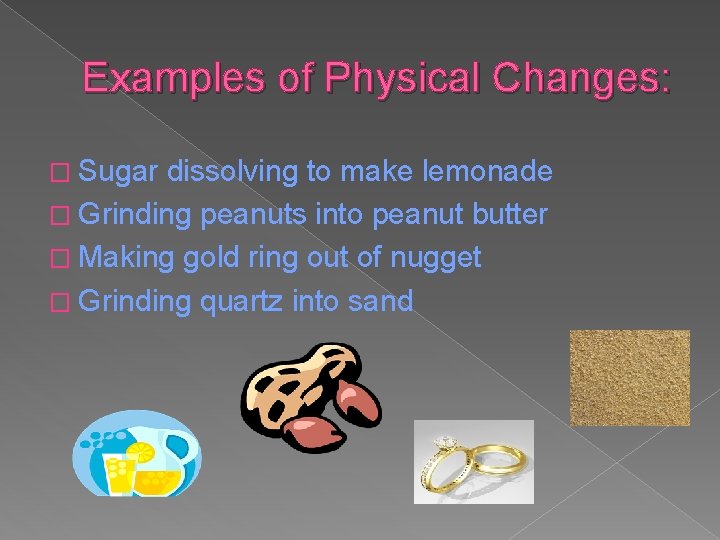
Examples of Physical Changes: � Sugar dissolving to make lemonade � Grinding peanuts into peanut butter � Making gold ring out of nugget � Grinding quartz into sand
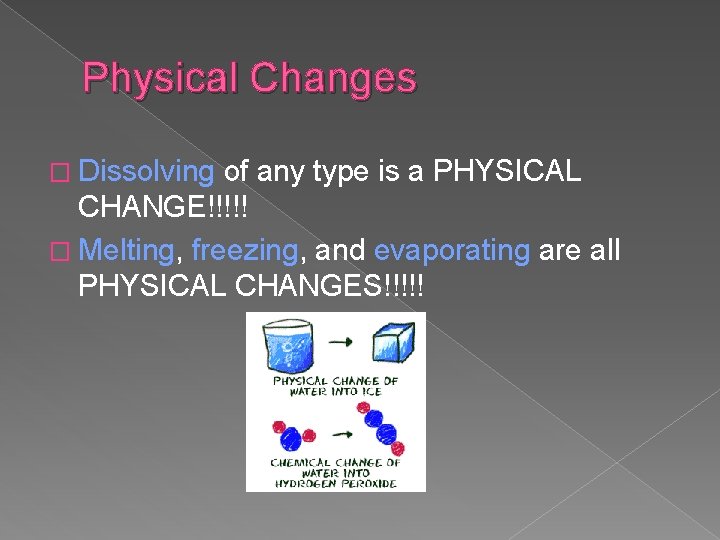
Physical Changes � Dissolving of any type is a PHYSICAL CHANGE!!!!! � Melting, freezing, and evaporating are all PHYSICAL CHANGES!!!!!
Gas Laws � Use the following variables: › T : Temperature › P : Pressure › V : Volume
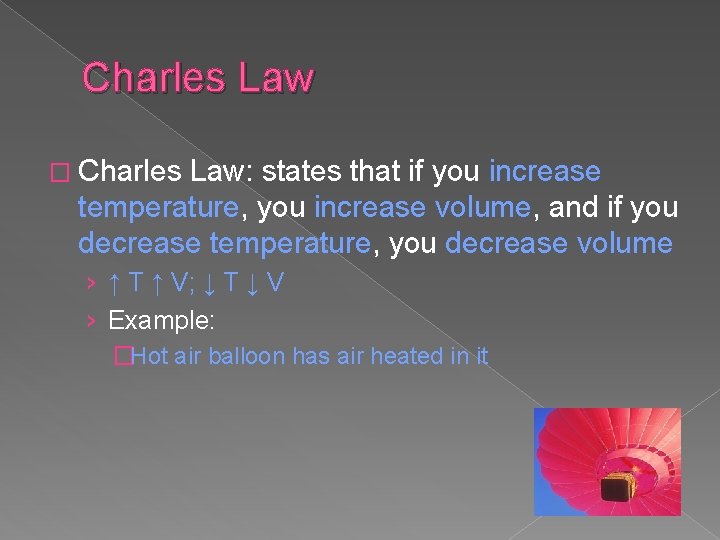
Charles Law � Charles Law: states that if you increase temperature, you increase volume, and if you decrease temperature, you decrease volume › ↑ T ↑ V; ↓ T ↓ V › Example: �Hot air balloon has air heated in it
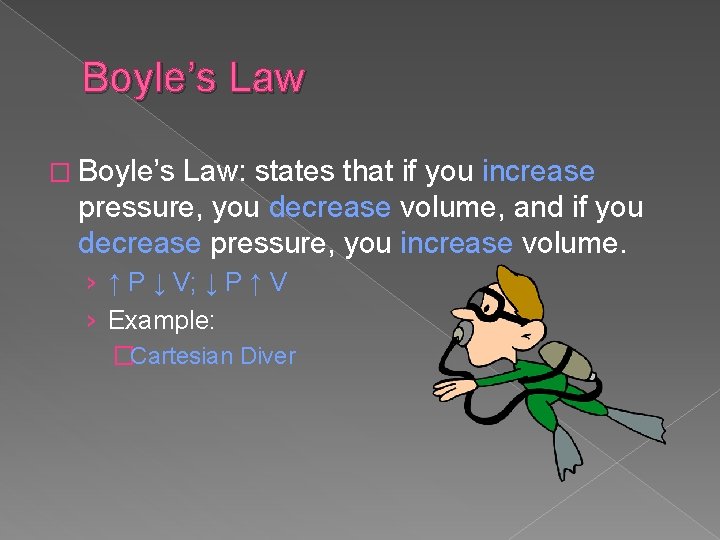
Boyle’s Law � Boyle’s Law: states that if you increase pressure, you decrease volume, and if you decrease pressure, you increase volume. › ↑ P ↓ V; ↓ P ↑ V › Example: �Cartesian Diver