
Chapter 2 Section 1 Scientific Method Objectives Describe
Chapter 2 Section 1 Scientific Method Objectives • Describe the purpose of the scientific method. • Distinguish between qualitative and quantitative observations. • Describe the differences between hypotheses, theories, and models. Chapter menu Resources Copyright © by Holt, Rinehart and Winston. All rights reserved.
Chapter 2 Section 1 Scientific Method • The scientific method is a logical approach to solving problems by observing and collecting data, formulating hypotheses, testing hypotheses, and formulating theories that are supported by data. Chapter menu Resources Copyright © by Holt, Rinehart and Winston. All rights reserved.
Chapter 2 Visual Concepts Scientific Method Chapter menu Resources Copyright © by Holt, Rinehart and Winston. All rights reserved.
Chapter 2 Section 1 Scientific Method Observing and Collecting Data • Observing is the use of the senses to obtain information. • data may be • qualitative (descriptive) • quantitative (numerical) • A system is a specific portion of matter in a given region of space that has been selected for study during an experiment or observation. Chapter menu Resources Copyright © by Holt, Rinehart and Winston. All rights reserved.
Chapter 2 Visual Concepts Qualitative and Quantitative Data Chapter menu Resources Copyright © by Holt, Rinehart and Winston. All rights reserved.
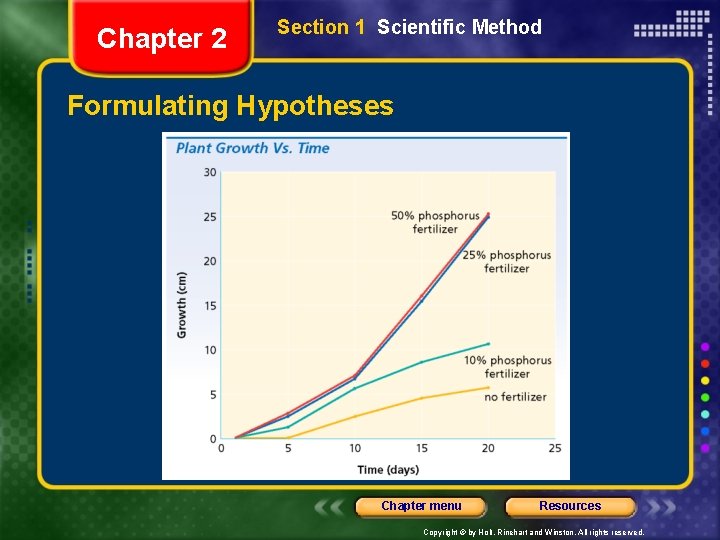
Chapter 2 Section 1 Scientific Method Formulating Hypotheses • Scientists make generalizations based on the data. • Scientists use generalizations about the data to formulate a hypothesis, or testable statement. • Hypotheses are often “if-then” statements. Chapter menu Resources Copyright © by Holt, Rinehart and Winston. All rights reserved.
Chapter 2 Section 1 Scientific Method Formulating Hypotheses Chapter menu Resources Copyright © by Holt, Rinehart and Winston. All rights reserved.
Chapter 2 Visual Concepts Hypothesis Chapter menu Resources Copyright © by Holt, Rinehart and Winston. All rights reserved.
Chapter 2 Section 1 Scientific Method Testing Hypotheses • Testing a hypothesis requires experimentation that provides data to support or refute a hypothesis or theory. • Controls are the experimental conditions that remain constant. • Variables are any experimental conditions that change. Chapter menu Resources Copyright © by Holt, Rinehart and Winston. All rights reserved.
Chapter 2 Section 1 Scientific Method Theorizing • A model in science is more than a physical object; it is often an explanation of how phenomena occur and how data or events are related. • visual, verbal, or mathematical • example: atomic model of matter • A theory is a broad generalization that explains a body of facts or phenomena. • example: atomic theory Chapter menu Resources Copyright © by Holt, Rinehart and Winston. All rights reserved.
Chapter 2 Visual Concepts Models Chapter menu Resources Copyright © by Holt, Rinehart and Winston. All rights reserved.
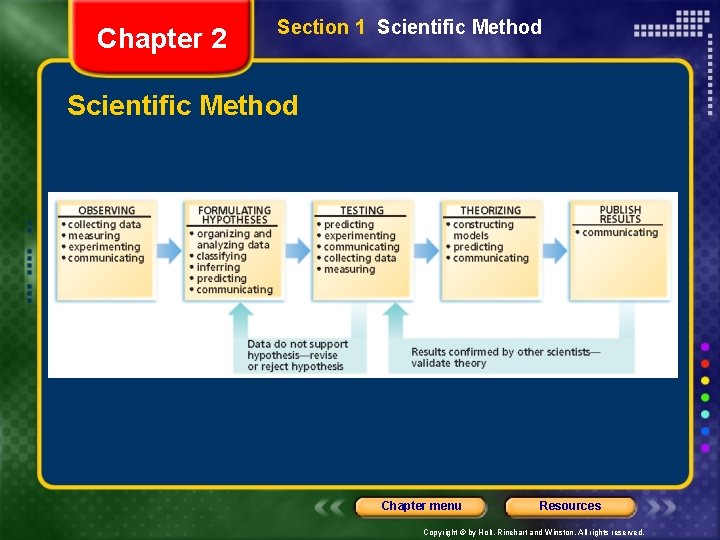
Chapter 2 Section 1 Scientific Method Chapter menu Resources Copyright © by Holt, Rinehart and Winston. All rights reserved.
Chapter 2 Standardized Test Preparation Multiple Choice 3. A theory differs from a hypothesis in that a theory A. cannot be disproved. B. always leads to the formation of a law. C. has been subjected to experimental testing. D. represents an educated guess. Chapter menu Resources Copyright © by Holt, Rinehart and Winston. All rights reserved.
Chapter 2 Standardized Test Preparation Multiple Choice 3. A theory differs from a hypothesis in that a theory A. cannot be disproved. B. always leads to the formation of a law. C. has been subjected to experimental testing. D. represents an educated guess. Chapter menu Resources Copyright © by Holt, Rinehart and Winston. All rights reserved.
Chapter 2 Standardized Test Preparation Multiple Choice 6. Which of the following is not part of the scientific method? A. making measurements B. introducing bias C. making an educated guess D. analyzing data Chapter menu Resources Copyright © by Holt, Rinehart and Winston. All rights reserved.
Chapter 2 Standardized Test Preparation Multiple Choice 6. Which of the following is not part of the scientific method? A. making measurements B. introducing bias C. making an educated guess D. analyzing data Chapter menu Resources Copyright © by Holt, Rinehart and Winston. All rights reserved.
- Slides: 16