
Chapter 2 Section 1 Scientific Method Objectives Describe
Chapter 2 Section 1 Scientific Method Objectives • Describe the purpose of the scientific method. • Distinguish between qualitative and quantitative observations. • Describe the differences between hypotheses, theories, and models.
Chapter 2 Section 1 Scientific Method • The scientific method is a logical approach to solving problems by observing and collecting data, formulating hypotheses, testing hypotheses, and formulating theories that are supported by data.
Chapter 2 Section 1 Scientific Method Observing and Collecting Data • Observing is the use of the senses to obtain information. • data may be • qualitative (descriptive) • quantitative (numerical) • A system is a specific portion of matter in a given region of space that has been selected for study during an experiment or observation.
Chapter 2 Section 1 Scientific Method Formulating Hypotheses • Scientists make generalizations based on the data. • Scientists use generalizations about the data to formulate a hypothesis, or testable statement. • Hypotheses are often “if-then” statements.
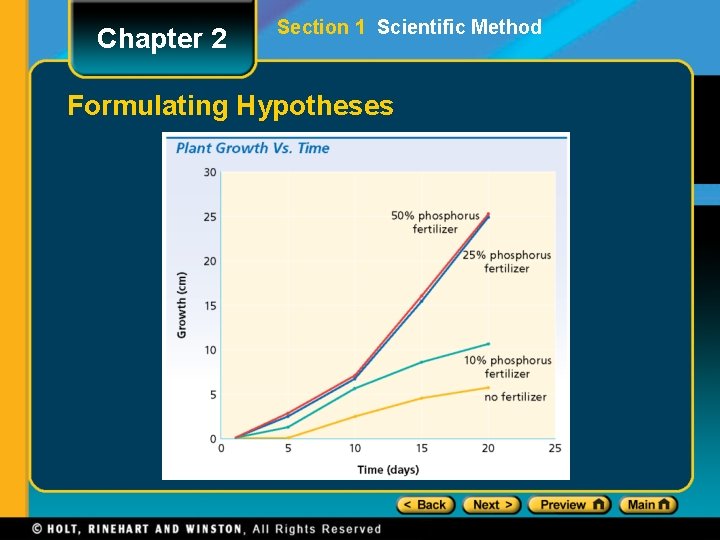
Chapter 2 Section 1 Scientific Method Formulating Hypotheses

Chapter 2 Section 1 Scientific Method Testing Hypotheses • Testing a hypothesis requires experimentation that provides data to support or refute a hypothesis or theory. • Controls are the experimental conditions that remain constant. • Variables are any experimental conditions that change.
Chapter 2 Section 1 Scientific Method Theorizing • A model in science is more than a physical object; it is often an explanation of how phenomena occur and how data or events are related. • visual, verbal, or mathematical • example: atomic model of matter • A theory is a broad generalization that explains a body of facts or phenomena. • example: atomic theory
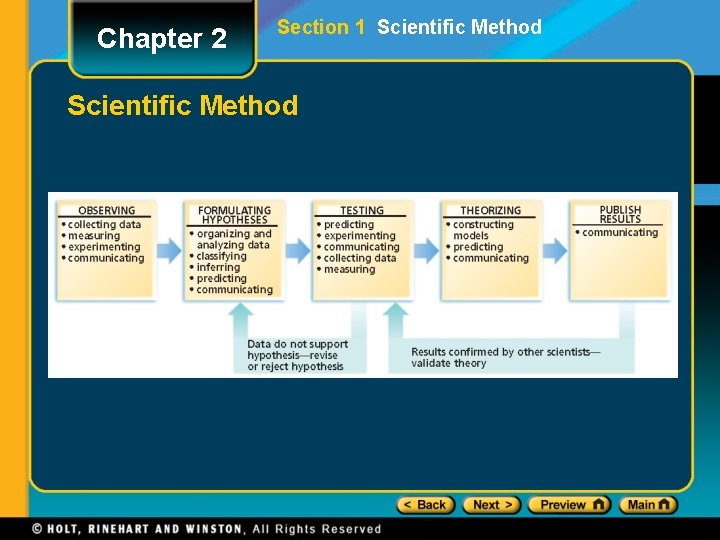
Chapter 2 Section 1 Scientific Method
- Slides: 8