
CHAPTER 2 SECTION 1 GRAVITY AND MOTION ALL

- Slides: 18
CHAPTER 2 SECTION 1 GRAVITY AND MOTION
ALL OBJECTS FALL WITH THE SAME ACCELERATION • Galileo proved that the mass of an object does not affect the rate at which it falls.
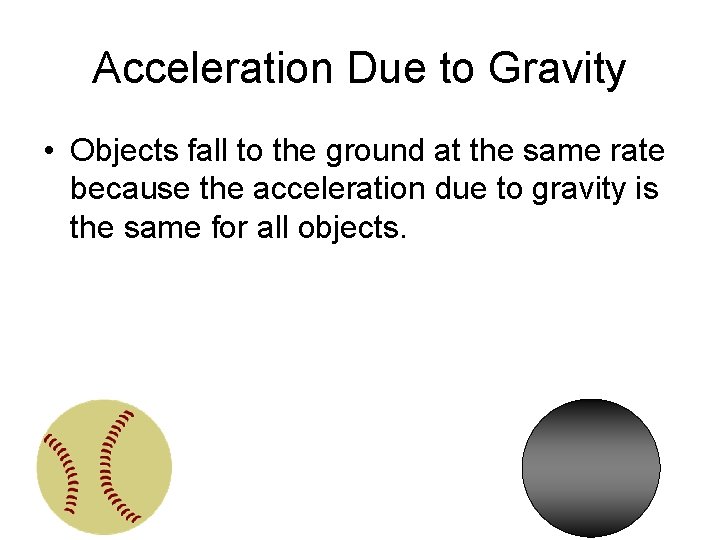
Acceleration Due to Gravity • Objects fall to the ground at the same rate because the acceleration due to gravity is the same for all objects.
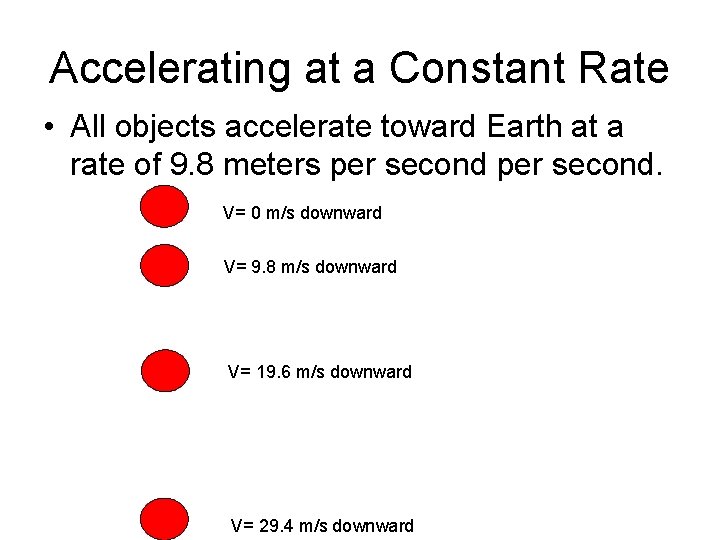
Accelerating at a Constant Rate • All objects accelerate toward Earth at a rate of 9. 8 meters per second. V= 0 m/s downward V= 9. 8 m/s downward V= 19. 6 m/s downward V= 29. 4 m/s downward
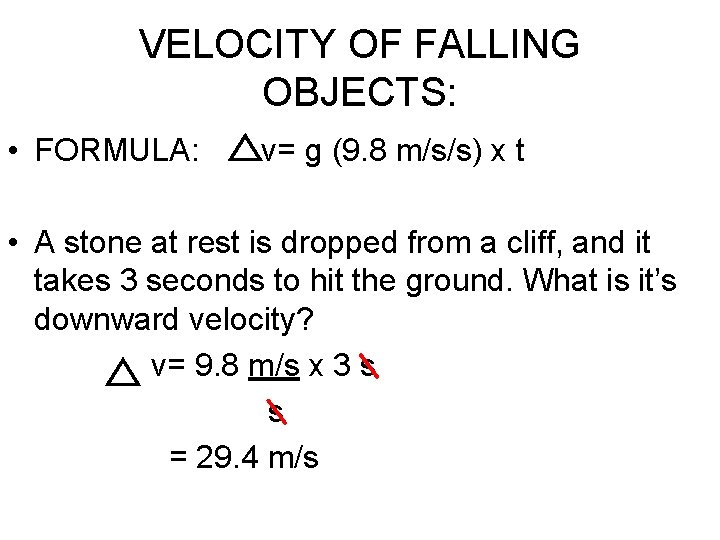
VELOCITY OF FALLING OBJECTS: • FORMULA: v= g (9. 8 m/s/s) x t • A stone at rest is dropped from a cliff, and it takes 3 seconds to hit the ground. What is it’s downward velocity? v= 9. 8 m/s x 3 s s = 29. 4 m/s
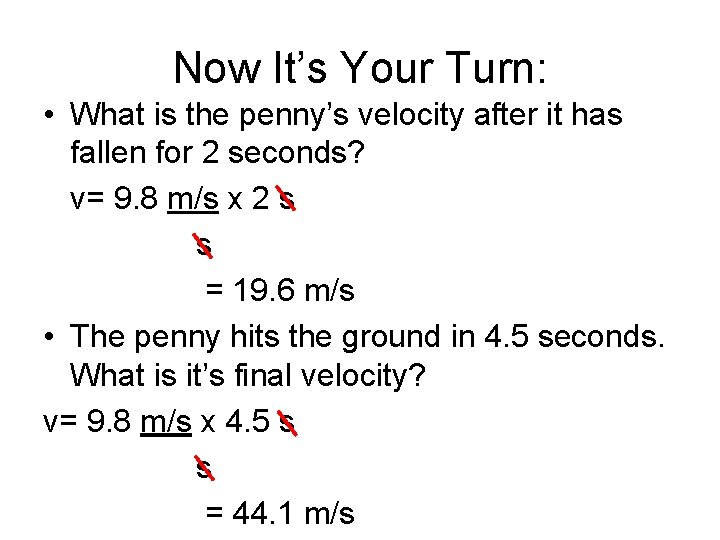
Now It’s Your Turn: • What is the penny’s velocity after it has fallen for 2 seconds? v= 9. 8 m/s x 2 s s = 19. 6 m/s • The penny hits the ground in 4. 5 seconds. What is it’s final velocity? v= 9. 8 m/s x 4. 5 s s = 44. 1 m/s
AIR RESISTANCE • A type of fluid friction that opposes the motion of objects through air. • This occurs between the surface of the falling object and the air that surrounds it.
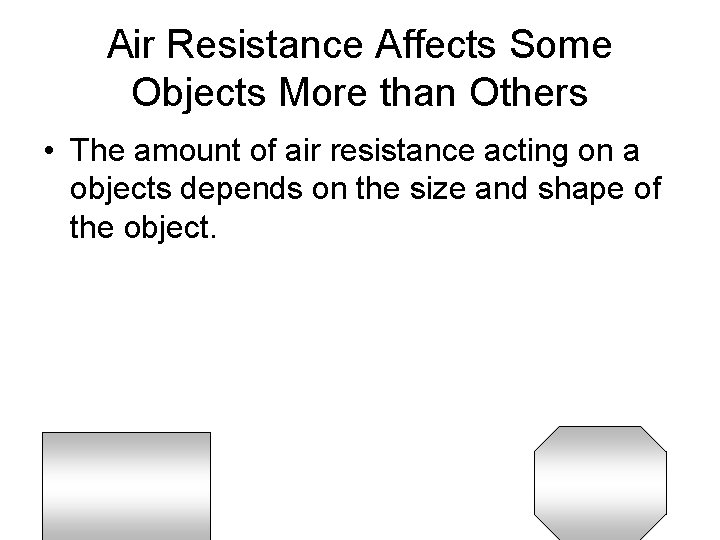
Air Resistance Affects Some Objects More than Others • The amount of air resistance acting on a objects depends on the size and shape of the object.
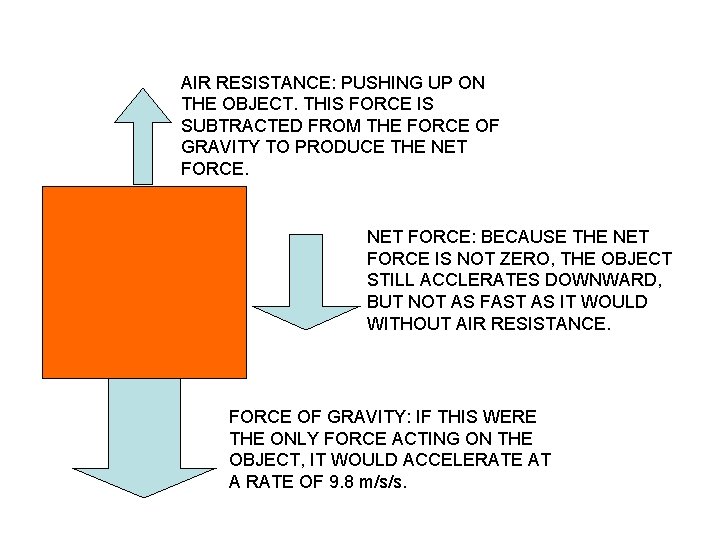
AIR RESISTANCE: PUSHING UP ON THE OBJECT. THIS FORCE IS SUBTRACTED FROM THE FORCE OF GRAVITY TO PRODUCE THE NET FORCE: BECAUSE THE NET FORCE IS NOT ZERO, THE OBJECT STILL ACCLERATES DOWNWARD, BUT NOT AS FAST AS IT WOULD WITHOUT AIR RESISTANCE. FORCE OF GRAVITY: IF THIS WERE THE ONLY FORCE ACTING ON THE OBJECT, IT WOULD ACCELERATE AT A RATE OF 9. 8 m/s/s.
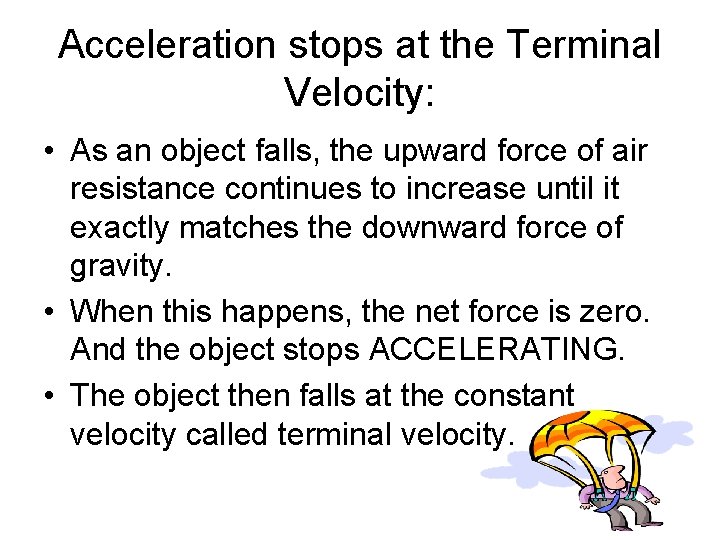
Acceleration stops at the Terminal Velocity: • As an object falls, the upward force of air resistance continues to increase until it exactly matches the downward force of gravity. • When this happens, the net force is zero. And the object stops ACCELERATING. • The object then falls at the constant velocity called terminal velocity.
Free Fall Occurs When There is NO AIR RESISTANCE • An object is in free fall ONLY if gravity is pulling it down and no other forces are acting on it. • This can only occur in a vacuum or in space.
STOP
ORBITING OBJECTS ARE IN FREE FALL • Astronauts don’t hit their heads on the ceiling of a space shuttle because they are in free fall.
TWO MOTIONS COMBINE TO CAUSE ORBITING • An object is said to be orbiting when it is traveling in a circular path around another object. • When a spaceship orbits Earth, it’s moving forward, but it is also in free fall toward Earth.
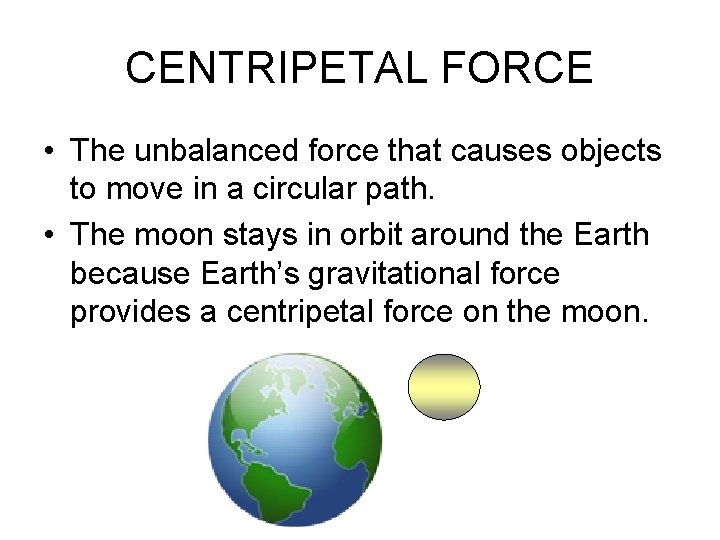
CENTRIPETAL FORCE • The unbalanced force that causes objects to move in a circular path. • The moon stays in orbit around the Earth because Earth’s gravitational force provides a centripetal force on the moon.
PROJECTILE MOTION AND GRAVITY • The curved path an objects follows when thrown or propelled near the surface of the Earth. • Projectile motion has two componentshorizontal and vertical. Each is independent- they have no effect on each other. When the two motions are combined, they form a curved path.
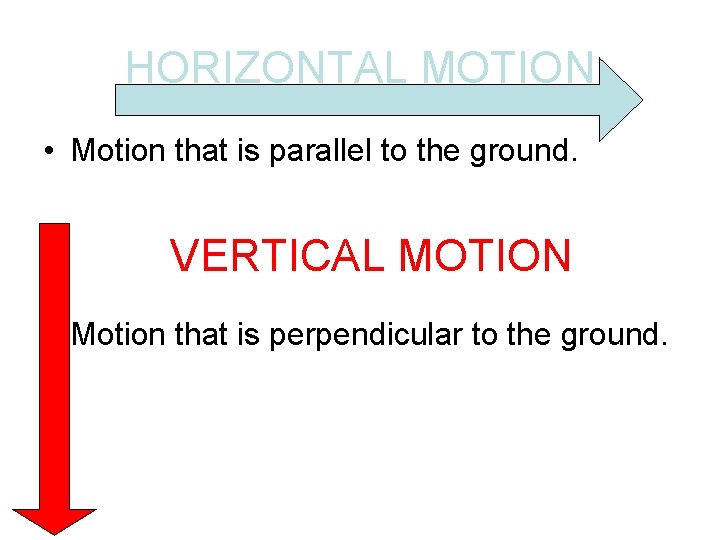
HORIZONTAL MOTION • Motion that is parallel to the ground. VERTICAL MOTION • Motion that is perpendicular to the ground.
BULLSEYE!!!! • Explain how projectile motion effects an arrow being shot at a target…