
Chapter 2 RISK MANAGEMENT ASSESSMENT BWU 10302 Occupational
Chapter 2 RISK MANAGEMENT & ASSESSMENT BWU 10302 Occupational Safety & Health Presented by Dr. Mohd Nasrull Bin Abdol Rahman
BWU 10302 Occupational Safety & Health Sub topics RISK MANAGEMENT AND ASSESSMENT 2. 1 Introduction to Risk Management 2. 2 Risk Assessment Techniques 2. 3 HIRARC
BWU 10302 Occupational Safety & Health 2. 1 Introduction to Risk Management
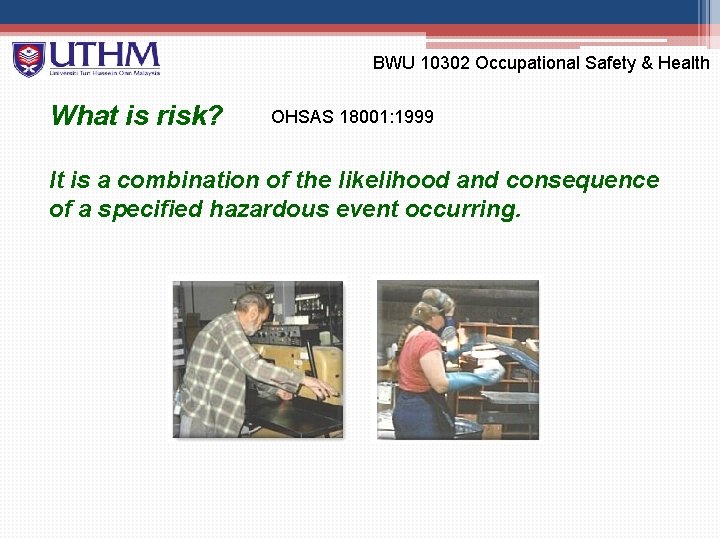
BWU 10302 Occupational Safety & Health What is risk? OHSAS 18001: 1999 It is a combination of the likelihood and consequence of a specified hazardous event occurring.
BWU 10302 Occupational Safety & Health Definition of the Risk • Risk means a combination of the likelihood of an occurrence of a hazardous event with ▫ specified period or in specified circumstances and ▫ the severity of injury or damage to �the health of people, property, environment or any combination of these caused by the event.
BWU 10302 Occupational Safety & Health Individual Perceptions Risk is a very individual concept. It is different for every one. Consider the activity of driving. On a scale of 1 -5 how would you rate driving as a daily activity? For a Grand Prix Driver? A Taxi Driver? My 88 year old grandmother?
BWU 10302 Occupational Safety & Health Risk is often viewed very differently from individual to individual. Another thing to consider is that peoples perceptions change as familiarity increases the perception of a hazard and its risks change.
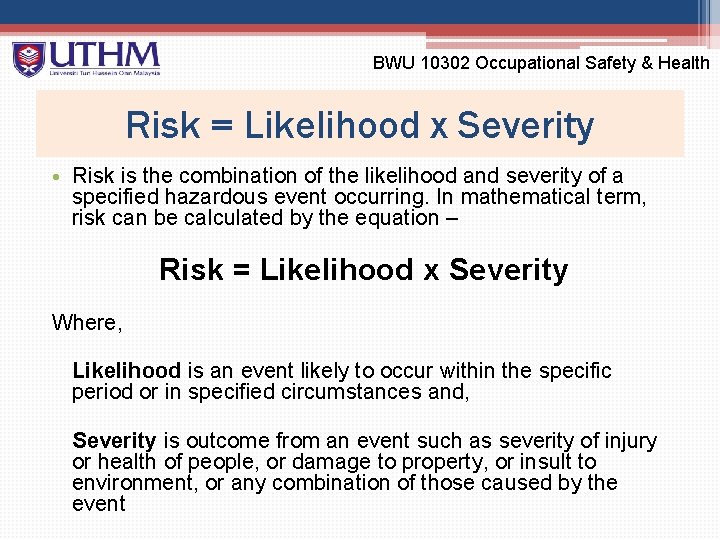
BWU 10302 Occupational Safety & Health Risk = Likelihood x Severity • Risk is the combination of the likelihood and severity of a specified hazardous event occurring. In mathematical term, risk can be calculated by the equation – Risk = Likelihood x Severity Where, Likelihood is an event likely to occur within the specific period or in specified circumstances and, Severity is outcome from an event such as severity of injury or health of people, or damage to property, or insult to environment, or any combination of those caused by the event
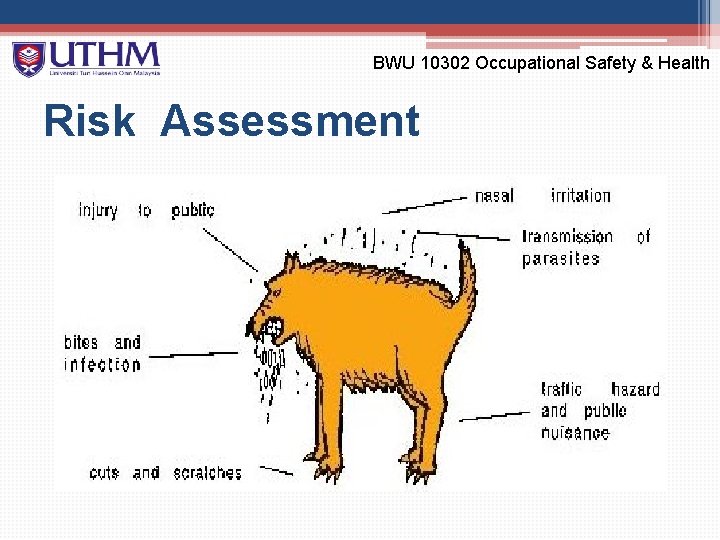
BWU 10302 Occupational Safety & Health Risk Assessment • Risk assessment means the process of evaluating the risks to safety and health arising from hazards at work.
BWU 10302 Occupational Safety & Health Risk Assessment
BWU 10302 Occupational Safety & Health Risk Management • Risk management means the total procedure associated with ▫ ▫ identifying a hazard, assessing the risk, putting in place control measures, and reviewing the outcomes.
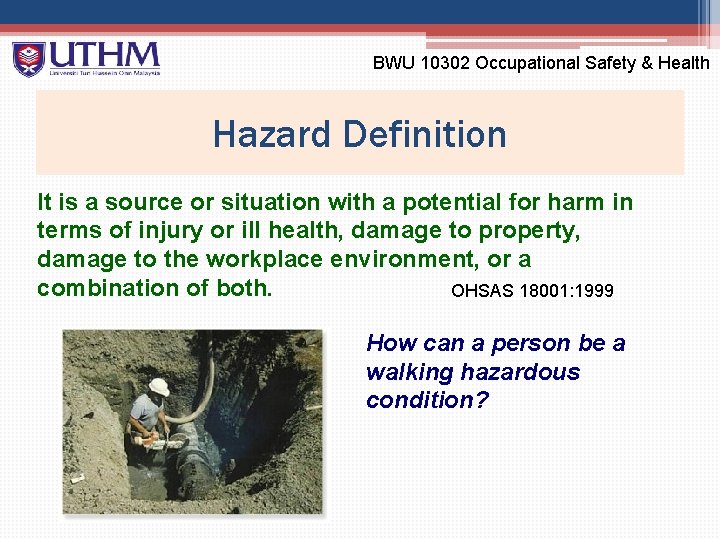
BWU 10302 Occupational Safety & Health Hazard Definition It is a source or situation with a potential for harm in terms of injury or ill health, damage to property, damage to the workplace environment, or a combination of both. OHSAS 18001: 1999 How can a person be a walking hazardous condition?
BWU 10302 Occupational Safety & Health Hazard Control • Hazard control means the process of implementing measures to reduce the risk associated with a hazard.
BWU 10302 Occupational Safety & Health Hierarchy of Control • Hierarchy of control means the established priority order for the types of measures to be used to control risks. Hazard identification means the identification of undesired events that lead to the materialization of the hazard and the mechanism by which those undesired events could occur.
BWU 10302 Occupational Safety & Health Hazard Identification • Hazard identification means the identification of undesired events that lead to the materialization of the hazard and the mechanism by which those undesired events could occur.
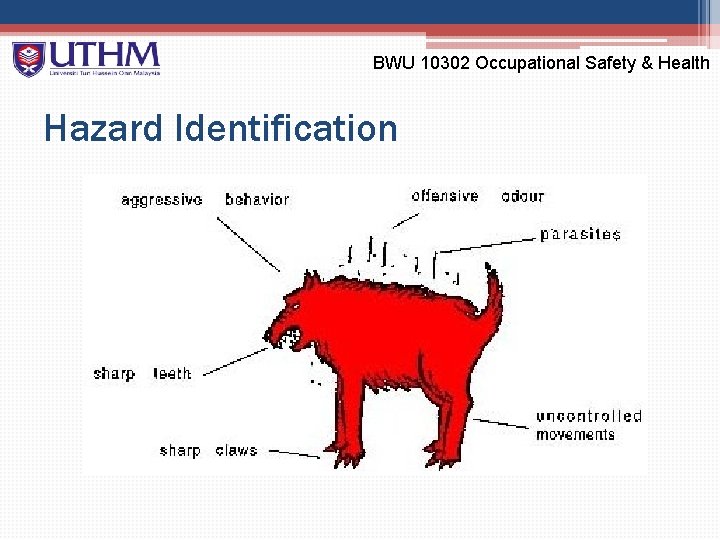
BWU 10302 Occupational Safety & Health Hazard Identification
BWU 10302 Occupational Safety & Health 2. 2 Risk Assessment Techniques
BWU 10302 Occupational Safety & Health Risk Assessment Techniques • The most fundamental risk assessment activity, called an informal risk assessment, occurs when workers are asked to think about the hazards in the workplace ▫ before work commences, ▫ determine what could go wrong, and ▫ report or fix the hazards.
BWU 10302 Occupational Safety & Health Risk Assessment Techniques • More formal risk management activities require structured procedures, often focusing on work processes that involve multiple levels of an organization. • These activities are practiced at some industries and are typically organized by an operations safety official and developed with the help of individuals familiar with the work practice in question.
BWU 10302 Occupational Safety & Health Informal Risk Assessment Techniques • Most informal risk assessment techniques consist of multiple steps where the worker is asked to look for hazards, determine the significance of the hazard, and take some action to mitigate the risk.
BWU 10302 Occupational Safety & Health Informal Risk Assessment Techniques Many systems have been proposed and are widely used in industries. Examples include, but are not limited to: • Stop-Look-Analyze-Manage (SLAM) asks workers to stop and consider the work process before it is started, examine the work environment, analyze the work process, and manage the risk. • Take-Two for Safety calls for persons to take 2 minutes to think through a job before it starts • Five-Point Safety System compels employees to take responsibility for the safety within workplace • Take Time, Take Charge requires miners to stop, think, assess and respond to hazards in their workplace.
BWU 10302 Occupational Safety & Health Basic-formal risk assessment techniques • Basic-formal risk assessment techniques are characterized by the requirement to follow a structured process that occurs prior to performing specific higher risk work activities. • These techniques also require documentation that allows management to monitor and audit individual risk assessment activities.
BWU 10302 Occupational Safety & Health Basic-formal risk assessment techniques • The most commonly used basic-formal risk assessment technique is the Job Safety Analysis (JSA). • A JSA typically leads to development of Standard Operating Procedures (SOP) that define how to best approach a task considering the hazards identified in the JSA. • A JSA is a technique used to identify, analyze and record the specific steps involved in performing a work activity that could have hazards associated with it. • JSAs are typically performed on work processes
BWU 10302 Occupational Safety & Health Basic-formal risk assessment techniques • Other techniques similar to JSAs include Job Hazard Analysis (JHA), Critical Task Analysis (CTA), and Job Hazard Breakdown (JHB). • An SOP is a set of instructions that act as a directive, covering those features of operations that lend themselves to a standardized procedure. • An SOP is typically a set of instructions or steps a worker follows to complete a job safely and in a way that maximizes operational and production requirements. • SOPs can be written for work processes by the individual or group performing the activity, by someone with expertise in the work process, or by the person who supervises the work process.
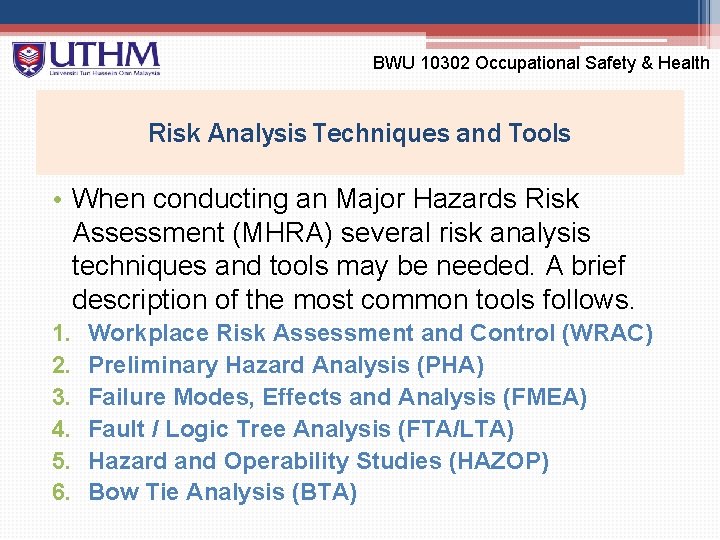
BWU 10302 Occupational Safety & Health Risk Analysis Techniques and Tools • When conducting an Major Hazards Risk Assessment (MHRA) several risk analysis techniques and tools may be needed. A brief description of the most common tools follows. 1. 2. 3. 4. 5. 6. Workplace Risk Assessment and Control (WRAC) Preliminary Hazard Analysis (PHA) Failure Modes, Effects and Analysis (FMEA) Fault / Logic Tree Analysis (FTA/LTA) Hazard and Operability Studies (HAZOP) Bow Tie Analysis (BTA)
BWU 10302 Occupational Safety & Health 1. Workplace Risk Assessment and Control (WRAC) • The Workplace Risk Assessment and Control (WRAC) tool is a broad-brush risk ranking approach, allowing the user to focus on the highest risk. • As applied to a MHRA, this structured preliminary analysis begins by breaking down the process associated with the potential major hazards in some logical manner. • This is often accomplished using a flow chart or process mapping technique where the potential major hazards of each step in a work process are identified.
BWU 10302 Occupational Safety & Health 1. Workplace Risk Assessment and Control (WRAC) • For example, in the mining process could be a breakdown of a major project or a geographical breakdown of the underground mine. • JSAs and SOPs can be used as a framework for the WRAC analysis.
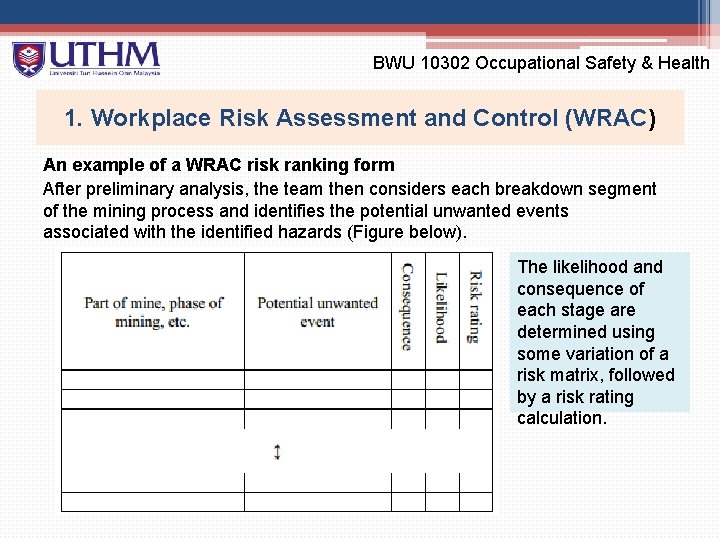
BWU 10302 Occupational Safety & Health 1. Workplace Risk Assessment and Control (WRAC) An example of a WRAC risk ranking form After preliminary analysis, the team then considers each breakdown segment of the mining process and identifies the potential unwanted events associated with the identified hazards (Figure below). The likelihood and consequence of each stage are determined using some variation of a risk matrix, followed by a risk rating calculation.
BWU 10302 Occupational Safety & Health 2. Preliminary Hazard Analysis (PHA) • The Preliminary Hazard Analysis (PHA) is another broad-brush risk ranking approach. • Like the WRAC, this tool identifies all potential hazards and unwanted events that may lead to miner injuries and ranks the identified events according to their severity. • Its main purpose is to identify those unwanted events that should be subjected to further, more detailed risk analysis. Once the potential unwanted events are risk ranked by the team, they can be prioritized so that the highest risk unwanted event is listed first and so on.
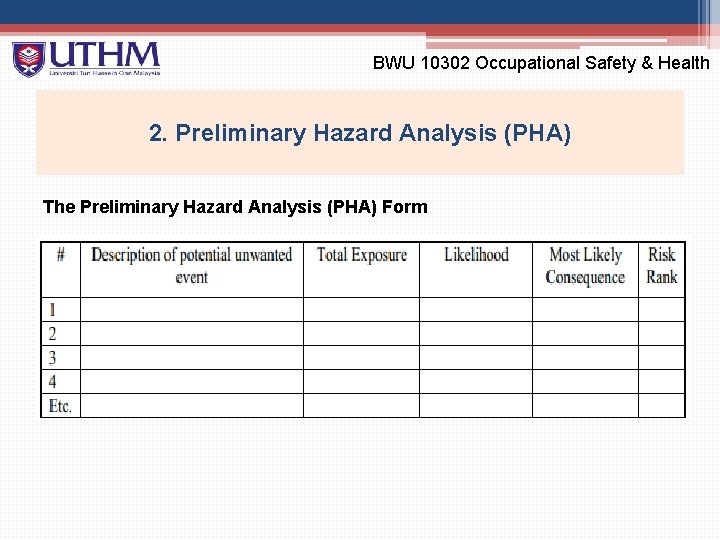
BWU 10302 Occupational Safety & Health 2. Preliminary Hazard Analysis (PHA) The Preliminary Hazard Analysis (PHA) Form
BWU 10302 Occupational Safety & Health 3. Failure Modes, Effects and Analysis (FMEA) • Generally, an FMEA is used to determine where failures can occur within hardware and process systems and to assess the impact of such failures. • For each item, the failure modes of individual items are determined, effects on other items and systems are recognized, criticality is ranked, and the control is identified
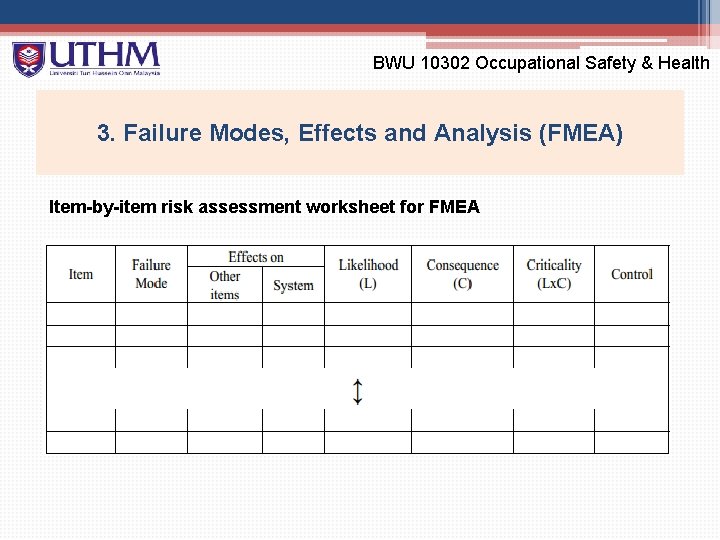
BWU 10302 Occupational Safety & Health 3. Failure Modes, Effects and Analysis (FMEA) Item-by-item risk assessment worksheet for FMEA
BWU 10302 Occupational Safety & Health 4. Fault / Logic Tree Analysis (FTA/LTA) • The Fault and Logic Tree Analysis are systematic, logical developments of many contributing factors to one unwanted event. • The FTA evaluates the one unwanted event while the LTA evaluates a wanted outcome. • With both tools it is necessary to first clearly define the top event, followed by an analysis of the major potential contributing factors. Each contributing factor is broken down into discrete parts.
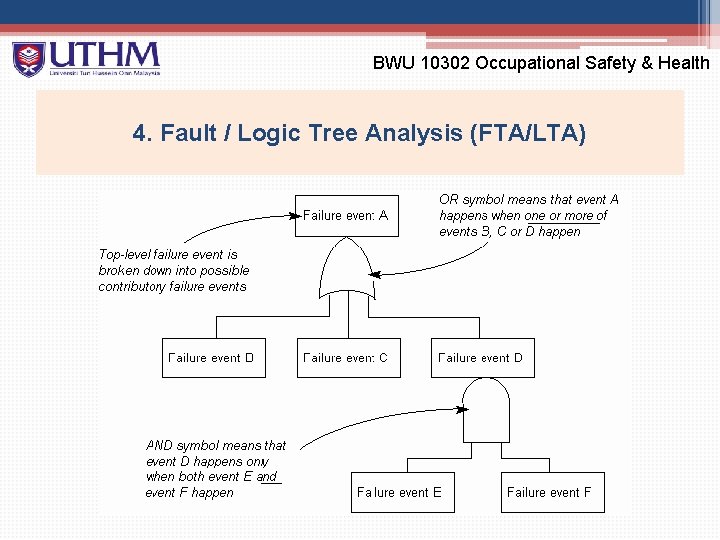
BWU 10302 Occupational Safety & Health 4. Fault / Logic Tree Analysis (FTA/LTA)
BWU 10302 Occupational Safety & Health 5. Hazard and Operability Studies (HAZOP) • Hazard and Operability Studies or HAZOPs have been used extensively in the chemical industries to examine what impact deviations can have on a process. • The basic assumption when performing a HAZOP is that normal and standard conditions are safe and hazards occur only when there is a deviation from normal conditions. • A HAZOP can be conducted during any stage of a project although it is most beneficial during the later stages of design.
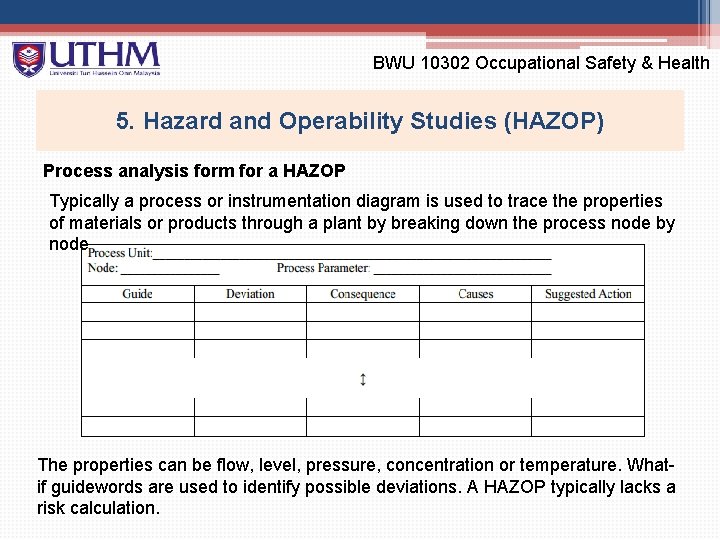
BWU 10302 Occupational Safety & Health 5. Hazard and Operability Studies (HAZOP) Process analysis form for a HAZOP Typically a process or instrumentation diagram is used to trace the properties of materials or products through a plant by breaking down the process node by node The properties can be flow, level, pressure, concentration or temperature. Whatif guidewords are used to identify possible deviations. A HAZOP typically lacks a risk calculation.
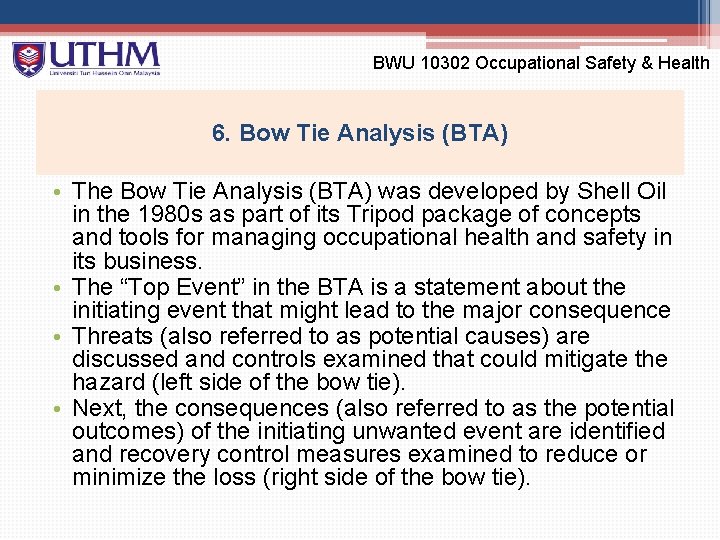
BWU 10302 Occupational Safety & Health 6. Bow Tie Analysis (BTA) • The Bow Tie Analysis (BTA) was developed by Shell Oil in the 1980 s as part of its Tripod package of concepts and tools for managing occupational health and safety in its business. • The “Top Event” in the BTA is a statement about the initiating event that might lead to the major consequence • Threats (also referred to as potential causes) are discussed and controls examined that could mitigate the hazard (left side of the bow tie). • Next, the consequences (also referred to as the potential outcomes) of the initiating unwanted event are identified and recovery control measures examined to reduce or minimize the loss (right side of the bow tie).
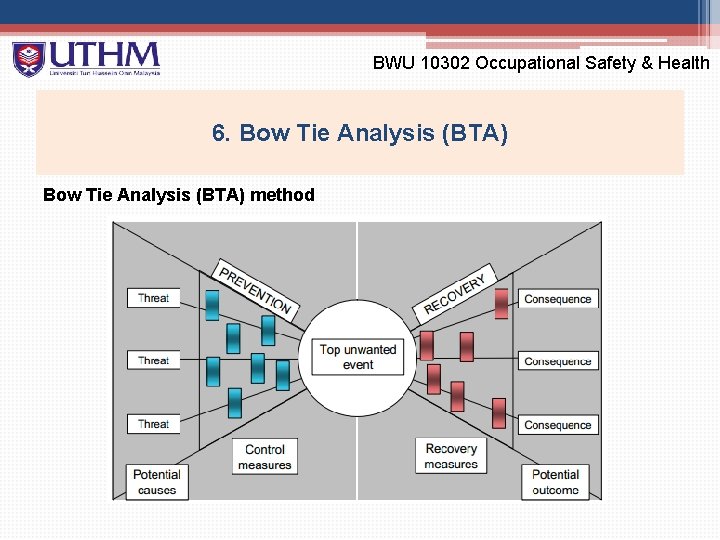
BWU 10302 Occupational Safety & Health 6. Bow Tie Analysis (BTA) method
BWU 10302 Occupational Safety & Health 2. 3 HIRARC

BWU 10302 Occupational Safety & Health Introduction to HIRARC • In recent years, Hazard Identification, Risk Assessment and Risk Control (HIRARC) has become fundamental to the practice of planning, management and the operation of a business as a basic of risk management. • The organizations that have carried out risk assessment at the work place have noted numerous changes in their working practice.
BWU 10302 Occupational Safety & Health Introduction to HIRARC • Those who have already carried out risk assessment in their work, have reported positive changes in their working practice, they recognize substandard act and working condition as they develop and take necessary corrective action. • Legislation requires that this process should be systematic and be recorded so that the results are reliable and the analysis complete. • The risk assessment process should be continuous and should not be regarded as a one-off exercise.
BWU 10302 Occupational Safety & Health What does HIRARC means? • Hazard Identification (HI) – the identification of undesired event that lead to the materialization of the hazard and the mechanism by which those undesired event could event • Risk Assessment (RA) – The process of evaluating the risk to safety and health arising from hazards at work • Risk Control (RC) – the methods used to reduce the amount of inherent risk or to manage the risk
BWU 10302 Occupational Safety & Health Purpose of HIRARC The purposes of HIRARC are as follows: - 1. To identify all the factors that may cause harm to employees and others (the hazards); 2. To consider what the chances are of that harm actually be falling anyone in the circumstances of a particular case and the possible severity that could come from it (the risks); and 3. To enable employers to plan, introduce and monitor preventive measures to ensure that the risks are adequately controlled at all times.
BWU 10302 Occupational Safety & Health Planning of HIRARC Activities HIRARC activities shall be plan and conducted – 1. For situation – i. where hazard appear to pose significant threat; ii. uncertain whether existing controls are adequate; or/and iii. before implementing corrective or preventive measures. 2. By organization intending to continuously improve OSH Management System.
BWU 10302 Occupational Safety & Health Process of HIRARC process that requires 4 simple steps – 1. classify work activities; 2. identify hazard; 3. conduct risk assessment (analyze and estimate risk from each hazard), by calculating or estimating - i. likelihood of occurrence, and ii. severity of hazard; 4. decide if risk is tolerable and apply control measures (if necessary).
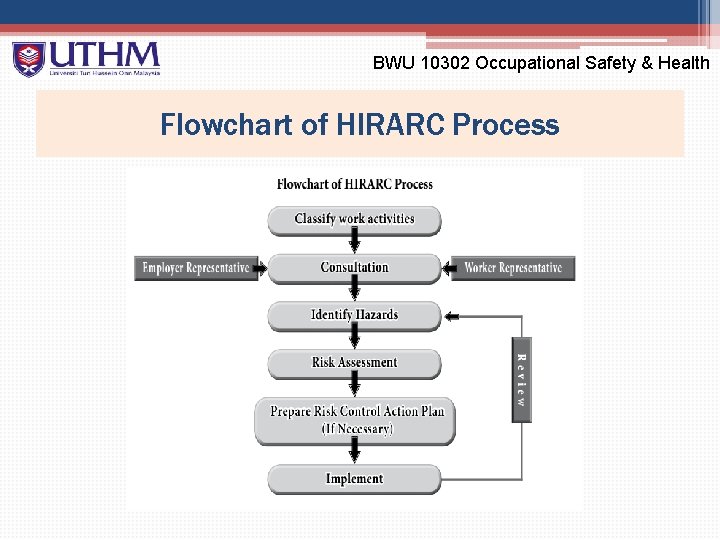
BWU 10302 Occupational Safety & Health Flowchart of HIRARC Process
BWU 10302 Occupational Safety & Health Step 1 - Classify Work Activities Classify work activities in accordance with their similarity, such as - i. geographical or physical areas within/outside premises; ii. stages in production/service process; iii. not too big e. g. building a car; iv. not too small e. g. fixing a nut; or v. defined task e. g. loading, packing, mixing, fixing the door.
BWU 10302 Occupational Safety & Health Step 2 - Identify Hazard • The purpose of hazard identification is to highlight the critical operations of tasks, that is, those tasks posing significant risks to the health and safety of employees as well as highlighting those hazards pertaining to certain equipment due to energy sources, working conditions or activities performed. • Hazards can be divided into FIVE (5) main groups, physical hazards, chemical hazards, ergonomic hazards, psychosocial hazards and biological hazards.
BWU 10302 Occupational Safety & Health Step 2 - Identify Hazard • Physical hazards are the most common and will be present in most workplaces at one time or another. They include unsafe conditions that can cause injury, illness and death. • They are typically easiest to spot but, sadly, too often overlooked because of familiarity (there always cords running across the aisles), lack of knowledge (they aren't seen as hazards), resistance to spending time or money to make necessary improvements or simply delays in making changes to remove the hazards (waiting until tomorrow or a time when "we're not so busy").
BWU 10302 Occupational Safety & Health Step 2 - Identify Hazard Examples of physical hazards include: ▫ electrical hazards: frayed cords, missing ground pins, improper wiring ▫ unguarded machinery and moving machinery parts: guards removed or moving parts that a worker can accidentally touch ▫ constant loud noise ▫ high exposure to sunlight/ultraviolet rays, heat or cold ▫ working from heights, including ladders, scaffolds, roofs, or any raised work area ▫ working with mobile equipment such as fork lifts (operation of fork lifts and similar mobile equipment in the workplace requires significant additional training and experience) ▫ spills on floors or tripping hazards, such as blocked aisle or cords running across the floor.
BWU 10302 Occupational Safety & Health Step 2 - Identify Hazard • Chemical hazards are present when a worker is exposed to any chemical preparation in the workplace in any form (solid, liquid or gas). Some are safer than others, but to some workers who are more sensitive to chemicals, even common solutions can cause illness, skin irritation or breathing problems.
BWU 10302 Occupational Safety & Health Step 2 - Identify Hazard • Beware of: ▫ liquids like cleaning products, paints, acids, solvents especially chemicals in an unlabelled container (warning sign!) ▫ vapours and fumes, for instance those that come from welding or exposure to solvents ▫ gases like acetylene, propane, carbon monoxide and helium ▫ flammable materials like gasoline, solvents and explosive chemicals.
BWU 10302 Occupational Safety & Health Step 2 - Identify Hazard • Ergonomic hazards occur when the type of work, body position and working conditions put strain on your body. They are the hardest to spot since you don't always immediately notice the strain on your body or the harm these hazards pose. Short-term exposure may result in "sore muscles" the next day or in the days following exposure, but long term exposure can result in serious long-term injuries.

BWU 10302 Occupational Safety & Health Step 2 - Identify Hazard Ergonomic hazards include: ▫ ▫ ▫ poor lighting improperly adjusted workstations and chairs frequent lifting poor posture awkward movements, especially if they are repetitive ▫ repeating the same movements over and over ▫ having to use too much force, especially if you have to do it frequently.
BWU 10302 Occupational Safety & Health Step 2 - Identify Hazard • Psychosocial hazards include but aren’t limited to stress, violence and other workplace stressors. • Work is generally beneficial to mental health and personal wellbeing. For example; ▫ ▫ ▫ Alcohol in the workplace Bullying in the workplace Customer aggression Driver fatigue Remote or isolated work Work-related mental stress
BWU 10302 Occupational Safety & Health Step 2 - Identify Hazard • Biological hazards come from working with animals, people or infectious plant materials. Work in day care, hospitals, hotel laundry and room cleaning, laboratories, veterinary offices and nursing homes may expose you to biological hazards. • The types of things you may be exposed to include: ▫ ▫ ▫ blood or other body fluids fungi bacteria and viruses plants insect bites animal and bird droppings.
BWU 10302 Occupational Safety & Health Step 2 - Identify Hazard • Biological hazards come from working with animals, people or infectious plant materials. Work in day care, hospitals, hotel laundry and room cleaning, laboratories, veterinary offices and nursing homes may expose you to biological hazards. • The types of things you may be exposed to include: ▫ ▫ ▫ blood or other body fluids fungi bacteria and viruses plants insect bites animal and bird droppings.
BWU 10302 Occupational Safety & Health Step 2 - Identify Hazard identification technique • The employer shall develop a hazard identification and assessment methodology taking into account the following documents and information - i. any hazardous occurrence investigation reports; ii. first aid records and minor injury records; iii. work place health protection programs; iv. any results of work place inspections; Continue……
BWU 10302 Occupational Safety & Health Step 2 - Identify Hazard v. any employee complaints and comments; vi. any government or employer reports, studies and tests concerning the health and safety of employees; vii. any reports made under the regulation of Occupational Safety and Health Act, 1994 viii. the record of hazardous substances; and ix. any other relevant information.
BWU 10302 Occupational Safety & Health Step 3 - Conduct Risk Assessment (Analyze and estimate risk) • Risk is the determination of likelihood and severity of the credible accident/event sequences in order to determine magnitude and to priorities identified hazards. • It can be done by ▫ qualitative, ▫ quantitative or ▫ semi quantitative method.
BWU 10302 Occupational Safety & Health Step 3 - Conduct Risk Assessment (Analyze and estimate risk) • A qualitative analysis uses words to describe the magnitude of potential severity and the likelihood that those severity will occur. • These scales can be adapted or adjusted to suit the circumstances and different descriptions may be used for different risks. • This method uses expert knowledge and experience to determine likelihood and severity category.
BWU 10302 Occupational Safety & Health Step 3 - Conduct Risk Assessment (Analyze and estimate risk) • In semi-quantitative analysis, qualitative scales such as those described above are given values. The objective is to produce a more expanded ranking scale than is usually achieved in qualitative analysis, not to suggest realistic values for risk such as is attempted in quantitative analysis.
BWU 10302 Occupational Safety & Health Step 3 - Conduct Risk Assessment (Analyze and estimate risk) • Quantitative analysis uses numerical values (rather than the descriptive scales used in qualitative and semi-quantitative analysis) for both severity and likelihood using data from a variety of sources such as past accident experience and from scientific research. • Severity may be determined by modeling the outcomes of an event or set of events, or by extrapolation from experimental studies or past data. • The way in which severity and likelihood are expressed and the ways in which they are combined to provide a level of risk will vary according to the type of risk and the purpose for which the risk assessment output is to be used. In this note qualitative and semi quantitative method uses as an example.
BWU 10302 Occupational Safety & Health Step 3 - Conduct Risk Assessment (Analyze and estimate risk) Likelihood of an occurrence • This value is based on the likelihood of an event occurring. • You may ask the question “How many times has this event happened in the past? ” • Assessing likelihood is based worker experience, analysis or measurement. • Likelihood levels range from “most likely” to “inconceivable. ”

BWU 10302 Occupational Safety & Health Step 3 - Conduct Risk Assessment (Analyze and estimate risk) • Table below indicates likelihood using the following values. Source: NIOSH RAM - NIOSH RISK ASSESSMENT MATRIK

BWU 10302 Occupational Safety & Health KEBARANGKALIAN (LIKELIHOOD) 5 : KERAP KEGAGALAN KERAP BERLAKU 4 : SELALU KEGAGALAN SELALU BERLAKU 3 : PERNAH BERLAKU KEGAGALAN, TETAPI TIDAK BESAR 2 : SEKALI-SEKALI JARANG BERLAKU DI DALAM ORGANISASI YANG SAMA/DALAM NEGARA 1 : JARANG BERLAKU MUNGKIN DI NEGARA LAIN Source: DOSH RAM - DOSH RISK ASSESSMENT MATRIK
BWU 10302 Occupational Safety & Health Step 3 - Conduct Risk Assessment (Analyze and estimate risk) Severity of hazard Severity can be divided into five categories. Severity are based upon an increasing level of severity to an individual’s health, the environment, or to property. Table below indicates severity.
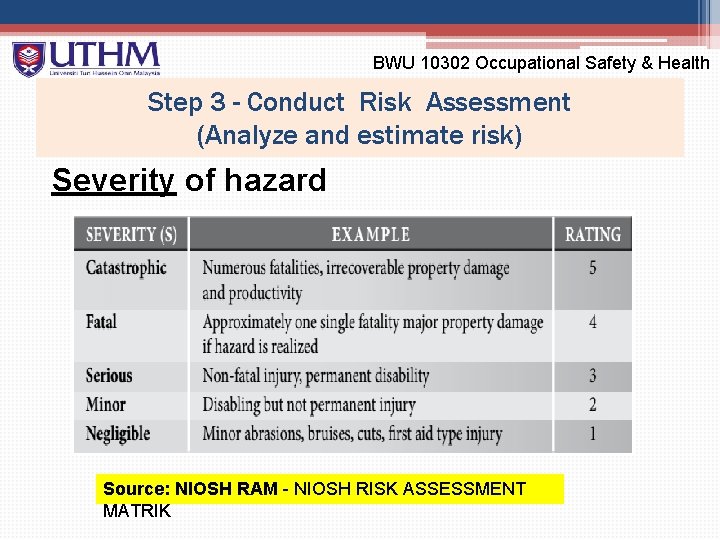
BWU 10302 Occupational Safety & Health Step 3 - Conduct Risk Assessment (Analyze and estimate risk) Severity of hazard Source: NIOSH RAM - NIOSH RISK ASSESSMENT MATRIK
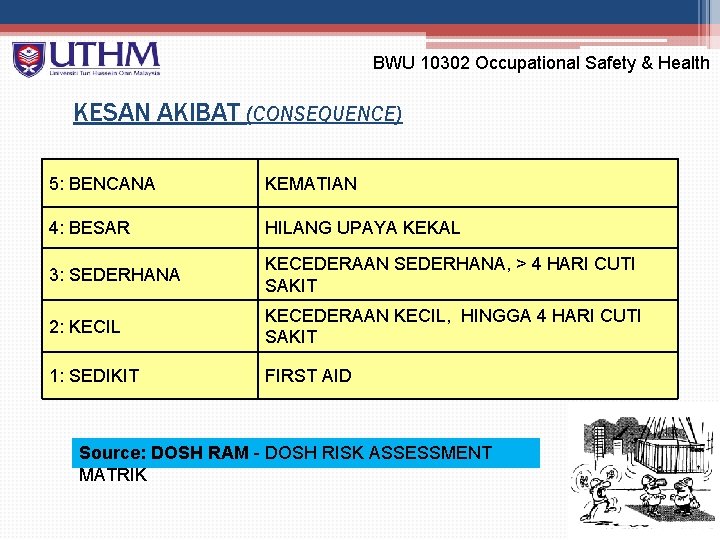
BWU 10302 Occupational Safety & Health KESAN AKIBAT (CONSEQUENCE) 5: BENCANA KEMATIAN 4: BESAR HILANG UPAYA KEKAL 3: SEDERHANA KECEDERAAN SEDERHANA, > 4 HARI CUTI SAKIT 2: KECIL KECEDERAAN KECIL, HINGGA 4 HARI CUTI SAKIT 1: SEDIKIT FIRST AID Source: DOSH RAM - DOSH RISK ASSESSMENT MATRIK
BWU 10302 Occupational Safety & Health Step 3 - Conduct Risk Assessment (Analyze and estimate risk) Risk assessment • Risk can be presented in variety of ways to communicate the results of analysis to make decision on risk control. For risk analysis that uses likelihood and severity in qualitative method, presenting result in a risk matrix is a very effective way of communicating the distribution of the risk throughout a plant and area in a workplace. • Risk can be calculated using the following formula: L x S = Relative Risk L = Likelihood S = Severity
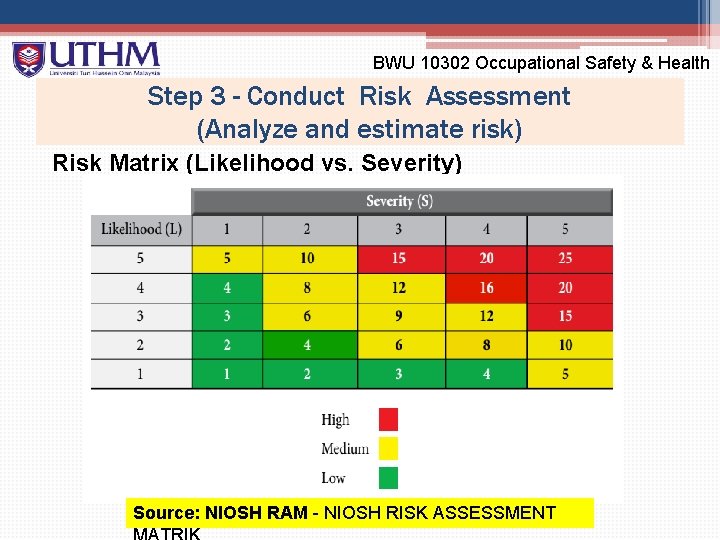
BWU 10302 Occupational Safety & Health Step 3 - Conduct Risk Assessment (Analyze and estimate risk) Risk Matrix (Likelihood vs. Severity) Source: NIOSH RAM - NIOSH RISK ASSESSMENT

MATRIK RISIKO BWU 10302 Occupational Safety & Health RPN : RISK PRIORITY NUMBER, 1 (SANGAT RENDAH) 25 (SANGAT TINGGI) 1 JARANG 2 SEKALI 3 PERNAH BERLAKU 4 SELALU 5 KERAP 1: SEDIKIT 1 2 3 4 5 2: KECIL 2 4 6 8 10 3: SEDERHANA 3 6 9 12 15 4: BESAR 4 8 12 16 20 5: BENCANA 5 10 15 20 25 Dapatkan RPN : Risk Priority Number berdasarkan kebarangkalian dan kesan akibat Source: DOSH RAM - DOSH RISK ASSESSMENT MATRIK
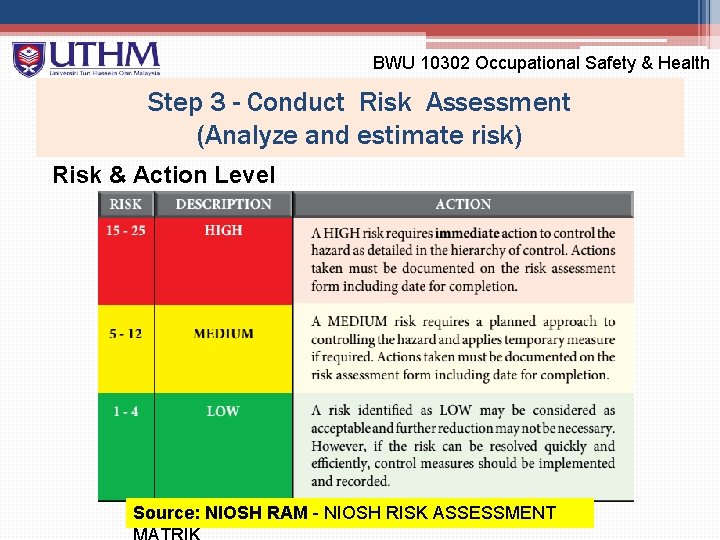
BWU 10302 Occupational Safety & Health Step 3 - Conduct Risk Assessment (Analyze and estimate risk) Risk & Action Level Source: NIOSH RAM - NIOSH RISK ASSESSMENT

BWU 10302 Occupational Safety & Health Menetapkan RISIKO (berasaskan RPN) RISIKO TINDAKAN SANGAT TINGGI (15 -25) BERITAHU PIHAK PENGURUSAN SEGERA HAPUSKAN : TIDAK BOLEH DIBIARKAN; PERLU KAWALAN SEGERA DAN JANGKA PANJANG YANG LEBIH BERKESAN TINGGI (8 -14) BERITAHU KETUA JABATAN. PERLU KAWALAN SEGERA DAN JANGKA PANJANG YANG LEBIH BERKESAN SEDERHANA (4 -7) RENDAH (1 -3) BERITAHU HAZARDS KEPADA PEKERJA; TOOL BOX MEETING; SAFE BEHAVIOUR; JSA KAWALANN JANGKA PANJANG BERKESAN RISIKO BOLEH DITERIMA; UMUMNYA TIDAK PERLU TINDAKAN; KEKALKAN KAWALAN SEDIA ADA Source: DOSH RAM - DOSH RISK ASSESSMENT MATRIK
BWU 10302 Occupational Safety & Health Step 4 - Decide if risk is tolerable and apply control measures (Risk Control). • Risk control is the elimination or inactivation of a hazard in a manner such that the hazard does not pose a risk to workers who have to enter into an area or work on equipment in the course of scheduled work.
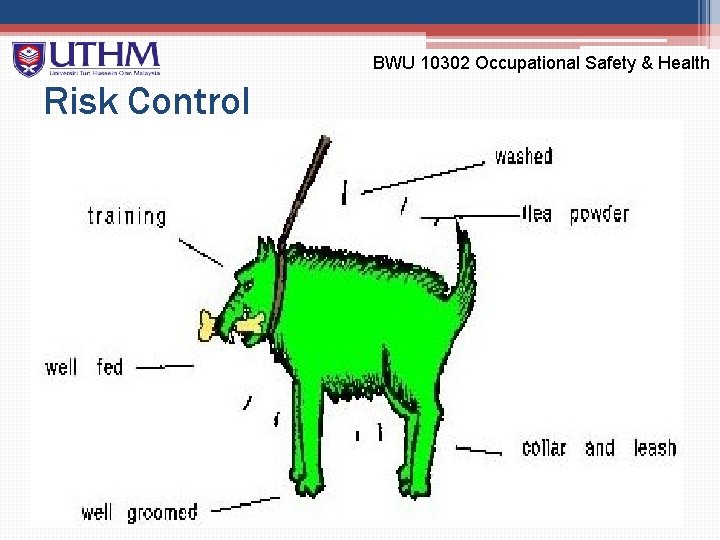
BWU 10302 Occupational Safety & Health Risk Control
BWU 10302 Occupational Safety & Health Step 4 - Decide if risk is tolerable and apply control measures (Risk Control). • Hazards should be controlled at their source (where the problem is created). The closer a control to the source of the hazard is the better. This method is often referred to as applying engineering controls.
BWU 10302 Occupational Safety & Health Step 4 - Decide if risk is tolerable and apply control measures (Risk Control). • If this does not work, hazards can often be controlled along the path to the worker, between the source and the worker. This method can be referred to as applying administrative controls. • If this is not possible, hazards must be controlled at the level of the worker through the use of personal protective equipment (PPE), although this is the least desirable control.
BWU 10302 Occupational Safety & Health Step 4 - Decide if risk is tolerable and apply control measures (Risk Control). • If this does not work, hazards can often be controlled along the path to the worker, between the source and the worker. This method can be referred to as applying administrative controls. • If this is not possible, hazards must be controlled at the level of the worker through the use of personal protective equipment (PPE), although this is the least desirable control.
BWU 10302 Occupational Safety & Health Selecting a suitable control Selecting a control often involves – a. evaluating and selecting short and long term controls; b. implementing short-term measures to protect workers until permanent controls can be put in place; and c. implementing long term controls when reasonably practicable. For example, suppose a noise hazard is identified. Short-term controls might require workers to use hearing protection. Long term, permanent controls might remove or isolate the noise source.
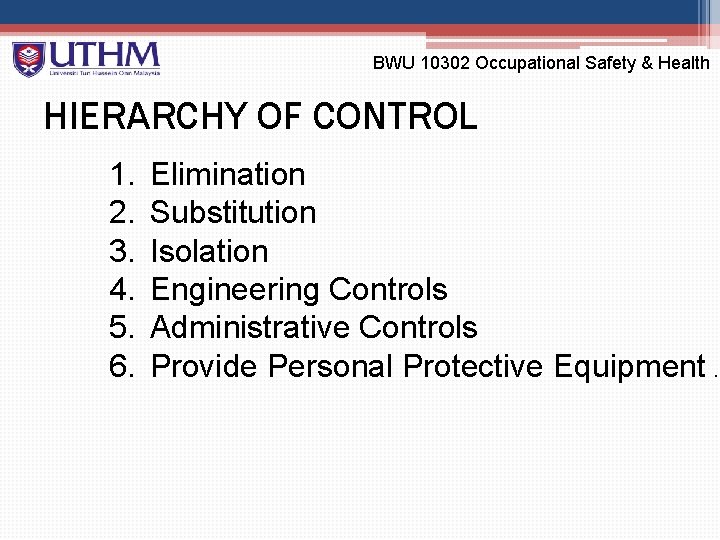
BWU 10302 Occupational Safety & Health HIERARCHY OF CONTROL 1. 2. 3. 4. 5. 6. Elimination Substitution Isolation Engineering Controls Administrative Controls Provide Personal Protective Equipment.
BWU 10302 Occupational Safety & Health Hierarchy of Control (1) Elimination - Getting rid of a hazardous job, tool, process, machine or substance is perhaps the best way of protecting workers. For example, a salvage firm might decide to stop buying and cutting up scrapped bulk fuel tanks due to explosion hazards.
BWU 10302 Occupational Safety & Health Hierarchy of Control (2) Substitution - Sometimes doing the same work in a less hazardous way is possible. For example, a hazardous chemical can be replaced with a less hazardous one. Controls must protect workers from any new hazards that are created.
BWU 10302 Occupational Safety & Health Hierarchy of Control (3) Isolation - If a hazard cannot be eliminated or replaced, it can some times be isolated, contained or otherwise kept away from workers. For example, an insulated and air-conditioned control room can protect operators from a toxic chemical.
BWU 10302 Occupational Safety & Health Hierarchy of Control (4) Engineering control • Redesign- Jobs and processes can be reworked to make them safer. For example, containers can be made easier to hold and lift. • Automation - Dangerous processes can be automated or mechanized. For example, computer-controlled robots can handle spot welding operations in car plants. Care must be taken to protect workers from robotic hazards. Continue……. .
BWU 10302 Occupational Safety & Health Hierarchy of Control (4) Engineering control • Barriers - A hazard can be blocked before it reaches workers. For example, special curtains can prevent eye injuries from welding arc radiation. Proper equipment guarding will protect workers from contacting moving parts. • Absorption - Baffles can block or absorb noise. Lockout systems can isolate energy sources during repair and maintenance. Usually, the further a control keeps a hazard away from workers, the more effective it is. • Dilution - Some hazards can be diluted or dissipated. For example, ventilation systems can dilute toxic gasses before they reach operators.
BWU 10302 Occupational Safety & Health Hierarchy of Control (5) Administrative controls • Safe work procedures - Workers can be required to use standardized safety practices. The employer is expected to ensure that workers follow these practices. Work procedures must be periodically reviewed with workers and updated. • Supervision and training– Initial training on safe work procedures and refresher training should be offered. Appropriate supervision to assist workers in identifying possible hazards and evaluating work procedures. • Job rotations and other procedures can reduce the time that workers are exposed to a hazard. For example, workers can be rotated through jobs requiring repetitive tendon and muscle movements to prevent cumulative trauma injuries. Noisy processes can be scheduled when no one is in the workplace.
BWU 10302 Occupational Safety & Health Hierarchy of Control (5) Administrative controls • Housekeeping, repair and maintenance programs - Housekeeping includes cleaning, waste disposal and spill cleanup. Tools, equipment and machinery are less likely to cause injury if they are kept clean and well maintained. • Hygiene - Hygiene practices can reduce the risk of toxic materials being absorbed by workers or carried home to their families. Street clothing should be kept in separate lockers to avoid being contaminated by work clothing. Eating areas must be segregated from toxic hazards. Eating should be forbidden in toxic work areas. Where applicable, workers should be required to shower and change clothes at the end of the shift.
BWU 10302 Occupational Safety & Health Hierarchy of Control (6) Personal protective equipment • Personal protective equipment (PPE) and clothing is used when other controls measures are not feasible and where additional protection is needed. Workers must be trained to use and maintain equipment properly. The employer and workers must understand the limitations of the personal protective equipment. The employer is expected to require workers to use their equipment whenever it is needed. Care must be taken to ensure that equipment is working properly. Otherwise, PPE may endanger a workers health by providing an illusion of protection.
BWU 10302 Occupational Safety & Health Hierarchy of Control (6) Personal protective equipment • Personal protective equipment (PPE) and clothing is used when other controls measures are not feasible and where additional protection is needed. Workers must be trained to use and maintain equipment properly. The employer and workers must understand the limitations of the personal protective equipment. The employer is expected to require workers to use their equipment whenever it is needed. Care must be taken to ensure that equipment is working properly. Otherwise, PPE may endanger a workers health by providing an illusion of protection.
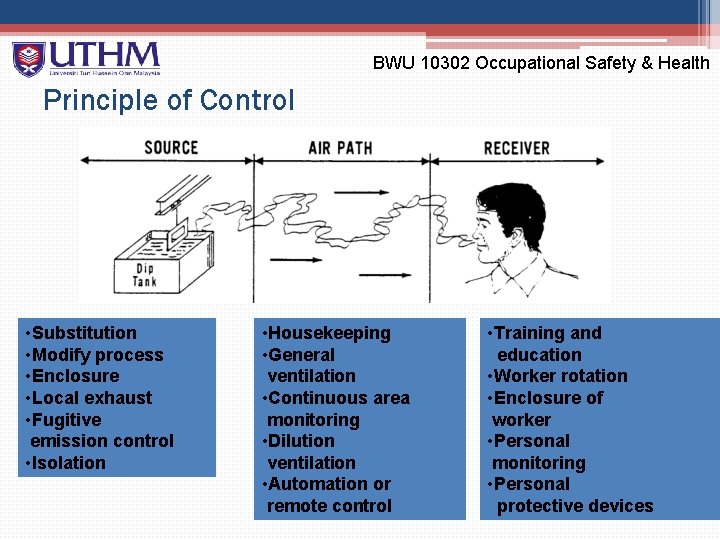
BWU 10302 Occupational Safety & Health Principle of Control • Substitution • Modify process • Enclosure • Local exhaust • Fugitive emission control • Isolation • Housekeeping • General ventilation • Continuous area monitoring • Dilution ventilation • Automation or remote control • Training and education • Worker rotation • Enclosure of worker • Personal monitoring • Personal protective devices
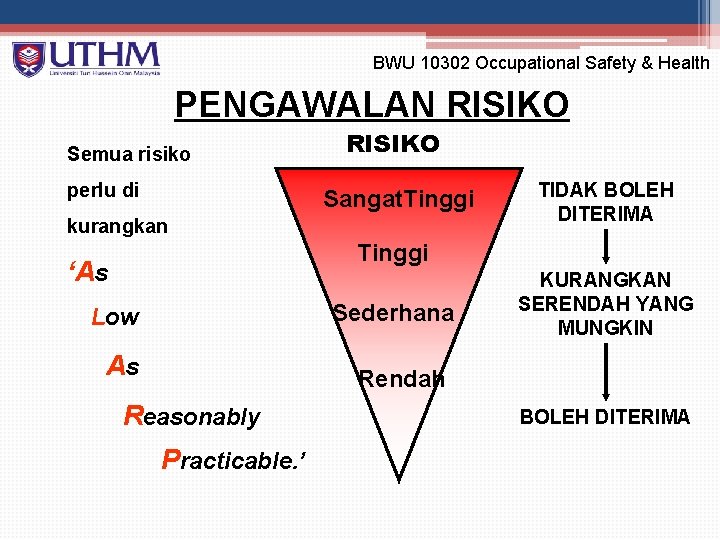
BWU 10302 Occupational Safety & Health PENGAWALAN RISIKO Semua risiko perlu di RISIKO Sangat. Tinggi kurangkan TIDAK BOLEH DITERIMA Tinggi ‘As Sederhana Low As KURANGKAN SERENDAH YANG MUNGKIN Rendah Reasonably Practicable. ’ BOLEH DITERIMA
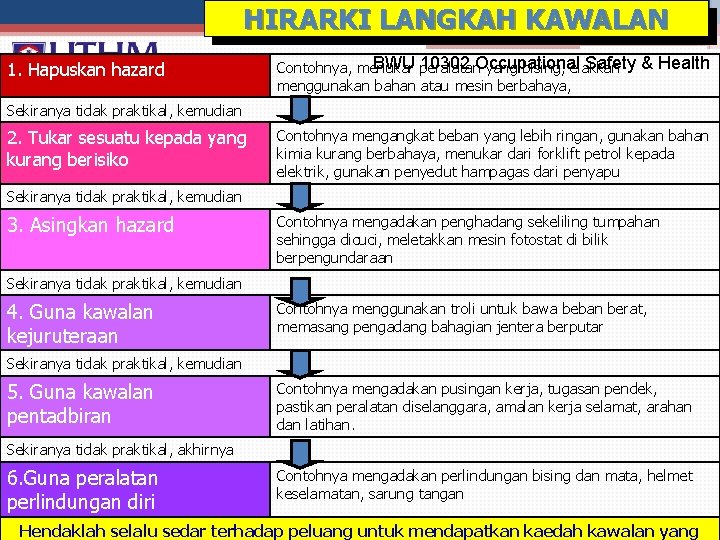
HIRARKI LANGKAH KAWALAN 1. Hapuskan hazard BWU 10302 Occupational Safety & Health Contohnya, menukar peralatan yang bising, elakkan menggunakan bahan atau mesin berbahaya, Sekiranya tidak praktikal, kemudian 2. Tukar sesuatu kepada yang kurang berisiko Contohnya mengangkat beban yang lebih ringan, gunakan bahan kimia kurang berbahaya, menukar dari forklift petrol kepada elektrik, gunakan penyedut hampagas dari penyapu Sekiranya tidak praktikal, kemudian 3. Asingkan hazard Contohnya mengadakan penghadang sekeliling tumpahan sehingga dicuci, meletakkan mesin fotostat di bilik berpengundaraan Sekiranya tidak praktikal, kemudian 4. Guna kawalan kejuruteraan Contohnya menggunakan troli untuk bawa beban berat, memasang pengadang bahagian jentera berputar Sekiranya tidak praktikal, kemudian 5. Guna kawalan pentadbiran Contohnya mengadakan pusingan kerja, tugasan pendek, pastikan peralatan diselanggara, amalan kerja selamat, arahan dan latihan. Sekiranya tidak praktikal, akhirnya 6. Guna peralatan perlindungan diri Contohnya mengadakan perlindungan bising dan mata, helmet keselamatan, sarung tangan Hendaklah selalu sedar terhadap peluang untuk mendapatkan kaedah kawalan yang
BWU 10302 Occupational Safety & Health Monitoring controls • The effectiveness of controls must be checked regularly. Evaluate and monitor hazard controls during inspections, routine maintenance, and other activities. Ask the following questions – a. have the controls solved the problem? b. is any risk to workers posed by the controls contained? c. are all new hazards being identified? d. are significant, new hazards appropriately controlled? e. are accident reports being analyzed? f. are any other measures required? • Document control activities to track their effectiveness, if necessary re-evaluate hazards and implement new control measures.
BWU 10302 Occupational Safety & Health MONITORING AND REVIEW KEY POINT A review follow-up is always essential. Review is an important aspect of any risk management process. It is essential to review what has been done to ensure that the controls put in place are effective
BWU 10302 Occupational Safety & Health CONCLUSION Hazard identification, risk assessment, control and review is not a task that is completed and then forgotten about. Hazard identification should be properly documented even in the simplest of situations Risk assessment should include a careful assessment of both likelihood and severity/consequence. Control measures should conform to the recommendations of the hierarchy of control. The risk management process is an on going one.
BWU 10302 Occupational Safety & Health Contoh 1 (Hirarc) üHazard Identification üRisk Assessment üRisk Control

BWU 10302 Occupational Safety & Health Kerja ‘formwork’- acuan (satu con Aktiviti terlibat: 1. Mengangkat 2. Menyimpan Sementara 3. Membersih 4. Memasang 5. Memeriksa 6. Menyimen 7. Membuka

Kerja ‘formwork’- acuan (satu contoh BWU 10302 Occupational Safety & Health K: Kebarangkalian KA: Kesan Akibat R: Risiko

Kerja ‘formwork’- acuan (satu contoh BWU 10302 Occupational Safety & Health
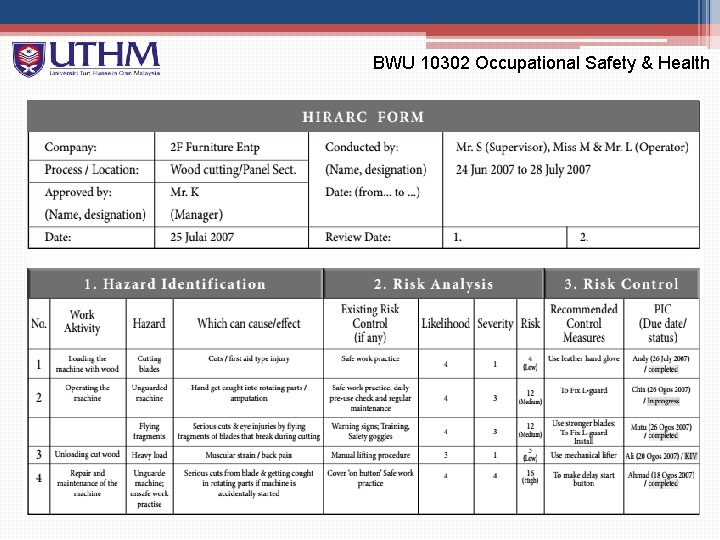
BWU 10302 Occupational Safety & Health Contoh 2 (Hirarc) Wood panel cutting process • A team of two workers operates a cross-cut saw machine. Their work includes loading wood panel onto the machine, cutting the wood and unloading the cut wood. They also need to repair and maintain the machine regularly as well as to change the blades of the machine. (Caution: This example may not be applicable to similar work in your workplace).
BWU 10302 Occupational Safety & Health
- Slides: 102