
Chapter 2 Rhythm Begins on page 10 Rhythm
Chapter 2 Rhythm Begins on page 10
Rhythm § § Rhythm is the term for the flow of music through time All music takes place in time
Beat § The beat is one aspect of rhythm It is the pulse you march or dance to ► Beats are the way music is measured ► Beats are usually steady ►
Notation of Rhythm § § Notes last for a certain number or portions of beats The length of notes follows a 2: 1 ratio

Meter § § § Meter is the pattern of the beats (not the notes) The pattern is created when certain beats are emphasized consistently Most patterns of beats occur in twos, threes, or fours
Notation of Rhythm § § Meter is indicated in notation by vertical lines They create units called measures The meter signature is two numbers aligned vertically They tell the number of beats in a measure (upper) and the type of note that equals one beat (lower)
Tempo § Tempo is the term for the speed of the beats (again, not the notes) Indicated by a general term, usually a word in Italian ► Can also be indicated by a metronome marking the number of beats per minute ►
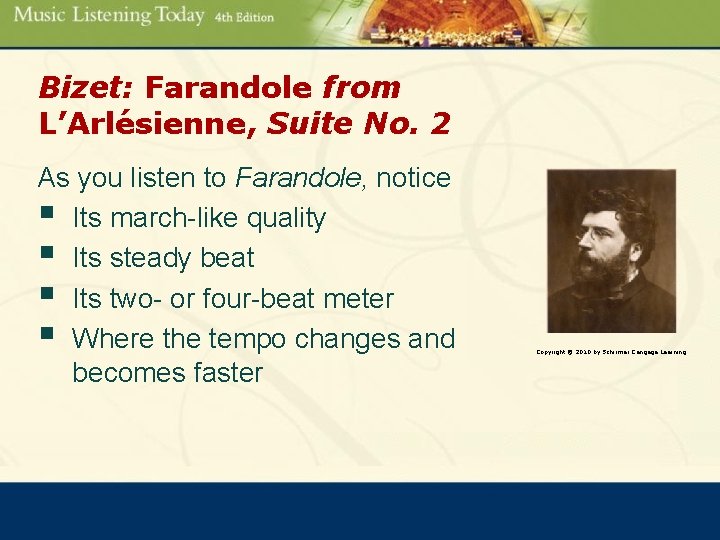
Bizet: Farandole from L’Arlésienne, Suite No. 2 As you listen to Farandole, notice § Its march-like quality § Its steady beat § Its two- or four-beat meter § Where the tempo changes and becomes faster Copyright © 2010 by Schirmer Cengage Learning
Syncopation § Syncopation happens when the rhythmic emphasis occurs where it is not expected ► or removed where it is expected ►
Polyrhythm § Polyrhythm occurs when two or more rhythmic patterns are performed at the same time They are heard in some twentieth-century music and are a feature of African music ► “Mitamba Yalagala Kumchuzi” ►
Summary § Rhythm Beat ► Meter ► Tempo ► § § § Notation of rhythm Bizet: Farandole Syncopation Polyrhythm Africa: “Mitamba Yalagala Kumchuzi”
- Slides: 12