
Chapter 2 Research Writing Style The most important

- Slides: 28
Chapter 2 Research Writing Style The most important goal of writing is to be clear without being boring. —Aristotle, Poetics Copyright © 2014 Wolters Kluwer Health | Lippincott Williams & Wilkins
Research writing is an important skill for students to develop. Copyright © 2014 Wolters Kluwer Health | Lippincott Williams & Wilkins
Characteristics of Good Research Writing • Grammatically correct • Clear • Logically organized • Avoids unnecessary jargon • Avoids long, complex sentences • Tells an interesting story Copyright © 2014 Wolters Kluwer Health | Lippincott Williams & Wilkins
Organization • Always start with an outline of the main points you wish to convey • Begin each paragraph with a topic sentence that states the main point of the paragraph • Make sure that the organization of each section of your paper/manuscript is logical Copyright © 2014 Wolters Kluwer Health | Lippincott Williams & Wilkins
Check Your Understanding 1. What are three characteristics of good research writing? 2. Why is it often helpful to create an outline before writing? 3. What is a topic sentence? Copyright © 2014 Wolters Kluwer Health | Lippincott Williams & Wilkins
Transitions • Phrases or clauses to help your reader follow the story you are trying to tell • Bridges between different lines of thought • Features take your writing more readable and more interesting Copyright © 2014 Wolters Kluwer Health | Lippincott Williams & Wilkins
Examples of Transitions 1. A sentence that briefly summarizes what you have said and indicates what will immediately follow e. g. , As discussed previously, there are good reasons to abandon the prosthetics used in the last decade for shoulder replacements and to move forward with new technology. 2. A sentence that begins with a statement of a possible objection (in the mind of a reader) to what will follow and responds to it e. g. , Although stretching prior to athletic performance has long been advocated as prophylactic, the credible evidence in the research literature does not support that notion. Copyright © 2014 Wolters Kluwer Health | Lippincott Williams & Wilkins
Examples of Transitions 3. A sentence that begins by summarizing a concept just presented and then posing a question about it e. g. , As discussed, bone responds to added mechanical stress by hypertrophying. Does this suggest that in the absence of mechanical stress bone will atrophy? 4. A sentence that begins with transitional words or clauses to show either similarity or contrast to the preceding sentence or preceding paragraph. e. g. , In a similar study, Smith and Jones found… Copyright © 2014 Wolters Kluwer Health | Lippincott Williams & Wilkins
Clarity • Communicate as clearly as possible with your choice of words • Choose words that are appropriate for your target audience • Eliminate unnecessary words and phrases, (avoid wordiness) • Omit unnecessary adverb and adjective modifiers • Omit words such as “in fact, ” “importantly, ” and “hopefully” Copyright © 2014 Wolters Kluwer Health | Lippincott Williams & Wilkins
Check Your Understanding 1. What are three advantages of using structured transitions between different lines of thought? 2. List three examples of words that are best avoided in research writing because they add no relevant meaning to a sentence. 3. What are some reasons for avoiding wordiness in research writing? Copyright © 2014 Wolters Kluwer Health | Lippincott Williams & Wilkins
Parallelism When writing a sentence that includes a list of phrases or clauses, state all of them in the same way. This structure, called parallelism, improves the clarity of the whole sentence, making it easier to read and understand. e. g. , Conducting a research study involves understanding the related literature, collecting the necessary data, running the statistical analysis, and writing the manuscript. Copyright © 2014 Wolters Kluwer Health | Lippincott Williams & Wilkins
Research Citation Conventions • Refer to researchers by last name only. • When referring to a specific study, include the year the study was published. • Within a body of writing, use a consistent editorial style. Copyright © 2014 Wolters Kluwer Health | Lippincott Williams & Wilkins
Common Writing Errors to Avoid 1. “Studies have shown. . . ” (with no accompanying citation of specific studies) 2. “The study found. . . " or "The study concluded. . . ” 3. “These results are significant because. . . ” 4. “This study was similar to the one described above. ” 5. “The results showed that exercise A produced higher heart rates. ” 6. “They looked at differences between men, women, and children. ” Copyright © 2014 Wolters Kluwer Health | Lippincott Williams & Wilkins
Common Writing Errors to Avoid 7. “The data was collected under three conditions. ” 8. “The treatment was shown to effect the subjects. ” Copyright © 2014 Wolters Kluwer Health | Lippincott Williams & Wilkins
Active and Passive Voice Consider the following sentences: Healing of the muscle strain was promoted by use of ultrasound treatments. Use of the patellar tendon for the ACL graft was elected by the surgeon. The mistake was admitted to be the fault of John. These sentences are examples of passive voice. Copyright © 2014 Wolters Kluwer Health | Lippincott Williams & Wilkins
Active and Passive Voice Consider the following sentences: Ultrasound treatments promoted healing of the muscle strain. The surgeon elected to use the patellar tendon for the ACL graft. John admitted that the mistake was his fault. These sentences are examples of active voice. Copyright © 2014 Wolters Kluwer Health | Lippincott Williams & Wilkins
Active and passive voice Advantages of active voice: • More direct • More clear • Less wordy • Increasingly preferred in research writing style • A more powerful form of expression than passive voice Copyright © 2014 Wolters Kluwer Health | Lippincott Williams & Wilkins
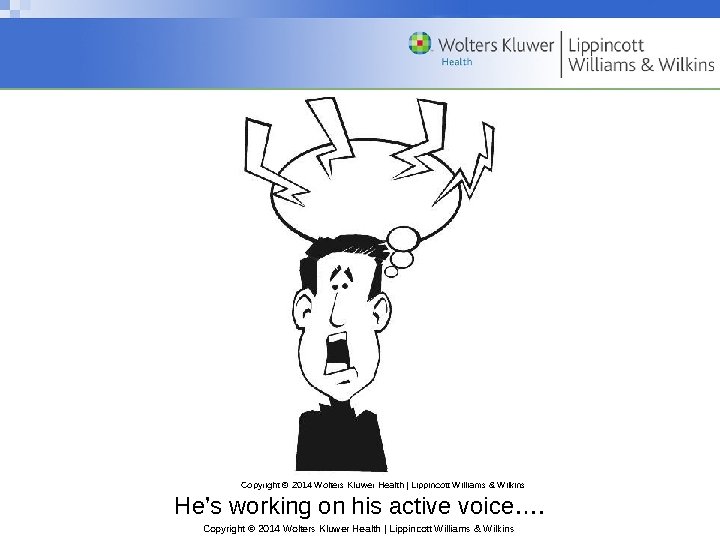
Copyright © 2014 Wolters Kluwer Health | Lippincott Williams & Wilkins He’s working on his active voice…. Copyright © 2014 Wolters Kluwer Health | Lippincott Williams & Wilkins
Check Your Understanding 1. What is parallelism and why is it helpful? 2. Give some examples of sentences that are appropriate in everyday conversation, but not appropriate in research writing. 3. Explain the difference between active and passive voices. Copyright © 2014 Wolters Kluwer Health | Lippincott Williams & Wilkins
Use of Quotations • Avoiding plagiarism is important. • It is usually best not to directly quote from another source. – Paraphrasing is usually less wordy – A quotation breaks the flow and can be distracting Copyright © 2014 Wolters Kluwer Health | Lippincott Williams & Wilkins
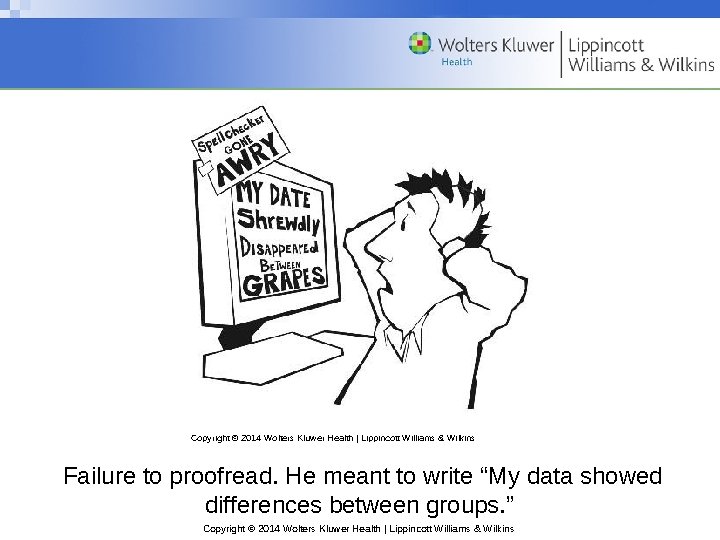
Failure to Proofread • Is irresponsible • Creates a poor impression of you and your work • Annoys those who must read your writing • Takes little time compared to the time you spent writing • Is facilitated by word processing software that highlights errors in spelling and grammar Copyright © 2014 Wolters Kluwer Health | Lippincott Williams & Wilkins
Copyright © 2014 Wolters Kluwer Health | Lippincott Williams & Wilkins Failure to proofread. He meant to write “My data showed differences between groups. ” Copyright © 2014 Wolters Kluwer Health | Lippincott Williams & Wilkins
Editorial Style Governs • The components of a paper and the headings for each section • The ordering and format of the reference list • Citation of references within the text • Figures and tables • Use of statistical symbols Copyright © 2014 Wolters Kluwer Health | Lippincott Williams & Wilkins
Common Editorial Styles National Library of Medicine (reference list example) 1. Gabel L, Proudfoot NA, Obeid J, Mac. Donald MJ, Bray SR, Cairney J, Timmons BW. Step count targets corresponding to new physical activity guidelines for the early years. Med Sci Sports Exerc. 2013; 45(2): 314 -8. Copyright © 2014 Wolters Kluwer Health | Lippincott Williams & Wilkins
Common Editorial Styles American Psychological Association (reference list example) Logan S. , Scrabis-Fletcher K. , Modlesky C. , & Getchell N. (2011). The relationship between motor skill proficiency and body mass index in preschool children. Res Q Exerc Sport, 82, 442 -448. Copyright © 2014 Wolters Kluwer Health | Lippincott Williams & Wilkins
Common Editorial Styles Chicago (a. k. a. Turabian) (reference list example) Modlesky, Christopher M. , Subramanian, Stephen, and Miller, Freeman. “Underdeveloped trabecular bone microarchitecture is detected in children with cerebral palsy using high-resolution magnetic resonance imaging. ” Osteoporosis International 19 (2008): 169– 176. Copyright © 2014 Wolters Kluwer Health | Lippincott Williams & Wilkins
Common Editorial Styles Harvard (reference list example) Horsak, B. , Baca, A. , 2013. Effects of toning shoes on lower extremity gait biomechanics. Clin. Biomech. 28, 344 -349. Copyright © 2014 Wolters Kluwer Health | Lippincott Williams & Wilkins
Check Your Understanding • What are reasons to minimize use of direct quotations in writing? • Why is it important to proofread your writing? • What elements vary depending on the editorial style in use? Copyright © 2014 Wolters Kluwer Health | Lippincott Williams & Wilkins